© 2017, IRJET | Impact Factor value: 5.181 | ISO 9001:2008 Certified Journal | Page 386
“SOLIDIFICATION/STABILIZATION OF ZINC PHOSPHATING AND AETP
SLUDGE USING A NOVEL COMBINATION OF CEMENT WITH A SINTERED
WASTE ADDITIVE”
Tejashwini M Teggihalli
1, Dr. Ramakrishnaiah C.R
21
Post Graduate Student, Environmental engineering, Dept of Civil Engineering ,BMSCE ,
Bengaluru, Karnataka, India
2
Associate Professor, Dept of Civil Engineering, BMSCE, Bengaluru, Karnataka, India
---***---Abstract -
The solidification/stabilization of metals in hazardous waste has been implemented at remediation sites for more than 20 years. Solidification/stabilization is a viable tool for processing of various wastes, hazardous or nonhazardous, from commercial and industrial operations or historic sites with residue in contaminated media such as soil or water. The main objective of the project is to optimize the mix of binders and nonconventional mix of additive materials for stabilization of the two given waste sludges from surface treatment plant and AETP in an eco-friendly and an economically viable manner and to study the leaching process of heavy metals from Surface treatment plant and AETP sludge1to optimize the process of stabilizations of hazardous waste using a specially prepared sinter along with the conventional material like Fly ash, Cement & Lime which are used as binders to evaluate the quantity of heavy metals that could possibly release and harm the environment and human beings. Efficiency of the mobilization depends on parameters such1as curing time, dosage of stabilizer and combination of stabilizer to reach the criteria of hazardous waste and safe disposal of this waste into the landfill.infectious characteristics causing risk to wellbeing or environment, regardless of whether alone or when in contact with different wastes or environment". The present study gives information about optimization of the stabilizer mixes for the solidification of the two given metal-laden sludge and to to arrive at a new unconventional partial substitute for the conventional binder (cement) using waste substances, for the solidification-stabilization process. A major task to manage hazardous waste is to stop the leaching of the disposed waste from polluting the underlying ground water. Of all the above mentioned options for management of hazardous waste, this project focuses on treatment/stabilization of hazardous wastes prior to disposal into a landfill, with addition of cement binders, fly ash, lime and sinter.
1.1 Zinc
Zinc is a very common substance that occurs naturally. Many foodstuffs contain certain concentrations of zinc. Drinking water also contains certain amounts of zinc, which may be higher when it is stored in metal tanks. Industrial sources or toxic waste sites may cause the zinc amounts in drinking water to reach levels that can cause health problems. Zinc occurs naturally in air, water and soil, but zinc concentrations are rising unnaturally, due to addition of zinc through human activities.
Most zinc is added during industrial activities, such as mining, coal and waste combustion and steel processing. Some soils are heavily contaminated with zinc, and these are to be found in areas where zinc has to be mined or refined, or were sewage sludge from industrial areas has been used as fertilizer.
1.2 IRON
Iron is believed to be the tenth most abundant element in the universe. Iron is also the most abundant (by mass, 34.6%) element making up the Earth; the concentration of iron in the various layers of the Earth ranges from high at the inner core to about 5% in the outer crust. Most of this iron is found in various iron oxides, such as the minerals hematite, magnetite, and taconite.
KEYWORDS:Solidification,stabilization,Hazardous waste, Zinc phosphate, CPCB, AETP, UCS.
1. INTRODUCTION
© 2017, IRJET | Impact Factor value: 5.181 | ISO 9001:2008 Certified Journal | Page 387
2. OBJECTIVES OF THE WORK
The main objective of the project is to optimize the mix of binders and nonconventional mix of additive materials for stabilization of the two given metal-laden waste sludges (from Zinc phosphating and AETP) in an ecofriendly and an economically viable manner.
1. To optimize the stabilizer mixes for the solidification of the two given heavy metal-laden sludge.
2. To arrive at a new0unconventional partial substitute for the conventional binder (cement) using waste substances,0for the solidification-stabilization process. 3. To arrive at the conditions0and operational parameters at which the metal concentration in leachate meets the specified criteria for disposal into a secured landfill.
4. To understand the mechanism of
Solidification/Stabilization (S/S) by determining the microstructure, microchemistry and component phases0present in the binders after curing and stabilization using Scanning Electron Microscopy (SEM) and X ray Diffractometry (XRD).
3. MATERIALS AND METHODOLOGY
The main aim of this project work was to study the leaching process of heavy metals from Surface treatment plant and Automated effluent treatment plant (AETP) sludge1to optimize the process of stabilizations of hazardous waste using a specially prepared sinter along with the conventional material like Fly ash, Cement & Lime which are used as binders to evaluate the quantity of heavy metals that could possibly release and harm the environment and human beings. Efficiency of the mobilization depends on parameters such1as curing time, dosage of stabilizer and combination of stabilizer to reach the criteria of hazardous waste and safe disposal of this waste into the landfill.
Zinc phosphating sludge and AETP sludge was taken from an industry, Bangalore and analyzed for
Physical and chemical Properties of Stabilization agents like cement, fly ash, and lime, additive were analyzed.
Leach resistance tests were conducted by varying the proportion of stabilizing agents.
Studies on characterization of these agents and extracted stabilized samples were done and concentrations of heavy metals were measured. Changing the operational parameters like dose of
stabilizers, combination of stabilizers and their ratios and curing time (3, 7and 28 days), the optimum operational conditions were arrived at.
The suitability of the stabilized material for land fill disposal was tested for moisture content, specific gravity and pH of samples.
[image:2.595.315.552.211.432.2] [image:2.595.315.550.468.644.2] Microstructure present in the binders after curing was determined using Scanning Electron microscopy, and X ray diffractometry .
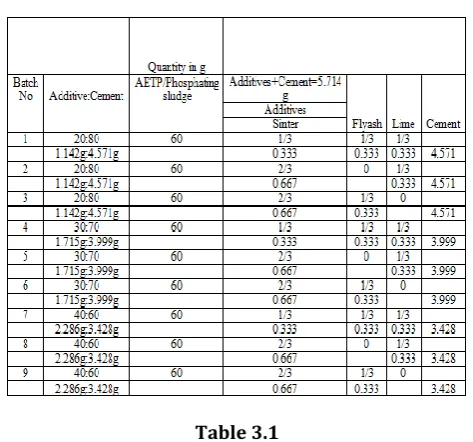
Table: Proportioning and combination of stabilizing agents (Set 1)
Table 3.1
Table: Proportioning and combination of stabilizing agents (Set 2)
Table 3.2
4.
RESULTS AND DISCUSSIONS
© 2017, IRJET | Impact Factor value: 5.181 | ISO 9001:2008 Certified Journal | Page 388 combinations and duration of curing, so as to solidify the
[image:3.595.307.562.81.245.2] [image:3.595.43.279.201.385.2]sludge and for secure landfill disposal with the reduction in heavy metal concentration. A novel combination of different additives like cement, fly ash, and lime with a sintered waste is used in this experiment to solidify the metal-laden soils and reduce the concentration of heavy metal in the leachate before it has been disposed off into a secured landfill. Table: Characteristics of the sludge samples
[image:3.595.322.553.327.704.2]Table 4.1
Table: Unconfined compression strength of AETP & Zinc phosphate sludge laden samples(Set 1)
Table 4.2
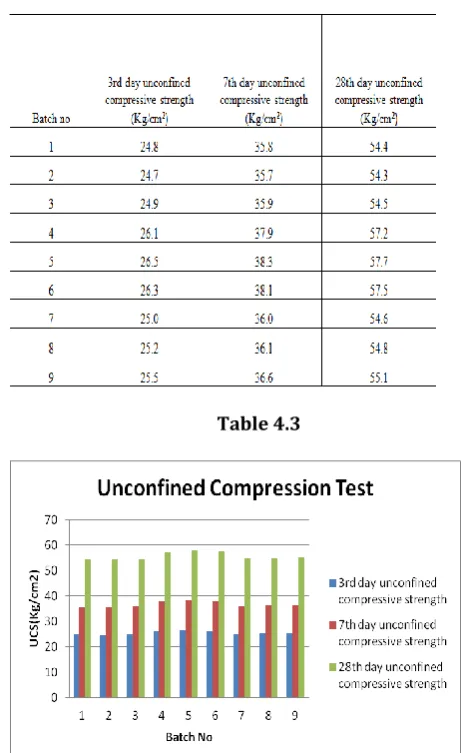
[image:3.595.57.270.432.639.2]Chart 1 -Unconfined Compressive Strengths for 9 Sludge Cylinders after 3 rd, 7th and 28th day curing (Set 1)
Table: Unconfined compression strength of AETP & Zinc phosphate sludge laden samples(Set 2)
Table 4.3
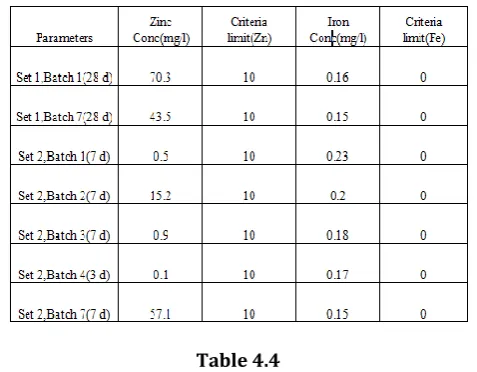
© 2017, IRJET | Impact Factor value: 5.181 | ISO 9001:2008 Certified Journal | Page 389 Table: Variation of Zinc and Iron concentration in leachate
with additive: cement ratio in AETP and Zinc phosphating Sludge
Table 4.4
5.
CONCLUSIONS
The result from this study gave some significance and conclusions with respect to solidification/stabilization method. The following conclusions were made based on the present study:
1) All the sinter stabilized mix design samples have proved to be effective for solidification as their Unconfined Compressive Strength (UCS) values were much greater than minimum criteria value prescribed for disposal on to Secure Landfill i.e. 3.5 kg/cm2
2) The additive: cement ratio of 80:20 proved ineffective for Zn stabilization, for both AETP & surface treatment plant sludges in both set 1 and set 2.
3) A very high compressive strength of 50.2 kg/cm² (set 1) and 57.7 kg/cm² (set2) is attainable for solidification additives when they are added to the sludge and cured at 23 °C for 28 days. The mix that that yielded this maximum Compressive strength (57.7 kg/cm2) was found to be the one which has sludge: additive ratio of 70:30 and the additives contain 60% sand and 10% cement.
4) This exploratory work justified the utilization potential of the the novel binder “S” as a useful blending component to ordinary portland cement . The optimum additive: cement ratio for both AETP & Zinc phosphating Sludges was found to be 70:30 which shows that the non conventional binder (ie. sinter) had replaced the conventional binder (ie. cement) considerably.
5) Irrespective of the type of sludge being treated the mix designs showed consistent solidification & stabilization (S/S) results which showed that the use of the Sinter mix for S/S across a variety of heavy metal contaminated sludges.
6) From the study, it can be concluded that the Sinter “S” provides a better reduction in the concentration of metals along with cement than the other conventional binders like fly ash and lime.
REFERENCES
[1] Carmalin Sophia A, K. Swaminathan (2005), Leaching of metals on stabilization of metal sludge using cement based materials, J. of Env. Science, Vol.17, No.1, 2005, pp:115-118.
[2] Mohamed R. Lasheen et al. (2013), Pozzolanic-based materials for stabilization / solidification of contaminated sludge with hazardous heavy metal: case study, Desalination and Water Treatment, 51 (2013), pp: 2644–2655.
[3] Shing Tet Leong & Preecha Laortanakul (2002), An Environmental optimsied soldification/stabilization for disposal of heavy metal sludge, Thammasat Int.J.Sc.Tech, Vol 7,No.3Sep-Dec 2002, pp 22-39.
[4] Choon-Keun Park (2000), Hydration & Solidification of hazardous wastes containing heavy metals using modified cementitious materials, Cement & Concrete Research 30 (2000), pp 429-435.
[5] E. Sobiecka (2013), Investigaing the chemical stabilization of hazardous waste material (fly ash) encapsulated in Portland cement, Int.J.Environ.Sci.Technol. (2013)10: pp:1219-1224.
[6] Garole D.J., Garole V.J. and Dalal D.S., March (2012),
Recovery of Metal Value from Electroplating Sludge, Research Journal of Chemical Sciences Vol. 2(3), 61-63.
[7] J. Cobb, R. D. Neufeld, J. Pritts and V. Clifford et al., Stabilisation of metal-laden hazardous waste using lime containing ash from two FBC’s & spray drier. Vol(3),56-71.
[8]. Paula Tereza de Souza e Silva, Nielson Torres de Mello, et al.,(2005) Extraction and recovery of chromium from electroplating sludge, Journal of Hazardous Materials B128 (2006) 39–43.
[9]. Li, P. P. , Peng C. S. Et al., (2011), Copper and Nickel Recovery from Electroplating Sludge by the Process of Acid-leaching and Electro-depositing, Int. J. Environ. Res., 5(3):797-804.
[10]. Ong Chuon Yi & Chui Peng Cheong, Solidification of industrial waste sludge with incineration fly ash & ordinary Portland cement.UROP, Nanyang Technological University, Singapore.
© 2017, IRJET | Impact Factor value: 5.181 | ISO 9001:2008 Certified Journal | Page 390 waste, J. of Indian Water Works Association, Vol.XXXXXV
No.4, 2013, pp:368-371.
[12]. Olcay Yilmaz, Kahraman Unlu, and Erdal Cokca, (2003), Solidification/stabilization of hazardous wastes containing metals & organic contaminants, Journal of Env. Engg, Vol 129, No.4, 2003.
[13]. Agamuthu pariatamby, Chitra Subramaniam (2006), et al, Solidfication and stabilization of Fly ash from mixed hazardous waste incinerator using ordinary portland cement, Environmental sciences, Vol. 13, 5, 2006, pp:289-296.