2018 International Conference on Applied Mechanics, Mathematics, Modeling and Simulation (AMMMS 2018) ISBN: 978-1-60595-589-6
Research on 3D Garment Prototype Modeling
Based on Triangulation
Algorithm
Meng-jiao DONG and Ye YUAN*
School of Information Engineering, Beijing Institute of Fashion Technology, Beijing 100029, China *Corresponding author
Keywords: Human body feature points, Developable surfaces, Triangulation algorithm, Garment
prototype modeling.
Abstract. This paper focuses on the key technical problems that need to be solved for large-scale tailoring of garment. This paper mainly studies the prototype modeling of 3D garments. Therefore, this paper proposes a 3D garment prototype modeling based on triangulation algorithm. First, the human body feature point recognition is performed; then the developable surface is constructed by the characteristic curve and the triangulation algorithm, and finally the piece of garment is attached to the human body model. The simulation results show that the proposed algorithm has a good fit for all kinds of 3D scanning human body models.
Introduction
In the process of digital garment development, 3D human body feature point recognition and 3D garment prototype modeling are two very important links. This paper focuses on the 3D garment prototype modeling, and the construction of the developable surface is the basis of 3D garment prototype modeling. Commonly used developable surface construction methods are roughly divided into two categories: point geometry[1] and line and surface geometry[2]. These methods of constructing surfaces all need to calculate the Gaussian curvature of the surface, and the construction method is more complicated. In this paper, constructing a developable surface by feature curve and triangulation algorithm, without calculating the Gaussian curvature of the surface, is very simple.
3D Human Body Feature Point Recognition Algorithm
The efficiency and accuracy of 3D feature point recognition directly affect the progress and quality of digital garment research and development. Therefore, this paper proposes 3D human body feature point recognition based on SURF[3,4] algorithm. The algorithm details are as follows:
Step1: The 3D scanning human body to be identified is processed by Geomagic Studio 11 to eliminate noise points in the original point cloud model.
Step2: The processed human point cloud image is converted into human body depth image. Step3: The integral image is constructed by treating the recognition area, and the integral image size is calculated to improve the recognition speed.
Step4: The scale space is constructed on the area to be identified, and all the points of interest are generated by using the Hessian matrix, and the wrong points of interest are filtered out.
Step5: Sub-pixel feature points are obtained by 3 linear interpolation methods, and those points whose values are less than a certain threshold are deleted. By increasing the extremum, the number of detected feature points is reduced, and finally only the strongest points of several features are detected.
Expandable Surface Overview
Straight Face
A developable surface[5,6] is a special ruled surface, which is a surface created by a straight line sweeping through a path of motion in space. It can be seen as a surface formed by a set of single-parameter straight lines. A line in space can be represented by a point through which the line passes and a direction vector parallel to the line, so the determination of the ruled surface includes two elements:
(1) A curve is , indicating the position of a fixed point on a moving line at a time that is ;
(2) A vector function is that represents the linear direction vector of the line at the moment. is a non-zero vector.
The parametric equation of the ruled surface is as shown in formula (1).
(1) The parametric equation of the ruled surface is a binary function that is about . Among them, the curve is that is called a guideline. The curve corresponding to the parameter is ,the curve is a straight line in the single-parameter line family, called the bus.
Developable Surface
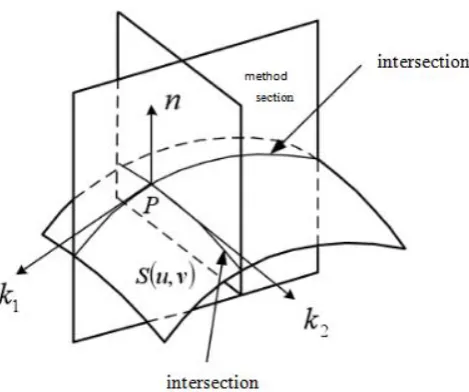
A point on the curved surface is formed as a section, and the intersection line formed by the intersection of the section and the curved surface is called a normal section line. The curvature of the normal line at this point is called the normal curvature. Since there are countless sections at any point on the surface, the surface has an infinite number of phase curvatures at that point. Among them, the maximum and minimum two curvatures must be perpendicular to each other, called the principal curvature, as recorded in Figure 1. The Gaussian curvature at any point on the surface is the product of the two principal curvatures at that point, noted . Its formula is as shown in formula (2).
2 1
k k
K (2)
The expandable surface has the following properties:
(1) The Gaussian curvature K of any point on the surface is equal to zero. (2) The surface has the same normal at any point of a busbar.
(3) The local upper energy can establish a corresponding relationship with the plane.
D Garment Prototype Construction
Triangulation Algorithm
Figure 1. Normal section and principal curvature.
The Delaunay triangulation algorithm is one of the most commonly used segmentation algorithms. It has several algorithms, such as flanging algorithm, point-by-point insertion algorithm, segmentation and merging algorithm, Bowyer-Watson algorithm[8]. The Bowyer-Watson algorithm is used in this paper. The basic steps of the algorithm are as follows.
Step1: Construct a super triangle containing all the discrete points and put them into the triangle list.
Step2: Insert the discrete points in the point set in turn, and find the triangle whose insertion circle contains the insertion point in the triangle linked list. This triangle is called the influence triangle of the point, delete the common edge that affects the triangle, and insert the insertion point with the influence triangle. All vertices are joined to complete the insertion of a point in the Delaunay triangle list.
Step3: Optimize the newly formed triangle according to the optimization criterion, and put the formed triangle into the Delaunay triangle list.
Step4: Loop through step 2 above until all scatters have been inserted.
Garment relaxation amount
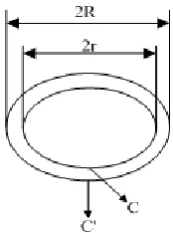
The amount of relaxation is about to increase the garment compared to the human body. The final garment is also around the human body. In order to achieve the relaxation of the circumference, the size of the body circumference can be distributed over the entire circumference of the circumference. A certain gap is added between the surface of the human body and the garment, but this gap may be different at each location. To simplify the model, it is assumed that this amount of void is uniform, which can be referred to herein as the average void fraction, expressed by .The relationship between the human body model and the average void fraction is shown in Figure 2. Among them, and respectively represent the mannequin circumference and the garment model circumference corresponding to a human body model section, and is the relaxation amount in the garment design. The relationship between the amount of relaxation and the degree of void is as shown in equation (3).
2 r
'
C C R
L
Figure 2. Relationship between human body model and voidage.
In this paper, according to the different characteristics of the human body, different voids are set for each part to study the effect of voidage on the garment effect. Since the chest garment is often closest to the human body model, the porosity of the part is set to , and the porosity of other parts is set in this unit. The garment porosity above the waist and above the chest is set ,such that the
looseness of the garment below the waist and above the buttocks is set ,such that the garment
below the buttocks is more deviated from the human body model, and the looseness is set to be .
Generating Pieces
The generation of garment prototype pieces[9] is a necessary part of the garment customization system, and the pieces are the reflection and reconstruction of the human body shape. The design of the piece of garment mainly includes: shoulder piece, chest piece, back piece and so on.
The generation algorithm of the shoulder piece is described as follows, and the generated effect diagram is shown in figure 3.
Step1: The garment human body feature points identified in this paper are mapped to the 3D human body, and then the approximate range of the garment pieces is determined. The range of the shoulder piece is determined by the side neck point SNP, the shoulder point SP, the front shoulder point FSP, and the front neck point FNP.
Step2: Fit the feature points into the characteristic curve by 3 times B-spline. Step3: Create a coarse original mesh containing the entire feature line area.
Step4: Use the Bowyer-Watson algorithm to insert the boundary points into the original mesh point by point. The boundary points are given manually by hand, and the distribution of the boundary points is assumed to be reasonable.
Step 5: Delete the triangle outside the feature line area and perform topology compatibility processing to ensure correct triangulation of the boundary surface.
Step6: Use the Bowyer-Watson algorithm to gradually insert new points into the calculation area. For a given point set, insert them in a certain order. If the inner point is automatically generated, the inner point needs to be generated according to a certain strategy until all the inner points are inserted or the mesh reaches a certain powder request.
Step7: Perform topology compatibility check and mesh smoothing on the generated mesh. Step8: Add the appropriate amount of relaxation.
The algorithm for generating the chest piece is described as follows:
different pieces of garment is that the characteristic curves are different, and the essence is that the positions of the feature points are different.
[image:5.595.195.405.99.219.2]
Figure 3. shoulder piece effect map. Figure 4. chest piece effect map.
After the construction of the garment area such as the shoulder piece, the chest piece, the chest piece, and the back piece, the adjacent pieces need to be spliced. Since the left and right adjacent pieces share two feature points, their boundaries are the same, so the stitching can be performed directly. For the upper and lower pieces, it is necessary to insert new points by triangulation, so that the upper and lower pieces are seamlessly spliced.
Simulation Results and Analysis
In order to verify the feasibility and universality of the algorithm, this paper selects a more complex female human body for verification, and has a wide coverage. The human body model of three age stages was selected for algorithm verification. Among them, the young human body model is slim; the middle-aged human body model, normal body type; the elderly body model, the body is fatter. The algorithm in this paper is realized by MATLAB simulation, and the simulation effect diagram is shown in Figure 5.
Figure 5. Simulation effect diagram of different human body models.
The simulation results show that the proposed algorithm has good applicability on the surface. The simulation of the front and back of the human body model of all ages and sizes is very good. The human body model fits perfectly with the garment.
Conclusion
In this paper, the structure of the garment prototype is realized by the characteristic curve and the triangulation algorithm, which avoids the calculation of the Gaussian curvature of the surface, so it has a smaller calculation amount, the versatility is stronger, there is no problem such as deformation and lengthening, and the structure can be developed. The fit between the surface and the human body model is also good.
Acknowledgement
[image:5.595.86.500.408.476.2]References
[1]Aumann G. Degree elevation and developable Bézier surfaces[J]. Computer Aided Geometric Design, 2004, 21(7):661-670.
[2]Solomon J, Vouga E, Wardetzky M, et al. Flexible Developable Surfaces[J].Computer Graphics Forum, 2012, 31(5):1567-1576.
[3]Syed Ali Gohar Naqvi, Hafiz Muhammad Faisal Zafar, Ihsanul Haq. Hard exudates referral system in eye fundus utilizing speeded up robust features[J].International Journal of Ophthalmology, 2017,10(07):1171-1174.
[4]Xie Zheng. Video Stabilization System Based on Speeded-up Robust Features[A]. International Informatization and Engineering Associations, Atlantis Press. Proceedings of 2015 International Industrial Informatics and Computer Engineering Conference. International Informatization and Engineering Associations, Atlantis Press:,2015:4.
[5]Charlie C.L. Wang. Incremental reconstruction of sharp edges on mesh surfacess[J]. Computer-Aided Design, 2006.38:689-702.
[6]Peternell M. Developable surface fitting to point clouds[J]. Computer Aided Geometric Design, 2004, 21(8): 785-803.
[7]Lawlor D A, Tilling K, Davey G S. Triangulation in aetiological epidemiology[J]. International Journal of Epidemiology, 2016, 45(6).
[8]Zhou X. Algorithm research to generate triangulation network based on Bowyer-Watson[J]. Computer Engineering & Applications, 2013, 49(6):198-200.