2018 International Conference on Computer, Communications and Mechatronics Engineering (CCME 2018) ISBN: 978-1-60595-611-4
Heterogeneous Network Selection Algorithm
Based on Principal Component Analysis
Xin-gang WANG
*, Bin-ruo ZHU and Zheng ZHU
Electric Power Research Institute, State Grid Shanghai Municipal Electric Power Company, Shanghai 200437, China
*Corresponding author
Keywords: Heterogeneous network, Network selection, Multiple attribute decision making, Weight, Principal component analysis.
Abstract. Multiple attribute decision making (MADM) methods have shown effectiveness for network selection of heterogeneous network system, and analytic hierarchy process (AHP) is often applied to determine subjective attribute weights. However, APH method needs constructing appropriate judgment matrix and cannot address different business scenes. In this paper, we propose a novel selection algorithm for heterogeneous network system by introducing principal component analysis (PCA). By locating key attributes of different subjective demands, the whole loading vectors of PCA model can be divided into several blocks to fit different scenes. Then, the loading vectors can be used to construct subjective weights. Furthermore, we apply Criteria importance though intercrieria correlation (CITIC) method based objective weight to construct a combined weight. Therefore, the subjective demand and network objective feature can be considered jointly to select the optimal network. Simulation results show that the proposed approach can select the optimal network for different business scenes.
Introduction
With the great application of the power acquisition system, especially the gradual promotion of the "multi-meter integration" project, the acquisition system can not only satisfy the acquisition of electricity information data, but also constitute a multi-source data fusion management system. Given various communication techniques including 4G, GPRS, CDMA, RF, Lora, Ethernet, and PLC, the next generation communication system would be an open heterogeneous network which can organically combine existing and future access systems. However, the integration of heterogeneous network also leads to the question of how to select the optional network to keep data connection and transmission between concentrator and collector.
CRITIC [9,10]. Both two kinds of weight decision methods have been successfully applied in MADM, however, there are still two problems deserving further investigation. On the one hand, “customer-centri” should emphasize the role of subjective weighting. However, it is difficult to construct appropriate judgment matrix to match different scenes, such as conversation, interaction and streaming media. For example, consistency test is often needed in AHP method. On the other hand, it is one-sided to decide attribute weights with only subjective weighting method or objective weighting method. Therefore, organically integrating the two methods would be a reasonable approach.
Based on above analysis, a novel heterogeneous network selection algorithm based on PCA is proposed in this paper. Firstly, PCA is introduced to construct subjective weights, where generalized Dice’s coefficient (GDC) is applied to divide weight vectors for different application scenarios. Secondly, CRITIC is used to determine objective weights. Finally, a combined weight is complicated and a decision function is constructed to select the optimal network. The main contribution of this work includes the following two aspects: (1) PCA is firstly used as a subjective weighting method, where judgment matrix is not needed and the weight vectors are able to fit several subjective demands; (2) a combined attribute weight is calculated to harmoniously consider subjective demands and objective factors.
The remainder of this paper is organized as follows. Section Methodology describes the proposed scheme in detail. Then, some simulation results are presented in section Performance evaluation. Finally, section Conclusions concludes this work.
Methodology
In this section, the proposed method is explained in detail. The first part shows that how to use PCA and GDC to construct subjective weights for various business situations. The second part gives objective weights by using CRITIC method. And the third part presents the combined weight and the final decision function.
PCA Based Subjective Weight. The mathematical principle of PCA is to transform input data into low-dimensional output feature through orthogonal matrix (i.e. loading matrix) [11]. Given a heterogeneous network system with nets and attributes, where is the value of
-th net’s -th attribute and be normalized by range transformation method, the PCA procedure is to solve the following eigenvalue problem:
T
1
1 i i i
n A Ap p (1)
where is further scaled to zero mean and unit variance. The solution of Equation (1) brings m
orthogonal loading vectors , whose eigenvalue follow descending order, and each loading vector indicates a projection direction.
It should be noted that we use the squared form of loading vectors in PCA model. This is because which satisfies normalization criterion. And for two vectors, they may reflect similar attribute importance, meaning that there would be several vectors corresponding to one scene.
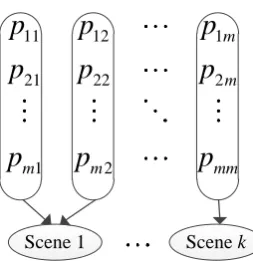
Figure 1 shows the structure of PCA based subjective weight, and the detailed procedure is summarized as follows.
Loading Matrix of PCA
11 12 1
21 22 2
1 2
m m
m m mm
p
p
p
p
p
p
p
p
p
[image:3.595.231.358.169.300.2]Scene 1 Scene k
Figure 1. Structure of PCA based subjective weight.
(1) Perform PCA model to obtain loading vectors . (2) Select the loading vector for one specific scene as follow:
1
1
_ ( ) arg max k lj l
k j j m m
ij i p S I p
αp (2)
where represents the index of loading vector corresponding to scene , denotes the indices of key attributes of scene , and is the element of .
(3) Calculate the generalized Dice’s coefficient among the rest vectors and the selected vectors in step 2 as follow [12]:
T
2 2
2 ( i, j) i j
j j
GDC
p p p p
p p (3)
(4) Cluster the rest vectors if .
Thus, we can get subjective weight vector for scene , presented as:
2 ,
1
k
i k iq
q k
w p
n
β (4)
where denotes the indices of loading vectors for scene , and is the corresponding number of loading vectors.
CRITIC Based Objective Weight. CRITIC is an objective weighting method proposed by Diakoulaki, and the brief computation is summarized as follows.
(1) Calculate the standard deviation of -th attribute, denoted as:
21
1 n
j ij j
i
a a
n
(5)where is the mean value of -th attribute.
11
m
j j ij
i
I r
(6)where is the correlation coefficient between the -th attribute and the -th attribute. (3) Determine the objective weight, calculated as:
1 j
j m
p p
I w
I
(7) Therefore, the objective weight vector can be obtained as .Combined Weight and Decision Function. To take account of the objective attributes of network and subjective preferences, a combined weight is defined as:
T
ˆ k
k
k
diag
w w
w
w w (8)
where is the subjection weight vector for scene , and denotes the diagonal matrix.
Then, the decision function corresponding to scene can be defined by using SAW method. And the optimal network is selected according to the following equation:
T
1
ˆ ( ) arg max
k i i k
i n
Opt
N N w (9)
where represents the optimal network (normalized by range transformation method) for scene .
Performance Evaluation
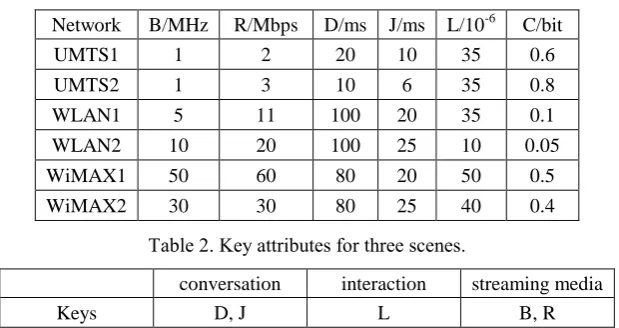
In this work, we set three business situations as conversation, interaction and streaming media for method evaluation. The heterogeneous network system has six networks with six attributes, as listed in table 1. And the most important attributes for three situations are tabulated in table 2 [13,14].
Table 1. Parameters of heterogeneous network system.
Network B/MHz R/Mbps D/ms J/ms L/10-6 C/bit
UMTS1 1 2 20 10 35 0.6
UMTS2 1 3 10 6 35 0.8
WLAN1 5 11 100 20 35 0.1
WLAN2 10 20 100 25 10 0.05
WiMAX1 50 60 80 20 50 0.5
[image:4.595.144.454.514.678.2]WiMAX2 30 30 80 25 40 0.4
Table 2. Key attributes for three scenes.
conversation interaction streaming media
Keys D, J L B, R
The proposed method is applied for this system to evaluate its performance. For comparison, the AHP method is used to determine subjective weights, and the judgment matrices are constructed according to literature [15]. Similarly, CRITIC based objective weight and SAW method are also employed to construct combined weight and decision function, respectively.
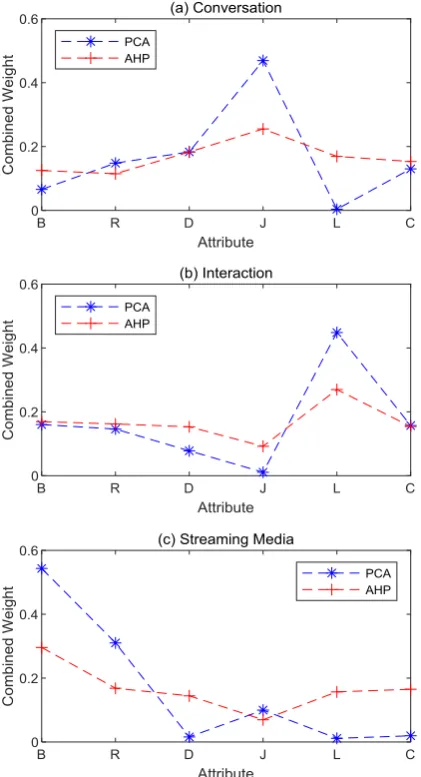
based on PCA method reflect more significant importance than that of AHP based method, which are in accordance with above analysis. Figures 3-5 show the final decision function values of PCA based and AHP based methods, from which we know network 2 (UMTS2) is suitable for conversation services, network 4 (WLAN2) is match with demand of interaction scene, and network 5 (WiMAX1) shows more advantage for streaming media business. And the decision results of the proposed method are more obvious, especially in figure 5.
Figure 2. Attribute weights for three scenes.
[image:5.595.67.278.180.569.2]Figure 3. Decision function values for conversation scene.
[image:5.595.325.537.320.444.2]Figure 4. Decision function values for interaction scene.
Figure 5. Decision function values for streaming media scene.
Conclusions
[image:5.595.326.538.472.594.2]Acknowledgement
This research was financially supported by the Science and Technology Project of State Grid Corporation Headquarters (52094016000H).
References
[1] Gwon Y., Funato D., Takeshita A. Adaptive approach for locally optimized IP handoffs across heterogeneous wireless networks[C]. Proceedings of the 4th International Workshop on Mobile & Wireless Communications Network. IEEE, 2002.
[2] Yan X., Mani N. Cekercioglu Y. A. A Traveling Distance Prediction Based Method to Minimize Unnecessary Handovers from Cellular Networks to WLANs[J]. Communications Letters IEEE, 2008, 12(1):14-16.
[3] Park H. S., Yoon S.H., Kim T.H., et al. Vertical handoff procedure and algorithm between IEEE802.11 WLAN and CDMA cellular network[C]. Proceedings of the Mobile Communications, cdma International Conference, Cic, Seoul, Korea, October 29-november 1, 2003.
[4] Jaberidoost M., Olfat L., Hosseini A., et al. Pharmaceutical supply chain risk assessment in Iran using analytic hierarchy process (AHP) and simple additive weighting (SAW) methods[J]. Journal of Pharmaceutical Policy & Practice, 2015, 8(1):1-10.
[5] Liu S., Pan S., Mi Z., et al. An improved multiplicative exponent weighting vertical handoff algorithm for WLAN/WCDMA heterogeneous wireless networks[J]. Engineering Sciences, 2012, 10(1):86-90.
[6] Chen T. Y. An interval type-2 fuzzy technique for order preference by similarity to ideal solutions using a likelihood-based comparison approach for multiple criteria decision analysis[J]. Computers & Industrial Engineering, 2015, 85:57-72.
[7] Xu G., Tian W., Qian L., et al. A novel conflict reassignment method based on grey relational analysis (GRA)[J]. Pattern Recognition Letters, 2007, 28(15):2080-2087.
[8] Saaty T. L. Decision making with the analytic hierarchy process[J]. International Journal of Services Sciences, 2008, 1(1):83-98.
[9] Diakoulaki D., Mavrotas G., Papayannakis L. Determining objective weights in multiple criteria problems: The CRITIC method[J]. Computers & Operations Research, 1995, 22(7):763-770.
[10] Alemi-Ardakani M., Milani A. S., Yannacopoulos S,. et al. On the effect of subjective, objective and combinative weighting in multiple criteria decision making: A case study on impact optimization of composites[J]. Expert Systems with Applications, 2016, 46:426-438.
[11] Wold S., Esbensen K., Geladi P. Principal component analysis[J]. Chemometrics & Intelligent Laboratory Systems, 1987, 2(1):37-52.
[12] Yu Z., Liu Y., Zhao J. Vector similarity measurement method[J]. Technical Acoustics, 2009, 28(4):532-536.
[13] Kavas A. Comparative analysis of WLAN, WiMAX and UMTS technologies[C]. Proceedings of the Progress in Electromagnetics Research Symposium(PIERS’07), 2007:140-144.
[14] Martinez-Moralesl J. D. Performance comparision between MADM algorithms for vertical handoff in 4G networks[C]. Proceedings of the 7th International Conference on Electrical Engineering. Computing Science and Automatic Control (CCE’ 10), 2010: 309-314.