Journal of Criminal Law and Criminology
Volume 58 | Issue 2
Article 17
1967
Predicting Police Failures
Ruth J. Levy
Follow this and additional works at:
https://scholarlycommons.law.northwestern.edu/jclc
Part of the
Criminal Law Commons
,
Criminology Commons
, and the
Criminology and Criminal
Justice Commons
This Criminology is brought to you for free and open access by Northwestern University School of Law Scholarly Commons. It has been accepted for inclusion in Journal of Criminal Law and Criminology by an authorized editor of Northwestern University School of Law Scholarly Commons.
Recommended Citation
THE JounNAL or CRnIN LAw, CRINOroGY AND POLICE SCIENCE
Copyright @ 1967 by Northwestern University School of Law
Vol. 58, No. 2
Printed in U.S.A.
PREDICTING POLICE FAILURES*
RUTH J. LEVY
Ruth J. Levy, Ph.D., has been Clinical Psychologist and Director, Peace Officer Research Project, San Jose City Health Department, San Jose, California, since 1958. Dr. Levy has served as a clinical psychologist af the Educa-tional Clinic City College of New York, at the Washington Children's Home Society, and subsequently, at the Veterans Administration Mental Hygiene Clinic, Seattle, Washington. From 1953 to 1956 she served as professor of Psychology, Seattle University. Dr. Levy has published papers in several professional journals. The results of her "Retrospective Study of Peace Officer's Personnel Files" have been presented at the International Association of Chiefs of Police in 1966 and at a Conference of Police Professors at Michigan State University in April, 1966.-EDIToR.
With the increase in crime and the concomitant slipping image of the police officer, comes an inten-sified interest in refining techniques used in se-lection of officers whose jobs include keeping the peace, maintaining law and order, and keeping their own houses above reproach. City Health Departments participate in the screening of police officers, and those of us involved in such programs feel less than adequate when we are asked to state whether police applicant John Smith is emotionally suited for the job for which he is applying. Accord-ingly, as one such Health Department, we under-fook to gather and study the personnel files of ca. 4,500 law enforcement officers in 14 police juris-dictions to see whether we could find any known and recorded pre-appointment factors which would significantly discriminate between those who left their positions because of occupational inade-quacies, including personal behaviors intolerable to their employers, and those who were considered adequate or successful.
Studies on selection in law enforcement have been sporadic, and conclusions often have had to be qualified because of small numbers of cases used. There are 1,762 cities in the United States with populations of over 100,000 each, and each of these cities maintains its own Police Department (18). Altogether, there are approximately 250,000 policemen in the United States (22). Their train-ing durtrain-ing the first year of employment is esti-mated by some (2) to cost $10,000. "The appoint-ment of an unfit person to the police force is always costly to the taxpayers" (7). 0. W. Wilson's book (23) is found in the libraries of Police Depart-ments throughout the country and is considered a
* This paper is based upon a retrospective study of Peace Officer Personnel Files which was made possible through a three year financial grant from the National Institute of Mental Health.
classic for police administrators. Of the book's 492 pages, only seven are devoted to selection, includ-ing recommendations concerninclud-ing age, height, and education.
It has been the practice, in the past, to exclude from groups of police applicants those whose life histories, test results, interviews, or references have revealed anxiety, rigidity, low intelligence, poor credit ratings, criminal records, sadistic tend-encies, alchoholism, dishonesty, homosexuality, or behavioral manifestations of impulsivity. The reasoning underlying these exclusions is that the behavior of individuals with these traits is not con-sistent with the needs of good law enforcement. Nevertheless, in spite of the fact that applicants with these characteristics are usually eliminated before appointment, common reasons for depart-mental termination of police officers' careers are drunkenness, extramarital sexual activity, and indebtedness. Absence of these traits at the time of appointment, and their not infrequent presence at time of termination, suggest the possibility that donning a police uniform and buckling on a holster may bring about a change in self-image and sub-sequent overt behavior. If this be so, then we can-not predict from absence of unwanted qualities before employment, a necessary continuation of such absence after employment. What then should we be seeking?
HYpoTnEsis
RUTH J. LEVY
historical events would have significantly discrim-inating values for the two groups.
Some definitions are in order. We used personal-ity characteristics in its broadest sense, including emotional, social, physical traits either overt or implied. Unsuccessful law enforcement officers, or as hereafter categorized, Failures, constituted the group of officers who had been dismissed for cause, or whose resignations had been requested due to failure to meet department expectations, either on the job or off. Personnel files included those kept by Police Departments, Sheriff's Offices, Highway Patrol, City and County Civil Service Personnel Departments, and Health Departments. Signifi-cant differences were measured using chi-square test of goodness of fit. As an extra precaution to avoid spuriousness of results, we programmed a stepwise multiple regression analysis which per-mitted us the option of randomly dividing the total sample into two approximately equal sub-samples for cross-validation purposes, and it was assumed that the minimal set of criterion predictors should be in essential agreement for these two sub-samples. Unless otherwise indicated, only such differences are reported which showed significance at better than the 1% level of confidence in both sub-samples.
SUBJECrs
Complete personnel files were collected for 2,139 former law enforcement officers, who had been separated (either as Failures or Non-failures) from their employment during the decade 1952-1962. These represented all terminations during that period of time in the 14 agencies included in the study. The 14 agencies were comprised of ten Police Departments in cities whose populations ranged from 13,000 to 700,000; three Sheriffs' Offices in Counties whose population ranged from 90,000 to one million, and the California Highway Patrol. Participants included inland and coastal communities, some heavily industrialized and others primarily agricultural. The 14 agencies showed the same range in peace officer population ratios as holds for the United States as a whole (19). From these same 14 agencies, we then collected 2,148 personnel files of officers still employed in 1962, whose dates of employment followed the same curve as that created by the appointment dates of the separated officers. With the exception of the three largest agencies, this group of Current employees represented all the peace officers em-ployed by our study participants in 1962. In the three largest agencies we "matched" the Current
with former officers for year of appointment, ran-domly eliminating excess Currents.
The study was confined to male officers, who represent 98% of law enforcement officers in the United States (22).
METHODOLOGY
As the study proceeded, we found it necessary to modify certain original plans. Because of the nature of the contents of the files; because of the tremen-dous variability among agencies in record-keeping, in extent of background investigations, in require-ments for appointment, and in methods used for commendation and punitive action; because of our desire to eliminate unnecessary additional hetero-geneity from a group which tends, by nature, to be heterogeneous; and because paucity of information in some files made them practically worthless for any serious scientific consideration, for these rea-sons we eliminated from the quantitative data computation phase all cases categorized as follows.
1. Service Retirement. We had originally thought
to include this group among the Non-Failures, but those who retired for service during the years 1952 to 1962 had been appointed before 1942. By elim-inating this group we eliminated the problem of introducing unwanted heterogeneity of entrance requirements, community ethos, and administra-tive philosophy. Inclusion of service retirements would have introduced a group of men born earlier and appointed earlier than the rest of the group.
2. Disability Retirenent. All law enforcement
administrators would like to have available a method of identifying the potential disability re-tirement. This group includes, in addition to on-the-job injuries, anticipated in a hazardous occu-pation, the accident-prone, the malingerer, and the hypochondriac. In one Department included in this study the Chief of Police reported an annual per capita cost of $330 (derived by dividing number of sworn peace officers into total annual cost to his city of disability pensions). However, the etiology of pathology in these men we assume to be different from that which is operative in the men who are terminated for reasons other than disability retire-ment.
3. Death While in Service. These were eliminated
PREDICTING POLICE FAILURE5
After eliminating cases falling into the above three categories, there remained 1,333 separations, of which 690 were considered by their Departments to have been Failures, and 643 Non-Failures.
Our next concern was with the excess (815) of
Currents over the 1,333 usable separation cases.
The reader may be wondering why we bothered altogether to collect the Currents. Before data collection started it was, very naively, believed that we would be able to combine into one group of satisfactory policemen the Non-Failure separa-tions and the Currents. Our statistical consultants pointed out the advantages which could accrue if
our Non-Failure group were twice the size of our Failure group, and adding Currents to Non-Failures seemed, before the research began, a solution to the problem of swelling the size of our Non-Failure group without contaminating the data by intro-ducing unnecessary heterogeneity and other prob-lems. The Non-Failures had demonstrated that they were such by the number of promotions they had received, citizen commendations, awards for bravery, expressions of Departmental disappoint-ment upon their terminations, and the like. It was reasoned, before collecting the files, that a Current employee was obviously, according to our defini-tion, not a Failure; he still received a paycheck; he still wore a uniform; and even if he were not the Chief's ideal, he either had not behaved in a man-ner unacceptable to his department or at least, if he had, he had not been publicly discovered. From this naive and so grossly incorrect assumption grew one of the most interesting findings of this study. In any event, we had an excess, for statis-tical computation purposes, of 815 Currents. To avoid the myriad problems which they would create (weighting, table collapsing, reliability) we randomly eliminated 815 cases from the group of
Currents.
Once the above-described eliminations had been completed, our staff abstracted from each file all information recorded up to the day of appoint-ment. We used no check-lists or other such devices, which might have shortened our task, because we insisted that the records tell the story. Conse-quentiy, from some departments we obtained voluminous case histories with information includ-ing subject's ordinal position in his parental family, school grades, I.Q., number of club memberships, tendency to enuresis during childhood, father's income, hobbies, use of authoritarian manner with own children, degree of observable cleanliness in home, illnesses of siblings, color of eyes, reasons for termination from former employment, number
of television sets in the home, military experiences, relationships with neighbors, amount of indebted-ness, stated life goals, and reasons for applying for employment as a law enforcement officer. From some departments we obtained handwritten pre-appointment autobiographies. From some we obtained only skeletal outlines, the personnel files being devoid of almost all pre-appointment infor-mation except for birthdate, education, and the place of residence, blood pressure, height, weight and marital status at time of application. It was agreed that, for quantitative analysis, we would use only such factors, or variables, on which in-formation was found in at least 50% of the records. When these had been ascertained we coded the in-formation for each variable in each record. The numbers of cases having information varied from factor to factor, depending upon what was con-tained in the files. It is not suggested that the 140 variables which met our criterion of appearing in at least 50% of the records, are necessarily the most important ones to know about in selecting police officers.
The 140 coded variables were punched across IBM cards. Onto each row we punched a subject's code number, the code for his department, his birthdate, his date of appointment, and his length of service. For each subject we punched the infor-mation under as many of the 140 variables as were contained in his personnel file. Finally, we identi-fied each subject according to the criterion Failure,
Non-Failure, or Current. It had been discovered,
on the basis of inspection and experimental com-putational trials, that we could not reasonably group the Currents with the Non-Failures, because contrary to earlier unwarranted assumptions, the 1,333 Currents constituted a group very different from the group of 643 Non-Failures. And so, against expectations, we report findings not about two groups of police officers (Failures and
Failures) but about three groups (Failures, Non-Failures and Currents).
RiEsULTs
The distribution of cases into three criterion groups is as follows:
Failures ... 21% Non-Failures ... 24% Currents ... 55% It may be remembered that in the three largest agencies the author determined the sizes of the
Current groups by numerically equating them with
the sizes of the groups of separated officers. In the remaining departments there was no such
TABLE I
AGE DISTRIBUTION OF CRITERION GROUPS
Failure Non-Failure Current
Age When Hired
S-I S-2 S-I S-2 S-i S-2
Less than 24 years N 39 47 78 55 126 88
% (17.2) (20.7) (29.2) (22.0) (20.6) (14.4)
24-26 years N 82 72 97 103 187 204 % (36.1) (31.7) (36.3) (39.0) (30.6) (33.4) 27-29 years N 65 68 53 61 151 186
% (28.6) (30.0) (19.9) (23.1) (24.7) (30.5) 30 plus years N 41 40 39 42 147 132
% (18.1) (17.6) (14.6) (15.9) (24.1) (21.6) Column Sums 227 227 267 264 611 610 Category Means 2.48 2.44 2.20 2.33 2.52 2.59
Sample 1 Sample 2
Criterion Comparison
Chi-Square df P Level Chi-Square df P Level
Fail/Non-Fail/Current ... 24.760 6 .001 17.188 6 .01
Fail/Current ... 6.206 3 N/S 5.508 3 N/S
Non-Fail/Current ... 17.513 3 .001 14.501 3 .005
Fail/Non-Fail ... 12.370 3 .01 4.309 3 N/S
mination. In those remaining eleven departments, the files of all Current employees were included. The retention rate (55%) resembles findings of other studies (14).
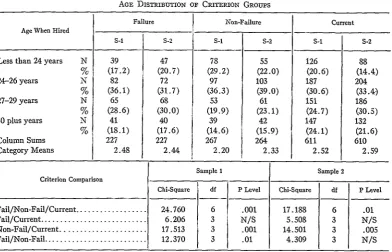
Age at appointment is significantly related to
later employment status. (Table I) Non-Failures are youngest at time of appointment, Current em-ployees are oldest, and Failures fall between. Approximately 25% of the Non-Failures were under 24 at the time of appointment, compared with 19% of the Failures and 17% of the Currents. About half of the Failures and Currents were 27 or older when appointed while only 37% of the
Non-Failures fell into that age bracket.
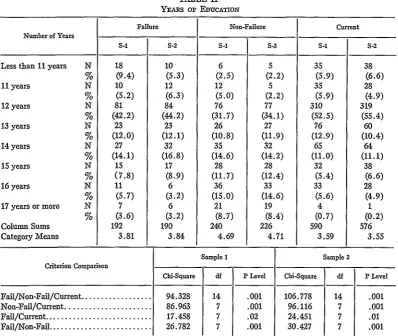
Education prior to appointment consistently
shows a greater number of years of formal educa-tion for the separated personnel (whether Failure or Non-Failure) than for the Current employees (Table II). Approximately 65% of the Currents re-ported 12 years or less formal education, com-pared with 39% of the Non-Failures and 56% of the Failures. Mean number of years of education for each criterion group indicates the Currents have 12 1/j years, the Failures 12 Y4 years, and the
Non-Failures 13 Y4 years. Each criterion group
com-parison for both samples is statistically significant at levels well beyond chance expectations.
Additional comparisons for schooling beyond high school in academic colleges (as distinguished from
business schools, vocational schools, trade schools, et al) reveal significant relationships between years attending college and the criterion: Currents who attended college averaged two years, Failures averaged a small fraction over two years, and
Non-Failures two and three-quarters years (Table III).
When the tables are collapsed so that comparisons are made for two years or less vs. three years or more of college, we find a significant chi-square relation between amount of college education and each criterion comparison except for Failures and
Currents. That is, amount of higher education does
not seem to separate the Failures from the Currents when these two criterion groups are looked at alone, although it does divide the Failures from both the Currents and from the Non-Failures when all 3 criterion groups are examined simultaneously. (It is interesting, in this connection, to note that Captain Rush of the Kansas Highway Patrol, in their already-cited 1960 pilot selection study, stated he had "not found that college graduates
work out particularly better for us.. ..") (2).
Non-Failures consistently have more education
than the other criterion groups regardless of the period of their birth. Except for the birth period 1900-1924, the Currents consistently have less formal education than Failures or Non-Failures.
PREDICTING POLICE FAILURES
TABLE II YEARS Or EDUCATION
Failure Non-Failure Current
Number of Years
S-I S-2 S-I S-3 S-I S-2
Less than 11 years N 18 10 6 5 35 38
% (9.4) (5.3) (2.5) (2.2) (5.9) (6.6)
11 years N 10 12 12 5 35 28
% (5.2) (6.3) (5.0) (2.2) (5.9) (4.9)
12 years N 81 84 76 77 310 319
% (42.2) (44.2) (31.7) (34.1) (52.5) (55.4)
13 years N 23 23 26 27 76 60
% (12.0) (12.1) (10.8) (11.9) (12.9) (10.4)
14 years N 27 32 35 32 65 64
% (14.1) (16.8) (14.6) (14.2) (11.0) (11.1)
15 years N 15 17 28 28 32 38
% (7.8) (8.9) (11.7) (12.4) (5.4) (6.6)
16 years N 11 6 36 33 33 28
% (5.7) (3.2) (15.0) (14.6) (5.6) (4.9)
17 years or more N 7 6 21 19 4 1
% (3.6) (3.2) (8.7) (8.4) (0.7) (0.2)
Column Sums 192 190 240 226 590 576
Category Means 3.81 3.84 4.69 4.71 3.59 3.55
Sample I Sample 2
Criterion Comparison
Chi-Square df P Level Chi-Square df P Level
Fail/Non-Fail/Current ... 94.328 14 .001 106.778 14 .001
Non-Fail/Current ... 86.963 7 .001 96.116 7 .001
Fail/Current ... 17.458 7 .02 24.451 7 .01
Fail/Non-Fail ... 26.782 7 .001 30.427 7 .001
hiring periods for each criterion group. Chi-square probability levels for education vs. the three-way criterion (Failure; Non-Failure; Current) were cal-culated for each hiring period. There is a statistic-ally significant relationship between education and the criterion for the hiring periods 1948-52, 1953-57, and for 1958 or later. The Non-Failures have the most education for each hiring period; Currents have the least education for the periods 1953-57 and 1958 and later, but slightly more education than Failures prior to 1953. In general, with each successive hiring period, the level of education in-creases for all applicants, as one might expect. But
the Non-Failures tend to have nearly a full year of
school more than either Currents or Failures. Cross-tabulation tables were computed showing relationships between the length of service in months and the three criterion groups for each of eight levels of education. Although the number of subjects in some instances is rather small (especi-ally of those having obtained 17 or more years of academic training), we find a consistent and
defi-nite trend that with increasing education, there is a reduction in length of service for all three crite-riongroups. Applicants having less than 11 years of education tend to serve a little more than four years if they are Failures or Non-Failures, whereas is they remain in service (Currents) they do so for about 11 6 years on the average. If they have 11 or 12 years of education the Failures and
Non-Failures serve between 4 and 4 Y years, but the
Current serve fewer than 11
J
years. This down-ward progression of the Currents in length of serv-ice continues until, with 17 or more years of school, the service length is little more than 7 years. For the Failures and Non-Failures, 17 or more years of school is associated with a Mean service of about 1 Y years.Police School or accredited Police Science courses
[image:6.431.17.416.47.383.2]TABLE III
YEARS OF COLLEGE
Failure Non-Failure Current
Number of Years
S-1 S-2 S-1 S-2 S-1 S-2
Less than I year N 11 10 18 9 19 18
% (11.6) (10.4) (11.0) (6.2) (8.4) (8.7)
1 year N 23 23 26 25 73 60
% (24.2) (24.0) (15.9) (17.4) (32.3) (28.1)
2 years N 27 33 34 34 64 61
% (28.4) (34.4) (20.7) (23.6) (28.3) (29.6)
3 years N 16 17 28 27 32 38
% (16.8) (17.7) (17.1) (18.7) (14.2) (18.4)
4 years N 11 7 37 31 34 28
% (11.6) (7.3) (22.6) (21.5) (15.0) (13.6)
5 years N 4 5 14 11 3 1
% (4.2) (5.2) (8.5) (7.6) (1.3) (0.5)
6 years N 2 1 6 5 -
-% (2.1) (1.0) (3.7) (3.5)
-7 years N 1 - 1 1 1
% (1.1) - (0.6) (0.7) (0.4)
8 years N - - - 1
% - - - (0.7) -
-Column Sums 95 96 164 144 226 206
Category Means 3.19 3.07 3.68 3.76 3.01 3.00
Sample 1 Sample 2 Criterion Comparison
Chi-Square df P Level Chi-Square df P Level
Fail/Non-Fail/Current ... 39.130 16 .005 40.758 16 .005
Fail/Non-Fail/Current... 18.946 2* .001 17.571 2* .001
Non-Fail/Current ... 18.246 1* .001 14.388 1* .001
Fail/Current ... .708 1* N/S .049 1* N/S
Fail/Non-Fail ... 6.706 1* .01 10.825 1* .005
• Based on Collapsed Tables, viz., 2 years or less/3 years or more.
appointment, 67 (or 16%) were terminated as
Failures; 132 (32%) terminated as Non-Failures;
and 219 (52%) fell into the category of Current employees. This distribution differs from the dis-tribution among the criterion groups. While the proportion of currently employed who attended police school is not widely divergent from the pro-portion of currently employed in the group as a whole, police school background is associated with a decrease in the proportion of terminations who are FAILURES and with an increased proportion of law enforcement officers who terminate as NON-FAILURES.
Previous law enforcement employment is divided
into that representing sworn peace officer employ-ment on the one hand, and jobs with industry, municipalities, educational institutions, banks,
prisons, and others who employ guards and keepers-of-the peace on the other hand. Looking at type of previous law enforcement experience (i.e. sworn peace officers vs. guards etc.) for those applicants who reported any, the Non-Failures are more likely to have been guards than are either the
Currents or Failures. However, none of the four
possible criterion comparisons held up as statisti-cally significant in both sample 1 and sample 2 of our data. A highly significant relationship does exist between criterion and variable when
Non-Failures are compared with Currents. Non-Non-Failures
are apt to have had prior guard jobs rather than sworn peace officer employment to a significantly greater degree than Currents. Of the Non-Failures who report prior law enforcement experience of
any kind, 42% report guard or other non-sworn
[image:7.431.19.414.53.416.2]PREDICTING POLICE FAILURES
peace officer employment, compared to 25% of the
Failures and 28% of the Currents. Conversely, if
an applicant applies with a history of prior sworn peace officer employment, rather than guard em-ployment, he is more apt to remain on the newly employing department or to fail, than to terminate as a Non-Failure.
There are 129 cases among the files we collected where it is definite that, at the time of application, the applicant had been previously appointed to more than one other law enforcement agency. Of these 129, 56% are Currents, 23 % became Failures, and 21% terminated as Non-Failures in the de-partment we studied. Other statistics computed for this variable are not reported because of the small size of the group. It can readily be seen that the distribution into criterion groups is much the same as the distribution of all cases.
Reason, given for applying for position shows no
significant relationship with criterion.
Religious affiliation, was often investigated
through questionnaires before F. E. P. C. pro-scribed pre-employment inquiry in this area. The number of cases in which we were able to collect data for this variable is too small to produce mean-ingful results.
Previous jobs, up to the fifth most recent job
before application, were classified in accordance with the categories in the Industrial Classification Manual. These categories are Agriculture, Mining, Construction, Manufacturing, Transportation-Communication, Wholesale-Retail Sales, Finance, Service, and Government. No significant relation-ship with criterion emerged at any point of the calculations, indicating that in our group of cases the industrial classification of previously held jobs, back through the fifth job before appointment, is predictive neither of "stayability" nor of type of
separation if the latter occurs.
The same five jobs were classified also according to the U. S. Employment Service's occupational categories. These categories are: Professional, Clerical and Sales, Service, Agriculture, Skilled trade, Semi-skilled, Unskilled, and "other" (in-cluding non-classifiable). Of the very large number of possible relationships computed, one emerged which is significantly related to criterion at better than the 1% level of confidence. This concerns the occupational classification of the second job before appointment (second most recent), which is significantly related to criterion when Currents and
Non-Failures are compared. There are more Currents and Non-Failures who report skilled and
semi-skilled employment in that second most
re-cent job. There are more Non-Failures than
Cur-rents who report Clerical and Sales jobs during
employment tenancy on that second job before appointment. Of interest also is the fact that pro-portionately more Non-Failures than Currents had to be eliminated from this segment of analysis due to information provided by applicant being too inadequate to permit occupational category cod-ing.
There appears to be a greater likelihood of corre-lation between length of employment on previous jobs and criterion than between occupational or industrial classifications of these jobs and the criterion. Length of employment was examined for each of the five most recent jobs held prior to ap-plication. The differences between the criterion groups are consistent for the most recently held position immediately prior to making application as well as for the second job more re-mote in time. Currents have the longest average tenure, Failures the next longest, and Non-Failures the shortest tenure on both jobs. Although for all three criterion groups the greatest percentages are in the category of under six months employment on the most recent job, 47% are Non-Failures, 37% are Failures, and 31% are Currents. For the second most recent job these percentages are consistently greater-as one might expect-but are consistent in direction with those of the first job:
Non-Fail-ures - 50%, Failures - 44%, Currenty - 36%. On the other end of the scale--three years or more of job tenure-the data are again consistent: Currents are more likely to remain on the job for this length of time than either the Failures or Non-Failures.
Currents have the longest average job tenure for
the third and fourth jobs also.
Longer employment history for Currents applies to total time of work experience as well as to time on individual jobs. Currents have longest total work history when we combine all five jobs held prior to application. Failures have second longest history. Non-Failures have the shortest history. Since length of total employment history is age-related, the fact that Currents have the longest total work history and Non-Failures the shortest may be nothing more than a reflection of the age differential at time of application. However, this age differential cannot explain the length of em-ployment on the individual jobs preceding appoint-ment as police.
on a few jobs and the one who had "flitted" from one job to another with greater flexibility. The men who showed the greatest job-mobility be-fore appointment were the ones most likely to end their law enforcement careers as Failures.
Have you ever been dismissed from a job? is a
question, answered in 606 records, significantly related to criterion with Failures most likely to answer in affirmative, and Currents most likely to answer in negative.
Number of citations for Vehicle Code violations
admitted by applicant also differentiates between
Failures and Currents to a degree beyond chance
expectations. Of the three criterion groups, the
Currents report fewest number of citations for
Vehicle Code violations; the average number re-ported 1.7. Average number of citations rere-ported by Faiures is 2.5. About 20% of the Currents, 12% of the Failures, and 7% of the Non-Failures report never having received any citation for Vehicle Code violation. Convictions for "other" violations (of both Civil Code and Penal Code); with misde-meanors and felonies grouped together because there is a total of only 831 cases on which any in-formation is available, and of these only 332 con-tain positive information; i.e. reporting of convic-tions for other than Vehicle Code Violaconvic-tions dis-criminate among our three criterion groups with the Currents reporting the fewest number of such convictions. Seventy-five percent of the Currents, 53% of the Non-Failures, and 49% of the Failures reported no such convictions.
When Birthplace is the City of Application this
datum has predictive value in discriminating
Cur-rents from Non-Failures to a statistically significant
degree. Twenty-two percent of the Currents, 13% of the Failures, and 12% of the Non-Failures re-ported birthplace identical with city of application.
Length of residence in city of application is
signi-ficantly related to criterion. As groups, the Currents had lived longest in the city of application, and the
Non-Failures had lived the shortest amount of
time in city of application. Interestingly, the greatest proportion of applicants who report never having lived in the city of application is found among the Currents (9%), compared to 4% of the
Failures and 5% of the Non-Failures. But the Currents are also most likely to have lived in the
city of application more than five years (44%) compared to 36% of the Failures and 32% of the
Non-Failures. As with the birthplace variable,
information regarding length of residence in city of application, may not discriminate between Failures and Non-Failures, but definitely does discriminate
between Currents and Non-Failures as well as having predictive value regarding "stayability".
Both variables together, birthplace plus length of residence in city of application, seem to add up to a picture of lesser mobility, a picture which appears to be, possibly, the most important characteristic predictive of an officer's remaining on the job. His past history of lesser mobility seems to be likewise predictive of lesser mobility (occupationally) after appointment.
Total Number oJ Residences listed in application
likewise is found to have discriminative function when all three criterion groups are compared simultaneously. Currents report the lowest total number of residences. Ten percent of the Currents list a total of seven or more home addresses, com-pared with 21% of the Non-Failures and 17% of the Failures so reporting. The difference between
Failures and Non-Failures on this variable, when
these criterion groups are isolated for comparison, is not statistically significant.
Marital Status at the time of application is
known in the majority of cases. The distribution of applicants according to marital status (married, single, divorced, separated, widowed) is the same for all fourteen departments, with the greatest percentage falling into the "married" category. There is no significant relationship between this variable of marital status and the criterion. In other words, in our group marital status not only fails to discriminate between occupational Failures and Non-Failures, but also fails to discriminate between applicants who stay on the job and those
who leave (regardless of type of separation).
Number of Marriages for those married two or
more times at the time of application definitively shows a relation with the criterion. In the 325 cases on which information regarding number of mar-riages is available, 32% of the Failures report two or more marriages, compared with 11% of the
Currents and 12% of the Non-Failures. This should
not be confused with percentages of total group. These percentages apply only to the 325 cases who answered on application blanks the question, "How many times have you been married?" In view of the relative frequency with which marital infidelity eventually leads to occupational Failure in law enforcement, it appears as though multiple mar-riages before appointment, everything else being equal, may constitute a high risk factor.
Psychiatric reports and psychiatrists'
PREDICTING POLICE FAILURES
authority figures; degree of intelligence; presence or absence of overt signs of dependency needs; degree of emotional maturity; degree of observable anxiety; degree of spontaneity; and degree of per-sonality rigidity. Although the gross number of psychiatric reports is adequate for analysis by inspection, since these reports emanate from only four of the fourteen departments, they are not in-cluded in the quantitative computations.
The remaining variables fail to show significant
relationship with criterion. Military branch, mili-tary rank, number of years of milimili-tary service, number of military enlistments, and whether or not applicant was hospitalized while serving mili-tary duty are all facts investigated by most hiring departments. Many law enforcement administra-tors feel that success or failure in military, as judged by promotions and demotions, correlate positively with later success or failure in law en-forcement. In this study such is not conclusively proven. It may be that the range in military ranks reported by applicants is too narrow to permit establishing a significant correlation. Approxi-mately half the applicants in this study who gave highest military rank, reported it as Sergeant or equivalent.
Reported financial status before appointment, including number and amount of debts and assets, failed to significantly discriminate among our criterion groups.
DiscussroN
Most police administrators want more officers. Most police administrators are realistic enough to know that they may never be able to employ the number of officers they consider adequate. Dr. Leo R. Eilbert of the New York Institute of Technology, after conducting a four year study in cooperation with the New York Police Depart-ment, in which the behaviors of officers were ex-amined and appraised, came to the conclusion that numbers alone solved nothing, and that a Police Department would be better served by, "17,000 highly qualified men than with a force of 25,000 or 30,000 men" (16). Can we identify the men who are "highly qualified"? Or, asking the question at the other end of the scale, because qualifications for success in law enforcement will continue to vary from community to community, Chief to Chief, and year to year, whereas the earmarks of Failure bear greater resemblance to each other regardless of time and place, can we identify the potential misfit? We believe the results of our study point in the direction of an affirmative answer. The officer
who failed to meet his department's expectations after appointment really was different from those who did not so fail (whether they remained on the department or left as Non-Failures), and the areas in which he was different, and the kinds and degrees of differences were known and recorded before his appointment. If only ive had known what to ex-amine!
The traditional methods used in evolving occu-pational selection tests may be inappropriate for law enforcement. Such approach would involve classification of qualifications and standardization of test items to probe for these qualifications. In law enforcement one of the obstacles is the con-trariness of the job.
Whereas most professional roles stress either support (physician, nurse, clergyman) or control (military officer, warden), there is reason to believe that it is difficult if not impossible to carry out both roles simultaneously (5). And yet, this duality of performance is what we are expecting more and more of a policeman. Dean Joseph Lohman of the School of Criminology, University of California has been quoted as saying that, "The Police are really being called on to handle social problems that they can't handle." Primers picture him as the kindly man on the corner, in the pretty blue suit, who helps Johnny and Mary across the street. Mental Health Associations underline the impor-tance of the supportive role of the policeman when he becomes involved in problems resulting from mental illness and numerous Police Departments now give courses in this area of interpersonal rela-tions as part of their in-service training. In the current civil rights demonstrations the policeman is likely to become the unwilling scapegoat of op-posing forces. Police administrators may give poor performance ratings to an officer whose activity is low, who gives fewer citations than his colleagues. "The Police Officer is charged with responsibility of controlling crowds, potential criminals, and the flow of traffic. The person who serves as the visible symbol of the disciplinary capacity of Government is the Police Officer. His badge and uniform tend to transform him from another human being into an authority" (18). In an article, "Who Cares?"
(11) by Leonard Gross, Police Chief Edward
J.
Allen of Santa Ana, California is quoted as refer-ring to a decisive feeling of estrangement between the public and law enforcement agencies. Chief Allen said that police feel "that they have been set aside by society." Not only do we want our police-men to have at their disposal care-giving, crime-detecting, and disciplinarian techniques, but wealso overtly demand that they enforce all criminal laws while we covertly expect a certain amount of selective enforcement (4). Are we expecting the impossible of our law enforcement officers? Possi-bly so, and more scrutiny of this aspect is urged. However, unless and until our role expectations in law enforcement change, we should examine those who have survived these ambiguous expectations and discover how they differ from those who have, occupationally, failed to survive (3).
That psychiatric examinations do not constitute a panacea is known not only to the examining psychiatrists but also to any one who peruses their reports and compares their predictions with later status. As yet we have no scientific proof that psy-chological tests and psychiatric interviews have better predictive value than do other police selec-tion techniques (1, 2, 8, 17). This is not surprising when we consider that we have not yet determined which characteristics constitute emotional suita-bility for law enforcement. We have no hesitation in recognizing the sophistication of psychologists and psychiatrists in identifying psychopathology. Professor Marc C. Hollender, Chairman of the Department of Psychiatry at the University of New York in Syracuse has written that, "The assumption often is made that psychological prob-lems lower the tolerance to stress. This is based on the concept that a human being can be likened to a machine capable of handling a specific load. Unfortunately, this concept has only a very limited usefulness. Moreover, there are situations in which emotional problems are assets and not liabilities" (8). Police applicants are subjected to a variety of biases because of lack of knowledge as to what constitutes emotional suitability or unsuitability for law enforcement work.
CONCLUSIONS
The usual procedure for developing a screening test is to first ascertain the special characteristics called for in the occupation in question and then to develop and validate a measuring instrument which evaluates the characteristics. We have by-passed this procedure because of the belief, sub-stantiated by the records studied, that the charac-teristics comprising successful law enforcement vary in accordance with geographic location, size and ethnic composition of community, individual philosophy of administration, salary, size of law enforcement agency, ratio of peace officers to pop-ulation, age of department, type of enforcement agency (Police Department, Sheriff's Office, High-way Patrol) and other factors. The characteristics
of a successful Highway Patrolman, enforcing the Vehicle Code, may be very different from the characteristics of the successful Sheriff's Deputy enforcing the Criminal Code. Attempts to devise police selection techniques addressed to identifying the successful or ideal peace officer may have failed largely because of the heterogeneity of character-istics required from agency to agency. Stenography and appendectomy each requires certain skills and characteristics whether performed in Chicago or Palm Springs. But law enforcement in Chicago requires skills, motivations, aptitudes, and interests different from those required in Palm Springs. On the other hand, characteristics leading to Failure in law enforcement, such as inability to suppress retaliatory aggressive behavior toward an arrestee, lack of respect for the authority to be upheld, ex-cessive emotional lability and behavioral mobility, will doom the job history of the peace officer, re-gardless of locale. One is not the reverse of the other. We can identify characteristics needed in some jobs such as finger dexterity in the work of an electronics technician. It is common sense and good economy to administer dexterity tests to applicants for jobs known to require the character-istic tested and to steer into other employment those who cannot qualify. It is equally sensible, economical and humane to steer into other em-ployment police applicants whose characteristics are predictive of probable failure in the law en-forcement profession.
PREDICTING POLICE FAILURES
the needs of their better educated officers. The better educated officer who meets the needs of his department may leave for more challenging em-ployment. The better educated officer whose frus-trations are expressed in overt behavior unaccept-able to his Department is likely to terminate at the department's request.
If we are to speculate on the meaning of our quantitative and qualitative findings we find that the appointees most likely to remain in law en-forcement are probably those who are more unre-sponsive to the environmental stresses introduced when they become officers of the law than are their fellow-appointees. These stresses include becoming a member of a "minority" (occupationally speak-ing) group, need to adhere to semi-military regi-men, community expectation of incongruous roles and the assumption of a position of authority com-plete with the trappings of uniform, badge, holster and gun and all that these imply. The officers who remain in law enforcement may well be the sons of fathers who imposed a rigid code of behavior, to which their children learned to adhere and who do not feel a strong need to defy or rebel against authority.
Those who leave police employment with a clean record may well be individuals with affective labil-ity whose developmental experiences have taught them to control their impulsivity. They are affected by the stresses inherent in their new occupation, they are predisposed to suppress overt reactions to those stresses and the ensuing internal battle creates anxieties and/or dissatisfactions which lead to their voluntary resignations despite good employment records.
Those who leave police employment by depart-mental request seem to have similarities to the self-terminating officers in that they, too, are mobile and flexible and experience reactions to the new milieu. However, unlike their occupationally more successful peers, their personality develop-ment has not equipped them to control their affect, and they are apt to channelize their feelings into overt behavior which is unacceptable to their departments. These occupational failures may pos-sibly be differentiated from other applicants before appointment by the recognition that they have more citations for vehicle code and other violations, greater number of marriages, greater tendency to have been fired or asked to resign from previous positions, and greater tendency to have grown up in a family from which the father was absent due to death, divorce, or emotional distanciation. Pres-ent attempts to idPres-entify the candidate
emotion-ally unsuited for law enforcement work leave something to be desired. Pre-appointment psy-chiatric examinations and personality testing have concentrated on identification of emotional pathol-ogy without knowledge as to specific factors which constitute high risk in police work. This study has attempted to identify some of the "diseases of adaptation" (21) which lead to occupational failure in the field of law enforcement. Despite the com-plexity of the problem, our approach to it has been both simple and straightforward and hopefully the reader has found this report to be likewise. The eighteenth century French moralist and friend of Voltaire, Luc de Clapiers de Vauvenargues once said: "Lorsqu' une pensee est trop faible pour porter une expression simple, c'est la marque pour la rejeter." (When a thought is too weak to be expressed simply, that is a sign it should be re-jected.)
Despite differences among the fourteen depart-ments in administrative philosophy of hiring and retention, there was consistency in the over-all generalizations elicited by electronically computing relatedness of the differentiating characteristics to occupational status; i.e. whether the appointee was retained or left with a good employment record or left as an occupational failure in law enforcement. This has been a retrospective study from which it was hoped there would evolve a set of traits and life historical events which could be incorporated into a screening device. Some areas of importance have been determined, and it is now mandatory that these be fully explored in a prospective study for the purpose of establishing their reliability and validity. As law enforcement changes, its repre-sentatives will also change. Factors constituting unsuitability for law enforcement are dynamic and not static, but the areas encompassing these char-acteristics will remain constant as long as the task of police officers is to enforce the laws imposed on
US.
We cannot create a fool-proof instrument. The Honorable Willard Wirtz, Secretary of Labor, when interviewed regarding problems of
automa-tion and employment, remarked that, ". ..We
could find out a lot more about our future needs than we know now. But we will probably go on guessing, which is part of democracy's magic for-mula" (13). Where loss of human dignity and even life is at stake, it is most notably in a democracy that we try to reduce the guess work! Through its Department of Mental Health, the State of Indiana supported a survey of methods of police selection in 61 cities with populations over 150,000 and con-cluded that the usual "police selection test" is nothing more nor less than a test of general intelli-gence, that very little is done, as a rule, to evaluate applicants' personalities, and that very little re-search has been conducted on police selection tech-niques (15). These conditions must change and are changing.
Police administrators are concerned with stand-ards of "professionalization" in law enforcement. Oregon's Multnomah County Sheriff, Donald Clark, recently told a news reporter, "This nation can't afford bargain-basement cops anymore." (20). While all of us would welcome an increase in standards, it must be remembered that "profes-sional" is a term denoting exclusiveness and is not necessarily synonymous with excellence. As long as we maintain our civil service system, with pro-tection of the rights of the policeman or other civil servant, it behooves us to continue to seek ways of achieving excellence in the performance of those whose task it is to enforce our laws. "The civil service, wrongly administered, may be the greatest obstacle to discipline in the police department. Combine this effect of the civil service status with the common failure of examining boards to select well-qualified men for appointment, and you have a combination of conditions that is serious in-deed." (9). It is not just the behavioral scientist who is pleading for quality rather than quantity on the police force. This sentiment is reflected also by the veteran police officer himself. Thus, Cap-tain Francis McCann, who commands New York City's 16th precinct, and who in 34 years on the police force has never been shot at and has never shot anyone, is quoted as saying in regard to tack-ling potential riots that "he would rather go into the situation with a few competent men than with a big armed group" (12). Nor is it a foregone con-clusion that the safest road to selection is via the well-worn path of "aptitude tests".
The most noteworthy and encouraging experi-ence during the collection of data for this study has been our discovery that administrators and other representatives of law enforcement are sin-cerely and energetically dedicated to the difficult task of self-examination and self-improvement. With assistance from the rest of the citizenry they will certainly achieve their goal.
REFERENCES
1. BLtzm, R. H., ed., POLICE SELEcTION, Charles C Thomas, 1964.
2. COLARELLi, N. J., and SIEGEL, S. M., A Method of Police Personnel Selection, J. OF Cm. LAW, CRImmoLoOY AND POLICE SCIENCE, Vol. 55, N 2,
June, 1964.
3. CummIG, E., EDDELL, L., and CUaMIo, I., Policeman's Philosopher, HEALTH ASSOCIATION, November 13, 1963.
4. GOLDSTEIN, H., Police Discretion: The Ideal Versus the Real, PUBLIC ADmINISTRATION REviEw, Vol. 23, j93, September, 1963.
5. GOODE, W. J., A Theory of Role Strain, AmERicAN SOCIOLOGICAL REviEw, Vol. 25,
§4,
August, 1960, pp. 483-496.6. GRoss, MARTIN L., THE BRAIN WATCHERS, Ran-dom House, 1962.
7. Ho s, B., Selection of Patrolmen, J. OF CRIm. LAW, AND CRmNOLOGY, Vol. 32, § 5, January,
1942, pp. 575-593.
8. HOLLENDER, M. C., The Psychiatrist and the Re-lease of Patient Information, AmER. J. OF PSYCHIATRY, Vol. 116, §9, March, 1960. 9. HoPKNS, E. J., OuR LAWLESS POLICE, The Viking
Press, N. Y. 1931.
10. KIIBLE, J. P., Police Training Today and the Challenge of Tomorrow, POLICE, Vol. 9, § 1, Sept.-Oct., 1964, pp. 11-15.
11. LooK MAGAZINE, September 8, 1964.
12. LOOK MAGAZINE, November 2, 1965.
13. MARxm2m, C., JoBs, MEN, AND MACHINES,
Frederick A. Praeger, N. Y. 1964.
14. MARSH, S. H., Validating the Selection of Deputy
Sheriffs, PUBLIC PERSONNEL REVIEW, Vol. 23,
§ 1, January, 1962, pp. 41-44.
15. NA ROL, H. G. and LEvrT, E. E., Formal As-sessment in Police Selection, PSYCHOL. REPORTS, Vol. 12, j93, June 1963, Pp. 691-694.
16. NEw YORK HERALD TRIBUNE, January 12, 1965. 17. OGLESBY, T. W., The Use of Emotional Screening in the Selection of Police Applicants, POLICE, Vol. 2, 3, Jan-Feb., 1958, pp. 49-53. 18. PARKER, W. H., The Police Services-a Key to
Community Quality, J. OF CRai. LAW, CRIm-INOLOGY AND POLICE SCIENCE, Vol. 55,
§
2, June, 1964, 99. 273-28019. PETERSON, V. W., ENCYCLOPEDIA BRITANNICA BOOK OF THE YEAR, 1965, Pg. 643.
20. Tim MAGAZINE, July 30, 1965.
21. SELYE, H., Man After 65: Resource or Burden? MEDICAL OPINION REVIEw, Vol. 1, 9 1, October, 1965, Pg. 81-85.
22. U. S. Census of Population, Bureau of Census, 1963. 23. WILSON, 0. W., POLICE PLANNING, Charles C
Thomas, 1952.