Journal of Criminal Law and Criminology
Volume 54
Issue 1
March
Article 11
Spring 1963
Sequence of Writings
Linton Godown
Follow this and additional works at:
https://scholarlycommons.law.northwestern.edu/jclc
Part of the
Criminal Law Commons
,
Criminology Commons
, and the
Criminology and Criminal
Justice Commons
This Criminology is brought to you for free and open access by Northwestern University School of Law Scholarly Commons. It has been accepted for inclusion in Journal of Criminal Law and Criminology by an authorized editor of Northwestern University School of Law Scholarly Commons.
Recommended Citation
LINTON GODOWN
The author is an Examiner of Questioned Documents with offices in Chicago, Illinois, and Memphis, Tennessee. Mr. Godown has previously published articles in this journal and other technical publica-tions, is a past-chairman of the Document Section of the American Academy of Forensic Sciences and is a member of the American Society of Questioned Document Examiners. His present paper is based upon a presentation prepared for an annual meeting of the American Society of Questioned Document Examiners several years ago which was revised and augmented in the light of special re-search done by Mr. Godown in preparation for the 1962 meeting of this society.-EDITOR.
it is frequently of the utmost importance to determine, if possible, which of two touching writings was last written. Solution of sequence problems may relate directly to the issue of au-thenticity or may on the other hand affect the issues only indirectly; such as to confirm or refute testimony of alleged eyewitnesses and thus give some insight into their reliability with regard to other matters testified about.
Many scientists have pointed out, observations are made in the light of experience. As Goethe put it, "We see only what we know". Thus experi-ments with writing carried out with many similar and diverse materials under known conditions provide the essential experience background which permits recognition of dues to sequence en-countered in actual problems. To interpret any available due to writing sequence and grasp its significance requires a "prepared mind".
As with many other aspects of writing, the examiner who expresses an opinion regarding the sequence of writings, which is not based on ex-tensive first-hand experiences and observations, may be inaccurate and invites possible embarrass-ment. Many experiments, using various writing materials, stroke sequences and surrounding conditions, should be undertaken and the results carefully studied. In many instances it is instruc-tive to observe the actual behavior of writings in crossing of lines under considerable magnification as the writing takes place. A variety of conditions will be found to sometimes but not invariably accompany specific writing sequences. Only the discovery of similar concrete evidence in actual problems justifies forming and expressing an opinion regarding writing sequence.
Extensive experiment with test material is sure also to establish that definite physical indications of writing sequence are not invariably present. Even though two writings touch at several points,
it is not unusual to find that most points of contact provide no reliable evidence of the writing sequence. It logically follows that in dealing with any specific problem, failure to discover concrete evidence of sequence of one of two possibilities does not prove that the sequence was the other of the two possibilities. The folly of drawing definite conclusions from and attempting proof of a nega-tive proposition is well known. An opinion regarding order of writing to be sound must be based on definite, demonstrable evidence and not the failure to observe evidence. If no definite indicatiohs are found, the answer is "I don't know", or "No opinion is justified". Natural, logical writing sequence should be assumed; and only contradicted when definite conclusive physical evidence of unnatural sequence has been dis-covered. Impressions of sequence not subject to recording and demonstration to others should be disregarded.
EXAMINATION PROCEDURES
The most useful techniques at the disposal of the document examiner are observational. Various viewing aids from simple magnifiers to elaborate microscopes may be used. By far the most useful optical aid is the steroscopic microscope. With some problems its utility may be extended by abandoning the vertical viewpoint customarily used in favor of observing the crossing at an angle. This is easily done using hand magnifiers but with the microscope -this technique requires either one with an inclination joint or the construction of some sort of special sloping stage.
micro-LINTON GODOWN
scope may be of assistance in estimating depth of indentations or position and thickness of coatings. Lighting control sometimes aids greatly in accurate interpretation of some conditions en-countered. The familiar incident illumination with facilities for control of intensity and direction are those of the greatest usefulness. Many styles of commercial microscope illuminators are appro-priate. The more concentrated raw light sources are frequently preferred to the broad diffused light types as delicate evidences of sequence are sometimes lost under diffused shadowless lighting. Such lightings tend to reduce both visual contrast and color saturation. Discrimination of fine detail is generally improved by high level lighting.
An interesting application of the 2-lamp fluores-cent lights attaching directly to the microscope is to fit them with lamps of differing color, i.e., one blue and one green. The resulting dual color illumination enhances stereo effects in some in-stances of line crossing examination.
Observation of surface texture and irregularities may be improved by use of low-angle, grazing illumination. For psychological reasons, inter-pretation may be improved by illumination from the upper left of viewing position. With some classes of sequence problems, specular reflection (the mirror-like reflections from the surface) is essential.
Experience indicates that transmitted light occasionally offers assistance in specific situations. Except in rare instances, ultraviolet fluorescence or infrared radiation have so far not proved useful in examining writing sequence problems.
Occasionally, difficult illumination problems can be met by use of a concentrated light source which is adjustable in position from nearly hori-zontal to substantially vertical positions. With infrequent problems, the incident illumination controls possible at high magnification, such as are obtained through the use of Leitz Ultropak equip-ment, may prove useful.
Color filters have occasionally found use in sequence examinations. Polarized light has been found particularly helpful. When the area of contact of writings is illuminated by a specularly reflecting beam of plain polarized light, the surface reflections may be emphasized or eliminated ac-cording to the axis orientation of a polarizing viewing filter. With crossed axes the details of the subject are revealed without surface glare, which aids observation of some conditions. With axes parallel, specular reflection is emphasized by partial reflection of the diffused light from
back-ground so that surface reflections are thrown into higher contrast. These two conditions can be accomplished using a single circular polarizing filter placed in contact with the document. Both lighting and viewing take place through the filter. With its circular face down, all specular reflection is eliminated. With its circular face up, the oppo-site effect is obtained, specular reflection is en-hanced and background subdued. Because of the inherent light losses of polarizing material, rela-tively strong lighting is required for best results. Just as some examiners find it desirable to examine documents "from the four comers" it is well to observe each line crossing or other sequence problem from viewpoints along the axes of each of its lines from both directions. Sighting along the margins of each line under magnification may be most instructive. An inclined viewpoint is also frequently of some assistance in this type of in-spection.
OPTICAL ILLUSIONS
Document examiners should be aware of the misleading optical illusion that the darker of two crossing lines appears to be uppermost whether it is or not. The illusion is readily demonstrated. It should stand as a perpetual warning, cautioning against reliance on superficial appearance or "impressions" in commenting on sequence of writings.
Scientific American, May 1962, contains an article by Ivo Kohler "Experiments with Goggles". In it he describes "color-stereo" effects, and depth illusions are examined and explained. Such illu-sions may result from the design and construction of optical instruments or from inherent qualities of the normal eye. U-V fluorescence observed under magnification may exhibit this stereo illusion. Some fluorescing lines appear to stand out from the paper surface. The effect is enhanced by the tendency of fluid inks to dry with more dense deposits at margins than in central areas. This resembles conventional representations of the cylinder. The possibility of depth or stereo illusion should be recognized when interpreting observa-tions in sequence problems.
PHYSICA EVIDENCES OF WRITING SEQUENCE
Some classification of the aspects and qualities
to be observed in writing which may offer some reliable indication of writing sequence is useful. Four broad classes of conditions may be encoun-tered, as follows:
1. Disturbances in the paper of the writing
background, i.e., surface rupture, changed absorbency.
2. Modification of first writing material brought about by the second writing or subsequent operations.
3. Inherent qualities of the subsequent writing. 4. Modifications of the subsequent writing because of the prior presence of the first writing.
The manifestation and the clues provided by these various significant aspects of the writings may be influenced and modified by many factors. Fore-most among the many variables and modifiers are: 1. The particular combination of writing ma-terials involved; papers, pens, pencils, carbon, etc.
2. The direction and speed of the writing move-ments, frequently readily determined by inspection of pencil and ball pen writing at high magnification.
3. The quantity of marking material deposited on the paper. Fraudulent writing is fre-quently the result of slow, deliberate move-ments resulting in unusually heavy ink deposits where fluid ink is involved. 4. Qualities of the writing instruments, pen
nib condition, foreign materials, chipped pen ball, etc.
5. Pressures during the writing acts evidenced by indenting the paper surface.
6. The time interval between writings. 7. The writing background, its texture,
absorb-ency, folding, etc.
8. The rigidity, flexibility, or pattern of the writing support.
In examining any specific problem, evidence from several classes affected by variables may be discovered, or nothing of any real significance observed. In the list of specific clues to sequence to follow, many writing materials have been- con-sidered, such as:
Randwriting:
Fluid Ink. Nibbed pens.
Ball stylographic and lettering pens. Ruling pens.
Brushes, felt and bristle. Dry Pigments.
Graphite pencils.
Dye and pigment mixtures. Colored pencils.
Wax crayons.
Carbon paper impressions.
Viscous Inks.
Dye and/or pigment mixtures. Liquid graphite.
N.C.R. papers.
Mechanical Writings or Operations:
Ink Impression.
Typewriting (fabric ribbon). Rubber stampings.
Metal stamping.
Carbon Impressions or Transfers. Original
Multi-copy.
Perforations:
Pierced-Pins, staples, etc.
Punchings-Hole (cancellation coding). Shredding, i.e., check writer.
Evtbossing-Seal. Folds or Seams.
Almost any combination of writings or opera-tions from this summary may be involved in a particular problem. Those most commonly en-countered involve either two handwritten lines in contact, or a typewriting and a handwriting in contact. An occasional problem may arise which involves offsets or transfers of writing impressions. Appreciative knowledge of the ingredients, be-havior, and interreactions of many writing materials is essential to intelligent interpretation of evidence of line sequences.
CLUES TO WRITING SEQUENCE
1. Background Conditions
a. Some fiber forming the paper surface may be dislodged, displaced, or distorted by one of the writing strokes in a way that demon-strates sequence. When observed, this usually has resulted from the sharp pen-point cutting and tearing away a fiber or bundle of fibers. Where the fibers carry a stain of the previously written line, this condition can be most persuasive.
LINTON GODOWN
c. Rupture of paper surface by folding, embossing, punching, scratching, or cutting of pen nibs, staple or pin holes may affect its absorbency and local reaction with subsequently applied writing materials of several classes. Transmitted light may assist in detecting slight reactions of this type.
2. Modifications of First Writing
a. The action of the tip of the writing instru-ment may serve as a burnisher or polisher of the existing writing. This effect is most likely in hand or machine carbon impres-sions where the original matt surfaced deposit is wax containing and easily polished by later ball or fluid ink pen action. Specular reflection is helpful.
b. The continuous concentration of dye at the margin of a fluid ink line is interrupted by the action of the fluid of the subsequent writing redissolving and redistributing this marginal deposit dye. The continuity of marginal dye deposit is best followed using specular reflections.
c. The soluble dye of the first writing is dis-solved and dispersed or redistributed along the later line. This effect differs somewhat in appearance from the type of flow-out observed running from the later to the first written line. It has a more diffused appearance, lacking sharp margins, and should not be confused with the common flow-out type of clue.
d. The dye of the first written line is redissolved by the subsequent writing and picked up by the blotter at the time of blotting of the second written line.
e. Pigment or dye solids of the first written line are displaced by the action of the second writing. Barr reported observing this condition where the black pigment of a pencil line was dragged from its original site by a crossing red pencil line.' Similar conditions may occur with other pencil combinations or when a sharp pen point drags ball pen, pencil, or insoluble ma-terials of a fluid ink away from point of original deposit.
f. Grooves or stria running with a first written pencil line may show interruption by 'R. E. Barr, St. Paul, Minnesota, during a group discussion of sequence evidence at a meeting of the American Society of Questioned Document Examiners.
subsequently written line. Specular re-flection helpful with such problems. g. Where hole punching has produced a raised
edge or burr on the side away from direc-tion of punch movement, subsequent writing may affect the regularity of this burr to reveal sequence.
h. The crust of ink forming an ink line may be sufficiently brittle to chip and flake off as the result of later folding of paper.
3. Aspects Inherent in Later Writing
a. Continuous, uninterrupted grooves or stria in uppermost of two pencil strokes. Specular reflection is very useful for observing this condition. Caution is required in consider-ing stria where one stroke is in ink as transparent ink may not affect stria over which it passes.
b. Continuous, uninterrupted marginal dye concentration of uppermost fluid ink writing. Specular lighting, using the metal-lic surface reflections helpful, particularly in dealing with dark inks. Transmitted light is also of value at times.
4. Subsequent Writing Modified by Original Writing
a. The running out or spreading of fluid ink into existing ink line. This effect may be very slight in some instances and it is helpful to observe crossing at an angle and in both directions along the length of each of the lines.
b. Somewhat similar effects have been observed where the original writing may be rubber stamp, ball pen or typewriting containing hygroscopic materials affecting absorb-ency of paper. The subsequent fluid ink, particularly if laid down heavily, may spread within paper structure. As this is not solely a surface condition, transmitted light helps materially to discover condition especially with dark materials. See figure 1. c. With some typewriting and subsequent
heavy fluid ink deposit, a similar flow-out effect may result from fluid following the type depressions, deeply embossed in the paper surface. Again transmitted light may prove helpful.
d. Some writing materials such as pencil pig-ments, ball pen, and typewriting ribbon inks contain water repelling substances picked up by pen point to cause repulsion of aqueous inks. This effect is likely to be
FIGUIR I
Showing fluid ink line touching upper part of typewritten letter "f". A By reflected light. Arrow indicates area where possible flow of lighter colored fluid ink into black typewriting impression cannot be observed with cer-tainty. B Same area by transmitted light, showing a distinct flow of fluid ink into the existing type impression. This suggests the utility of transmitted light for inspection and illustration of this and similar classes of evidence. Note also the improved paper fiber definition afforded by transmitted light photography.
prominent on the side of intersection in the direction of pen movement. See figure 2. e. A similar discontinuity of fluid ink deposit
may be observed within the confines of the typewritten impression. Specular and transmitted lighting are both helpful. f. Uniformity of line interrupted by depth of
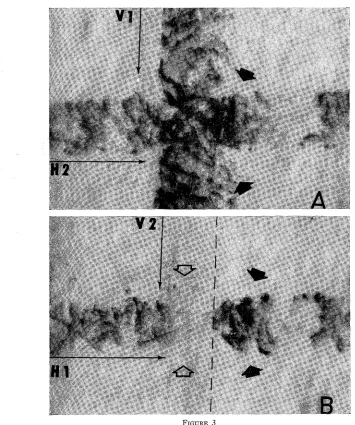
depression of first writing. Observed in some ball, fluid ink, typewriting situations as well as with embossing, printing, etc. The second writing does not reach down into the first made depression, there is a
"skip" caused by the depression (figure 3). At times with ball pens and pencils the track is narrowed where it encounters the existing furrow. See figure 4.
LINTON GODOWN
FIGu, 2
Upper. Waxy or fatty ingredients of the first written (horizontal) pencil line affect the later fluid ink line (verti-cal). Arrows point to distinct repulsion effects of the antagonistic water vs. oil writing materials. Lower. Similar repulsion effects involving ball pen ink (vertical, first written) and the horizontal black fluid ink line. Note gray area of little ink density to left of ball pen line (hollow arrows) and abrupt high density ink margin at right of ball pen line (solid arrows).
Observation of this colored light may be aided by slight shifts from sharpest focus. h. The opposite of the phenomena of (g) has been observed, a lessening of marginal deposit over the typewriting. In some instances this has been observed as a slight diffusion resulting in a less sharp, well defined ink line margin than occurs on the paper at either side of the typewriting impression.
i. Deflection of writing instrument tip by presence of holes punched for accounting, cancellation, fastening, etc. purposes.
FIGURE 3
Crossing ball pen lines showing skip of trough of existing ball pen furrow (vertical) and piling up of ink at ridge on side toward which the ball pen moves. A Pigment in both lines. Light arrows show direction of movement, heavy arrows point to significant ink deposit. This condition is only occasionally encountered clearly defined and requires careful evaluation. B Dotted line indicates axis of uninked ball pen furrow. Hollow arrows point to area of skip while solid arrows indicate blob of ball pen ink deposited on far ridge of furrow by advancing pen.
as the ball or nib skips at the near side and strikes the slight ridge or wall more heavily as it moves on.
CLUES To RELATIVE TImn OF WRITING
Occasionally conditions observed during writing sequence investigation may suggest something regarding possible time lapse between the touching writings. Typical significant qualities are:
a. Maturity of ink of first stroke affecting its solubility in or other reaction with
suc-ceeding writing may be helpful, i.e., in-soluble and unaffected by crossing stroke or, on the other hand, evident running out which took place prior to oxidation, might be indicative.
b. The hygroscopic qualities of some slow drying rubber stamp, ball pen, and type-writing inks continue over some time, possibly days, under some atmospheric or storage conditions.
type-LINTON GODOWN
FIouRx 4
Illustrating narrowing of ink deposit of last written ball pen line at point of crossing existing ball pen furrow sometimes encountered. A Crossing ball pen line. Both lines show ink deposit but narrowing hour-glass-like deposit of last written line clearly shown. This condition results from the presence of the horizontal ball pen furrow. B Shows the same effect with horizontal uninked ball trace, (axis indicated by dashed line).
writing impressions disappears with pas-sage of time. Presence of repulsion would suggest relatively contemporaneous writ-ings, at least not separated by weeks or
months.
d. Paper surface fibers, while soft and still moist, are more readily displaced by the friction of the crossing stroke.
e. Some ball pen inks tend to penetrate or bleed through paper in time.
f. Offset of ink to associated sheet may provide clue.
g. Transfer of pigment or carbon coating com-prising existing writings by subsequent writing. This may involve pickup of
ma-terial from other sources by writing pres-sure as well as transfer away.
As with sequence problems, caution and reserve should dominate any expressions of opinion re-garding relative time of writing. The reminder of
the lack of value of negative findings and the absence of criteria will bear repeating.
ILLUSTRATING SEQUENCE EVIDENCE
Special photographic methods are rarely of help in determining sequence. However, photog-raphy is of the utmost importance in recording and demonstrating the evidence of sequence to others. Usually, this requires photomacrography and photomicrography. Much ordinary black and white photography may result in disappointment as sequence criteria usually involve colored ma-terials, fine detail and delicate, subtle interpreta-tion of spatial relainterpreta-tionships, sheen, texture, etc., suitably recorded in color. Transparency viewing devices are seldom equalled by other photographic methods for effective display of fine detail.
Most examiners agree that the most useful instrument for observing writing sequence condi-tions is the stereoscopic microscope. It seems to follow logically that the ideal method of illustrat-ing what is thus observed would be stereo photog-raphy, color stereo photography. Although some few individuals may lack stereoscopic visual skills, their non-stereo interpretations of color trans-parencies seen by hand viewer would seem to at least equal, probably greatly surpass, their com-prehension of the less realistic black and white print representations of the same material. Equip-ment for simplified color-stereo photography using stereo microscopes is readily available in commercial outfits or can be assembled from available camera, optical, and laboratory equip-ment.
CONCLUSIONS
Both experience and controlled experiments indicate that numerous physical conditions may provide reliable evidence of writing order or sequence. Concrete evidence is not invariably present. The stereo microscope accompanied by flexible incident and transmitted lighting provides the most useful examination equipment. Clues to sequence should be interpreted cautiously in the light of first-hand experiences. Negative evidence or failure to observe clues should be disregarded. Evidence not subject to review or demonstration to others must be considered with caution. Occa-sionally, conditions may justify cautious state-ments regarding lapse of time between touching
writings. Color-stereo photo-micrography appears to offer maximum promise as an illustrating medium.
AuTxoR's NOTE
Special comment on the illustrations seems desirable in view of the unusual circumstances culminating in the present publication. Because of long standing dissatisfaction with black and white photographic methods applied to illustrating line sequence problems, an effort was made to use modem color films, stereography, and electronic flash to prepare more useful illustrations to demon-strate line sequence evidence. In a paper reporting on the results achieved at the 1962 meeting ot the American Society of Questioned Document Ex-aminers, numerous illustrations in color-stereo were prepared for display, either by projection or band viewer. To accompany this paper on color stereo, an outline of line sequence evidence pre-pared several years ago was reviewed, expanded and brought up to date in the form of the present text. Because of the publication limitations, the original color-stereo illustrations were not appro-priate, and it became necessary to resort to specially prepared black and white photographs, the process whose disappointing nature prompted the original investigation.