on Rape Myth Acceptance: Application of Propensity Score Matching Technique. Deviant Behavior, 37 (6). 634 - 643. ISSN 0163-9625 DOI: https://doi.org/10.1080/01639625.2015.1060805
Link to Leeds Beckett Repository record: http://eprints.leedsbeckett.ac.uk/1663/
Document Version: Article
The aim of the Leeds Beckett Repository is to provide open access to our research, as required by funder policies and permitted by publishers and copyright law.
The Leeds Beckett repository holds a wide range of publications, each of which has been checked for copyright and the relevant embargo period has been applied by the Research Services team.
We operate on a standard take-down policy. If you are the author or publisher of an output and you would like it removed from the repository, please contact us and we will investigate on a case-by-case basis.
Running head: INCARCERATION AND RAPE MYTH ACCEPTANCE
The effect of male incarceration on rape myth acceptance: Application of
propensity score matching technique
Agata Debowska1, Daniel Boduszek2, Katie Dhingra3 & Matthew DeLisi4
1
University of Chester, Chester, UK
2
University of Huddersfield, Huddersfield, UK
3
Manchester Metropolitan University, Manchester, UK
4
Iowa State University, USA
Paper accepted for publication in Deviant Behavior
Correspondence to: Dr Daniel Boduszek University of Huddersfield
Queensgate, Ramsden Building R2/06 Huddersfield, HD2 3DH
United Kingdom
Tel: +44 (0)1484 47 1887
Abstract
The aim is to assess the effect of imprisonment on rape myth acceptance. The research used a sample of male prisoners incarcerated for non-sexual crimes (n = 98) and a sample of males drawn from the general population (n = 160). Simple linear regression did not indicate a significant effect of incarceration on rape myth acceptance. After controlling for background covariates using propensity score matching, analysis revealed a positive significant effect of incarceration on rape myth acceptance. Although further research is required, results indicate that being subject to incarceration has a significant positive effect on stereotypical thinking about rape.
Keywords: male incarceration, rape myth acceptance, propensity score matching, non-sexual
The effect of male incarceration on rape myth acceptance: Application of propensity
score matching technique
Rape myths are stereotypical or false beliefs about the culpability of victims, the innocence of rapists, and the illegitimacy of rape as a serious crime. Rape myths act as “psychological neutralizers” which allow men to turn off social prohibitions against using force in sexual
interactions (Bohner et al., 1998; Burt, 1980). Despite the fact that Ward, Polaschek, and Beech (2006) considered rape myth acceptance (RMA) to be the most prominent, best researched, and theoretically most developed individual factor in the aetiology of sexual offending, little is known about the demographic, sociocultural, and behavioural determinants of RMA.
Recent research indicated that the core affective traits of psychopathy (Callous Affect) and childhood exposure to violence have a significant positive effect on attitudes towards rape and rape victims (Debowska, Boduszek, Dhingra, Kola, & Meller-Prunska, in press). Attitudes toward rape have also been found to vary by gender, with men more likely to support rape myths, using a variety of research methodologies and populations (Burt, 1980; Ewoldt, Monson, & Langhinrichsen-Rohling, 2000; Koss, 1988; Lundberg-Love & Geffner, 1989; Muehlenhard & Linton, 1987; Rapaport & Burkhart, 1984; Simonson & Subich, 1999). This greater willingness to accept rape myths and to engage in sexually coercive and aggressive behaviour among males has been suggested to be the result of learning, rather than predispositions (Boeringer, Shehan, & Akers, 1991; Ellis, 1989; Herman, 1984). Male groups, for instance, have been argued to promote sexist attitudes and behaviours through providing a set of norms condoning violence in sexual relationships – a belief system referred to as rape culture (Boswell & Spade, 1996).
and negative attitudes pertaining to sexual coercion are neutralised (Boeringer, 1999). Previous research findings also indicate that being exposed to male-dominated environments may result in greater RMA (Boeringer, 1996; Koss & Gaines, 1993). Koss and Dinero (1988), for example, reported that sexually aggressive men had more associations with groups supporting dominating views of women; while, in another study, Bleecker and Murnen (2005) reported that fraternity men were more likely to endorse rape supportive attitudes than non-fraternity college men. Other research has also revealed that fraternity men hold more traditional gender role beliefs (Schaeffer & Nelson, 1993) and stronger male dominance attitudes (Kalof & Cargill, 1991) than non-fraternity men. Although research on RMA among college athletes is scarce, preliminary findings suggest that male athletes, especially those involved in team-based (football or basketball) versus individual sports, express increased levels of RMA, which suggests a significant effect of the environment on RMA (Sawyer, Thompson, & Chicorelli, 2002). Aggressive team sports in particular have been noted to cultivate sexism, promote hostility towards women, and influence attitudes towards rape and rape victims (Forbes, Adams-Curtis, Pakalka, & White, 2006).
Several mechanisms have been proposed to explain the increased prevalence of violence-supportive attitudes and violent behaviour among men in such contexts. One is group socialisation: in joining particular sports teams or fraternities, individuals are actively inducted into the existing norms and values of these contexts. Another is identification. Membership of a certain group may not in itself be sufficient to increase an individual‟s
violence-supportive beliefs or likelihood of violent or coercive behaviour. Instead,
individuals may have to identify with a particular group and see it as their reference group (Humphrey & Kahn, 2000). Another mechanism is self-selection: men with certain
environmental exposure, influence the proclivity to accept rape myths (White, Donat, & Bondurant, 2001).
If being exposed to male groups is one of the developmental pathways leading to increased RMA and sexual coercion, it is important to further examine such settings. Due to the paucity of research on how stereotypical thinking about rape and women is shaped in male groups, studies utilising more robust statistical analyses and with more diverse samples are still needed. Although evidence suggests that negative attitudes towards women may be fostered in male-dominated settings, there are no data examining RMA among prisoners.1 It may be that fraternal organisations, in which membership is voluntary, create a unique environment in which RMA arises due to peer-group forming rules and hence a similar genesis of RMA among prison populations would be unlikely. In order to verify this, however, studies with inmates are warranted.
Male prisons are a form of male-dominated environment in which masculinity, dominance, and aggression may be decisive factors influencing survival (Hua-Fu, 2005; Walters & Crawford, 2013; Wooldredge & Steiner, 2012). Prison settings have also been argued to reinforce toxic masculinity, defined as the constellation of stereotypical male traits, which fosters violence, devaluation of women, and misogyny (Kupers, 2010). Previous studies found misogynistic beliefs to be positively correlated with rape (Shotland, 1985) and rape-supportive attitudes (Koo, Stephens, Lindgren, & George, 2012). Consequently,
prisoners may subscribe to negative attitudes pertaining to rape and rape victims. This suggestion is also consistent with Malamuth‟s (1998) confluence model according to which hostile masculinity, which pertains to behaviours such as risk-taking, defending one‟s honour, and competiveness, increases sexual aggression. Men who score high on hostile masculinity
1 An important exception is seen in recent research of RMA among incarcerated women. Heath, Lynch, Fritch,
have been found to distrust and dominate women (Malamuth, Linz, Heavey, Barnes & Acker, 1995). Moreover, hypermasculinity has been noted as one of the main factors leading to high prevalence rates of sexual abuse in the U.S. military (Turchik & Wilson, 2010). Locke and Mahalik (2005) reported that college men conforming to masculine norms had higher levels of RMA and were more sexually aggressive. Additionally, general intergroup dominance has been reported to be a significant predictor of RMA (Hockett, Saucier, Hoffman, Smith, & Craig, 2009). On the other hand, however, sexual offenders tend to be victimised by other inmates, which may indicate that rape-supportive attitudes will not be fostered in prison settings.
Studies with prison populations are needed in order to verify whether the above research findings with college athletes and fraternity members can be extended to other male-dominated milieus. Research has consistently found a relationship between RMA and both self-reported sexual aggression and self-reported rape proclivity (e.g., Bohner, Pina, Viki, & Siebler, 2010; Lonsway & Fitzgerald, 1994; Muehlenhard & Falcon, 1990). Additionally, a strong endorsement for rape-supportive attitudes was reported for sexual and violent
offenders (Feelgood, Cortoni, & Thompson, 2005). More rape distortions were found among sexual offenders, in comparison with non-sexual offenders (Bumby, 1996). Therefore, it may be that cognitive distortions pertaining to rape serve to mitigate the responsibility for one‟s actions and hence precede sexually-coercive behaviour (Bohner et al., 1998; Burt, 1980; Ward & Siegert, 2002). Given the possibility of increased levels of RMA among sexual offenders before imprisonment, studies examining the possible effect of incarceration on RMA should be conducted with prisoners sentenced for crimes of non-sexual nature.
Murnen, 2005; Boeringer, 1996; Forbes et al., 2006; Koss & Gaines, 1993; Sawyer et al., 2002). However, no known studies to date have examined whether the above findings can be extended to male prison population. We acknowledge that drawing on literature linking RMA with fraternity and sports team membership in prison context may appear problematic due to the cultural gap between those environments. However, it has been noted that the prison culture reflects the culture of the community within which it is set and, by providing its distorted mirror image, exaggerates some of its characteristics (Clemmer, 1966; Goetting, 1985; Michalowski, 1985). Thus, forming rules in prison groups are not created in a cultural vacuum and, even though they are more extreme than the ones found among community groups, they are not distinct. Indeed, according to Kupers (2010, p. 113), “the prison code that reigns in men‟s prisons is an exaggeration of the unspoken “male code” on the outside”.
In light of this argument, our references to phenomena reported among general population samples seem justified and our attempt at examining similar processes within prison context is well-founded. Therefore, the main purpose of this research was to examine the effect of imprisonment on RMA. Based on previous studies, a significant effect of incarceration on stereotypical thinking about rape was expected.
Methods
Participants
committing other non-violent offences. Most participants (75.5%) reported having been brought up by both parents, 24.5% were brought up by single parents, relatives, or foster parents. Duration of imprisonment ranged from 1 to 17 years (M = 2.46, SD = 2.33).
Sample two consisted of 160 working male adults undertaking part-time evening courses at the University of Security in Poznan (Poland). Participants ranged in age from 19 to 49 years (M = 25.83, SD = 6.14). Most participants (90.6%) reported having been brought up by both parents, whereas 9.4% were brought up by single parents, relatives, or foster parents.
Measures
Updated Illinois Rape Myth Acceptance Scale (IRMA;McMahon & Farmer, 2011) is a 19-item measured designed to assess general rape myth acceptance rated on a 5-point Likert scale. In the present sample, Cronbach‟s alpha for the scale was α = .87.
Self-Report Psychopathy Scale (SRP-III;Paulhus, Neumann, & Hare, in press) is a 64-item measure generated on the basis of the Psychopathy Checklist-Revised (PCL-R; Hare, 1991). It consists of four subscales: Interpersonal Manipulation (α = .81), Callous Affect (α = .65), Erratic Lifestyle (α = .71), and Antisocial Behaviour (α = .85). Items are scored on a 5-point Likert scale.
The Relationships Structure Questionnaire(ECR-RS; Fraley, Heffernan, Vicary & Brumbaugh, 2011) is a 36 item measure of adult attachment with mother, father, romantic partner, and best friend. For the purpose of the current study only the relationship with mother and father subscales were utilised. Internal consistency for subscales was good (α = .82 for mother avoidance; α = .88 for mother anxiety; α = .89 for father avoidance; α = .91 for father anxiety).
Criminal Friend Index (CFI; Mills & Kroner, 1999). Participants from general population were asked to recall three adult friends with whom they spend most of their time and answer the following questions about them: (1) Has this person ever committed a crime?; (2) Does this person have a criminal record?; (3) Has this person ever been to prison; (4) Has this person tried to involve you in a crime?. In terms of prison sample, the CFI was used to collect retrospective data. Inmates were asked to recall friends with whom they spend most their time before first incarceration.
Loneliness and Social Dissatisfaction Questionnaire (LSDA; Cassidy & Asher, 1992) is 15 items scale about children‟s feelings of loneliness and dissatisfaction with peer relations. Cronbach‟s alpha was α = .88.
Statistical analysis
studies, researchers have no control over the assignment to treatment condition. Accordingly, differences in background variables between participants may have a significant influence on treatment effects, which in turn may result in misleading findings (D‟Agostino, 1998).
Matching procedures can be used to identify for each participant in the treatment group one person in the control group who would be similar on a chosen number of covariates (Apel & Sweeten, 2010). The propensity score matching (PSM) technique attempts to assess the effect of treatment by accounting for covariates and hence correcting selection bias in making estimates (Rubin, 2006).
In the present study, it was assumed that the „treatment group‟ (prisoners) would differ from the „control group‟ (general population) on a number of covariates, and that these
variables may also affect the outcome variable (RMA). These potential confounding variables (covariates) were used to estimate a propensity score (ranging from 0 to 1) that represents each participant‟s likelihood of being assigned to the treatment group. The propensity score is
then used to generate a matched sample of treatment and control respondents. Thus, the propensity score is a balancing score of covariates, meaning the distribution of variables are the equivalent for the participants from treatment and control groups.
The covariates were age, upbringing, exposure to violence, criminal friend index, loneliness and social dissatisfaction, mother avoidance, mother anxiety, father avoidance, father anxiety, interpersonal manipulation, callous affect, erratic lifestyle, and antisocial behaviour. From the logistic regression analysis, the predicted likelihood (propensity score) is estimated for each participant.
After calculating the propensity scores for each participant, a matching procedure was employed to match participants from both samples. The propensity score matching procedure utilised in this study was greedy matching (nearest neighbour matching without replacement; Guo & Fraser, 2010). The “MatchIt” package in R version 3.0.1 was used to perform „greedy matching‟. Here is the procedure applied to conduct nearest neighbour matching. Pi and Pj
are the propensity scores for treated and control participants, respectively, I1 is the set of
treated participants, and I0 is the set of control participants. A neighbourhood C(Pi) contains a
control participant j (i.e., j ϵ I0) as a match for a treated participants i (i.e., i ϵ I1), if the
absolute difference of propensity scores is the smallest among all possible pairs of propensity scores between i and j, as:
C(P
i)
= min
j׀׀
P
i-
P
j׀׀,
j ϵ I
0Once a j is found to match i, j is removed from I0 without replacement. If for each i there is
only a single j found to fall into C(Pi), then the matching is nearest neighbour pair matching
(Guo & Fraser, 2010).
Results
Pre-matching analyses
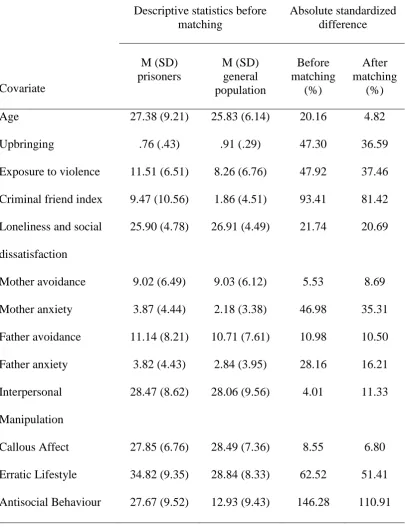
Table 1
Descriptive statistics and absolute standardized difference between prisoners and general
population
Descriptive statistics before matching Absolute standardized difference Covariate M (SD) prisoners M (SD) general population Before matching (%) After matching (%)
Age 27.38 (9.21) 25.83 (6.14) 20.16 4.82
Upbringing .76 (.43) .91 (.29) 47.30 36.59
Exposure to violence 11.51 (6.51) 8.26 (6.76) 47.92 37.46 Criminal friend index 9.47 (10.56) 1.86 (4.51) 93.41 81.42 Loneliness and social
dissatisfaction
25.90 (4.78) 26.91 (4.49) 21.74 20.69
Mother avoidance 9.02 (6.49) 9.03 (6.12) 5.53 8.69 Mother anxiety 3.87 (4.44) 2.18 (3.38) 46.98 35.31 Father avoidance 11.14 (8.21) 10.71 (7.61) 10.98 10.50 Father anxiety 3.82 (4.43) 2.84 (3.95) 28.16 16.21 Interpersonal
Manipulation
28.47 (8.62) 28.06 (9.56) 4.01 11.33
Nearest neighbour matching and post matching linear regression
The results in Table 1 indicate that observed systematic differences between prisoners and general population were greatly reduced or eliminated for all covariates except mother avoidance and interpersonal manipulation (but these two did not exceeded 20 percent) suggesting that the application of greedy matching was effective.
With a new matched sample linear regression was employed to help determine if incarceration has an effect on RMA. The results suggest that after controlling for background variables using propensity score matching, incarceration has a significant positive effect on RMA (F[1, 195] = 3.17; B = 2.96, SE = 1.66; β = .12, p < .05).
Discussion
Very few studies with sound methodological designs have examined the influence of environmental variables on RMA. Consequently, the main purpose of the current study was to examine the effect of incarceration on RMA using propensity score matching technique. As already noted, PSA reduces selection bias by controlling for the influence of covariates which may have an effect on the outcome variable (Boduszek, Shevlin, Hyland, & Adamson, 2013; D‟Agostino, 1998). Therefore, the utilisation of PSM in the present research increases
the reliability and validity of the findings (Berzin, 2010; Brown, 2012).
effect of incarceration on rape supportive attitudes. However, as previous research findings have indicated that certain background characteristics can have a significant effect on incarceration, RMA and sexual coercion (e.g., Bouffard, 2002; Debowska et al., in press; Malamuth, Sockloskie, Koss, & Tanaka, 1991; Smallbone & Dadds, 2000) this was not entirely unexpected. Thus, in order to reduce bias in background characteristics between our two samples and to isolate the effect of imprisonment, a propensity score matching procedure was utilised. Post-matching linear regression analysis revealed a statistically significant effect of incarceration on RMA. This finding is in line with previous similar studies which found that male-dominated settings can promote rape supportive attitudes (e.g., Bleecker & Murnen, 2005; Boeringer, 1996; Forbes et al., 2001; Koss & Gaines, 1993; Sawyer et al., 2002), and suggests an environmental influence on attitudes towards rape and rape victims. Thus, male groups appear to provide a set of norms condoning violence in sexual
relationships (Boswell & Spade, 1996) which, in turn, may lead to the neutralisation of negative attitudes towards sexual aggression (Boeringer, 1999). Consequently, stereotypical perceptions of victim culpability in the context of rape are likely to be formed.
Furthermore, it appears that the effect of male-dominated settings on rape-supportive attitudes is not limited to fraternal organisations or sport clubs and is not due to internal forming rules of such milieus. Prisoners, just like other men joining community-based all-male circles voluntarily, seem to be subject to group socialisation and may develop an
identification with the group‟s values. It may also be that men who choose to spend time with
other males and men subject to incarceration share similar psychological make-up, making them more aggressive and dominant and hence more likely to endorse rape myths (Locke & Mahalik, 2005).
masculinity, dominance, and aggression. Past research has indicated that hostile masculinity and dominance increase sexual aggression, distrust towards women, and the readiness to endorse rape myths (Locke & Mahalik, 2005; Malamuth, 1998; Malamuth et al., 1995). Moreover, it appears that the intensification of toxic masculinity, important for survival in prison settings, may lead to negative evaluations of femininity and hence increased RMA (Kupers, 2010). The present findings thus may be considered to provide tentative evidence that the exacerbation of stereotypical male traits may result in cognitive distortions pertaining to rape and rape victims.
The results of the present study should be interpreted in light of some limitations. First, the present sample consisted of Polish adults and hence it cannot be certain that the findings apply to other populations. Further research with participants from other cultural and linguistic backgrounds is therefore needed in order to exclude the possibility that the effects reported here are solely due to cross-cultural differences. Second, the use of self-report data within a sample of prisoners whose command of language is poor may have introduced several well-known limitations, such as response bias. Therefore, the concern is that the participants could not fully understand the questions posed to them. However, this aspect of the study could not be controlled by the researchers. Finally, the study did not control for participants‟ affiliation with male-dominated groups, such as sport clubs or gangs. It may be,
hence, that increased RMA was due to pre-existing experiences, rather than incarceration. It is recommended that future studies address this limitation. Previous research on RMA in male-dominated settings has focused on college fraternity men and athletes drawn predominantly from North American populations, thus, despite the aforementioned
References
Apel, R.J., & Sweeten, G. (2010). Propensity score matching in criminology and criminal justice. In A.R. Piquero, & D. Weisburd (Eds.), Handbook of Quantitative
Criminology (pp. 543-562). New York: Springer.
Astbury, B. (2012). Using theory in criminal justice evaluation. In E. Bowen, & S. Brown (Eds.), Perspectives of evaluating criminal justice and corrections (pp. 3-28). Bingley, UK: Emerald.
Austin, P.C. (2008). A critical appraisal of propensity-score matching in the medical literature between 1996 and 2003. Statistics in Medicine, 27(12), 2037-2049.
Bleecker, E.T., & Murnen, S.K. (2005). Fraternity membership, the display of degrading sexual images of women, and rape myth acceptance. Sex Roles, 53(7/8), 487-493.
Boduszek, D., Shevlin, M., Hyland, P., & Adamson, G. (2013). Eysenck‟s Personality Model and Criminal thinking style within a violent and non-violent offender sample - application of propensity score analysis. Deviant Behavior, 34(6), 483-493.
Boeringer, S.B. (1996). Influences of fraternity membership, athletics, and male living arrangements on sexual aggression. Violence Against Women, 2, 132-147.
Boeringer, S.B. (1999). Associations of rape-supportive attitudes with fraternal and athletic participation. Violence Against Women, 5, 81-89.
Bohner, G., Pina, A., Viki, G. T., & Siebler, F. (2010). Using social norms to reduce men‟s rape proclivity: Perceived rape myth acceptance of out-groups may be more
influential than that of in-groups. Psychology, Crime and Law, 16, 671-693.
Bohner, G., Reinhard, M. A., Rutz, S., Sturm, S., Kerschenbaum, B., & Effler, D. (1998). Rape myths as neutralizing cognitions: Evidence for a causal impact of anti-victim attitudes on men's self-reported likelihood of raping. European Journal of Social Psychology, 28, 257-268.
Boswell, A.A., & Spade, J.Z. (1996). Fraternities and collegiate rape culture: Why are some fraternities more dangerous places for women? Gender and Society, 10(2), 133-147.
Bouffard, J. A. (2002). The influence of emotion on rational decision making in sexual aggression. Journal of Criminal Justice, 30(2), 121-134.
Brown, S. (2012). Propensity score analysis. In E. Bowen, & S. Brown (Eds.), Perspectives of Evaluating Criminal Justice and Corrections (pp. 173-198). Bingley, UK: Emerald.
Bumby, K. M. (1996). Assessing the cognitive distortions of child molesters and rapists: Development and validation of the MOLEST and RAPE scales. Sexual Abuse: A Journal of Research and Treatment, 8(1), 37-54.
Bumby, K.M., & Hansen, D.J. (1997). Intimacy deficits, fear of intimacy, and loneliness among sexual offenders. Faculty Publications, Department of Psychology. Paper 25. Retrieved from http://digitalcommons.unl.edu
Cassidy, J., & Asher, S.R. (1992). Loneliness and peer relations in young children. Child Development, 63, 350-365.
Clemmer, D. (1966). The prison community. New York: Holt, Rinehart, and Winston.
D‟Agostino, R.B. (1998). Tutorial in biostatistics: Propensity score methods for bias
reduction in the comparison of a treatment to a non-randomized control group. Statistics in Medicine, 17, 2265-2281.
Debowska, A., Boduszek, D., Dhingra, K., Kola, S., & Meller-Prunska, A. (in press). The role of psychopathy and exposure to violence in rape myth acceptance. Journal of Interpersonal Violence
DeLisi, M., Barnes, J.C., Beaver, K.M., & Gibson, C.L. (2009). Delinquent gangs and adolescent victimization revisited: A propensity score matching approach. Criminal Justice and Behavior, 36(8), 808-823.
Ellis, L. (Ed.). (1989). Theories of rape: Inquiries into the causes of sexual aggression. Taylor & Francis.
Ewoldt, C. E., Monson, C. M., & Langhinrichsen-Rohling, J. (2000). Attributions about rape in a continuum of dissolving marital relationships. Journal of Interpersonal Violence, 15, 1175-1182.
Feelgood, S., Cortoni, F., & Thompson, A. (2005). Sexual coping, general coping and cognitive distortions in incarcerated rapists and child molesters. Journal of Sexual Aggression, 11(2), 157-170.
Vazsonyi, & I.D. Waldman (Eds.), The Cambridge Handbook of Violent Behavior and Aggression (pp. 306-321). New York: Cambridge University Press.
Forbes, G.B., Adams-Curtis, L.E., Pakalka, A.H., & White, K.B. (2006). Dating aggression, sexual coercion, and aggression-supporting attitudes among college men as a function of participation in aggressive high school sports. Violence Against Women, 12(5), 441-455.
Fraley, R.C., Heffernan, M., Vicary, A.M., & Brumbaugh, C.C. (2011). The experiences in close relationships – Relationship Structure Questionnaire: A method for assessing attachment orientations across relationships. Psychological Assessment, 23, 615-625.
Goetting, A. (1985). Racism, sexism, and ageism in the prison community. Federal Probation Journal, 49, 10-22.
Guo, S., & Fraser, M.W. (2010). Propensity score analysis: Statistical methods and applications. Thousand Oaks: Sage Publications.
Hare, R.D. (1991). The Hare Psychopathy Checklist-Revised. Toronto: Multi-Health Systems.
Heath, N. M., Lynch, S. M., Fritch, A. M., & Wong, M. M. (2013). Rape Myth Acceptance Impacts the Reporting of Rape to the Police A Study of Incarcerated Women. Violence Against Women, 19(9), 1065-1078.
Herman, D. (1984). The rape culture. In J. Freeman (Ed.), Women: A feminist perspective (pp. 20-39). Mountain View, CA: Mayfield Publishing.
Hua-Fu, H. (2005). The patterns of masculinity in prison. Critical Criminology, 13(1), 1-16.
Humphrey, S. E., & Kahn, A. S. (2000). Fraternities, athletic teams, and rape. Journal of Interpersonal violence, 15(12), 1313-1320.
Kalof, L., & Cargill, T. (1991). Fraternity and sorority membership and gender dominance attitudes. Sex Roles, 23, 417-423.
Kassing, L., Beesley, D., & Frey, L. (2005). Gender role conflict, homophobia, age, and
education as predictors of male rape myth acceptance. Journal of Mental Health Counseling, 27, 311–328.
Koo, K.H., Stephens, K.A., Lindgren, K.P., & George, W.H. (2012). Misogyny,
acculturation, and ethnic identity: Relation to rape-supportive attitudes in Asian American college men. Archives of Sexual Behavior, 41(4), 1005-1014.
Koss, M.P. (1988). Hidden rape: Sexual aggression and victimization in a national sample of students in higher education. In A.W. Burgess (Ed.), Rape and sexual assault II (pp. 3-25). New York: Garland.
Koss, M.P., & Dinero, T.E. (1988). Discriminant analysis of risk factors for sexual
victimization among a national sample of college women. Journal of Consulting and Clinical Psychology, 57(2), 242-250.
Koss, M.P., & Gaines, J. A. (1993). The prediction of sexual aggression by alcohol use, athletic participation, and fraternity affiliation. Journal of Interpersonal Violence, 8, 94-108.
Locke, B.D., & Mahalik, J.R. (2005). Examining masculinity norms, problem drinking, and athletic involvement as predictors of sexual aggression in college men. Journal of Counseling Psychology, 52(3), 279-283.
Lonsway, K.A., & Fitzgerald, L.F. (1994). Rape myths: In review. Psychology of Women Quarterly, 18, 133-164.
Loughran, T.A., Mulvey, E.P., Schubert, C.A., Chassin, L.A., Steinberg, L., Piquero, A.R., Fagan, J., & Cota-Robles, S. (2010). Differential effects of adult court transfer on juvenile offender recidivism. Law and Human Behavior, 34, 476–488.
Lundberg-Love, P.K., & Geffner, R. (1989). Date rape: Prevalence, risk factors, and a proposed model. In M.A. Pirog-Good & J.E. Stets (Eds.), Violence in dating relationships: Emerging social issues (pp. 169-184). New York: Praeger.
Malamuth, N.M. (1998). An evolutionary-based model integrating research on the
characteristics of sexually coercive men. In J. Adair, K. Dion, & D. Belanger (Eds.), Advances in psychological science: Vol. 1 Social, personal, and developmental
aspects (pp. 151-184). Hove, UK: Psychology Press/Erlbaum.
Malamuth, N.M, Linz, D., Heavey, C.L., Barnes, G., & Acker, M. (1995). Using the confluence model of sexual aggression to predict men‟s conflict with women: A
10-year follow-up study. Journal of Personality and Social Psychology, 69, 353–369.
Malamuth, N.M., Sockloskie, R.J., Koss, M.P., & Tanaka, J.S. (1991). Characteristics of aggressors against women: Testing a model using a national sample of college students. Journal of Consulting and Clinical Psychology, 59, 670-681.
Michalowski, R.J. (1985). Order, law and crime. New York: Random House.
Mills, J. F., & Kroner, D. G. (1999). Measures of criminal attitudes and associates. Unpublished User Guide.
Mouilso, E.R., & Calhoun, K.S. (2013). The role of rape myth acceptance and psychopathy in sexual assault perpetration. Journal of Aggression, Maltreatment and Trauma, 22, 159-174.
Muehlenhard, C., & Falcon P. (1990). Men‟s heterosocial skill and attitudes toward women
as predictors of verbal sexual coercion and forceful rape. Sex Roles, 23(5/6), 241–259.
Muehlenhard, C. L., & Linton, M. A. (1987). Date rape and sexual aggression in dating situations: Incidence and risk factors. Journal of Counselling Psychology, 34, 186-196.
Paulhus, D.L., Neumann, C.S., & Hare, R.D. (in press). Manual for the Self-Report Psychopathy Scale. Toronto: Multi-Health Systems.
Rapaport, K., & Burkhart, B. (1984). Personality and attitudinal characteristics of sexually coercive college males. Journal of Abnormal Psychology, 93, 216-221.
Rosenbaum, P.R., & Rubin, D.B. (1985). The central role of the propensity score in observational studies for causal effects. Biometrika, 70, 41-55.
Rubin, D.B. (2006). Matched sampling for casual effects. New York: Cambridge University Press.
Sawyer, R.G., Thompson, E.E., & Chicorelli, A.M. (2002). Rape myth acceptance among intercollegiate student athletes: A preliminary examination. American Journal of Health Studies, 18(1), 19-25.
Schaeffer, A.M., & Nelson, E.S. (1993). Rape-supportive attitudes: Effects of on campus residence and education. Journal of College Student Development, 34, 175-179.
Shadish, W.R., Cook, T.D., & Campbell, D.T. (2002). Experimental and quasi-experimental designs for generalized casual inference. Boston: Houghton Mifflin Company.
Shotland, R.L. (1985). A preliminary model of some causes of date rape. Academic Psychology Bulletin, 7, 187-200.
Simonson, K., & Subich, L. M. (1999). Rape perceptions as a function of gender-role traditionality and victim–perpetrator association. Sex Roles, 40, 617–634.
Smallbone, S.W., & Dadds, M.R. (2000). Attachment and coercive sexual behavior. Sexual Abuse: A Journal of Research and Treatment, 12(1), 3-15.
Smallbone, S.W., & Dadds, M.R. (2001). Further evidence for a relationship between attachment insecurity and coercive sexual behavior in nonoffenders. Journal of Interpersonal Violence, 16(1), 22-35.
Turchik, J.A., & Wilson, S.M. (2010). Sexual assault in the U.S. military: A review of the literature and recommendations for the future. Aggression and Violent Behavior, 15(4), 267-277.
Ward, T., Polaschek, D., & Beech, A. R. (2006). Theories of Sexual Offending. Chichester, UK: Wiley.
Ward, T., & Siegert, R.J. (2002). Toward a comprehensive theory of child sexual abuse: A theory knitting perspective. Psychology, Crime and Law, 8(4), 319-351.
White, J.W., Donat, P.L.N., & Bondurant, B. (2001). A developmental examination of violence against girls and women. In R.K. Unger (Ed.), Handbook of the psychology of women and gender (pp. 343-357). New York: John Wiley.