Journal of Chemical and Pharmaceutical Research, 2015, 7(3):1170-1175
Research Article
CODEN(USA) : JCPRC5
ISSN : 0975-7384
Application of set pair analysis in three-way decisions
Lihong Li, Yan Li*, Jie Sun and Baoxiang Liu
College of Science, Hebei United University, Tangshan, Hebei, China
____________________________________________________________________________________________
ABSTRACT
The connection degree is used in set pair analysis theory to build a new model of three-way decisions. The concept “Set pair situation” can help deal with the reliability of the new model. When the parameter “b” of connection degree function becomes 0, three-way decisions turns into binary decisions. The new model is an extension and new application of three-way decisions theory. Examples verify good effect.
Key words: Three-way decisions; Set pair analysis; Set pair situation; Reliability; Connection degree
_____________________________________________________________________________________________
INTRODUCTION
Three-way decisions theory[1] is a new decision theory proposed by Y.Y.Yao and others basing on decision-theoretic rough sets[2], which can deal with uncertainty decision problems in case of lack of information. Three-way decisions theory use accept, rejection, and not to promise to express three types in decision-making, and is used in uncertain decision-making problem[3-9]. Set pair analysis theory links certain and uncertain information together with contact function, what is an effective way to deal with uncertain information. This paper discusses how to use the set pair analysis method [10] in the building of three-way decisions model and the application of it, which provides a new practical method of three-way decisions.
RELATIONSHIP BETWEEN THREE-WAY DECISIONS AND SET PAIR ANALYSIS
Three-way decisions are the basic idea of evaluations function in the entity, the two thresholds are introduced and three needed domains are constructed. Set U is limited not empty entity set or decision schemes set, C is limited conditions set. Conditions set may contain indicators, targets or restrains. Decision task is to make corresponding
decision based on the given conditions of each entityx∈U. Conditions set C gives the basis of the decision which
give the result by constructing evaluation function. When information is uncertain or incomplete, we may not be able to determine whether the entity is to meet the conditions. In this time, evaluation function is a kind of entity estimate rather than a precise value to satisfy the conditions and due to the uncertainty of the estimate, using binary decision may be difficult.
We bring in the three-way decisions when the evaluations function value is neither high nor low, in this condition
whether to accept or reject appear unreasonable. The given thresholds are α and β:
(1)When the evaluations function value is greater than or equal to α, we choose to accept the entity;
(2)When the evaluations function value is smaller than or equal to β, we choose to reject the entity;
(3)When the evaluations function value is between αandβ, neither refused nor accepted but to choose not to
______________________________________________________________________________
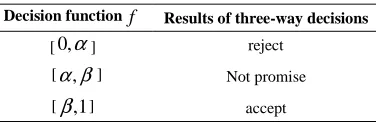
[image:2.595.213.401.146.207.2]In decision making, when lack of information or obtain letter requires a certain price, we can give three-way decisions of to accept, to rejection and no promise. Rough set is a typical three-way decision-making model. The positive domain, negative domain and boundaries in Rough Set model can be interpreted to accept, rejection and don't promise to the results of the three-way decisions.
TABLE 1: Three-way decisions table
Decision functionf Results of three-way decisions
[0,α] reject
[α β, ] Not promise
[β,1] accept
Set pair is a connection of two set of pairs. The core idea of set pair analysis is to determine certainty and uncertainty as a system. Certainty and uncertainty in the system interconnected influence each other, mutual restrict, and under certain conditions mutual conversion. Connection degree is used to describe the relationship between certainty and uncertainty.
Given two sets A and B , and they set up a set pair, expressed asH=(A,B). In a specific problem context (like
W ), we analyses the characteristic of set pair, received N features, of which: there are S features are shared in
the set pair of A and B; there are P feature opposite in the set pair of A and B; on the rest of the F =N−S−P
features, they are not contradictory and not shared by the set pair of A and B. We call the ratio:
N
S is the degree of identity for two sets under problem W ;
N
F is the degree of difference for two sets under problem W ;
N
P is the degree of opposites for two sets under problem W ;
With the formula:
j N P i N F N S
W)= + +
(
µ
we can see the relationship clearly. Type µ is called connection degree of sets A and B . Of which N
P N F N S
+ + =1,
j takes -1 commonly. And we often make N P c N F b N S
a= , = , =
, then cj bi a W)= + + (
µ
THE MODEL OF SET PAIR ANALYSIS IN THREE-WAY DECISIONS
Three-way decisions use positive domain, negative domain and boundaries to express the uncertainty decision-making results, and set pair analysis put forward the contact function to say the certain and uncertain in formations. The representation of uncertain problem for the two theories is different. Three-way decisions theory and set pair analysis’ contact embodied in: The degree of identity in set pair analysis is corresponding to the positive domain in three-way decisions; the degree of opposites in set pair analysis is corresponding to the negative domain in three-way decisions; the degree of difference in set pair analysis is corresponding to the boundary domain in three-way decisions. We define set pair analysis under the background of three-way decisions problem.
Definition 1 According to the decision-making problem W , there suppose to be a set of evaluation factors
likeX ={x∀x∈X,X ≠φ}, and the evaluation standard factors like Y ={y∀y∈Y,Y≠φ}. Their cardinal number are
respectively X1 =m and Y1 =n, we call
} & )
, {( )
,
(X Y X Y x y x X y Y
H = × = ∀ ∈ ∈
are the decision set pair grounds by X and Y . The cardinal number is H =N=mn.
Definition 2 Suppose there are relationship R and problem W , whether there is a relationship R between two sets X and Y :
If there is a relationship R between two sets x∈X and y∈Y, which evaluation factors accord with the
______________________________________________________________________________
} , & ) , {( ) ,(X Y x y x X y Y xRy
HR = ∀ ∈ ∈
is the subset pair of identity degree for two sets X and Y under problem W . Suppose that HR =S is cardinal
number of H , R N
S H HR
=
is the degree of identity for two sets X and Y under problem W , we stand it with a for short.
If there isn’t a relationship R between two sets x∈X and y∈Y, which evaluation factors don’t accord with the
requirement of evaluation standard, shown as xRy
} , & ) , {( ) ,
(X Y x y x X y Y xRy
HR = ∀ ∈ ∈
is the subset pair of opposites degree for two sets X and Y under problem W . Suppose that HR =P is
cardinal number of H , R N
P H HR =
is the degree of identity for two sets X and Y under problem W , we stand it
with
c
for short.If there is not sure a relationship R between two sets x∈X and y∈Y, which evaluation factors are not sure to
accord with the requirement of evaluation standard, shown as xRoy.
} , & ) , {( ) ,
(X Y x y x X y Y xRy
H R
o
o = ∀ ∈ ∈
is the subset pair of difference degree for two sets X and Y under problem W . Suppose that HRo =F is
cardinal number of o
R H
, N
F H H
Ro =
is the degree of difference for two sets X and Y under problem W , we stand it with b for short.
The following expression:
j N P i N F N S Y X
u( , )= + +
is degree of difference and counter connection set H(X,Y) under question W , and
cj bi a Y X
u( , )= + + for short.
Among it, a,b,c∈[0,1], anda+b+c=1.
Degree of difference and counter connection set H(X,Y) under question W is u(X,Y)=a+bi+cj. We use the
connection function as the evaluation function. According to the minimum risk decision making principles, the definition of the three domains are:
} } , , max{ { )
(u X U abc a
POS = ∈ =
} } , , max{ { )
(u X U ab c c
NEG = ∈ =
} } , , max{ { )
(u X U ab c b
BND = ∈ =
Decisions in positive domain are to accept the result, decisions in negative domain are to reject the result, decisions in boundary domain are not promised to corresponding results.
When max{a,b,c}=a, which says that the decision result can be divided into positive domain. The factors who
influence the reliability of correct dividing are two:(1)value a / . we can see that the nearer 1 the value c a / , the c
lower reliability of the decision of correctness. (2)the compare of b c+ anda. a> +b csays that X andY in set
pair H have “strong same situation” in problem W and it means that the two collections mainly have "the same
trend", the reliability of the decision of correctness in this time is high; while a< +b cis the circumstance of “weak
same situation”, the effect of two collections have "the same trend" are weak, the reliability of the decision of correctness in this time correspondingly weakened.
When max{a,b,c}=c, which says that the decision result can be divided into negative domain. The factors who
influence the reliability of correct dividing are two:(1) value a / . The nearer 1 the value c a / , the lower reliability c
______________________________________________________________________________
“strong opposite situation” in problem W and it means that the two collections mainly have "the opposite trend", the
reliability of the decision of correctness in this time is high; while c< +a bis the circumstance of “weak opposite
situation”, the effect of two collections have "the opposite trend" are weak, the reliability of the decision of correctness in this time correspondingly weakened.
whenmax{a,b,c}=b, which says that the decision result can be divided into boundary domain. It’s reliability of
correction just depend on b . The larger b , the higher reliability of the decision of correctness.
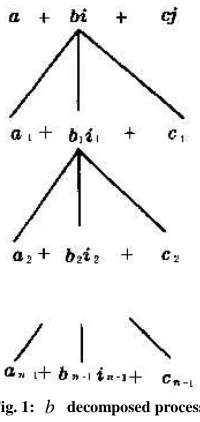
In connect function u(X,Y)=a+bi+cj, b can continue to be "decomposed". The decomposition process are the i
updating process and meanwhile the three-way decisions turn to branch decisions process. With more and more in-depth understanding of the problem of uncertainty, the value b is more and more certain. The b "decomposed" is like figure1.
j c c c i b a a a a Y X
u( , )=( + 1+ 2+...+ n−1)+ n−1n−1+( + 1+...+ n−1)
With the decomposition, the uncertainty is getting smaller, and b are getting smaller too.
When bn−1 approaches 0, three-way decisions turn to branch decisions:
} } , max{ {
)
(u X U a c a
POS = ∈ =
} } , max{ {
)
(u X U a c c
[image:4.595.257.357.336.547.2]NEG = ∈ =
Fig. 1: b decomposed process
The realization of the set pair analysis in three-way decisions model requires three important steps:
(1)According to the statistical analysis, connection degree of set pair analysis is determined;
(2)According to the acceptance of the results and determine the decision threshold;
(3)According to the decision rule to judge the results of the three-way decisions.
Apply the results using C language programming, and the main process is as follows:
Begin
Input initial evaluation results IF(Wpq==1), a++;
IF(Wpq==0), b++;
IF(Wpq==-1), c++; //Statistic the votes situation
u=a+bi+cj; //shown as connection function
______________________________________________________________________________
printf("Decisions in positive domain");
IF(max(a,b,c)=c)
printf("Decisions in negative domain");
IF((max(a,b,c)=b)
printf("Decisions in boundary domain ");//Output three-way decisions result
End
AN APPLICATION EXAMPLE
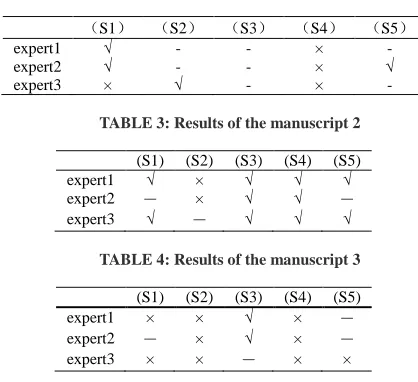
An academic journal organizes experts to judge manuscripts are adopted, retreat or rejection. Qualified manuscript requires conditions like:high academic standards(S1), innovative(S2), practical(S3), literature references are complete(S4) and writing concise accurate(S5). For excellent overall evaluation manuscript they directly use it, for general overall evaluation manuscript they use it after retreating and for rejection overall evaluation manuscript they will not use it directly. Select three manuscripts to review them using our model. Evaluation factors of manuscripts
accord with the requirement of evaluation standard will be marked with“√”, the opposite situation be marked
with“×”,and mark“×”when without a clear tendency. Determine the results as follows
TABLE 2: Results of the manuscript 1
(S1) (S2) (S3) (S4) (S5)
expert1 √ - - ×
-expert2 √ - - × √
expert3 × √ - ×
-TABLE 3: Results of the manuscript 2
(S1) (S2) (S3) (S4) (S5)
expert1 √ × √ √ √
expert2 - × √ √ -
expert3 √ - √ √ √
TABLE 4: Results of the manuscript 3
(S1) (S2) (S3) (S4) (S5) expert1 × × √ × -
expert2 - × √ × -
expert3 × × - × ×
Manuscript 1 and evaluation standard’s connection degree of set pair analysis:
j i j i Y X
u 0.26 0.47 0.26 15 4 15 7 15 4 ,
1 )= + + ≈ + +
(
Manuscript 2 and evaluation standard’s connection degree of set pair analysis:
j i j i Y X
u 0.67 0.2 0.13
15 2 15 3 15 10 ,
2 )= + + ≈ + +
(
Manuscript 3 and evaluation standard’s connection degree of set pair analysis:
j i j i Y X
u 0.13 0.26 0.6
15 9 15 4 15 2 ,
3 )= + + ≈ + +
(
Contact function as the evaluation function, basing on the results of set pair analysis in three-way decisions, we get
the three domains of three-way decisions(three manuscripts are present like X1,X2,X : 3
} { } } , , max{ { )
(u X U ab c a X2
POS = ∈ = =
} { } } , , max{ { )
(u X U a bc c X3
NEG = ∈ = =
} { } } , , max{ { )
(u X U a bc b X1
BND = ∈ = =
We get the decision scheme that manuscript 1 should be used after retreat, manuscript 2 should be used directly and
manuscript 3 directly rejected. Further more, there are a> +b cin manuscript 2, so the manuscript 2 and evaluation
criteria set have “strong same situation”, that is to say the paper have obvious advantage; there are c> +a bin
[image:5.595.199.408.267.458.2]______________________________________________________________________________
CONCLUSIONSet pair analysis theory and three-way decisions theory fusion, basing on which the core of the three-way decisions theory can be expressed according to set pair analysis method. Model in this paper provides a practical and effective new method for the application of three-way decisions.
Acknowledgments
Supported by National Science Fund of China (NO.61370168), National Science Fund of Hebei Province China (NO.A2012209030)
REFERENCES
[1] Yao Y Y. Information Sciences. 2010, 180, 341-353. [2] Yao Y Y. Information Sciences, 2011, 181, 1080-1096. [3] Liu D, Yao Y Y, Li T R.Computer Science. 2011, 38, 245-250.
[4] Jia X Y, Shang L. China's progress in artificial intelligence. 2009, 193-198.
[5] P. Shamoi. Computer modelling and new technologies, 2012, 16(3), 33–40.
[6] Huang S H, Wang Q. Journal of Computer Applications, 2014, 34(1), 244-248. [7] Jia X Y, Shang L. Journal of Chinese Computer Systems, 2013, 11(11), 2603-2606.
[8]Liu D, Yao Y Y, Li T R. International Journal of Computational Intelligence Systems, 2011, 4, 66-74.
[9] A M Liu, J M Wang. Computer modelling and new technologies, Computer Modelling and New Technologies,
2013, 17(4), 83-90.