http://dx.doi.org/10.12988/ams.2014.46403
Embedded Explicit Two-Step Runge-Kutta-Nystr¨
om
for Solving Special Second-Order IVPs
L. M. AriffinDepartment of Mathematics and Statistics,
Faculty of Science, Technology and Human Development Universiti Tun Hussein Onn Malaysia
86400 Batu Pahat, Johor, Malaysia
N. Senu, M. Suleiman and Z.A. Majid
Department of Mathematics and Institute for Mathematical Research Universiti Putra Malaysia, 43400 UPM Serdang
Selangor, Malaysia.
Copyright c2014 L. M. Ariffin, N. Senu, M. Suleiman and Z.A. Majid. This is an open access article distributed under the Creative Commons Attribution License, which permits unrestricted use, distribution, and reproduction in any medium, provided the original work is properly cited.
Abstract
A third-order three-stage explicit Two-step Runge-Kutta-Nystr¨om (TSRKN) method embedded into fourth-order three-stage TSRKN method is developed to solve special second-order initial value problems (IVPs) directly. The stability of the method is investigated. Numerical re-sults are obtained by solving a standard set of test problems, which then reduced to first-order system when solved using Runge-Kutta (RK) method and comparison are made with existing RK method with same order using variable step-size. The results clearly showed the advantage and the efficiency of the new method.
Mathematics Subject Classification: 65L05, 65L20
1
Introduction
Special second-order ordinary differential equations (ODE’s) is given by
y(x) =f(x, y(x)) (1)
with the initial conditions
y(x0) =y0, y(x0) = y0
where y(x)f(x, y)∈Rn.
Equation (1) can be solved when using standard Runge-Kutta (RK) method provided that it has to be reduce to an equivalent first-order system of twice the dimension. However, Sharp and Fine [1], Dormand et al. [2] and El-Mikkawy and El-Desouky [3] shows that they manage to solve equation (1) directly and efficiently by using Runge-Kutta-Nystr¨om (RKN) method. In general, RK and RKN codes involving the embedded pairs of order q(p) is efficient when the method of order q = p+ 1 is used to obtain the numerical solutions of the problem where as the method of order pis used to obtain the local trun-cation error. Unlike two-step RK method used in Jackiewicz and Verner [4], RK method for the numerical solution of (1) requires many evaluations of the function fper step and hence is not as efficient as linear multistep methods, when the derivative evaluations are relatively expensive.
According to Senu et al. [5], when solving (1) numerically, the algebraic order of the method is essential where it is the main criterion to achieve high accuracy and to have lower stage of RKN method with maximal order in order to reduce the computational cost. Thus, in this paper we derive an embedded pair which is explicit and two-step in nature.
We consider the TSRKN method for the initial value problem (1) by Pa-ternoster [6] which was derived as an indirect method from the two-step RK method presented by Jackiewicz et al. [7], as follows
yi+2 = (1−θ)yi+1+θyi+h m
j=1
vjy
i+h
m
j=1
wjy
i+1+
h2 m
j=1
¯ vjf
xi+cjh, Yij
+ ¯wjfxi+1+cjh, Yij+1 (2)
yi+2 = (1−θ)yi+1+θyi +h
m
j=1
vjf
xi+cjh, Yij
+
wjf
xi+1+cjh, Yij+1
(3)
where
Yij+1 = yi+1+hcjy
i+1+h2
m
s=1
ajsf
xi+1+csh, Yis+1
Yij = yi+hcjyi+h2
m
s=1
ajsf(xi+csh, Yis), j = 1, . . . m (4)
where θ, vj, wj,¯vj,w¯j, ajsfor j, s = 1, . . . m are the coefficients of the methods with m is the number of stages for the method.
Alternatively TSRKN (2)and (3) can be written as
yi+2 = (1−θ)yi+1+θyi+h m
j=1
vjy
i+h
m
j=1
wjy
i+1+
h2 m
j=1
¯
vjkji + ¯wjkji+1 (5)
yi+2 = (1−θ)y
i+1+θy
i+h
m
j=1
vjkji +wjkji+1 (6)
where
kij = f
xi+cjh, yi+hcjy
i+h2
m
s=1
ajskis
, j = 1, . . . m
kij+1 = f
xi+1+cjh, yi+1+hcjy
i+1+h2
m
s=1
ajsksi+1
, j= 1, . . . m. (7)
Essentially, the methods derived should have the properties of zero stable and consistent. According to Paternoster [6], TSRKN is zero stable if −1< θ≤1 and it is consistent ifmj=1(vj+wj) = 1 +θ. Fulfillment of these two properties implies that the method is convergent (see Watt [8] and Jackiewicz et al. [7]). Thus, we apply both properties into the derivation of our new method with θ= 0 that will guarantee zero stability of our method as proposed by Jackiewicz and Verner [4].
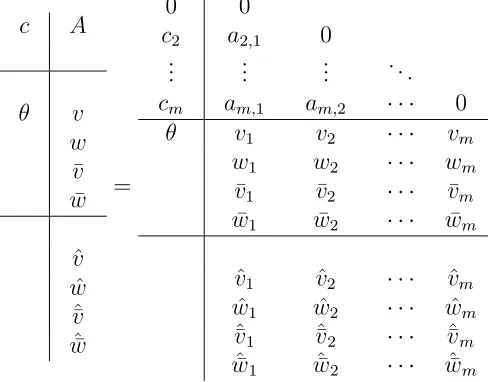
An embedded q(p) pair of TSRKN methods is based on the method (c, A, v, w,¯v,w¯) of order q and the other TSRKN method (c, A,v,ˆ w,ˆ ˆv,¯ wˆ¯) of order p(p < q) which is similar with the embedded pair for one-step RKN derived by Senu et al. [5]. It can also be presented by the following Butcher array:
where c = [c1, c2, . . . , cm]T, A = [aij], θ = 0, v = [v1, v2, . . . , vm]T, w = [w1, w2, . . . , wm]T, ¯v = [¯v1,v¯2, . . . ,v¯m]T, ¯w= [ ¯w1, w¯2, . . . ,w¯m]T, ˆv = [ˆv1, vˆ2, . . . ,vˆm]T,
ˆ
w= [ ˆw1,wˆ2, . . . ,wˆm]T, ˆ¯v =vˆ¯1,vˆ¯2, . . . ,ˆv¯m T and ˆ¯w=wˆ¯1, wˆ¯2, . . . ,wˆ¯m T
Table 1: Embedded m-stage 2-step explicit RKN method c A θ v w ¯ v ¯ w ˆ v ˆ w ˆ ¯ v ˆ¯ w = 0 0
c2 a2,1 0
..
. ... ... . . .
cm am,1 am,2 · · · 0 θ v1 v2 · · · vm
w1 w2 · · · wm
¯
v1 v¯2 · · · v¯m
¯
w1 w¯2 · · · w¯m
ˆ
v1 vˆ2 · · · vˆm
ˆ
w1 wˆ2 · · · wˆm
ˆ¯
v1 ˆv¯2 · · · ˆ¯vm
ˆ¯
w1 wˆ¯2 · · · wˆ¯m
2
Stability of the Method
In this section the linear stability of the TSRKN method will be discussed. By substituting
xi+1 =xi+h, yi+1=yi+hy
i+
h2 2 y
i, y
i+1 =y
i+hy
i
and apply the test equation y = f(x, y) = −λ2y into TSRKN method (2) and (3), we obtain
yi+2 = yi+hy
i +
h2 2
−λ2yi
+h
m
j=1
vjy
i +h
m
j=1
wj
yi+h−λ2yi+
h2 m j=1 ¯ vj
−λ2Yij
+ ¯wj−λ2Yij+1 (8)
yi+2 = yi+h−λ2yi+h
m
j=1
vj
−λ2Yij+wj−λ2Yij+1 (9)
where
Yij+1 = yi+hy
i+
h2 2
−λ2yi
+hcjyi+h−λ2yi+ h2 m s=1 ajs
−λ2Yis+1 (10)
Yij = yi+hy
icj+h2
m
s=1
ajs
−λ2Yis
Multiply equation (9) by h gives
hyi+2 =hyi+h2−λ2yi+h2
m
j=1
vj
−λ2Yij+wj−λ2Yij+1. (12)
The application of the test equation to equation (10) and (11) yields the re-cursion Yi and Yi+1 respectively.
Yi =N−1yie+hyicandYi+1=N−1yie+eH2 +cH+hyi(e+c). Elimination of the auxiliary vectors Yi and Yi+1 in equations (8) and (9) yields
yi+2 = yi
1 + H
2 +Hwe+H¯vN
−1e+wN¯ −1e+ H
2wN¯
−1e+HwN¯ −1c+
hyi1 +ve+we+HvN¯ −1c+wN¯ −1e+wN¯ −1c (13) hyi+2 = yi
H+HvN−1e+HwN−1e+H
2
2 wN
−1e+H2wN−1c
+
hyi
1 +HvN−1c+ HwN−1e+ HwN−1c (14)
with v= (v1, v2, . . ., vm), w= (w1, w2, . . ., wm), v¯= (¯v1,v¯2, . . .,v¯m) andw¯ = ( ¯w1,w¯2, . . .,w¯m) .
The resulting recursion is Zi+2 =D(H)Zi with Zi+2 =
yi+2, hy
i+2
T
and Zi =yi, hyiT
D(H) =
A(H) B(H) A(H) B(H)
with
A(H) = 1 + H
2 +Hwe+H¯vN
−1e+wN¯ −1e+H
2wN¯
−1e+HwN¯ −1c
B(H) = 1 +ve+we+H¯vN−1c+wN¯ −1e+wN¯ −1c
A(H) = H+HvN−1e+HwN−1e+H
2
2 wN
−1e+H2wN−1c
B(H) = 1 +HvN−1c+ HwN−1e+ HwN−1c
whereN=I−HA, H =−(λh)2,c= (c1, . . . , cs)T, e= (1, . . . , 1)T with D(H) is the stability matrix for the TSRKN methods above. The character-istic equation of D can be written as
ξ2−trace(D)ξ+ det(D) = 0 (15)
which is the stability polynomial of the TSRKN method.
Definition 2.1 (Absolute stability interval) An interval (−Ha,0) is called the interval of absolute stability of the method (2) and (3) if for all H ∈
3
Construction of the Method
The ETSRKN4(3) parameters must satisfy the following algebraic conditions as given in Ariffin et al. [9]. These order conditions was obtained in a more elementary way using the Taylor series expansion as proposed by Williamson [10]. Different approach was done by Jackiewicz et al. [7] where they used the theory of Hairer and Wanner [11] in order to derive the TSRK order conditions up to fourth-order. Here are the order conditions for TSRKN methods:
Order conditions fory:
order 1 :
vi+wi = 1 (16)
order 2 :
wi+ ¯vi+ ¯wi =
3
2 (17)
order 3 :
¯
wi+civ¯i =
4 3,
¯
wi+ci(¯vi+ ¯wi) =
4
3 (18)
order 4 :
1 2
¯
wi+c2i¯vi =
2 3, 1 2 ¯
wi+ 2aijv¯i =
2
3, (19)
1 2
¯
wi+c2i(¯vi+ ¯wi) + 2ciw¯i=
2 3,
¯
wi+c2iv¯i+ciw¯i =
4
3. (20) Order conditions fory
order 1 :
vi+wi = 1 (21)
order 2 :
wi+ci(vi+wi) = 2,
wi+civi = 2 (22)
order 3 :
1 2
wi+c2ivi =
4 3,
1 2
wi+ 2aijvi =
4
3, (23)
1 2
wi +c2i(vi+wi) + 2ciwi =
4 3,
wi+c2ivi+ciwi =
8
3 (24)
order 4 :
1 2
wi+ 2aijcivi = 2,
1 6
wi+c3ivi =
2
3, (25)
aijciwi = 0,
1 6
wi+c3i(vi+wi) + 3ciwi+ 3c2iwi =
2
1 2
wi+ciwi+ci2wi+c3ivi = 2,
1 2
wi+ciwi+ 2aijcivi = 2, (27)
1 2
wi+ciwi+c3ivi = 2,
aijcjvi =
2
3 (28)
Paternoster [12] gives the following definition:
Definition 3.1 An m-stage TSRKN method is said to satisfy the following simplifying conditions if its parameters satisfy
m
j=1
aijckj−2 = ck
i
k(k−1), i= 1, . . . , m, k= 1, . . . , q. (29)
Equation (29) allow the reduction of order conditions in the theory of TSRKN methods.
For the fourth-order method, solving simultaneously the equations (16)– (28) together with simplifying assumption (29). It involved 20 equations with 17 parameters and by setting c2, c3 and ¯v3 as free parameters, the following solution of three-parameter family is obtained:
a21 = 1
2c
2
2, a31 = (c 2
2c3−4c2c3+ 2c2 −2c3+ 2c23)c3
2c2(c2 −2) , a32 = −c3(−c2c3+c2+c
2 3−c3)
c2(c2−2) , v1 =−
(−2c3 + 3c2c3−2c2+ 4)
3c2c3 ,
v2 = 3(−1 +2(c3−2)
c2)c2(c3−c2), v3 =−
2(c2−2)
3c3(−c2c3+c2+c23−c3), w1 = 2(−4c3+ 3c2c3+ 6−4c2)
3(−1 +c2)(−1 +c3) , w2 = 0, w3 = 0, ¯
v1 = −[6¯v3c33c2−6¯v3c33+ 12¯v3c23−6¯v3c23c22−6¯v3c23c2−6¯v3c3c2+
12¯v3c3c22+ 11c3c22−15c3c2−6¯v3c3+ 23c2+ 6¯v3c2−6¯v3c22−15c22]/ [6c2(−1 +c2)(−1 +c3)],
¯
v2 = −v¯3c3(−1 +c3)
c2(−1 +c2) ,w¯1 =
−4 + 4c2−3¯v3c3c2+ 3¯v3c23
3(−1 +c2) ,w¯2 = 0,w¯3 = 0. According to Dormand [2], the strategy to choose the free parameter is by minimizing the truncation error coefficients which are defined by
τ(p+1)
2 =
np+1
j=1
τj(p+1)
2
andτ(p+1)
2 =
np+1
j=1
τj(p+1)
2
forynand yn respectively.
Lettingc2 = 56 gives||τ(5)||2in term ofc3. By using the minimize command in MAPLE, ||τ(5)||2 has a minimum value zero at c3 = 39502473. Since TSRKN is a two-step method, we may consider for the case c3 ∈[0,2]. Obtaining the value ofc3 gives||τ(5)||2 in terms of ¯v3. Again, by using the minimize command
||τ(5)||2 has a minimum value zero at ¯v3 = 1457972669558837292647323125. The above obtained
value of the free parameters gives ||τ(5)||2 = 2.925926110901890175 ×10⁻² and||τ(5)||2 = 4.3167507760102019788×10⁻². The stability interval of the fourth-order formula is approximately(-0.1805,0).
For the third-order method, using the same values for aij and ci obtained in the fourth-order method, solving the first four equations forynand the first seven equations foryn simultaneously, the following solution of four-parameter is obtained:
¯
v1 = −15− 33483596115729v¯3,v¯2 =−245 + 420058806115729 ¯v3,
ˆ ¯
v2 = −35−6ˆv¯1+24738862ˆv¯3+ 2686395006115729 vˆ3,
ˆ
w1 = 6− 447732506115729 ˆv3,wˆ2 = 0,wˆ3 = 0,
ˆ¯
w2 = −47402267wˆ¯1+1445702267 +237002267 vˆ¯1− 237002473 ˆ¯v3−4680750006115729 vˆ3,
ˆ¯
w3 = 24732267wˆ¯1− 1508534534 − 123652267 vˆ¯1+ 5ˆv¯3+ 987502473 ˆv3.
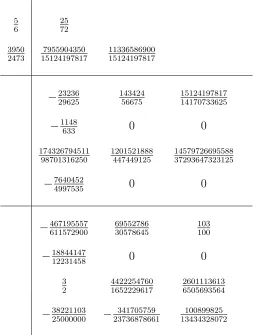
Using the minimize error approach; we obtain the value for all param-eters. By minimizing ||¯τ(4)||2, we obtain the minimum value zero at ˆv3 = 1.0672840388671126404. However, we choose ˆv3 = 103100 and it gives ||τ¯(4)||2 = 3.6354254266897047443×10⁻². Letting ˆv¯1 = 32 and ˆ¯w1 =−3822110325000000, we obtain the value of ˆ¯v3 with||τ¯(4)||2 = 1.8965491105519564054×10⁻². The coefficients in Table 2 are generated using MAPLE where the significant digits is set to 20 by the command Digits.
4
Problems Tested
Below are some of the problems tested:
Problem 1 (Homogeneous) d2y(x)
dx2 =−64y(x), y(0) = 1, y
(0) =−2.
Table 2: Coefficients for ETSRKN4(3) method represented by Butcher array 0
5
6 2572
3950
2473 151241978177955904350 1133658690015124197817
−23236
29625 14342456675 1512419781714170733625
−1148
633 0 0
174326794511
98701316250 1201521888447449125 1457972669558837293647323125
−7640452
4997535 0 0
−467195557
611572900 6955278630578645 103100
−18844147
12231458 0 0
3
2 44222547601652229617 26011136136505693564
−38221103
The first order system: The new variable are y1 =y and y2 =y.
y1 =y2, y2 =−64y1, y1(0) = 1, y2(0) =−2, 0≤x≤50.
Exact solutions are y1(x) = −1/4 sin(8x) + cos(8x), y2(x) = −2 cos(8x) − 8 sin(8x).
Problem 2 (Inhomogeneous)
d2y(x) dx2 =−v
2y(x) + (v2−1) sin(x), y(0) = 1, y
(0) =v+ 1, x≥0, where v 1,0≤x≤50.
Exact solution is y(x) = cos(vx) + sin(vx) + sin(x).Numerical result is for the case v = 10.
Source: van der Houwen and Sommeijer [13] The first order system:
y1 =y2, y2=−100y1+ 99 sin(x), y1(0) = 1, y2(0) = 11, 0≤x≤50. Exact solutions arey1(x) = cos(10x)+sin(10x)+sin(x), y2(x) =−10 sin(10x)+ 10 cos(10x) + cos(x).
Problem 3
d2y1(x)
dx2 +y1(x) = 0.001 cos(x), y1(0) = 1, y
1(0) = 0
d2y2(x)
dx2 +y2(x) = 0.001 sin(x), y2(0) = 0, y
2(0) = 0.9995, 0≤x≤1000
Exact solutions arey1(x) = cos(x)+0.0005xsin(x), y2(x) = sin(x)−0.0005xcos(x) Source: Stiefel and Bettis [14].
The first order system:
y1 = y2, y2 =−y1 + 0.001 cos(x), y1(0) = 1, y2(0) = 0,
y3 = y4, y4 =−y3 + 0.001 sin(x), y3(0) = 0, y4(0) = 0.9995,0≤x≤1000. Exact solutions are
y1(x) = cos(x) + 0.0005xsin(x), y2(x) =−sin(x) + 0.0005xcos(x) + 0.0005 sin(x),
y1 = −y1
(
y21+y22)3
, y1(0) = 1, y1(0) = 0,
y2 = −y2
(
y21+y22)3
, y2(0) = 0, y2(0) = 1, 0≤x≤15π.
Exact solutions are y1(x) = cos(x), y2(x) = sin(x). Source: Dormand et al. [2].
The first order system:
y1 = y2, y2 =− y1 y21+y32
3, y1(0) = 1, y2(0) = 0,
y3 = y4, y4 =− y3 y21+y32
3, y1(0) = 0, y2(0) = 1,0≤x≤15π.
Exact solutions are y1(x) = cos(x), y2(x) = −sin(x), y3(x) = sin(x), y4(x) = cos(x).
Problem 5
d2y(x)
dx2 =−y(x) +x, y(0) = 1, y
(0) = 2,0≤x≤500.
Exact solution y(x) = sin(x) + cos(x) +x. Source: Allen and Wing [15].
The first order system:
y1 =y2, y2 =−y1+x, y1(0) = 1, y2(0) = 2,0≤x≤500.
Exact solutions are y1(x) = sin(x) + cos(x) +x, y2(x) = cos(x)−sin(x) + 1.
Problem 6 (Inhomogeneous System)
d2y1(x)
dx2 = −v
2y
1(x) +v2f(x) +f(x), y1(0) =a+f(0), y1(0) =f
(0),
d2y2(x)
dx2 = −v
2y
2(x) +v2f(x) +f(x), y2(0) =f(0), y2(0) =va+f
(0),0≤x≤100.
Source: Lambert and Watson [16]. The first order system:
y1 = y2, y2 =−16y1+ 16e−10x+ 100e−10x, y1(0) = 1.1, y2(0) =−10,
y3 = y4, y4 =−16y3+ 16e−10x+ 100e−10x, y3(0) = 1, y2(0) =−9.6.
Exact solutions arey1(x) = 0.1 cos(4x)+e−10x, y
2(x) =−0.4 sin(4x)−10e−10x, y3(x) =
0.1 sin(4x) +e−10x, y
4(x) = 0.4 cos(4x)−10e−10x. Problem 7 (Nonlinear System)
d2y1(x)
dx2 = −4x
2y
1− y2
y12+y22
, y1(t0) = 0, y1(x0) =−
π/2
d2y2(x)
dx2 = −4x
2y
2+ y1
y12+y22
, y2(x0) = 1, y2(x0) = 0,
π/2≤x≤50
Exact solutions are y1(x) = cos(x2), y2(t) = sin(x2). Source: Sharp et al. [17].
The first order system:
y1 = y2, y2=−4x2y1− 2y3 y12+y23
, y1(0) = 0, y2(0) =−
√
2π,
y3 = y4, y2=−4x2y3+ 2y1 y21+y23
, y1(0) = 1, y2(0) = 0.
Exact solutions arey1(x) = cos(x2), y2(x) = −2xsin(x2), y3(x) = sin(x2), y4(x) = 2xcos(x2).
5
Implementation and Numerical Results
The set of test problems in section 4 is solved using the new method and the results are compared with the numerical results when the same set of test problems are reduced to first order system twice the dimension and solve using method by Fehlberg [18] and Butcher [19]. For the new method and the existing methods, the next step size is determined by
hnew = 0.4×
T OL 2×LT E
p+1
×hold
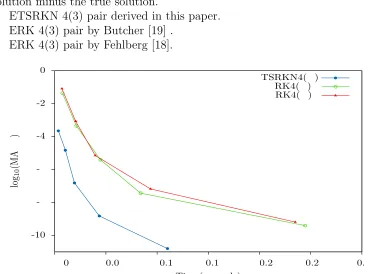
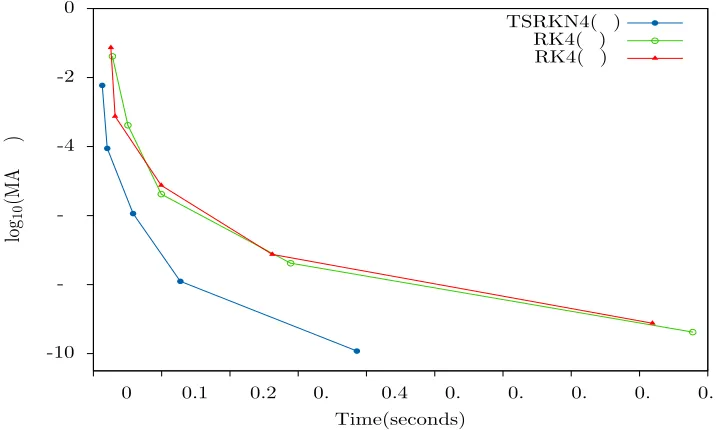
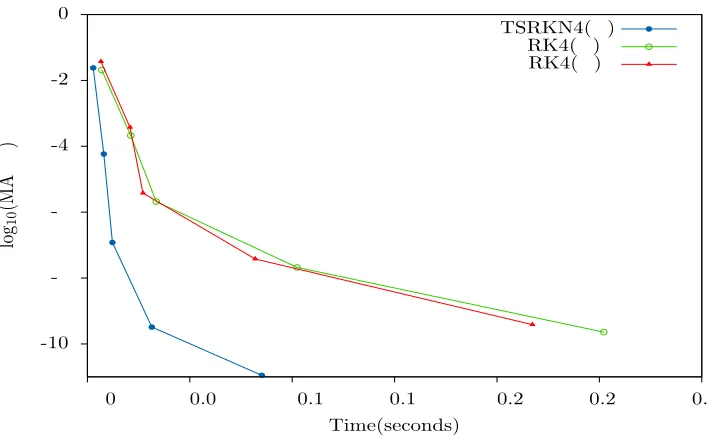
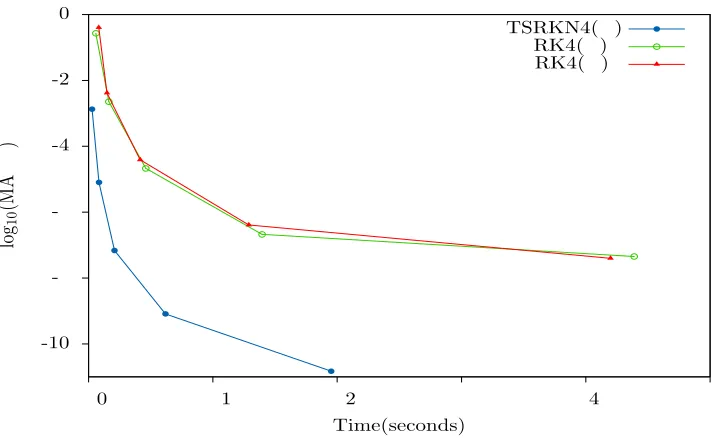
The numerical results are given in Figs. 1-7 and the notations used as follows:
MAXE – maximum global error (maxyn−y(xn)), that is the computed solution minus the true solution.
ETSRKN 4(3) pair derived in this paper. ERK 4(3) pair by Butcher [19] .
ERK 4(3) pair by Fehlberg [18].
RK4( ) RK4( ) TSRKN4( )
Time(seconds)
lo
g10
(MA
)
0. 0.2
0.2 0.1
0.1 0.0
0 0
-2
-4
[image:13.612.109.479.126.400.2]
--10
RK4( ) RK4( ) TSRKN4( )
Time(seconds)
lo
g10
(MA
)
0. 0.
0.4 0.
0.2 0.1
0 0
-2
-4
[image:14.612.117.476.95.313.2]
--10
Figure 2: The efficiency curves of the ETSRKN4(3) method and its compar-isons for Problem 2 with xend= 50
RK4( ) RK4( ) TSRKN4( )
Time(seconds)
lo
g10
(MA
)
0. 0. 0. 0. 0. 0.4 0.
0.2 0.1
0 0
-2
-4
--10
[image:14.612.117.475.410.625.2]RK4( ) RK4( ) TSRKN4( )
Time(seconds)
lo
g10
(MA
)
0.1 0.0
0.0 0.04
0.02 0
0
-2
-4
[image:15.612.114.482.97.313.2]
--10
Figure 4: The efficiency curves of the ETSRKN4(3) method and its compar-isons for Problem 4 with xend= 15π
RK4( ) RK4( ) TSRKN4( )
Time(seconds)
lo
g10
(MA
)
0. 0.2
0.2 0.1
0.1 0.0
0 0
-2
-4
--10
[image:15.612.120.475.407.626.2]RK4( ) RK4( ) TSRKN4( )
Time(seconds)
lo
g10
(MA
)
0.4 0.
0. 0.2 0.2 0.1
0.1 0.0
0 0
-2
-4
[image:16.612.117.479.96.314.2]
--10
Figure 6: The efficiency curves of the ETSRKN4(3) method and its compar-isons for Problem 6 with xend= 100
RK4( ) RK4( ) TSRKN4( )
Time(seconds)
lo
g10
(MA
)
4 2
1 0
0
-2
-4
--10
[image:16.612.120.479.407.626.2]6
Discussion and Conclusion
From Figures 1-7, we observed that ETSRKN4(3) is more efficient when com-pared to ERK4(3)B and ERK4(3)F in terms of computational time. This is due to the fact that when second-order problems is solve using method ERK4(3)B and ERK4(3)F, it has to be reduce to first-order system that is twice its dimension. In terms of global error, ETSRKN4(3) produced smaller error compared to ERK4(3)B and ERK4(3)F for all problems except for prob-lem 4 where ETSRKN4(3) global error is comparable with ERK4(3)B and ERK4(3)F. Thus we can conclude here that ETSRKN4(3) is more efficient than the existing technique where all the special second-order problems are solved directly whereby for other techniques, the problems need to reduce to first-order system of ODEs. Hence less time is needed to solve the same set of problems.
References
[1] P.W. Sharp and J.M. Fine, Some Nystr¨om pairs for the general second-order initial-value problem, Journal of Computational and Applied Math-ematics, 42 (1992), 279-291.
[2] J.R. Dormand, M.E.A. El-Mikkawy and P.J. Prince, Families of Runge-Kutta-Nystr¨om Formulae, IMA Journal of Numerical Analysis, 7(1987), 235-250.
[3] M.E.A. El-Mikkawy and R. El-Desouky, A new optimized non-FSAL em-bedded Runge-Kutta-Nystr¨om algorithm of orders 6 and 4 in six stages,
Applied Mathematics and Computation,145 (2003), 33-43.
[4] Z. Jackiewicz and J.H. Verner, Derivation and Implementation of Two-Step Runge-Kutta Pairs, Japan J. Indust. Appl. Math., 19 (2002), 227-248.
[5] N. Senu , M. Suleiman and F. Ismail, An embedded explicit Runge-Kutta-Nystr¨om method for solving oscillatory problems, Phys. Scr., 80 (2009), 015005 (7pp)
[7] Z. Jackiewicz,R. Renaut and A. Feldstein, Two-Step Runge-Kutta Meth-ods,SIAM J. Numer. Anal,28 (1991), 1165-1182.
[8] J.M. Watt, The asymptotic discretization error of a class of methods for solving ordinary differential equations, Proc. Cambridge Philos. Soc., 61
(1967), 461-472.
[9] L.M. Ariffin, N. Senu and M. Suleiman, A three-stage explicit two-step Runge-Kutta-Nystr¨om method for solving second-order ordinary differen-tial equations, National Symposium on Mathematical Sciences, AIP Conf. Proc. 1522, (2013), 323-329.
[10] R.A. Williamson Numerical Solution of Hyperbolic Partial Differential Equations, Ph.D. Thesis, Churchill College, Cambridge, (1984).
[11] E. Hairer and G. Wanner, Multistep-Multistage-Multiderivative Methods for Ordinary Differential Equations,Computing,11 (1973), 287-303. [12] B. Paternoster, Two Step Runge-Kutta-Nystr¨om Methods for Oscillatory
Problems Based on Mixed Polynomials, P.M.A. Sloot et. al. (Eds): ICCS 2003, LNCS 2658 (2003), 131-138.
[13] P.J. van der Houwen and B.P. Sommeijer, Explicit Runge-Kutta(-Nystrom) methods with reduced phase errors for computing oscillating solutions, SIAM J. Numer. Anal. 24 (1987), 595-617.
[14] E. Stiefel and D.G. Bettis, Stabilization of Cowell’s methods, Numerische Mathematik,13 (1969), 154-175.
[15] R.C. Allen Jr. and G.M. Wing, An invariant imbedding algorithm for the solution of inhomogeneous linear two-point boundary value problems,
Journal of Computational Physics,14 (1974), 40-58.
[16] J.D. Lambert and I.A. Watson, Symmetric multistep methods for periodic initial value problems, IMA Journal of Applied Mathematics, 18 (1976), 189-202.
[17] P.W. Sharp, J.M. Fine and K. Burrage, Two-stage and Three-stage Diag-onally Implicit Runge-Kutta-Nystr¨om methods of orders three and four,
IMA Journal of Numerical Analysis, 10 (1990), 489-504.
[18] E. Fehlberg, Classical Runge-Kutta fourth-order and lower order formulas with step size control and their application to Waermeleitungs problem,
[19] J.C. Butcher,The Numerical Analysis of Ordinary Differential Equations: Runge-Kutta and General Linear Methods, John Wiley & Sons, Great Britain, (1987).