@ IJTSRD | Available Online @ www.ijtsrd.com
ISSN No: 2456
International
Research
Load Frequency
using
M.Tech Scholar, Electrical Engineering Department Yamuna Institute of Engineering & Technology
ABSTRACT
In interconnected power system load frequency control has been used extensively. This study presents an application of a fuzzy gain scheduled proportional and integral (FGPI) controller for load
control of a three-area electrical interconnected p system. The main aim is to design a FGPI controller that can ensure good performance. The paper present analysis on dynamic performance of Load Frequency Control (LFC) of three area interconnected thermal non-reheat power system by the use of Fuzzy Intelligence. The fuzzy rules are developed to ensure there is minimum frequency deviation occur when load is changed. The proposed controller limits the frequency deviations effectively as compared to conventional controller. The results has been verified by using MATLAB/Simulink software.
Keywords: Load frequency control, Classical control, Optimal Control, Adaptive control, Energy storage systems
I. INTRODUCTION
In power systems, active and reactive power flows function independently. Therefore, different control blocks are used to control them. The automatic generation control (AGC) is the major technique for solving this problem [1]. Interconnected electrical power systems operate together adjusting their powe flows and frequencies at all areas by AGC. In this study, a three-area power system is considered to control power flows. A power system has a dynamic characteristic meaning that it can be affected by disturbances and changes at the operating point [2,3] Given that frequencies at the areas and power flows in
@ IJTSRD | Available Online @ www.ijtsrd.com | Volume – 2 | Issue – 4 | May-Jun
ISSN No: 2456 - 6470 | www.ijtsrd.com | Volume
International Journal of Trend in Scientific
Research and Development (IJTSRD)
International Open Access Journal
requency Control in Three Area Power System
using Fuzzy Logic Controller
Nazia Kosser
M.Tech Scholar, Electrical Engineering Department,
Yamuna Institute of Engineering & Technology, Gadhauli, Yamunanagar, Haryana
In interconnected power system load frequency control has been used extensively. This study presents an application of a fuzzy gain scheduled proportional and integral (FGPI) controller for load-frequency area electrical interconnected power system. The main aim is to design a FGPI controller that can ensure good performance. The paper present analysis on dynamic performance of Load Frequency Control (LFC) of three area interconnected thermal reheat power system by the use of Fuzzy telligence. The fuzzy rules are developed to ensure there is minimum frequency deviation occur when load is changed. The proposed controller limits the frequency deviations effectively as compared to conventional controller. The results has been verified
Load frequency control, Classical control, Optimal Control, Adaptive control, Energy storage
In power systems, active and reactive power flows function independently. Therefore, different control blocks are used to control them. The automatic generation control (AGC) is the major technique for solving this problem [1]. Interconnected electrical power systems operate together adjusting their power flows and frequencies at all areas by AGC. In this area power system is considered to control power flows. A power system has a dynamic characteristic meaning that it can be affected by disturbances and changes at the operating point [2,3]. Given that frequencies at the areas and power flows in
tie-lines produce unpredictable load changes and also, generated and demand powers are not equal. Such difficulties are taken care of by AGC systems which are also called load-frequency control (L
being improved over the years [4]. Load frequency control, a technical requirement for the proper operation of an interconnected power system, is very important for supplying reliable electric power with good quality. The goals of the LFC are t
zero steady state errors in a multi
power system and to fulfill the requested dispatch conditions [5]. During last decades, several studies on the load frequency control in interconnected power systems have been presented in
Different control strategies have been suggested based on the conventional linear control theory [6 among others. Since, the dynamics of a power system even for a reduced mathematical model is usually nonlinear, time-variant and governe
couplings of the input variables, the controllers have to be designed with special care [9]. Thus, a gain scheduling controller had been used for nonlinear systems by some researcher e.g. [5]. In this method, control parameters can be cha
parameter estimation is not required, and thus system outputs are obtained faster with higher quality as compared with conventional controllers. However, in the same method, the transient response can be unstable because of abruptness in system parameters. Also, accurate linear time invariant models cannot be obtained at variable operating points [5]. Recently, FGPI controllers have been proposed to solve the above mentioned difficulties in power systems. For
Jun 2018 Page: 32
www.ijtsrd.com | Volume - 2 | Issue – 4
Scientific
(IJTSRD)
International Open Access Journal
trol in Three Area Power System
Yamunanagar, Haryana, India
International Journal of Trend in Scientific Research and Development (IJTSRD) ISSN: 2456
@ IJTSRD | Available Online @ www.ijtsrd.com example, [5] and [10] developed different fuzzy rules for the proportional and integral gains separately and showed that response of power systems can be further improved using fuzzy logic controller [11]. In this study, a FGPI controller was designed with seven triangular membership functions to LFC application in a two-area power system for generating electricity with good quality. In the design of the controller, rules for the gains (Kp and Ki) are chosen to be
identical in order to improve the system performance. Settling times and overshoots of the systems and absolute integral values were utilized as comparison criteria to evaluate the performance of controllers. It was shown that the proposed FGPI controller generally has better performance than the other controllers.
II. INTERCONNECTED ELECTRICAL POWER SYSTEMS
Interconnected power systems consist of many control areas connected by tie-lines. The block scheme of an uncontrolled three-area power system is shown in Fig. 1. All blocks are generally nonlinear, time
and/or non-minimum phase systems [12]. In each control area, the generators are assumed to form a coherent group. Loads changing at operating point affect both frequencies in all areas and tie
flow between the areas [13]. As known that power systems have parametric uncertainties and they must have small oscillations in the magnitude of transient frequency. Their speed control must be taken care of as quickly as possible [12]. The load
control generally is accomplished by two different control actions in interconnected three
systems: (a) the primary speed control and (b) supplementary or secondary speed control actions. The former performs the initial vulgar readjustment of the frequency by which generators in the control area track a load variation and share it in proportion to their capacities. This process typically takes place within 2–20 s. The latter takes over the fine adjustment of the frequency by resetting the frequency error to zero through an integral action. The relationship between the speed and load can be adjusted by changing a load reference set point input. In practice, the adjustment of the load reference set point is accomplished by operating the speed changer motor. The output of each unit at a given system frequency can be varied only by changing its load reference, which in effect moves the speed
characteristic up and down. This control is considerably slower and goes into action only when
International Journal of Trend in Scientific Research and Development (IJTSRD) ISSN: 2456
@ IJTSRD | Available Online @ www.ijtsrd.com | Volume – 2 | Issue – 4 | May-Jun veloped different fuzzy rules
for the proportional and integral gains separately and showed that response of power systems can be further improved using fuzzy logic controller [11]. In this study, a FGPI controller was designed with seven ship functions to LFC application area power system for generating electricity with good quality. In the design of the controller, ) are chosen to be identical in order to improve the system performance. s and overshoots of the systems and absolute integral values were utilized as comparison criteria to evaluate the performance of controllers. It was shown that the proposed FGPI controller generally has better performance than the other
TERCONNECTED ELECTRICAL POWER
Interconnected power systems consist of many control lines. The block scheme of an area power system is shown in Fig. 1. All blocks are generally nonlinear, time-variant minimum phase systems [12]. In each control area, the generators are assumed to form a coherent group. Loads changing at operating point affect both frequencies in all areas and tie-line power flow between the areas [13]. As known that power ave parametric uncertainties and they must have small oscillations in the magnitude of transient frequency. Their speed control must be taken care of as quickly as possible [12]. The load-frequency control generally is accomplished by two different actions in interconnected three-area power systems: (a) the primary speed control and (b) supplementary or secondary speed control actions. The former performs the initial vulgar readjustment of the frequency by which generators in the control area a load variation and share it in proportion to their capacities. This process typically takes place 20 s. The latter takes over the fine adjustment of the frequency by resetting the frequency error to zero through an integral action. The hip between the speed and load can be adjusted by changing a load reference set point input. In practice, the adjustment of the load reference set point is accomplished by operating the speed changer motor. The output of each unit at a given system cy can be varied only by changing its load reference, which in effect moves the speed-droop characteristic up and down. This control is considerably slower and goes into action only when
the primary speed control has done its job. In this case, response time may be of the order of 1 min
Fig. 1. The interconnection scheme of an uncontrolled three-area power system
III. MODELLING OF POWER SYSTEM
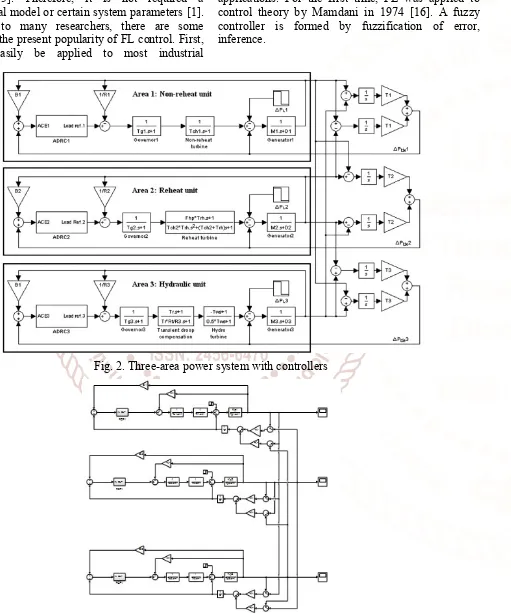
The three-area interconnected power system used in this study is displayed in Fig. 2 where f is the system frequency (Hz), Ri is regulation constant (Hz per
unit), is speed governor time constant (s), T
time constant (s), Tp is power system time constant (s)
and DPL1,2 is load demand increments. The overall system can be modeled as a multi
the following form.
.
( ) ( ) ( )
x Ax t Bu t Ld t
Here A is the system matrix, B and L are input and disturbance distribution matrices, x(t), u(t) and d(t) are state, control and load changes disturbance vectors, respectively.
1 1 1 123, 2 2 2 213, 3 3 3 321
( ) [ g v g v g v ]
x t f P P P f P P P f P P P
1 2 3
( ) [ , , ]T
u t u u u
1 2 3
( ) [ , , ]T
d d d
d t P P P
where ∆ denotes deviation from the nominal values and u1, u2 and u3 are the control outputs in Fig. 2. The
system output, which depends on area control error (ACE) given in Fig. 3, is written as follow:
1 1 2 2 3 3 ( ) ( ) ( ) ( ) ( )
y t ACE
y t y t ACE cx t
y t ACE
123
i i i
ACE P b f
where bi is the frequency bias constant,
frequency deviation and ∆P123
power for area i (i=1 for area 1, i=2 for area 2 and i=3 for area 3) and C is the output matrix [14].
International Journal of Trend in Scientific Research and Development (IJTSRD) ISSN: 2456-6470
Jun 2018 Page: 33 the primary speed control has done its job. In this
me may be of the order of 1 min
Fig. 1. The interconnection scheme of an uncontrolled area power system
MODELLING OF POWER SYSTEM
area interconnected power system used in this study is displayed in Fig. 2 where f is the system is regulation constant (Hz per unit), is speed governor time constant (s), Tt is turbine
is power system time constant (s) and DPL1,2 is load demand increments. The overall as a multi-variable system in
(1)
Here A is the system matrix, B and L are input and disturbance distribution matrices, x(t), u(t) and d(t) are state, control and load changes disturbance
1 1 1 123, 2 2 2 213, 3 3 3 321
( ) [ ]T
g v g v g v
x t f P P P f P P P f P P P (2)
(3)
(4)
∆ denotes deviation from the nominal values are the control outputs in Fig. 2. The system output, which depends on area control error (ACE) given in Fig. 3, is written as follow:
(5)
(6)
is the frequency bias constant, ∆fi is the 123 is the change in tie-line
International Journal of Trend in Scientific Research and Development (IJTSRD) ISSN: 2456-6470
@ IJTSRD | Available Online @ www.ijtsrd.com | Volume – 2 | Issue – 4 | May-Jun 2018 Page: 34
IV. THE PROPOSED CONTROLLER
Originally developed by Zadeh in 1965 fuzzy logic (FL) is today implemented in all industrial systems all over the world. It is much closer in spirit to human thinking and natural language than classical logical systems [15]. Therefore, it is not required a mathematical model or certain system parameters [1]. According to many researchers, there are some reasons for the present popularity of FL control. First, FL can easily be applied to most industrial
applications in industry. Second, it can deal with intrinsic uncertainties by changing controller parameters. Finally, it is appropriate for rapid applications. Fuzzy logic has been applied to industrial systems as a controller in various applications. For the first time, FL was applied to control theory by Mamdani in 1974 [16]. A fuzzy controller is formed by fuzzification of error, inference.
Fig. 2. Three-area power system with controllers
Fig.3. The three-area interconnected power system used in this study
International Journal of Trend in Scientific Research and Development (IJTSRD) ISSN: 2456-6470
@ IJTSRD | Available Online @ www.ijtsrd.com | Volume – 2 | Issue – 4 | May-Jun 2018 Page: 35 Mechanism and defuzzification levels. Therefore, an
analog signal is taken from output of the FL controller. For systems, human experts prepare linguistic descriptions as fuzzy rules which are obtained based on step response experiments of the process, error signal, and its time derivative [10]. In general, conventional FL controllers are not suitable for system controlling since they cannot produce reliable transient response. Also, they are unable to decrease steady-state errors down to zero [17]. Thus, a fuzzy gain scheduling PI (FGPI) controller is proposed in this study to maintain load-frequency control in the three-area power system. The main goal of the load-frequency control in the interconnected power systems is to protect the balance between production and consumption [17].
Fig. 4. Rules for input (frequency deviation)
Fig. 5. Rules for input (rate of change of frequency deviation)
Fig. 6. Rules for output (proportional gain)
Fig. 7. Rules for output (integral gain)
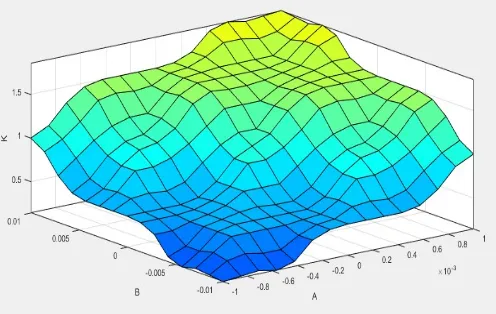
Fig.8 The variations of Ki with respect to e and de, Surface plot
V. RESULTS AND ANALYSIS
The simulations are done on MATLAB/ Simulink environment for the three area control. A step disturbance is considered for the three same areas. With the help of fuzzy controller with twenty five rules, the frequency deviations are set to zero with minimum settling time and overshoot. Fig.8 shows the surface plot of FLC for the variations of Ki with respect to error and derivation of error.
In this model shown by Fig.3, the application of fuzzy controller [3] for load-frequency control in power systems is used. For the same, interconnected power system having three control areas including same turbine units. In the system, non-reheat turbines are used for each area. So, same properties and physical constants of the areas above are considered in the simulation. In the simulation, a step load increment in the three areas of power system is considered [7]. The area control error for each area is controlled with FLC to optimize the integral coefficient and hence to achieve the zero frequency steady state error. The fuzzy model used is Mamdani and bisector is used as defuzzification method. In the decision-making stage, total twenty five rules are used, which are specified by a set of IF–THEN statements [9] define the controller behavior. The fuzzy simulation model in Simulink is shown in Fig. 3.
International Journal of Trend in Scientific Research and Development (IJTSRD) ISSN: 2456
@ IJTSRD | Available Online @ www.ijtsrd.com respectively. The figures also shows the dynamics which are controlled by the FLC to get the steady zero frequency error. From the simulation study, the fuzzy
Fig.9. Plot for change in frequency for Area one
Fig.10. Plot for change in frequency for Area two
Fig.11. Plot for change in frequency for Area three
VI. CONCLUSIONS
In this study, FLC application to three area generation controls is considered for the frequency deviations of each area [7]. The transient behavior of frequency for the load perturbation in areas is studied. In practice, power systems generally have more than three areas and each area is different than others. Because of this,
International Journal of Trend in Scientific Research and Development (IJTSRD) ISSN: 2456
@ IJTSRD | Available Online @ www.ijtsrd.com | Volume – 2 | Issue – 4 | May-Jun figures also shows the dynamics
which are controlled by the FLC to get the steady zero frequency error. From the simulation study, the fuzzy
logic controller is very effective to suppress the frequency oscillations caused by load disturbances.
Fig.9. Plot for change in frequency for Area one
Fig.10. Plot for change in frequency for Area two
Fig.11. Plot for change in frequency for Area three
In this study, FLC application to three area generation controls is considered for the frequency deviations of each area [7]. The transient behavior of frequency for the load perturbation in areas is studied. In practice, than three areas and each area is different than others. Because of this,
in the study, the power systems with three areas that consist of thermal units are considered. The simulation results obtained shows the performance of FLC controller against to the load perturbation at each area in the considered power system. From the analysis, the settling time of controllers was reached in the time region of 9 to 10 seconds and overshoot is very low (0.04 percent of nominal frequency of 50 International Journal of Trend in Scientific Research and Development (IJTSRD) ISSN: 2456-6470
Jun 2018 Page: 36 logic controller is very effective to suppress the frequency oscillations caused by load disturbances.
International Journal of Trend in Scientific Research and Development (IJTSRD) ISSN: 2456-6470
@ IJTSRD | Available Online @ www.ijtsrd.com | Volume – 2 | Issue – 4 | May-Jun 2018 Page: 37 Hz). From the study, the fuzzy logic improves the
system performance by effectively reducing the overshoot. Also the stability of the system was thus maintained effectively by the proposed controller. Decreased settling time in power systems significantly decreases generating cost, providing economical advantages to the consumer and the management. The machines corrosions, used in the system can be stopped by lowered overshoot of the system outputs. Hence, the life of machines and power plants are longer.
References
1) Hassan Yousef, “Adaptive fuzzy logic load frequency control of multi-area power system”, International Journal of Electrical Power & Energy Systems Volume 68, June 2015, Pages 384– 395, January 2015.
2) Anand B., Ebenezer A. Jeyakumar, “Load frequency control with fuzzy logic controller considering non-linearities and boiler dynamics”, ICGST-ACSE Journal, ISSN 1687-4811, Volume 8, issue 111, pp 15-20, 2009.
3) Aravindan P., Sanavullah M.Y., “Fuzzy Logic Based Automatic Load Frequency Control of Two Area Power System With GRC”, International Journal of Computational Intelligence Research, Volume 5, Number 1. pp. 37–44, 2009.
4) P. Kundur, Power System Stability and Control. New York: McGraw-Hill, 1994, pp. 581–623. 5) Mines J. N. 1997. MATLAB Supplement to Fuzzy
& Neural approach in Engineering, John Wiley NY.
6) George-Gross, Lee J.W., “Analysis of Load Frequency Control Performance Assessment Criteria”, IEEE transaction onPower System, Vol. 16, No. 16, pp. 520-525,2001.
7) Nanda J., Kakkarum J.S., “Automatic Generation Control with Fuzzy logic controllers considering
generation constraints”, In Proceeding of 6th Int Conf on Advances in Power System Control Operation and managements, Hong Kong, 2003. 8) Magla A., Nanda J., “Automatic Generation
Control of an Interconnected Hydro- Thermal System Using Conventional Integral and Fuzzy logic Control”, In Proc. IEEE Electric Utility Deregulation, Restructuring and PowerTechnologies.(DRPT2004), Hong Kong, pp. 372-377, 2004.
9) Anand B., Ebenezer A. Jeyakumar., “ Load frequency control with fuzzy logic controller considering non-linearities and boiler dynamics”, ICGST-ACSE Journal, ISSN 1687-4811, Volume 8, issue 111, pp 15-20., 2009.
10) Chatterjee K.. “Design of Dual Mode PI Controller for Load Frequency Control”, International Journal of Emerging Electric Power System. Vol. 11, Issue 4, Article 3, 2010.
11) Demiroren A., Zeynelgil H.L., Sengor N. S., “The Application of ANN Technique to Load-frequency Control for Three- area Power System”, IEEE Porto Power Tech Conference, PPT001, 10th -13th September2001, Porto, Portugal. 2001 12) Nasser Jalleli, Donald N. Ewart, Lester H. Fink,
Louis S. Vanslyck, “Understanding Automatic Generation Control”, IEEE Transactions on power systems, vol. 7, No. 3, August 1992..
13) Gayadhar-Panda, Sidhartha-Panda, Cemal Ardil, “Automatic Generation Control of Interconnected Power System with Generation Rate Constraints by Hybrid Neuro Fuzzy Approach”, World Academy of Science, Engineering & Technology 52, pp543-548. 2009.