International Journal of Emerging Technology and Advanced Engineering
Website: www.ijetae.com (ISSN 2250-2459,ISO 9001:2008 Certified Journal, Volume 3, Issue 5, May 2013)
Enhancing Interoperability among Mobile Apps Using LCIM
Model
R. Hema
1, C. Shanthi
2, R. Madhavarajan
3,Dr. A. Muthukumaravel
41Research scholar, 2,4Assiatant Professor, Department of Computer Science, Vels University, Pallavaram, Chennai
3Quality Analyst, WFM, SERCO, Ambattur, Chennai
Abstract — This paper describes Levels of conceptual interoperability model as the method and model towards enhancing interoperability among mobile apps. The LCIM is used in both descriptive and prescriptive form. In descriptive form LCIM is used to reduce the discrepancies in rating mobile apps based on content by suggesting a rating system that is completely based on interoperability. In the prescriptive form it acts as the guideline for app development, which allows us to produce apps with high level of interoperability.
Index Terms — Mobile apps, interoperability, levels of conceptual interoperability model, descriptive form, prescriptive form, mobile computing, rating.
I. INTRODUCTION
Mobile device continue to increase in the market with improvement in mobile infrastructure, device affordability and cultural acceptance. However there is an unease trend in mobile application. Mobile applications are becoming increasingly focused but the applications are less interoperable. On analyzing all the existing interoperability models, it was found that LCIM model used in systems engineering domain can be tailored to improve the interoperability of mobile apps.
LCIM model not only enhances the interoperability but it also provides a better way to rate the mobile apps. The mobile apps are currently rated based on content. There are no specific approaches to rate the mobile apps on technical terms. Currently many apps that are technically sound are being rejected because of the content they provide. The apps must be grouped based on the content and not rejected. The rating mechanism need to be changed thus comforting the developers. This paper suggests that rating the mobile apps based on interoperability would solve the problem.
The LCIM model of the system engineering domain, is the method and model towards enhancing interoperability among apps. The LCIM is used in both descriptive and prescriptive form.
In descriptive role, the LCIM can be used to describe the levels and properties of interoperability a given app can exhibit that is rate the apps based on interoperability. In the prescriptive role, the model prescribes the methods and requirements that must be satisfied during engineering phases of app development to achieve a desired level of interoperability.
II. INTRODUCING A SYSTEMS ENGINEERING FRAMEWORK FOR APP INTEROPERATION
Systems engineering defines several principles that support the design of systems and documenting their functionality and interfaces in a way ensuring that independently designed systems can interoperate with each other. This section, we will introduce the ideas of conceptual modeling and capturing the resulting artifacts in a systematic way, using the LCIM as the guiding frame, in support of App interoperation.
A. Conceptual Modeling and Interoperability
Zeigler proposed a model for understanding a system that is within another observing system. He proposed three main premises that must be supported and they are, Perception, Meta model and Mapping.
Perception
Observing system must be able to sense the behavior of the system that is being observed.
Meta model
The observing system must have a Meta model of the observed system.
Mapping
International Journal of Emerging Technology and Advanced Engineering
Website: www.ijetae.com (ISSN 2250-2459,ISO 9001:2008 Certified Journal, Volume 3, Issue 5, May 2013)
A conceptual model is the abstract and simplified representation of systems for some specific purpose by languages, figures, tables, or other suitable artifacts. Robinson defines a conceptual model as "a non-software specific description of the simulation model that is to be developed, describing the objectives, inputs, outputs, content, assumptions, and simplifications of the model." [1]
Following Robinsons proposal, conceptual models and conceptual modeling:
Reduce ambiguity, incompleteness, inconsistency, and mistakes in the description of requirements,
Facilitate the communication between stakeholders in modeling and simulation processes, such as users, architects, analyzers, domain experts, modelers, and developers,
Form the basis and start for successive phases (analysis, design, implementation and application), Facilitate the Verification, Validation and
Accreditation (VV&A) of models and systems, and Promote the reusability, interoperability, and
composability of simulation resources.
We can see that conceptualization promotes composability. Composable systems are highly self contained and stateless. Self-contained means that a system can be deployed independently. That is the component will co-operate with other component but the dependant components are replaceable. Stateless means that the components treat the requests from other components independently. The requests are not related to any previous requests.
In order for the apps to interoperate efficiently they must be self contained and stateless, which can be effectively achieved through conceptual modeling. LCIM was chosen as an effective model for enhancing interoperability among mobile apps as it basically depends on conceptual modeling and makes the apps composable. Thus making the apps self contained and stateless.
B. Levels of Conceptual Interoperability Model
LCIM was originally proposed by Tolk and Muguira[2].
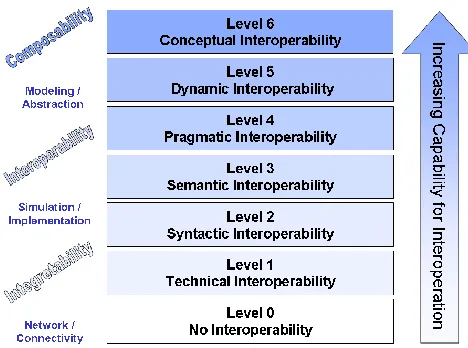
After continuous evolution, it forms the latest version illustrated in Figure 1.
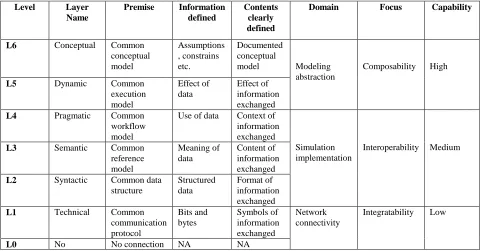
The seven levels from no interoperability‟ to conceptual interoperability‟ are notated from L0 to L6, whose implications are listed in Table 1. Bottom-up refers to from L0 to L6, top-down vice versa.
[image:2.612.331.565.196.370.2]Besides the simulation interoperability community, LCIM is used by scientists of multiple disciplines to deal with problems in their communities, e.g. system biologist and ontology researchers.
Figure 1. The Levels of Conceptual Interoperability Model
III. DESCRIPTIVE AND PRESCRIPTIVE ROLES
Systems engineering distinguishes between explaining (descriptive) and mandating (prescriptive) models. LCIM can serve in both functions[3]: In its descriptive role, LCIM
describes the levels and properties of interoperability existing in a given app. In the prescriptive role, LCIM prescribes the methods and requirements that must be satisfied during the engineering of an app to achieve a desired level of interoperability. Referring to the definitions of descriptive linguistics[4] and prescriptive linguistics[16] in
addition to the definitions of descriptive and prescriptive models by Department of Defense (DoD)[5], the definition
of descriptive and prescriptive roles of LCIM are defined and their relationship is clarified.
A. Descriptive Role
International Journal of Emerging Technology and Advanced Engineering
Website: www.ijetae.com (ISSN 2250-2459,ISO 9001:2008 Certified Journal, Volume 3, Issue 5, May 2013)
Developers must label their applications according to Google Play ratings system, which consists of four levels, Everyone Low maturity, medium maturity, high maturity.
We see that apps submitted to Apple and Google are both classified according to the content they posses. Some of the apps get rejected due to the content they provide even when they provide the users with a lot of technical comfortness. Descriptive form of LCIM allows us to rate them based on interoperability.
Referring to the definition of descriptive model by the DoD[5], we define the descriptive role of LCIM as the role
used to depict or analyze the ability, properties, characteristics and the levels of conceptual interoperability of an existing system or system of systems. In this case, LCIM serves as a documentation and maturity model. The goal of descriptive role is to describe how existing systems are interoperating and what level of conceptual interoperability can be reached by user's specific approaches without prescription. In the descriptive role, LCIM is used to show the gaps that need to be closed.
The characteristics of the descriptive role are listed as:
Real systems or system of systems that have been implemented or existed;
The specific technical approaches, implementations and documentations are known;
LCIM is used as a maturity model. When higher levels are reached, the lower levels must have been satisfied;
The levels are mutual supportive bottom-up. The lower level is the premise of the higher and the higher needs the implementation of lower levels.
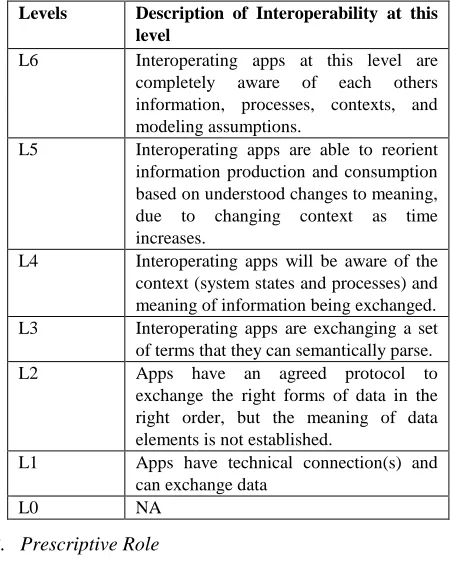
The contents of descriptive role at each level are shown in Table 2.
[image:3.612.66.554.416.667.2]The use and processes of descriptive role describe the documentation, specific approach, and implementation of interoperating systems from L0 to L6 according to Table 2, and evaluate the levels they have reached. If the recommended approaches in Table 3 are used in the implementation, then the systems can be described and judged by referring to the prescription role in Section B.
Table 1 Implication of LCIM
Level Layer Name
Premise Information defined
Contents clearly defined
Domain Focus Capability
L6 Conceptual Common
conceptual model
Assumptions , constrains etc.
Documented conceptual
model Modeling
abstraction
Composability High
L5 Dynamic Common
execution model
Effect of data
Effect of information exchanged
L4 Pragmatic Common
workflow model
Use of data Context of information exchanged
Simulation implementation
Interoperability Medium
L3 Semantic Common
reference model
Meaning of data
Content of information exchanged
L2 Syntactic Common data
structure
Structured data
Format of information exchanged
L1 Technical Common
communication protocol
Bits and bytes
Symbols of information exchanged
Network connectivity
Integratability Low
International Journal of Emerging Technology and Advanced Engineering
[image:4.612.54.279.161.442.2]Website: www.ijetae.com (ISSN 2250-2459,ISO 9001:2008 Certified Journal, Volume 3, Issue 5, May 2013)
Table 2. Descriptive Role of LCIM
Levels Description of Interoperability at this level
L6 Interoperating apps at this level are
completely aware of each others
information, processes, contexts, and modeling assumptions.
L5 Interoperating apps are able to reorient
information production and consumption based on understood changes to meaning, due to changing context as time increases.
L4 Interoperating apps will be aware of the
context (system states and processes) and meaning of information being exchanged.
L3 Interoperating apps are exchanging a set
of terms that they can semantically parse.
L2 Apps have an agreed protocol to
exchange the right forms of data in the right order, but the meaning of data elements is not established.
L1 Apps have technical connection(s) and
can exchange data
L0 NA
B. Prescriptive Role
The mobile apps need to be modeled and implemented in a systematic way so as to increase interoperation among them. The prescriptive form of LCIM guides us to build our app in a systematic way so that the apps reach a high level of interoperability.
Referring to the definition of prescriptive model by DOD, we define the prescriptive role of LCIM as the role used to depict and prescribe the ability, properties, characteristics and the levels of conceptual interoperability of a proposed system or system of systems. In other words, it prescribes the approaches and requirements that must be satisfied to accommodate a target degree of conceptual representation between systems. In this case, LCIM serves as a conceptual interoperability guidance model. The interoperability or real systems may even not exist. As a prescription, LCIM gives users a metric of requirements to reach a certain level of conceptual interoperability.
The characteristics of the prescriptive role are listed as the following:
Real systems or system of systems do not exist or in the phase of conceptual modeling;
As an interoperability guidance model, LCIM can be used to recommend the required conditions and possible engineering approaches to reach a certain interoperability level;
Top-down mappings are needed from conception to implementation. If problems are only dealt with at the conceptual level without any real systems, the lower levels are unreachable until real systems are implemented;
The levels are mutually supportive bottom-up, mapped, and refined top-down. Higher levels need the implementation of the lower. There are much work to do for the mapping from the higher to the lower; Only reaching the higher level is not enough, full
spectrum interoperability at all the levels is needed especially for the prescriptive role of LCIM;
As the development of techniques, the recommended approaches by the prescriptive role are ever changing and evolving and only have relative stability in a certain period.
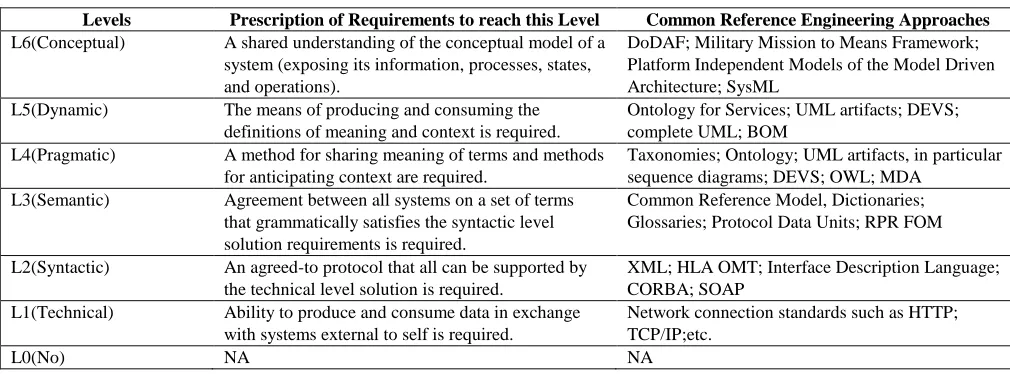
The contents of prescriptive role at each level are illustrated in Table 3. From which Ontology, Unified Modeling Language (UML), Model Driven Architecture (MDA), and Discrete Event System Specification (DEVS) are the important approaches to enhance the conceptual interoperability and composability. The use and processes of prescriptive role are synthesizing and balancing the goal, scheduling, conditions, costs etc., deciding the highest level that should be reached.; determining the information exchange requirements and choosing the proper approaches and data structures, semantics and so on according to Table 3; refining problems and objectives, analyzing and mapping top-down and select approaches at lower levels to guide the design and implementation.
International Journal of Emerging Technology and Advanced Engineering
Website: www.ijetae.com (ISSN 2250-2459,ISO 9001:2008 Certified Journal, Volume 3, Issue 5, May 2013)
C. Comparison and Relationship between Descriptive and Prescriptive Roles
The descriptive and prescriptive roles apply to LCIM through different viewpoints. To reach semantically lossless interoperation, all levels are needed in both cases. Description and prescription have differences and similarities as illustrated in Table 4.
The combinations of the two roles can facilitate better solutions to interoperation and composition problems. There are two kinds of combinations. One is from scratch without any existing and implemented systems. Prescription can be first used with the analysis to the interoperation objectives, costs, conditions and so on. As the refinement and implementation gradually, the descriptive role can be used to evaluate the interoperability of that process. The gaps from reality to objective must be found to facilitate the design and implementation in later processes. The prescription - description - prescription again - description again iterative cycle can be used in this case. The other kind of combination is reuse-based. Some systems or subsystems have existed or been implemented and need to be integrated to reach a certain interoperation goal. The description and evaluation - prescription - objective execution - description - evaluation iterative cycle can be used.
In both cases, LCIM can be seen as the two sides of a coin - one is what exist or have done, the other is what needs to be done.
IV. CONCLUSION
Interoperation is only possible - in a meaningful way - if the technical structures are aligned with the conceptual ideas. As such, the LCIM is a framework describing a spectrum from what is conceptually modeled to how this is technically implemented. It requested that data (entities, propertied concepts) and how they are used (process concepts, methods) and the constraints are described by artifacts following the ideas of system architecture and modeling as known from the domain of system engineering. These descriptions must support the semantic loss-free mediation of viewpoints, as models may differ in scope, resolution, and structure on all levels.
[image:5.612.51.556.480.667.2]By following LCIM the apps can be rated based on interoperability. Apps of different vendors can interoperate efficiently when LCIM is followed while implementation. The vendors must come open minded in allowing their apps to interoperate with third part apps. This allows users to manage their apps more efficiently instead of downloading lots of apps. This also gives users the choice to select apps from different vendors instead of sticking to apps of single vendor.
Table 3. Prescriptive Role of LCIM
Levels Prescription of Requirements to reach this Level Common Reference Engineering Approaches
L6(Conceptual) A shared understanding of the conceptual model of a
system (exposing its information, processes, states, and operations).
DoDAF; Military Mission to Means Framework; Platform Independent Models of the Model Driven Architecture; SysML
L5(Dynamic) The means of producing and consuming the
definitions of meaning and context is required.
Ontology for Services; UML artifacts; DEVS; complete UML; BOM
L4(Pragmatic) A method for sharing meaning of terms and methods
for anticipating context are required.
Taxonomies; Ontology; UML artifacts, in particular sequence diagrams; DEVS; OWL; MDA
L3(Semantic) Agreement between all systems on a set of terms
that grammatically satisfies the syntactic level solution requirements is required.
Common Reference Model, Dictionaries; Glossaries; Protocol Data Units; RPR FOM
L2(Syntactic) An agreed-to protocol that all can be supported by
the technical level solution is required.
XML; HLA OMT; Interface Description Language; CORBA; SOAP
L1(Technical) Ability to produce and consume data in exchange
with systems external to self is required.
Network connection standards such as HTTP; TCP/IP;etc.
International Journal of Emerging Technology and Advanced Engineering
[image:6.612.53.560.156.552.2]Website: www.ijetae.com (ISSN 2250-2459,ISO 9001:2008 Certified Journal, Volume 3, Issue 5, May 2013)
Table 4
Comparisons between the Descriptive and Prescriptive Roles of LCIM
Items Descriptive Role Prescriptive Role Relationship
Purpose Act as interoperability maturity
model to evaluate the
interoperability and composability of existing systems
Act as interoperability guidance model to pre-scribe and guide the interoperability and composability design and implementation of proposed systems
1. Both base on the basic levels and meanings of LCIM
2. Both concentrate on and are limited to the data exchange focus 3. Both have some similar content. 4. Complementarily: Prescription and description are essentially complementary and can be combined for certain purposes. 5. Conflict: Collisions may occur when reality does not conform to expectation, especially when integrating existing systems to system of systems for a certain conceptual interoperability goal. Compelling means may be used by government for these
circumstances.
6. When specific methods described by the descriptive role prevail and are standardized, they may be accepted by the prescriptive role.
Form of objects Existing systems may have interoperability
Proposed systems without interoperability
Stakeholder Users, VV&A users Decision makers and designers
Applicable phase Late phases such as VV&A and after action review etc.
Early phases such as requirements analysis and conceptual design etc.
Utility Evaluate the degree of conceptual
representation between
interoperating systems. Accept and evaluate specific approaches actually used.
Provide a metric of requirements to reach a certain degree of conceptual interoperability. Recommend the required conditions and possible engineering approaches.
Principle Describe what data and how
current systems exchange in practice.
Guide the proposed systems as to how and what data and form should be exchanged.
Content Objectively describe current
interoperability without comments or bias. Accept non-standard and specific approaches.
Prescribe the requirements, rules, recommendations, or avoidable mistakes for systems to reach a certain level. Try to avoid non-standard approaches. Improvements to old standard approaches can be accepted when they are
standardized. Application
Context
Various applications used by private community or individuals. Not constrained by government standards or formal circumstances.
Education, publishing or compulsory formal standards or circumnutates by government sponsors (e.g. The compelling use of HLA standard by DoD)
Process Check and aggregate bottom-up Refine and implement top-down
REFERENCES
[1] Robinson S. "Conceptual modelling for simulation part I: Definition and requirements". Journal of the Operational Re-search Society, 2008, 59:278-290. A. N. Netravali and B. G. Haskell, Digital Pictures, 2nd ed., Plenum Press: New York, 1995, pp. 613-651. [2] Tolk, A. and Muguira, J.A. (2003). The Levels of Conceptual
Interoperability Model (LCIM). Proceedings IEEE Fall Simulation Interoperability Workshop, IEEE CS Press
[3] http://kiwigis.blogspot.in/2011/07/app-interoperability-conundrum.html.
[4] http://blogs.sybase.com/carolynfitton/2011/10/application-interoperability-and-the-mobile-enterprise.
[5] Amitava biswaas and Jagmit singh. Software engineering challenges in new media applications.
[6] Luis Corral, Alberto Sillitti, Giancarlo Succi. Preparing Mobile Software Development Processes to Meet Mission-Critical Requirements.
[7] Florence T. Balagtas-Fernandez. Model-Driven Development of Mobile Applications.
[8] Rawan Tarek Khalil and Ala’ Fathi Khalifeh.System. Design and Software Engineering Challenges in Building an Android Application: a Case Study.
[9] Rajesh Krishna balan, Joao petro souse, Mahadev satyanarayanan. Meeting the software engineering challenges of adaptive mobile applications.
[10] Anthony I. Wasserman. Software Engineering Issues for Mobile Application Development.
International Journal of Emerging Technology and Advanced Engineering
Website: www.ijetae.com (ISSN 2250-2459,ISO 9001:2008 Certified Journal, Volume 3, Issue 5, May 2013)
[12] Tolk A, Muguira JA. "The levels of conceptual interoperability model". Fall Simulation Interoperability Workshop. Orlando, Florida: Simulation Interoperability Standards Organization, 2003. [13] Tolk A, Turnitsa C, Diallo S. "Implied ontological representation
within the levels of conceptual interoperability model". Intelligent Decision Technologies, 2008, 2:3-19. H. Sun, W. Kwok, and J. Zdepski, “Architectures for MPEG compressed bitstream scaling,” IEEE Trans. Circuits Syst. Video Technol., vol. 6, no. 2, pp. 191-199, Apr. 1996.
[14] Wikipedia. "Descriptive linguistics". 2008/2008-07-29. http://en.wikipedia.org/wiki/Descriptive_linguistics.