An Exploratory Study of Dignity with a Conceptual
Model
Anjali Tiwari and Radha. R. Sharma
DOI: 10.29322/IJSRP.9.08.2019.p9278
http://dx.doi.org/10.29322/IJSRP.9.08.2019.p9278 Abstract- The study adopts qualitative research paradigm for
studying the concept of dignity from different perspectives from the Indian workforce. In-depth interviews were conducted with 20 personnel representing different occupations to encapsulate their concept of dignity emanating from their experience. Interesting patterns emerged through content analysis of the interview scripts. Based on the analysis of the results a 3N model of dignity has been developed.
Index Terms- Dignity, Dignity at the workplace, 3N Model, Human Dignity,
I. INTRODUCTION
ignity is a common word frequently used by people, but its connotation is not the same. People often amalgamate the meaning of dignity with self-respect or human rights. Dignity is all about people and is not only intrinsic but also relational and is created between and among people. Most people dismiss and ignore it or pay attention to it despite violence against women like rape, which affect their dignity (Sharma et.al, 2014). Poor working environment, workplace bullying, ill-treatment and harassment, long hours, have a direct relation with dignity and making dignity as a complex phenomenon (Hodson, 2001; Rayman, 2001; TUC, 2003). Dignity has crucial significance that has divided upon—both implicitly and explicitly — just to recognize the environment of labor and work (Bolton 2007; Sayer 2007). Given on emphasizing ILO (1947) placed it on the constitution and positioned it as a fundamental human right. ‘‘All human beings, irrespective of race, creed or sex, have the right to pursue both their material well-being and their spiritual development in conditions of freedom and dignity,
of economic security and equal opportunity". Although putting
Dignity into a definite framework and giving one definition is difficult to work and because of these difficulties, it lacks a specific definition (Lee 2008; Sayer 2007). Therefore, Dignity as a phenomenon is an important area of study as it varies culturally and occupationally. Hodson (2001) connect “Dignity as an ability which helps in establishing a sense of self-respect and
self-worth and to realize the respect of others’’ (p. 3). Lee (2008)
offers a similar definition ‘‘the state of being treated with respect or honor, with a sense of self-worthiness and self-esteem
resulting there from’’ (p. 5). In today’s world when the working
hour and pressure are so high, the employee spent major time either at the workplace or thinking towards work. In this situation
essential situation of dignity is being ‘‘treated as an end in oneself, at least in part, and not merely as a means to someone
else’s ends or as substitutable for someone else’’ (Sayer 2007, p.
568). Despite that achievement of dignity is little difficult as an employee generally got hired for the fulfillment of some instrumental role the achievement of dignity becomes inherently problematic in employment relationships.
Dignity as a word most used in contemporary work. Hodson (2001) identifies four means or practices which contribute towards the experience or denial of dignity at work. These include mismanagement and abuse, overwork, incursions on the autonomy and contradictions of employee involvement.
II. RESEARCH OBJECTIVES
a) To study different perspectives of workplace dignity in the Indian context.
b) To analyze the meaning of dignified person and dignified work in the Indian Context.
III. RESEARCH QUESTIONS
1. How people in different occupations conceptualize and experience dignity.
2. When one calls oneself as a dignified person and one's work as the dignified work.
IV. SAMPLE
After consulting a number of people the following occupations were chosen for sample selection. From these occupations, random sampling was done for the selection of the final sample. Army Personnel, Doctors, Social worker, Businessman, Manager, Student, Acid attack survivor, Contract Waiter, and Labor. A sample of 20 was randomly selected from different occupations. The sample comprised 50% female, 50% male participants. The further breakup, of the female sample constituted 2 doctors, 3 acid attack survivors, 3 students, 2 labors. The male sample comprised of 2 businessmen, 2 managers, 1 waiter at the hotel, 2 social workers, 2 soldiers and one labor from the construction site.
V. PROCEDURE
ISSN 2250-3153
http://dx.doi.org/10.29322/IJSRP.9.08.2019.p9278 www.ijsrp.org
Qualitative research is more suitable when there is a need for unfolding what surrounds a phenomenon (Carson et al., 2001). Interview questions was developed through dignity literature. A set of question got generated and checked by experts, so none of the important factor could be missed. The questions were designed to be open-ended and interviewers had the flexibility to follow-up and probe further using additional non-scripted questions whenever new themes or information appeared. The questions were designed to solicit information related to each of the major content areas of the study. During the beginning of the interview demographic data were collected.
VI. DATA COLLECTION
At the outset, the participants were made aware of the objectives of the study. Their informed consent was taken. Researcher established rapport before the interview and all the respondents were secure that their responses would be held in reserve.
During the interview, researcher asked each participant to identify the most painful part of their life. When permission was granted, interviews were audiotaped. To get into the real context all the interviews were conducted in face to face situation. Each interview lasted for approximately 30 minutes.
VII. ANALYSIS OF RESULTS
KMS uses as a technical/ rational artifact, a depositary system which can be used for codifying, retrieve, store and distribute their knowledge (Alavi & Leidner, 2001). Knowledge management systems (KMS) is a type of information system used by employers to create distributes and utilization of knowledge, which finally could impact on the organizational competitiveness (Alavi & Leidner, 2001; Alavi et al, 2006; Kulkarni et al, 2007). Though, research says up to 70% of KMS does not meet up organisational objectives (Malhotra, 2005). A few studies have shown that culture plays a major role when KMS are deployed outside Western countries (Voelpel & Han, 2005; Ardichvili et al, 2006). These cultural issues are quite common as KMS generally reveal the Western values of the designers(Nonaka & Takeuchi ,1995). Considering the above and keeping in view the importance of context in pursuing the objectives of the study, manual analysis has been conducted by the authors, which was considered to be most appropriate for the largely descriptive interview data. Also, any qualitative software focuses on the words and thereby ignores the context; therefore, the software was not used at this stage. Besides, the aim of the study was to capture the context in the study of dignity and dignified work therefore, context should not be ignored. Thus, for enriching the output, context needed to be captured and this was done through manual analysis.
There are majorly 3 types of content analysis is in use, Conventional, Directed, and Summative content analysis. During
the current study, we rely on conventional analysis; in this case, the aim was to know how one perceives dignity in his/ her work life. Conventional analysis been used mainly in the studies which do not have existing theories and also a limited research . (Kondracki & Wellman, 2002), alternatively allowing the categories and names for categories to flow from the data. Researchers submerge themselves in the data to permit original insights to appear (Kondracki & Wellman, 2002), in addition explained as an inductive category development (Mayring, 2000).
VIII. EVOLVING A CONCEPTUAL MODEL: 3N MODEL OF
DIGNITY
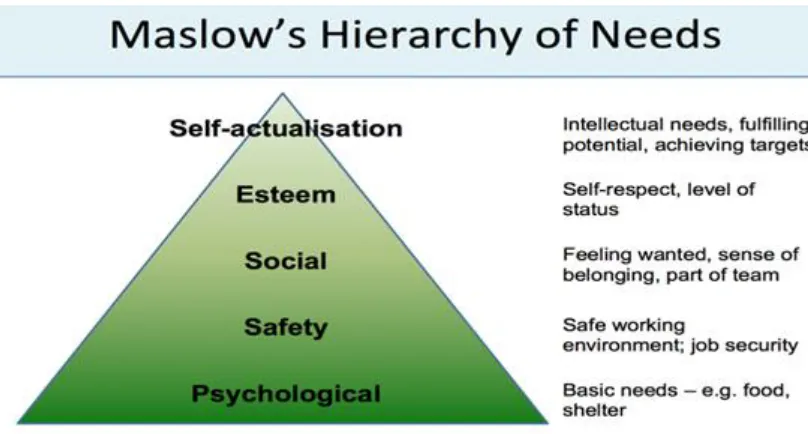
Based on the literature, we identified majorly two types of dignity 1, intrinsic 2, extrinsic (Brennan and Lo, 2007; Hodson, 2001). However, intrinsic one is defined which has no outer connection and extrinsic has defined with the support of the extrinsic environment. The whole interview process was based on these two concepts. All the concept of dignity has been linked with the Maslow' need theory as well. Based on characteristic we divided the 5 basic needs into two parts. Likewise, psychological, social and safety clubs on one group and name as Extrinsic need, the last two as self-actualization and esteem club in one group called as intrinsic dignity. Based on this separation, we re-conducted our interview in a semi-structured way. But after the interview, the whole model changed and emerged as a 3N Model. This model is a pure outcome of interview analysis. Firstly, our data were tabulated; the essence of the interview was conceptualized and coded to draw a meaningful implication regarding the meaning of dignity.
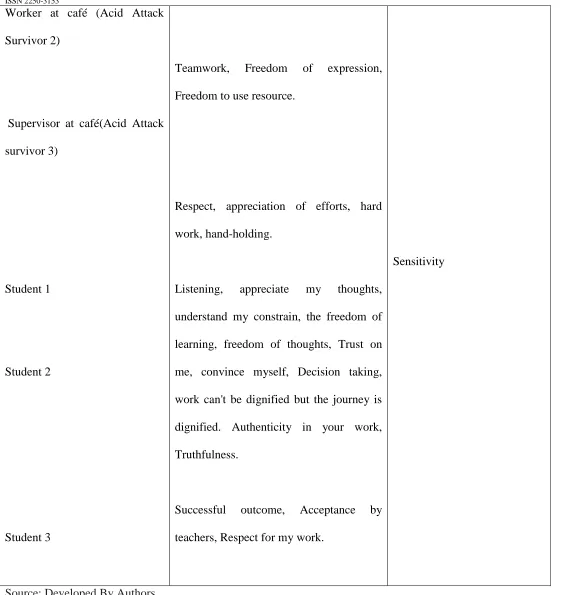
Data Analysis < Insert table 1>
The Outcome of Interview analysis < Insert table 2 >
Themes emerging from the Data <Insert table 3 >
[image:3.612.99.503.55.272.2]
Figure 2
Source: Developed by the authors
IX. DISCUSSION AND FUTURE RESEARCH
The most surprising fact which we got throughout the interview, that dignity is a dynamic word which keeps changing its connotation. Everyone relates dignity with one's current work:
ISSN 2250-3153
http://dx.doi.org/10.29322/IJSRP.9.08.2019.p9278 www.ijsrp.org
vulnerable stage. So the common themes which emerged were equality, in terms of equal pay or equal treatment, trust, happiness, and satisfaction. The results of the exploratory study reveal that culture has been one of the major factors which could give another shade to the definition of dignity. This paves the way for future research in the field of dignity. The study has a sample size as one of the limitations, besides interview as a methodology and cultural context. A larger sample and other methods of data collection would lead to greater generalizability of results. Nevertheless, the study has explored an emerging area of study which is pivotal for the sustainable growth of organizations and the society and had developed a 3N model of dignity.
The whole research has been placed in one culture in another way culture could enrich the color or meaning of dignity, the status in the society may also have an impact on it one needs to search and do further research on it.
X. CONTRIBUTION AND CONCLUSION
When we analyze the data it emerges as three needs and these three needs falls into the Maslow’s hierarchy and there for the contribution of this paper is to convert 5 needs into the three needs. Dignity is an integral part of one's life, but many compounds it with human rights. Kant had a provided philosophical perspective, but it needs to be operationalized for organizations and society. The present study has developed a need-based 3N conceptual model of human dignity. As an area of scholarship, it is at the nascent stage and needs to be explored and developed.
REFERENCES
[1] Alavim., Leidner De. (2001) . Review: knowledge management and knowledge management systems: conceptual foundations and research issues. MIS Quarterly 25,107–136. doi:10.2307/3250961
[2] Alavi, M., Kaywortht, T.R., Leidner, D. E. (2006) . An empirical examination of the influence of organizational culture on knowledge management practices. Journal of Management Information Systems 22(3), 191–224.doi 10.2753/mis0742-1222220307
[3] Ardichvili, A., Maurer, M., Li, W., Wentling, T., & Stuedemann, R. (2006). Cultural influences on knowledge sharing through online communities of practice.Journal of Knowledge Management,10(1), 94-107. doi:10.1108/13673270610650139
[4] Brennan, A. Lo., Y. S. (2007). Two conceptions of dignity: honour and self-determination . Springer
[5] In Malapss, J. and Lickiss, N. (Eds), Perspectives on Human Dignity: A Conversation. Dordrecht:Springer, 43–58
[6] Bulter, J.K.(1991). 'Toward understanding and measuring conditions of trust: Evolution of trust inventory . Journal of Management, 17(3) , 643-663. doi:10.1177/014920639101700307
[7] Bolton, S. C. (2007). Dignity in and at work: why it matters Dimensions of Dignity at Work. Oxford: Butterworth-Heinemann.
[8] Bolton, S. C. (2010). Being human: dignity of labor as the foundation for the spirit-work connection . Journal of Management, Spirituality & Religion, 7 (2), 157–72.doi :10.1080/14766081003746422
[9] Cronbach, L.J., Meehl, P.C., 1995, Construct validity in psychological tests , PsychologicalBulletin,52, .281-302.
[10] Carson, D., Gilmore, A., Perry, C., Gronhaug, K. (2001), Qualitative Marketing Research,London: Sage Publications.
[11] Craven, William G. Giovanni Pico Della Mirandola. Symbol of his Age: Modern Interpretations of a Renaissance Philosopher. Geneve: Librairie Droz,1981.
[12] DeVellis, R.F. (2003). Scale development: Theory and applications (2nd ed.). Thousand Oaks, CA: Sage.
[13] DL. Sunder.(2013).’ Putting dignity at a workplace an corporate agenda ‘Corporate governance. l6, 32-48
[14] “Human Dignity.” The Westminster Dictionary of Christian Ethics. Philadelphia: Westminster Press, 1986.
[15] Hair, J.F., W.C. Black, B.J. Babin, R.E. Anderson, and R.L. Tatham. 2005. Multivariate data analysis, 6th ed. New Jersey: Pearson Prentice Hall. [16] Hodson, R. (2001). Dignity at Work. Cambridge, UK: Cambridge
University Press
[17] Kulkarniur, Ravindrans., Freezer., (2007) A knowledge management success model: theoretical development and empirical validation. Journal of Management Information Systems. 3, 309–347.
[18] Kondracki, N. L., & Wellman, N. S. (2002). Content analysis: Review of methods and their applications in nutrition education. Journal of Nutrition Education and Behavior, 34, 224-230
[19] Lee, M. Y. K. (2008). ‘Universal human dignity: some reflections in the Asian context’. Asian Journal of Comparative Law, 3, 283–313.
[20] Mayring, P. (2000). Qualitative content analysis. Forum: Qualitative Social Research, 1(2). Retrieved March 10, 2005, from http://www.qualitative-research.net/fqs-texte/2-00/02-00mayring-e.htm
[21] Mirandola, Pico della. On the Dignity of Man. Trans. Charles Glenn Wallis. Indianapolis: Bobbs-Merrill Company, 1965.
[22] Malhotra. Y., (2005). Integrating knowledge management technologies in organizational business processes: getting real time enterprises to deliver real business performance. Journal of Knowledge Management .1, 7–28. [23] Nonka.I., Takeuchi.H. (1995) The Knowledge-Creating Company. , New
York.:Oxford University Press.
[24] Suff.P., Strebler.M .(2006). Bulling and harassment building a culture of Dignity and respect.Institution for employment study.Retrieved From [25]
http://www.employment-studies.co.uk/system/files/resources/files/mp59.pdf
[26] Sayer, A. (2007). Dignity at work: broadening the agenda. Organization, 14, 565–81.
[27] Sayer, A. (2009). Contributive justice and meaningful work. Res Publica, 15, 1–16.
[28] Sharma , Radha R.; Pardasani, R. & Nandram, S. 2014.The problem of rape in India: a multi-dimensional analysis International Journal of Managing Projects in Business7:3 , 362-379
[29] Suleman R., Nelson B. (2011). Motivating the millennials: Tapping into the potential of the youngest generation. Leader to Leader. 62, 39-44. [30] Voelpel.S., Hanz (2005) Managing knowledge sharing in China: the case of
Siemens ShareNet. Journal of Knowledge Management .3, 51–63.
Occupations
Description
Codes
Social worker 1.
Social worker 2.
Businessmen 1
Businessmen 2
Manager 1
Manager 2
Army personnel 1
Making yourself Proud, Self-motivation,
Social
justice,
Righteousness,
The
importance of once life,
Achieve it from others, continuous
improvement, earn your self-respect, hard
work pay, Society enrichment.
Respect in other eyes, Satisfaction, Seeing
others happy, Family happiness.
Gain respect, big empire, More employees,
output achievement, Spending more on
CSR activities. The accomplishment of
mission and vision
Self Trust, Peer group Trust, Acceptance,
Appreciation, integrity.
Supervisor
Trust,
Acknowledgement,
Target Achievement.
Code of conduct, Pride in Nation Flag,
Nations Welfare, Fight for the nation,
Wholesomeness.
Satisfaction
ISSN 2250-3153
www.ijsrp.org
Army Personnel 2
Waiter
Labor 1
Labor 2
Labor 3
Doctor 1
Doctor 2
Manager at café (Acid Attack
survivor 1)
Support system at the time of emergency,
Save society, respect within and outside
organization.
Persuade
promise,
full
payment,
Respectful behavior, timely payment.
365 days of work, full money, shelter,
nutritious food.
Break during the work, get the opportunity
to feed our children, some freedom, equal
pay.
Equal job opportunity, shelter, respect.
It’s a two way process, patient satisfaction,
respect in the eyes of the patient.
Successful treatment gives us immense
pleasure and happiness, the joy of giving,
delightful experience.
Acceptance of your decision, Equality, get
an opportunity to work together, a sign of
acceptance,
Job opportunity, acceptance of our
services, equal pays for equal work,
learning opportunity.
Empathy
Fair-minded
Happiness
Worker at café (Acid Attack
Survivor 2)
Supervisor at café(Acid Attack
survivor 3)
Student 1
Student 2
Student 3
Teamwork,
Freedom
of
expression,
Freedom to use resource.
Respect, appreciation of efforts, hard
work, hand-holding.
Listening,
appreciate
my
thoughts,
understand my constrain, the freedom of
learning, freedom of thoughts, Trust on
me, convince myself, Decision taking,
work can't be dignified but the journey is
dignified. Authenticity in your work,
Truthfulness.
Successful
outcome,
Acceptance
by
teachers, Respect for my work.
Sensitivity
[image:7.612.31.612.49.644.2]Source: Developed By Authors
ISSN 2250-3153
www.ijsrp.org
Occupation
Army Personnel
Social worker
Businessmen
Manager
Waiter
Labor
Doctors
Acid Attack survivor
Students
Emerged Themes
Pride
Wholesomeness.
Satisfaction
Credence
Empathy
Fairness
Happiness
Acceptance
Sensitivity
Themes emerging from the Data
Source: Developed By Authors
Maslow’s Need
Themes
Occupation
Needs/
Dignity
Self-Actualization
Esteem
Social
Safety
Psychological
Pride, Wholesomeness
Satisfaction,
Credence,
Sensitivity.
Fair-Minded,
Empathy,
Adoption
Army personnel, Social
Worker
Managers,
Doctors,
Businessmen,
Student.
Acid Attack survivor,
Labor, Contract waiter.
Noble
NETHER
ISSN 2250-3153