ODMP: A new Overlay Dynamic Multicast Protocol
framework
Prof Prashant B Kumbharkar
*, Dr Trimbak R Sontakke
** *Research Scholor (PhD), JJT University, Gram Chudella Churu Bishau Rd., Dist – Jhunjhunu Rajastan -333001
**
Research Guide, JJT University, Gram Chudella Churu Bishau Rd., Dist – Jhunjhunu Rajastan -333001
Abstract- An increasing number of Peer-to-Peer (P2P) Internet applications rely today on data dissemination as their cornerstone, e.g., audio or video streaming, multi-party games. These applications typically depend on some support for multicast communication, where peers interested in a given data stream can join a corresponding multicast group. As a consequence, the efficiency, scalability, and reliability guarantees of these applications are tightly coupled with that of the underlying multicast mechanism.
At the network level, IP Multicast offers quite good efficiency and scalability but best-effort reliability only. Moreover, the deployment of IP Multicast requires all routers to be appropriately configured, which makes it quite impractical in large scale or open settings, i.e., where one does not have full control over the networking environment. For this reason, several research directions have focused on trying to offer some form of multicast communication at a higher level, typically via an application-oriented middleware. Such a higher level data dissemination support is often referred to as Application Layer Multicast (ALM) Multicasting provides an efficient way of delivering data from a sender to a group of receivers.
Recent application-layer multicast and overlay multicast approaches provide a new way of handling multicast without upgrading the infrastructure in a large scale. Meanwhile, they introduce a number of challenges and are still plagued with concerns pertaining to scalability, deployment, heterogeneity and dynamic performance. In this paper we propose a new protocol framework for relieving these issues, so-called the Overlay Dynamic Multicast Protocol or ODMP, which intends to provide an efficient and reliable multicast support by dynamically managing an overlay core comprised of end hosts.
Index Terms- Overlay, multicast, end host, application layer multicast, media streaming
I. INTRODUCTION
ith the wide deployments of broad band technologies and due to the insufficient infrastructure support of IP-Multicast, tremendous amount of work has been carried out on building application-layer multicast systems for providing end users the media streaming service. According to their overlay structures, existing works could be classified as tree-like systems and mesh like systems. The former ones include ESM NICE ,SCRIBE and Zigzags. In these systems, nodes are organized in a spanning tree, and the media data are pushed from parent node to child nodes. For fully utilizing nodes’ bandwidths, systems
containing multiple trees are also designed, such as CoopNet, Split Stream, and Chunky spread. On the other hand, data driven- based mesh-like overlays have been proposed recently for media multicasting, examples include Cool- Streaming and PRIME, and many successful commercial applications such as PPLive also adopts this mesh-like design. Compared with the tree-like design, the mesh-like overlay is more resilient against node failures, but it incurs additional control overhead with the data-driven technique.
In ALM approach, end hosts form a virtual network, and multicast delivery structures are constructed on the top of this virtual overlay network. A basic ALM approach is to form and maintain an overlay for data transmission, where all end hosts in a multicast session are involved without considering the heterogeneities of them, e.g. computation power, bandwidth and access possibilities. For instance, all end hosts join the full mesh construction of ESM (Narada) [4] and multiple connections exist between any two nodes. The main advantage of constructing such a mesh is the easy implementation and being relatively stable, i.e. it can recover quickly from faults. Unfortunately, the mesh maintenance introduces a very high control overhead (O(2N ) where N is the number of group members) because each node must keep the information of the whole group or at least most of group.
Observing the weaknesses from ALM approaches, an alternative approach – overlay multicast or OM, by using a kind of “infrastructure-based” solution, has been proposed to implicitly gain the underlying network information. Proposals of such an approach include OMNI [3] and TOMA [7]. Generally, overlay multicast relies on intentionally placed infrastructure nodes (instead of end hosts) in the network like overlay proxies or MSNs to implement the functionalities similar to IP multicast routers. These intermediate nodes can then obtain and utilize the knowledge about the underlying network topology to optimize the overlay routing path. The design issues of OM can be summarized in the following two aspects:
On the one hand, OM approaches employ these fixed or long-term infrastructure-based nodes to simplify membership management and multicast tree construction. This advantage can become a weakness, too, since the assumption of these fixed nodes in the infrastructure limits the extensibility and flexibility of deployment. Before constructing trees to be adaptive to a different metric, the infrastructure must be re-established based on other long-term measurements.
On the other hand, the locations of these intermediate nodes and the status of the overlay links among them are crucial to the overlay construction and maintenance. However, it is not realistic to conjecture the locations of each newly joining member; hence
it cannot ensure that the selected node can provide optimal connections for the new member. That is, TOMA and OMNI need dedicated infrastructure deployment and costly server, which could not be adaptive to dynamic network changes and group member changes. Therefore, it is relatively difficult to implement them into the current Internet environment although they are proposed to provide multicast support for group communication applications. Obviously, to develop a practical, efficient and reliable multicast framework is the exclusive way to wide deployment of multicasting services.
Strongly motivated, in this paper, we present a new overlay multicast framework which manages a dynamic mesh-based overlay core where involves only participating end hosts without relying on the availability of the OM-aware infrastructure nodes, while providing certain degree of efficiency, reliability and resilience. The remainder of the paper is structured as follows. Section 2 gives a brief overview about ODMP framework. Section 3 further analyzes the properties of ODMP. Then, section 4 discusses the performance metrics used in application level multicast. Finally, section 5 concludes with a brief summary and future work.
II. FRAMEWORKOVERVIEW
Different from aforementioned application level multicast protocols, the Overlay Dynamic Multicast Protocol(ODMP) approach presented in this proposal attempts to support large-scale groups without relying on any predefined intermediate nodes. In this approach, the overlay multicast mesh is solely constructed and maintained by end hosts. In addition, ODMP is designed to be suitable for real-time media streaming applications, which represents a substantial group of user applications such as IPTV. Therefore, ODMP tries to tackle the twin requirements of bandwidth and delay. Actually, the conjunction with delay and bandwidth guarantees has not been explicitly considered in prior work. To make ODMP a reality, we decouple the proposed solution into the following parts. Firstly, ODMP constructs an on-demand overlay core by which it can achieve the optimal performance. Secondly, ODMP distributes the burden of group management and data delivery to a few nodes instead of the source. Thirdly, the self-organizing protocol scales well to at least hundreds of nodes without sacrificing the quality of the overlay network. Fourthly, ODMP achieves the scalability by limiting group management within locality so that it can dramatically reduce the overhead and complexity of the overlay maintenance. The preliminary ideas of ODMP have been proposed as an Internet draft [8] and currently being discussed in the Scalable Adaptive Multicast Research Group (SAMRG) of the Internet Research Task Force (IRTF) [15]. The following subsections discuss more details about ODMP.
2.1 ODMP architecture overview
Essentially, ODMP can be regarded as a hybrid approach of application layer multicast and overlay multicast, which attempts to support one-to-many real-time media streaming applications over the Internet [8]. Before we explore the details of ODMP, several terms need to be clarified [5] [16]:
1. Out-degree: residual degree, namely, the number of the rest outgoing multicast sessions that a node can establish;
2. Free-rider: an end host which is not able to provide extra out-degree for other members, that, it can only receive multicast service;
3. Rendezvous Point (RP): a server or a proxy to assist managing group members and to store some required information (e.g. performance related);
4. Source: the multicast session sender. It can be either a video stored server or some video distributed servers in one service domain, which delivers the data traffic to the source-based multicast group members. ODMP currently is designed to only provide the source-specific multicast mechanism to realize the single source-based overlay multicast;
5. Uptime: the time duration from a node joining in a multicast session to its leaving the session;
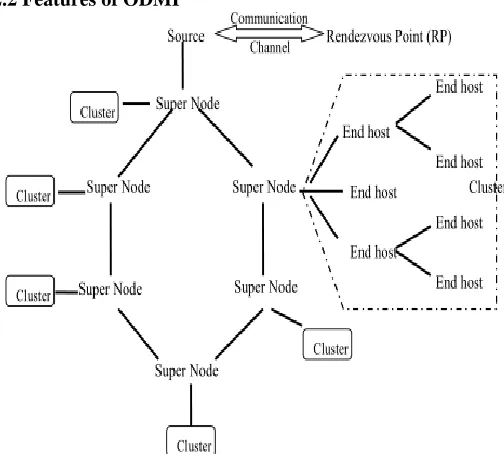
6. Super node: some end hosts are selected to construct and maintain a dynamic overlay mesh which is used to manage the multicast group and relay data from the source to receivers. ODMP employs a two-tier hierarchy consisting of an overlay mesh and some core-based clusters. The key idea behind it is to select a few (presumably higher capability) end hosts (i.e. super nodes) during the multicast initialization phrase and also when group member changes self-organize into an overlay mesh, and dynamically maintain such a mesh. The rest of end hosts select their super nodes according to local policies and service requirements. Based on the mesh, those end hosts sharing the same super node form a core-based cluster. The reason why ODMP limits the membership management in locality is that
network situation changes (e.g., multicast members
joining/leaving) within a certain cluster will not have any impact on other clusters. In this way, the total control overhead can be alleviated. Fig. 1 depicts a simple example of this hierarchy, in which six super nodes construct the overlay mesh. Based on the mesh, some core-based clusters are shaped to connect the super nodes.
Here, a corresponding communication channel between the source and Rendezvous Point (RP) is built by exploiting the existing protocol stacks such as UDP/IP or TCP/IP. The data channels utilize IP unicast according to the underlying IP transport scheme.
Specifically, four phrases are involved in the ODMP architecture construction, detailed descriptions could be found in the draft [8]:
1) after initialization, RP will estimate the out-degree of all end hosts, from which it selects some high out-degree nodes to be super nodes;
2) selected super nodes are then connected in a mesh; 3) each non- super node measures the e2e latency to each of the super nodes and one of them with less e2e latency will be chosen;
2.2 Features of ODMP
Figure 1 An example of ODMP overlay hierarchy
Cluster
Fig:2 Example of Cluster
After having taken a glimpse at the basic primitives of ODMP, its main features, to emphasize the necessity of such a design, are presented as follows.
Support end hosts with heterogeneity It can be used in heterogeneous environments like the Internet as the upper level nodes in the overlay hierarchy are chosen dynamically. In ODMP, it is possible that only a small number of end hosts are selected to construct the overlay mesh when there are a large proportion of free-riders in the group.
Dynamic mesh-based approach
Tree-based overlays are regarded as the most efficient solution for data distribution in a stable network. Nevertheless, lacking of redundant links, an essential characteristic of the tree structure, is not efficient for dynamic scenarios. To address the inherent fragility of trees in dynamic networks, an overlay mesh which connects nodes by multiple paths is introduced in this approach to support efficient and reliable applications.
Efficient data distribution tree
Because overlay multicast networks are built on top of a general unicast infrastructure, the problem of efficiently managing network resources is somehow more difficult than classical networks. Overlay links are built and maintained depending on how well they are utilizing the underlying links. To take advantage of the underlying network, an efficient data delivery tree is constructed upon a mesh and core-based clusters.
Adaptive and resilient to dynamic network changes
The transient nature of the end hosts introduces some issues regarding reliability in an overlay multicast tree. The ungraceful departure of nodes or unexpected network failures may result in data outages on the downstream nodes or even crashes to the whole multicast system. Nevertheless, ODMP is designed to be robust to handle these problems by preventing incapable or transient nodes from staying at the center of the multicast tree. Also it has to note that ODMP could be extended as a pure OM solution when some known designated infrastructure nodes can be used. Previously, there have been several approaches to devise the mesh-based overlay multicast. One example is Scattercast [17], a mesh-based application level infrastructure for content distribution, in which the mesh is first built among multicast proxies by a neighbor discovery protocol. Another example is a mesh-based data dissemination overlay called Bullet [16]. However, to the best of our knowledge, ODMP is the first proposal supporting all the above four features for real-time media streaming applications over the Internet. Thus, our main contributions can be summarized as follows.
1. ODMP considers the heterogeneous capabilities of group members by investigating their available bandwidth. In this framework, high out-degree nodes which are able to and willing to make more contributions to the network are likely to get better performances. So far, they are entitled to having better performances and more responsibilities. Another benefit that ODMP offers makes it an attractive option as this principal we propose here might further augment the available bandwidth for the overlay tree.
2. In addition to supporting heterogeneous end hosts with considering their available bandwidth, ODMP also considers the end-to-end delay for end hosts. While constructing the overlay multicast tree, high-capacity nodes have the priority to stay at the higher level of the tree: this allows us to produce the tree as short as possible and hence the
overall delay can be reduced. Furthermore, it is beneficial to achieve the fast convergence during tree initialization phrase and after dynamic changes.
III. ANALYSISOFODMPPROPERTIES
As known, media streaming is a bandwidth-constraint service and available bandwidth resources may be insufficient for multicast sessions during runtime [9]. It is why we need to consider the out-degree bound in streaming applications, which can be easily observed from the available bandwidth. For example, on the assumption that the bit rate of media is B and the outbound bandwidth of an end host i is b(i), the total number of sessions it can establish is b(i)/B which is also the maximum degree of the end host. The knowledge of available bandwidth in overlay routing is nowadays regarded as acquirable, based on recent advances in avail-bandwidth measurement techniques and tools [10-12]. If an end host’s maximum degree is less than two (<2), the end host can only perform as a leaf node because it can only receive data from incoming sessions. One important aspect of ODMP is the ability to support the heterogeneity of the node capability: currently we take out-degree as the primary capability. Usually, only a small number of nodes can serve in the overlay mesh (non-leaf) nodes, while a large number of hosts can only work as leaf nodes. One question immediately arises: how many non-leaf nodes are required when constructing the overlay multicast tree for a given sized group and a given topology of network? To answer this question, we firstly estimate the required non-leaf nodes which can provide extra out-degrees for other nodes in terms of different group numbers, to form the multicast tree in each cluster. The rest of this section will be organized as follows. Section 3.1 will give an analysis on how it is possible to support end hosts with different capacities. The issue of overall delay optimization with respect to tree depth and out-degree will be discussed in section 3.2. In section 3.3, we show the importance of uptime deployment since ODMP is able to be adaptive and resilient to dynamic network changes. Meanwhile, we will consider the instability caused by dynamic network changes, e.g. end hosts may join/leave the group at will. Another metric in the protocol design, namely the convergence time, will be finally discussed, which covers the session start procedure and dynamic network change scenarios.
3.1. Required number of non-leaf nodes for tree construction
We assume that m end hosts participating in the cluster in which the percentage of end hosts are non-leaf nodes which have average n out-degrees. That is, end hosts could only be performed as leaf-nodes as they can hardly provide extra out-degree for other nodes. These leaf-nodes can just receive the services instead of making some contributions to the network. Thus, according to the overlay construction mechanism of ODMP they are striven to be placed at the bottom as possible. In order to compose a complete overlay multicast tree, the number of multicast sessions for leaf nodes should be no less than
(1-α).m Then, we have k+m.n.α>(1-α).m+α.m It is clear that k>=n
because the super nodes selected based on the selection mechanism of ODMP (as depicted in section 6.2 of [8]) should provide more out-degrees than other cluster members.
Thus,
k+m.n.α>n(1+m.α)
To make (1) come into existence α should satisfy the following inequality:that is,
n(1+m.α)> (1-α).m
Fig.3 Percentage Of Required non-leaf nodes Vs Average out-degree
that is, α>(m-n)/m.n.
Note that α relies on the total number of participants (m) and the average out-degree of non-leaf nodes(n),We show the exact relationship between out-degree and the percentage of non-leaf nodes in fig.3
3.2. The analysis on the tree depth
To reduce the overall delay of the tree, a mechanism could be used in ODMP is to assign nodes with larger out- degree to the higher level in each cluster.
3.2.1 The worst case of tree depth problem
In the worst case, leaf nodes will try to attach to the tree at the higher level so that only one non-leaf node can stay at each level. Theoretically, at least one non-leaf node should stay at each level of the tree; otherwise, it is impossible to support multicast sessions for downstream nodes. For example, the mechanism attaching to the tree without invitation allows nodes to join in the tree once they receive an answer from one of the group members [13]. This approach would create deep graphs with a high worst- case tree depth (m(1-α)/(n-1)) but fast join operations and less cost of tree construction.
3.2.2 The best case of tree depth problem
In contrast to the worst case, the best situation is that all nodes with higher out-degree try to occupy the positions at the higher level of the multicast tree so that all leaf nodes can only be placed at the bottom level. For example, the approach of attaching to the tree with best invitation supposes that a newly joining node waits for all responses from the requested nodes until it finds the best one [13]. This approach would create wide graphs with a low worst-case tree depth
([logn m(1-α) ]) but slow join operations and high cost of tree
construction as well.
between the cost of tree construction and the performance, we need to investigate a new tree construction mechanism for ODMP. For example, a hybrid method of attaching to tree with best invitation and attaching to the tree without invitation might alleviate the cost of construction by sacrificing some performances.
3.3 The impact of uptime
Compared to the network layer multicast, overlay multicast approaches usually are more susceptive to dynamic network changes, e.g., nodes leave the group just after a short time, which are also called transient nodes. ODMP is able to tackle this problem by periodically pushing high-capacity nodes to higher levels of the tree. Then, it is very likely that super nodes and their immediate children are the high-capacity nodes after a certain time. They are placed at the top level of the tree since they have relatively higher capacity, which is an indication of being more stable than low level nodes. In addition, the newcomers who have higher capacities could climb from the bottom to a higher level after some switching phrases. For example, newcomers at the lower level could switch to the higher level if their capacities exceed (over a predefined threshold) their current parent. Here, an appropriate threshold will be defined to avoid unnecessary switching since if the child has a smaller bandwidth support, it will be ultimately placed below the parent.
How can ODMP achieve the above objective? We combine uptime (its definition seen in section 2.2.1) with out-degree as the capacity of the node, to strengthen the maintenance of the overlay hierarchy. The main goal of doing so is to reduce the impacts of frequent changes on the management of memberships, e.g. transient nodes leave the group. Hence, only a small portion of the tree will be affected and needs to be re-constructed after the dynamic changes.
To illustrate the problem in a simple way, it is assumed that the capacity of each host is linear distributed.
Explicitly, we assign the capacity of each end host Ck as follows:
Ck = bk + (bk/m).tk
Where 1<=k<=m
, m is the total number of cluster members, bk is the out-degree of node k.
Once an end host participates in the multicast session, tk
starts to calculate the uptime for this member. When it leaves the group, the tk will be reset as 0.
To show the importance of the uptime explicitly, we apply the expression (7) into the experiment of Fig. 4 In this case, some node may have higher capacity at the beginning due to its higher out-degree (i.e. out-degree=15).
When it leaves the group at time t=30, other nodes, e.g. whose out-degree=10, can exceed its capacity in the end. Moreover, some node may join in the multicast session later but it can also exceed the lower degree node after a certain time. Actually, this is a kind of self-refinement used to achieve the efficiency and reliability of the multicast tree. For example, node with out-degree of 12 joins the group at time t=30 and exceeds the node with out-degree 10 at time t=90 due to its higher bandwidth support. Seen from this simple example, stable nodes
with higher out- degree are likely placed at the higher level regardless of dynamic changes.
Fig.4 An example of the uptime and the capacity of nodes
In above three sections, we have shown the possibility of constructing the overlay multicast tree in ODMP and discussed some performance related factors, e.g. the out-degree, the tree depth and the uptime. Next, we discuss the convergence time which is one of required metrics for protocol designs.
3.4 The analysis on the convergence time
The proposed approach of multicast tree construction should be beneficial not only to satisfy the service requirements, but also to shortening the convergence time [14]. On the assumption that N nodes take part in the multicast group, they have totally n different levels of capacities. Figure 5 An example of the uptime and the capacity of nodes.
Let’s suppose m = 10 and n = 4, where five nodes in this group are free-riders, two nodes have only one out-degree and the rest three nodes respectively have two, three and four out-degrees. If we only select one super node to lead the multicast tree, one of the nodes with highest capacity will be selected as the super node. Here, the node with capacity c = 4 will lead constructing the multicast tree.
Fig. 5 shows two possible constructions, in which five nodes can only act as leaf nodes and each of the rest nodes occupies one certain capacity. Each circle represents one ode and the number inside is the capacity of this node. On the left side (a), it is one of the possible best cases, where all leaf nodes are placed at the bottom level as possible. Comparatively, the worst case is shown in the right side (b). According to the proposed mechanism, the worst case should be that all low-capacity nodes are placed at the high level of the tree.
Fig.5 Possible tree constructions :a) the best case b) the worst case
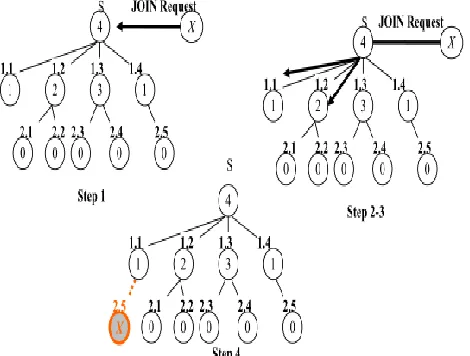
Besides, we need to find out how long will it take for a new joining member to attach into the tree as end hosts may join the group at will, which is another indication of convergence. So far we take Fig. 6 as an example to explore how a newcomer (i.e. node X) can join in the multicast tree.
Fig. 6 An example of a newcomer joining in the multicast tree
Step 1 Firstly, node X sends a JOIN request to the super node S to be its intermediate node.
Step 2 The super node will check the rest of its out-degree. Unfortunately, S, in Fig. 7, has no other possible sessions for X. Step 3 Then, S will check its intermediate children and transfer the JOIN request to one of its children with the largest out-degree. In this example, S will transfer the request to node 1.1 and 1.3 because both of them have additional out-degrees. Step 4 If there are multiple potential parents at the same depth, it chooses the best one in terms of their uptime. Suppose node 1.1 has larger uptime than node 1.3, the newcomer X will accept the JOIN response from the node 1.1. Based on the message exchange procedure, the newcomer finally attaches to the node 1.1 and joins in the multicast tree. Therefore, it takes 2T for X to join in the multicast session.
From this example, we also find that the depth of the multicast tree largely impacts the time of joining procedure. Besides, it turns out that it is important to take the tree depth into consideration during the overlay multicast tree construction. The
analysis on the node leaving procedure is similar to the above example, but is omitted for simplicity reasons.
IV. PERFORMANCEMETRICS
In this section, we analyze the stress, stretch and overhead metrics which are usually used evaluating application level multicast approaches.
Model: Since we are interested in the asymptotic nature of the metrics, we assume a large number of end hosts are densely and uniformly distributed in the network. For a large set of uniformly distributed end hosts, the clusters created by the ODMP protocol will have similar properties, i.e. will have the similar number of cluster members, m, as defined by the protocol.
Stress: Stress is defined as the number of copies of an identical packet sent over a single link. Stretch: as another performance metric. According to its definition, we only consider the maximum stress of ODMP:
Maximum stress = max (Sn, ks)
where Sn is the total number of super nodes and ks is maximum average degree of the super node. The maximum stress of ODMP is greatly smaller than NICE’s since the value of Sn is not large (its maximum size is smaller than hundred) and ks the maximum out-degree of the super node, will not very large (e.g. tens).
Stretch: Stretch is also called Relative Delay Penalty (RDP), defined as below:
RDP = Overlay delay / unicast delay
Consider a member, X located at an arbitrary point in the space, that belongs to one certain cluster Ls of the overlay hierarchy. Let S be the super node of Ls to which X belongs. Then, we assume that average tree depth of ODMP could be calculated as a combination of the worst case and the best case (seen in section 3.2):
davg = A(m(1-α)/n-1) + B(lognm(1-α) )
in which A, B are two parameters used in synthetically computing the average tree depth. We briefly outline due to space constraints. To simplicity, we just assume A = B = 0.5, α =0.9 and each level of the tree depth represents the unit delay. Thus, the average stretch within each cluster could be described as:
Stretchavg=0.2 Sn + 2(1-logn10Sn) and Sn << n
Then,
Stretchavg=0.2 Sn+2
Protocol overhead: Corresponding to the structure of ODMP overlay hierarchy, protocol overhead could be divided into two components: mesh management overhead and cluster maintenance overhead. In ODMP, super node needs to exchange update information with each other at a constant frequency of c1. Besides, each super node takes charge of one cluster in which m cluster members construct a core-based tree. Thus, mesh management overhead on each super node is O(c1(ns + m)). To maintain each cluster and to be adaptive to dynamic changes, cluster members periodically (at the constant frequency of C2)
[image:6.612.61.296.308.486.2]Therefore, the overall overhead on super node is O(C1(ns + m) +
C2K).
V. CONCLUSION
In this paper, we proposed a novel Overlay Dynamic Multicast Protocol (ODMP) framework to overcome some dynamic efficiency and deployment issues with media streaming applications over the Internet.
Under this framework, some selected nodes in a physical region self-organize into an overlay mesh, which is dynamically maintained according to their resource availability and performance. By systematic analysis, we verified that it is possible to construct such an overlay hierarchy for ODMP although there are a large number of free-riders in the network. Secondly, the tree depth has a great impact on the performance of the applications, and hence we construct multicast tree within each cluster as short as possible. To address the instability and unreliability traits of end hosts, ODMP periodically pushes high-capacity nodes to the higher level of the tree. Furthermore, we analyzed the three important metrics for application level multicast, namely, stress, stretch and protocol overhead.
REFERENCES
[1] Bhattacharyya, S., "An Overview of Source-Specific Multicast (SSM)", RFC 3569, July 2003.
[2] Bradner, S., "Key words for use in RFCs to Indicate Requirement Levels", BCP 14, RFC 2119, March 1997.
[3] Almeroth, K., "The evolution of multicast: From the MBone to inter-domain multicast to Internet2 deployment", IEEE Network 2000, Jan./Feb 2000.
[4] Diot, C., Levine, B., Lyles, J., and D. Balensiefen, "Deployment issues for IP multicast service and architecture", IEEE Network 2000, Jan. 2000. [5] Chu, Y., Rao, S., and et. al, "A Case for End System Multicast", IEEE
JSAC Vol. 20, No. 8, October 2002.
[6] Banerjee, S. and B. Bhattacharjee, "Analysis of the NICE Application Layer Multicast Protocol", UMIACS Technical report TR 2002-60 and CS-TR 4380, June 2002.
[7] Banerjee, S., Bhattacharjee, B., and et. al, "Scalable Application Layer Multicast", SIGCOMM 2002, August 2002.
[8] Lao, L., Cui, J., and et. al, "TOMA: A Viable Solution for Large-scale Multicast Service Support", IFIP Networking 2005,May 2005.
[9] Saroiu, S., Gummadi, P., and S. Gribble, "A Measurement Study of Peer-to-Peer File Sharing Systems", MMCN’02 Proceedings of Multimedia Computing and Networking, July 2002.
[10] Sripanidkulchai, K., Maggs, B., and H. Zhang, "An analysis of live streaming workloads on the Internet", SIGCOMM IMC Proceedings of the 4th ACM SIGCOMM IMC, Oct. 2004.
[11] Lei, J., Fu, X., and D. Hogrefe, "DMMP: A New Dynamic Mesh- based Overlay Multicast Protocol Framework", accepted in the 2007 IEEE Consumer Communications and Networking Conference, Workshop on Peer-to-Peer Multicasting (P2PM 2007) Jan. 2007.
[12] Ballardie, A. and J. Crowcroft, "Core based trees (CBT)", ACM SIGCOMM Computer Communication Review, October 1993.
[13] Hu, N. and P. Steenkiste, "Evaluation and Characterization of Available Bandwidth Probing Techniques", IEEE JSAC Special Issue in Internet and WWW Measurement, Vol. 21, No. 6, August 2003.
[14] Tan, G., Jarvis, S., and D. Spooner, "Improving Fault Resilience of Overlay Multicast for Media Streaming", DSN’06 IEEE International Conference on Dependable Systems and Networks, June 2006.
[15] Jain, M. and C. Dovrolis, "End-to-end available bandwidth: measurement methodology, dynamics, and relation with tcp throughput", Transaction’03 IEEE/ACM Transaction on Networking 11 (4), August 2003.
[16] Strauss, J., Katabi, D., and F. Kaashoek, "A measurement of study of available bandwidth estimation tools", IMC’03 Proceedings of ACM SIGCOMM Conference on Internet Measurement, Oct. 2003.
[17] Lo, V., Zhou, D., and et. al, "Scalable Supernode Selection in Peer-to-Peer Overlay Networks", HOT-P2P’05 Proceedings of International Workshop on Hot Topics in Peer-to-Peer Systems 2005, July 2005.
[18] Handler, G. and P. Mirchandani, "Location on Networks: Theory and Algorithms", The MIT Press Cambridge Massachusetts, Mar. 1979. [19] Lynch, A., "Distributed Algorithms", Morgan Kaufmann San Francisco,
April 1997.
[20] Zhi, L. and P. Mohapatra, "HostCast: A New Overlay Multicasting Protocol", IEEE ICC’03 Proceedings of IEEE ICC 2003, June 2003. [21] Banerjee, S., Lee, S., and et. al, "Resilient Multicast using Overlays",
ACM SIGMETRICS 2003, June 2003.
[22] Paul, S. and K. Sabnani, "Reliable multicast transport protocol (RTMP)", IEEE JSAC, Vol. 15, No. 3, April 1997.
AUTHORS
First Author – Prof Prashant B Kumbharkar, B.E,M.E ( Comp
Engg ), Dept of Computer Engg , Siddhant College OF Engineering Pune, [email protected]
Second Author –Dr. Trimbak R Sontakke, B.E,M.E,PhD,