Design and Cost Analysis of PV System Using Nano Solar
Cell
Preeti Bhatt
*, Arunima Verma
** *Department of Electrical Engineering, HBTI, Kanpur, India **
Department of Electrical Engineering, IET, Lucknow, India
Abstract- Photovoltaic is a technical term for generating electricity from light. In the present day scenario of electricity generation, it is fast becoming an important industrial product. Presently the PV market is dominated by wafer based crystalline Si cells, but is hampered by high cost. Nanotechnology is worldwide regarded as a key technology for innovations and technological progress in almost all branches of economy. The paper presents the designing of PV system for a commercial organization to meet its load demand with conventional solar cell and nano solar cell. Moreover, the cost comparison of conventional PV system and nano PV system carried out in this paper shows the superiority of nano solar cells over others in terms of cost and efficiency.
Index Terms- PV System, nano solar cell, grid, nano PV system.
I. INTRODUCTION
he generation of electricity with the ever depleting conventional sources has led to the development of photovoltaic (PV) systems. On an average India receives 6-7 KW/m2 of solar radiant energy for about 300 days in a year [1]. This energy can be harnessed to obtain electrical energy to meet the commercial and domestic load demands. These PV systems utilize solar energy for producing electricity. The efficiency and cost of the conventional PV cells, made from wafer based crystalline Si cells, are low and high respectively. Nevertheless to meet the domestic load demands a comparison between grid system and solar PV (SPV) system have shown the latter to less costly and economically viable [2]. The drawbacks of conventional PV solar cells to some extent have been curbed by nano solar cells [3].
The paper presents the design and cost analysis of nano solar PV system for a commercial building. The comparison of the proposed nano SPV system with the existing systems viz. conventional SPV plant on the basis of cost have also been carried out. The analysis indicates that nano SPV system for a commercial building is an economically viable alternative to conventional SPV system.
II. SOLARPHOTOVOLTAIC(SPV)SYSTEMS
A SPV system generates electrical energy and provides power for different types of devices after storing the energy in a battery bank. [4]. The SPV panel is the fundamental component irrespective of any system configuration. Solar cells are the building blocks of the panel [2]. A complete system includes
different components which are selected taking into consideration individual needs, site location, climate and expectations.
2.1 Major System Components
The functional and operational requirements determine the components to be included in the PV system [3]. The major components incorporated in PV system as shown in Figure 1 are DC-AC power inverter, battery bank, system and battery controller, auxiliary energy sources and sometimes the specified electrical loads (appliances) [3].
Fig.1 Different components of PV system [3]
PV Module – It converts sunlight instantly into DC electric power.
Inverter –It converts DC power into standard AC
power for use in the home, office etc synchronizing with utility power whenever the electrical grid is distributing electricity.
Battery – Battery stores energy when there is an excess coming in and distribute it back out when there is a demand. Solar PV panels continue to re-charge batteries each day to maintain battery charge.
Utility Meter - utility power is automatically provided at night and during the day when the demand exceeds your solar electric power production. The utility meter actually spins backwards when solar power production exceeds house demand, allowing you to credit any excess electricity against future utility bills.
Charge Controller – It prevents battery overcharging and prolongs the battery life of your PV system. In addition, an assortment of balance of system hardware; wiring, over-current surge protection and disconnect devices, and other power processing equipment.
III. DESIGNOFPVSYSTEMFORACOMMERCIAL APPLICATION
To design a PV system for offices the following steps have been considered. The designing depends on the types of load connected, built in area available for the installation of the system, the amount of sunlight available and the availability of fund[5].
Step1 Determination of load
To determine the total load demand, individual ac and dc loads and usage hours of particular equipments or appliances are considered. The total load is calculated using equation (1).
(1)
Step2 Select the battery size
To calculate number of batteries required for battery bank, equations (2-4) is used. The days without sunshine (as monsoon) i.e the days of autonomy are decided. During this period the load is met through the batteries for which the depth of discharge (DoD) of the battery is required to be considered. The battery capacity in Ah in equation (2) is
Now, total number of batteries comprises of number of batteries in series and in parallel. To calculate number of batteries in series, the knowledge of nominal voltage of the battery is necessary as shown in equation (3).
Similarly by knowing the value of Ah of battery, number of batteries in parallel is calculated from equation (4)
Step3 Select the size of solar array
Equations (5-8) provide the size of the PV solar array. The array sizing should be such that it meets the average Ah demand per day needed with the nominal operating voltage. The average Ah per day that has to be supplied by the array to the battery is obtained from equation 5.
Module in parallel can be calculated as
Module in series can be calculated as
Step4 Select the array inclination
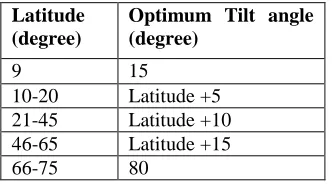
place, for which it becomes necessary to either add or subtract another 10o depending on the season. Table 1 gives the optimum tilt angle at different latitude [6].
Table 1: PV module tilt angle
Latitude (degree)
Optimum Tilt angle (degree)
9 15
10-20 Latitude +5 21-45 Latitude +10 46-65 Latitude +15 66-75 80
Step5 Finally estimate the system design
After carrying out the above calculations including size of battery bank, size of array and array inclination, final estimation of the system design is taken up to connect all the components as shown in figure 1.
3.1Designing and calculations of PV system (Case Study-1)
The commercial building [7], National Thermal Power Corporation (NTPC), Lucknow, considered as a case study, is a very well known organization of the country housed in the northern region. The building is a newly constructed Northern Region Head Quarter (NRHQ) of NTPC organization located at
[image:3.612.86.253.114.206.2]Gomti Nagar in Lucknow, Uttar Pradesh, India. The total load of the commercial building of 269.3318 KWh [7] has been calculated using equation (1). Table 2 gives the total load of the NTPC building including the internal and external load.
Table 2. Load of NTPC, NRHQ Building, Lucknow
Internal load (Wh) 222931.8
external load (Wh) 46400
Total 269331.8
Internal load (W) 24770.2
External load (W) 4640
Total 29410.2
Table 3 provides the different rating values of Battery, PV conventional modules and Nano PV module .These equipments are used for designing the conventional solar PV and nano solar PV systems.
Table 3. Ratings of Different Equipments Used
Battery
Module
(conventional PV)[5]
Module (Nano) [6]
Voltage 12 V Peak power 170W Peak power 170 W Peak power
voltage 31.7A
Peak power
voltage 27 .8V ampere
hours 200Ah
Peak power current 3.8 A
Peak power current 4.3A Open circuit
voltage 43.6 V
Open circuit
voltage 41.1 V Depth of
discharge 0.8
Short circuit current 8.1 A
Short circuit current 5.7 A Max. system
voltage 600 V
Max. system
voltage 1500 V
Efficiency 0.9
Series fuse rating 15A
Series fuse rating 25 A
3.2 Calculation for designing of PV system using conventional SPV module
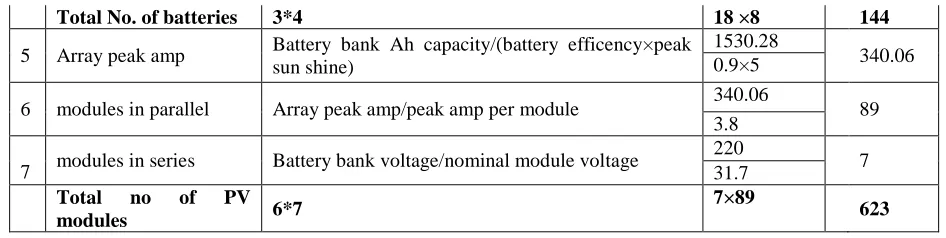
Table 4 shows step wise calculation for battery bank and array size referring equations (2-8) of section2. The rating values provided in table 3 for battery and PV module (conventional) and assumed data given in appendix are used.
Table 4 Calculation of PV system (Conventional module)
1 Battery bank amp/Ah (Avg Wh/day×day of autonomy)/battery voltage 26933.8×1 1224.23 220
2 Final battery bank
capacity Ah Battery bank Amph/DOD
1224.23
1530.28 0.8
3 Batteries in series System voltage /battery voltage 220/12 18
[image:3.612.130.484.385.579.2]Total No. of batteries 3*4 18 ×8 144
5 Array peak amp Battery bank Ah capacity/(battery efficency×peak sun shine)
1530.28
340.06 0.9×5
6 modules in parallel Array peak amp/peak amp per module 340.06 89 3.8
7 modules in series Battery bank voltage/nominal module voltage
220
7 31.7
Total no of PV
modules 6*7
7×89
623
3.3 Calculation for designing of PV system using nano solar PV module
[image:4.612.69.542.55.174.2]The step wise calculation for battery bank and array size for nano solar based PV system using equations (2-8) is provided in table 5. The rating values provided in table 3 for battery and PV module (nano) and assumed data in appendix are utilized for designing.
Table 5 Calculation of PV system (Nano Solar Cell)
1 Battery bank amp/Ah (Avg Wh/day × day of autonomy)/battery voltage
26933.8×1
1224.23 220
2 Final battery bank capacity Ah Battery bank Amph/DOD 1224.23 1530.28 0.8
3 Batteries in series System voltage /battery voltage 220/12 18
4 Batteries in parallel Ah of battery bank/Ah of battery 1530.28/200 8
Total No. of batteries 3*4 18 ×8 144
5 Array peak amp Battery bank Ah capacity / (battery efficiency× peak sun shine)
1530.28
340.06 0.9×5
6 modules in parallel Array peak amp/peak amp per module 340.06 79 4.3
7 modules in series Battery bank voltage/nominal module voltage
220
9 27
Total no of PV modules 6*7 79×9 623
IV. COST ANALYSIS OF CONVENTIONAL SPV AND NANO SPVSYSTEMS
3.1 Data used for cost analysis of SPV Systems
For determining the cost viability of a SPV system, the power requirements of NRHQ, NTPC for internal and external lightings are being considered. The cost analysis is further based on the following configuration.
[image:4.612.69.541.252.437.2]a) The life expectancy of different of PV system are given in table 6 [8]
Table 6 Life expectancy of components
PV module 25 years Regulator 15 year Inverter 10-15 years Solar Battery 5 years Wiring 10 years
b) Financial incentive to investor of SPV plants
Subsidy provided by MNRE is 30% of capital cost of PV system.[8]
Soft loan upto 80% of project cost is provided by IREDA[9]
c) The average number of sunshine days in a year in India is 300 days.
d) The average insulation during the least sunny days is 5.3 kWh/m2 /day in India.
e) The maximum power of each PV panel is 150 Wp.[10] f) Market price of different equipment components of PV
system are:
PV panels @ Rs 150/ Wp {Cost of panel=150×No of cells in panel(72)}[10]
Nano PV panels @ Rs 50/Wp {Cost of panel=50*No of cells in panel(84)}[11-12]
Solar Battery @ Rs 11000/- each 30 KW inverter @ Rs 246000/- each
g) Cost of conventional (grid) power including fix tariff for commercial building is Rs. 9 per unit [7].
i) Annual operation and maintenance (O&M) cost of the system is 0.5% of the capital cost and interest charge [8].
j) Depreciated value is calculated on the basis of sinking fund method and is given by equation (9) [8]
-1] (9)
Where;
r = rate of compound interest per annum =8%
n= number of years over which the total amount of depreciation is to be saved= 25 years
3.2 Cost analysis of SPV system using conventional module.
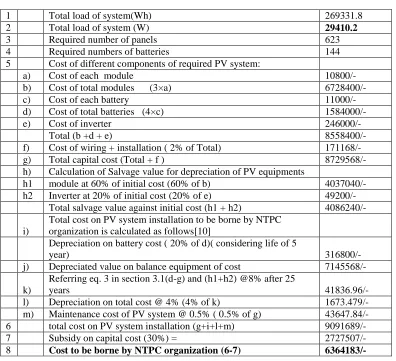
[image:5.612.110.506.186.547.2]Consider data in section 3.1 to calculate the total cost of the SPV system using conventional solar cells. Stepwise cost calculation is shown in table 7.
Table 7 Cost analysis of PV System considering Conventional Solar cell
3.3 Cost Analysis of SPV system using nano module.
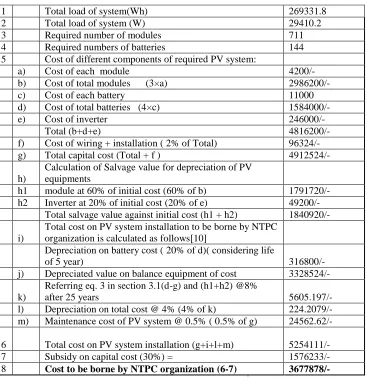
The data in section 3.1 have been utilized in calculating cost of SPV system considering nano solar cells. The cost of module and required data has been collected from a company based in California, USA [11-12]. Stepwise cost calculation is shown in table 8.
1 Total load of system(Wh) 269331.8
2 Total load of system (W) 29410.2
3 Required number of panels 623
4 Required numbers of batteries 144
5 Cost of different components of required PV system:
a) Cost of each module 10800/-
b) Cost of total modules (3×a) 6728400/-
c) Cost of each battery 11000/-
d) Cost of total batteries (4×c) 1584000/-
e) Cost of inverter 246000/-
Total (b +d + e) 8558400/-
f) Cost of wiring + installation ( 2% of Total) 171168/- g) Total capital cost (Total + f ) 8729568/- h) Calculation of Salvage value for depreciation of PV equipments
h1 module at 60% of initial cost (60% of b) 4037040/- h2 Inverter at 20% of initial cost (20% of e) 49200/-
Total salvage value against initial cost (h1 + h2) 4086240/-
i)
Total cost on PV system installation to be borne by NTPC organization is calculated as follows[10]
Depreciation on battery cost ( 20% of d)( considering life of 5
year) 316800/-
j) Depreciated value on balance equipment of cost 7145568/-
k)
Referring eq. 3 in section 3.1(d-g) and (h1+h2) @8% after 25
years 41836.96/-
l) Depreciation on total cost @ 4% (4% of k) 1673.479/- m) Maintenance cost of PV system @ 0.5% ( 0.5% of g) 43647.84/- 6 total cost on PV system installation (g+i+l+m) 9091689/- 7 Subsidy on capital cost (30%) = 2727507/-
Table 8 Cost analysis of PV System considering Nano Solar cell
V. RESULTSANDDISCUSSIONS
The results obtained from the analysis of the cost of conventional SPV and nano SPV system for a commercial
building. Table 10 shows comparison of cost calculation of both systems.
Table 10 Comparison of two systems
Sr. No. System Cost(Rs) Result
2. SPV 6364183 Nano system is better than SPV system
3. Nano 3677878
The cost analysis for two systems has been carried out for 10 years including maintenance cost of the system. From the above calculations, it is evident that to have reliable and power conditioned electric energy supply, the proposed nano SPV system is much more cost-effective than conventional PV systems to meet the load demand of the commercial building in concern. This is because, the cost of nano SPV system installation to be borne by the commercial consumer to meet the load requirement of 269.18 units is less (i.e. Rs. 3677878) than the cost of conventional SPV system to meet the same load demand over a period of 10 years (i.e. Rs. 6364183). Thus, nano
SPV system is an economically viable alternative to both conventional SPV system and grid supply. Besides the SPV system has an advantage over grid system of providing non pollutant electric energy which in the long run will be beneficial for the government and the society as a whole. This clearly establishes the higher efficacy of SPV system over the conventional SPV system to meet the load requirement of a residential building [my paper].
1 Total load of system(Wh) 269331.8
2 Total load of system (W) 29410.2
3 Required number of modules 711
4 Required numbers of batteries 144 5 Cost of different components of required PV system:
a) Cost of each module 4200/-
b) Cost of total modules (3×a) 2986200/-
c) Cost of each battery 11000
d) Cost of total batteries (4×c) 1584000/-
e) Cost of inverter 246000/-
Total (b+d+e) 4816200/-
f) Cost of wiring + installation ( 2% of Total) 96324/- g) Total capital cost (Total + f ) 4912524/-
h)
Calculation of Salvage value for depreciation of PV
equipments
h1 module at 60% of initial cost (60% of b) 1791720/- h2 Inverter at 20% of initial cost (20% of e) 49200/- Total salvage value against initial cost (h1 + h2) 1840920/-
i)
Total cost on PV system installation to be borne by NTPC organization is calculated as follows[10]
Depreciation on battery cost ( 20% of d)( considering life
of 5 year) 316800/-
j) Depreciated value on balance equipment of cost 3328524/-
k)
Referring eq. 3 in section 3.1(d-g) and (h1+h2) @8%
after 25 years 5605.197/-
l) Depreciation on total cost @ 4% (4% of k) 224.2079/- m) Maintenance cost of PV system @ 0.5% ( 0.5% of g) 24562.62/-
6 Total cost on PV system installation (g+i+l+m) 5254111/- 7 Subsidy on capital cost (30%) = 1576233/-
VI. CONCLUSION
In this paper application of renewable energy sources, particularly solar energy, for commercial load demand has been explored in view of the merits of solar energy over other types for such application. From the results it can be concluded that nano SPV system designed for single phase load of NTPC NRHQ building, Lucknow is much more economical as compared to that of conventional SPV system. This makes the consumer independent of paying the recurrent cost to the grid and in turn, also reduces the burden on the electricity grid. A part of the total connected load especially single phase load of the NRHQ building has been considered for analysis purpose, because nano SPV system cannot be utilized for high power load on account of its low conversion efficiency. Such high power loads are still supplied by grid system. To provide a complete stand alone nano SPV system for the three phase load requirement of the whole building, the conversion efficiency is required to be high. In this light, this work can be helpful for the researches to carry out further investigations regarding improvement in conversion efficiency of nano solar cells.
APPENDIX
Assumed data:
Inverter: 30 KW; Day of Autonomy: 1; System Voltage: 220V; Peak Sun Shine: 5
REFERENCES
[1] Dr. M.N.Bandyopadhyay & O.P. Rahi, "Non-conventional Energy Sources", Proceedings of All India Seminar on Power Systems: Recent Advances and Prospects in 21st Century, AICTE, Jaipur, 17 February 2001, pp 1-3.
[2] A. Dey, A.Tripathi, A.Verma & A. Banodha, “Analysis of Solar Photovoltaic(SPV) Systems for Residential Application”, National Journal of The IE(I), vol. 87, May 06, pp 6-9.
[3] Tracy Dahl, “Photovoltaic Power Systems Technology”, White paper, www.polarpower.org, 2004, pp 1-33.
[4] Shirish Sinha, Anand Shukla & Nandita Hazarika, "From Sunlight to Electricity: Solar Photovoltaic Applications", Journal of Tata Energy Research Institute (TERI), New Delhi, 1998.
[5] Parmita Mohanty, “Renewable Energy Engineering and Technology” pp267-327.
[6] Arunima Dey “ Application of Renewable Energy sources for Domestic load”, ME Thesis, MNIT Jaipur, Rajasthan University, December 2001. [7] National Thermal Power Corporation, Lucknow.
[8] Ministry of Nonconventional Energy Resources, http://www.mnre.gov.in. [9] The Indian Renewable Energy Development Agency (IREDA),
http://www.ireda.gov.in.
[10] TATA BP Solar Company, Indira Nagar, Lucknow, www.tatabpsolar.com. [11] Nano Solar Company, www.nanosolar.com .
[12] Neil Savage, “Nanowire Silicon Solar Cell for Powering Small Circuits”, Spectrum IEEE, October 2007.
AUTHORS
First Author – Preeti Bhatt, Department of Electrical
Engineering, HBTI, Kanpur, India
Second Author – Arunima Verma, Department of Electrical