Studying type wet blue tannery process for estimating
environmental performance using the Life Cycle Analysis
methodology: A Case Study in Mexico
Beatriz Padilla-Rizo*, María Maldonado-Santoyo*, Celso Moises Bautista-Rodríguez*, Luz Elena Mora-Maldonado*, Jorge Elias Soto-Maldonado*, Roberto Zitzumbo-Guzmán*, Luz Adriana Arias-Hernández**
*
Dirección de Investigación, Posgrado y Capacitación. CIATEC, A.C. Omega 201, Industrial Delta. León, Guanajuato, México. C.P. 37545
**
Departamento de Ingeniería en Geomática e Hidraúlica. División de Ingenierías Campus Guanajuato. Juarez 77. Zona Centro. C.P. 36000. Guanajuato, Gto.
DOI: 10.29322/IJSRP.8.6.2018.p7855 http://dx.doi.org/10.29322/IJSRP.8.6.2018.p7855
Abstract- In this article the results obtained during a study using the Life Cycle Analysis methodology for the tanning process environmental performance, are reported. This study considered as a total environmental system, the chromium tanning process, and the beamhouse for hide/skin preprocessing. The study uses a functional unit of 1 kg of tanned cowhide produced by the wet blue process. The general procedure incorporated direct indicators including the weight of raw materials, volumetric water and electrical consumption, type of waste generated (recycled, for treatment and/or for disposal), input transportation, and output transportation of tanned leather to local finished. The data was obtained by conducting interviews with local tanneries in Leon, Guanajuato, Mexico. Using these inventory data inputs and outputs of the system, including waste streams, potential impacts on different environmental categories were developed. The team used SimaPro Software and developed models of the ReCiPe Midpoint and Endpoint methods for evaluating environmental impact and damage, respectively. The results show that the beamhouse contributes 0.0352 kg N eq
(93.04%) to marine eutrophication and a loss of 1.22 x 10¹¹ species.yr (59.53%) on freshwater eutrophication while the chrome
tanning stage contributes 1.47 kg Fe eq, and US$0.105 dollar (93.67% of the measured effect) on metal depletion as found from midpoint and endpoint evaluation, respectively. When damage was evaluated, the chrome tanning stage stands out in the depletion of resources contributing 80.43%. In conclusion, it is observed that both the beamhouse and chrome tanning stages present areas of opportunity for improved environmental management.
Index Terms- Tannery, furs, life cycle assessment (LCA), environmental performance measurement, wet blue process.
I. INTRODUCTION
The tanning industry in Mexico is one of the ten largest producers of leather in the world, manufacturing about 4% of the leather produced worldwide. The number of tanneries currently registered nationally is 1056, of this total, 540 tanneries, mainly in the city of Leon, are located in the state of Guanajuato. These Guanajuato based tanneries perform about 75% of tanning and leather finishing production in Mexico. The remaining 25% is divided among the cities of Guadalajara, Monterrey, and Mexico City. Of all registered tanneries in Guanajuato about 70% use the mineral (chromium salt) and remaining use the vegetable tanning process [1, 2].
greater environmental impact due to chromium has particular dangers. The chromium ions that are generated in the wet blue process are much more difficult to treat than the waste products of vegetable tanning. Once the leather from either the wet blue or wet white processes has been washed and dried, it passes to the finishing stage. Here it is subjected to a series of treatments to refine certain physicochemical properties needed in the finished leather products. These treatments are intended to provide upgrades and special properties to either side of tanned hide: the so-called flower (grain) side or the opposite, flesh side. Finishing also gives the leather protection against mechanical damage, moisture, dirt, and resistance to effects of further manufacturing of leather articles. Finishing can also be performed to develop special fashion effects. Additionally, leather finishing is done to remove, or increase the intensity of, unequal dying; to cover hide defects in the flower, or to give certain tactile qualities to the tanned product. Of these three stages, the first two, the beamhouse and chrome tanning, the methodologies are regularly standardized within the tanning industry, while the finishing stage poses the most variation as it is a function of final application of the finished leather product.
In the literature, it is well documented that during each stage a considerable amount of waste, both solid and aqueous, is generated. The major amount of waste and contaminated effluent is created during the beamhouse stage, which includes the activities soaking, liming, fleshing, and splitting, with the main purpose of cleaning the hide, to facilitate the tanning step. Specifically, during hide liming, which is performed to remove hair before tanning, 70% to the organic load in the effluent stream is produced, including all residual sulfides, 45% of the chromium free solid wastes (associated with sebum/grease, flesh, hair, and soluble proteins), 35% of total nitrogen, and approximately 50% of aqueous effluent volume [2-5, 8, 9]. The amount of waste generated in the tanning industry depends on the hide thickness and hide care as well as hair type, which in turn depends on the origin of the hides. Thus during LCA, it is important to consider the type of hide being tanned, since the process may vary (mainly in amount of water consumption and the total pollutant load in the effluent). The most common is bovine hide, followed by sheep and goat hides, while most literature reports results only from manufacturers that process bovine hides [2, 3, 5].
The amount and composition of the waste generated depends on different factors including the tanning technique used; the number, type, and sequence of unit operations (as some are optional), chemical dosage and control of the process variations. Additionally, it can be influenced not only by technical factors and operating formulations (infrastructure, environmental experience of the technical staff, etc.), but also by regional and national economic and social factors prevailing in this industrial sector. And finally, perhaps, by a perceived lack of support for providing external resources that facilitate any desired environmental improvement among tanners [2].
The current environmental impact in Mexico has been magnified by long periods in which waste management has been inadequate at a vast majority of tanneries and similar companies. Their solid wastes are accumulated in their plants and then are sent, in mass, to landfills or mixed municipal dumps. Most managers have to pay for third parties certificates to facilitate final disposal, however, since these wastes are highly bio-degradable, disposal in landfills generate strong, and unpleasant odors, and they can release the toxic chemicals they contain, into the soil or groundwater [3, 10]. Some of these solid wastes (flesh, hair, sebum/grease, hide trims and sludges) may be treated to recover valuable components including proteins (either collagen or keratin), chromium, or oils and fats for energy production [ 2, 3, 5, 11]. In the following section, we highlight some of the, admittedly, limited information about recovery and ways to increase valuation of the waste materials, their treatment and, finally, proper ways to dispose of these solid wastes.
Currently, all wastes from the tannery industry are considered hazardous which forces generators to either collect, confine, and store them on their premises, or transport them for recycling, reuse, or treatment using governmentally authorized companies [2, 11]. Thus governments have put significant pressure on leather producers to develop proper environmental management systems (EMS). These EMS would then direct the proper use and disposal of raw materials and wastes generated at each stage of the overall process. One of the tools commonly used in the EMS is life cycle analysis (LCA), a methodological tool for quantitative analysis to determine the environmental impact of a product, process, or activity [12-15]. It considers all the production phases of the product or process, from extraction of raw materials necessary for manufacture, to the final disposal as waste. However, in some cases, its scope can be reduced to a partial LCA, focused only on specific production phases, or even a single production step. The purpose of LCA in environmental management is the identification and quantification of the inputs and outputs of the process: energy and raw materials used, waste generation (treatment, recycling and disposal) and air, water or soil emissions to the environment [13,14,16]. LCA thus can actively assist in identifying opportunities to improve the environmental performance of products/processes at various stages, providing information for decision making enables the selection of relevant indicators of environmental performance and product marketing [13-15].
According to the methodology described by ISO 14040 and ISO 14044, the LCA process, as an informative tool, can be divided into four main phases: goal and scope of the study, inventory analysis, impact analysis and interpretation of findings. These four phases are not purely sequential, LCA is an iterative informative tool, that allows the user to study operations at increased levels of detail during each successive iteration. The first phase, defining goal and scope, can pinpoint what is to be included in the study (system boundaries, functional unit and the environmental impact categories), in terms of the product system under analysis. The second, inventory analysis, includes data collection and calculation procedures to quantify the inputs (energy, raw- and processing materials) and outputs (products, byproducts/wastes, air and water emissions, and soil discharges). The third stage, impact assessment, is where the organization takes the results of the inventory analysis and classifies them in environmental impact categories. For example,
equivalent (kg CO2 eq). The fourth phase, interpretation, is where the results of the impact assessment are turned into
recommendations and understandable arguments that facilitate decision making to achieve acceptable EMS [13, 17].
Several studies reported in the literature [18-22] show the advantages of using LCA methodologies across different industrial sectors, either to compare processes and/or products, to develop opportunities for process improvement, through cost control, or by learning about relevant environmental indicators and potential damage. Specifically, in the tanning industry, Brugnoli and Kral (2012) conducted a review of methodologies and recommendations in order to understand the carbon footprint to determine the climate change environmental impact. They suggested a functional unit of 1 m2 of finished leather (or 1 kg in the case of leather soles) and the system boundaries in the study to start with the animal being killed in a slaughterhouse and including all activities to prepare and tan the hide finishing the study set as the finished leather exited the tannery. Stages involved in the study included slaughterhouses, producers of chemicals, energy and water suppliers, tanneries, wastewater treatment plants and the waste treatment process [17]. The study by Laurenti et al. (2016) compared the chrome tanning and vegetable tanning processes for 12 tanneries in seven countries (including Mexico). These authors employed as their functional unit 1 m2 of leather (from 1.2 to 1.4 mm thick) and the evaluation compared both processes for total water consumption, energy consumption, and overall carbon footprint, across the various tanneries and processes that were included [7]. A similar study, performed by Zia-Uddin et al. in 2015, compared the environmental burdens in the tanning stage, either with chromium or aluminum use, they also using as their functional unit 1 m2 of leather [16]. They evaluated several environmental categories and resulting damage in their LCA.
Based on the advantages of LCA, this work presents a case study of the wet blue (chromium) tanning process used on bovine hides processed in Guanajuato, Mexico. The study includes an evaluation of several environmental indicators to identify opportunities to improve the environmental performance of this process in local tanneries.
II. METHODOLOGY
A. Objective and scope of the study
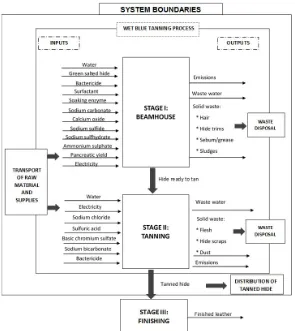
It's the foremost preliminary step for proceeding with any research work writing. While doing this go through a complete thought process of your Journal subject and research for it's viability by following means: The goal was to obtain data on the wet blue tanning process from the tanning industry in Leon, Guanajuato, México. These data would then be used to estimate their environmental performance by preforming a LCA study to assist with the identification of opportunities for process improvement. The functional unit chosen was 1 kg of tanned bovine hide and included the beamhouse stage, the chrome tanning stage, and also considered the transport of raw materials and processing supplies and finally ended with the tanned hide transported to finishers. While the finishing step is important for a better understanding of the totality of a leather tanning, and might be included in the LCA study system, this stage was excluded from our study for the following reasons: i) more than 40% of the tanneries surveyed only carried their process through the tanning step before the leather was sold to others for finishing and, ii) companies that performed all of the process stages exhibited great variability in their methods for finishing the tanned hides, including significant differences in inputs and equipment used, making it difficult to homogenization the data obtained. Figure 1 is a diagram illustrating the system boundaries used in this study. Details of the inputs and outputs for each stage are listed. Notice that the transport of raw materials and supplies are included as well as distribution of the tanned wet blue hides.
B. Drawing up an inventory of inputs and outputs
Figure 1. System boundaries for wet blue tanning process
C. Environmental performance evaluation
III. RESULTS
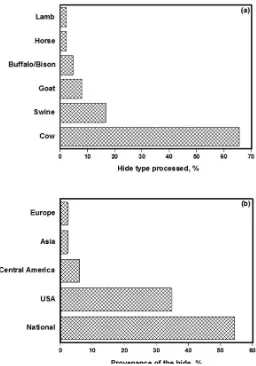
One noteworthy issue was that the team encountered a high level of unwillingness to participate in this data gathering effort among the local tanneries who were contacted. As stated above, only 39 tanneries currently operating in León, and using the wet blue tanning process, agreed to answer questionnaires, this represented a response rate of approximately 10.32%. Later, using the information collected in the questionnaires, the input and output inventory data for each process step was prepared. Figure 2a illustrates the types of hides processed at the interviewed tanneries; the most common was bovine (65.6%) followed by swine (16.8%).
[image:5.612.181.437.244.610.2]Total environmental emissions are important indicators when assessing environmental impacts, this is why it is important to have information on the place of origin of the raw hide inputs; figure 2b shows that only 54.5% the original hides to be processed are of Mexican origin and the rest were imported (45.5%), mainly from the USA (34.9 %). This issue is related to the current market boom and the growing market for finished leather particularly for use by the automotive industry in Central Mexico. To meet this demand, tanneries have to import the hide, since domestic sources are insufficient to meet the current production demand. Using this information on raw material source it is possible to obtain indicators about the transport methods and travel distances involved, leading to a more complete understanding of the total environmental costs of the process.
Figure 2. Type of processed hide (a) and their place of origen (b).
The information obtained showed that the majority of sales of finished leather was to the shoe industry (68.6%), followed by leather goods (18.6 %), furniture (7.1%) and finally automotive (5.7%). It is important to note that the finished leather specifications are targeted to the product market and that the team noted significant differences in physicochemical properties and cost as a function of the finished product market.
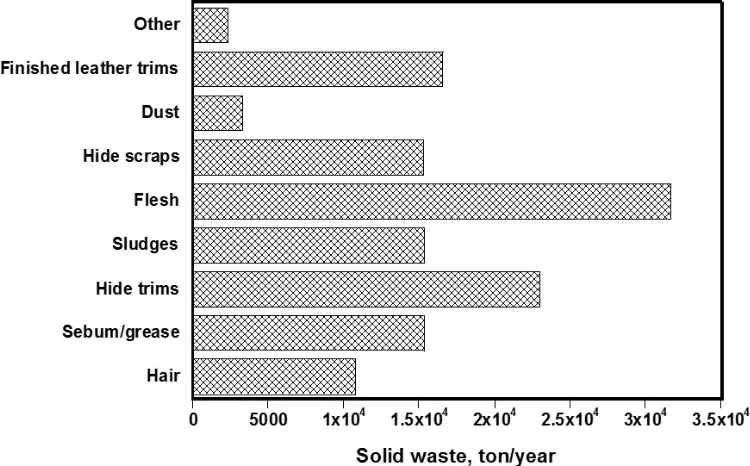
includes hair, sebum/grease, hide trims, scrapings, leather trims, flesh, sludge, and dust/dirt. The major solid residues were flesh (31,657.5 ton/year) and hide trims (23,036.8 ton/year) (see figure 3). The most commonly recycled sub-product was animal protein, mainly collagen, which was commonly reused to produce food for dogs and cats; the sebum/grease obtained are using in the production of soaps and shampoo by some companies [28] (Bajza and Vrcek, 2001), and the hair waste (approximately 10,700 ton/year), is also a rich source of the protein keratin, which can be utilized by various industrial sectors including companies making cosmetics, foods, composites, or as a fertilizer or energy source, among others potentials[29]. There is little information reported about recovery of this waste product, however, suggesting that it is an opportunity for further exploitation. Here then, by gathering data to conduct a LCA for this industry, the team identified a potential new revenue stream for the industry, exposing one of the most important aspects of the LCA procedure, in general. The sludge that is generated contains an average of 35.0 % organic material and 65.0 % mineral matter [30,31] depending on operating practice. Its recovery, if enhanced, can be used as a resource for energy production, through bio-digesters, or composted to produce a low quality material intended for use on green areas. Similar work was reported by Guo-Tao et al. (2013), who published a study describing the conversion of tannery sewage sludge, in composite, by a high temperature aerobic fermentation process for possible application in agriculture and forestry [32].
Figure 3. Solid waste generated annually in the process of tannery.
[image:6.612.122.497.245.478.2]Of these solids wastes: hair, sebum/grease, hide trims and sludge are generally generated in beamhouse stage; the flesh, hide scraps and dust/dirt in the tanning stage; and finished leather trims and others solids during the finishing stage.The total amount of aqueous residue generated, drawing on information from the team collected data, was 3,653,444.2 m3/year. The beamhouse stage contributes 85.6% (3,127,348.2 m3/year) and the (chrome) tanning stage 14.4 % (526,956 m3/year). Most small tanneries produce only slurries during finishing and they typically sent their tanned leathers to other companies having the machinery to give the required finish to the tanned leather, as stated earlier these external finishing operations were outside the scope of this study. Also important to note was that the aqueous waste values reported here are specific to tanning bovine hide [3, 23]; and the effluent parameters for each stage of the tanning process used information supplemented from the literature [5, 24, 25, 30].
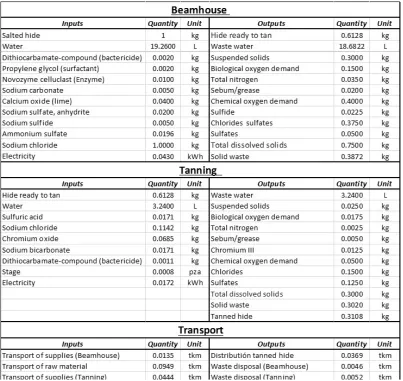
Table 1. Inventory of inputs and outputs for wet blue tanning process
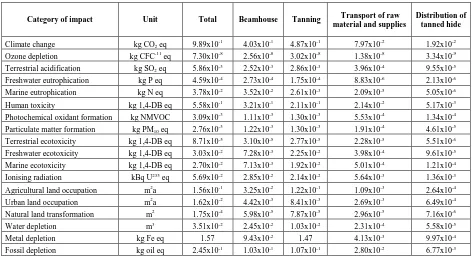
The results of the modeling by the ReCiPe Midpoint method, for estimation of environmental impacts in the 18 categories considered, are presented in table 2 and separated by the various stages. As seen here the beamhouse stage affects different categories: marine
eutrophication at 0.035 kg N eq representing 93.04 % of the total amount; water consumption 0.025 m3 (or 69.75% of the total
consumption), climate change 0.403 kg CO2 eq (40.72% of total generated) and human toxicity 0.321 kg 1,4-DB eq (57.47% of total
generated). The chrome tanning step has a major impact on depletion of metals 1.47 kg Fe eq (93.67% of total level), occupation of agricultural land 0.122 m2a (78.29% of total occupied), freshwater ecotoxicity 0.023kg 1,4-DB eq (74.36%) and 0.487 kg CO2 eq
Table 2. Average environmental impacts obtained for the 18 categories evaluated by ReCiPe Midpoint analysis.
Category of impact Unit Total Beamhouse Tanning Transport of raw
material and supplies
Distribution of tanned hide
Climate change kg CO2 eq 9.89x10⁻¹ 4.03x10⁻¹ 4.87x10⁻¹ 7.97x10⁻² 1.92x10⁻² Ozone depletion kg CFC-11 eq 7.30x10⁻⁸ 2.56x10⁻⁸ 3.02x10⁻⁸ 1.38x10⁻⁸ 3.34x10⁻⁹ Terrestrial acidification kg SO2 eq 5.86x10⁻³ 2.52x10⁻³ 2.86x10⁻³ 3.96x10⁻⁴ 9.55x10⁻⁵ Freshwater eutrophication kg P eq 4.59x10⁻⁴ 2.73x10⁻⁴ 1.75x10⁻⁴ 8.83x10⁻⁶ 2.13x10⁻⁶ Marine eutrophication kg N eq 3.78x10⁻² 3.52x10⁻² 2.61x10⁻³ 2.09x10⁻⁵ 5.05x10⁻⁶ Human toxicity kg 1,4-DB eq 5.58x10⁻¹ 3.21x10⁻¹ 2.11x10⁻¹ 2.14x10⁻² 5.17x10⁻³ Photochemical oxidant formation kg NMVOC 3.09x10⁻³ 1.11x10⁻³ 1.30x10⁻³ 5.53x10⁻⁴ 1.34x10⁻⁴ Particulate matter formation kg PM10 eq 2.76x10⁻³ 1.22x10⁻³ 1.30x10⁻³ 1.91x10⁻⁴ 4.61x10⁻⁵ Terrestrial ecotoxicity kg 1,4-DB eq 8.71x10⁻⁵ 3.10x10⁻⁵ 2.77x10⁻⁵ 2.28x10⁻⁵ 5.51x10⁻⁶ Freshwater ecotoxicity kg 1,4-DB eq 3.03x10⁻² 7.28x10⁻³ 2.25x10⁻² 3.98x10⁻⁴ 9.61x10⁻⁵ Marine ecotoxicity kg 1,4-DB eq 2.70x10⁻² 7.13x10⁻³ 1.92x10⁻² 5.01x10⁻⁴ 1.21x10⁻⁴ Ionising radiation kBq U235 eq 5.69x10⁻² 2.85x10⁻² 2.14x10⁻² 5.64x10⁻³ 1.36x10⁻³ Agricultural land occupation m2a 1.56x10⁻¹ 3.25x10⁻² 1.22x10⁻¹ 1.09x10⁻³ 2.64x10⁻⁴ Urban land occupation m2a 1.62x10⁻² 4.42x10⁻³ 8.41x10⁻³ 2.69x10⁻³ 6.49x10⁻⁴ Natural land transformation m2 1.75x10⁻⁴ 5.98x10⁻⁵ 7.87x10⁻⁵ 2.96x10⁻⁵ 7.16x10⁻⁶ Water depletion m3 3.51x10⁻² 2.45x10⁻² 1.03x10⁻² 2.31x10⁻⁴ 5.58x10⁻⁵ Metal depletion kg Fe eq 1.57 9.43x10⁻² 1.47 4.13x10⁻³ 9.97x10⁻⁴ Fossil depletion kg oil eq 2.45x10⁻¹ 1.03x10⁻¹ 1.07x10⁻¹ 2.80x10⁻² 6.77x10⁻³
CO2 carbon dioxide; eq, equivalent; CFC, chlorofluorocarbon; SO2, sulfur dioxide; P, phosphorus; N, nitrogen; DB, dichlorobenzene; NMVOC, non-methane volatile
organic compounds; PM10, particulate matter ≤10µm diameter; U235, uranio-235; Fe, iron;
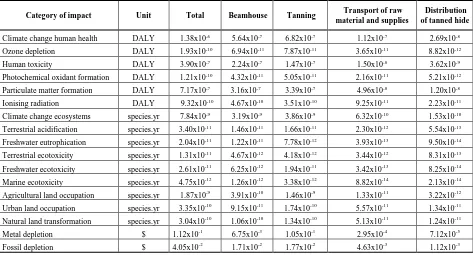
Table 3. Average environmental impacts obtained for the 18 categories evaluated by ReCiPe Endpoint analysis.
Category of impact Unit Total Beamhouse Tanning Transport of raw
material and supplies
Distribution of tanned hide
Climate change human health DALY 1.38x10⁻⁶ 5.64x10⁻⁷ 6.82x10⁻⁷ 1.12x10⁻⁷ 2.69x10⁻⁸ Ozone depletion DALY 1.93x10⁻¹⁰ 6.94x10⁻¹¹ 7.87x10⁻¹¹ 3.65x10⁻¹¹ 8.82x10⁻¹² Human toxicity DALY 3.90x10⁻⁷ 2.24x10⁻⁷ 1.47x10⁻⁷ 1.50x10⁻⁸ 3.62x10⁻⁹ Photochemical oxidant formation DALY 1.21x10⁻¹⁰ 4.32x10⁻¹¹ 5.05x10⁻¹¹ 2.16x10⁻¹¹ 5.21x10⁻¹² Particulate matter formation DALY 7.17x10⁻⁷ 3.16x10⁻⁷ 3.39x10⁻⁷ 4.96x10⁻⁸ 1.20x10⁻⁸ Ionising radiation DALY 9.32x10⁻¹⁰ 4.67x10⁻¹⁰ 3.51x10⁻¹⁰ 9.25x10⁻¹¹ 2.23x10⁻¹¹ Climate change ecosystems species.yr 7.84x10⁻⁹ 3.19x10⁻⁹ 3.86x10⁻⁹ 6.32x10⁻¹⁰ 1.53x10⁻¹⁰ Terrestrial acidification species.yr 3.40x10⁻¹¹ 1.46x10⁻¹¹ 1.66x10⁻¹¹ 2.30x10⁻¹² 5.54x10⁻¹³ Freshwater eutrophication species.yr 2.04x10⁻¹¹ 1.22x10⁻¹¹ 7.78x10⁻¹² 3.93x10⁻¹³ 9.50x10⁻¹⁴ Terrestrial ecotoxicity species.yr 1.31x10⁻¹¹ 4.67x10⁻¹² 4.18x10⁻¹² 3.44x10⁻¹² 8.31x10⁻¹³ Freshwater ecotoxicity species.yr 2.61x10⁻¹¹ 6.25x10⁻¹² 1.94x10⁻¹¹ 3.42x10⁻¹³ 8.25x10⁻¹⁴ Marine ecotoxicity species.yr 4.75x10⁻¹² 1.26x10⁻¹² 3.38x10⁻¹² 8.82x10⁻¹⁴ 2.13x10⁻¹⁴ Agricultural land occupation species.yr 1.87x10⁻⁹ 3.91x10⁻¹⁰ 1.46x10⁻⁹ 1.33x10⁻¹¹ 3.22x10⁻¹² Urban land occupation species.yr 3.35x10⁻¹⁰ 9.15x10⁻¹¹ 1.74x10⁻¹⁰ 5.57x10⁻¹¹ 1.34x10⁻¹¹ Natural land transformation species.yr 3.04x10⁻¹⁰ 1.06x10⁻¹⁰ 1.34x10⁻¹⁰ 5.13x10⁻¹¹ 1.24x10⁻¹¹ Metal depletion $ 1.12x10⁻¹ 6.75x10⁻³ 1.05x10⁻¹ 2.95x10⁻⁴ 7.12x10⁻⁵ Fossil depletion $ 4.05x10⁻² 1.71x10⁻² 1.77x10⁻² 4.63x10⁻³ 1.12x10⁻³
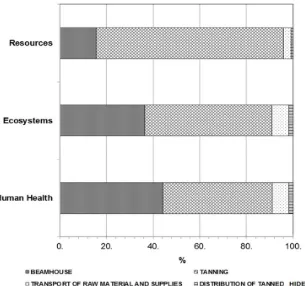
Figure 4. Damage assessment indicators categorized as effects on human health, ecosystems and resource depletion.
A. Significant issues
Significant issues of a product refer to the processes, materials or emissions that generate the greatest potential environmental impact during the life cycle within its defined system limits. Generally, the LCI results of both the beamhouse and chrome tanning stages had significant environmental impacts in several categories. For the beamhouse stage significant impact were in the categories: eutrophication of marine and fresh water, water depletion and human toxicity, caused by the materials used in the processes, particularly the large volume of water. The main effects of chromium tanning stage were with metals depletion through the use of chromium salts, depletion of agricultural land, fresh water eco-toxicity, and urban land occupation. Transportation makes no significant contribution in any of the impact categories when compared to the other process stages. Note that the transportation of solid wastes, mostly an organic waste, was dumped locally into Leon’s landfill sites. Finally, no significant contributions were observed for the final leather distribution step either. Typically, distribution of tanned leather was done on (returnable) wooden pallets or in wooden containers, that were carried in freight vans, an average distance of less than 50 km.
B. Study limitations
Limitations to this LCA study are primarily related to the lack of information. Due to the reluctance of most tanners to respond, some of the assumptions that have been made, and the use of international databases to represent the processes studied in the life cycle of wet blue tanning within Leon, Guanajuato could have somewhat skewed the results.
This LCA study focused only on the beamhouse, and chrome tanning stages within a typical local tannery, transport of raw materials and supplies to the tannery, and transportation employed to bring the tanned leather to finishers. It does not evaluate hide finishing activities since little of the relevant data about different types of finishing processes for tanned leather could be obtained from the tanneries studied. The team found that because of the widely varying uses for the wet blue tanned leather, that most of the interviewed tanneries (about 60%) do not perform their own finishing activities.
suppliers (not including hides/skins) used by the two internal stages come from an average distance of 124 km and 50 km respectively during material transport analyses.
A general measure of electrical energy consumption was developed from an average energy consumption rating for each machine within each stage and then multiplied by the number of each machine type and average hours of operation they were used during each process stage.
It was assumed that wastewater is discharged directly into municipal sewers. More than 90% of the companies who responded reported do not have wastewater treatment systems within their plants.
The team treated all reported waste materials as bio-solids which were then carried to municipal dumps. All of the survey responders only reported organic waste from the leather processes while no inorganic residues were reported.
During the product distribution stage, it was assumed that all production leather was placed in/on wooden containers/pallets, capable of handling 1.3 ton of leather and transported in freight vans with capacities of 3.5 to 7.5 tons. The tanned leather was carried an average distance was 50 km.
IV.CONCLUSIONSANDRECOMMENDATIONS
Both, the beamhouse as well as the wet blue (chrome) tanning stages have areas of opportunity to provide environmental performance improvements. The LCA suggested that tanneries should study means to optimize their level of inputs and sources of raw materials, improve their recovery of waste by developing recycling activities, including reuse, recovery and reduction. Specific recommendations that were observed include:
• Studying and employing means to reduce the water used (particularly during the beamhouse stage). Tanneries are encouraged
to develop techniques to allow water reuse in the process to directly decrease water stress in their area of operation. It is also advisable that they perform effluent treatment processes on site to better prepare their wastewater streams for discharge. These steps should reduce potential eutrophication impacts on fresh- or marine-water bodies caused by the discharge of the untreated reactive and organic pollutants they contain.
• Solid wastes that are generated, including flesh, sebum/grease, hide trims, hair and sludge, could be successfully recycled
(valorization). By recycling potentially valuable materials into beneficial uses industrial sustainability in this and other industrial sectors of the Mexico economy will increase.
• Transportation of raw materials and inputs to the production site can be a significant ecotoxin for the earth, especially when considering the impact of imported materials and their extended travel distances. Efforts should be studied to reduce industrial dependence of materials sourced far away from León.
• Finally, as the distribution of wet blue tanned leathers is mostly local, this step was found to have little impact on the
environmental categories that were evaluated, but may benefit from the use of reusable plastic or metal pallets or boxes during transport.
ACKNOWLEDGMENT
The authors acknowledge the key beneficial support from project #263182 in 2015-01 that was provided by a SEMARNAT-CONACYT Fund.
The authors also acknowledge Dr. Richard R. Lindeke, Professor Emeritus, University of Minnesota Duluth and Peace Corps
Mexico Volunteer at CIATEC, for its contributions to this paper.
REFERENCES
[1] INEGI (Instituto Nacional de Estadística y Geografía). (2017). Directorio Estadístico Nacional de Unidades Económicas. [National Statistical Directory of Economic
Units]. www.beta.inegi.org.mx/app/mapa/denue/. Accessed May 2017.
[2] INE (Instituto Nacional de Ecología). (1999). Manual de procedimientos para el manejo adecuado de los residuos de curtiduría. [Manual of procedures for the proper handling of tannery waste]. Instituto Nacional de Ecología- SEMARNAP. Primera edición, México, D.F., Nov 1999.
[3] UNEP (United Nations Environment Programme). (1996). Cleaner production in leather tanning. 1a Edition, United Nations Environment Programme, Industry and Environment. Paris, France.
[5] CEPIS (Centro Panamericano de Ingenieria Sanitaria y Ciencias del Ambiente). (1993). Guía técnica para la minimización de residuos curtiembres. [Technical guide for the minimization of tanneries waste]. Auspiciado por la Agencia Alemana de Cooperación Técnica. Lima, Perú.
[6] V. Dandira, K. Mugwindiri and T. Chikuku. (2012). A cleaner production exercise of a leather manufacturing company: a Zimbabwean experience. International Journal of Scientific and Tecnology Researc, 1(11):97-101.
[7] R. Laurenti, M. Redwood, R. Puig and B. Frostell. Measuring the environmental footprint of leather processing technologies. (2016). Journal of Industrial Ecology. In press.
[8] M.E. Bautista, L. Pérez, M.T. García, S. Cuadros, and A. Marsal. (2015). Valorization of tannery wastes: lipoamino acid surfactant mixtures from the protein fraction of process wastewater. Chemical Engineering Journal, 262: 399–408.
[9] J. Jing Hu, Z. Xiao, W. Deng, M. Wang and S. Ma. (2011). Ecological utilization of leather tannery waste with circular economy model. Journal of Cleaner Production, 19:221-228.
[10] V. J. Sundar, A. Gnanamani, C. Muralidharan, N. K. Chandrababu and A.S. Mandal. (2011). Recovery and utilization of proteinous wastes of leather making: a review. Rev. Environ Sci Biotechnol, 10:151-163
[11] USEPA (United States Environmental Protection Agency). (1978). Assessment of potential toxic releases from leather industry dyeing operations. U.S. EPA Industrial Enviro. Research Lab., Cincinnati, USA. www.epa.gov. Accessed January 2017.
[12] M. Goedkoop, R. Heijungs, M. Huijbregts, A. de Schryver, and J. Struijs. (2009). ReCiPe 2008: A life cycle impact assessment method which comprises harmonised category indicators at the midpoint and the endpoint level. Ministerie van VROM Rijnstraat. www.vrom.nl. Accessed May 2017.
[13] ISO (International Standard Organization). (2006a). ISO 14040:2006. Environmental management-life cycle assessment-principles and framework. Second edition, July 2006
[14] ISO (International Standard Organization). (2006b). ISO 14044:2006: Environmental management-Life cycle assessment-Requeriments and guidelines. First edition, July 2006.
[15] A. Aranda-Usón, I. Zabalza-Bribián, A. Martínez-Gracia, A. Valero-Delgado, and S. Scarpellini . (2006). El análisis del ciclo de vida como herramienta de gestión empresarial. [The life cycle analysis as a business management tool]. España: Fundación Confemetal.
[16] C. Zia-Uddin, J. Ariful-Islam, and P. Hira- Lal. (2015). Comparative evaluation of environmental impact of leather process using LCA methodology. Paper present at International Conference on Mechanical Engineering and Renewable Energy, 26-29 November, Chittagong, Bangladesh.
[17] F. Brugnoli, and I. Král. (2012). Life cycle assessment, carbon footprint in leather processing. Eighteenth sesion of leather and leather products industry panel.
United Nations Industrial Development Organization, 01-05 september, Shanghai, China.
[18] T. Daddi, B. Nucci, and F. Iraldo. (2015). Enhancing the adoption of life cycle assessment by small and medium enterprises grouped in an industrial cluster.
Application and implementation 20(5):1199-1211.
[19] K. Cooman, M. Galardo, J. Nieto, and C. Bornhard. (2003). Tannery waswater characterization and toxicity effects on Daphnia spp. Environ Toxicol 18(1): 45-51. [20] X. Xu, G. Baquero, R. Puig, J. Shi, J. Sang and W. Lin. (2015). Carbon footprint and toxicity indicators of alternative chromium-free tanning in China. JALCA
110:130-138.
[21] M. Puccini, M. Seggiani, D. Castiello, and S. Vitolo. (2014). Sustainability in process innovation: development of a green tanning process supported by LCA methodology. JALCA 109:110-116.
[22] B.R. Ranón-Méndez, C. Bornhardt, and G. Vidal. (2004). Towards a cleaner production in developing countries: a case study in a Chilean tannery. Waste Manag Res 22:131-141.
[23] J. Buljan, and I. Král. (2015). The framework for sustainable leather manufacture. United Nations Industrial Development Organization 1-209
[24] IUE (International Union of Environment) Commission. (2008). IUE Document on recent developments in cleaner production and environment protection in world leather sector. Tamil Nadu, India. www.iultcs.org/environment-iue.php. Accessed May 2017.
[25]IFC (International Finance Corporation). (2007). Environmental, health and safety guidelines for tanning and leather finishing. http://www.ifc.org/wps/wcm/connect/de6c3d00488556f2bb14fb6a6515bb18/Final++Tanning+and+Leather+Finishing.pdf?MOD=AJPERES. Accessed May 2017
[26] K.Joseph, and N. Nithya. (2009). Material flows in the life cycle of leather. Journal of Cleaner Production 17: 676-682.
[27] J. Kanagaraj, K.C. Velappan, N. K. Chandra-Babu, and S. Sadulla. (2006). Solid wastes generation in the leather industry and its utilization for cleaner environment-A review. Journal of Scientific and Industrial Research 65:541-548.
[28] Z. Bajza, and V. Vrcek. (2001). Thermal and enzymatic recovering of proteins from untanned leather waste. Waste Management 21(1): 79-84. [29] K. Chojnacka, H. Górecka, I. Michalak, and H. Górecki. (2011). A review: valorization of keratinous materials. Waste Biomass Valor 2:317-321.
[30] J. Salmerón. (1995). Generación y tramiento de residuos en la industria del curtido de Valencia. [Generation and treatment of waste in the Valencia tanning industry]. Confederación Empresarial Valenciana.
pollution control in the tanning industry in South-East Asia. November 2001.
[32] F. Guo-Tao, S. Zhi-Hua, L. Shuqing, and C. Hui. (2013). The production of organic fertilizer using tannery sludge. JALCA 108:189-196.
AUTHORS
First Author-Beatriz Padilla-Rizo is a Master's Degree in Environmental Engineering at the Centro de Innovación Aplicada en Tecnologías Competitivas in León, Guanajuato, México. E-mail: [email protected]
Second Author-María Maldonado-Santoyo is a professor-researcher at the Centro de Innovación Aplicada en Tecnologías Competitivas in León, Guanajuato, México. E-mail: [email protected]
Third Author-Jorge Elías Soto-Maldonado is an engineering in electronics and computer science at the Centro de Innovación Aplicada en Tecnologías Competitivas in León, Guanajuato, México. E-mail: [email protected]
Fourth Author-Celso Moises Bautista Rodríguez is a Professor-researcher in Centro de Innovación Aplicada en Tecnologías Competitivas in León, Guanajuato, México. E-mail: [email protected]
Fifth Author-Luz Elena Mora-Maldonado is a master of environmental engineering candidate at the Centro de Innovación Aplicada en Tecnologías Competitivas in León, Guanajuato, México. E-mail: [email protected]
Sixth Author-Roberto Guzman Zitzumbo is a professor-researcher at the Centro de Innovación Aplicada en Tecnologías Competitivas in León, Guanajuato, México. E-mail: [email protected]
Seventh Author-Luz Adriana Arias Hernández is a Professor-researcher at the University of Guanajuato in Guanajuato, México. E-mail: [email protected]