Criminal Justice Theses Department of Criminal Justice
Summer 2018
Financial Literacy and Victimization
Mecca Samaria MuhammadFollow this and additional works at:https://scholarworks.gsu.edu/cj_theses
This Thesis is brought to you for free and open access by the Department of Criminal Justice at ScholarWorks @ Georgia State University. It has been accepted for inclusion in Criminal Justice Theses by an authorized administrator of ScholarWorks @ Georgia State University. For more information, please [email protected].
Recommended Citation
viii ABSTRACT
FINANCIAL LITERACY AND VICTIMIZATION
By
MECCA SAMARIA MUHAMMAD
2018
Committee Chair: Dr. Volkan Topalli
Major Department: Criminal Justice and Criminology
This paper examines the relationship between financial literacy (FL) and susceptibility to
economic victimization. Susceptibility to victimization functions as a proxy variable for
victimization. It employs a modified, quasi-experimental case study approach and pulls from
survey and interview data. It measures changes to FL and susceptibility to victimization after a
FL workshop was delivered to a sample of refugees based in a city in southeastern US. Results
demonstrate that FL seemed to increase for those within the treatment group. Subsequent
changes to susceptibility to victimization indicated a decrease. The study also notes some
evidence of a multiplier and reverse multiplier effect. Implications for future research, policy,
FINANCIAL LITERACY AND VICTIMIZATION
BY
MECCA SAMARIA MUHAMMAD
A Thesis Submitted in Partial Fulfillment of the Requirements for the Degree
of
Master of Science in the
Andrew Young School of Policy Studies of
Georgia State University
Copyright by
ACCEPTANCE
This dissertation was prepared under the direction of the candidate’s Thesis Committee. It has been approved and accepted by all members of that committee, and it has been accepted in partial fulfillment of the requirements for the degree of Master of Science in Criminal Justice in the Andrew Young School of Policy Studies of Georgia State University.
Thesis Chair: Dr. Volkan Topalli
Committee: Dr. Richard Wright Dr. William Sabol
Electronic Version Approved:
Sally Wallace, Dean
Andrew Young School of Policy Studies Georgia State University
iv
ACKNOWLEDGEMENTS
The creation of this thesis would not have been possible without several invaluable figures in my life. I have only completed it because of their constant support and selfless
dedication. To those figures: I do not think I could ever properly convey how much I appreciate your being in my life through this process, but I would like to try, anyway. This thesis is more yours than it is mine (so I hope you like it).
Thank you, Dr. Volkan Topalli, for serving as my thesis chair. Thank you for letting me laugh (and cry) in your office, and thank you for putting so much thought into my development, as though it were your only priority. Thank you for calming my worries and sharing in my excitement. Your advice and guidance have been vital to not only the completion of this thesis, but also my growth as a person and a scholar. I could not have asked for a better mentor.
I would also like to thank my committee members, Dr. Richard Wright and Dr. William Sabol, for dedicating their time and effort to this project. Your doors were always open to me, and you were always willing to discuss and bounce around new ideas. These sessions were immeasurably important to making me a better thinker and making my thesis a better product. I am so grateful for your unwavering support.
I would also like to thank Dr. Mary-Helen O’Connor and the participants of this study for making this thesis possible. It would not exist without your generosity. Thank you for working so closely with me.
Thank you to everyone I could not name explicitly: I would have to write another thesis to name all those who had a hand in this project. I could not have completed this work without going out for therapeutic coffee sessions with my friends, barging into my fellow graduate students’ offices for advice, taking breaks to look at memes with my siblings, or pulling the occasional all-nighter with my closest companion. Thank you all for being so supportive, and for staying in such good spirits. You have made this process such a treasured memory.
Finally, I would like to say how profoundly grateful I am to my parents, Cynthia Lewis and Ray Muhammad. Your endless support has given me the courage to try my hand at a project like this and the ability to complete it. I cannot express in words how thankful I am for
everything you have done for me. Thank you for your care, support, and encouragement through every stage in my life. I love you.
Thank you.
v
TABLE OF CONTENTS
ACKNOWLEDGEMENTS ... iv
LIST OF TABLES ... viii
LIST OF FIGURES ... ix
LIST OF ABBREVIATIONS ... x
CHAPTER 1: INTRODUCTION ... 1
CHAPTER 2: LITERATURE REVIEW ... 4
2.1 Defining Financial Literacy ... 4
2.2 The Effectiveness of Financial Literacy in Practice ... 7
2.3 Direct Effects of Financial Literacy ... 11
2.4 Indirect Effects of Financial Literacy... 13
2.5 Financial Literacy and Victimization ... 16
2.6 Groups Vulnerable to Economic Victimization ... 18
2.7 The Current Gap in Research ... 22
CHAPTER 3: METHODOLOGY ... 24
3.1 Hypothesis and Variables of Interest ... 24
3.2 Research Design ... 26
3.3 Limitations ... 29
CHAPTER 4: RESULTS ... 31
4.1 Changes to Financial Literacy ... 32
4.2 Changes to Susceptibility to Victimization ... 35
4.3 The Possibility of a Multiplier Effect ... 38
CHAPTER 5: DISCUSSION ... 41
5.1 Takeaways from the Results ... 41
5.2 From Change in Knowledge to Change in Behavior ... 42
5.3 Limitations of the Results ... 45
5.4 Implications for Future Research ... 46
5.5 Policy Implications ... 49
APPENDIX A ... 52
APPENDIX B ... 68
vi
REFERENCES ... 71
viii
LIST OF TABLES
ix
LIST OF FIGURES
Figure 1: Depiction of Hypothesized Relationship ... 24
x
LIST OF ABBREVIATIONS
1
CHAPTER 1: INTRODUCTION
Understanding financial concepts, institutions, and management techniques is considered
crucial for improving one’s financial life (Lusardi 2009; Cole et al. 2011; Klapper and Panos
2011). This understanding – henceforth referred to as financial literacy (FL)– has been found to
reduce default rates (Hartarska and Gonzalez-Vega 2006) and debt accumulation (Lusardi 2009).
It also has had more proximal effects on factors such as business outcomes (Berge et al. 2014)
and retirement (Yoong et al. 2012). One potential, though understudied, effect of FL might be
that it inversely affects financial victimization experiences. While little is known about the
relationship between FL and victimization, studies (Gamble et al. 2013; James et al. 2014) have
noted a relationship amongst certain populations. This study seeks to address the lacuna in
research on FL and victimization, employing quasi-experimental mixed methods in a modified
case study to isolate the effect of FL on victimization.
While criminological literature on FL is lacking, academics from other disciplines have
documented its effects. During some interventions, FL has been found to change people’s
understanding of finances; that knowledge subsequently affected economic outcomes (Xu and
Zia 2012). In Tanzania, microenterprise and entrepreneurial endeavors amongst men improved
after receiving financial education (Berge et al. 2011); in the US, financial counseling sessions
decreased the number of participants who defaulted on their mortgage (Hartarska and
Gonzalez-Vega 2006). These studies illustrate cases in which FL has affected people’s relationships with
their money as well as with the financial institutions within their society. They document the
potential of FL to reduce negative financial outcomes.
FL might inversely affect financial victimization. Though academics have not yet
2
lack of literacy might have an effect on victimization. James et al. (2014) found that decreasing
FL accompanies increasing victimization experiences. Other papers (Gamble et al. 2013;
Sukumaran 2015) similarly note that low FL is associated with financial exclusion. They further
speculate that lack of familiarity with financial systems and concepts makes one more
susceptible to predatory economic victimization. This includes high-risk lending practices and
debt accumulation. Such links lead authors to infer the ability of FL to affect victimization.
Consequently, these authors and others (i.e., Marlowe and Atiles 2005) ultimately make
recommendations to increase FL should one hope to decrease financial victimization amongst
populations which are traditionally vulnerable to it.
Researchers have begun to explore why some communities are systematically more
vulnerable to economic predation. Populations which are most consistently targets of predatory
economic behavior are those which have had historically fewer economic services available to
them (Gallmeyer and Roberts 2009). That is, these communities face a structural lack of
financial services, both practical (i.e., banking services) and educational (i.e., financial
counseling services). Such a context leads to low familiarity with and little access to traditional
financial services. It creates a financially marginalized population with heightened susceptibility
to economic victimization. Thus, it is possible that communal vulnerability to financial predation
is in part due to a structural lack of FL.
Despite the research on FL, financial stratification, and victimization across different
literatures, research has yet to explicitly examine the relationship between FL and crime. Some
studies have noted the relationship between FL, financial marginalization, and victimization
(Marlowe and Atiles 2005; James et al. 2014). Others have noted instances in which FL
3
Cole et al. 2011; Berge et al. 2014). None, however, has evaluated the effect of FL on
victimization experiences. This paper sets out to rectify the gap in the literature.
By studying the relationship between FL and victimization more closely, researchers can
document notable implications for policymaking and criminological research. Should FL
stimulate changes in victimization, the most evident policy imperative would be to invest in FL
initiatives aimed at populations vulnerable to victimization. Less apparent, though no less
important, are implications for criminal behavior. If FL rectifies financial marginalization and
offers people tools to protect themselves from victimization, it can serve as a target hardener, or
a protective factor against acquisitive and interpersonal crime (Mayhew 1984).
FL was previously thought to be unrelated to financial victimization and crime. Research
is increasingly hinting that this might not be the case. FL is an inconsistently-defined and
understudied topic, specifically regarding the relationship between it and victimization.
Understanding more about this relationship can guide further research and policy development.
Thus, the lack of research on FL and the potential implications for such research creates the
context for this paper. It will attempt to explore the relationship between FL and victimization, as
4
CHAPTER 2: LITERATURE REVIEW 2.1 Defining Financial Literacy
Researchers have defined FL in several ways. Annamaria Lusardi’s works have been
pivotal in defining and evaluating FL. Her definition is woven throughout FL literature. “Debt
Literacy, Financial Experiences, and Overindebtedness” (Lusardi 2009) defines FL as the
“ability to perform simple economic calculations and knowledge of basic financial
concepts…and the knowledge of more complete concepts.” She ultimately characterizes this
knowledge as necessary to make informed financial decisions. Unlike others (see below),
Lusardi’s definition prioritizes one’s knowledge of financial concepts over one’s actual
decision-making practices. In this way, it separates financial knowledge from the financial outcomes that
accrue from such decision-making. It conceptualizes and operationalizes them differently.
Hira and Schuchardt’s “Setting the Standard for Financial Literacy” (2008) defines FL as
a form of financial knowledge, mirroring Lusardi’s (2009) definition, but adds to it an important
component: the relevancy of the knowledge to the learner. In doing so, the authors recognize that
the concepts which are most important vary by population. Hira and Schuchardt define a
financially literate person as one who understands “the concepts of controlling cash flow, saving,
investing, borrowing wisely, managing risk, and transferring assets. Every person deemed
financially literate understands and applies the concepts appropriate to their life stage and
circumstance” (Hira and Schuchardt 2008). In addition to conceptualizing FL as a general
understanding of financial processes, they caution that the concepts one needs to understand to
be “functionally” literate are those most relevant to their specific life circumstance.
Given the multitude of definitions and their contributions to the literature, David L.
5
conceptualizations fall into one or more of five main components. These components identify FL
as, the “(1) knowledge of financial concepts, (2) ability to communicate about financial concepts,
(3) aptitude in managing personal finances, (4) skill in making appropriate financial decisions,”
and/or “(5) confidence in planning for future financial needs” (Remund 2010).
Though each of these components is represented in different definitions in the literature, I
argue that only some of them accurately characterize what it means to have FL. I support a
definition of financial literacy which takes from the most common themes in the literature but
disqualifies those components which, albeit related, are not directly inherent to financial literacy.
This brings us to the current paper’s working definition of FL. I define FL as the ability to
understand financial concepts, institutions, and techniques to manage individual financial
resources. That is, if one is financially literate, they understand how they can manage their
financial resources using their society’s economic institutions, and they understand the potential
costs and benefits associated with different management techniques. Such knowledge is marked
by an understanding of how to access and open bank accounts, identify legitimate and fraudulent
tax preparers, and identify high-risk lending practices, to name a few. These skills allow you to
understand legitimate and illegitimate financial systems within your society and, ultimately,
make more informed decisions regarding your own money. This working definition of FL builds
upon several of the above definitions featured in the literature.
It should be noted that I only accept some of the characteristics of FL that Remund
(2010) identifies in his analysis of FL definitions. Remund’s fifth component measures
confidence in making financial decisions as essential to having FL. I do not include this theme in
this paper’s definition because of other pieces which have noted perceived FL as often separate
6
themselves to be financially literate but were objectively not, they had negative financial
outcomes. This group made financial decisions unilaterally because of their confidence in
financial planning and despite their lack of FL. From works like these, one gathers that
confidence in financial decision-making does not necessarily indicate FL, and thus I do not
include confidence as either a measure of literacy or inherent to its definition.
Similarly, Remund’s third and fourth themes define FL as the ability to make the “best”
or “most appropriate” financial decision. Remund notes that definitions which incorporate these
themes tend to pinpoint specific financial decisions and behaviors that define “aptitude,” or an
appropriate financial choice. I do not include these themes in this paper’s definition, arguing that
the determination of which behaviors are “appropriate” is subjective. Variability in financial
decisions across people does not necessarily determine whether a given person is more or less
able than another to comprehend the risks and ramifications of those decisions. Thus, this paper’s
definition focuses on the ability to understand the pros and cons of different financial decisions
and techniques for financial management, not in selecting the “best” one.
Regarding the third and fourth themes, it is also important to consider that, even if there
were a universal “best” financial decision, FL does not always translate into optimal financial
decision-making. It is intuitive to believe that knowledge of financial concepts would lead to one
to make ideal financial decisions. The literature informs us, however, that this is not necessarily
true. Instead, FL interacts with sociopolitical structures in such a way that one’s improved
understanding of finances tends to translate to improved financial decisions only within certain
contexts. Tuominen, M. C., & Thompson, E. L. (2015) and Berge et al. (2014) observe that, if
certain economic institutions are not available to the population or if social stratification makes
7
able to meaningfully employ their financial education. Thus, this paper’s working definition
distinguishes between actual decision-making practices and FL. Instead, my definition
specifically hones in on the first theme (knowledge of financial concepts), which is the most
common across definitions. This allows researchers to distinguish across confidence; financial
decision-making in practice; and ability to understand financial concepts and decision-making, or
literacy.
2.2 The Effectiveness of Financial Literacy in Practice
While FL has putative benefits for everyone in that it should allow for better financial
decision-making, its actual effectiveness varies depending on context. Several studies have
evaluated FL programs’ consequences on different populations, documenting a range of
outcomes. In considering whether or not FL programs have been effective thus far, the short
answer is sometimes. Variables including the demographics of the sample receiving financial
literacy training, the social hierarchy of the society, and the manner in which the class is taught
seem to play important roles in determining how helpful a program can be to its beneficiaries
(see below). Even with these limitations, previous evaluations consistently document the
potential for improved FL initiatives to positively affect beneficiaries’ lives in several contexts.
FL programs have had mixed results amongst youth. McCormick (2009) summarizes
youth experiences with FL programs, noting their effectiveness seems to depend on the specific
age of the youth as well as the format of the class. She finds that some programs amongst college
students led to increased knowledge of financial concepts and improved attitudes about
money-making decisions (though, these evaluations do not attempt to measure actual behavioral
change). These findings suggest some promise for youth FL initiatives. Mandell and Klein
8
knowledge nor even in perceived knowledge amongst youth around 15-16 years old. They
account for the difference in findings by noting that students with interactive learning materials
did improve significantly (Mandell and Klein 2009). They also speculate that the results of FL
programs could largely depend on whether the students perceive the information to be relevant or
not. This would help explain why youth in their mid-teens (under the legal working age; likely
financially dependent on their guardians) might be less receptive than teens with jobs or those
who are in or about to go to college, where they will presumably become more financially
independent.
Whereas youth have a mixed response to FL initiatives, research demonstrates the elderly
to be more uniformly responsive. Lusardi and Mitchell (2011), for instance, use survey data to
examine the elderly’s general FL rates as well as their receptiveness to financial training
methods. Researchers consistently find FL amongst the elderly to be systematically low (Lusardi
and Mitchell 2011; Gamble et al. 2013; James et al. 2014); though, Lusardi and Mitchell
document patterns of receptivity amongst the elderly, as well. Their findings suggest that more
financially savvy elders tend to get their knowledge from recent FL training services, including
seminars and expert financial consultation. This, in addition to studies that show positive
outcomes correlated with higher FL amongst the elderly (Klapper and Panos 2011; Yoong et al.
2012), suggests that tailored FL initiatives within this population could be worthwhile
investments.
The effectiveness of FL programs on subsequent outcomes might also be a gendered
phenomenon. Berge et al. (2014) evaluate a mixed-gender financial literacy program in Tanzania
that was specifically geared toward microfinance entrepreneurs. Amongst men and women, the
9
financial outcomes for women as it did for men. Through surveys assessing other aspects of the
entrepreneurs’ lives, Berge et al. assert that the ineffectiveness of the knowledge for women was
likely due to external societal constraints. Women entrepreneurs had less decision-making power
over their businesses than men (the women’s spouses were more heavily involved); women spent
10 hours fewer per week on their businesses than men due to household responsibilities; and
women were less likely to engage in competitive business practices due to discomfort acting
competitively, or aggressively (Berge et al. 2014). Despite this study, Field et al. (2010) similarly
evaluated women in a literacy program for entrepreneurs in India, and found some women’s
income to improve. Such studies indicate that FL programs interact with sociological factors
within the society and, depending on the context, may or may not be consequential enough to
themselves influence outcomes. They also suggest that, only when participants in FL programs
can apply their knowledge can they experience the intuitively beneficial effects of improved
financial understanding.
Programs have also led to mixed results amongst low-income populations, sparking
controversy regarding their viability. In some cases, positive results may include decreased rates
of mortgage defaulting and improved saving practices (Hartarska and Gonzalez-Vega 2006; Xu
and Zia 2012; Braunstein and Welch 2002). These cases suggest that FL programs are
worthwhile for people in financially precarious situations. However, Tuominen and Thompson
(2015) document an instance in which a FL program is inconsequential for low-income families.
In this case, families saved a few more dollars per month post-intervention, but that was too low
an amount to translate into anything meaningful. Such mixed findings again suggest nuance to
10
To look further into the effectiveness of FL in practice, several researchers examined the
specific contexts in which FL programs seem to most effectively increase both financial
understanding and subsequent outcomes. Hathaway and Khatiwada (2008) and Mandell and
Klein (2007) are representative of these papers. Both advise program directors to train
beneficiaries on concepts that are necessary to the participants at or near the moment it is being
taught. That is, FL trainings are unsurprisingly evidenced to be more effective when the learners
perceive the information to be immediately relevant to their lives. Braunstein and Welch (2002)
also note that the relevancy of the materials, the manner in which they are learned (e.g., passively
vs. actively), and the personal characteristics of the learners (e.g., comfort in changing one’s
behaviors) all affect the potential of FL programs to improve literacy. Finally, Tuominen and
Thompson (2015) remind policymakers and researchers that financial literacy programs must
consider and address structural factors that would inhibit positive outcomes even if financial
literacy improved. A program’s potential to affect its participants’ lives works quite markedly
well in some contexts and negligibly in others.
Researchers have explored the impact of FL programs in several contexts. The studies
that have evaluated them so far have produced mixed results, though, results that show a trend.
FL initiatives seem to have the most potential in contexts in which the participants a) view the
training as useful (Mandell and Klein 2007; Hathaway and Khatiwada 2008); b) feel comfortable
employing the tools they master (Braunstein and Welch 2002; Berge et al. 2014); and c) have
some access to the financial institutions they learn about (Tuominen and Thompson 2015). Given
11
2.3 Direct Effects of Financial Literacy
The previous section describes which populations are receptive to FL programs. It also
delineates the conditions where such programs produce successful outcomes. Moving forward,
researchers should consider what the effects of successful programs have been1. FL studies
suggest that effective financial literacy initiatives can influence several different outcomes.
Because of their variety, this paper divides outcomes into direct and indirect effects. Direct
effects are those which are an immediate and un-mediated result of increased FL. Indirect effects
are mediated results. In the literature, direct effects are mostly to do with a subject’s interaction
with financial systems.
One example of a direct effect of FL is its relationship to reducing mortgage defaults.
Hartarska and Gonzalez-Vega (2006) analyze a Midwestern American FL program that had a
training dedicated to bettering one’s understanding of mortgages. The sample, comprised of
adults from low-income households, could receive counseling on their mortgages, and the
authors studied mortgage default rates amongst those who were counselled or not. They found
that participants who received counseling were less likely to default on their mortgages, and
simultaneously more likely to employ the default option optimally2. This study suggests
increased information about default options lessens negative financial outcomes (e.g., default
rates), particularly for vulnerable populations.
Similarly, Cole et al. (2011) document the ability of FL initiatives to prompt individuals
to become “banked” (i.e., to open and utilize a bank account). The longitudinal study, which was
conducted in India and Indonesia using survey data, finds a strong correlation between FL and
1 It should be noted that outcomes discussed within this and the next section are from programs that were deemed
effective. That is, of effective programs, these sections discuss outcomes of financial literacy initiatives.
12
your likelihood of employing banking services. Cole et al. observe a FL intervention about
banking, which was provided to unbanked households at random. They then note a significant
effect on their sample’s likelihood to open bank accounts, especially amongst those with lower
initial FL. This effect persists through time, as their second wave of data collection shows that
the bank accounts opened in response to the FL program remained open and in use for two years
post-intervention (Cole et al. 2011). Such findings imply that access to basic financial
information can affect long-lasting outcomes on participation in a society’s financial institutions.
They also suggest that a lack of access to information can directly exclude populations from
financial institutions. These results demonstrate promise for FL initiatives amongst unbanked
and underbanked populations.
Another potential direct effect is the ability of FL to influence debt accumulation
outcomes (Lusardi 2009). Though Lusardi’s study was based on survey data that is correlational,
her work suggests that your debt situation might be a direct effect of FL. Lusardi’s survey
measures participants’ FL and their debt outcomes, operationalized as ability to judge debt,
amount of debt accrued, and kind of debt accrued (i.e., payday loans, auto title loans, etc.).
Lusardi’s weighted sample shows strong and significant differences between groups that were
financially literate versus those who were not and their debt outcomes. Those who were
financially literate were better able to understand lending practices, and thus were better able to
judge the severity of their own debt (Lusardi 2009). Consistently, they had accrued less debt than
their less financially-literate counterparts. Finally, those who were not financially literate were
more likely to take high-risk, high-interest loans from predatory lenders, such as payday lenders.
It is not clear if having low levels of FL and borrowing from predatory lenders are confounding
13
and little access to low-risk lenders), or if borrowing from high-risk lenders is a consequence of
having poor FL. Still, given the other correlates (e.g., poor ability to judge debt), Lusardi’s study
implies FL might have an inverse, direct, and causal relationship with several debt outcomes.
The above studies suggest that, in the appropriate contexts, FL programs can and do have
notable effects on different populations. As such, they lead researchers and policymakers to
consider the potential of FL programs to serve as interventions for poor financial outcomes.
2.4 Indirect Effects of Financial Literacy
The direct effects of FL programs on financial outcomes are relatively straightforward.
However, researchers have also documented several indirect, or mediated, effects of these
programs. In these cases, FL programs have led to one outcome which has in turn caused
another.
As an example, Berge et al. (2014) observed the indirect effect of FL initiatives on
business outcomes. These include both (1) profit and (2) business practices (indicated by
superior-employee relations, involvement in certain markets, and record-keeping). The authors
conducted a case study in Tanzania on FL training for microfinance entrepreneurs. Using several
sources of data, including records from the organization that delivered the training as well as
multiple waves of surveys, Berge et al. measure the impact of the program. When it was
effective3, they found that entrepreneurs in the intervention group took calculated steps to expand
their businesses post-treatment. These practices then increased the profits of said entrepreneurs
(Berge et al. 2014).
3 Only some entrepreneurs experienced the indirect effects discussed here, namely, the men. The effects of this
14
Similarly, the treatment group attempted to run their businesses more efficiently, taking
advantage of tools they had acquired during the training. Their improved knowledge of financial
management techniques and marketplaces led entrepreneurs to manage their employees in a way
that increased productivity. The entrepreneurs both terminated employees who were stealing and
offered impressive employees rewards for their behavior (Berge et al. 2014). Business owners
also exploited their newfound resources from the training by venturing into more profitable
markets, thereby increasing their revenue (Berge et al. 2014). Finally, the treatment group put
their management skills to use by improving record-keeping practices, which would allow for
better analysis of funds and practices in the future. These business improvements led men in
particular to report having a higher quality of life post-treatment as well as increased personal
satisfaction surrounding their endeavors (Berge et al. 2014). The improvements also suggest that,
amongst some populations, FL interventions can lead to better economic outcomes for
businesses and quality of life.
Multiple authors have also written on the ability to retire. Yoong et al. (2012) conducted
a study in Malaysia using survey data. In their study, they assess the effect of financial training
exposure on FL rates, self-perception, and overall economic well-being amongst older age
groups (operationalized as 50+ years old). They find that those who received financial education
were more likely to have higher financial literacy (Yoong et al. 2012). Those who received the
training perceived themselves to have greater financial ability and thus felt more confident
directing their finances and modifying their financial behavior. Because their perception was
accurate4 (they did, in fact, have considerably higher amounts of financial literacy), behavioral
4 Some studies have documented increased confidence in financial decision-making to be uncorrelated to actual
15
modifications ultimately resulted in improved economic standing, particularly in the ability to
plan for retirement. These results indicate that FL training helped the older population attain a
higher quality of life. This was especially true as they aged, which has historically been atypical
(Lusardi and Mitchell 2011).
Using data from Russia, Klapper and Panos (2011) similarly examine the effect of FL on
the ability to retire in good economic standing. The authors use in-person survey data from a
2008 World Bank-supported endeavor that documented FL and retirement behaviors. In
compiling data from over one thousand participants, mostly heads of household, Klapper and
Panos found that increased FL was significantly correlated with the employment of responsible
retirement mechanisms, namely, the ability to pursue private retirement pension plans and
evaluate their terms, costs, and benefits. While this study does not attempt to claim causal
relationships between FL and retirement planning, it does suggest the possibility that FL could
facilitate optimal retirement planning, especially in the context of Yoong et al.’s 2012 findings.
As such, Klapper and Panos’ study holds implications for future investment in FL programs. It is
likely they possess the potential to decrease economic vulnerability and increase quality of life in
retirement amongst the elderly population.
Berge et al. (2014) write that financial literacy training is an investment in a country’s
human capital, and studies such as the above demonstrate that this could be the case. By
increasing educational resources for a country’s population, countries allow for the possibility
that their people will experience positive outcomes, including improved business performance
and ability to retire5. These outcomes likely also advance quality of life for their beneficiaries.
16
These results indicate that the larger benefits of FL programs may be in their ability to result in
indirect effects, with implications for aspects of peoples’ lives that go beyond their financial
health. The results of studies focused on indirect outcomes suggest that there are distal effects of
FL programs which may be related to less obvious but no less important facets of a person’s life.
It is these areas to which we turn in the next section.
2.5 Financial Literacy and Victimization
In noting the indirect effects of FL, it is reasonable to consider that indirect effects extend
beyond traditional financial outcomes. One possibility is that FL may provide some individuals
protection against victimization. Previous work identifying FL as a causal factor on victimization
does not exist, but extant work strongly suggests it is so (see below). One can therefore
hypothesize that increased FL could decrease your vulnerability to victimization, particularly
economic victimization. This hypothesis is based on previous findings that have indicated a
relationship between the two variables.
The below studies build a foundation for the notion that FL might have preventative
effects on victimization that are twofold. First, they allow for the more intuitive idea that
improved FL might foil victimization. This is because increased financial literacy should
theoretically render people (1) more able to identify potential victimizations before they happen;
(2) more able to identify and employ legitimate entities (e.g. IRS-certified tax preparers) as
alternatives to predatory entities (e.g. tax scammers); (3) more familiar with the financial jargon
needed to navigate certain financial systems6; and (4) more trusting of formal institutions and
thereby likely to report victimization. Second, increased FL might deter victimization through a
6 This jargon seems most obviously beneficial to non-native English speakers; though, one can hypothesize that such
17
target hardening effect (Whitaker 1964; Clarke 1983). The subject would be able to exhibit more
familiarity with financial processes, communicating to potential predators that they are a
suboptimal target for victimization. As such, studies like this allow researchers to theorize the
effects of FL on victimization experiences.
Several authors have suggested that their samples experienced economic victimization in
part because they were unfamiliar with financial tools and institutions. Most of these studies
focus on whether a group is likely to be victimized (see section 2.6 on victimization
susceptibility), and their authors then draw connections between victimization and unfamiliarity
with financial systems. Marlowe and Atiles (2005), for example, conducted a study on Latino
immigrant vulnerability to victimization, from which they identify a lack of familiarity with
American financial systems as systematically contributing to vulnerability amongst their sample.
Gamble et al. (2013) also note low levels of FL preceding economic victimization amongst the
elderly. The authors assert that this is because their sample needed to employ financial services
at a constant rate, but their FL was decreasing with their cognitive abilities. Such studies
demonstrate that FL might be a predictor of economic victimization.
James et al. (2014) tested the correlation between FL and economic victimization,
measuring both explicitly (among other variables) in their sample. They surveyed over 600
elderly people without dementia, attempting to highlight the relationship between victimization
experiences and financial literacy. The authors identify an inverse relationship between the two
variables: those who were likely to have experienced fraud had lower rates of financial literacy
and vice versa.
To understand the extent to which FL may have an ameliorative effect on victimization, it
18
refugees are good examples of these populations (Davis et al. 2001; Marlowe and Atiles 2005).
Although they did not study FL as a cause of victimization, Marlowe and Atiles (2005) found
that Latino immigrants were more likely to be economically victimized because of their lack of
familiarity with financial and legal resources. The authors suggest investing in FL programs for
Latino immigrants, writing that “understanding of the formal financial system can reduce the
need to utilize or obtain high-cost, non-traditional, law-defying consumer financial services, such
as advance-fee loan scams” (Marlowe and Atiles 2005).
Though the above studies do not test financial literacy initiatives’ ability to alter
victimization experiences, they do indicate support for the idea that initiatives could potentially
do so. Studies like these suggest that financial literacy programs could be especially
consequential for groups who are susceptible to economic victimization. While the literature has
evidenced a correlation between financial literacy and victimization, it has not yet identified a
causal relationship which asserts that increased financial literacy can lead to a decrease in
victimization experiences. They have instead only suggested that the hypothesis might be
supported.
2.6 Groups Vulnerable to Economic Victimization
The research hypothesis, that increased FL leads to decreased victimization, implies that
FL initiatives can mitigate victimization experiences. As such, FL initiatives with this purpose
would potentially be most meaningful if they were targeted toward groups that are susceptible to
economic victimization. Several authors (see below) have explored these groups. This literature
is vital to financial literacy research in that it allows researchers to identify potential groups for
19
Financially-marginalized communities often make ideal targets for economic predation.
Gallmeyer and Roberts (2009) attempt to identify the most susceptible communities. The authors
employ geographic spatial analyses to examine the communities in Colorado where payday
lenders are common. In doing so, they were able to identify a clear pattern linking financial
marginalization (indicated by having less access to both capital and formal financial services)
and financial victimization (the presence of predatory lenders). Communities that were
financially marginalized (i.e., which had less familiarity with and access to the financial
institutions of their society) were systematically the same communities in which financially
predatory entities operated.
Though they shared experiences of financial marginalization, communities susceptible to
economic victimization did vary (Gallmeyer and Robert 2009). Moderately low-income
neighborhoods as well as communities with a relatively high percentage of immigrants, the
elderly, or military personnel were most vulnerable to the presence of predatory industries. Upon
delving further into the characteristics of these communities, Gallmeyer and Roberts speculated
that the low but steady income commonly found in susceptible neighborhoods as well as
residents’ unfamiliarity with financial institutions, either due to linguistic barriers or geospatial
ones7, made these neighborhoods ideal locations for payday lenders to set up and maintain
business operations. The authors emphasize the need for formal financial services, such as banks
and traditionally lower-interest lenders, to begin development in financially marginalized
communities; though, Gallmeyer and Roberts also propose that, within some communities, lack
of financial experience with traditional institutions might facilitate economic predation. In this
7 Communities with systematically lower incomes are less attractive communities for banks and other financial
20
case, it is reasonable to surmise that supplying financially marginalized communities with
information regarding predatory lending practices and financial scams could make groups less
vulnerable to economic victimization8. In its use of spatial analyses on the payday lending
industry, their study provides a wealth of data that offers insight regarding which populations are
frequent targets of economic predation. It also identifies the structural institutions that make
them so.
Gamble et al.’s 2013 study analyzes the vulnerability of elderly populations to fraud. In
using longitudinal data on the elderly population’s cognitive abilities, FL, and economic
victimization experiences, the authors create risk-factors for victimization. They find that, as
their sample gets older, their cognitive skills and FL both decrease. They also find that when FL
decreases, especially when the participant is unaware of the deficit, their susceptibility to fraud
increases. As such, their findings back Gallmeyer and Robert’s, asserting that the elderly are a
group with comparatively high propensity for economic victimization.
Marlow and Atiles’s 2005 study specifically examines immigrant susceptibility to
economic victimization in Georgia. Though they employ a convenience sample, they were able
to conduct dozens of interviews with Latino immigrants on victimization experiences. They find
that Latino immigrants were highly susceptible to predatory lending practices (corroborated by
Gallmeyer and Roberts [2009]) and of outright fraud. Study participants had experienced affinity
fraud9 in several settings, were provided misinformation about financial systems, and were
charged high prices for services and then delivered fraudulent ones. While the sample is limited,
8 I offer this idea with the caveat that such an initiative might be most effective alongside increased presence of
traditional financial services, creating a compound effect.
9 Affinity fraud is fraud in which the offender uses shared identity to take advantage of their prey. That is, an
21
its findings do support existing theory (Marlowe and Atiles 2005). In combination with
Gallmeyer and Robert’s findings, Marlowe and Atiles’s results suggest that predatory entities’
have a high propensity for capitalizing on financially-distressed, linguistically-isolated, and/or
geospatially-isolated communities. As such, Marlowe and Atiles ultimately recommend
investing in financial literacy programs that familiarize vulnerable populations with legitimate
financial systems and resources. Their study holds implications for conceptualizing how
financial literacy might affect communities with barriers to financial systems and linguistic
knowledge, suggesting that such initiatives might provide the tools to lessen a community’s
susceptibility to being victimized.
Davis et al. (2001) also examine immigrant and refugee susceptibility to victimization,
noting that a fear of law enforcement, mistrust of legal institutions, and linguistic barriers often
make the groups highly susceptible to crime, specifically without retaliation. Davis et al. (2001)
base their findings on survey data from law enforcement and legal officials’ opinions, half of
whom cite community leaders’ concerns as the basis for their ideas. Because the data is a
collection of opinions, its substance cannot be assumed as true. Still, Davis et al.’s findings are
relevant in that they delineate between immigrants and refugees. They evidence that these
populations are less likely to report crime and that, as such, predators can target these
populations with little fear of consequence. While Davis et al. do not study FL explicitly, they
allow for a fuller understanding of groups who are vulnerable to victimization and why. In
22
communities where FL initiatives might be especially impactful and in what ways (i.e., increased
ability to foil victimization10; increased ability to deter victimization).
Understanding which populations experience comparatively high rates of economic
victimization is pivotal to selecting contexts in which FL interventions are most impactful.
Should FL initiatives hope to mitigate susceptibility to victimization, they would be most useful
in contexts in which victimization is more likely a concern. Likewise, understanding the
dynamics of economic predation and victimization allows researchers to draw evidence-based
conclusions about where FL initiatives should be directed. In this way, the literature on economic
victimization is invaluable to discussions of FL and informed practice.
2.7 The Current Gap in Research
To gather more informed ideas on the effectiveness of FL and optimal (or ineffective)
contexts, research should address current gaps in the literature on financial literacy. Namely, it
should attempt to examine the relationship between FL and economic victimization, aiming to
get as close to identifying causality as possible.
The literature on FL identifies the same communities (i.e., elderly, low-income,
immigrant) as having systematically poor access to financial information and education, leading
to low levels of FL (Marlowe and Atiles 2005; Gallmeyer and Roberts 2009; Gamble et al.
2013). Structural deprivation of financial resources likely creates a climate in which
victimization, particularly economic, is much more possible (Marlowe and Atiles 2005; James et
al. 2014). Thus, rectifying poor access to financial education and increasing FL could
23
theoretically11 decrease some instances of financial victimization12. Because academics have
never studied or tested the effect of a FL initiative on victimization, however, it is difficult to
assert this statement with confidence. Research should take into account empirical findings on
(1) the settings in which FL interventions are most effective, (2) the relationship between FL and
victimization, and (3) group vulnerability to victimization. In this way, this current study seeks to
address the lacuna in knowledge on how FL affects victimization. It seeks to shed light on the
merit of using FL to ameliorate victimization experiences. It will test whether a financial literacy
workshop given to a community with systematically high susceptibility to economic
victimization could lessen that community’s vulnerability to economic predation.
The most important focus of this study is to test the potential ability of FL to decrease
victimization experiences, specifically amongst persons vulnerable to victimization. It will
employ mixed methods via survey and interview data to deliver a FL intervention and then
measure changes in FL as well as victimization over time. It aims to inform researchers and
policymakers about the viability of FL interventions as a mechanism for increasing participation
in the mainstream economy and decreasing victimization (and thus crime).
In better grasping the effects of FL initiatives on a variety of indicators, researchers and
policymakers can more accurately understand it and its potential in practice. Addressing the
current gap in FL research can propel these actors toward evidence-based practices which have
the potential to positively affect our world.
11 Assuming the context is conducive to financial literacy initiatives: see section 1.2 for guidelines.
12 Evidence suggests that financial literacy could potentially remedy some instances of financial victimization, as in
24
CHAPTER 3: METHODOLOGY 3.1 Hypothesis and Variables of Interest
This study will test the hypothesis that FL has an inverse effect on economic
victimization susceptibility (see figure 1). It will measure, via survey and interview questions,
[image:35.612.81.528.291.328.2]subjects’ vulnerability to victimization alongside their FL levels.
Figure 1: Depiction of Hypothesized Relationship
The primary independent variable of this study is FL. It will be operationalized through
knowledge-based survey questions about basic American financial tools (see Appendix A for full
survey). Questions on the survey are designed to provide an assessment of the participants’
levels of FL. Most questions have correct and incorrect answers so I can assign subjects a clear,
definable score with a meaningful distance between units. Others, which do not have a “correct”
answer, still offer an intuitive measure of FL which allow them to be categorized into the
financial literacy score as correct or incorrect (i.e., “Do you know how to open a checking and
savings bank account? A. Yes. B. No.”). This will allow subjects to receive an interpretable
25
The dependent variable of interest to this paper is “susceptibility to victimization.”
Susceptibility to victimization is the dependent variable as opposed to victimization itself
because of the rarity of victimizing experiences. Less than 10% of American households
encounter any one particular kind of crime (BJS 2014). As such, there is a considerable
possibility that, even amongst a population with greater criminal victimization rates, I will not be
able to detect a change in victimization. This is especially true within small sample sizes, such as
the one in this study. Examining changes in susceptibility to victimization will inform how
victimization could change thereafter.
This study extends the definition of victimization beyond criminal victimization to
encapsulate other victimizing experiences. I am not only interested in criminal victimization
(e.g., tax fraud scams), but also predatory economic behaviors that capitalize on someone’s
inability to avoid predatory financial systems and their consequences due to some barrier. This
barrier includes financial desperation, linguistic barriers, or unfamiliarity. The theme connecting
these experiences to victimization is the same: they are instances in which a person is unable to
avoid an institution that then exploits them.
Susceptibility to victimization will be operationalized through survey and interview
questions which elicit from the subject whether they engage in protective behaviors likely to
reduce victimization (ex., “Where do you plan on getting your taxes done this year, and why?”).
Interview-style questions will be completed after the final post-test survey has been collected
(see Appendix B for interview guide). Topics include (1) how, if at all, their behavior has
changed regarding filing taxes, (2) how, if at all, their feelings about formal institutions have
26
permit me to assess how changes in financial literacy correlate with changes in protective
behaviors (and thus, susceptibility to victimization).
3.2 Research Design
To measure the effect of FL on victimization, this study will employ a
quasi-experimental, modified case study approach. In this approach, participants will be given the
survey as a pre-test and as several post-tests. They will also be asked open-ended, in-person
interview questions.
The reason for this design is threefold. First, the sample should be comprised of a group
more susceptible to victimization, and thus more likely to evidence documentable changes.
Second, while it would be methodologically preferable to randomly select at-risk persons to take
the FL workshop, this is not logistically possible. Therefore, it is necessary to use an available
(convenience) sample. Because the convenience sample is considerably small (n=10), statistical
analyses will have little power. Thus, a more appropriate design is to follow study participants
over time and document how the FL course affected their lives. Finally, this design calls for a
post-test immediately after the financial literacy course, four months after the course, and five
months after the course13. This will allow me to gauge whether the results of the intervention
were sustained over time.
The sample for this study are participants of a Georgia State University-affiliated
organization called Mentoring Initiative for New Americans (MINA). This is a convenience
sample (n=10) comprised of refugees who are learning skills that will help them attend college.
Based on the literature (Davis et al. 2001; Marlowe and Atiles 2005), vulnerable immigrants
13The distance between the first, second, and third post-tests is largely dependent upon the sample’s meeting times.
27
such as refugees are more likely to have been victimized, making this sample useful for
documenting changes in susceptibility to victimization. Refugees often face linguistic and
geospatial barriers that make them (a) vulnerable to victimization such as affinity fraud and (b)
less likely to report such victimization. The sample from MINA is made up of mostly
college-aged (19 – 25 years old) participants, with one participant age 34. It is also comprised of mostly
women (7:3 ratio).
The MINA sample will be given a pre-test survey and then randomly assigned to
treatment and control groups. After this, I will deliver a FL workshop to the treatment group. The
workshop will provide information on budgeting, banking, loans/grants, and taxes (see Appendix
C for workshop materials). It will offer tools for creating a budget as well as explain the
differences between bank accounts and the processes one can use to choose a bank. It will delve
into both grants and loans, discussing which lenders have comparatively higher and lower
interest and what that means definitionally. Finally, it will describe the American tax process,
common tax scams, and explain the implications taxes can have on one’s ability to borrow from
the government. In covering these topics during a workshop that will last roughly two hours14,
the FL course will offer information that is intended to improve upon the sample’s FL scores.
To measure immediate changes, the FL survey will be re-administered to the treatment
group immediately post-workshop. This immediate post-test will not be administered to the
control group because there will not have been time for other factors to affect the control group’s
FL (the pre- and post-tests will be roughly two hours apart, and the control group will have been
28
in a MINA meeting during this time). I will therefore assume there is no change from pre- to
immediate post-test amongst the control group.
I will re-administer the survey to all participants four months after the course and five
months after the course. This will inform me of the degree to which subjects experience and
maintain changes in FL and susceptibility to victimization. After the final survey has been
collected, I will ask all participants in-person, open-ended questions. These questions will allow
for more nuance in understanding how the intervention affected participants.
I will use data from both the survey as well as the open-ended, interview-style questions
to conduct analyses. These analyses will inform how the FL workshop affected susceptibility to
victimization in the case of MINA. From survey data, I can identify patterns in knowledge-based
changes, including what participants have and have not learned or retained. I can also identify
trends in behavioral changes, such as where participants saved their money pre- and
post-intervention. Interviews will add to survey data, for example in asking participants about their
tax preparation practices pre- and post-intervention. Interviews will also enrich existing survey
data. I will ask participants to elaborate on patterns recorded on former pre- and post-test
surveys, for example by discussing how people have implemented their demonstrated knowledge
from the FL workshop. This will provide me a more thorough understanding of how the FL
workshop affected participants’ lives. As such, I will be able to identify more nuanced changes
in behavior pre- and post-intervention and draw more informed conclusions on FL and
29
3.3 Limitations
Though the study was designed with analytical rigor in mind, it is not without its
limitations. The research design faces some threats to both internal and external validity which
must be addressed before much weight can be attributed to its findings.
Regarding internal validity, there are some factors about this study design that could
affect its findings. First, because of the nature of MINA’s organizational structure, experimental
mortality is a concern. MINA is an organization in which participants choose to attend meetings,
meaning that not all participants are at every meeting. This could translate into subject attrition.
There is also a risk of contamination of the comparison group. Because participants are all
members of the same organization and some are related or friends, members of the treatment
group could offer members of the comparison group information they received in the FL
workshop, especially if they found it useful. While this could be good in practice for the
participants, all of whom might benefit from engaging in protective behaviors, it could falsely
increase the comparison group’s protective behaviors and mute effects of the program. To gauge
the effects of contamination, the treatment group will be asked during the interview-style
questions if they have communicated information they learned about in the workshop.
Regarding external validity, this study faces the challenge of not being generalizable.
Because I am using a convenience sample, there could be an interaction of the treatment and
selection process, meaning that the sample is not representative of the population. MINA
members might be systematically different from other refugees in Atlanta, the study location, or
the U.S. This could make them unrepresentative. For example, their enrollment in MINA may
mean that they have more resources than other refugees and are thus less susceptible to
30
school-like learning environment. Finally, many programs face the threat of having unique
program features, and this workshop is no exception. The deliverer of this program could be
better or worse at communicating than the average teacher; MINA participants could be more or
less comfortable asking questions than most students; and unique features like these could affect
results. Therefore, one must consider these threats when drawing implications from the research.
While the study is not fully generalizable, its potential implications for future research as
well for FL is notable. Because its methodology is designed in such a way that the researcher
will document changes or lack thereof on the treatment group’s FL score immediately
post-course, there will a reliable and valid measure of how a FL workshop immediately affects one
group’s FL. Also, the interviews will explicitly elicit from subjects their feelings on the class,
steps they have taken to reduce susceptibility to victimization, and how the class has affected
other aspects of their lives. Findings from these tools will allow me to qualitatively follow
participants and observe how the FL workshop affected their knowledge, behaviors, and
experiences.
The above methodology is most appropriate for documenting the relationship between FL
and susceptibility to victimization. Attention has been given to the methodology to ensure that
findings are attributable to the FL workshop. These include (1) the use of several post-test
surveys, one of which is immediately after the workshop to mitigate risk of attrition; (2) the
measurement of protective factors against victimization so as to document observable changes,
and (3) interviews that prompt subjects to speak directly and openly about their experience with
the FL workshop, their communities, and victimization. Because of these precautions, this
study’s methodology allows me to measure each variable of interest, isolated and alongside the
31
CHAPTER 4: RESULTS
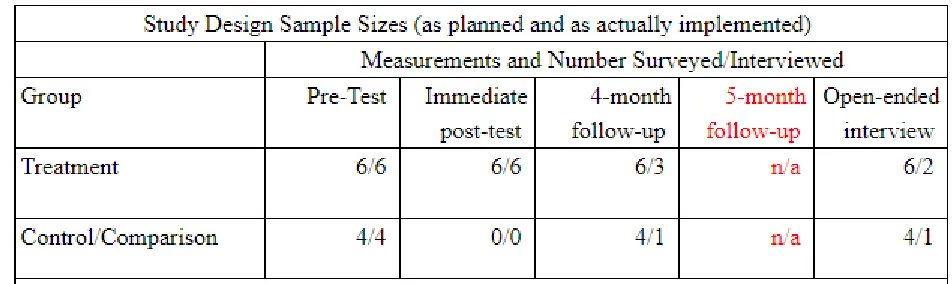
I issued a FL survey pre-intervention, immediately post-intervention, and then four
months post-intervention. I conducted interview-style questioning after the second post-test (four
months post-intervention). About half of the original participants attended. Because no
participants were able to attend the MINA meeting five months post-intervention, disqualifying
the possibility for a third survey, the second survey served as the final survey, which preceded
[image:42.612.65.541.342.484.2]the interviews. Table 1 below details the number of participants at each wave of data collection.
Table 1: Study Design Sample Sizes
Through these data collection measures, I was able to observe several changes within my
sample. Still, these findings must be caveated: because of the small and ever-decreasing sample
size, the strength of the results is questionable. Statistical testing with power was not possible.
Therefore, results below describe individual changes as well as group tendencies to change.
Similarly, discussions stemming from the study will analyze these tendencies and their
32
Participants indicated notable changes throughout the study. FL improved amongst the
treatment group. Susceptibility to victimization also indicated a decrease. People from the
treatment group were better able to identify and avoid predatory behavior, especially regarding
topics they found relevant to their own lives. Finally, there appeared to be evidence of a
multiplier effect, in which one person’s knowledge and beliefs about finances altered the lives of
those around them. This multiplier effect persisted regardless of if the financial perspective
would benefit or adversely affect the advisee. All these results are detailed below.
4.1 Changes to Financial Literacy
Before the intervention, FL was relatively low amongst MINA members in both the
control and treatment groups. Virtually no one knew what a mortgage was; no one knew which
lenders traditionally charged high interest; and no one knew what a shareholder was. Everyone,
however, reported that they knew how to open a bank account. Similarly, when asked to circle
all situations that would likely lead to economic predation, many participants selected soliciting
someone they did not know and who did not work with a business for tax preparation services. It
is worth noting, however, that no one identified both likely predatory situations15 in question.
Overall, MINA members showed a relatively low FL score.
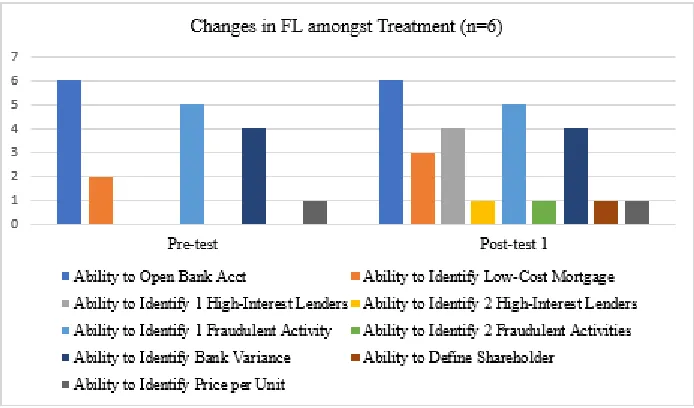
Survey data indicated that FL tended to increase amongst the treatment group (see figure
2)16. This lasted throughout the final wave of data collection. Members noted this, one of whom
stated, “I learned a lot from this [FL] class. I think it was very useful.” Several members were
able to identify predatory situations they did not identify pre-intervention. Likewise, most
workshop recipients could identify more lenders that traditionally charge high interest rates.
15 The situations in question were a) soliciting the services of an unknown and uncertified tax preparer and b) paying
someone who calls, states that they are a bill collector, and requests that a balance be paid immediately.
16 It is assumed that the control group’s FL did not change during the two hours from the pre- to immediate post-test
33
These skills lasted amongst those who were present for the second wave of data collection. That
is, their ability to identify predatory behavior, pinpoint varied policies between banks, and
[image:44.612.132.479.214.418.2]recognize high-risk lenders remained better than it was pre-intervention.
Figure 2: Changes in FL from Pre-test to Post-test One
Notable, however, is that the extent of the effect of the FL course decreased over time for
some topics. For example, one subject could not identify any high-risk lenders pre-intervention.
Immediately post-intervention, they were able to identify two of the three listed lenders. Four
months later, they could only identify one. Likewise, two members displayed more intimate
knowledge of mortgages immediately post-intervention; though, this knowledge decreased over
time. Still, one of those members maintained in full their increased knowledge on high-risk