An Acceptance Model for E-Loaning Services among
University Students
Esther Makori
Jaramogi Oginga Odinga Univ. Sci. & Tech. P.O Box 210, Bondo, Kenya
Department of Information Communication and Technology, Kisii University, P.O Box 408, Kisii, Kenya *Corresponding Author: [email protected]
Copyright © 2014 Horizon Research Publishing All rights reserved.
Abstract
The objective of this research paper was to develop a model that would explain the adoption of electronic loaning applications among University students using the decomposed theory of planned behavior. The researchers obtained the requirements for this model from the field study that they carried out. Before the implementation of the electronic loaning applications, applications were done manually using pen and paper, using forms which were later sent to the Helb headquarters in Nairobi for processing. This system faced setbacks such as losses of the application forms, inefficiency in loan applications processing, loaning repayment evasion due to lost records and lack of transparency and accountability in the loaning process. This led to the adoption of e-loaning applications by Helb, an institution charged with the disbursement of loans to university students. This paper sought to establish the factors that could better explain why e-loaning services users would prefer it over other loaning applications mechanisms. The target population for the study included the University student who are beneficiaries of Helb loans. Simple random sampling method was utilized to select respondents. The collected data was then tabulated and presented in graphs and interpreted. A hypothesized model was designed and the researchers used the study findings drop and adopt the hypothesized constructs. A model was afterwards developed, which the researchers gave the name DTPBMEL (Decomposed Theory of Planned Behavior Model for Electronic Loaning).Keywords
E-loaning, University Students, Model, Helb, Automation1. Introduction
The Kenyan government has an ambitious plan of automating its services. This is meant to boost service delivery to the Kenyan citizens by making them efficient, faster, transparent and reliable. Both the national government and the county governments are keen to achieve these goals.
In the face of soaring inflation rates, automation can greatly help reduce manpower required to do or deliver some services, so that their efforts can be directed elsewhere. One of the key areas of automation is revenue collection. The counties in Kenya are obliged to spend the funds that they collect wisely in order to spur development throughout the country. For this to be achieved, transparency and efficiency in revenue collection is key. Unfortunately, the pen and paper system that most governments inherited from the councils is faced with many challenges, such as non-remittances of revenue, inefficiency in revenue collections, revenue payment evasion and lack of transparency and accountability (Omollo, 2014). In nutshell, revenue consists of both cash inflows and cash outflows. Cash inflow is the movement of cash into the business while revenue outflow is the movement of cash out of the business. The difference between cash inflow and cash outflow is the net cash flow. Example of cash inflows include receipts from trade customers, sales of spare assets, investment of share capital, personal funds invested, investments receipts of bank loan, government grants. On the other hand, cash outflows are items such as payment of wages and salaries, payment of suppliers, buying equipment, interest on bank loans and overdraft, payment of dividends, payment of loans and payment of ;leasing or hiring (Riley, 2012).
The national government of Kenya is faced with many calls for referendums, one of the reasons being the push for more allocation of funds to the county governments. There is therefore need to improve revenue collections at the county level if vision 2030 is to be achieved. Diamond Trust Bank has come in as one of the facilitators for easy revenue collection for county governments. According to Herbling (2014), the bank has already signed a deal with Kisii and Migori Counties and is eyeing more deals to automate revenue collection in other counties.
personal computer (Herbling, 2014).
It is these efforts by the government of Kenya and the county governments to digitize their service that has made other government departments to automate their services, with Helb, an organization that offers loaning facilities to university students, being one of them. Helb has to be in a position to collect all the loans given to the students, and who have finished their studies, so that it can disburse the same to the university students who need them. There is therefore need to increase the avenues through which these loans can be repaid and borrowed.
Helb has so far introduced a number of ways through which its loans can be settled. These include using their website, M-PESA, Airtel Money, direct deposit to bank accounts, EFTs, standing orders, Pesa points, Visa and Mastercards. Despite these efforts, little is known about the factors that can make loan payers and applicants to use these loaning platforms. This was the motivation for the researchers to develop a model that could effectively explain the factors influencing the utilization of these loaning platforms.
This paper utilized the Decomposed Theory of Planned Behavior as basis in the provision of a model that could effectively be applied during the implementation of the E-loaning applications among University students as well as other government departments in Kenya.
2. Related Work
The Decomposed Theory of Planned Behavior (DTPB) was introduced to try and understand the utilization of Information Technology. It more completely explores the dimensions of attitude belief, subjective norm (social influence) and perceived behavioral control by decomposing them into specific belief dimensions (Woon, 2007). Its proposition is that behavioral intention is the principal direct determinant of behavior. However, the original three core constructs still exist: Attitude Toward Behavior (ATB), Subjective Norm (SN), and Perceived Behavior Control (PBC) as first introduced in Theory of Planned Behavior (TPB).
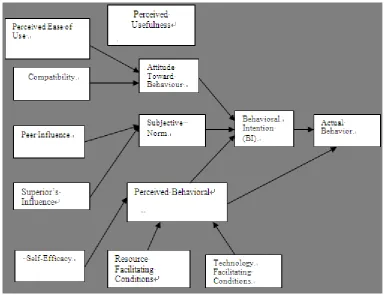
[image:2.595.113.499.414.709.2]This model decomposes attitudinal belief into three factors: Perceived Usefulness (PU), Perceived Ease of Use (PEOU), and Compatibility. These factors have proved to be constantly correlated specifically to Information Technology utilization. Just like other models, it has the ability to introduce immense efficiencies to business processes that can lead to increased loaning applications. The application of technological solutions towards the strategic goals for governments is a key step towards transforming them into entities that can keep abreast of the needs, requirements and expectations of today's modern world (Gidisu, 2012). The figure below shows the pictorial representation of this model.
In this model, normative belief is decomposed into peer influence and superior’s influence. This is because each of these two may have diverse perspectives on Information systems usage. For instance, peers of a customer may be opposed to the use of an information system because they think it needs too much change in their work processes. However, the superiors in an organization may be encouraging their employees to use the system because they anticipate certain productivity payoffs. In such a situation, a monolithic normative structure may show no influence on subjective norm or intention because the effects of the referent groups may cancel each other out. So it has been suggested to decompose normative belief into two referent groups (peers and superiors) because the expectations of peers, and superiors may be expected to differ (Kripanont, 2007).
Perceived Behavior Control (PBC) is decomposed into three constructs: self efficacy, resource facilitating conditions, and technology facilitating conditions. Self efficacy is related to perceived ability, and it is anticipated that higher levels of self-efficacy will result to higher levels of behavioral intention and Information systems utilization. (Sniehotta, 2009). The facilitating conditions construct gives two dimensions for control beliefs. These are one relating to resource factors (resource facilitating conditions) such as time and money and the other relating to technology
compatibility issues (technology facilitating conditions) that may constrain usage. The absence of facilitating resources represents barriers to usage and may inhibit the formation of intention and usage. However the presence of facilitating resources may not encourage usage.
3. Methodology
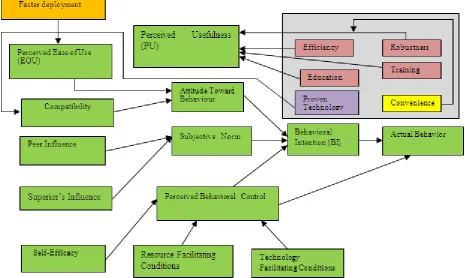
This paper introduced seven constructs to the original DTPB to try and explain the usage of Electronic loaning applications among University students. These variables were education, training, efficiency, proven technology, convenience, faster deployment and robustness. Education is any act or experience that has a formative effect on the mind, character or physical ability of an individual. Training involves identifying the e-loaning service training needs (needs assessment), setting objectives for the training, design the training program (means and methods to be used), identifying users who need the training, conducting the training with follow-up, observing users for signs of adoption or rejection (with feedback) and comparing training outcomes with objectives (Colesca, 2009). Figure 2 below shows this modified DTPB
[image:3.595.72.538.417.695.2].
Efficiency is the degree to which an activity is free of effort while robustness is the robustness is the ability of a system to resist change without adapting is initial stable configurations (Wallenburg, 2012). The E-loaning technology runs on an existing Global System for Mobile Communication (GSM), which is indeed a proven technology. The E-loaning applications should be conveniently accessed from a number of platforms.
All the items are measured by using a four-point Likert scale with anchors ranging from strongly agree (1) Not sure (4). The questionnaires were distributed to 40 respondents and 35 usable data sets were entered into SPSS and analyzed using Lisrel software. The respondents consist of 25.8 percent females against 74.2 percent males. The majority of the sample aged between 29- 45 (44.4 %) and having education at diploma’s degree (37.8%).
Structured Equation Modeling
Structural equation modeling (SEM) was used as the main statistical technique and data were collected through survey questionnaires. The SEM was used to model interactions,
correlations between independent variables, measurement errors and their correlations. This is because of its ability to determine the relationship between multiple latent independent and dependent variables (Werner, 2010). The software of choice was Lisrel (linear structural relations). This is because LISREL can provide its users with potent and user-friendly software. It can generate more realistic models than using standard multivariate statistics or multiple regression models alone. It makes it easy for one to specify, estimate, assess, and present the model in an intuitive path diagram to show anticipated relationships among the research variables.
Structural model
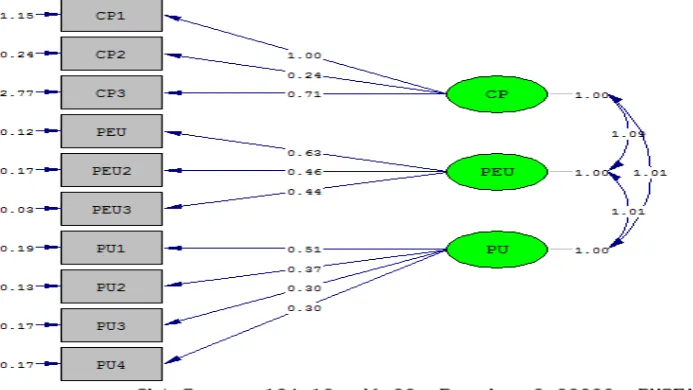
[image:4.595.124.491.346.485.2]The six constructs introduced in the original DTPB were measured using three latent variables, PU PEU and CP. The PU latent variable measured efficiency, robustness, convenience education and training. CP measured proven technology while PEU measured faster deployment. This structural model is shown below.
Figure 3. The Structural Model
As can be seen CP was measured using 3 observable variables, PEU with 3 observable variables while PU was measured using 4 observable variables.
[image:4.595.114.461.539.734.2]4. Results and Discussion
Validity test was performed using reliability (Cronbach Alpha) composite reliability, confirmatory factor analysis (CFA) and average variance extracted (AVE). From the study findings, reliability readings for all variables were well above 0.6 which indicate internal consistency for all measurement variables. The result of CFA shows that all factor loadings are above 0.5 for all items, thus indicating convergent validity for all latent variables. The result of AVE as compared to correlation square (R2) are positive
which shows that discriminant validity was sufficient for all questionnaire constructs.
The structural equation modeling analysis that the researchers carried out showed satisfactory results in terms of model fit and connotation of the relationships. The model fit analysis indicated acceptable scores with 0.908 for CP, 0.932 for PEU and 0.905 for PU. According to Garson (2006), a score of above 0.90 on these indices indicates a good fit. These fit indices have been suggested to be more robust regarding sample biases than the commonly used GFI and AGFI. Moreover, the RMSEA was also satisfactory with a score of 0.380. All relationships within the model reported significant p-values (p=0.000). The final model with the regression weights is shown in Figure 2 above.
The results suggest that efficiency, convenience, education, faster deployment, training robustness and experience with the technology (proven technology) in question is crucial before the technology can be adopted. The result emphasizes that Helb need to make electronic loaning applications technology easily accessible to the loaning payers in all the governments. In addition, it implies that Helb need to make this technology easy to use for it to be efficient. The electronic loaning applications gadgets should thrive on existing technologies so as to be compatible with many devices. Education was also found to be crucial for a given technology’s success. Both the Helb staff rendering E-loaning applications services and the loaning payers and applicants need to be educated on the merits of the new system as well as on its working principles. The loaning platform (which is currently web-based and hence can be accessed via computers, mobile phones and other gadgets) must be able to work effectively for a reasonable period of time so as to build trust on their robustness. During the introduction phase of any technology, the staff needs training. This will ensure that errors occurring as a result of entry of invalid figures are eliminated. Users tend to doubt and lose confidence on new information systems if they frequently give wrong output, hence training of staff on how to operate new information systems is paramount
5. Summary and Conclusions
The Decomposed Theory of Planned Behavior (DTPB) has proven to be effective in predicting Information systems adoption. Nevertheless, this model has never been utilized to predict the usage of E-loaning applications among University students. Given the effort made by the government of Kenya and County governments to automate various services, applying this model is appropriate. This study used the DTPB to predict intention to use electronic loaning applications among University students. A structural equation modeling analysis of data gathered from a sample of more than 37 participants revealed that perceived usefulness, perceived ease of use and compatibility are influential factor. The results of this study suggest governments and Helb should focus their efforts on these fastidious factors, in order to make e-loaning services as effective as possible.
REFERENCES
[1] I. Woon and A. Kankanhalli, (2007), “Investigation of IS professionals’ intention to practice development of applications”, International Journal of Human-Computer Studies, 65(1), 29-41.
[2] E. Gidisu (2012), “Automation System Procedure of the Ghana Loaning Authority on the Effectiveness of Loaning Applications”, Master’s Thesis, Kwame Nkrumah University of Science and Technology.
[3] N. Kripanont (2007), “Examining a Technology Acceptance Model of Internet Usage by Academics within Thai Business Schools”.
[4] F. Sniehotta, (2009), “An experimental test of the Theory of
Planned Behavior”, Applied Psychology: Health and Well-Being, 1, 257–270.
[5] E. Colesca and L. Dobrica, (2009), “E-government Adoption in Romania”, International Journal of Business, Economics, Finance and Management Sciences 1:2
[6] A. Wallenburg, (2012), “Dealing with supply chain risks: linking risk management practices and strategies to performance”, International journal of physical distribution & logistics management, 42(10).
[7] V. Omollo & P Sungu, (2014), “Biometric-Based Authentication Model for E-Card Payment Technology”,
Journal of Computer Engineering.
[8] D. Herbing, (2014) , “DTB eyes more automation deals for
loaning applications in counties ”, Business Daily.
[9] W. Werner (2010), “Introduction to Structural Equation Modeling”, American Institute of Research, America. [10] G. Garson, (2006), “Structural equation modeling”, North