ISSN (Online): 2319-8753 ISSN (Print) : 2347-6710
I
nternational
J
ournal of
I
nnovative
R
esearch in
S
cience,
E
ngineering and
T
echnology
(A High Impact Factor, Monthly, Peer Reviewed Journal)
Visit: www.ijirset.com Vol. 7, Issue 1, January 2018
Copyright to IJIRSET DOI:10.15680/IJIRSET.2018.0701065 400
Combat data Sparsity using Spatial
Hierarchical Collaborative Deep Learning for
user POI Recommendation
Rajnandini Jamdade1, Jyoti kharat2
P.G. Student, Department of Computer Engineering, JSPM Narhe Technical Campus, Pune, Maharashtra, India1
Associate Professor, Department of Computer Engineering, JSPM Narhe Technical Campus, Pune, Maharashtra, India2
ABSTRACT: Point-of-interest recommendation has become an important way to help people discover attractive and
interesting places, especially when they travel out of town. User performance may very important with respect to the geographical reason with different urban area cultures, environment. For solving these all issue I have to propose deep learning and proposed a special aware hierarchical collaborative deep learning algorithm. In this model jointly perform deep representation learning for point of interest from heterogeneous feature and hierarchical additive information learning from special aware individual performance. the collective preferences of the public in a given target regionand the personal preferences of the user in adjacent regions are exploited in the form of social regularization and spatial smoothing. To deal with the multimodal heterogeneous features of the point of interests, we introduce a late feature fusion strategy into our special aware hierarchical collaborative deep learning method model.
KEYWORDS:POI recommendation, Spatial-Aware User Modeling, Deep Learning, DBN, Collaborative Filtering,
Cold Start.
I. INTRODUCTION
In location based social network user can post their current location in the form of check in data on social network and share their experience on it. Using user check in data to make personalized point of interest recommendation in location based social network is used for helping users to explore new point of interests and regions and for facilitating location socialnetwork. In personalized point of interest recommendation ismore essentially important and useful whenever user travelsto unfamiliar area. In this scenario recommendation task isreferred to out of town user. This paper is helpful for goodrecommendation system for home town and out of home townby effectively leveraging their check in data. There are threeproblems for challenging such problem.
A. Special Dynamics for user preferences
In special dynamics for user preferences Users tend tohave different preferences when they travel in regions withdifferent urban compositions and cultures, as noted in userspreferences learned from their check-in history in one region (e.g., home town) may not always be effective for makingrecommendations in another region.
B. Data Sparsity
ISSN (Online): 2319-8753 ISSN (Print) : 2347-6710
I
nternational
J
ournal of
I
nnovative
R
esearch in
S
cience,
E
ngineering and
T
echnology
(A High Impact Factor, Monthly, Peer Reviewed Journal)
Visit: www.ijirset.com Vol. 7, Issue 1, January 2018
C. Cold Start Problem
In point of interests recommendation system cold start is very usual problem. point of interests that have not received any check-ins are called cold-start point of interests. Similarly, users who have not rated any point of interests are called cold-s tart users. Now days there are lots of methods are developed to make POI recommendations for both called cold-s tart users. Now days there are lots of methods are developed to make POI recommendations for bothhometown and out-of-town users. Now a day deep learning models have demonstrated great potential for learning effective representations and delivered the state-of-the-art performance in traditional recommendation tasks. We propose a novel POI recommendation framework to jointly perform spatial-aware personal preference modeling and POI semantic representation learning from versatile POI auxiliary information.
II. RELATED SURVEY
J. Bao, Y. Zheng, and M. F. Mokbel have introduced present a location based and preference-aware recommender system that offers a particular user a set of venues within a geospatial range with the consideration of both: 1) User personal preferences, which are automatically learned from her location history and 2) Social opinions, which are mined from the location histories of the local experts.[1]
T. Chen, W. Zhang, Q. Lu, K. Chen, Z. Zheng, and Y. Yu. Svdfeature introduced SVDFeature, a machine learning toolkit for feature-based collaborative filtering. SVD Feature is designed to efficiently solve the feature-based matrix factorization. The feature-based setting allows us to build factorization models incorporating side information such as temporal dynamics, neighborhood relationship, and hierarchical information.[2]
P. Covington, J. Adams, and E. Sargin described the system at a high level and focus on the dramatic performance improvements brought by deep learning. The paper is split according to the classic two-stage information retrieval dichotomy: first, we detail a deep candidate generation model and then describe
a separate deep ranking model.[3]
R. Das, M. Zaheer, and C. Dyer replaced LDAs parameterization of topics as categorical distributions over opaque word types with multivariate Gaussian distributions on the embedding space. This encourages the model to group words that are a priori known to be semantically related into topics.[4]
G. Ference, M. Ye, and W.-C. Lee introduced the issues in making location recommendations for out-of-town users by taking into account user preference, social inuence and geographical proximity.[5]
G. E. Hinton, S. Osindero, and Y.-W. Teh introduced the each training case consists of an image and an explicit class label, but work in progress has shown that the same learning algorithm can be used if the labels are replaced by a multilayer pathway whose inputs are spectrograms from multiple different speakers saying isolated digits.[6]
G. E. Hinton and R. R. Salakhutdinov presented the efficient learning and inference algorithms for this model, and show how a Monte-Carlo based method, Annealed Importance Sampling, can be used to produce an accurate estimate of the log-probability the model assigns to test data.[7]
D. Kim, C. Park, J. Oh, S. Lee, and H. Yu proposed a novel context-aware recommendation model, convolutional matrix factorization that integrates convolution neural network (CNN) into probabilistic matrix factorization .Consequently, ConvMF captures contextual information of documents and further enhances the rating prediction accuracy.[8]
S. Li, J. Kawale, and Y. Fu introduced a deep learning modelfor collaborative filtering that tightly couples matrix factorizationbased collaborative filtering with deep learning algorithmnamely marginalized denoising auto-encoders (mDA).[9]
III. PROPOSED SYSTEM
ISSN (Online): 2319-8753 ISSN (Print) : 2347-6710
I
nternational
J
ournal of
I
nnovative
R
esearch in
S
cience,
E
ngineering and
T
echnology
(A High Impact Factor, Monthly, Peer Reviewed Journal)
Visit: www.ijirset.com Vol. 7, Issue 1, January 2018
Copyright to IJIRSET DOI:10.15680/IJIRSET.2018.0701065 402
this model jointlyperform deep representation learning for point of interestfrom heterogeneous feature and hierarchical additive informationlearning from special aware individual performance.the collective preferences of the public in a given targetregion and the personal preferences of the user in adjacentregions are exploited in the form of social regularization andspatial smoothing. To deal with the multimodal heterogeneousfeatures of the point of interests, we introduce a late featurefusion strategy into our special aware hierarchical collaborative deep learning model.
A. Proposed System Architecture
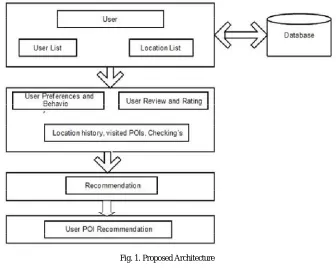
Architecture introduces, users can post their physical locationsin the form of a check-in and share their life experienceson the location based social network such as Yelp ,foursquare. Using user check-in data to make personalized POI recommendationin location based social network is crucialfor helping users to explore new POIs and regions. In oursystem user can upload dataset (yelp, foursquare) and user canapply spatial-aware hierarchical collaborative deep learning onreview rating of location history, visited POI, and checkings.The model jointly performs deep representation learning forPOIs from heterogeneous features and hierarchically additiverepresentation learning for spatial-aware personal preferences.By using location based review and rating record our modelwill generate user POI recommendation.
Fig. 1. Proposed Architecture
A. Mathematical Formulae:-
Let S be a system having Input(I), user(u) and POI(v).
S=I,U,V
where,
ISSN (Online): 2319-8753 ISSN (Print) : 2347-6710
I
nternational
J
ournal of
I
nnovative
R
esearch in
S
cience,
E
ngineering and
T
echnology
(A High Impact Factor, Monthly, Peer Reviewed Journal)
Visit: www.ijirset.com Vol. 7, Issue 1, January 2018
V is the user point of interest. F={F1}
where,
F is the set of functions used for SH-CDL. F1 is a function for SH-CDL.
Here we consider two latent factor for user and their POI interest (pu , qv). The probabilistic generative model is listed as follow-
1)Sample Pu| u –N(0, ˆ2u I)
2)Sample qv | v –N(0, ˆ2v I)
3)Sample C u ,v | u, – qv , PC -N(g( ), Pˆ2C I) Then,
1) Calculate the log-likelihood of probabilistic matric factorization…
LMF= +λu/2
LMF=
2)RBMs and Their Generalizations
E(x,y;ψ)=
Where,
Ψ={W, a, b} are the model parameters and ɛ= is the total number of words in a document.
3) Deep Belief Network
P(x , h 1.h L; ψ )= )P( )
4)Model inference of SH-CDL
=
5)POI Recommendation
S(q,v)=g( )
B. SH-CDL Algorithm
Step 1) Input: q=(uq , rq ,sq) Where,
ISSN (Online): 2319-8753 ISSN (Print) : 2347-6710
I
nternational
J
ournal of
I
nnovative
R
esearch in
S
cience,
E
ngineering and
T
echnology
(A High Impact Factor, Monthly, Peer Reviewed Journal)
Visit: www.ijirset.com Vol. 7, Issue 1, January 2018
Copyright to IJIRSET DOI:10.15680/IJIRSET.2018.0701065 404
Step 2) Select the top-k with highest ranking scores as recommendations.
S(q; v) = g(PT uq; rqqv)
Step 3) As a latent factor vector qv is approximate to hidden feature vector DBN (Xv , ) .
The ranking score of the cold star POI can becomputed as:
S(q , v)= g( )
Step 4)As for cold –start userSH-CDL can makeaccurate recommendation according to collectivepreferencesof the crowed with the sam role Sq at target region rq.
S(q, v)=g( )
IV. EXPERIMENTAL RESULTS
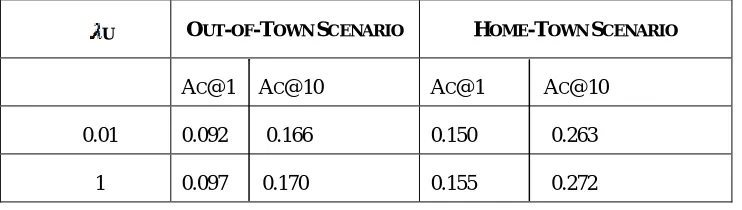
I have studied the impact of the spatial pyramids height and the regularization parameter for personal preference vectors on the Yelp dataset.
U OUT-OF-TOWN SCENARIO HOME-TOWN SCENARIO
AC@1 AC@10 AC@1 AC@10
0.01 0.092 0.166 0.150 0.263
1 0.097 0.170 0.155 0.272
Fig. 2. Recommendation Accuracy on Yelp Dataset
u is another important hyper-parameter in SH-CDL. The larger the u more similar the personal preferences
, r are to the collective preferences of the crowd with the same role s,r and the more strongly , r is regularized.
When u becomes extremely small, our SH-CDL would degenerate to SH-CDL-T2 where the collective preferences
are not exploited. To study its impact, we test the performance of SH-CDL model by varying the value of u from 0.01 to 100, and the results are presented in Table 2. From the results,we observe that the recommendation accuracy of SH-CDL first increases with the increasing u and then begins to decrease.
ISSN (Online): 2319-8753 ISSN (Print) : 2347-6710
I
nternational
J
ournal of
I
nnovative
R
esearch in
S
cience,
E
ngineering and
T
echnology
(A High Impact Factor, Monthly, Peer Reviewed Journal)
Visit: www.ijirset.com Vol. 7, Issue 1, January 2018
Fig 3. Out-of-town Recommendation for Yelp
Fig 4. Home-town Recommendation for Yelp
V. CONCLUSION
We developed a POI recommendation model SH-CDL to jointly perform deep representation learning for POIs from heterogeneous features and hierarchically additive representation learning for spatial-aware personal preferences to overcome the challenges of the spatial dynamics of user preferences, cold start and data sparsity. Social regularization and spatial smoothing technologies were developed to overcome data sparsity in the spatial-aware dynamic user preference modeling. To deal with the multimodal heterogeneous features, we extended the DBN to MDBN by introducing a late feature fusion strategy.
REFERENCES
1. J. Bao, Y. Zheng, and M. F. Mokbel. Location-based and preferenceaware recommendation using sparse geo-social networking data. In SIGSPATIAL, pages 199208, 2012.
2. T. Chen, W. Zhang, Q. Lu, K. Chen, Z. Zheng, and Y. Yu. Svdfeature: A toolkit for feature-based collaborative filtering. J. Mach. Learn. Res., 13(1):36193622, Dec. 2012.
3. P. Covington, J. Adams, and E. Sargin. Deep neural networks for youtube recommendations. In RecSys, pages 191198, 2016. 4. R. Das, M. Zaheer, and C. Dyer. Gaussian lda for topic models with word embeddings. In ACL, pages 795804, 2015.
5. G. Ference, M. Ye, and W.-C. Lee. Location recommendation for outoftownusers in location-based social networks. In CIKM, pages 721726, 2013. 6. G. E. Hinton, S. Osindero, and Y.-W. Teh. A fast learning algorithm for deep belief nets. Neural computation, 18(7):15271554, 2006.
7. G. E. Hinton and R. R. Salakhutdinov. Replicated softmax: an undirected topic model. In Advances in neural information processing systems, pages 16071614, 2009.
8. D. Kim, C. Park, J. Oh, S. Lee, and H. Yu. Convolutional matrix factorization for document context-aware recommendation. In RecSys, pages 233240, 2016.
9. S. Li, J. Kawale, and Y. Fu. Deep collaborative filtering via marginalized denoising auto-encoder. In CIKM, pages 811820, 2015.