
Supporting the Tutor in a Tutor-Tutee Adaptive
Educational System
A thesis submitted to the University of Dublin, Trinity College
for the degree of Doctor of Philosophy
Orla Lahart
Department of Computer Science University of Dublin
Declaration
The work presented in this thesis is, except where otherwise stated, entirely that of the author and has not been submitted as an exercise for a degree at this or any other university.
Signed:
_________________________ Orla Lahart
October, 2008
Permission to Lend or Copy
I agree that the library of the University of Dublin, Trinity College of Dublin, has my permission to lend or copy this thesis.
Signed:
_________________________ Orla Lahart
iii
Acknowledgements
Firstly, I would like to thank my supervisor, Brendan Tangney, for all his guidance throughout my PhD journey.
Secondly, I would like to express gratitude to all the members of the CRITE research group for providing a forum where I could discuss ideas and receive important feedback. In addition, I would like to express thanks to the many anonymous reviewers of papers I have submitted to conferences over the years.
Thirdly, I would like to thank my colleagues in the School of Computing for all their support. In particular, to Elaine Maher and Stephan Weibelzahl for their insightful comments on drafts of this thesis and Frances Sheridan and Shauna Cassidy for their help in carrying out the research studies.
I would also like to express heartfelt gratitude to all the teachers, parents and children who participated in the various studies.
To my wonderful sister Johanna, thank you for all your help with proof reading and research studies but above all thanks for your precious friendship. Thank you to my brothers Dáire and Ronan for all your encouragement.
I would like to thank my parents for instilling the value of education within me from an early age and for their incredible support throughout out my academic endeavours.
Executive Summary
Adaptive educational systems have been successful in providing personalised support in a myriad of domains (Melias & Siekmann, 2004). To provide such support, the adaptive educational system builds an internal representation of the user by analysing the user’s behaviour including their knowledge and traits (Brusilovsky & Peylo, 2003). The resulting model is used to adapt the learning environment to that which best suits the individual learner. Furthermore, within a tutoring environment where there are two users, tutor and tutee, working collaboratively to reach a common goal, there may be a need to provide personalised domain support for both users.
One particular environment where there may be a need for such a system is home tutoring. Despite the large body of research, which suggests a high correlation between home tutoring and a child’s academic success (Greenwood & Hickman, 1991; Dornbusch & Ritter, 1988), parental involvement in learning activities in the home may not occur spontaneously due to self-believed lack of ability, knowledge and skills (Hoover-Dempsey & Sandler, 1995). However, research indicates the benefit of supporting the tutor in the development of tutoring strategies (Cotton & Savard, 1982). Hence, the need for the development of an adaptive educational system, which supports both, tutor (parent) and tutee (child) during the home tutoring process. Such a system could in particular be of most benefit in supporting the tutor in the development of tutoring strategies.
There are many unresolved issues in developing such an adaptive educational systems. Research questions still outstanding include: (1) how can an adaptive engine simultaneously support dual users (tutor and tutee) (2) what is the appropriate educational theory from which to elicit a set of rules, which define tutoring best practice and (3) what is an appropriate basis for adapting to the needs of the tutor and tutee? This thesis describes how the Parent and Child Tutor (P.A.C.T.) adaptive educational system addresses these challenges.
v
Empirical studies were conducted to explore the effect of using an adaptive educational system to support the home tutoring process in the domains of Suzuki violin and mathematics. In particular, these studies explored the effect of P.A.C.T. on parents’ (1) self-efficacy (2) knowledge and (3) perception of their role as home tutor. In addition, studies investigated the effect of providing affective support for the child throughout the home tutoring process. Results suggest that P.A.C.T. may be of benefit in increasing parental self-efficacy and parents’ knowledge of home tutoring skills. They also indicate that P.A.C.T. may have a positive effect on parents’ perception of their role as home tutor. Results also suggest that adapting the tutoring process based on the affective needs of the child may have a positive effect on the home tutoring process.
In summary the main contributions of this thesis are:
• The design and development of an architecture, which supports dual user adaptivity in the domain of home tutoring.
• The articulation and development of a set of novel tutoring rules based on Talent Education philosophy, which defines tutoring best practice.
Related Publications
Lahart, O. & Weibelzahl, S. (2004). Music Matters an ITS for Violin students. In G. Richards (Ed.), Proceedings of World Conference on E-Learning in Corporate, Government, Healthcare, and Higher Education 2004. Chesapeake, VA: AACE, 1662-1666.
Lahart, O. (2005). An ITS that provides Positive Feedback for Beginning Violin Students. AIED 2005. In: Proceedings of the Twelfth International Conference on Artificial Intelligence in Education, AIED'05, Amsterdam, Netherlands, 964.
Lahart, O., Kelly, D. & Tangney, B. (2006). P.A.C.T. - Scaffolding best practice in home tutoring. IN: Proceedings of the Eight International Conference on Intelligent Tutoring Systems (ITS’06), 26-30 June, Jhongli, Taiwan. Berlin, Springer, 615-625.
Lahart, O., Kelly, D. & Tangney, B. (2007a). Tutoring Strategies to facilitate positive emotional states during home tutoring. Workshop on Modeling and scaffolding Affective experiences to impact Learning Supplementary Proceedings of the 13th International Conference of Artificial Intelligence in Education (AIED 2007), Los Angeles, U.S.A. July 2007, 85-93.
Lahart, O., Kelly, D. & Tangney, B. (2007b). Ask the Tutor - Supporting the Home Tutoring Process. CIANEI 07, Portugal. Oct. 2007, 257-265.
Lahart, O., Kelly, D. & Tangney, B. (2007c). Towards Personalised Support for Home Tutors: Identification of Tutoring Rules. EdMedia, Vancouver, Canada. June, 2864-2870.
vii
Lahart, O., Kelly, D. & Tangney, B. (2008a). Development of a Dual User Adaptive Education System. In Proceedings of World Conference on Educational Multimedia, Hypermedia and Telecommunications 2008. Chesapeake, VA: AACE, 1768-1778.
Lahart, O., Kelly, D. & Tangney, B. (2008b). Evaluation of PA.C.T. - Measuring its effect on the Home Tutoring Process. In Proceedings of the International Conference on Interactive Computer Aided Learning 2008. Villach, Austria , Kassel University Press, 2008, ISBN 978-3-89958- 353-3.
Table of Contents
1.1 Motivation... 1
1.2 Background ... 1
1.3 P.A.C.T. Adaptive Educational System ... 3
1.4 Research Goals & Contributions... 5
1.5 Structure of Dissertation ... 6
2 LITERATURE REVIEW ... 8
2.1 Introduction... 8
2.2 Education Theory... 9
2.2.1 Home Schooling... 9
2.2.2 Classroom context... 11
2.2.3 Talent Education Philosophy ... 12
2.2.4 Education Theories Summary ... 13
2.3 Self-Efficacy... 13
2.3.1 Sources of Self-Efficacy ... 14
2.3.2 Effects of Self-Efficacy... 15
2.3.3 Measuring Self-Efficacy ... 16
2.3.4 Self-Efficacy Summary... 17
2.4 Affect ... 17
2.4.1 Basic Emotions ... 17
2.4.2 Affect Summary... 20
2.5 Adaptive Educational Systems... 20
2.5.1 Introduction... 20
2.5.2 Adaptive Hypermedia ... 23
ix
2.5.3.1 Supporting the Collaborative Process... 25
2.5.3.1.1 Supporting Deep Collaborative Discussion ... 25
2.5.3.1.2 Supporting Group Collaboration... 26
2.5.3.2 Supporting Domain Learning through Collaboration... 27
2.5.4 Adaptive Education Systems & Self-Efficacy ... 31
2.5.5 Adaptive Education Systems & Affect ... 36
2.5.5.1 Techniques for eliciting emotion... 36
2.5.5.2 Adapting the Learning Environment Based on Affect ... 40
2.5.6 Adaptive Education Systems Summary ... 42
2.6 Discussion... 43
2.7 Research Challenges ... 45
2.8 Summary... 46
3 P.A.C.T. ... 47
3.1 Introduction... 47
3.2 Overall Architecture ... 47
3.3 Domain Model ... 49
3.3.1 Parent Domain Model ... 49
3.3.2 Child Domain Model ... 53
3.3.2.1 Suzuki Violin... 53
3.3.2.2 Mathematics ... 55
3.3.3 Domain Models Summary ... 60
3.4 User Models ... 63
3.5 Presentation Model ... 64
3.6 Pedagogical Model ... 66
3.7 Technical Implementation... 67
4 ADAPTIVE ENGINE ... 69
4.1 Introduction... 69
4.2 Engine Architecture... 69
4.2.1 Tutoring Rules ... 70
4.2.1.1 Elicitation of Tutoring Rules ... 70
4.2.1.2 Description of Tutoring Rules ... 72
4.2.2 Content Rules... 73
4.2.2.1 Phase Specific Content Rules ... 73
4.2.2.2 Domain Specific Content Rules ... 75
4.2.3 Efficacy Rules ... 75
4.3 The Dual-User Approach ... 79
4.4 Implementation of Engine Architecture ... 79
4.5 Summary... 81
5 RULE ELICITATION AND VALIDATION... 82
5.1 Introduction... 82
5.2 Rule Elicitation... 82
5.2.1 Validating Tutoring Tactics – Methodology... 82
5.2.2 Validating Suzuki Tutoring Tactics – Results ... 83
5.3 Tutoring Phases Validation... 84
5.3.1 Validation Key Phases in a Suzuki Lesson ... 84
5.4 Tutoring Rules Validation... 85
5.4.1 Tutoring Rules Validation – Phase 1 ... 85
5.4.2 Tutoring Rules Validation – Phase 2 ... 90
5.4.2.1 Validation Tutoring Rules Phase 2 - Instrument Development... 90
5.4.2.2 Validation Tutoring Rules Phase 2 - The Study ... 92
5.4.2.3 Validation Tutoring Rules Phase 2 - The Results... 93
5.4.3 Validation Tutoring Rules – Phase 3 ... 94
xi
6 EXPERIMENTAL DESIGN ... 96
6.1 Introduction... 96
6.2 Experimental Design... 96
6.2.1 Experimental Design – Phase 1 ... 97
6.2.2 Experimental Design – Phase 2 ... 97
6.3 Experimental Procedure... 98
6.4 Data Collection ... 100
6.4.1 Self-Efficacy ... 100
6.4.2 Affective State... 101
6.5 Participants... 101
6.6 Summary... 102
7 RESULTS ... 103
7.1 Introduction... 103
7.2 Study 1: Evaluating the effect of an AES to support the home tutoring process in the domain of music ... 105
7.2.1 Investigating the effect of P.A.C.T. on Parents... 106
7.2.1.1 Self-Efficacy... 106
7.2.1.1.1 Self-Efficacy Pre and Post Test Scores... 107
7.2.1.1.2 Self -Efficacy Paths... 109
7.2.1.2 Parents’ Knowledge... 119
7.2.1.3 Role of Home Tutor... 123
7.2.1.3.1 Providing Structure ... 124
7.2.1.3.2 Giving Full Attention... 124
7.2.1.3.3 Be more Fun/Positive... 125
7.2.1.3.4 Awareness of Child’s Affective State... 126
7.2.1.3.5 Role of Home Tutor Summary ... 127
7.2.1.4 The Effect of P.A.C.T. on Parents Summary ... 127
7.2.2 The provision of Affective Support ... 128
7.2.2.2 Strategies for Eliciting Affect... 129
7.2.2.3 Adapting based on Affect ... 130
7.2.2.4 Affective Support Summary... 132
7.2.3 Role of P.A.C.T... 133
7.2.3.1 Creating a Positive Environment ... 133
7.2.3.2 Acting as Mediator ... 134
7.2.3.3 Role of P.A.C.T. Summary ... 136
7.2.4 Study 1 Summary... 136
7.3 Study 2: Evaluating the effect of using an adaptive educational system to support mathematics homework. ... 137
7.3.1 Investigating the effect of P.A.C.T. on Parents... 139
7.3.1.1 Self-Efficacy... 139
7.3.1.1.1 Self-Efficacy Pre and Post Test Scores... 140
7.3.1.1.2 Self-Efficacy Paths... 140
7.3.1.2 Parents’ Knowledge... 151
7.3.1.3 Role as Home Tutor... 154
7.3.1.4 The Effect of P.A.C.T. on Parents Summary ... 156
7.3.2 The provision of Affective Support ... 156
7.3.2.1 Affective Experiences ... 156
7.3.2.2 Strategies for Eliciting Affect... 157
7.3.2.3 Adapting based on Affect ... 158
7.3.2.4 Affective Support Summary... 158
7.3.3 Role of P.A.C.T... 159
7.3.3.1 Role of P.A.C.T. Summary ... 160
7.3.4 Study 2 Summary... 160
7.4 Discussion... 160
8 CONCLUSIONS... 167
8.1 Introduction... 167
8.2 Summary of Research Findings... 167
8.2.1 Dual-User Architecture ... 168
8.2.2 Tutoring Strategies ... 169
xiii
8.3 Limitations of Work ... 171
8.4 Directions for Future Research ... 172
8.4.1 Dual-User Architecture ... 172
8.4.2 Tutoring Strategies ... 173
8.4.3 Basis for Adaptivity ... 173
8.5 Conclusion ... 174
APPENDIX A...……….177
APPENDIX B...……….186
APPENDIX C...……….201
APPENDIX D...……….210
List of Figures
Figure 1.1 P.A.C.T. Architecture ... 4
Figure 2.1 The taxonomy of Adaptive Hypermedia Technologies, (adapted from Brusilovsky, 2001) ... 24
Figure 3.1 P.A.C.T. Architecture ... 48
Figure 3.2 Tutor-Tutee Support ... 48
Figure 3.3 Tutoring Tactics... 49
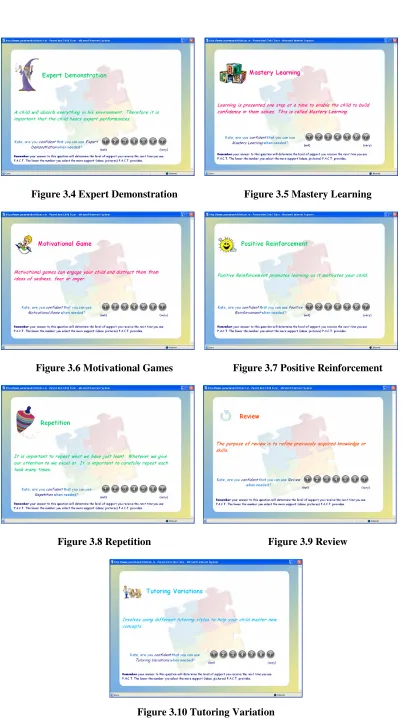
Figure 3.4 Expert Demonstration... 52
Figure 3.5 Mastery Learning... 52
Figure 3.6 Motivational Games ... 52
Figure 3.7 Positive Reinforcement... 52
Figure 3.8 Repetition ... 52
Figure 3.9 Review... 52
Figure 3.10 Tutoring Variation ... 52
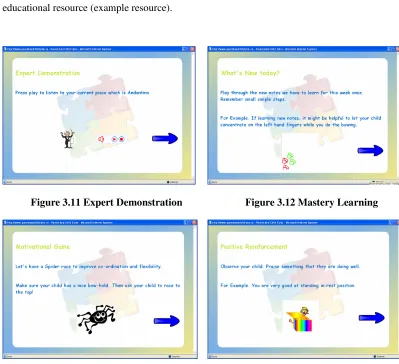
Figure 3.11 Expert Demonstration... 54
Figure 3.12 Mastery Learning... 54
Figure 3.13 Motivational Games ... 55
Figure 3.14 Positive Reinforcement... 55
Figure 3.15 Repetition ... 55
Figure 3.16 Review... 55
Figure 3.17 Tutoring Variation ... 55
Figure 3.18 Early Mathematical Activities – Matching... 57
Figure 3.19 Number - Portioning... 57
Figure 3.20 Algebra – Extending Patterns ... 57
Figure 3.21 Shape and Space – 2-D ... 57
Figure 3.22 Measures – Money... 58
Figure 3.23 Data... 58
Figure 3.24 Expert Demonstration... 59
Figure 3.25 Mastery Learning... 59
xv
Figure 3.27 Positive Reinforcement... 59
Figure 3.28 Tutoring Variation ... 60
Figure 3.29 Presentation Model Events ... 64
Figure 3.30 Events in Presentation Model ... 65
Figure 3.31 Events in Presentation Model ... 65
Figure 3.32 Mediator Behavioural Design Pattern ... 68
Figure 4.1 Adaptive Engine - Pedagogical Rules ... 69
Figure 4.2 Inferred Rule... 70
Figure 4.3 Sample Scenario ... 71
Figure 4.4 Rule Elicitation ... 71
Figure 4.5 Phase Specific Content Rules (Explanation & Example) ... 74
Figure 4.6 Phase Specific Content Rules (Reflection)... 74
Figure 4.7 Domain Specific Content Rules (Review)... 74
Figure 4.8 Domain Specific Content Rules (Expert Demonstration)... 74
Figure 4.9 Self-Efficacy Collection Instrument ... 76
Figure 4.10 Self-Efficacy Rules... 77
Figure 4.11 Self-Efficacy Value 1 - 2 ... 77
Figure 4.12 Self-Efficacy Value 3 - 4 ... 78
Figure 4.13 Self-Efficacy Value 5 - 6 ... 78
Figure 4.14 Self-Efficacy Value 7 ... 78
Figure 4.15 Forward Chaining Algorithm ... 80
Figure 5.1 Rule Validation... 91
Figure 5.2 Rule Validation Reflection ... 91
Figure 5.3 Capturing Feedback on Specific Tutoring Rules... 91
Figure 5.4 Role-Play Card ... 92
Figure 6.1 Experimental Procedure ... 98
Figure 6.2 Excerpt form Pre-Questionnaire... 99
Figure 6.3 Eliciting Self-Efficacy ... 100
Figure 6.4 Eliciting Emotion... 101
Figure 7.1 Pre-Questionnaire Excerpt – Self-Efficacy ... 107
Figure 7.3 Tutoring Tactic Occurrences ... 109
Figure 7.4 Mastery Learning Self-Efficacy Values – Full Support ... 110
Figure 7.5 Repetition Self-Efficacy Values – Full Support ... 111
Figure 7.6 Review Self-Efficacy Values – Full Support... 112
Figure 7.7 Mastery Learning Self-Efficacy Values – Adaptive Support ... 114
Figure 7.8 Repetition Self-Efficacy Values – Adaptive Support ... 115
Figure 7.9 Review Self-Efficacy Values – Adaptive Support ... 116
Figure 7.10 Chloe’s Self-Efficacy Values ... 119
Figure 7.11 Pre-Questionnaire Excerpt – Knowledge ... 120
Figure 7.12 Affective Experiences... 128
Figure 7.13 Self-Efficacy Value of 7 ... 138
Figure 7.14 Self-Efficacy Value of 5-6... 138
Figure 7.15 Self-Efficacy Value of 3-4... 138
Figure 7.16 Tutoring Tactic Occurrences ... 141
Figure 7.17 Review Self-Efficacy Values – Full Support... 142
Figure 7.18 Mastery Learning Self-Efficacy Values – Full Support ... 143
Figure 7.19 Positive Reinforcement Self-Efficacy Values – Full Support ... 145
Figure 7.20 Review Self-Efficacy Values – Adaptive Support ... 146
Figure 7.21 Mastery Learning Self-Efficacy Values – Adaptive Support ... 147
Figure 7.22 Positive Reinforcement Self-Efficacy Values – Adaptive Support ... 148
Figure 7.23 Breakdown of Requests for Additional Support by Tutoring Tactic... 150
Figure 7.24 % Time Further Support Required by Tutoring Tactic ... 150
Figure 7.25 Pre and Post Questionnaire Example... 151
Figure 7.26 Affective Experiences... 157
xvii
List of Tables
Table 2.1 Major Basic Emotion Theorists (Based on Ortony & Turner, 1990)... 18
Table 2.2 Categories of Emotions (Based on Parrot, 2001)... 19
Table 2.3 Adaptive Collaborative Systems... 29
Table 2.4 Adaptive Educational Systems and Self-Efficacy ... 35
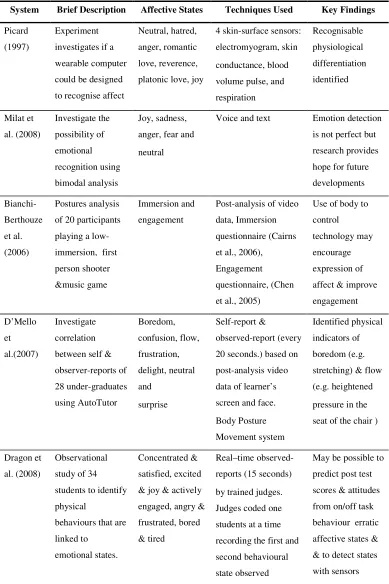
Table 2.5 Eliciting Emotion Using Biophysical Sensor Recordings ... 37
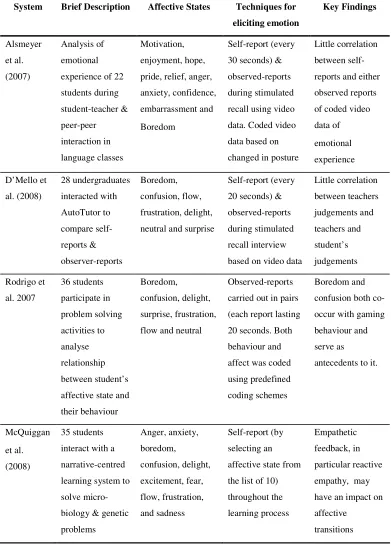
Table 2.6 Emotion Using Self-Reports/Observed-Reports... 39
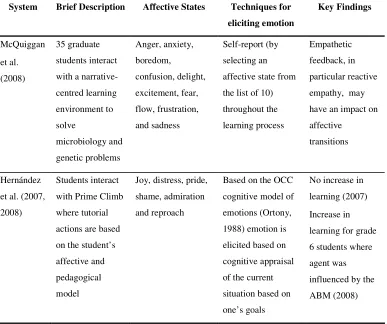
Table 2.7 Adapting the Learning Environment based on Affect ... 41
Table 3.1 Domain Content (Explanation, Example & Reflection) ... 51
Table 3.2 Junior Infants Mathematics Strands and Strand Units ... 56
Table 3.3 Suzuki Violin Resources... 61
Table 3.4 Mathematics Resources ... 62
Table 4.1 Rule Elicitation – Resulting Rules ... 72
Table 4.2 Tutoring Rules ... 73
Table 5.1 Tutoring Tactics Validation ... 83
Table 5.2 Tutoring Phases Validation... 84
Table 5.3 Tutoring Rules (51 rules) ... 85
Table 5.4 Rule Refinements – Beginning Phase... 86
Table 5.5 Rule Refinements – Review Phase ... 87
Table 5.6 Rule Refinements – New Material Phase ... 88
Table 5.7 Rule Refinements – Repetition Phase... 89
Table 5.8 Tutoring Rules (42 rules) ... 90
Table 5.9 Validation Study Phase 2 – Results ... 93
Table 5.10 Tutoring Rules (40 rules) ... 95
Table 7.1 Data Collection and Analysis Techniques ... 104
Table 7.2 Pre and Post Test Mean Values (Self-Efficacy)... 108
Table 7.3 Calculating Self-Efficacy Values – Mastery Learning Full Support ... 111
Table 7.4 Calculating Self-Efficacy Values – Repetition Full Support ... 112
Table 7.5 Calculating Self-Efficacy Values – Review Full Support ... 113
Table 7.7 Calculating Self-Efficacy Values – Mastery Learning Adaptive Support ... 115
Table 7.8 Calculating Self-Efficacy Values – Repetition Adaptive Support... 116
Table 7.9 Calculating Self-Efficacy Values – Review Adaptive Support ... 117
Table 7.10 Qualitative Data - Self-Efficacy Path Adaptive Support ... 118
Table 7.11 Pre and Post Test Mean Values (Knowledge What)... 120
Table 7.12 Pre and Post Test Mean Values (Knowledge When) ... 121
Table 7.13 Qualitative Data – Knowledge... 123
Table 7.14 Qualitative Data – Role of Home Tutor (Structure) ... 124
Table 7.15 Qualitative Data – Role of Home Tutor (Attention) ... 125
Table 7.16 Qualitative Data – Role of Home Tutor (Creating a Positive Learning Environment) ... 126
Table 7.17 Qualitative Data – Role of Home Tutor (Awareness of Child’s Affective State) ... 127
Table 7.18 Strategies for Eliciting Affect ... 129
Table 7.19 The Effect of Adapting Based of Affect ... 130
Table 7.20 Effect of Adapting Based on Affect... 131
Table 7.21 Gaming the System ... 132
Table 7.22 Creating a Positive Learning Environment with P.A.C.T... 134
Table 7.23 P.A.C.T. as Mediator ... 135
Table 7.24 Challenges of using P.A.C.T... 136
Table 7.25 Pre and Post Test Scores of all Participants... 140
Table 7.26 Calculating Self-Efficacy Values – Review Full Support... 143
Table 7.27 Calculating Self-Efficacy Values – Mastery Learning Full Support ... 144
Table 7.28 Calculating Self-Efficacy Values – Positive Reinforcement Full Support ... 145
Table 7.29 Calculating Self-Efficacy Values – Review Adaptive Support ... 146
Table 7.30 Calculating Self-Efficacy Values – Mastery Learning Adaptive... 147
Table 7.31 Calculating Self-Efficacy Values – Positive Reinforcement Adaptive... 148
Table 7.32 Requests for Further Support ... 150
Table 7.33 Knowledge (What) Pre and Post Test Scores ... 152
Table 7.34 Knowledge (When) Pre and Post Test Scores ... 153
xix
1 Introduction
1.1 Motivation
Adaptive educational systems have been successful in providing personalised support in a myriad of domains (Melias & Siekmann, 2004). To provide personalised support, adaptive educational systems build an internal representation of the user by analysing the user’s behaviour including their knowledge and traits (Brusilovsky & Peylo, 2003). Subsequently, the resulting model is used to adapt the learning environment to that which bests suits the individual learner. Furthermore, within a tutoring environment where there are two users, tutor and tutee, working collaboratively to reach a common goal, there may be a need to provide personalised domain support for both users.
One tutoring environment where there may be a need for such a system is the area of home tutoring. Despite the large body of research, which suggests a high correlation between home tutoring and a child’s academic success (Greenwood & Hickman, 1991; Dornbusch & Ritter, 1988), parental involvement in learning activities in the home may not occur spontaneously due to self-believed lack of ability, knowledge and skills (Hoover-Dempsey & Sandler, 1995). However, research indicates the benefit of supporting the tutor in the development of tutoring strategies (Cotton & Savard, 1982). Hence, the need for the development of an adaptive system, which supports both, tutor (parent) and tutee (child) working collaboratively throughout the home tutoring process. Such a system could in particular be of most benefit in supporting the tutor in the development of tutoring strategies.
1.2 Background
2
tutee throughout the home tutoring process, there may be most benefit in providing adaptive domain support, as the nature of learning activities in the home will naturally promote parent-child collaboration.
Building an adaptive system that simultaneously supports dual users (tutor and tutee) working collaboratively is non-trivial and includes two important considerations. Firstly, what is the appropriate educational theory from which to elicit a set of rules that define tutoring best practice and secondly what is an appropriate basis for adapting to the needs of the tutor and tutee?
A number of educational theories exist supporting both the home and school contexts. Home schooling comprises numerous approaches (Mason, 1993; Holt & Farenga, 2003) and in parallel, a number of educational theories support the traditional classroom context (Schunk, 2000). However, few educational theories bridge the gap between home and school. Talent Education philosophy is one such theory, which defines a learning environment where the parent complements the classroom teaching through learning activities in the home (Suzuki, 1986). Shinichi Suzuki (1898-1998) believed that every child has talent, which can be developed if the proper learning environment exists. Suzuki was one of the founding members of a music school, which later became known as the Talent Education Research Institute. Since then Talent Education philosophy (also known as the Suzuki method) has been found to be useful in a number of domains (general education (e.g. The Suzuki Charter School, Alberta, Canada) and teaching programming (Lui et al., 2004)). However, it has predominantly been applied to teaching music. One aspect of Talent Education philosophy that differs from other educational philosophies is the importance of the role of the parent as home tutor, hence, its suitability for informing a set of tutoring rules that inform home tutoring best practice.
In a tutor-tutee, adaptive system there is also a need to provide personalised support for the tutee. In the domain of home tutoring, in parallel to adapting support to the parent based on self-efficacy, there is also a need to provide personalised support for the child. This support can comprise cognitive, affective and motivational support (Parkinson & Coleman, 1995). The importance of the provision of affective support is clearly outlined in Talent Education philosophy (“circumstances surrounding the repetition (practice) must be happy” (Suzuki, 1981 p14)), and therefore, this research will also focus on providing affective support for the child. Providing affective support for the child involves adapting the tutoring process based on the child’s affective states where such states include happy, sad, fearful and angry (Kort et al., 2001).
1.3 P.A.C.T. Adaptive Educational System
P.A.C.T. is an adaptive educational system that endeavours to address the challenge of building an adaptive system, which simultaneously supports both tutor and tutee in the home tutoring environment. Firstly, P.A.C.T.’s design uses a novel dual user architecture that comprises dual user models and domain models. Secondly, P.A.C.T. provides an instantiation of Talent Education philosophy, which defines tutoring best practice. Thirdly, using two levels of adaptivity P.A.C.T. provides varying levels of support based on parental self-efficacy while simultaneously providing affective support for the child.
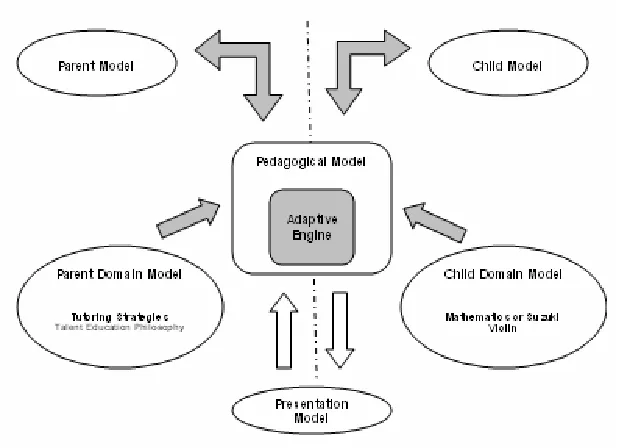
The overall architecture of P.A.C.T. is illustrated in Figure 1.1. Typically, an adaptive educational system comprises student, domain, pedagogical and presentation models (Wenger, 1987). In order to provide a personalised learning path, P.A.C.T. comprises a number of additional features; a dual user architecture, which comprises dual domain models and dual user models in order to simultaneously support both parent and child, a novel adaptive engine that comprises a set of rules and the use of the Talent Education philosophy to define tutoring best practice.
The different components have the following functions:
• The domain model is a representation of the material to be learnt. In P.A.C.T. the
parent domain model comprises an instantiation of the Talent Education
philosophy in an endeavour to support the parent in the development of tutoring best practice. Currently the child domain model provides support for the child in two domains, Suzuki violin and mathematics.
4
parents’ interactions with P.A.C.T.. The child model represents the affective experience, a record of the child’s affective states such as happy, sad, fearful and angry (Kort et al., 2001) as they progress through the system. It also maintains information on students’ knowledge-level.
• The presentation model monitors the interactions between the user and the system and handles the flow of information.
• The pedagogical model, informed by the adaptive engine, uses adaptive presentation and adaptive sequencing techniques to determine what next to present to the parent and child.
Figure 1.1 P.A.C.T. Architecture
P.A.C.T. provides personalised support through its adaptive engine, which comprises a set of pedagogical rules. The pedagogical rules are categorised in terms of:
• Content rules determine the specific content to display.
• Efficacy rules based on parental self-efficacy, determine the level of support required by the parent. High levels of self-efficacy receive low levels of support while low levels of self-efficacy receive high levels of support.
Based on feedback from the presentation model and input from the user models P.A.C.T. deciphers the type and level of support required by both parent and child.
1.4 Research Goals & Contributions
As previously stated, the research goal was to develop an adaptive educational system, which supports both tutor (parent) and tutee (child) working collaboratively throughout the home tutoring process. In order to achieve such a goal a number of specific research questions were identified.
• How can an adaptive engine simultaneously support dual users (tutor and
tutee)?
This was addressed through the design and development of P.A.C.T., which uses adaptive technology and contains a novel dual user architecture that comprises dual user models and domain models.
• What is the appropriate educational theory from which to elicit a set of rules,
which define tutoring best practice?
This was addressed using Talent Education philosophy. In particular, this philosophy informs the set of tutoring rules, which encapsulate tutoring best practice.
• What is an appropriate basis for adapting to the needs of the tutor and tutee? This was addressed through the use of adaptive strategies, which enable P.A.C.T. to provide the correct level of support for the parent based on their self-efficacy, while simultaneously adapting to the affective needs of the child. In particular, empirical studies were conducted to investigate:
• The effect of using adaptive strategies on parents’ self-efficacy, knowledge and their perception of their role as home tutor.
• The effect of adapting to the affective needs of the child throughout the home tutoring process.
6
• The design and development of an architecture, which supports dual user adaptivity in the domain of home tutoring.
• The articulation and development of a set of novel tutoring rules based on Suzuki’s Talent Education philosophy, which define tutoring best practice.
• Empirical evidence, which indicates the effectiveness of adaptive strategies based on self-efficacy in supporting the parent as tutor and strategies based on affect in supporting the child as tutee.
1.5 Structure of Dissertation
There are a number of requirements in the design and development of an architecture, which supports dual user adaptivity in the domain of home tutoring. Firstly, there is the need to develop a dual user architecture, which can simultaneously support both the parent and child. Secondly, there is a need to derive a set of tutoring rules, which using the principles of Talent Education philosophy define tutoring best practice. Additionally, there is a need to develop adaptive technologies that can simultaneously support the needs of both parent and child. Finally, there is the need to analyse, using empirical studies, the effect of P.A.C.T. on the home tutoring process. The following chapters describe in detail each of these different stages.
Chapter 2 provides the literature review of the home tutoring paradigm and adaptive educational systems. It also describes how self-efficacy and affect may be of benefit during the home tutoring process. It provides discussion on these areas in order to support the architecture, design and implementation of P.A.C.T.
Chapter 3 describes the principles, architecture, design and implementation of P.A.C.T.. It outlines the empirical studies involved in incorporating Talent Education philosophy into its design (Lahart et al., 2004, 2005, 2006, 2007b, 2007d). It outlines P.A.C.T.’s novel dual user architecture (Lahart et al., 2008a) and demonstrates how traditional adaptive educational systems can be exploited to support dual users.
Chapter 4 describes P.A.C.T.’s adaptive engine. It describes how the adaptive engine consists of a rule-based system comprising a novel set of pedagogical rules. These rules can be categorised in terms of tutoring rules, content rules and efficacy rules (Lahart et al., 2007c).
rules reflected the principles of Talent Education philosophy (Lahart et al., 2006, 2007a, 2008b, 2008c).
Chapter 6 describes the experimental design of the studies carried out in order to explore the effect of the adaptive educational system on the home tutoring process.
Chapter 7 presents an analysis and discussion of the experimental results. In particular, it evaluates the results in terms of its effect on the parents’ (1) self-efficacy (2) knowledge of home tutoring best practice and (3) perception of their role as home tutor. In addition, it evaluates the effect of adapting to the affective needs of the child. Results suggest that P.A.C.T. can have a positive effect on parental self-efficacy and learning performance. In addition, adapting to the affective needs of the child may have a positive effect on the home tutoring process.
8
2 Literature Review
2.1 Introduction
The following chapter provides the research context for this thesis. In addressing the challenge of building an adaptive educational system, which supports both tutor (parent) and tutee (child) working collaboratively throughout the home tutoring process there are a number of research considerations. Given that adaptive educational systems have been of benefit in adapting to individual needs (Melias & Siekmann, 2004; Mitrovic, 2003; De Bra & Calvi, 1998), it is necessary to investigate how this technology may be of benefit in supporting dual user adaptivity. In particular, it is important to determine how emergent adaptive collaborative technologies may be further exploited in order to provide the necessary support during the home tutoring process. It is also necessary to investigate how, given the known benefit of parental involvement in learning activities in the home (Greewood et al., 1991; Dornbusch, 1988), adaptive educational systems may be of benefit in encouraging such involvement. Educational theories provide a number of approaches, which may be relevant, and in particular, Talent Education philosophy (Suzuki 1986) is identified as being an educational theory of particular relevance in developing greater parental involvement. Research suggests a myriad of reasons why parental involvement may not occur spontaneously. This research focuses on one in particular, parental self-efficacy. Within the context of home tutoring, it is also necessary to provide support for the child; this research also investigates the use of affective support to encourage a positive learning environment.
This research investigates the question of how best can we support both tutor and tutee throughout the home tutoring process through the use of an adaptive educational system. More specifically, there is a need to investigate the following research questions:
• How can an adaptive engine simultaneously support dual users (tutor and tutee)? • What is the appropriate educational theory from which to elicit a set of rules, which
define tutoring best practice?
• How adaptive educational systems and adaptive collaborative systems through the use of appropriate adaptive strategies can support the tutor and tutee during the tutoring process.
• Educational theories that indicate home tutoring best practice.
• How self-efficacy can be used to determine the level of support required by tutors (parent) when tutoring and in what ways is it possible to provide affective support for tutees (child) during the tutoring process.
In this chapter, section 2 outlines educational theories that support the home and school contexts. In particular, Talent Educational philosophy is described as a philosophy that may be of particular relevance in the home tutoring paradigm. Section 3 describes the concept of self-efficacy, one of the reasons why parental involvement in learning activities in the home may not occur spontaneously. Within the home tutoring context, it is also necessary to provide support for the tutee (child), section 4 outlines how the provision of affective support for the child may promote a positive learning environment. Section 5 describes the role that technology can play in supporting the home tutoring process and in particular, it outlines how adaptive systems may be of benefit.
2.2 Education Theory
A myriad of educational theories exist supporting both the home and school contexts. Home schooling comprises numerous approaches from highly structured to unstructured; from those, which are based on conventional schools to those, which are far removed from conventional practice (Holt & Farenga, 2003). In parallel, there are a number of educational theories, which support the traditional classroom context (Schunk, 2000). This section will firstly discuss the educational approaches, which have influenced the paradigm of home schooling. Subsequently there will be a discussion of some of the educational theories, which have influenced conventional teaching. Finally, we will discuss Talent Education philosophy an educational theory that may be best placed to bridge the gap between home and school.
2.2.1 Home Schooling
10
them. He believed that if children were provided with the freedom to follow their own interests and were provided with a rich assortment of resources learning would naturally follow. Over the past number of years a multitude of home schooling approaches have emerged including unit studies and classical education. Unit studies is based on the concept that knowledge is interrelated and if presented and studied in a related way may result in a deeper understanding (Bennett, 1996). Classical education is based on a particular pattern called the Trivium, which comprises grammar, dialectic, and rhetoric. It is based on the premise that if the tools of learning are taught they can be used in the study of any subject (Wilson, 1991). However, this section will focus on two of the most popular home schooling approaches namely, unschooling (Holt & Farenga, 2003) and the Charlotte Mason approach (Mason, 1993).
Unschooling involves learning based on the child's interests, needs, and goals where parents play the role of facilitator as opposed to teacher. Learning does not follow a strict curriculum but rather is as a result of every day life. Holt observed that children are born inquisitive, with an inherent desire to experiment and explore the world around them (Holt, 1967). Young children learn to walk, to talk, and to formulate ideas and opinions with little instruction from adults. He believed that the same natural learning process should be applied to learning at all levels.
on living books. Living books (often referred to as classics) promote imagination, originality and noble thoughts.
In summary, home schooling approaches promote the idea that learning should begin with curiosity in the child. It should be as a result of everyday life. The child should be presented with interesting material to learn from and it should be a natural process.
2.2.2 Classroom context
A myriad of educational theories have been applied in the classroom context. Arguably, the most commonly used educational theories include behaviourism and constructivism. However, there are numerous others including Cognitivism (Piaget, 1928) and Multiple Intelligence (Gardner, 1983). Cognitivists are concerned with exploring mental processes such as thinking, memory, knowing, and problem solving. They believe knowledge can be viewed as schema or symbolic mental constructions where learning can be defined as a change in a learner’s schemata. The theory of Multiple Intelligence challenges the conventional view of intelligence as a single general capacity. Instead, Gardner (1983) proposes eight different intelligences to account for a broader range of human potential in children and adults. These intelligences are linguistic, logical-mathematical, musical, bodily kinaesthetic, spatial, interpersonal, intrapersonal and naturalist. The theories of behaviourism and constructivism will now be described in detail.
12
this theory where reinforcement is anything that strengthens the desired response e.g. verbal praise (Skinner, 1968).
Constructivism is based on the premise that learning occurs as a result of the processes of accommodation and assimilation. Assimilation involves incorporating new experiences without modification into exiting frameworks. However, accommodation involves reframing one's mental representation of the external world as a result of new experiences (Piaget, 1950). Social constructivism is based on the premise that much learning can take place in the Zone of Proximal Development (ZPD). The ZPD is described as the distance between actual development during independent problem solving and the learner’s potential development if assisted by a more able peer or adult (Vygotsky, 1978). Much of Vygotsky’s (1978) work highlights the benefits for the learner of working in collaboration with a more able peer, adult or domain expert.
Educational theories from both home and school contexts provide great insights into how knowledge is acquired by the learner and to some extent, how this can be facilitated. However, there is little research to support the home-school relationship. One educational theory, which may go some way in bridging the gap between home and school, is Talent Education philosophy (Suzuki 1986).
2.2.3 Talent Education Philosophy
There are a number of principles of Talent Education. Firstly, there is a belief that every child can be educated. Talent Education has often been misunderstood as education for gifted children; however, this is not the case. Secondly, there is a belief that learning begins the day a child is born. Suzuki believed that beginning the child’s education at the traditional school age was far too late (Suzuki, 1981). The third principle of Talent Education philosophy is intuition. Suzuki believed that if a child did not receive love and encouragement from its mother it might not develop the mother tongue. Suzuki believed that children should never be forced to practice or rehearse, as it is not a good basis for education. He believed that given a nurturing environment, children would develop their own ability. Repetition should occur every day where possible. Finally, it is important that children feel confident in their abilities and thoroughly master what they are learning. Initially, children learn simple skills through repetition. Once the skill is mastered, the child is given another challenge. This motivates the child to continue learning.
2.2.4 Education Theories Summary
A myriad of research exists on education theories, which support the home and school context. Home schooling provides a myriad of approaches to education in the home context including the Charlotte mason approach (Mason, 1993) and unschooling (Holt, 1964). Both approaches highlight that learning is a natural process and if the child is presented with interesting resources, there will be a natural tendency to learn. In parallel, there are a number of educational theories, which have been applied in the school context, including behaviourism (Watson, 1913) and constructivism (Piaget, 1950). Such theories provide great insights on how students learn and how best this can be facilitated. However, there is little research, which explores the home-school relationship and how teacher, parent and child can work together to create a nurturing environment. One philosophy, which provides some insights into this, is Talent Education philosophy (Suzuki, 1986). Talent Education philosophy involves the teacher, child and Suzuki parent. Therefore, Talent Education philosophy maybe an appropriate educational theory to inform tutoring best practice, in an adaptive system, which supports both tutor and tutee throughout the home tutoring process.
2.3 Self-Efficacy
14
to (1) lack of parental self-efficacy (Desforges & Abouchaar, 2003) (2) a perception that it is not part of the parental role (Desforges & Abouchaar, 2003) (3) negative attitude towards school (Heystek & Louw, 1994) (4) time (Russell & Granville, 2005). This research attempts to overcome one of these reasons, lack of parental self-efficacy. With this in mind, an overview of the research, which exists on self-efficacy, is now presented.
Firmly situated in social cognitive theory, Bandura believed that the beliefs people have about themselves are key elements in their ability to achieve desired outcomes (Bandura, 1986; Bandura, 1997). Consequently, he believed that how people behave might be as a result of their beliefs and therefore behaviours may be better predicted by these beliefs than by the result of their previous performances. Research has indicated that self-beliefs may have an impact on cognitive engagement, which suggests that enhancing self-beliefs may have a positive effect on learning (Pintrich & De Groot, 1990). An individual’s self-efficacy is included in such self-beliefs.
The following section will provide a detailed description of self-efficacy. Section 2.3.1 will provide a description of the sources of self-efficacy. Section 2.3.2 provides a discussion on the effect of self-efficacy and finally section 2.3.3 provides some guidelines on measuring self-efficacy.
2.3.1 Sources of Self-Efficacy
suggests that vicarious experience may be most influential when peers with similar abilities are working together. Verbal persuasion is another source of self-efficacy. Albeit that this source of self-efficacy is weaker than the previous two, verbal judgements that others provide have an influence on self-efficacy beliefs (Zeldin & Pajares, 1997). Bandura (1986) suggests that it is often easier to weaken self-efficacy beliefs through negative appraisals than strengthen them through positive appraisals. The final source of self-efficacy beliefs is physiological states. Physiological states such as anxiety, stress, fatigue and affective states provide insights on self-efficacy beliefs where positive moods enhance perceived self-efficacy and despondent moods diminish it (Bandura, 1997). It is important to note that with all the aforementioned sources of self-efficacy it is the interpretation of the experience that form the judgements of self-efficacy and not that the sources themselves are directly translated into judgments of competence.
2.3.2 Effects of Self-Efficacy
Research informs us that self-efficacy beliefs can have effect on four process namely cognitive process, motivational processes, affective processes and selection processes (Bandura, 1997).
• Cognitive processes: self-efficacy can increase or diminish problem-solving and reasoning capabilities (Bandura, 1995; Schunk & Pajares, 2002 & Zimmerman, 2000). Self-efficacious students pose the ability to set ambitious future goals and a commitment to achieve them.
• Motivational processes: levels of self-efficacy will influence the amount of effort individuals expend on any activity, the degree of perseverance when faced with challenges and level of resilience in adverse situations. Self-efficacious students are more likely to visualise successful outcomes. Those who doubt their self-efficacy, visualise unsuccessful scenarios dwelling on the many things that can go wrong.
• Selective processes: self-efficacy beliefs play a role in the course of individuals’ lives as it influences the types of activities and the environments they choose. Students with high self-efficacy often select challenging activities and environments while individuals with low self-efficacy choose to avoid challenges or activities and situations, which they believe, exceed their competency.
16
a key factor in regulating thought patterns around stress and depression. It is the perceived inability to disengage in such thoughts and not the frequency of disturbing thoughts that is the major source of distress.
2.3.3 Measuring Self-Efficacy
Self-efficacy is not a global trait but a differentiated set of self-beliefs linked to distinct sets of tasks. The “one measure fits all” approach to self-efficacy provides little valuable insight and poor predictive value (Bandura, 2006). On measuring self-efficacy, it is important that it is measured in terms of perceived capability. Items should be measured in terms of can do rather than will do. Bandura (2006) indicates that can is a judgement of capability where will is a statement of intention. The development of effective self-efficacy scales relies on a deep analysis of the domain of functioning. Identifying which aspects of self-efficacy should be measured arises from a thorough understanding of the domain. If scales are created around factors, which in fact have little or no impact on the domain of functioning, the results will have little predictive power. However, activities that may be measured include:
• Regulating one’s motivation - e.g. get yourself to keep trying when things are going really badly.
• Thought processes - e.g. take you mind off upsetting experiences.
• Performance level - e.g. increase your memory of what has been taught in the previous lesson.
• Emotional states - e.g. overcome discouragement when nothing you try seems to work.
• Altering environmental conditions - e.g. get neighbourhood groups involved in working with schools.
2.3.4 Self-Efficacy Summary
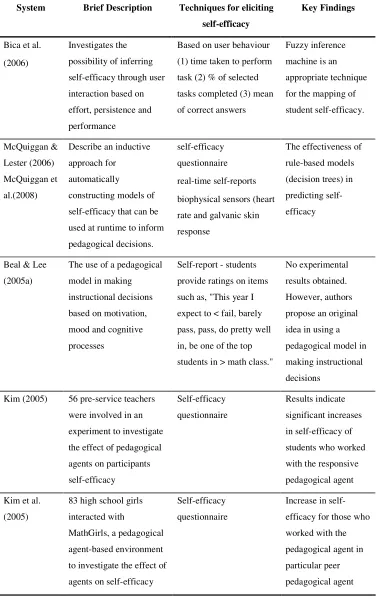
Self-efficacy involves individuals’ belief in their capability to produce desired outcomes. There are four main sources of self-efficacy namely, mastery experiences, vicarious experiences, verbal persuasion and physiological states. It is understood that self-efficacy can have an effect on our cognitive, motivational, social and affective processes. Self-efficacy should be measured in terms of perceived capability, with measurements of generalised self-efficacy best avoided. Self-efficacy judgements should be recorded in private to reduce evaluative concern. Due to the potential effect of self-efficacy on learning, there is a need to investigate how it can be measured and supported through the use of an adaptive system. This will be described in section 2.5.4.
2.4 Affect
In a tutor-tutee, adaptive system there is also a need to provide personalised support for the tutee. This support can comprise cognitive, affective and motivational support (Parkinson & Coleman, 1995). As the importance of providing affective support is clearly outlined in the Talent Education philosophy (“circumstances surrounding the repetition (practice) must be happy” (Suzuki, 1981 p14)), this research will also focus on providing affective support for the child.
Research suggests an integral link between emotion and cognition (Schute, 2006; Goleman, 1996; Block, 1995; Bower, 1992). A student’s emotion towards learning can have an effect on the learning experience (Dweck, 1999; Craig et al., 2004). The need to study emotion as part of the learning process is understood (Picard, 1997; Porayska-Pomsta & Pain, 2004; Boekaerts, 2003; Pekrun et al., 2002). Goleman suggests that learning does not take place when there is anxiety, depression or anger (Goleman, 1995). Suzuki suggests that “Children learn abilities best when they are having fun” (Suzuki, 1981, p20) and that the “circumstances surrounding the repetition (practice) must be happy” (Suzuki, 1981, p14). The suggestion of such an integral link between emotions and learning suggests the need for adaptive systems that accommodate students’ affective experiences and promote positive affective states.
2.4.1 Basic Emotions
18
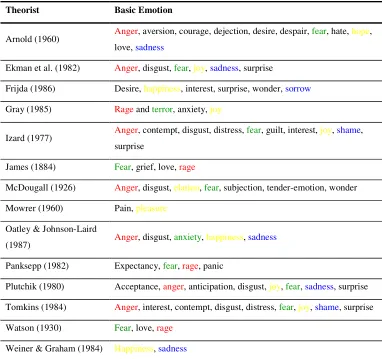
[image:37.612.127.509.248.607.2]central list of six basic emotions comprising happiness, surprise, fear, sadness, anger and disgust/contempt (Fridlund et al., 1987; Ekman et al., 1982). There is some debate around the inclusion of surprise, as many believe it to be a cognitive component that could be present with any emotion (Oatley & Johnson-Laird 1987; Power & Dalgleish, 1997). In addition, as can be observed from Table 2.1 Parrot (2001) suggests that disgust and contempt are secondary and tertiary emotion concepts of the basic emotion anger. This suggests that fear, anger, sadness, and joy are the four basic emotions (Kort et al., 2001).
Table 2.1 Major Basic Emotion Theorists (Based on Ortony & Turner, 1990)
Theorist Basic Emotion
Arnold (1960) Anger, aversion, courage, dejection, desire, despair, fear, hate, hope,
love, sadness
Ekman et al. (1982) Anger, disgust, fear, joy, sadness, surprise
Frijda (1986) Desire, happiness, interest, surprise, wonder, sorrow
Gray (1985) Rage and terror, anxiety, joy
Izard (1977) Anger, contempt, disgust, distress, fear, guilt, interest, joy, shame,
surprise
James (1884) Fear, grief, love, rage
McDougall (1926) Anger, disgust, elation, fear, subjection, tender-emotion, wonder
Mowrer (1960) Pain, pleasure
Oatley & Johnson-Laird
(1987) Anger, disgust, anxiety, happiness, sadness
Panksepp (1982) Expectancy, fear, rage, panic
Plutchik (1980) Acceptance, anger, anticipation, disgust, joy, fear, sadness, surprise Tomkins (1984) Anger, interest, contempt, disgust, distress, fear, joy, shame, surprise
Watson (1930) Fear, love, rage
Table 2.2 Categories of Emotions (Based on Parrot, 2001)
Primary Secondary Tertiary
Cheerfulness
Amusement, bliss, cheerfulness, gaiety, glee, jolliness,
joviality, joy, delight, enjoyment, gladness, happiness,
jubilation, elation, satisfaction, ecstasy, euphoria
Zest Enthusiasm, zeal, zest, excitement, thrill, exhilaration
Contentment Contentment, pleasure
Pride Pride, triumph
Optimism Eagerness, hope, optimism
Enthrallment Enthrallment, rapture
Joy
Relief Relief
Irritation Aggravation, irritation, agitation, annoyance, grouchiness,
grumpiness
Exasperation Exasperation, frustration
Rage
Anger, rage, outrage, fury, wrath, hostility, ferocity,
bitterness, hate, loathing, scorn, spite, vengefulness,
dislike, resentment
Disgust Disgust, revulsion, contempt
Envy Envy, jealousy
Anger
Sympathy Pity, sympathy
Fear Horror Alarm, shock, fear, fright, horror, terror, panic, hysteria, mortification
Nervousness Anxiety, nervousness, tenseness, uneasiness,
apprehension, worry, distress, dread
Torment Torment
Sadness Suffering Agony, suffering, hurt, anguish
Sadness Depression, despair, hopelessness, gloom, glumness,
sadness, unhappiness, grief, sorrow, woe, misery
Disappointment Dismay, disappointment, displeasure
Shame Guilt, shame, regret, remorse
Neglect
Alienation, isolation, neglect, loneliness, rejection,
20
The prevalence of these four emotions throughout emotional theories (or their associated secondary/tertiary concepts as outlined in Table 2.2) is highlighted in Table 2.1. Table 2.1 provides an overview of different emotional theories and associated emotions. The emotions are colour coded in terms of joy/happy (yellow), sad (blue), fearful (green) and angry (red). These colour codes are used throughout the rest of this thesis in conjunction with these emotions. Table 2.2 provides a list of each of the emotions and their associated secondary/tertiary concepts, which suggests the range of concepts that fall within each of the four categories of emotions.
2.4.2 Affect Summary
In summary, the need to study emotion as part of the learning process is understood with research suggesting an integral link between both. In addition, research suggests the need for positive affective states in order for learning to take place. However, consensus has not been reached as to which emotions constitute the set of basic emotions. Emotional theories propose anything from two to twenty basic emotions. However, a review of the literature suggests that happy, sad, angry and fearful may be amongst the most common among those theories reviewed. Therefore, this suggests that there is a need for adaptive systems that accommodate students’ affective experiences and promote positive affective states. This will be described in section 2.5.5.
2.5 Adaptive Educational Systems
2.5.1 Introduction
incorporate the learner’s affect. Particular emphasis is placed on how affect can be elicited and adapted to.
Educational systems that treat all students in the same way by providing the same level of support and instructional approach may be ineffective where there are students with various goals, levels of knowledge, and preferences. Adaptive and Intelligent Educational Systems attempt to overcome this problem by building a model of the goals, preferences and knowledge of each individual student, and by subsequently using this generated model to dynamically adapt the learning environment for each student in a manner that best supports their needs (Brusilovsky, 2001). This may involve the provision of scaffolding, identifying misconceptions. (Mitrovic, 2003), or modifying the presentation in order to adapt to the knowledge level of the student (De Bra & Calvi, 1998).
Adaptive educational systems and intelligent educational systems share similarities, however, each have distinct emphasis. In adaptive systems, the emphasis is on providing a personalised environment for each student using information collected in the student model. Intelligent systems place the emphasis on the application of techniques from the field of Artificial Intelligence in the provision of greater support for the student (Brusilovsky & Peylo, 2003).
The term ‘technologies’ is used to describe the myriad of approaches to the inclusion of adaptive and intelligent functionality, which can be used (Brusilovsky, 1998). Brusilovsky & Peylo, (2003) propose five major groups of technologies: intelligent tutoring, adaptive information filtering, intelligent class monitoring, intelligent collaboration support and adaptive hypermedia.
The major intelligent tutoring technologies are curriculum sequencing, problem solving support and intelligent solution analysis. The purpose of curriculum sequencing is to help the student find the most suitable path through learning material by making decisions on what content to present next (Weber & Brusilovsky, 2001). The goal of interactive problem solving support is to provide help with problem solving by giving hints or executing the next step (Melis et al., 2001). With intelligent solution, analysis attempts are made to find out what exactly is wrong or incomplete, identify what piece of incorrect knowledge that may be responsible for the error and provide suitable feedback (Mitrovic, 2003).
22
filtering the results, and subsequently recommends the most relevant documents. Two categories of AIF technologies exist, namely content based filtering and collaborative filtering. With the content-based approach, the behaviour of a user is predicted from their past behaviour (e.g. MLTutor, Smith & Blandford, 2003). While with the collaborative approach, the behaviour of the user is predicted from the behaviour of other like-minded people, for example (e.g. WebCOBALT, Mitsuhara et al., 2003).
Intelligent collaborative learning technologies can be used in an endeavour to support collaboration between students. Collaborations are supported using three types of technologies: adaptive collaboration support, adaptive group formation and peer help and virtual students. Adaptive collaboration support technologies provide interactive support to help collaboration using knowledge about good and bad collaborations (Soller & Lesgold, 2003). Adaptive group formation and peer help technologies use knowledge about collaborating peers to form matching groups for different tasks (Greer at al, 1998). Virtual student technology attempts to introduce virtual peers into the learning environment (Chan & Baskin, 1990).
Intelligent class monitoring technologies recognize students who need support or extra challenges. These technologies use Artificial Intelligence techniques to explore large amounts of information that is collected when tracking student actions (Maceron & Yacef, 2003).
Adaptive hypermedia includes two major technologies: adaptive navigation and adaptive presentation. Adaptive navigation supports the student by changing the appearance of links. For example, it can adaptively sort, annotate, or partly hide the links of the current page to make it easier to choose where to go next (de Bra, 1996). Adaptive presentation adapts the content to be presented by dynamically generating the content for individual students according to their needs (Weber & Brusilovsky, 2001).
2.5.2 Adaptive Hypermedia
Static hypermedia applications present the same page content and set of links to all users. On the other hand, adaptive hypermedia systems construct a model of the knowledge, goals, and preferences for each individual user, and use this model to adapt the presentation to the users needs. Adaptive hypermedia systems include on-line information systems, on-line help systems, information retrieval hypermedia, and systems for managing personalized views (Brusilovsky, 2001).
Adaptive decisions are informed by the user’s characteristics, which may comprise the user’s knowledge, goals, tasks, background, preferences and interests. Adaptive educational systems capture and represent these characteristics in a learner model for each individual learner and subsequently predict different characteristics such as knowledge level and interest (Kobsa, 2001). For example, knowledge can be based on the visited web pages (history-based) or assessment results (knowledge-based) (Eklund & Sinclair, 2000).
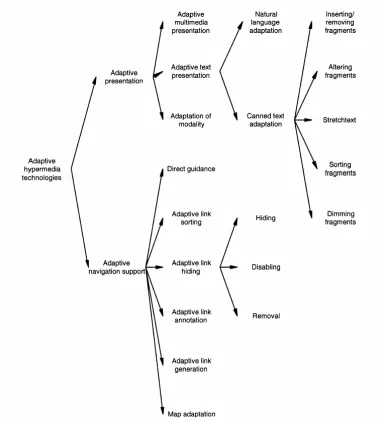
Adaptation decisions are made based on the information in the learner model. Two distinct areas of adaptation exist, adaptive presentation and adaptive navigation support. Both encompass a broad range of techniques (Brusilovsky, 1998, 2001). Adaptive presentation includes text, multimedia and modality adaptation. Adaptive navigation support includes direct guidance, link hiding, sorting, generation, annotation, and hypertext map adaptation. Figure 2.1 displays the different adaptive hypermedia technologies and their associated techniques.
Adaptive presentation and navigation techniques provide a rich basis for developing adaptive educational systems, which support dual users in achieving a common goal. In order or develop an adaptive educational system, to support home tutoring there are a number of considerations.
• How can we exploit adaptive educational technology to simultaneously support two users tutor (parent) and tutee (child)?
• How can self-efficacy be incorporated in adaptive educational systems in order to provide personalised support for the tutor (parent)?
• How is it possible to elicit the tutee’s (child’s) affective state in order to adapt the learning environment to best suit their needs?
24
Figure 2.1 The taxonomy of Adaptive Hypermedia Technologies, (adapted from Brusilovsky, 2001)
2.5.3 Adaptive Collaborative Systems
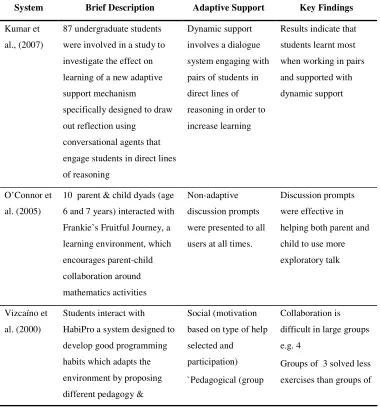
collaboration (Walker et al., 2008; Biswas, 2005). Although these categories are by no means mutually exclusive, they do exhibit significant differences in their approach. Research from both categories will be described with emphasis on the latter due to its particular relevance. A summary of the research described in this section is listed in Table 2.3.
2.5.3.1 Supporting the Collaborative Process
The following sections describe research conducted in order to investigate the benefits of providing support to encourage deep collaborative discussions and the effect of support group collaboration.
2.5.3.1.1 Supporting Deep Collaborative Discussion
Kumar et al. (2007) present research, which suggests the benefits of providing dynamic support, which is triggered, based on observed need and fades over time as students acquire the skills necessary to collaborate productively. In particular, this research presents a new adaptive support mechanism specifically designed to draw out reflection using conversational agents that engage students in direct lines of reasoning. 87 undergraduate students took part in an experiment where students were divided across six conditions comprising three levels of support (no support, static support or dynamic support) and two levels of collaboration (working with partner or working alone). Static support involves prompts, which stimulate thinking towards an idea without giving the idea away. Dynamic support involves a dialogue system engaging with pairs of students in direct lines of reasoning in order to increase learning. Results indicate that students learnt most when working in pairs and supported with dynamic support. However, there is a need for further research to develop a more effective approach and overcome student frustration with the dialogue system.
26
suggest that the discussion prompts may have taught parents when and where to intervene appropriately in the absence of prompts. There is a need to develop this research further to include intelligent conversation prompts tailored to the needs of the collaborators.
2.5.3.1.2 Supporting Group Collaboration
![The use of tibial Less Invasive Stabilization System (LISS) plate [AO-ASIF] for the treatment of paediatric supracondylar fracture of femur: a case report](data:image/gif;base64,R0lGODlhAQABAIAAAP///wAAACH5BAEAAAAALAAAAAABAAEAAAICRAEAOw==)