BUILDING A KNOWLEDGE BASE D
SOCIETY WITH ENGINEERIN G &
TECHNOLOGY
AIJAZ AHMA D
BRUNEI INTERNATIONA L CONFERENC E O N
ENGINEERING AN D TECHNOLOG Y
(BICET 2005 )
PROCEEDINGS
of
BRUNEI INTERNATIONAL CONFERENC E
ON ENGINEERING AND TECHNOLOG Y
(BICET 2005)
15
th-18
thAugust 2005
"Building A Knowledge Based Society
with Engineering & Technology"
Chief Editor :
y
Aijaz Ahmad
Editors:
Dr. Hj. Afzaal H. Seyal
Dr. Sikandar K. Khatri
Dr. Md. Ghulam Yazdarii
Dr. Ahmad Nazri Wahidudin
Copyright © Brunei International Conference on Engineering and Technology, 2005. Copyright © Institut Teknologi Brunei.
All rights reserved. No part of this publication may be reproduced, in any form or by any means, without the prior written of Institut Teknologi Brunei.
Institut Teknologi Brunei, Editors, Authors of Papers and Printers accept no liability for the contents of these Proceeding s
First published in 2005
Printed in Brunei Darussalam by Borneo Printer
Additional copies of these Proceedings may be purchased from
Institut Teknologi Brunei , Tungku Link ,
Gadong BE141 0 Brunei Darussalam . Tel: (673)2461020 Faz: (673)246103 5
Proceedings of the Brunei International Conference on Engineering and Technology - 200 5
Brunei internationa l Conferenc e on Engineerin g and Technology 20Q 5 (BICET 2005 )
HEAVY METAL REMOVAL FROM DOMESTIC SLUDGE B Y
BRASSICA JUNCEA
AN D
IPOMOEA AQUATICA
Ab. Azi z Abdul Latiff* , Ahmad Tarmiz i Abd. Karim*, Moh d Baharudi n Ridzuan** , Youventaran Doraisamy** *
(* Associate Professor , """Lecturer, ***Researc h Assistant ) Faculty of Civil an d Environmental Engineerin g
Kolej Universiti Teknologi Tun Hussi n On n 86400 Pari t Raja, Batu Pahat, Johor, Malaysia . Tel: +607-4536350 , E-mail : [email protected] y
Abstract: Treatmen t an d disposa l o f domesti c sludg e hav e bee n problemati c due t o th e presenc e o f heav y metals . Th e applicatio n o f sludg e t o agricultur e land i s considere d a s a feasibl e metho d o f disposal . Severa l factor s tha t attributed t o th e feasibilit y o f thi s metho d includ e th e nutrien t conten t o f domestic sludg e necessar y fo r plan t growth , lo w handlin g cost s an d promotio n of recycling. Th e objective s o f thi s research ar e to determin e th e heav y metal s content i n domesti c sludg e from variou s treatmen t processe s an d th e effec t o f the sludg e applicatio n t o soil . Thi s sludg e wer e the n applie d t o soi l b y surfac e spraying t o application cell s o f 0.091 m2 at differen t application rate s o f 0 C/m2, 2 €/m2, 4 i/m , 6 i/m2, 8 £/m2 and 1 0 Vm2. Thes e cell s were the n plante d wit h two differen t types o f plants, brassica juncea an d ipomoea aquatica, an d wer e placed i n th e ope n wit h a transparen t roo f t o simulat e th e natura l environmen t while allowin g contro l o f soi l moistur e a t 6 0 % . Sample s take n from roots , stems an d leave s wer e separatel y analyze d fo r heav y meta l absorptio n b y th e plants. Analyse s wer e conducte d usin g Inductivel y Couple d Plasma-Mas s Spectrometry (ICP-MS) . Th e result s showe d tha t th e meta l conten t o f treate d sludge i s stil l belo w th e permitte d leve l fo r applicatio n t o agricultura l lan d a s indicated b y USEPA , Par t 50 3 regulations . Highe r concentration s o f metal s were foun d i n th e root s compare d t o th e othe r part s o f plants . Th e stud y o f uptake o f metals b y th e plant s a t variou s rate s o f sludg e applicatio n show s tha t the relationships betwee n th e parameters studie d ar e polynomial. I n general , th e use o f plant s ha s helpe d i n reducin g meta l conten t bot h i n th e sludg e an d agricultural lan d under study .
1.0 INTRODUCTIO N
Malaysia produce s abou t 5 million cubi c meter s o f sewag e sludg e pe r yea r an d thi s i s expected to increas e continuously. B y the year 2022, the amoun t ha s been estimated to reach 7 million cubic meters per year. This is a tremendous amount of waste that has to be disposed off. World wide, the traditional means of sludge disposal is on land and into the sea . Du e to increasin g environmenta l awareness , disposa l o f sewage sludg e will b e costly and an alternative disposal method needs to be studied that will enhance soil
Brunei internationa l Conferenc e on Engineerin g an d Technology 20Q 5 (BICET 2005)
Sewage sludg e i s produce d from conventiona l wastewate r treatmen t plant s wit h d r solids varyin g from 0. 5 t o 95 % (Kiely,1998) . Wit h increasin g populatio n especiall y i i urban areas , Malaysi a lik e othe r emergin g industrialize d economies , i s face d wit h t b problem o f increasin g waste sludg e generatio n from it s wastewater treatmen t plants . I i 1994 fo r exampl e th e tota l wast e sludg e collecte d from septi c tank s an d connecte < services amounted t o 3.0 2 Mm3 which comprised o f 1.1 3 Mm3 (37% ) from septi c tank;
and 1.8 9 Mm3 (63%) from connected services, and increased to 3.4 Mm3 in 1998 . Then
is however a reduction i n sludg e pro-duction o f 32% from septi c tanks wit h a n increas< from connecte d service s t o 68 % durin g th e four-yea r period . Th e overal l increas e i i sludge production is about 15 % in four years (Indah Water Sdn. Bhd. Malaysia, 1997). Ii 20 year s th e projected increas e i n sludg e pro-duction wil l b e abou t 75 % usin g 199 8 a : base year.
The curren t metho d o f sludg e disposa l i s mad e u p o f oxidatio n pond/aerate d lagoon s (50%), dryin g bed s (30%) , other s (Oxidatio n ditch , bio-filter , SB R etc ) 20% . Al l thes e technologies especiall y oxidation ponds and drying beds require the use of large areas oi land which is a dwindling resource with increasing industrialization and urbanization. As an alter-nativ e t o this , Lan d Farmin g metho d wil l b e usefu l because lan d tha t ha s bee n overgrazed an d tha t ha s expende d it s nutrient s ma y b e brough t bac k int o commissio n quickly by application of sewage sludge. This method is also known as land culti-vation , sludge farmin g or soi l incorpo-ratio n (Huan g an d Iskandar , 2001) . I t i s a better metho d when compared with se a disposal. The conditions fo r application are in this case is more metal limited than nutrient limited which was the case of land filling.
2.0 MATERIAL S AND METHODS
2.1 Samplin g
Sludge sample s wer e take n from variou s location s i n Kluang , Johor , Malaysia . Thes e sludge wer e sample d from fou r sewag e treatmen t plants , namel y oxidatio n pond , activated sludge , aerate d lagoo n an d septi c tank . Thes e treatmen t plant s wer e operate d and maintained by Indah Water Konsortium (IWK), Malaysia.
2.2 Field Experimental Setu p
The experimenta l plots wer e erecte d behin d th e Studen t Affair s building i n KUiTTHO , Batu Pahat , Johor , Malaysia. Th e plot siz e i s about 2 0 m2. Brassica juncea an d ipomea
aquatica plant s wer e plante d i n plasti c pots . Al l pot s woul d b e treate d equall y wit h
respect t o deionize d wate r application . Howeve r th e plant s woul d b e subjecte d t o different sludge application rates of 0 e/m2, 2 Um2, 4 i/m2, 6 i/m2, 8 i/m2 an d 1 0 £/m2.
2.3 Sample Preservation
Sludge sample s collecte d wer e imme-diatel y preserve d wit h concentrate d Nitri c Aci d
Brunei internationa l Conferenc e on Engineerin g and Technology 20Q5 (BICET 2005)
2.4 Sample Digestion
Exactly 0.5 g samples were digested using 1 0 ml of concentrated nitri c aci d fo r 1 0 min using microwav e sampl e preparatio n syste m (Anto n Paar , Denmark) . Th e sampl e an d acid were placed in fluorocarbon microwave vessels. The vessels were capped and heated in the microwave unit. After cooling, the vessel contents were filtered, and then diluted to 100 ml volume and analyzed.
2.5 Sample Analysis
Inductively couple d plasm a mas s spec-trometr y (ICP-MS) , (Ela n 9000 , Perki n Elme r Sciex) was used for chemical analysis of the extracts which in this case are heavy metals.
Concentration o f metal, mg/kg (dr y weight)
Element Al Cu Fe Mn Zn Mean 55.03 1.20 55.93 4.86 1.46
USEPA
Limit n.a 4300 n.a n.a 7500
3.0 RESULTS AND DISCUSSION
[image:6.604.109.421.259.415.2]For the majority of crops, maximum yield i s achieved i n the soil pH range of 5.5 - 6.5 . Yields decrease below and above this range. Based on Table 3.1, the soil pH falls slightly below thi s range. The problem of low soil pH occurs i n regions of rainfall in excess o f 500 mm per annum and irrigated areas. The problems o f high pH ar e common i n lower rainfall environment s wit h calcareou s sand s an d crackin g clay s a s wel l a s wit h man y sodic non-saline soils.
Table 3.1: Physicochemica l Characteristi c o f soil
Parameter Ran Mean
Parameter Min Max. Mean
PH 5.2 5.5 5.3
Specific
gravity 2.7 2.7 2.7 Moisture
contents (% ) 32.0 80.0 78.0 Particle siz e
sand
(0.5-0.2 mm ) 4.7 8.0 6.2 silt
(0.2-50 um ) 38.0 71.0 50.7 Clay
Brunei international Conference on Engineering an d Technology 20Q5 (BICET 2005 )
Table 3.2 shows the result o f determination o f metal concentrations test i n the domesti c sludge samples. Referring to the U.S. Environmental Protection Agency (USEPA, 1993 -Part 503 ) guideline, th e content o f some metals such copper an d zinc in sludge remains well below the limiting values. While the rest, suc h as aluminum, feru m and manganes e are not considered in the guideline.
Table 3.2: Mean Concentratio n o f Metals i n Domestic Sludg e
na: not availabl e
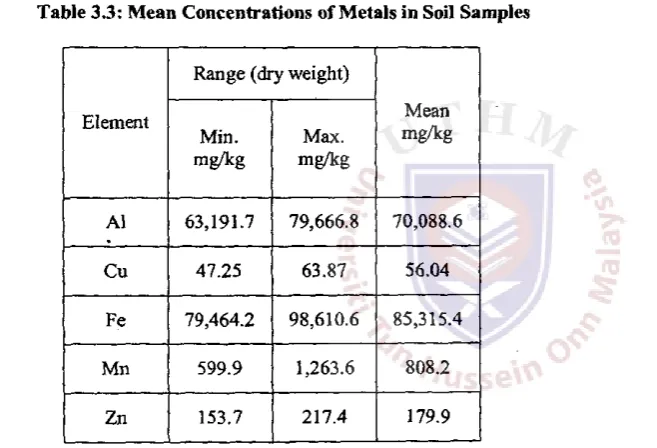
Metal concentrations o f soil sample s are presented i n Table 3.3. The study showed tha t the concentration s o f meta l i n th e soi l sample s ar e highe r tha n i n th e domesti c sludg e samples. Th e selectio n o f contaminate d sit e i s importan t t o b e simulate d t o a n actua l environment at the
[image:7.604.62.391.290.514.2]disposal sites.
Table 3.3: Mean Concentration s o f Metals in Soil Sample s
Element
Range (dr y weight )
Mean mg/kg Element
Min.
mg/kg mg/kg Max.
Mean mg/kg
Al 63,191.7 79,666.8 70,088.6 Cu 47.25 63.87 56.04
Fe 79,464.2 98,610.6 85,315.4 Mn 599.9 1,263.6 808.2
Zn 153.7 217.4 179.9
Table 3.4 shows the uptake of selected metals by brassica juncea an d ipomoea aquatica
Brunei internationa l Conferenc e on Engineerin g an d Technology 20Q 5 (BICET 2005)
Table 3.4: Uptake of Metal by Crops fro m Application Cell s
Concentration of heavy metal, mg/kg (dry weight)
Al Cu Fe Mn Zn
Application
cell 70164 56.6 85409 810.0 181.7
Brassica
juncea 2089 15.871 2379 33.94 81.96
Ipomoea
aquatica 1984 21.9 1208 140.1 46.0
Metals suc h a s copper , ferum , manganes e an d zin c ar e micronutrient s t o th e plant' s growth, but it can be toxic a t high concentration level . Zinc fo r example is essential fo r the transforma-tio n o f carbohydrates , regulate s consumptio n o f sugars an d par t o f th e enzyme system s whic h regulat e plan t growt h bu t ca n als o b e toxi c t o plants . Th e concentration of zinc in plant specie s varies widely. Zinc deficiency in plants as a result of lo w zin c i n soi l occur s i n man y o f th e croppin g area s o f th e Unite d State s an d throughout th e world. Usuall y zinc deficiency in plants i s associated with high pH soil s or with coarse-textured, highl y leached acid soils (Welch et al., 1991) . Chapman (1966 ) indicated that zinc deficiencies in plants occurred whe n zinc level s were les s than 20 to 25 mg/kg dry matter.
The absorptio n o f sewag e sludg e constituent s i n a soil-plan t syste m ar e influence d b y factors suc h a s climat e (rainfal l an d temperature) , managemen t (irrigation , drainage , liming, fertili-zation , additio n o f amendments ) an d compositio n o f th e sewag e sludg e (application rates). In addition, soil properties affect the chemical reaction and processes, which occu r afte r application o f sewag e sludg e to a soil. Soi l properties tha t affec t the reactions an d resultant plan t uptak e o f sewage sludg e constituent s includ e pH , organi c matter, catio n exchang e capacit y (CEC) , iro n an d aluminu m oxides , texture , aeration , specific sorption sites and water availability.
Many of these factors are interrelated and thus create a rather complex medium involving chemical and microbial reactions. The factors which tend to be stable are texture, organic matter an d iro n an d aluminu m oxides . Factor s suc h a s pH , wate r content , an d aeratio n (relates water content) vary frequently or are easier to adjust. For example, soil pH can be increased by lime additions while ammonium fertilizers acidify soils.
Brunei internationa l Conferenc e on Engineerin g an d Technology 20Q5 (BICET 2005 )
•element mov e through a solution phase; thus water solubilit y and a variety of chelatin and other chemical reaction become important.
Table 3. 5 show s th e percentag e o f remova l o f meta l b y brassica juncea an d ipomoe
aquatica from application cell. The result showed that both crops were able to reduce th
concentration o f total metals in the application cel l especially fo r zinc and copper. Thi study indicate d tha t brassica juncea wer e abl e t o remov e zin c a s muc h a s 45%, whi l
[image:9.598.55.398.215.571.2]ipomoea aquatica could remove 39 % copper as illustrated in Figure 3.1.
Figure 3.1: Percentage Remova] of Metal b y Crops from Application Cel l
Table 3.5: Percentage Remova l o f Metal by Crops fro m Application Cel l
Removal o f metal, %
Al Cu Fe Mn Zn
brassica
juncea 3.0 28.1 2.8 4.2 45.1 ipomoea
aquatica 2.8 38.7 1.4 17.3 25.3
Brunei Internationa l Conferenc e o n Engineering and Technology 2005 (BICE T 200S )
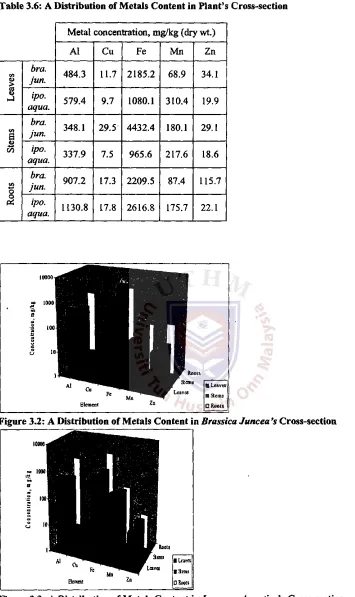
Table 3.6: A Distribution of Metals Content in Plant's Cross-sectio n
Metal concentration , mg/kg (dry wt.) Al Cu Fe Mn Zn n
1> >
bra.
jun. 484.3 11.7 2185.2 68.9 34.1
<U I—I ipo.
aqua. 579.4 9.7 1080.1 310.4 19.9
CO
a
bra.
jun. 348.1 29.5 4432.4 180.1 29.1
D
GO ipo.
aqua. 337.9 7.5 965.6 217.6 18.6
CO
O
bra.
jun. 907.2 17.3 2209.5 87.4 115.7
2 ipo.
aqua. 1130.8 17.8 2616.8 175.7 22.1
Figure 3.2: A Distribution o f Metals Content in Brassica Juncea's Cross-sectio n
[image:10.596.96.322.88.296.2]Brunei internationa l Conferenc e o n Engineerin g an d Technology 20Q5 (BICET 2005 )
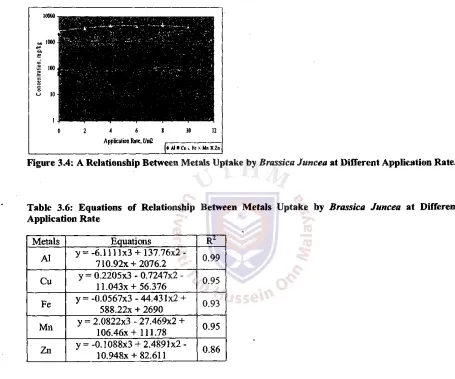
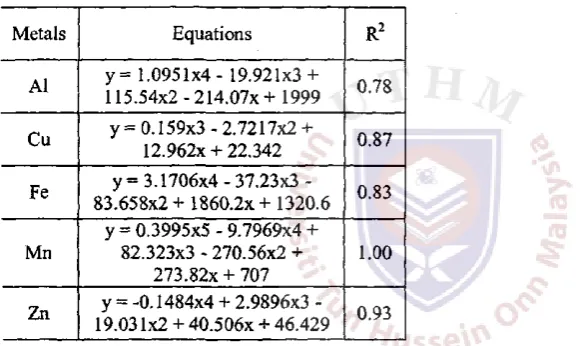
This experiment showed that the relationship between metals uptake by plants and sludge application rate s wer e not linear . Figur e 3. 4 an d Figur e 3. 5 sho w tha t th e relationshi p fitted a polynomia l tren d wit h coefficien t o f regression , R 2 close d t o 1.00 . Thes e
[image:11.596.56.511.178.557.2]polynomial relationship s wer e show n i n Tabl e 3. 6 an d Tabl e 3.7 . I n general , th e relationships indicate d tha t increasin g th e applicatio n rat e di d no t necessaril y indicat e increasing metal uptake.
Figure 3.4: A Relationship Between Metals Uptake b y Brassica Juncea a t Different Application Rate .
Table 3.6 : Equation s o f Relationshi p Betwee n Metal s Uptak e b y Brassica Juncea a t Differen t Application Rat e
Metals Equations R
Brunei internationa l Conferenc e o n Engineering an d Technology 20Q5 (BICET 2005 )
[image:12.598.85.376.306.479.2]Figure 3.5 : A Relationshi p Betwee n Metal s Uptak e b y Ipomoea Aquatica a t Differen t Applicatio n Rate.
Table 3.7 : Equation s o f Relationshi p Betwee n Metal s Uptak e b y Ipomoea Aquatica a t Differen t Application Rate .
Metals Equations R2
Al y = 1.0951x4 - 19.921x 3 + 115.54x2-214.07x+ 199 9 0.78 Cu y = 0.159x3-2.7217x 2 + 12.962x +22.34 2 0.87 Fe 83.658x2 + 1860.2 x + 1320. 6 0.83 y = 3.1706x437.23x 3 -Mn y = 0.3995x 5 -9.7969x 4 + 82.323x3 - 270.56x2 +
273.82x + 70 7 1.00 Zn 19.031x2 + 40.506x + 46.42 9 0.93 y=0.1484x4+ 2.9896x3
-CONCLUSION
Brunei internationa l Conferenc e o n Engineerin g and Technology 20Q 5 (BICET 2005 )
REFERENCES
Chapman, H.D. , (1966). "Diagnosti c Criteria fo r Plants and Soils , i n Epstein, E. Land Application o f Sewage Sludg e and Biosolids. " Lewis Publisher, London .
Bache, D.H. , (1984) . "Vegetatio n I n Civil and Landscape Engineering", Granada , London .
Epstein, E., (2002). "Land Applicatio n o f Sewage Sludg e and Biosolids " Lewis Publisher , London . Howard, T., (2001) . "Inductivel y Coupled Plasma-Mas s Spectrometry " Academi c Press, USA .
Huang, P.M . an d I.K . Iskandar , (1999) . "Soil s an d Groun d Wate r Pollutio n an d Remediation " L e Publisher, London .
Huang, P.M . an d Iskandar I.K . (2001) . "Environmenta l Restoratio n o f Metals Contaminate d Soils. " Lew Publisher. London .
Indah Wate r Konsortiu m Sdn . Bhd. , Malaysia , (1997) . "Sludg e treatmen t an d disposa l strategy" , Plan n Report. (No t published) .
Kiely, G. (1998). "Environmental Engineering", McGraw-Hill , New York .
Lake, D.I. , P.W.W. Kir k an d J.N . Lester . (1984) . "Fractionation , Characterizatio n an d Speciatio n o f Hea Metals i n Sewag e Sludg e an d Sludge-Amende d Soils : A Review. " Journal Environmental Quality. 1 3 ( 175-183.
Marian T. , T. Korolewicz, an d J. Ciba. (2005). "Remova l o f Heavy Metal from Sewag e Sludge Used a s Soil Fertilizer". Soi l & Sedimen t Contamination . 14 . 143-154 .
Salt, D. E., I. J. Pickering, R. C. Prince, D. Gleba, S. Dushenkov, R . D. Smith , and I. Raskin, (1997) . "Metal Accumulatio n b y Aquacultured Seedling s of Indian Mustard." Environmental Science and Technology. 3 1 (6). 163 6 - 1644 .
USEPA, (1994) . "Lan d Application o f Sewage Sludge: A Guid e for Land Appliers on the Requirements o the Federal Standard s for the Use or Disposal o f Sewage Sludge , 40 CFR Par t 503. " Washington , DC: U.S Environmental Protectio n Agency . (EP A 8 3 l/B/9/002b).
Welch, R.M. , W.H. Allaway, W.A . House, and Kubota (1991). "Geographi c Distribution o f Trace Eleme n ProbIems."in J.J . Mortvedt,, F.R . Cox, L.M. Shuma n da n R.M . Welc h (eds.) . "Micronutrient s i n
agriculture." Madison, WI: Soi l Scienc e Societ y o f America.


![Figure 3.1: Percentage Remova] of Metal by Crops from Application Cel l](https://thumb-us.123doks.com/thumbv2/123dok_us/8784465.906039/9.598.55.398.215.571/figure-percentage-remova-metal-crops-application-cel-l.webp)