Journal of Chemical and Pharmaceutical Research, 2013, 5(12):118-122
Research Article
ISSN : 0975-7384
CODEN(USA) : JCPRC5
An independence display platform using multiple media streams
Zhang Gen-Yuan
1,21
School of Information Engineer, Wuhan University of Technology, Wuhan, China
2School of Electronics and Information, Zhejiang University of Media and Communications Hangzhou, China
_____________________________________________________________________________________________
ABSTRACT
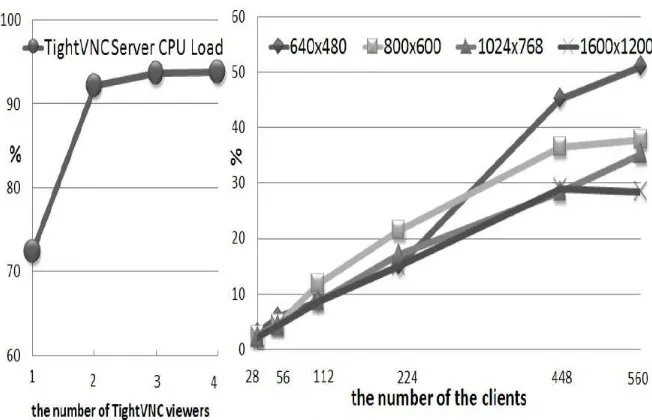
Sharing of display content amongst different display device such as laptop, desktop, handheld computers and smart phones (IPAD) is needed for collaboration. Because of different architectural, sharing of display content is complicated and the performance is very low. By using special media stream formats, the complexities and performance bottlenecks is reduced or avoided. Display content is encoded by continuous media, and a media server processes and distributes customized or fixed rate streams to viewers by streaming it to the media server, and playing it back on up to 1000 clients distributed over 20 computers. The CPU load is below 40% on the server.
Keywords: Display Technique; Media Streams
_____________________________________________________________________________________________
INTRODUCTION
Design and Implementation
To support multiple users with a range of different devices and applications, MultiStream must (1) capture visual content without requiring the shared applications to be modified and (2) provide for heterogeneous clients that may require different media resolutions and encodings. To support multiple platforms and reduce network bandwidth usage, MultiStream uses standard media streams as the communication protocol to share content. The implementation includes three components, shown in Figure 1, that solve each of the problems identified above: (1) live streaming producers, (2) streaming servers, and (3) live streaming consumers.
Figure 1. MultiStream Implementation
Capturing and Encoding
The goal of the live streaming producer is to produce media stream sources, which includes capturing pixels and encoding pixels. It requires the independence on shared applications in order to support various applications. The independence is based on the pixel model because the model reads pixels from frame buffers. Sharpshooter is one prototype of producers implemented by us, which is developed with visual C++. Sharpshooter supports to share display of desktop and 3D applications. Sharpshooter employs Windows hooking, which is a technique uses hooks to make a chain of procedures as an event handler. A hook is a point in the system message handling mechanism. When Sharpshooter starts, it registers the hook procedure which notifies Sharpshooter before activating, creating, destroying, minimizing, maximizing, moving, or sizing a window. When the system receives the window messages, Sharpshooter gains a chance to check whether the hooked application is needed to capture pixels. If Sharpshooter finds that the application is interesting, it modifies a few of the graphics library functions addresses. These functions are used to render the graphics into the frame buffer so that Sharpshooter reads the pixels data from the frame buffer when the hooked application updates the frame buffer each time. Sharpshooter sends the data to one thread, which is to encode pixels into media streams and send media over network. Sharpshooter uses FFmpeg library to deal with media/audio encoding.
Scale Media Server
resolutions and frame rates, in order to address devices polymorphism. When the server finds requests from one consumer is different in media quality, the server scales the media into the requested media quality and sends the scaled media to the consumer.
Performance
We have measured the frame rate which the 3DMark application can achieve with and without concurrently encoding a media of the frames. The media resolution was 320*200, 640*480, 800*600, 1024*768, and 1600*1200. Each experiment ran for 10 minutes. The result is shown in Figure 2. The five values on the X-axis is the number of kilobytes per frame for each of the five resolutions, respectively. Each pixel is encoded by four bytes. The y-axis is the frame rate of 3DMark. When 3DMark runs without encoding a media of its frames, the frame rate drops from about 50 to 18 with increasing resolution. When encoding is done concurrently with running 3DMark, the frame rate drops from about 38 to 4.
[image:3.595.135.461.501.711.2]Figure 2. Performance impacts on producer
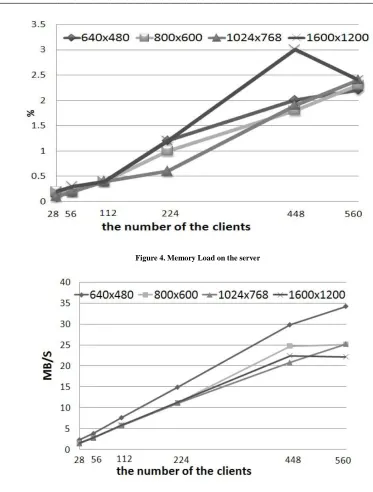
Figure 4. Memory Load on the server
Figure 5. Network bandwidth usage
CONCLUSION
REFERENCES
[1]G. Humphreys, M. Houston, R. Ng, R. Frank, S. Ahern, P. D. Kirchner, and J. T. Klosowski. Chromium: A stream processing framework for interactive rendering on clusters. SIGGRAPH ’02: Proceedings of the 29th annual conference on Computer graphics and interactive techniques, July 2002, pages 693–702.
[2]K. A. Perrine and D. R. Jones. Parallel graphics and interactivity with the scaleable graphics engine. Proceedings of the 2001 ACM/IEEE conference on Supercomputing, November 2001, pages 5–5.
[3]R. Singh, B. Jeong, L. Renambot, A. Johnson, and J. Leigh. Teravision: a distributed, scalable, high resolution graphics streaming system..Proceedings of the 2004 IEEE International Conference on Cluster Computing, September 2004,pages 391–400.
[4]B. Jeong, L. Renambot, R. Jagodic, R. Singh, J. Aguilera, A. Johnson, and J. Leigh. High-performance dynamic graphics streaming for scalable adaptive graphics environment. Proceedings of the 2006 ACM/IEEE conference on Supercomputing SC ’06, November 2006, page 24.
[5]Richardson, Q. Stafford-Fraser, K. R. Wood, and A. Hopper. IEEE Internet Computing, January 1998, 2(1):33–38.