Journal of Chemical and Pharmaceutical Research, 2012, 4(4):1889-1894
Research Article
ISSN : 0975-7384
CODEN(USA) : JCPRC5
Study the effect of chlorosubstituted pyrazoles and their complex on spinach
(Spinacia oleracea L.) at different pH
A. A. Ramteke*
1, M. L. Narwade
1and P. D. Shirgave
21Department of Chemistry, Government Vidarbha Institute of Science and Humanities, Amravati(M.S.), India
2Department of Chemistry, Devchand College Arjunnagar Tal. Kagal, Dist. Kolhapur (M.S.) India
______________________________________________________________________________
ABSTRACT
The metal Tb (III), chlorosubstituted pyrazoles and their complex were used to study the plant growth regulators on spinach. The spinach has high nutrinal and medicinal value. The growth parameters like germination, survival, seedling height and root/shoot ratio etc were studied on the seeds of spinach at different pH. The results found were used to assay the effect of complex, metal Tb (III), chlorosubstituted pyrazoles as ligand and control solution on Spinacia oleracea and the chlorosubstituted pyrazoles and pyrazolines compounds were tested against pathogenic bacteria and studied their effect.
Key words: Chlorosubstituted Pyrazoles, Pyrazoline, Plant growth parameters, Antibacterial.
______________________________________________________________________________
INTRODUCTION
Vegetable plants and human being have unique relationship since time immemorial and they played vital role in the human life. People should consume several hundred grammes of plant-based diet a day since it is a good source of nutrients and dietary fibre. A plant-based diet – focusing mainly on vegetables, fruits and whole grains – has become one of the most important guidelines for lowering the risk of human diseases. Therefore, need to improve the nutritive value of the final products of vegetables plant. The important contributions of the nineteenth century, experimental plant physiology to agriculture was discovery that soil fertility and crop yields could be increased by adding several nutrients to the soil. Germination is an economical and simple Method for improving the nutritive value and several studies have reported [1-4] higher levels of nutrients and lower levels of antinutrients in sprouts compared to the ungerminated seeds. The derivatives of chlorosubstituted pyrazoles and pyrazolines have played a crucial role in the history of the heterocyclic chemistry. Pyrazoles and pyrazolines have been synthesis by various methods [5-7].The pyrazoles derivatives are extensively used in the field of medicine and agrochemistry. Chlorinated containing organic compounds have various bioactivities which render them valuable active ingredients of medicine or plant protecting agent. Naik et al[8] have studied the effect of binary complexes of Pr (III) with some pyrazoles and metal, ligands and control solution on germination survival, seedling height etc. on Brassica (Mohari) and Trigonella (Methi) plants.Rao et al [9] were studied the antimicrobial activity of some pyridine and pyrrole derivatives of pyrazolo (3, 4-c) pyrazoles. Activity of thiocyanates of titanium as plant growth regulators has been reported[10]. The complexes of transition metals with bis-allyl thiourea and their herbicidal and plant growth regulating activity are tested with Wheat and Cucumber by Deverski et al[11].Burghate et al[12], Ikheet al[13] has observed the effect of chalcones and antibiotic drugs on the chlorophyll content and germination of Triticum
arientein has been studied by Waghet al[14] at different pH. Reddy et al [15] have been studied the effects of cotton ginning mill effluents on soil enzymatic activities and nitrogen mineralization in soil. The observation of antifungal and antibacterial activities on complexes show that are more active as compared to free ligand and metal involved [16,17].Studies on special structural requirement and complexation as a possible mode of pesticidal action have also been reported [18]. The antibacterial activity of some new amino acid derivatives of 3-chloro-6-methylbenzo[b]thiophene-2-carboxylic acid have been studied by Hassan et al [19]. Dayalan et al [20] reported the antibacterial effect on some of chlorocobaloximes containing axial substituted pyridines. The pharmaceutical uses of metal complexes have been reported by many workers [21- 24].Thakare et al[25] has been studied the effects of some substituted pyrazoles on germination of Brassica compestris L. Some bivalent metal ions have been reported to be useful in agriculture as plant growth regulators. Such a vast uses of lanthanides necessitate concentrating on the study of lanthanides and ligands for studying the germination pattern. Since, chlorosubstituted pyrazoles/pyrazolines have intense biological activity and since no work is reported on the biological applications of binary complexes of Tb (III) with L1 comparing with pure ligand, metal and control solution distilled water
.Therefore, the aim of this work was to study the effects of chlorosubstituted pyrazoles, trivalent metal Tb (III) and their complex on germination process and growth regulatorson spinach (Spinacia oleracea) plant because spinach have rich source of vit-A, vit-C, vit-E, vit-K, Mg, Mn, Foliate, Betaine, Fe, vit-B12, Ca, K, vit-B6, Folic acid, Cu,
Protein, P, Zn, Niacin, Se and omega 3 fatty acids. Study antibacterial activities of chlorosubstituted pyrazoles/pyrazolines against gram positive and gram negative micro-organisms with the help of Agar well diffusion method.
EXPERIMENTAL SECTION
Metal Ions -The solutions of metal ions [Tb (III)] in the form of nitrate of the concentration of 0.01 M were
prepared using double distilled water.
Ligands Used-Ligand – L1, Ligand – L2, Ligand – L4, Ligand – L5 Ligand – L6, Ligand – L7, Tb (III) - Ligand (L2)
were used and prepared their solutions as 0.01M in 1,4-dioxane (Merk B.D.H. (Anala RyE).The applications of complex, metal, ligand solution are studied by dissolving it in proper solvent at desired pH. The biological applications are therefore, studied in aqueous medium at 4.5, 8.0 and 9.5 pH. The following ligands were used in the present investigation and they are synthesized by known literature methods [26-28].
1) L1:3–(2–Hydroxy–3,5–dichlorophenyl)-4–anisoyl–5–(4’–methoxy phenyl)–1–phenyl pyrazole.
2) L2:3–(2–Hydroxy–3,5–dichlorophenyl)–4–anisoyl–5–(4–methoxy phenyl)–1–phenyl–∆2–Pyrazoline.
3) L4:3–(2–Hydroxy–3,5–dichlorophenyl)–4–benzoyl–1,5–diphenyl pyrazole.
4) L5:3–(4–Chlorophenyl)–4–(3–Pyridoyl)–5-(2–hydroxy phenyl)–pyrazole.
5) L6:3–(4–Chlorophenyl)–4–(2–Chlorophenyl benzoyl)–5–(2–hydroxy phenyl)pyrazole.
6) L7: 3–(4–Chlorophenyl)–4–(2–Furanoyl)–5–(2–hydroxy phenyl)–pyrazole.
7) L2 -Tb (III).
Soil-The basic requirement for this experiment was soil. Fertilized soil was collected from agricultural land. Stones
and other hard material removed from it. It was then grind and filtered. Two parts of this finely powdered soil was mixed with one part of filtered pink stone sand. This soil was then filled in two wooden trays having compartments of equal size. The soil in the tray was moistened with water. Sowing of seeds was done in this soil after one hour.
Spinacia oleracea (spinach) are selected as plant system in present investigation. These plants are ideal system to
control system. The germination and Survival was noted after 3 and 10 days. After noting the survival of the plants, they were taken out of the soil. The seedling height (root length/shoot length) and leaf area (width & length) of young leaf of survived plants were measured. The average values of these parameters are presented in table 1, 2 and 3. The above compounds were tested against five pathogenic bacteria for their antibacterial activities using agar diffusion method.
Table 1.Effect of ligand, metal ion and complex on Germination, Survival, seeding height etc. on Spinacia oleracea (L.) at 4.5 pH.
Table 2.Effect of ligand, metal ion and complex on Germination, Survival, seeding height etc. on Spinacia oleracea (L.) at 8.0 pH.
Table.3. Effect of ligand, metal ion and complex on Germination, Survival, seeding height etc.on Spinacia oleracea (L.) at 9.5 pH.
Parameters
Effect of
General order of plant Growth regulators. Control Ligand (L1) Complex
(Tb (III)-L1)
Metal (Tb (III))
%germination after 3days 52.00 68.00 58.00 55.00
L1>Complex >metal>control
% survival after 10 days 68.00 83.00 76.00 74.00 Seedling height (cm) 2.36 2.45 2.42 2.39 Root length (cm) 4.02 4.09 4.04 4.03 Shoot length (cm) 4.30 4.54 4.49 4.45 Root/Shoot ratio 0.9348 0.9008 0.8997 0.9056 Width length of young leaf (cm) 0.9726 0.9734 0.9727 0.9637
RESULTS AND DISCUSSION
Plant growth is decided on the basis of parameters such as percentage of germinations survival, seedling height, shoot length, root length and leaf area of young leaves having high values compared to control system. 1) The germination was noted after 3 and 10 days. 2) Survival was noted after 3 and 10 days. 3) After noting the survival of the plants, they were taken out of the soil. The seedling height (root length/shoot length) and leaf area (width & length) of young leaf of survived plants were measured. The average values of these parameters are presented in table 1, 2 & 3. In the present investigation, effect of the ligand, complex and metal ion on percentage seed
Parameters
Effect of
General order of plant Growth regulators. Control Ligand (L1)
Complex
(Tb (III)-L1)
Metal
(Tb (III))
%germination after 3days 48.00 63.00 51.00 49.00
L1>Complex >metal>control
% survival after10days 63.00 79.00 73.00 71.00
Seedling height (cm) 2.25 2.40 2.35 2.34
Root length (cm) 3.98 4.05 4.03 4.00
Shoot length (cm) 4.25 4.45 4.40 4.37
Root/Shoot ratio 0.9364 0.9101 0.9159 0.9153
Width length of young leaf (cm) 0.9602 0.9659 0.9601 0.9553
Parameters
Effect of
General order of plant Growth regulators. Control Ligand (L1)
Complex Tb (III)-L1)
Metal (Tb (III))
%germination after 3 days 51.00 65.00 55.00 54.00
L1>Complex >metal>control
germination, root length, shoot length (root /shoot ratio) and seedling height etc. have been studied. The general order of plant growth regulators found at different pH is as –
1) Ligand (L1) > Complex (Tb (III) –L1) > Metal ion (Tb (III)) > Control (at pH 4.5).
2) Ligand (L1) > Complex (Tb (III) –L1) > Metal ion (Tb (III)) > Control (at pH 8.0).
3) Ligand (L1) > Complex (Tb (III) –L1) > Metal ion (Tb (III)) > Control (at pH 9.5).
Thus, at pH 4.5, 8.0 and 9.5 Ligand (L1) can functions as plant growth regulators.
Percent Germination
Seed Germination is one of the major aspects of plant physiology. To understand an actual development in an organism one has to go through in its life cycle. Plant development is a cyclic process. Germinating seed is a convenient place to begin because seeds are quiescent or resting organs that represents a normal hiatus in life cycle. When the conditions are appropriate, the seed will renew its growth and geminates. Such an important phenomenon will be affected by different conditions. It was cleared from table 1, 2 & 3 that, the percent germination in all the treatments showed increase than that of control (distilled water).
Root length, Shoot length and Root/Shoot Ratio
Germination starts when the seed shows emergence phase of growth, which begins with penetration of embryo from the seed coat and end with the development of root and shoot system. The elongation of shoot axis follows emergence of radical. In the seedlings, the hypocotyls are the first to elongate, pulling the cotyledon and the enclosed first foliage leaves up through the soil. The rate and extent of elongation is subjected to a variety of controls, including nutrition, hormones and environmental factors. The shoot apical meristem contains a small number of dividing cells that give rise to all of the other cells and tissues in the primary shoot, including stem, leaves, branches and flowers. The root apical meristem appears structurally less complex than the shoot apical meristem. Though the root and shoot development start within a fraction of time but the further developments may vary according to the nutrients required for the development of root and shoot independently. Therefore, root and shoot lengths differ. Table 1, 2 & 3 clearly indicates that average root length in ligand, complex, Tb (III) at all pH increases over control. In table 1, 2 & 3, it is seen that in Tb (III) complex with Ligand–(L1) showed decrease in
shoot length but increase as compared to control. It is observed that Root/ Shoot ratio is decrease in complex (Tb (III)-L1) and ligand But it is increases for control. The change in the growth pattern of root and shoot were studied
by the proportional growth. The roots – shoot ratio reflect the same and represent the development in root and shoot simultaneously.
[image:4.595.163.436.599.714.2]The pyrazoles and pyrazolines compounds have medicinal values due to this interest to know their biological activities. Presence of antibacterial agent is indicated by the growth inhibition of the bacterial strains and appearance of zone by inhibition i.e. observes a clear zone where the growth of bacteria had not occurred. The aim of present study was to see the effects of above ligands and their complexes. The influence of halogen atoms of organic compounds [29] showson the biological activities. Antimicrobial activity of some bromo-benzothiazolo pyrazolines studied by Bharat Kumar[30] they used E.coli, S. typhi, S.aureus and B. subtilis as micro-organisms by agar cup plate method[31] at concentration of 40 µg/ml in solvent DMF using nutrient agar medium.
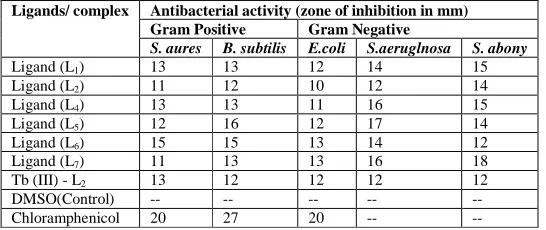
Table 4: Effect of chlorosubstituted pyrazoles and pyrazolines and their complexes on gram positive and gram negative bacteria
Ligands/ complex Antibacterial activity (zone of inhibition in mm) Gram Positive Gram Negative
S. aures B. subtilis E.coli S.aeruglnosa S. abony
Ligand (L1) 13 13 12 14 15
Ligand (L2) 11 12 10 12 14
Ligand (L4) 13 13 11 16 15
Ligand (L5) 12 16 12 17 14
Ligand (L6) 15 15 13 14 12
Ligand (L7) 11 13 13 16 18
Tb (III) - L2 13 12 12 12 12
The present study shows, the antibacterial activities of all the compounds were against five different microorganisms (i.e. S. aures, B. subtilis, E.coli, P. aeruginosa and S. abony) by measuring the zone of inhibition on agar plates. The compounds showed the moderate to good activity against all the microorganisms in comparison with standard (chloramphenicol) it showed in table 4.
It can be observed from these results that compound have shown positive bacterial activities against different bacterial species, which are also known as human pathogenic bacteria. All compounds showed good activity against
P. aeruginosa, S. abony microorganisms and it showed moderate activity against S. aures and B. subtilis and low
moderate antibacterial activities against only E.coli. The Ligand (L1), Ligand (L5), Ligand (L6) and Ligand (L7)
showed good antibacterial activity against all microorganisms. The Tb (III) – L2 complex showed the less moderate
activity with all microorganisms.
Thus from results of screening, it was observed that, the most of the chlorosubstituted pyrazoles compounds were found more or less effective against the microorganisms. Hence these compounds can easily be used for the treatment of diseases caused by test pathogens only when they do not have any toxic and other side effects.
CONCLUSION
The seedling height (root length/shoot length) and leaf area (width & length) of young leaf of survived plants were measured. The average values of these parameters are presented in table 1, 2 & 3. In the present investigation, effect of the ligand, complex and metal ion on percentage seed germination, root length, shoot length (root /shoot ratio) and seedling height etc. have been studied. The ligand-L1 has found high value for all these parameters at different
pH. Thus, at pH 4.5, 8.0 and 9.5 Ligand (L1) can functions as plant growth regulators. The percent germination in all
the treatments showed increase than that of control (distilled water). The root and shoot lengths differ. It clearly show in the Table 1, 2 & 3, the average root length in ligand, complex, Tb (III) at all pH increases over control and complex of Tb (III) with L1 showed decrease in shoot length but increase as compared to control. It is also observed
that Root/ Shoot ratio is decrease in complex (Tb (III)-L1) and ligand But it is increases for control. From results of
screening, it was observed that, the most of the chlorosubstituted pyrazoles compounds were found more or less effective against the microorganisms. The Ligand (L1), Ligand (L5), Ligand (L6) and Ligand (L7) showed good
antibacterial activity against all microorganisms. The Tb (III) – L2 complex showed the less moderate activity with
all microorganisms. Hence these compounds can easily be used for the treatment of diseases caused by test pathogens only.
Acknowledgment
The authors are thankful to the university grants commission (UGC-CSIR), New Delhi for the financial support to carry out this research work. The authors are also thankful to Department of Chemical Technology, SGB Amravati University, Amravati – 444602 (M.S.) India and Department of Library, Sant Gadge Baba Amravati, University, Amravati – 444602 (M.S.) India & Devchand College Arjunnagar, Tal.Kagal, Dist.Kolhapur, (M.S.) India for collecting data.
REFERENCES
[1] RD King; P Perwastien. J. of Food Science., 1987, 52, 106–108.
[2] J Frias; M Prodanov; I Sierra; C Vidal-Valerie. Journal of Food Protection., 1995, 58, 692–695.
[3] J Honke; H Kozłowska; C Vidal-Valverde; J Frias; R Go. Recki Zeitschrift f €ur Lebensmittel- Untersuchung und -Forschung A., 1998, 206, 279–283.
[4] A Levai. Kim Geterotsiki Soedin., 1997,747.
[5] N Ganesh; Sharma; K Susheel; Dubey; Nitin Sati. J. Chem. Pharm. Res., 2011, 3(1), 732-736. [6] A Levai. J Heterocycl Chem., 2002, 39, 1.
[7] J Elguero. In comprehensive heterocyclic chemistry II, Vol 3, edited by A R Katritzky; C W Rees; E F Scriven. (Pergamon press oxford) 1996, pl.
[8] AB Naik. Ph. D. Thesis in Chemistry, SGB Amaravati University, Amaravati. 2007.
[9] R Mallikarjuna Rao; J Sreeramulu; L K Ravindranath; G NagarajaReddy; K. Hanumanthurayudu; G Nageswara Reddy; A Jayaraju; P Madhusudhan. J. Chem. Pharm. Res., 2012, 4(1), 272-278.
[12] AS Burghate. Ph.D.Thesis in Chemistry, SGB Amaravati University, Amaravati. 2002. [13] SA Ikhe. Ph.D.Thesis in Chemistry, SGB Amaravati University, Amaravati. 2004. [14] SP Wagh. Ph.D.Thesis in Chemistry, SGB Amaravati University, Amaravati. 2004.
[15] B Rajasekhar Reddy; G Narasimha; A Sridevi; G Venkat; Subba Reddy. J. Chem. Pharm. Res., 2011, 3(1), 128-137.
[16]AM Shel; EA Shariel; A Gharib; YA Ammar. J. Ind. Chem. Soc., 1983, 60, 1067. [17] P Shashhindharam; L Ramchandra. J. Ind. Chem. Soc., 1985, 62, 920.
[18] TA Clark Bannol; The chemistry and Mode of Action of plant Growth substances. Edited by RI Wain; Wrightmann. Butterworth scientific publication, London. 1956, 286.
[19] H M Hassan; S A M Shedid; F A Kora; R M El- Eisawy. J. Chem. Pharm. Res., 2011, 3(1), 388-394.
[20] A Dayalan; M. Amutha Selvi; P Jothi; V Duraipandiyan; S Ignacimuthu. J. Chem. Pharm. Res., 2011, 3(1), 382-387.
[21] JM Tien. Antibio and Chemother. 1953, 3, 491. Chem. Abstr., 1953, 47, 11531. [22] T Axolant. Biochem. Pharmacol. 1952, 11, 995. Chem. Abstr., 1983, 58, 837.
[23] B Suraj Ade; M N Deshpande; D G Kolhatkar; S M Bhagat. J. Chem. Pharm. Res., 2012, 4(1), 105-111.
[24] Gauri P Deshapande; Murlidhar P Wadekar; Vivek M. Raut; Gopalkrushna H. Murhekar; J. Chem. Pharm.
Res., 2011, 3(1), 72-78.
[25] VJ Thakare. Ph. D. Thesis in chemistry, SGB Amaravati University, Amaravati. 2007. [26] AD Bhuyar. Ph. D. Thesis in Chemistry SGB Amaravati University, Amaravati. 2008. [27] VN Ingale. Ph.D. Thesis in Chemistry, Marathawada University, Aurangabad. 1977. [28] VJ Thakare. Ph. D. Thesis in Chemistry SGB Amaravati University, Amaravati. 2007. [29]MD Ankhiwala; HB Naik. J. Ind. Chem. Soc., 1990, 67, 258.
[30]Bharat kumar; V Pathak; S Rani; R Kant; IC Tewari. International J. of Microbio. Res., 2009, Vol. 1, issue 20-22.