FUZZY LOGIC – GENETIC ALGORITHM BASED MAXIMUM POWER POINT TRACKING IN PHOTOVOLTAIC SYSTEM
ZALIFAH BINTI TUKEMAN
A project report submitted in partial
fulfillment of the requirement for the award of the Degree of Master of Electrical Engineering
Faculty of Electrical and Electronic Engineering Universiti Tun Hussein Onn Malaysia
ABSTRACT
This project is about to carried out the optimization and implementation a fuzzy logic controller (FLC) used as a maximum-power-point tracker for a PV system, are presented. Maximum power point tracking (MPPT) are used to integrate with photovoltaic (PV) power systems so that the photovoltaic arrays are able to deliver the maximum power available. The near optimum design membership functions and control rules were found simultaneously by genetic algorithms (GAs) which are search algorithms based the mechanism of natural selection and genetics. These are
easy to implement and efficient for multivariable optimization problems such as in
vi
ABSTRAK
TABLE OF CONTENTS
TITLE i
DECLARATION ii
DEDICATION iii
ACKNOWLEDGEMENT iv
ABSTRACT v
ABSTRAK vi
TABLE OF CONTENTS vii
LIST OF TABLES x
LIST OF FIGURES xi
LIST OF ABBREVIATIONS AND SYMBOLS xiii
LIST OF APPENDICES xv
CHAPTER 1 INTRODUCTION 1
viii
1.2 Problem Statements 2
1.3 Project objectives 3
1.4 Project Scopes 3
1.5 Expected results 3
CHAPTER 2 LITERATURE REVIEW 4
2.1 Introduction 4
2.2 Previous study 5
2.2.1 Fuzzy logic controller 5 2.2.2 Genetic alorithms 6 2.2.3 Maximum power point
tracking
6
2.2.4 Photovoltaic system 7
2.3 Project review 7
2.3.1 Photovoltaic system 8
2.3.2 Solar radiation and photovoltaic effect
9
2.4 Theory for whole system 10
2.4.1 Common types of PV module 11 2.4.2 Maximum power point transfer
technology (MPPT)
12
2.4.2.1 MPPT works 12
2.4.3 Fuzzy MPPT for PV system 13 2.4.4 Genetic algorithm as a tool of
FLC optimisation for a MPPT
16
CHAPTER 3 METHODOLOGY 18
3.1 Introduction 18
3.2 Overall project veification and analysis 20 3.3 FLC – GA based structural optimisation 22
3.4 Data solar 23
3.4.1 The measured data voltage for solar
3.4.2 The measured power for solar 25 3.4.3 The measured irradiance fo
solar insolation analysis
26
CHAPTER 4 MODELING USING MATLAB/SIMULINK 28
4.1 Introduction 28
4.2 Building of generalized PV model 28 4.3 Building of boost DC/DC converter 31 4.4 Building of photovoltaic and MPPT fuzzy
controller implemented in SIMULINK
32
CHAPTER 5 RESULTS AND ANALYSIS 34
5.1 Intoduction 34
5.2 MPPT in PV module 34
5.3 Computing membership functions using genetic algorithm
38
5.4 Simulation results of PV MPPT fuzzy controller in SIMULINK
47
CHAPTER 6 CONCLUSION AND RECOMMENDATION 51
6.1 Conclusion 51
6.2 Future and recommendation 51
REFERENCES 53
x
LIST OF TABLES
4.1 Specification of the solar panel for sunset ASM 80 31
5.1 Parameters of genetic algorithm used 40
5.2 First iteration using genetic algorithm for determining optimal membership function
42
5.3 Selected strings 42
5.4 Second iteration using genetic algorithm for determining optimal membership function
42
LIST OF FIGURES
2.1 Elements of PV system 8
2.2 PV modules on the roof 10
2.3 Diagram for make a PV cells 11
2.4 The power gained through the use of MPPT controller
13
2.5 Fuzzy inference system 14
2.6 Basic mechanism of genetic algorithms 17 3.1 Flowchart of overall verification and analysis 19 3.2 Flowchart of the system detail for FLC – GA based
structural optimisation
21
3.3 Graph for voltage during shiny day 24
3.4 Graph for voltage during cloudy day 25
3.5 Graph for power during shiny day 25
3.6 Graph for power during cloudy day 26
3.7 Graph for irradiance during shiny day 26 3.8 Graph for irradiance during cloudy day 27 4.1 Subsystem implementation of generalized PV
model
30
4.2 Generalized PV model 31
4.3 Modeling for boost DC/DC converter 32
4.4 Photovoltaic and MPPT fuzzy controller implemented in SIMULINK
33
5.1 Graph for I-V characteristic for constant temperature
xii
5.2 Graph for P-V characteristic for constant temperature
36
5.3 Graph for I-V characteristic for different temperature
37
5.4 Graph for P-V characteristic for different temperature
37
5.5 Information which will be coded using binary coding (X1,X2,X3,X4)
38
5.6 Structure of the used chromosome with binary coding
39
5.7 Graph for best fitness in first string 41 5.8 Physical representation of the first string in Table
5.2 for a) input (E), (b) input (∆E) and c) output (D)
43
5.9 Evolution of GA to evolve the FLC 43
5.10 Best membership functions obtained for system variable a) input (E), (b) input (∆E) and c) output (D)
45
5.11 Control surface for the fuzzy model found by the GA
47
5.12 Simulation results for PV module for a) power, b) current and c) voltage
48
5.13 Duty cycle for best membership function for iteration 1 in whole PV system
48
5.14 Duty cycle for best membership function for system in whole PV system
49
5.15 Modeling for fuzzy based MPPT 49
5.16 Duty cycle for best membership function for iteration 1 in fuzzy based MPPT
50
5.17 Duty cycle for best membership function for system in fuzzy based MPPT
50
LIST OF ABBREVIATIONS AND SYMBOLS
PV Photovoltaic MPPT Maximum power point tracking
DC Direct current
FLC Fuzzy logic controller
P&O Perturb and observe
GAS Genetic algorithms
ANFIS Adaptive neuro-fuzzy inference system
INC Incremental conductance
AC Alternating current
GUI Graphical user interface FIS Fuzzy inference system IAE Integral absolute error E Error of power and voltage
∆E Change of the error
D Duty cycle
ISC Short circuit current VOC Open circuit voltage
q Electron charge
k Boltzman’s constant
A Ideal factor
xiv
TREF Cell’s reference temperature
EG Band gap of the semiconductor used in the cell NP Parallel number of cells
IPH Photocurrent
V Input voltage
IRS Reverse saturation current
IS Saturation current
I Output current
PWM Pulse width modulation
NB Negative big
NS Negative small
ZE Zero
PS Positive small
PB Positive big
LIST OF APPENDICES
A M FILE SCRIPT 56
B SOLAR DATA 58
CHAPTER 1
INTRODUCTION
1.1 Project background
Photovoltaic (PV) system or “solar electricity” converts sunlight (light energy) into electricity. The electricity is produced silently with no pollution, no maintenance and no depletion of natural resources [1]. PV is compassionate and exceedingly versatile. PV actually in a small scale and reliable that can be use to pump water, provide power for communications and village electrification in remote areas.
This project is basically focused on the charge controller component that consists in PV system. This part will be used to detect the maximum power receive during daylight at right angle. The output power induced in the PV modules depends on solar irradiation and temperature of the solar cells. The PV system has an operating system that can supply maximum power to the load. The point that gathers the power called the maximum-power point (MPP). In order to operate the PV array at its MPP, the PV system can implement a fuzzy logic controller (FLC) that used in a maximum-power point tracking (MPPT) controller.
much as possible power from PV and various MPPT method is used to track MPP of PV. Fuzzy logic is a form of many-valued logic. It deals with reasoning that is approximate rather than fixed and exact. Fuzzy logic control based on operator experience is an ideal solution for applications where mathematical model is known or not precisely known especially for problems with varied parameters and nonlinear models [2]. The fuzzy logic method cannot avoid the output vibration. So, MPPT method is necessary in order to improve the output efficiency of costly PV power system. Furthermore, the DC/DC circuit is used to track the actual MPP, which will consume partial electric power and an efficiency DC/DC circuit is important to track the MPP such as Buck, Boost, Buck-Boost and Sepic circuit have been used in MPPT of PV generating system.
1.2 Problem statements
Nowadays, there are many technologies available for photovoltaic system. Malaysia is located just north of the Equator, where the solar irradiation can be extracted optimally. MPPT is usually integrated with PV power system so that PV array is able to deliver the maximum power available. Due to their search nature associated with simplicity and effectiveness, for both linear and non-linear systems, fuzzy logic controller (FLC) methods have showed their outstanding features in MPPT application to get the faster and accurate value when the MPPT collect the power receive. FLC can avoid the oscillation problem of the conventional perturb-and-observe method (P&O) and suitable for any DC/DC topology. Hence, many studies and applications have been proposed, combining MPP tracking and FLC. For example, the experimental results obtained via the fuzzy tracker is presented by Khaehintung and Sirisuk (2004) who have shown that the MPPT was more than eight times better in terms of tracking speed over the conventional MPPT using the P&O method [3]. These results have also revealed that a PV system based upon the proposed controller can reach a power efficiency of about 85%.
3
in this project which utilising Genetic Algorithms (GAs). The GA is based on concept of evolutionary theory and provides an effective way of searching a large and complex solution space to give close to optimal solution.
1.3 Project objectives
The main objective of this project is to introduce a guided approach for FLC based MPPT in improving the trial and error approach.
Its measurable objectives are as follows:
i. To maximise the computation time for fuzzy logic controller. ii. To enhance the calculation accuracy by using genetic algorithms.
1.4 Project scopes
This project is primarily concerned with the implementation between FLC and MATLAB-Simulink. The scopes of this project are:
i. Consider fuzzy inference system to describe FLC rule. ii. Design coding for GA is in converge condition
iii. Using input data according to MSX 60 specifications
1.5 Expected results
The expected results of this project are:
CHAPTER 2
LITERATURE REVIEW
2.1 Introduction
6
2.2 Previous study
This subtopic discusses about the previous study that has been done about the concept and implementation of this system which that use in suitable applications. Sub-subtopic 2.2.1 discusses about the fuzzy logic controller that usually used in one of the method to find MPPT in PV system. Sub-subtopic 2.2.2 discusses about the functionality of genetic algorithm in fuzzy logic. Sub-subtopic 2.2.3 discusses about the comparison of the method to find maximum power point tracking. Sub-subtopic 2.2.4 discusses about the design model for photovoltaic system.
2.2.1 Fuzzy logic controller
M.A.S. Masoum and M. Sarvi proposed new fuzzy maximum power point tracker (MPPT) for photovoltaic system. This project used fuzzy controller input parameter dP/dI , ∆ (dP/dI) and variation of duty cycle (∆DC) are used to generate the optimal MPPT converter duty cycle such that solar panel maximum power is generated under different operating conditions [4].Fuzzy logic controller for maximum power point tracking (MPPT) in photovoltaic system. This paper make a comparison performances between perturb & observe (P&O), proportional integrated (PI) - controlled system and fuzzy logic controller [5].
2.2.2 Genetic algorithms
Intelligent control method for the maximum power point tracking of a photovoltaic system under variable temperature and irradiance conditions. A fuzzy logic controller based MPPT has shown better performance than P&O MPPT approach. So to improve the proposed FLC, genetic algorithm has been proposed for optimization [8].
M.Mohammadian and R.J.Stonier presents general method in how to develop the fuzzy rules by using genetic algorithm and fuzzy logic controller. By using GAs the learning procedure and a FLC as the system performance evaluator. The proposed architecture can construct as input-output mapping in the form of fuzzy IF-Then rules [9].
2.2.3 Maximum power point tracking
This research is about fuzzy logic controller gives a closed loop control method, by use adaptive neuro-fuzzy inference system (ANFIS). The given model operator very fast in comparison on with available methods and has proper accuracy in maximum power point tracking [10]. Other paper proposed to improved efficiencies of power electronics converter, to operate PV system at MPP. This paper presents a fuzzy control method for tracking the MPP based on the fuzzy control methd is developed in the MATLAB. This is suitable for fast changing environmental conditions [11].
8 atmospheric condition. However FLC also have disadvantages because FLC tuning difficulty of membership function scaling factor and control rules [13].
2.2.3 Photovoltaic system
Circuit model of photovoltaic module that can be used as a common platform for the material scientists as well as as power electronic circuit designer to develop the better PV power plant. The developed model is integrated with DC – DC boost converter with closed loop control of maximum power point tracking algorithm [14]. PV module for stand-alone PV system, where a one diode equivalent circuit based versatile simulation model in the form of masked block PV module. By the model, it is allowed to estimate behavior of PV module with respect changes on irradiance intensity, ambient temperature and parameters of the PV module. In addition, the model capable of function to detect MPPT which can be used in the dynamic simulation of stand-alone PV system [15].
Circuit-based simulation model for a PV cell in order to allow estimate the electrical behavior of the cell with respect changes on environmental parameter of temperature and irradiance. An accurate PV module electrical model based on the Shockley diode equation. The general model was implemented on matlab script file and accepts irradiance and temperature as variable parameters and outputs the I-V characteristic [16]. Implementation of generalized photovoltaic model using Matlab/Simulink software, which can be representative of PV cell module and array for easy use on simulation platform. The proposed model is designed with a user-friendly icon and a dialog box like simulink block libraries. This makes geberalized PV model easily simulated and analyzed in conjuction with power electronics for a MPPT [17].
This subtopic is discusses about review project that will be used in this project. subtopic 2.3.1 is about the explanation in photovoltaic system in daily life. Sub-subtopic 2.3.2 is about solar radiation and the effect in photovoltaic system.
2.3.1 Photovoltaic system
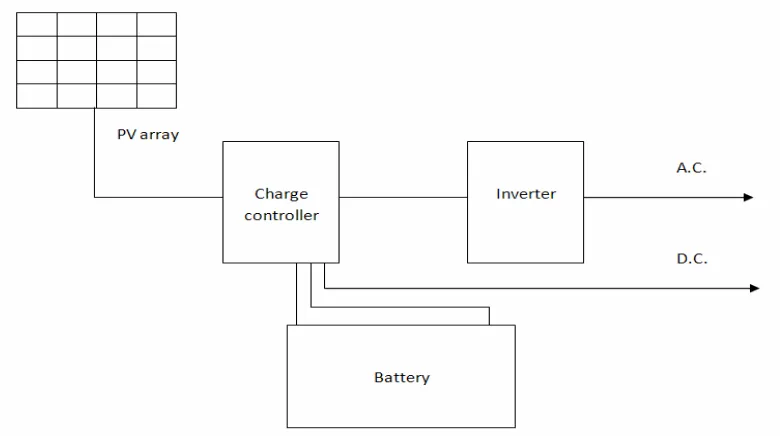
A photovoltaic system broadly normally consists of photovoltaic array is comprise a few numbers to a few hundreds of modules. The sun pointed to PV array and the charge controller will regulate the power. Then the power will stored at the battery bank that consisting of deep cycle batteries. Lastly, the inverter will convert the dc power from array into ac power.
The daily energy output from PV array will vary depending on its size, orientation and location, season of the year and the daily weather conditions. Energy storage is required for the power when sun is not shining. Battery sizing depends on the application, the daily solar radiation, the total load, peak load and the number of days which storage required.
10
Figure 2.1: Elements of PV System
2.3.2 Solar radiation and photovoltaic effect
The design of a photovoltaic system relies on a careful assessment of solar radiation at a particular site. Although solar radiation data have been recorded for many locations in the world, they have to be analyzed and processed before a sufficiently accurate estimate of the available solar radiation for a photovoltaic system can be made.
About half of the scattered energy from a clear sky reaches the earth in the form of diffuse radiation. The sum of the diffused, reflected and direct radiation on a horizontal surface is known as total radiation or global radiation. Then, the total power from a radiant source falling on a unit area called irradiance, which means solar radiation intensity.
The amount of radiation that reaches the ground is variable. In addition, the regular daily and yearly variations due to the apparent motion of the sun, irregular variations are caused by the cloud cover. For this reason, the design of a photovoltaic system relies on the input of measured data close to the site of the installation. Other factors include the response of various PV types to the solar energy wavelength as well as the physical positioning of the module itself.
from the sun’s ray, solar irradiance. When the sun falls on solid-state, it causes an electrical charge and direct current flows. There are two systems of utilization, either the DC power is used directly or the DC power is inverted for AC application. Figure 2.2 shows the direct sunlight to PV modules and convert the sunlight into electricity.
Figure 2.2: PV modules on the roof
The photovoltaic effect is the basic physical and chemical process through which a PV cell converts sunlight into electricity. Sunlight is composed of photons – packets of solar energy. These photons contain different amounts of energy that correspond to the different wavelengths of the solar spectrum. When photons strike a PV cell, they may pass through it. The absorbed photons are photons are the ones responsible to generate electricity.
2.4 Theory for the whole system
12 2.4.4 is explanation about the genetic algorithms (GAs) as a tool of FLC optimisation for a MPPT.
2.4.1 Common types of PV modules
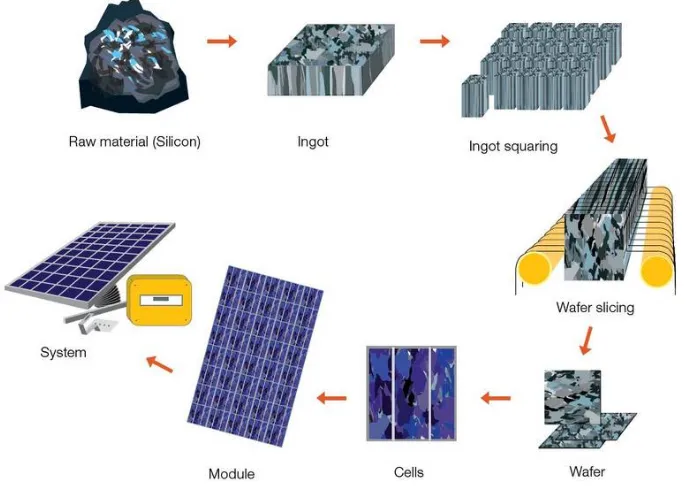
[image:23.595.150.493.343.586.2]PV cells are generally made either from crystalline silicon, sliced from ingots or castings, from grown ribbons or thin film, deposited in thin layers on a low-cost backing. Figure 2.3 shows the process to make a PV cells.
Figure 2.3: Diagram for make a PV cells
Crystalline PV modules, which are made by grouping a number of individual solar cells together, are currently used for residential and commercial applications. One of the reasons why crystalline modules are used so frequently is that they’re more efficient than other PV technologies. Typical crystalline modules are rated at 11 to 14 watts per square (W/ft²). Some of the higher-efficiency modules are rated in excess 0f 17 W/ft², which allows a consumer to generate a greater amount of energy in limited space, like on roof.
Thin film technologies vary in their raw materials and exact manufacturing processes the thin film only that material on the substrate is extremely thin, ranging from just nanometers (nm) to a few micrometers (µm) thick.
2.4.2 Maximum power point transfer technology (MPPT)
MMPT is the technology that allows a PV array to deliver the maximum amount of energy to a battery bank. MPPT charge controllers gained popularity in the early 2000s when manufacturers released highly reliable and accurate version that allowed users to maximize the charging ability of their PV array and reduce the required PV array size for battery charging compared to some of the older technology.
2.4.2.1 MPPT works
14
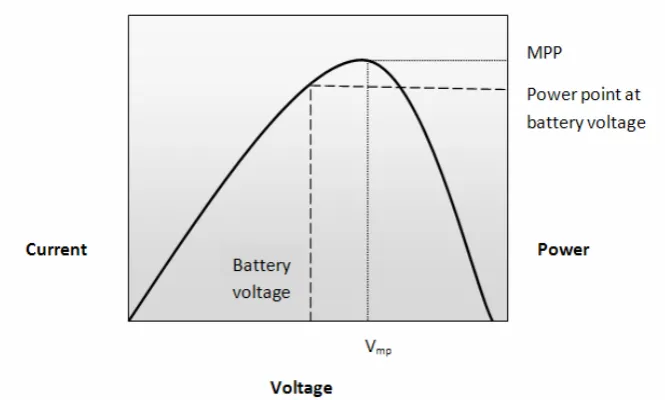
Figure 2.4: The power gained through the use of MPPT controller
Figure 2.4 shows the location of a typical battery charge set-point. When the point straight over to the right from that point, the power level associated at the battery-charging voltage. The difference in the MPP and the power level associated with the battery-charging voltage represents the increased power output due to the use of the MPPT technology. The PV array’s power levels move throughout the day depending on the environmental conditions and MPPT controllers adjust right along them.
2.4.3 Fuzzy MPPT for PV systems
Fuzzy logic has two different meanings. In a narrow sense, fuzzy logic is a logical system, which is an extension of multivalued logic. However, in a wider sense fuzzy logic (FL) is almost synonymous with the theory of fuzzy sets, a theory which relates to classes of objects with unsharp boundaries in which membership is a matter of degree. In this perspective, fuzzy logic in its narrow sense is a branch of FL.
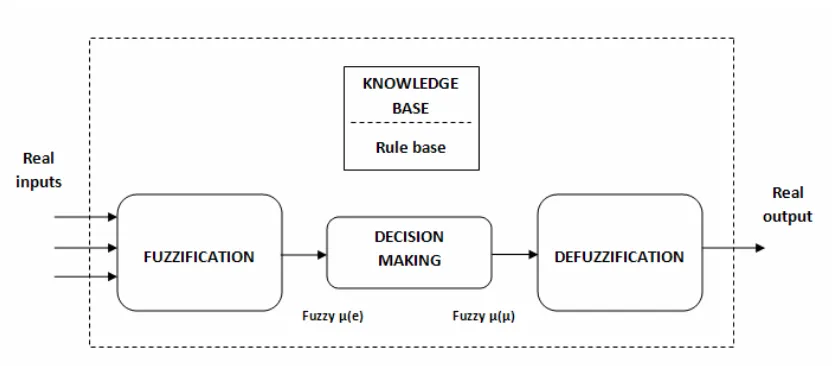
stand-alone C programs that call on fuzzy systems user build with MATLAB. This toolbox relies heavily on graphical user interface (GUI) tools to help user accomplish their work. FLC contains four main components as shown in Figure 2.5 [9]:
a) The fuzzifier that maps crisp values into input fuzzy sets to activate rules. b) The rules which define the controller behavior by using a set of IF–THEN
statements.
c) The inference engine which maps input fuzzy sets into output fuzzy sets by applying the rules.
[image:26.595.134.550.308.491.2]d) The defuzzifier that maps output fuzzy values into crisp values.
Figure 2.5: Fuzzy inference system
The rules describing the FLC operation are expressed as linguistic variables represented by fuzzy sets. The controller output is obtained by applying an inference mechanism [10] which defines:
1) The kind of membership functions.
2) The connections used to link the rules antecedents. 3) The implication function chosen.
4) The rule aggregation operator.
16 It should be noted that the number and shape of the membership functions of each fuzzy set as well as the fuzzy logic inference mechanism was initially selected based on trial-and-error methods, in a manner that the region of interest is covered appropriately by the input data. The idea behind the chosen reasoning in this paper was, if the last change in the control signal (D) caused the power to rise, keep moving in the same direction. Otherwise, if it has caused the power to drop move it in the opposite direction. Subsequently, as it will be explained in the following sections, a genetic algorithms (GAs) technique was used to tune both of membership functions and the rule-base set.
The MPPT using the Mamdani’s FLC approach, which uses the min–max operation fuzzy combination law, is designed in a manner that the control task try to continuously move the operation point of the solar array as close as possible to the maximum power point (MPP) [3]. The two inputs of the proposed fuzzy controller are the tracking error (E) and the change of the error (∆E), which are defined by:
(2.1)
(2.2)
where E and ∆E are the error and change in error, n is the sampling time, p(n) is the instantaneous power of the PV generator, and V(n) is the corresponding instantaneous voltage. These inputs are chosen so that the instantaneous value of E(n) shows if the load operation power point is located on the right or in the left compared to the Pmax actual position. While ∆E(n) expresses the moving direction of this operation point (see Figure 2.4).
2.4.5 Genetic algorithms (GAs) as a tool of FLC optimization for a MPPT
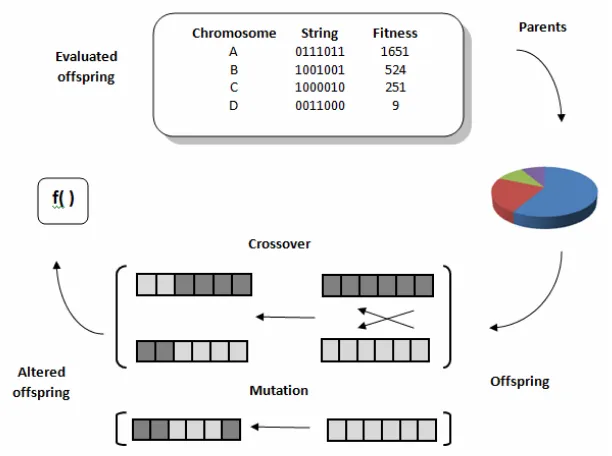
The genetic algorithms are based on concepts of evolutionary theory, and provide an effective way of searching a large and complex solution space to give close to optimal solutions much faster than random trial-and-error methods. They are also generally more effective at avoiding local minima than differentiation-based approaches. The basic mechanism of a GA can be simply described as follows [9]:
1) Define the string of a chromosome: The string of searching parameters for the
optimization problem should be defined first. These parameters are genes in a chromosome, which can be binary coded or real coded. Different chromosomes represent different possible solutions.
2) Define the fitness function: The fitness function is the performance index of a
GA to resolve the viability of each chromosome. The design of the fitness function is according to the performance requirements of the problem such as convergence value, error, rise time and others.
3) Generate an initial population: A set of chromosomes should be randomly
generated before using a GA operation. These chromosomes are called the initial population. The size of the population is chosen according to the complexity of the optimization problem. Generally speaking, larger values require fewer generations to converge to a solution. However, the total computation time depends also on the number (N) of used generations to reach the algorithm’s convergence.
4) Generate the next generation or stop: GAs use the operations of
18
Figure 2.6: Basic mechanism of genetic algorithm
Genetic algorithms as just described can be used to tune the fuzzy controller parameters like the structure of rules and membership functions to find those parameter values that are optimal with respect to the design criteria [11]. The optimization of these two entities can be done separately, which may result in a suboptimal solution, because the design parts are mutually dependent by using GA’s to design both parameters simultaneously [12], the two elements of fuzzy controllers can be fully integrated to deliver a more finely tuned, high performance controller.
CHAPTER 3
METHODOLOGY
3.1 Introduction
20
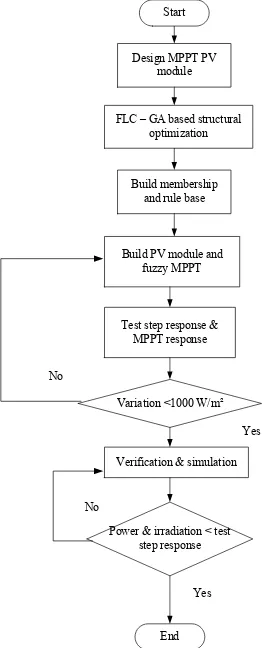
Design MPPT PV module
FLC – GA based structural optimization
Variation <1000 W/m²
Yes No
Start
Power & irradiation < test step response
End
Build PV module and fuzzy MPPT
Verification & simulation
No
Yes Build membership
and rule base
[image:31.595.186.448.72.720.2]Test step response & MPPT response
3.2 Overall project verification and analysis
In this part, the software that will be used in this project has been work. Fuzzy logic toolbox in the MATLAB Simulink for as one of MPPT method has been studied about it criteria and how to use it. As shown in Figure 3.1, firstly design MPPT PV module. In order to test the robustness of the design fuzzy-based MPPT, the various parts of the PV system will be design using MATLAB-Simulink. Then compute FLC – GA based structural optimization. The system detail will be elaborated in subtopic 3.3. Build the membership function and rule base using Fuzzy Inference System (FIS) editor.
22
3.3 FLC – GA based structural optimization
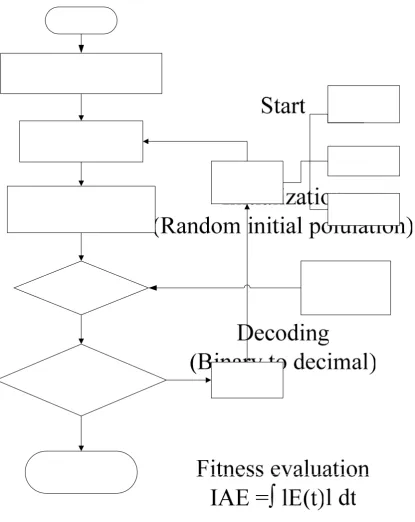
Figure 3.2 is explanation about how to optimize the GA value. First, initialize the parameter for GA and FLC. Divide the input and output space of the system to be controlled into fuzzy region. Then set the random initial population of n string (for n parameter) of the length L is created by using bit string (0 and 1) for each input and output region. Each string is decoded into a set of parameters that it represents to find the membership function and fuzzy rule set parameter. This set of parameters is passed through a numerical model of the problem space. The numerical model gives out a solution based on the input set of parameters. By using below equation to find the base value for decode value:
(3.1) where
b = Number in decimal form that is represented in binary form L = Length of the bit string
Xmax and Xmin = User defined constant between which Xi vary linearly
The fitness values are determined for each string in the entire population of strings. The fitness evaluation for GA can be done using fitness function of the GA by using global optimization toolbox in matlab. Therefore, the fitness function of the GA for each individual is defined as follows:
The optimization also can be done by GA on the minimization of integral absolute error ( IAE ) given by :
(3.2)
where
e(t) = P(t)expect – P(t)PV
P(t)expect = Maximal theoretical delivered power i.e., T = 25 OC and G = 1000 W/m2
24
The fitness values are scaled so as to distinguish the individual for which the fitness value is calculated. The fitness measure defined by:
(3.3)
The IAE value is relatively small compared to 1000, so minimizing IAE is equivalent to maximize fitness expression. Build the membership function using base value and choose the best fitness value for each string. With these fitness values, the three genetic operators are used to create new generation of string. The new set of strings is again decoded and evaluated using three basic genetic operators. This process is continued until convergence is achieved within population.
The operations of reproduction, crossover and mutation are used in order to generate the next generation. Reproduction is the process by which strings with better fitness values receive correspondingly better copies in the new generation. The second operator, crossover, is the process in which strings are able to mix and match their desirable qualities in random fashion. The third genetic operator, mutation is used when reproduction and crossover may not be able to find the optimum solution to a problem. From generation to generation the maximum value of the fitness value is achieved. During the creation of a generation it is possible that the entire population of string is missing a vital bit of information. So the value at certain string location can change (changed to zero or vice versa). Use a FLC to assess the set of fuzzy rules and assign a value to each generated set of fuzzy rules. Stop generating new set of fuzzy rules once some performance criteria are met.
3.4 Data solar
REFERENCES
[1] A. H. Haris, "Grid-Connected and Building Integrated Photovoltaic : Application Status & Prospect for Malaysia," Master Builder , Pusat Tenaga Malaysia, 2006.
[2] C. Lee, "Fuzzy Logic in Control System : Fuzzy Logic Controller - Psrt I,"
IEEE Trans. Syst. Man Cybernet, pp. 404-435, 1990.
[3] K. N. a. S. P, "Implementation of Maximum Power Point Tracking Using Fuzzy Logic Controller for Solar-Powered Light Flasher Applications," in The 47th
IEEE International Midwest Symposium on Circuits and Systems, Hiroshima,
2004.
[4] M. a. M.A.S.Masoum, "A new fuzzy-based maximum power point tracker for photovoltaic applications," Iranian Journal of Electrical & Electronic
Engineering, vol. I, 2005.
[5] S. S. a. G.Balasubramaniam, "Fuzzy Logic Controller for the Maximum Power Point Tracking in Photovoltaic System," International Journal of Computer
Appplications, vol. 41, no. 12, 2012.
[6] M. E. a. H. I.Okumus, "Fuzzy Logic Controlled Buck-Boost DC-DC Conveter for Solar Energy-Battery System," Turkey, 2011.
[7] P. a. K. C.S.Chin, "Optimisation of fuzzy based maximum power point tracking in PV system for rapidly changing solar irradiance," Global Hournal of
Technology & Optimization, vol. II, 2011.
56
International Workshop on Robot and Human Communication, Australia, 1994.
[10] A. J. a. M. R.Ahmadian Majin, "Speed Improvement of MPPT in Photovoltaic Systems by fuzzy Controller and ANFIS Reference Model," in M.S. Student, Shahid Bahanor University of Kerman, Process Control and Optimization
Research Center and Technical College of Ilam, Iran.
[11] a. H. W. Jiyong Li, "Maximum power point tracking of photovoltaic generation on the fuzzy control method," China, 2008.
[12] H. A. m. H. A. E. h. a. M. E. E. K. S. Mohamed M. Algazar, "Maximum power point tracking using fuzzy logic control," Electric power and energy systems,
pp. 21-28, 2012.
[13] I. P. a. Y. K. Lo, "A fuzzy control maximum power point tracking photovoltaic system," IEEE International Conference on Fuzzy Systems, 2011.
[14] R. R. a. R. M. Pandiarajan N, "Application of curcuit model for photovoltaic energy conversion system," India.
[15] C. Q. a. Z. Ming, "Photovoltaic module simulink model for a stand-alone PV system," in 2012 International Conference on Applied Physics and Industrial
Engineering, China, 2011.
[16] F. M. Gonzalez-Longatt, "Model of Photovoltaic Module in Matlab," in
American Student Congress of Electrical, Electronic and Computer Engineering
, 2005.
[17] C. S. T. a. Y. J. S. Huang Liang Tsai, "Development of Generalized Photovoltaic Model Using MATLAB/SIMULINK," in Proceeding of the World
Congress on Engieering and Computer Science, USA, 2008.
[18] R. Mayfield, "Photovoltaic Design & Installation for Dummies," in Wiley
Publishing, Inc., 2010.
[19] J. R. Timothy, "Fuzzy Logic with Engineering Applications," in John Wiley &
Sons Ltd., 2004.
[20] C. S. S. S. B. A. Jime´nez, "Hardware Implementation of a General Purpose Fuzzy Controller," in IFSA, 1995.
[21] C. G. E. Karr, "Fuzzy Control of pH using Genetic Algorithms," in IEEE
[22] A. M. E. Homaifar, "Simultaneous Design of Membership Functions and Rule Sets for Fuzzy Controllers using Genetic Algorithms," in IEEE Transactions on
Fuzzy Systems 3 (2), 1995.
[23] R. L. a. S. E. Haupt, Practical Genetic Algorithms, New York: Wiley-Interscience, 1998.
[24] X. Q. a. H. Li, "Application of Fuzzy Logic and Immune Response Feedback for PV Generating System," in Taiyuan Univerity of Science & Technology,
China, 2010.
[25] A. E.-S. A. Nafeh, "Fuzzy Logic Operation Control for PV-Diesel-Battery Hybrid Energy System," in Electronics Research Institute, Egypt, 2009.
[26] S. L. a. D. Rekioua, "Modeling and Simulation of a Photovoltaic System using Fuzzy Logic Controller," in Department of Electrical Engineering, University of
Bejaia, Algeria, 2009.
[27] S. a. G. V. Pai, Neural Networks, Fuzzy Logic and Algorithms ( Synthesis and Aplications), India: Prentice Hall, 2007.