mi
ìhiW.Wt
E U R O P E A N ATOMIC E N E R G Y COMMUNITY — EURATOM
^ l ·
1ι·.· J.'T..,
U&K
isliif
A ONEGROUP COLLISION PROBABILITY CODE
SLABS
FOR CYLINDERS AND
I
t l
í l
fíilíi?
!I'
• [¡ ititrfjUajli
B
(Hb
S?îh
Joint Nuclear Research Center
Ispra Establishment — Italy
Reactor Physics Department
Reactor Theory and Analysis
,.(¡«•1 :*Ι!!·ί*1πί!'' til"«¡fllflÍa'l™i':«i»,ll"lHi¡M,JII«
VJîli??»"
Neither the EURATOM Commission, its contractors nor any person
acting on their behalf:
M
'"■"■ï u-v
m
Make any warranty or representation, express or implied, with respect
to the accuracy, completeness, or usefulness of the information con
tained in this document, or that the use of any information, apparatus,
method
owned
in this document, or that the use of any information, apparatus,
i,
or process disclosed in this document may not infringe privately
ri8hts;or
llllll^^
Assume any liability with respect to the use of, or for damages resulting
from the use of any information, apparatus, method or process disclosed
at the price of FF 6.—
FB 60
DM 4.80
Lit. 750
Fl. 4.30
E U R number and the title,
each report.
1 -t . . » ' < ■
This doeu,
; r jr; "J3TÍÍ1
jment was reproduced on the basis of the best available copy.
líil
M
'
¡inf
mmWL
EUR 2624.e
Λ ONE-GROUP COLLISION PROBABILITY CODE FOR CYLINDERS AND SLABS
by B. QUIQUEMELLE
European Atomic Energy Community - EURATOM Joint Nuclear Research Center - Ispra Establishment (Italy) Reactor Physics Department - Reactor Theory and Analysis Brussels, January 1966 - 38 Pages - FB 60
The Code TIJ performs the numerical evaluation of the collision probabilities in concentric cylinders or slabs. For cell calculations several boundary condi tions can be imposed including a black inner region. Escape probabilities and Dancoff coefficients calculations are compared with other methods. The complete list of the FORTRAN programme is given.
EUR 2624.e
A ONE-GROUP COLLISION PROBABILITY CODE FOR CYLINDERS AND SLABS
by B. QUIQUEMELLE
European Atomic Energy Community - EURATOM Joint Nuclear Research Center - Ispra Establishment (Italy) Reactor Physics Department - Reactor Theory and Analysis Brussels, January 1966 - 38 Pages - FB 60
The Code TIJ performs the numerical evaluation of the collision probabilities in concentric cylinders or slabs. For cell calculations several boundary condi tions can be imposed including a black inner region. Escape probabilities and Dancoff coefficients calculations are compared with other methods. The complete list of the FORTRAN programme is given.
EUR 2624.e
A ONE-GROUP COLLISION PROBABILITY CODE FOR CYLINDERS AND SLABS
by B. QUIQUEMELLE
European Atomic Energy Community - EURATOM Joint Nuclear Research Center - Ispra Establishment (Italy) Reactor Physics Department - Reactor Theorv and Analysis Brussels, January 1966 - 38 Pages - FB 60
EUR 2 6 2 4 . e
EUROPEAN ATOMIC ENERGY COMMUNITY — EURATOM
A ONE-GROUP COLLISION PROBABILITY CODE
FOR CYLINDERS AND SLABS
by
B. QUIQUEMELLE
1 9 6 6
Summary
C O N T E N T S
Part I Description of the method
Part II Some applications of the code
References
Appendix 1 Summary of main equations
Appendix 2 Input data format
Appendix 3 Sample problem
Appendix
k
List of symbols with printig option
Appendix 5 Description of the subroutines
Appendix 6 List of the code
pag. 3
8
ík
15
17
19
2.Z
2k
2.Ί
A one-group collision probability code for cylinders and slabs
Part I : Description of the method
Introduction (°)
In solving practical problems of neutron transport, the first flight
collision probability theory has been proved successful since already
some years. This theory provides a link between the most powerful
methods for calculating the slowing down and the spatial distribution
of neutrons.
Several works have dealt the analytical evaluation of collision
probabilities in the simplest geometries. It has been thought inter
esting to solve the problem in using a straightforward numerical
technique. Useful conclusions can then be drawn on the validity of
such numerical techniques by comparison with the exact analytical
evaluation
k
_
Method of Calculation
We will consider now a reactor or a lattice cell which can be represented
by a one-dimensional geometry. Those geometries are formed of concentric
cylinders or side by side slabs; also if we consider a regular lattice,
the periodic structure will be taken into account by a suitable boundary
condition.
We want to calculate the probability P
p._ that a neutron born in a
region "R^" - with a given space-angle distribution - collides in a region
"RJ", In case of a regular lattice, R^ refers to a well defined region of
the cell together with the homolog region in the other cells (through a
suitable cell boundary condition).
Considering a normalized source of neutron in region "R/
1and the corres
ponding first flight collision flux φ , the quantity to be calculated is
just Λ
where
£_
is the total cross section at space point r.
Such a problem is easily solved by the numerical integration of the
in-homogeneous Boltzmann equation using the so-called "S approximation".
η
This approximation consists in the discretisation of the angular and
space variables. A mesh cell is then specified by an index i for the
space variable and two indices l,m for the direction of flight vector.
One then considers the value of the flux on each boundary of the mesh
cell such as
<p>
which is the value at space point r Cor χ ) when the
direction of flight is an averaged direction inside the mesh cell.
Similar definitions exist for
<φ
and
φ
,. A set of difference type
' m * 1
conver- 5
gence criterium is reached. In our case we are interested in the
collision probabilities for which the medium is considered to be ab
sorbing for all types of collisions. Then no iteration is needed which
avoid the most time consuming operations of the usual S^ ,
Without going in any more details the main equations solved by the
code have been gathered in appendix I.
If the calculation is done inside one cell of a lattice, the contri
butions from other cells are introduced through a balance equation at
the external boundary
Φ. -
ÍK
■ ( f «·
τ. Ζ)
The vectors have for components the flux along the discrete directions
chosen for the mechanical quadrature. It is really this balance equation
which avoids the iteration over the space mesh and which suppresses the
need for the inner iteration of the usual S codes.
η
g
represents the neutrons coming directly from the source and
leaving the lattice cell without having collided.
^ p
represents the neutrons coming from the other cells in the lattice,
Τ
is the transmission matrix of the lattice cell for incoming neu
trons. When the set of discrete directions is symmetric for inward and
outward directions this matrix is diagonal. In this case the elements
of the matrix Τ are found in solving the system of equations of appendix
I for an isotropic boundary source of unit intensity and collecting the
number of neutrons leaving the cell along discrete outward directions.
The elements of the matrix R represent the coefficients of transfer from
one outward direction to one inward direction.
The result of the calculation is just a square matrix of the
P R1 ^ . R1we
J
which will write more simply Pjj·
satisfy the reciprocity relations
we
which will write more simply Pj.. The elements of this matrix must
6
-and also the conservation relations (in an infinite lattice)
Zl·«-k
where V and /\ are the volume and mean free path inside the region
designated by the subscript. It should be noted that those relations
are already a very good check for the accuracy of the numerical method.
Conclusion
This method for calculating the collision probabilities is fast and
accurate. When used for a lattice geometry, rather complicated
bound-ary laws are simply introduced through the specification of the R
matrix. In the present code the neutrons are started uniformly and
isotropically in each region but an extension has been done for
14
dealing with anisotropic sources . This code can also be used like
a subroutine for calculating transport kernels with a flux calculation
12
method similar to the THERMOS method . It is thought that rather
accurate kernels are found in a short time even for large size regions.
The advantageof this method over the DSN method is that the S
appro-n
ximation is used only for calculating accurate transport kernels with
a minimum effort, then well developed techniques for accelerating
7
-List of Symbols
i index for designation of a space mesh boundary
l,m two indices for designation of an angular mesh boundary
<τ> (k * 1,1 or m) value of the flux on the boundary labelled
by index k when the variables which varies over other bound
aries have a mean value
Ζ
i i i+l
total cross section inside space mesh ί , jr
w weight associated to the discrete direction inside the mesh
cell and used for mechanical quadrature {half value indices
are generally omitted for clarity)
IX direction cosine
r ,r inner and outer radius of mesh i in cylindrical geometry
χ ,x abscissa defining the mesh i in slab geometry
i i+1
PB _vj probability that a neutron born uniformly and isotropically
S
in region R suffers his first collision in region R
is 1 inside the region R and O outside
R
I number of space mesh
η order of approximation for the discrete angular representation
η(η+4)
In cylindrical geometry there exist
Λdiscrete directioi
8
Part 2: Some applications of the code
The code has been applied to a variety of problems and results were
compared with exact methods.
a) calculation of es'cape probabilities:
We consider, by example, a twomedia cell in a lattice consisting of a
fuel rod surrounded by a moderator. The probability of escaping the rod
is just
Ρ
= P.
o
î-f
m
where Ρ
is calculated using the code TIJ with two regions (fuel +
moderator). Such a calculation is reported in table II and compared
with other analytical methods. It should be noted that the best bound
ary condition is given by an isotropic return along directions which
have the same azimuth that the incident neutron direction (although
the difference with a purely isotropic return is negligible). In this
case the results compared very closely with the analytic calculations
4
of Pennington . We can also state that there exists no simple speci
5
fication for finding the exact results of Fukai with any combination
of two or three boundary laws.
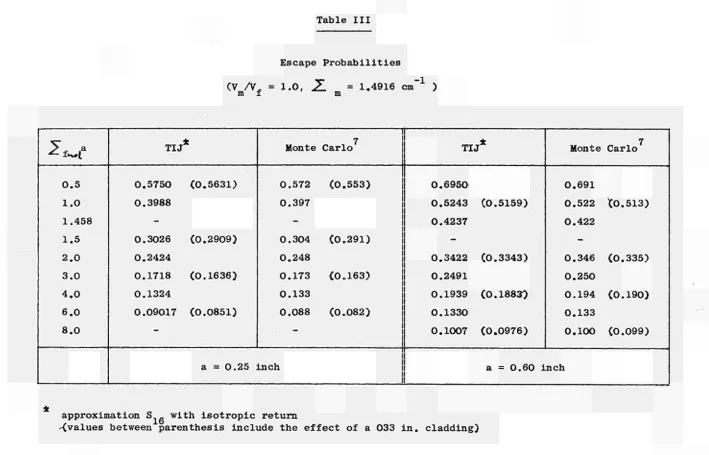
In table III a similar calculation was performed and shows a very good
7
Table II
Escape Probabilities
(a (radius of rod) = 0.183 inch, V /V = 1.0,
2. -
1.49170 cm"
1)
m' f
m
^ f u 4
a0.1
0.3
0.5
0.8
1.0
2,0
4.0
a
Takahashi
0.76875
0.52590
0.39776
0.28918
0.24372
0.18393
0.068981
TIJ
IBVL - 1
0.7723
0.5295
0.4014
0.2927
0.2471
0.1358
0.07047
IBVL = 3
0.8160
0.5908
0.4589
0.340O
0.2884
0.1603
0.08281
IBVL = 2
0.8157
0.5898
0.4575
0.3383
0.2866
0.1588
0.08196
Pennington
0.81364
0.58855
0.45695
0.33839
0.28694
0.15912
0.082044
exact
0.80745
0.57988
0.44745
0.32973
0.27918
0.15490
0.080363
approximation S,_
16
IBVL « 1 (mirror reflection)
IBVL * 3 (white boundary)
Table III
Escape Probabilities
CV/V, =1.0, Σ. = 1.4916 cm" )
m f m
Έ-uf
0.5
1.0
1.458
1.5
2.0
3.0
4.0
6.0
8.0
TIJ*
0.5750 (0.5631)
0.3988
0.3026 (0.2909)
0.2424
0.1718 (0.1636)
0.1324
0.09017 (0.0851)
I
7
Monte Carlo
0.572 (0.553)
0.397
0.304 (0.291)
0.248
0.173 (0.163)
0.133
0.088 (0.082)
a = 0.25 inch
T U *
0.6950
0.5243 (O.5159)
0.4237
0.3422 (0.3343)
0.2491
0.1939 (0.1883)
O.1330
0.1007 (0.0976)
7
Monte Carlo
0.691
0.522 tO.513)
0.422
0.346 (0.335)
0.250
0.194 (0.190)
0.133
0.100 (0.099)
a = 0.60 inch
approximation S _ with isotropic return
11
b) Dancoff factor calculations
It is possible to specify a black inner region in the cylindrical geo
metry. In this case TIJ code prints the current J
of neutrons en
tering the black region. If we perform a two region calculation with
a cell boundary condition (IBVL different of 0 ) we can calculate the
shadowing factor of Dancoffι
C Ä
J"
* *f
2
where 1/4
¿
is the current in the infinite moderator.
m
Such a calculation is reported on table IV and compared to exact Monte
g
Carlo calculations. There is a maximum discrepancy of 3.5% which can
well be explained by the inadequacy of the linear approximation near
the Inner black boundary. It should be also necessary to use more dis
crete directions near the discontinuity of the angular flux at the
black boundary. Those calculations compare well with some analytical
9
lo
Table IV
Dancoff coefficient
( ¿ = 1.4916)
m
Rod size (inch)
0.250
0.387
0.600
V /V.
m f
1.0
1.5
2.0
3.0
4.0
1.0
1.5
2.0
3.0
4.0
1.0
1.5
2.0
3.0
4.0
IBVL = 1
0.4532
0.5637
0.6342
0.7366
0.8026
0.5960
0.7071
0.7751
0.8670
0.9252
0.7446
0.8434
0.9005
0.9567
0.9817
TIJ
IBVL = 2
0.5507
0.6797
0.7551
0.8514
0.9040
0.6898
0.8023
0.8678
0.9357
0.9729
0.8186
-0.9487
0.9854
0.9989
IBVL = 3
13
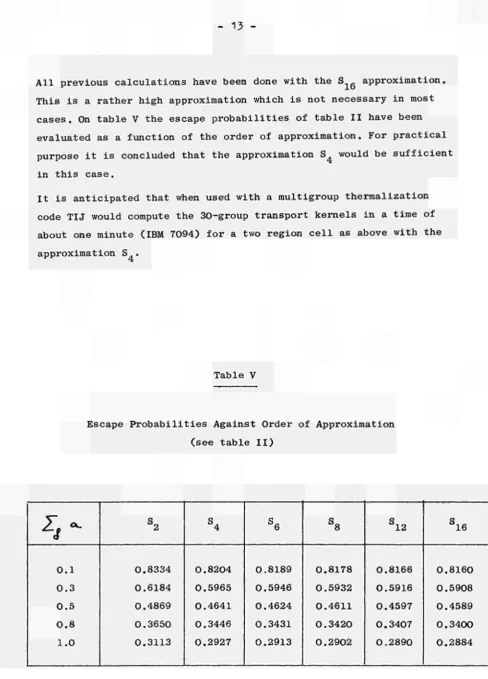
-All previous calculations have been done with the S _ approximation.
This is a rather high approximation which is not necessary in most
cases. On table V the escape probabilities of table II have been
evaluated as a function of the order of approximation. For practical
purpose it is concluded that the approximation S
4would be sufficient
in this case.
[image:17.595.63.552.37.717.2]It is anticipated that when used with a multigroup thermalization
code TIJ would compute the 30-group transport kernels in a time of
about one minute (IBM 7094) for a two region cell as above with the
approximation S .
Table V
Escape Probabilities Against Order of Approximation
(see table II)
Σ,-0.1
0.3
0.5
0.8
1.0
S
2
0.8334
0.6184
0.4869
0.3650
0.3113
S
4
0.8204
0.5965
0.4641
0.3446
0.2927
S
6
0.8189
0.5946
0.4624
0.3431
0.2913
S
8
0.8178
0.5932
0.4611
0.3420
0.2902
S
12
0.8166
0.5916
0.4597
0.3407
0.2890
S
16
14
References
Carlson,B.G.,
Numerical Formulation and Solution of Neutron Transport
Problems", LA2996 (1963)
Lee,CE.,
Carlson,B.G.,
"The Discrete S Approximation to Transport Theory", LA259£
η
"The Numerical Theory of Neutron Transport", Methods in
Computational Physics, 1, pp. 142 (1963)
Pennington,E.M., Collision Probabilities in Cylindrical Lattices , Nucl,
Sei. Eng., 19, pp. 215220 (1964)
Fukai,Y.,
'First Flight Collision Probability in Moderator Cylindrical
Fuel Systems" Reactor Sci., 17, pp. 115120 (1963)
6
Takahashi,H.,
"Resonance Escape Probabilities in Circular Cylindrical Cel]
Systems", Reactor Sci., 12_, pp. 2631 (1960)
7
Rothenstein,W., "Collision Probabilities and Resonance Integrals for Lattici
BNL 563 (T151)
8
Seghal,B.R.,
private communication
9
Kiesewetter,H.
"Tabellen für die DancoffKorrektion in regulären Stabgit
tern", Kernenergie 6, pp. 608616 (1963)
10
Sauer,Α.,
11
Bonalumi,R.,
12
Honeck, Η . C ,
13
Jonsson,Α.,
Approximate Escape Probabilities , Ν. Sci.Eng. 16,
329335 (1963)
"Neutron First Collision Probabilités in Reactor Physics"
Energia Nucleare, 8, pp. 326336 (1961)
"THERMOS A thermalization Transport Theory Code for
Reactor Lattice Calculations"
tG>N
L O Ö i o
"Onegroup Collision Probability Calculations for Annular
Systems by the Method of Bonalumi", Reactor Sci., 17,
pp. 511518 (1963)
15
Appendix 1
Summary of main equations
1) Cylindrical geometry
difference equation for boundary values
U.ÎC Φ
-Ο.ώΑ-
Iî±i—
c
' ( V
φ
Υ
ψ
)
+-<Υ*
- c .
recursion relation for the coefficients of streaming between rays
γ
- y
β
4icw u = °)
linear approximation for the shape of the flux inside a mesh cell
i = 1,2,3
I+l
m = 1,2
n2(Cl)
t =
1,2
....
η
2
for m = o the following difference equation is used:
^ ^ • ¿ Γ
fun»♦<*.·)^ *i'
<
i*Ofc.
1
J ^ V
and
φ. + Φ
= -e <£
16
2) Slab geometry
difference equation
I* <" «fc*. " « I )
+
^
U C H
M^M, +*)
^
( Λ α
» *^
approximation (same as in cylindrical geometry)
i = 1,2 .... 1+1
m = 1,2 ....
η
3) Both geometries
< c \ .
Σ
w
Ψ
φ><
1)
- ¿L.
'
(total flux)
-
17
-Appendix 2
Input data format
card 1
col 2-72 identification of the problem
card 2
(FØRMAT 2413)
c o l 1-3
c o l 4 - 6
c o l 7-9
(ISN)
(IGEØM)
(ICVL)
n = 2,4,6,8,12 or 16
0 slab geometry
1 cylindrical geometry
condition at r (or x) = o
- cylindrical geometry
0 the inner region is a black region
1 reflective condition
- slab geometry
1 reflective condition
2 periodicity condition
col 10-12 (IBVL) condition at the outer boundary
- cylindrical geometry (r = r
T)
0 the system is in void
1 mirror reflection condition
2 isotropic return along directions of
same azimuth
3 isotropic return along all directions
4 arbitrary input law of reflection
- slab geometry
18
col 1315 IAFPT
1618 ITSNPT
1921 IBVLPT
2224 ICVLPT
2527 ITPT
2830 ISNPT
printing options
(see list of symbols in appendix 4)
card 3
(FØRMAT 213)
col 13
(NR)
nb of regions
col 46
(NMAT)
nb of cross sections
card 4
(FØRMAT 2413)
col 13 etc...
nb of cross section inside each consecutive region
card 5
(FØRMAT 6E12.5)
col 112 etc...
ι
2
c r o s s s e c t i o n nb 1
2
NMAT
(as much card as necessary)
card 6
(FØRMAT 6E12.5)
col 112 etc...
t
thickness of region 1
"NR
(as much card as necessary)
2
NR
card 7
(FØRMAT 6E12.5)
col 112
13124
2536
a = 10.0
b = 2.0
c = 1.0
(see subroutine MESH)
-
m
*>
Appendix 3
Sample Problem
13
The sample problem corresponds to the case calculated by Jonsson
We consider a three-region system with radii of 1, 2 and 3 mean free
path. Results are given in following table.
p
i J
i J
1 1
1 2
1 3
2 1
2 2
2 3
3 1
3 2
3 3
TIJ
(IBVL = 2)
0.5915
0.3012
0.0740
0.1002
0.6190
0.2122
0.0148
0.1271
0.6112
Theseus
^A^PLC" PftoibLÊ/<l FOR
- » ·
ru
( A öf/E" &ROÜP
C O L L I
s i W PKOÔA6«
L I T /
coot" FcR
C / L I ' I / O A I C A L
φα
b
L A *
G r o s t r a ι e~^j
S/WH F p a o f t L ^ ( j D ^ s o i T j . o F h/üc.fï^.
VOL
17- P. íTi^J
CA < U )
ι
4
3
-h-Ib
(
a ι
I
i
l . o
Ι · ο
io· ο
ι
ι
ο
Ι . ο
4 . 0
Ι
* XEQ
ENTRY POINTS TC SUBROUTINES REQUESTED FROM LIBRARY,
(FPT) (TSHM) (RTN) (STHM)
(FID
EXIT
SQRT
EXECUTION
SAMPLE PROBLEM OF TIJ(A ONE-DIMENSIONNAL COLLISION PROBABILITY CODE)
APPROXIMATION S
IGEOM= 1
16
ICVL =
IBVL =
1
2
3
1
0
THICKNESS
1
0. lOOOOE 01
C. 1000ÛE 01
0. 10000E 01
MATERIAL
2
1
1
1
SIGMA-TOT
3
0.10000E 01
MATRIX PIJ*LAMCAJ*VI
1
1 0.2957UE-00
2 0.15Û31E-00
3 0.37126E-01
0.15061E-00
Ü.9285UE 00
0.31785E-00
VOLUME OF REGIONS
1
1 0.50000E 00
2 0.15000E 01
3 0.25000E 01
COLLISION PROBABILITY MATRIX
1
1 0.591U8E 00
2 0. 10021E-00
3 0. 1U850E-01
0.30123E-00
0.61903E 00
Ü.1271UE-00
0.370QUE-O1
Q.31837E-Q0
0.15279E 01
0.7U008E-01
0.21224E-Ü0
0.61118E 00
32 LINES OUTPUT THIS JOB.
JOB START AT
COMP./LOAD
EXECUTION
TOTAL JOB
22
-Appendix 4
List of symbols with printing
option
Fortran name
Variable name
or description
Printing option
DMU (M,L)
W («Αι«-)
F(M,L)
CVL(M,L)
BVL(M.L)
PTTP(ML,ML)
BVLZWCL)
TH(I)
SGT(I)
IMAT(I)
T(I,J)
R(D
(direction cosine)
w (weight for quadrature)
Diagonal elements of matrix Τ
(boundary transparence coefficients)
Angular fjux at center
Angular flux at boundary
and g vector components
Elements of reflection matrix R (direc
tions are ordered like in ref. 2 p. 13)
Angular flux at boundary along m = o
directions (zero weight directions)
thickness of regions )
cross section . see input data
. , . ,, s specifications
material table )
P
R,-»R.
i J
r
i'
Xi
ISNPT
ISNPT
ISNPT
ICVLPT
IBVLPT
ISNPT
IBVLPT
always printed
ITPT
ITSNPT
23
-DR(I)
RM(I)
V(I>
VNR(I)
FMT(I)
BM(I)
TSN(I)
r
i+i -
ri '
xi+i -
xi
r
i+i
+ ri
xi+i
+ xi
2
'
2
2
2
r... -
r.
χ
-
x.
l+l
i
l+l
i
2
volume of regions
+ *
Φ .
^ ■ ( i )
ITSNPT
ITSNPT
ITSNPT
ITSNPT
IAFPT
IAFPT
Zk
Appendix 5
Description of the subroutines
1) TIJ (main routine)
read input data
set up the elements of the R matrix if IBVL
Φ
O, 1, 4
monitor the complete calculation
2) Subroutine CYL (ARG1, ARG2, ARG3)
This routine solves the equations of table I and has two calling sequences:
a) CALL CYL (IR, ISL, ISR) then an uniform and isotropic source is placed
in region IR which means between mesh points r _
(or χ
) and r
IöL+1
IoL+1
IoR
(or x
T C !_). The flux Is stored in vector TSN (direct transfer) and compo
ISR
nents of vector g are collected.
b) CALL CYL (0, IMAXI, IMAXI) then no source is introduced but the bound
ary flux found in the data block BVL is imposed at the external surface.
The flux value are cumulated in TSN (total transfer).
3) Subroutine DMND
From appendix I this subroutine calculates :
Φ
,
function of Φ
,
Φ
. . , for inward directions
'
i
' m »
ï+l
φ
. , function
ol φ
,
φ
.
for outward directions
« ï+l
' m r i
4) Subroutine ZWGHT (Y)
is used in cylindrical geometry for the directions (m=o) which cross the
axis of the cylinder.
2 Y = (ψ
±+
^>
ί+1)
25
-5) Subroutine BVLCYL
solves the balance equation at the boundary of the lattice cell in
cylindrical geometry.
When IBVL is different of 0 or 1, the equation is solved after a fixed
number (11)of successive substitutions.
6) S u b r o u t i n e SLABBC
applies boundary condition on each discrete direction in a slab geometry
7) Subroutine TKRNL(IR)
sets up the collision probability matrix elements when the source region
is IR. Also it computes
¿~ ii
which ι
*
*
conserves neutrons and is symmetrical.
is IR. Also it computes
¿~ i{
which must sum to one if the boundary la
*
à8) Subroutine SNWGT
prepares LL and w for each discrete directions. The three direction
cosines are taken from the set of n/2 values.
2 _
6m 5
_
n
M
T 7 T T
m 1,
Δ
.... —
l^
m
3(η1)
2
2
The weights are those calculated by Lee using the area method.
9) Subroutine MESH
A fine mesh is automatically prepared. In each region i, the mesh size
is
ι
Κ /A with a minimum of Β mesh interval in each region (A and Β are
i
input data). C is used to modify the mesh size within C mean free path
of a boundary.
10) Subroutine MATPT (A, IDIM, JDIM, KDIM, I, J, K)
prints automatically in a suitable form a matrix A with one, two or
26
-11) Subroutine VCTRPT (N, VI, II, Fl,..., VN, IN, FN)
prints N vectors of dimension I with variable format
F = 2 (floating point format)
F = 1 (fixed point format)
12) Subroutine RLINK
« LÍSEL
CTIJOOO
C I F ' E N S I C N D N U ( 1 7 , 8 ) , W ( 1 7 , 8 ) , F < 1 7F. E ) , C V L ( 1 7 , E ) , B V L ( 1 7 , H ) , P T T P ( 3 6 , 3 6 T I J O O O O 1
1)iBVLZh(8) T U 0 0 0 0 2 C IMENS ICN T K 2 0 ) . SCT( 20 ), IMAT (20) ,NNSH(20),Τ(20,20) Τ IJ 00003 D IMENS ICN RI 500),CR(500),V(500),RM(500),SGThV(500),BN(500),FMT(500TIJ00004
1),TSN(5C0) TIJ00005
CCMMCNICEOM, ISN,ISNF,MC,LC,NR, IMAX,IMÄX1,NTIN,NTCUT T U 0 0 0 0 6 CCWM0NK1,K2,K3,K4,J1,J2,J3,J4, 11,12,13,14 TIJ00007
CCMNCNWPK1,KRK2,WRK3,WRK4,DMUML,WNL,GNP,GNP1t fi I.S T U 0 0 0 0 8 CC"NONCf'U,W,F,CVL,BVL,PTTP TIJ00009 CCMMCNTF.SCT, IMAT.NMSH.T T U 0 0 0 1 0 CCMMONR.CR.V.RM.SCThV.BN.FMT.TSN.EVLZK TIJ00011 CCMM0N1SNH1C,ISNH1,I SN 1,I SN IG,ICVL,IBVL» IBLCK,NRINI Τ , PI TIJ00012 CCMNONIAFPT,ITSNPT,IBVLPT,ICVLPT,ITPT , ISNPT TIJ00013
NTIN=5 T U 0 0 0 1 4
NT0UT=6 TIJ00015
PI=3.1415927 TIJ00016
10 ISNC=ISN TIJ00017
REAC INPUT TAPE NTIN.6 TIJ00018 WRITE OUTPUT TAPE NTCLT.6 TIJ00019 READINPUTTAPENTIN , 1 , ISN, IGEOM, ICVL,IBVL.I AFP Τ,ITSNPT,IBVLPT,ICVLPTIJ00020 IT, ITPT, ISNPT TIJ00021
WRITE OUTPUT TAPE NTCLT,5 ,1 SN,IGECM,ICVL , IBVL T U 0 0 0 2 2 IF(ISNOISN)15,20,15 TIJ00023 15 ISNF=ISN/2 TIJ0002U ISNH1G=ISNH+1+IGE0M T U 0 0 0 2 5
ISNH1=ISNH+1 TIJ00026
ISN1=ISN+1 TIJ00027
ISN1G=ISN+1+IGE0M TIJ00028 ISNHG=ISNH+IGEOM TIJ00029 ISNG=ISN+IGE0M T U 0 0 0 3 0
CALLSNWGT TIJ00031
20 REAC INPUT TAPE NT IN,1,NR,NMAT TIJ00032 REAC INPUT TAPE NT IN, 1,(IMAT(I),1 = 1,NR) TIJ00033 REAC INPUT TAPE NTIN,3,(SGT(I),1=1,NMAT) T U 0 0 0 3 4 REAC INPUT TAPE NT IN,3,(TH(I),1 = 1,NR) TIJ00035 WRITE CUTPUT TAPE NTCLT.4 TIJ00036 CÍLLVCTRPT13,TH,NR,2,IMAT,NR,1,SGT,NMAT,2) TIJ00037
CALLMESH TIJ00038
CC5CLC=1,ISNH TIJ00039
CC5CMC=1,ISN1 TIJ00040
50 F(MC,LC)=0.C TIJ00041 IF( IGECN)30C,300,100 TIJ00042 C CALCULATION OF TRANSPARENCE COEFFICIENTS FOR CYLINDER ■ T U 0 0 0 4 3 100 DC 150 1 = 1,IMAXI TIJ00044 150 TSN(I)=C.0 TIJ00045
CC8000LC=1,ISNH TIJ00046
J1=ISNH1GLC TIJ00047
CC8C00MC=1, Jl T u o o o u e 8000 BVL(MC,LC)=1.0 TIJ00049 CALLCYL10, IfAXI,IMAXI ) . TIJ00050 IF( IBVLFT18200, 82 00,6100 T U 0 0 0 5 1 8100 WRITCCUTPUTTAPENTCUT.20C1 TIJ00052 CALL MATPTÍBVL, 17,8,1.ISN1, ISNH, 1 ) TIJ00053 e200 CC8500LC=1,ISNH TIJ00054
F(1,LC)=BVLZW(LC) T U 0 0 0 5 5
J1=ISNH1GLC TIJ00056
CC85CCNC=2,J1 TIJ00057
MP=2«J1+1MC TIJ00058
8500 F(MC,LC)=BVL(MP,LC) T U 0 0 0 5 9 IF(ISNPT18600,8600,855 0 TIJ00060 8550 WRITECUTPUTTAPENT0LT.30C0 TIJ00061 CÍLL "ÁTPTCF,17,8,1,ISNHG,ISNH,1) TIJ00062 8600 Kl = ISN'«(ISN + 2) T U 0 0 0 6 3
Kl=Kl/8 TIJ00064
IF( IPVLU) 154, 152,1514 TIJ00065 154 IF( IBVL11370,370,175 TIJ00066 152 DC 153 K2=1,K1 T U 0 0 0 6 7 153 REAC INPUT TAPE NT IN , 3,(ΡTTP(K2,K),K=1,K1) TIJ00068 170 IF t ISNPT137C370, 171 TIJ00069 171 WRITECUTPUTTAPENTCUT,50C0 TIJ00070
CALLMâTPT(PTTP,36,36,l,Kl,Kl,l) T U 0 0 0 7 1
GCTC37C TIJ00072
175 IF( IPVL21999,176, 185 TIJ00073
176 MCLC=C TIJ00074
DC1P0LC = 1,ISNI¡ TIJ00075 J2=ISNH1GLC+1 TIJ00076 J3=ISNG2(LC1) TIJ00077
WRK1=0.C TIJ00078
CC178MC=J2,J3 TIJ00079
178 WRK1=WRK1 + W ( M C , L O « C M U ( M C L C ) TIJ00080
K2=NCLC+1 TIJ00081
180 185 188 190 300 350 355 360 365 370 40C 410 412 415 420 450 460 462 4620 463 464 465 470 475 480 500 520 550 560 562 1562 563 2563 CC180 MC=J2,J3 MCLC=MCLC+1 WML=W(MC,LC) DMUML=DMUIMC,LC) CC180K=K2,K3 PTTP(K,MCLC)=DMUML«ViML/WRK1 GCT0170 MCLC=0 WRK1=0.C CC188LC=1,ISNH J1=ISNH1G-LC DC188MC=1,Jl WRK1=WRK1+W(MC,LC)«CNU(MC,LC) CC190LC=1,ISNH J2=ISNhlG-LC+l J3=ISNG-2»(LC-1) DC190M.C = J2,J3 MCLC=MCLC+1 WML=W(MC,LC) CMUML=CMU(MC,LC) CC190K=1,K1 PTTP(K,MCLC)=CMUML*WML/ABSF(WRK1) GCT0170
CALCULATION OF TRANSPARENCE COEFFICIENTS DC355MC=1, ISNH
CNUML=CMU(MC,1) BI=1.0
DC350I=1,IMAX I 1 = IMAX1-I CÍLLCMNC FIMC, 1 )=BI
IF( ISNPT)37C,370,365 WRITECUTPUTTAPENTCUT,30CO CALLVCTRPT(1,F,ISNH1G,2) CC400I=1,NR DC4C0J=1,NR T( I,J)=C.O ISR = 0 ISL = 0
IF( ICVL)410,410,415 IF( IGECM-1415,415,412 NRINIT=2 GCT042C NPINIT=1 CC600IR=NRINIT,NR DC450LC=1, ISNH CC450MC=1, ISN1 CVL(MC,LC)=C.O BVL(MC,LC)=C.O DC460I=1,IMAXI TSN( I ) = C 0 CTIM=0.0 ISR=ISR+NMSH(IR) ISL=ISR-NMSH(IR) CALLCYLtlR, ISL.ISR) DC463LC=1, ISNH J1=ISNH 1G-LC DC4620MC=1,J1 CTIM=CTIM+CVL(MC,LC)«W(MC,LC)«DMU(MC, J2=J1+1 J2=2«J1-IGECK CCNTINLE ISL1=ISL+1 IF( ITSNFT)470,470,465 WRITECLTPUTTAPENTOUT,2000,ISL1,ISR WRITECUTPUTTAPENT0UT.20C2 CALLVCTRPTtl.TSN,IMAX 1,2) IF( IBVLFT)480,480,475 WRITECUTPUTTAPENTOUT,2001 CALL MATPTIEVL,17,8,1,ISNG,ISNH,1) IF( IGECM)50C,500,520 CALLSLAeBC GCT0560
IF( I 8 V D 5 5 0 , 2 5 6 3 , 5 5 0 CALLBVLCYL
CALLCYLIO,IMAXI,IMAXI) DC563LC=1,ISNH
J1=ISNF 1G-LC C C 1 5 6 2 M 0 1 . Jl
CTIM=CTIM+CVL(MC,LC)«W(MC,LC)»DMU(MC: J2=J1+1
J3=2»J1-IGECM CONTINUE
IF( ICVL 1564,1563,564
,LC) ,LC) TIJ00083 TIJ00084 TIJ00085 TIJ00086 TIJ00087 T U 0 0 0 8 8 TIJ00089 TIJ00090 TIJ00091 T U 0 0 0 9 2 TIJ00093 TIJ00094 TIJ00095 T U 0 0 0 9 6 TIJ00097 TIJ00098 TIJ00099 T U 0 0 1 0 0 TIJ00101 TIJ00102 TIJ00103 T U 0 0 1 0 4 TIJ00105
FOR SLAB TIJ00106 TIJ00107
563 564 565 570 575 580 600 999 1 3 4 5
WRITE OUTPUT TAPE 6,5001,CUM TIJ00167 IF( ITSNFT)570,570,565 T U 0 0 1 6 8 WRITECUTPUTTAPENTOUT,2000,ISL1,I SR ΤI JOO 169 WRITECUTPUTTAPENT0UT,20C3 ΤI JOO 170 CALLVCTRPTI l.TSN, IMA XI,2) Τ I JOO 171
IF( IBVLPT)580,580,575 T U 0 0 1 7 2 WRITECUTPUTTAPENT0UT,20C1 Τ I JOO 173 CíLLMATFTIGVL, 17, 8 , 1 , ISNG, ISNH , 1 ) T U 0 0 1 7 4
CALLTKRNLIIR) TIJ00175
CONTINUE TIJ00176
GCTOIO TIJ00177
FCRNATI24I3) TIJ00178
FCRMAT(éE12.5) TIJ00179 FORMATI 1H09X37HTHICKNESS MATERIAL SIGMATOT) T U 0 0 1 8 0 FORMAT ( 16H0APPROXIMATION S, I3/7H0IGECM = I3/7H0ICVL =I3/7F0IBVL =I3TIJ00181
1) TIJ00182
6 FCRMAT (72H T U 0 0 1 8 3
1 ) T U 0 0 1 8 4
200C FCRMATI 1H08X1 1HSOURCEII )=1/10X3H(1 = 12,lh,12,1h)) TIJ00185 2002 FORMATI 1H07X15HDIRECT TR.COEF.) TIJ00186 2001 FCRMAT(23H0EOUNDARY VALUES MATRIX) TIJ00187 2003 FORMATI 1H07X 14HT0TAL TR.COEF.) T U 0 0 1 8 8 3000 FCRMAT(35H0B0UNDARY TRANSPARENCE COEFFICIENTS) TIJ00189 4001 FORMATI IHO) TIJ00190 5000 FORMATI 18H0REFLECTION MATRIX) TIJ00191 5001 FCRMAT (27HCCURRENT AT BLACK BCUNDARY = E 12.5 ) T U 0 0 1 9 2
ENC TIJ00193
» LABEL
CCYLOOO CYLOOOOO
SLBROLTINECYL(IR, I SL, I SR) CYL 00001 C IMENS ICN CMU(17,8),W(17,E),Fl 17,8),CVL I 17,8),ΒVL I 17,8),FTTPI 36,36CYL00002
1),BVLZW(8) CYL00003
DIMENSION T U 20),SGT(20),IMATt20),NMSH(20),Τ(20,20) CYL00004 DIMENSION R(500),CR(500),V(500),RM(500).SGTHV(500),RM(500),FMTI 500CYL00005
1),TSN(5C0) CYL00006
CCMMOMCEOM.ISN,ISNH,MC,LC,NR,I MAX,IMAX 1,NTIN»NTOUT CYL00007 CCMN0NK1,K2,K3,K4,J1,J2,J3,J4,I1,12,13,14 CYL00008 CCMM0NWRK1,WRK2,WRK3,WRK4,DMUML,WML,GMP,GMP1,fi I,S CYL00009 CCMMONCMU,W,F,CVL,BVL,PTTP CYL00010 CCNMONTh.SGT,IMAT.NMSH.T CYL00011 CCMMCNR,DR,V,RM,SGTHV,BM,FMT,TSN,BVLZh CYL00012 CCMM0NISNH1G,ISNH 1,ISN1,I SN 1 G,ICVL,IBVL,IPLCK,NRINIT,PI CYL00013 COMMONIAFPT, ITSNPT,IBVLPT,ICVLPT,ITPT,ISNPT CYL00014 0C4C0LC=1,ISNH CYL00015
CC20I=1,IMAXI CYL00016
BMII)=0.0 CYL00017
20 FMT(I)=C.O CYL00018
GMP=0.0 CYL00019
GMP1=0.C CYL00020
C INWARC CIRECTIONS MESH SWEEP CYL00021
J1=ISNH1GLC CYL00022
DC200MC=1,J1 CYL00023
WML=W(MC,LC) CYL00024
CMUML=CMU(MC,LC) CYL00025 75 IF( IGECM)85,85,80 CYL00026
80 GMP=GMP1 CYL00027
GMP1=GMF12.0»WML«DMLML CYL0002B 85 IF( IR)9C,90,99 CYL00029 90 BI=BVL(MC,LC) CYL00030
IM=IMAX CYL00031
GCTC1C0 CYL00032
99 BI=C.C CYL00033
ΙΜ=ΙΜΔΧ CYL00034
100 T S M IM+1 ) = TSN(IM+1)+WML«BI CYL00035
FMT(IM+1)=BI CYL00036
CC 1501=1,IH CYL00037
11 = IM—I + 1 CYL00038
12=11 CYL00039
IFI IlISL)110,110,113 CYL00040 113 IF( IlISR) 112,112,110 CYL00041
11? S=1.0 CYL00042
GCTC115 CYL00043
110 S=0.0 CYL00044
115 IF(KML) 120,120,130 CYL00045 120 CÍLLZWGFTIY) CYL00046
BM(I1)=Y CYL00047
GCTC15C CYL00048
130 CALLCMNC CYL00049
TSN(I2)=TSN(I2)+WML«FMT(I2) CYL00050
150 CONTINUE CYL00051
192 IF(WML)1920,1920,194 CYL00056 1920 IF t ICVL H921.1921.1930 CYL00057
1921 BI=0.0 CYL00O58 1930 CC 196CI1 = 1,ΙΜΔΧ CYL00059
12=11+1 CYL00060 IFI Il-ISL)1950,1950,1935 CYL00061
1935 IF( Il-ISR)1940,1940,1950 CYL00062
1940 S= 1 .0 CYL00063 GCTC195E CYL00064 1950 S=0.0 CYL00065 1955 CALLZWCHTIY) CYL00066
FMT(I1)=Y CYL00067 1960 CONTINUE CYL00068
OVLZW(LC)=BI CYL00069 IF(IAFPT)20C ,200 ,1961 CYL00070
1961 WPITECUTPUTTAPENTOUT,4000 CYL00071 CALLVCTRPTl1,FMT,IMAX,2) CYL00072
GCTC2CC CYL00073 194 IF( IGECM)20C,200,195 CYL00074
195 MF=2«J1+1-MC CYL00075 IF( ICVL ) 196,196,197 CYL00076 196 CVL(MP,LC)=C.O CYL00077
G0TC2CC CYL00078 197 CVL(MP,LC)=PI CYL00079 200 CONTINUE CYL00080 260 J2=J1+1 CYL00081
J3=2»J1-IGECM CYL00082 CC390MC=J2,J3 CYL00083 WML=W(MC,LC) CYL00084 DMUML=CMU(MC,LC) CYL00085 264 IFI IGECM)265,265,270 CYL00086 265 IFI IR)275,275,267 CYL00087
267 BI=C.C CYL00088 IMIN=ISL+1 CYL00089 GCTC28C CYL00090 270 GMP=GNP1 CYL00091
GMP1=GMF1-2.0«WML«DMUML CYL00092
275 IMIN=1 CYL00093 DI=CVL(MC,LC) CYL00094
280 TSNI IMIN) = TSN(IMIN) + WML«BI CYL00095
FMT(IMIN)=BI CYL00096 CC350I 1 = IM IN,IMAX CYL00097
12=11+1 CYL00098 304 IFI I1-ISL)320,320,305 CYL00099
305 IF( Il-ISR)310*310,320 CYL00100
310 S=1.0 CYL00101 GCTC33C CYL00102 320 S=0.0 CYL00103 330 CALLDMNC CYL00104 335 TSN(I2)=TSN(I2)+KML«FMT(12) CYL00105
350 CONTINUE CYL00106 356 IF( IAFPT)38C,380,357 CYL00107
357 WRITECUTPUTTAPENTOUT,10C0,MC,LC CYL00108 CALLVCTPPT(2,FMT,IMAX1,2,HM,IMAX,2) CYL00109
380 BVL(MC,LC)=EI CYL00110 390 CONTINUE CYL00111
If(IGEOM)41C,410,400 CYL00112
400 CONTINUE CYL00113 J1 = ISNH C Y L 0 0 U 4 GCT0415 CYL00115 410 Jl=l CYL00116 415 IF(ICVLFT)450,450,42C CYL00117
420 WRITECUTPUTTAPENTOUT,20C0 CYL00118 CALLMATPT(CVL,17,8 , 1 , I SN 1,Jl,1) CYL00119
450 IF{ IBVLFT)460,460,455 CYL00120 455 WRITECUTPUTTAPENTOUT.30C0 CYL00121
CALLVCTRPTll.BVLZW,ISNH,2) CYLO0122
460 RETURN CYL00123 1000 FCRMATI 1H013X12HANGULAR FLUX/14X4H (M=I2,4H,L= I 2,IH)/1 HC 11X3H NI1CYL00124
11ΧΊΗΝΜ+1) CYL00125 2CCC FORMATI22H0CENTRAL VALUES MATRIX) CYL00126
3000 FORMATI28H0ZERO WEIGHT BOUNDARY VALUES//) CYL00127
4000 FORMAT(20H0RADIAL OUTWARD FLUX//) CYL00128
ENO CYL00129 » LABEL
CCMNCOO CMNDOOOO SLBROUTINEDMND CMND0001
DIMENSION CMU( 1 7 , 8 ) , W I 17,8 ) ,Ft 17,8),CVL(17,8),BVLI 17,8),FTTPI36.36CMNC0002
1),BVLZW(8) CMND0003 DIMENSION THI 20),SGTI 20),IMAT(20) ,NMSH(20),T I 20,20) CMND0004
DIMENSION R(500),CR(5 00),V(500),RM(500),SGTHV(50 0),BM(50C),FMT(500CMND0005
1),TSN(500) DMND0006 COMMCNIGEOM,ISN,ISNH.MC,LC,NR,IMAX,IMA X1,NTIN ,NTOUT CMND0007
COMMONWPKI,WRK2.WRK3.WRK4 C C M M O N C M U , W , F , C V L , B V L , P T T CCMMCNTh.SGT, I M A T . N M S H . T C C M M O N R , D R , V , R M , S G T h V , B M , CCMMONISNH1G, I S N H 1 , ISN 1 , 1 C C M M O N I A F P T , I T S N P T , I B V L P T 50 I F ( I G E 0 M 2 2 C 2 2 0 , 100 C CALCULATES ANGULAR TERMS
100 B M I 1 = B M ( I I )
WRK3 = CR( Il l/WML/2.0 W R K 2 = G M F 1 » W R K 3
W R K 1 = ( G M P + G M P 1 ) * W R K 3 » B M I 1 WRK4 = SGTHV( I1)/(6.0«RM(II 120 FM = (S«V(II )/2.0+BI*(ABSFI 1+WRK1 )/(4.0*WRK4*RM(Il) + (
BM( II )=2.0«FMBMI1 200 B I = 2 . 0 « F M B I
FMT( 12 ) =BI 210 RETURN
220 F M = ( S « V ( I 1 ) / 2 . + A B S F ( D M U M L GCTC2CC
ENC « LÍBEL CZWGhTO
S L B R O U T I N E Z W G h T I B M I 1) DIMENSION CMU( 1 7 , 8 ) , W ( 1 7 , 1) ,BVLZW(8)
DIMENSION T K 2 0 ) , S G T ( 2 0 ) , CIMENSICN R I 5 0 0 ) , C R ( 5 0 0 ) , 1),TSN(5C0)
COMMUNI GEOM, I SN, I SNH,MC,L CCMMCNK 1,K2,K3,K4,J1,J2,J C C M M C N W P K 1 , W R K 2 . W R K 3 . W R K 4 C C M M O N D M U , W , F , C V L , B V L , P T T C C M M O N T H , S G T , IMAT.NMSH.T C C M N O N R . D R . V . R M . S G T H V . B M , C C M M C N I A F P T , I T S N P T , I B V L P T C M U M L = C M U ( M C , L C )
WRK1= ABSF(DMUML)«RM(I W R K 2 = 0 . 2 3 3 3 3 * S G T H V ( I 1 ) / R M WRK3=ni
OBI =(S«VIII 1 + IWRK1WRK2»! 1 ( W R K 1 + W R K 2 * ( 2 . 0 » R M ( I 1 ) + R (
BMI 1 =(WRK3 + BI)/2.0 RETURN
END « LABEL CBVLCYO
S L B R O U T I N E B V L C Y L
DIMENSION D M U I 1 7 , 8 ) , W ( 1 7 , 1 ) ,BVLZW(8)
DIMENSION ThI 2 0 ) , S G T ( 2 0 I. DIMENSION R I 500 )., CR I 500 ) , 1 ) , T S N ( 5 0 0 )
C C H M O N I G E O M . I S N . I S N H . M C . L C C M M C N K 1 , K 2 . K 3 , K 4 , J 1 , J 2 , J C C M M 0 N W R K 1 , W R K 2 , W R K 3 , W R K 4 C C M M C N C N U . W . F . C V L . B V L . P T T C C M N O N T H . S G T , I M A T . N M S h . T CCMMONR.CR.V.RM.SGTh.V.BM, C C H H 0 N I S N H 1 C , I S N H 1 , I SN 1,1 C C M M C N I A F P T , I T S N P T , I B V L P T
ISN 1=ISN+1 C C 1 C 0 L C = 1 , ISNH J t = I S N H 1 G L C C C 1 C 0 M C = 1 , J 1 100 C V L ( M C , L C ) = C . O
IFI IBVL1) 145, 110,145 110 D C 1 3 5 L C = 1 , ISNH
J 1 = I S N H 1 G L C C C 1 3 0 M C = 2 , J l M F = 2 « J 1 + 1 M C
130 B V L ( M C , L C ) = BVL(MP,LC)/( 1. 135 BVLI 1,LC) = BVLZW(LC)/I l.C
GC TO 3C0 145 K1=ISN'*< ISN + 2)
Kl=Kl/8 D C 2 5 0 N I T = 1 , 10 CC160LC = 1, ISNH J 1 = I S A H 1 G L C J2=2«J1IGECM J3=J1+1
CO 150MC = J3, J2 M P = 2 » J 1 + 1 M C
,DMUML,WML,GMP,GMP1,0 1,S Ρ
FMT.TSN.BVLZW
S N 1 G , I C V L , I B V L , I E L C K , N R I N I T , P I .ICVLPT,ITPT.ISNFT
FOR CYLINDER
/2.0 ))
D M U M L ) * R M ( I 1 ) + S I G N F ( D R ( I 1 ) , C M U M L ) » W R K 4 ) ABSF(DMUML)+2.C«V,RK4)«R( I21+WRK2)
CMNC0009 C M N 0 0 0 1 0 CMND0011 CMND0012 CMNC0013 CMND0014 D M N D 0 0 1 5 DMND0016 CMNC0017 DMND0018 CMND0019 CMNC0020 CMND0021 DMND0022 C M N D 0 0 2 3 0MND0024 CMNC0025 CMND0026 C M N D 0 0 2 7 CMND0028 CMNC0029 C M N D 0 0 3 0 ZWGHTOOO ZWGHT001 T P ( 3 6 , 3 6 Z W G H T 0 0 2 ZWGHT003 Z W G H T 0 0 4 , F M T ( 5 0 0 Z W G H T 0 0 5 Z W G H T 0 0 6 Z W G H T 0 0 7 Z W G H T 0 0 8 Z W G H T 0 0 9 Z W G H T 0 1 0 ZWGHT011 ZWGHT012 Z W G H T 0 1 3 ZWGHT014 ZWGHT015 ZWGHT016 Z W G H T 0 1 7 Z W G H T 0 1 8 ZWGHT019 Z W G H T 0 2 0 ZWGHT021 Z W G H T 0 2 2 BVLCYOOO BVLCY001 8 ) , F ( 1 7 , 8 ) , C V L ( 1 7 , 8 ) , B V L I 17,8),PTTPI 3 6 , 3 6 8 V L C Y 0 0 2 B V L C Y 0 0 3 B V L C Y 0 0 4 F M T ( 5 0 0 B V L C Y 0 0 5 B V L C Y 0 0 6 ) « B I ) / ( S G T H V ( I 1 ) + A B S F ( D M U M L ) )
8 ) , F ( 1 7 , 8 ) , C V L ( 1 7 , 8 ) ,BVL(17,8) ,PT I M A T ( 2 0 ) , N M S H ( 2 0 ) , T ( 2 0 , 2 0 )
V ( 5 0 0 ) , R M ( 5 0 C ) , S G T h V ( 5 0 0 ) , B M I 500) C,NR,IMAX,I MAXI,Ν Τ IN,ΝTOUT
3.J4,I 1,12,13,14 ,CMUML,WML,GMP,GMP1,BI,S Ρ FMT.TSN.BVLZW .ICVLPT,ITPT.ISNFT 1 )
( I D
4.«RM(II)R( 12)) ) « B I ) / 12)))
I M A T ( 2 0 ) , N M S h ( 2 0 ) , T ( 2 0 , 2 0 )
V ( 5 0 0 ) , R M ( 5 0 0 ) , S G T H V ( 5 0 0 ) , B M ( 5 0 C ) · C N R , Ι Μ Α Χ , Ι Μ Α Χ Ι , Ν Τ Ι Ν , Ν Τ Ο υ Τ
3,J4,II,12,13,14
,DMUML,WML,GMP,GMP1,BI,S Ρ
FMT.TSN.BVLZW
S N I G , I C V L , IBVL, IBLCK.NRI NIT,ΡI .ICVLPT,ITPT.ISNFT
O F ( M C . L C ) ) FI 1, LC) )
150 F(MC,LC)=BVLIMC,LC)+BVL(MP,LC)«F(MP,LC) BVLCY037
160 CONTINUE BVLCY038
MCLC=0 BVLCY039
DC220LC=1,ISNH BVLCY040
J1=ISNH1GLC BVLCY041
CC210MC=2,J1 BVLCY042
MCLC=MCLC+1 BVLCY043
LP=1 BVLCY044
K2=0 BVLCY045
WRK1=0.C BVLCY046
CC2C0K=1,K1 BVLCY047
K2=K2+1 BVLCY048
IF iISNHLP+1K2)180, 190,190 BVLCY049
180 K2=l BVLCY050
LP=LP+1 BVLCY051
190 MF = K.2 + ISNH1CLP BVLCY052 200 WRK1=WRK1+PTTP(MCLC,K)»FIMP,LP) BVLCY053 210 BVL(MC,LC)=WRK1 BVLCY054 220 BVLI 1,LC) = BVL(2,LC) BVLCY055
IF(IBVLPT)250,250,225 BVLCY056 225 WRITECUTPUTTAPENTOUT,1000,NIT BVLCY057 CALL MATPTtEVL,17,8,1, ISN1, ISNH,1 ) BVLCY058
250 CONTINUE BVLCY059
IF(ITSNFT)255,300,255 BVLCY060 255 WRITECUTPUTTAPENTOUT,10C0,NIT BVLCY061 CALL MATPTtEVL,17,8,1,ISN1,ISNH,1) BVLCY062
300 RETURN BVLCY063
1000 FCRMATI29H0BOUNDARY VALUES MATRIX ,NIT=I2) BVLCY064
END BVLCY065
* LABEL
CSLAEEC SLABBCOO
SCBROUTINESLABBC SLABBC01 DIMENSION DMU(17,8),W(17,8),FI 17,8),CVL 117,8),BVL(17,8),PTTP(36.36SLABBC02
1),BVLZW(8) SLABBC03
CIMENSICN TK20),SGT(20),IMAT(20) ,NMSH ( 20 ) ,T ( 20 ,20 ) SLA8BC04 DIMENSION R(500),DR(500),V(500),RM(500).SGTHV(500),BM(500),FMT(500SLABBC05
1),TSN(5C0) SLABBC06
CCMMONIGEOM.ISN,ISNH,MC,LC,NR,IMAX , IMAX 1,NTIN,NTOUT SLABBC07 CCMMONK1,K2,K3,K4,J1,J2,J3,J4,I1,I2,I3,I4 SLABBC08 CCMM0NWRK1,WRK2,WRK3,WRK4,DMUML,WML,GMP,GMP1,BI,S SLABBC09 CCMMCNCMU.W.F.CVL.BVL.PTTP SLABBC10 CCMMCNTh.SGT,IMAT.NMSh.T SLABBC11 CCMMONR,DR,V,RM,SGTHV,BM,FMT.TSN.BVLZW SLABBC12 COMMON ISNH ICISNH1,ISN 1,I SN IG,ICVL,IBVL,IELCK.NRINIΤ,Ρ I SLABBC13 COMMONIAFPT,ITSNPT,IBVLPT, ICVLPT, ITPT.ISNFT SLABBC1M 500 IF(ICVL11530,520,505 SLABBC15 C PERIOOIC SLAB SLABBC16 505 CC510MC=l,ISNh SLABBC17 BVLtMC, 1)=CVL(MC, 1)/( 1.0FIMC1 ) ) SLABBC18
MP=ISN1MC SLA8BC19
510 CVL1MP, 1) = BVL(MP, l)/( 1.0FIMC,1)) SLABBC20
GCTC560 SLABBC21
C REFLECTIVE SLAB SLABBC22 520 CC525MC=1,ISNH SLABBC23
MF=ISN1MC SLABBC24
CVLIMP, 1) = ICVL I M C I )+F(MC, 1 )«BVL I MP,1 ) )/( 1. OF ( M C I )«*2) SLABBC25 52 5 BVL(MC, 1) = IBVL(MP, 1 )+F(MC, 1 )»CVL(MC, 1 ))/( 1.0F(MC,1)·«2) SLABBC26
GCT0560 SLABBC27
C BLACK INNER CONDITION SLABBC28 530 CC535MC=1,ISNH SLABBC29 MF = I S M M C SLABBC30 C V U M P , 1)=0.0 SLABBC31 535 BVLIMC, 1) = BVL(MP, 1) SLABBC32
560 RETURN SLABBC33
ENG SLAB8C34
» LÍBEL CTKRNLO
SLGROUTINETKRNLIIR) TKRNL001 CIMENSICN CMU(17,8),WI17,E),F(17,8),CVL(17,8),BVL(17,8),PTTPI 36,36TKRNL002
1),BVLZW(8) TKRNL003
DIMENSION THI 20),SGT(20),IMATI 20),NMSHI 20),Τ I 20,20) TKRNL004 DIMENSION R(500),CR(500),V(500),RM(50C),SGTHV(500),BM(500),FMT(500TKRNL005
1),TSN(500) TKRNL006
CCMMONIGEOM, ISN,ISNH,MC.LC,NR , IMAX,IMAX1,NTIN.NTOUT TKRNL007 CCMMCNK1,K2,K3,K4,J1,J2,Ji,J4,I1,12,12,14 TKRNL008 CCMMCNWRKl,WRK2,WRK3,WRK4,CMUML,WML,GMP,GMP1,BI,S TKRNL009 CCMMCNCMU,W,F,CVL,BVL,PTTP TKRNL010 CCMMONTH.SGT,IMAT.NMSH.T T K R N L O U CCMMONR, DR,V,RM, SGTHV,BM,FMT.TSN.BVLZW TKRNL012 CCMMCMSNH1G,ISNH1,ISN 1,ISN IG,ICVL,IBVL,1RLCK.NRINIT,PI TKRNL013 CCMMONIAFPT,ITSNPT,IBVLPT , ICVLPT, ITPT.ISNFT TKRNL014 C(MENSICNVNR(20) TKRNL015
IF(ICVL)45,45,50 TKRNL016
GCTC55 T K R N L 0 1 8 50 N R I N I T = 1 T K R N L 0 1 9 55 K 1 = N R I N I T T K R N L 0 2 0 K2 = N'MSH(K1) TKRNL021 DCI 101=1,IMAX T K R N L 0 2 2 IF( IK21100, 100,90 TKRNL023
90 K1=K1+1 TKRNL024
K 2 = K 2 + N M S H ( K 1 ) T K R N L 0 2 5 100 I F ( I G E C M ) 1 0 5 , 1 0 5 , 1 0 8 T K R N L 0 2 6 105 TIIR.K1 ) = T( IR.K1 )+0.5*DR(1 ) «(TSN( I )+ TSN(1 +1) ) T K R N L 0 2 7
G C T C 1 1 0 TKRNL028
108 T( IR,Kl ) = T( IR,Kl 1+DRI I ) * I TSNI1 + 1)«I 2.0«RI 1 + 1)+RI I))+TSN(I)» I 2.O* TKRNL029 1 R I I ) + R ( 1 + 1 ) ) ) / 6 . 0 T K R N L 0 3 0 110 C O N T I N U E TKRNL031 160 I F ( I R N R ) 2 0 C , 6 5 0 , 2 0 0 T K R N L 0 3 2 650 I F ( I T P T ) 6 5 5 , 2 0 0 , 6 5 5 T K R N L 0 3 3 655 J2=C T K R N L 0 3 4 WRITE OLTPUT TAPE N T C U T . 3 0 C 0 TKRNL035 C A L L M A T F T ( T , 2 0 , 2 0 , l.NR.NR, 1 ) TKRNL036 D C 6 6 0 I = N R I N I T , N R T K R N L 0 3 7 J1=J2+1 T K R N L 0 3 8 J2 = J2 + NMSH( I) TKRNL039 V N R ( I ) = C . O TKRNL040 C C 6 6 0 J = J 1 , J 2 TKRNL041 660 V N R I I ) = VNR( I)+V(J) T K R N L 0 4 2 W R I T E C U T R U T T A P E N T O U T , 4 0 0 0 TKRNL043 CÍLLVCTPPTI 1,VNR,NR,2> TKRNL044 C C 6 8 0 I = N R I N I T , N R TKRNL045 W R K 1 = C . C T K R N L 0 4 6 D C 6 7 0 J = N R I N I T , N R T K R N L 0 4 7 K 2 = I M A T ( J ) T K R N L 0 4 8 T ( I , J ) = S G T ( K 2 ) * T I I , J ) / V N R ( I ) T K R N L 0 4 9 670 WRK1=WRK1 + T( I.J) T K R N L 0 5 0 I F I I B V L ) 2 0 0 , 6 8 0 , 6 7 5 TKRNL051 675 WRITE CLTPIT TAPE N T C U T , 1CCC, I,WRK 1 T K R N L 0 5 2
680 CONTINUE TKRNL053
W P I T E C U T P U T T A P E N T C U T , 2 0 C 0 T K R N L 0 5 4 C A L L M A T F T ( T , 2 0 , 2 0 , 1 , N R , N R , 1 ) TKRNL055 200 RETURN T K R N L 0 5 6 1C0C FORMAT (16H0SUM OVER J CF P.I3.4H J = E 1 2 . 5 ) TKRNL057 2000 F C R M A T I 2 9 H 0 C O L L I S I O N P R O B A B I L I T Y MATRIX) T K R N L 0 5 8 2000 FORMAT (21HCMATRIX Ρ I J » L A M D A J » V I / / ) TKRNL059 4000 FORMAT! 18H0V0LUME OF R E G I O N S ) TKRNL060
END TKRNL061
» LÍBEL
CMEShCO MESHOOOO
S L B R O U T I N E M E S H MESH0001 C I M E N S I C N DMU(17,8),W( 1 7 , 8 ) , F ( 1 7 , 8 ) , C V L ( 1 7 , 8 ) , B V L ( 1 7 , 8 ) , Ρ Τ Τ Ρ ( 3 6 , 3 6 M E S H 0 0 0 2 1),DVLZW(8) M E S H 0 0 0 3 CIMCNSICN Thi 20) . S G T I 2 0 ) , Ι Μ Δ Τ 1 2 0 ) , N M S h ( 2 0 ) . T I 2 0 . 2 0 ) M E S H 0 0 0 4 CIMENSICN RI500 ),CRI 5 0 0 ) , V I 5 0 0 ) , R M ( 5 0 0 ) , S G T H V ( 5 0 0 ) , B M ( 5 0 0 ) , F M T ( 5 0 0 M E S H 0 0 0 5
l).TSN(SCO) MESH0006
CCMMONICEOM.ISN, I S N H . M C L C N R , IMAX , I M Í X 1 , N T I Ν , Ν TOUT MESH0007 C C M M 0 N K 1 , K 2 , K 3 , K 4 , J 1 , J 2 , J 3 , J 4 , 1 1 , 1 2 , 1 3 , 1 4 MESH0008
C C M M O N W R K l , W R K 2 , W R K 3 , W R K 4 , D M U M L , W M L , G M P , G M P 1 , Β Ι , S M E S H 0 0 0 9 CCMMONCf*U,W,F,CVL,BVL,PTTP ME SHO010 C C M M C N T h . S G T , IMAT.NMSH.T MESH001 1 C C M M C N R . D R . V . R M . S G T h V . B M . F M T . T S N . R V L Z W M E S H 0 0 1 2 C C M M 0 N I S N H 1 G . I S N H 1 , I SN 1,1 SN IG,ICVL,IBVL , IBLCK.NRINIT,PI M E S H 0 0 1 3 C C M M C N I A F P T , I T S N P T , I B V L P T , I C V L P T , I T P T . I S N F T ME SHOO 14 D I M E N S I C N 3 M S H I 2 0 ) , C M S h ( 2 0 ) M E S H 0 0 1 5 REAC INFUT TAPE 5,1C04,A,R,C M E S H 0 0 1 6 M S H M X = 5 C 0 M E S H 0 0 1 7 I F I I G E 0 M ) 7 5 , 7 5 , 5 0 M E S H 0 0 1 8 50 I F I I C V L 1 6 0 , 6 0 , 7 5 MESH0019 60 N R I N I T = 2 M E S H 0 0 2 0 R ( l ) = T h ( l ) MESH0021
GCTC8C M E S H 0 0 2 2
75 NRINIT=1 M E S H 0 0 2 3 RI1)=0.C M E S H 0 0 2 4 80 C C 1 3 0 K 1 = N R I N I T , N R M E S H 0 0 2 5 W R K l = T h ( K l ) M E S H 0 0 2 6 Κ 2 = Ι Μ Λ Τ Ι Κ 1 ) M E S H 0 0 2 7 W P K 2 = 1 . / S G T ( K 2 ) M E S H 0 0 2 8 WRK2=WRK2/A M E S H 0 0 2 9
WRK4=WRK1/B MESH0030
I F I W R K 3 W R K 4 ) 100, H C , H C MESH0031 ICO C M S K K l ) = WRK3 M E S H 0 0 3 2
GCTC131 MESH0039
130 BMSH(K1)=WRK4 MESH0040
131 IMSH1=1 MESH0041
XR2=R(1) MESH0042
YR2 = C M S K N R I N I T ) MESH0043
XR1=XR2 MESH0044
YR1=YR2 MESH0045
X=R(1) MESH0046
C R C = C M S K N R I N I T ) MESH0047 DC260K=NRINIT,NR MESH0048
K2=0 MESH0049
K2=IMAT(K) MESH0050
XL1=XR1 MESH0051
XL2=XR2 MESH0052
YL1=YR1 MESH0053
YL2=YR2 MESH0054
WRK1=R(IMSH1) MESH0055
WRK2 = WRK1 + T K K ) MESH0056 IF(KNR)135,1352,1352 MESH0057
135 YP1=YR2 MESH0058
YR2 = C M S K K +1) MESH0059 IFIYR2YR1)1351,1352,1353 MESH0060 1351 XR1=WRK2BMSH(K ) KESH0061
XR2=WRK2 MESH0062
GCTC137 MESH0063
1352 XR1=WRK2 MESH0064
XR2=WRK2 MESH0065
GCTC137 MESH0066
1352 XR1=WRK2 MESH0067
XR2=WRK2+BMSH(K +1) MESH0068
137 Kl=1 MESH0069
140 IMSh=IMSH1 MESH0070
IMShl=IMSH+1 MESH0071
IF(MSHMXIMSH)270,270,145 MESH0072
145 K2=K2+1 MESH0073
IFÍXXL2) 15C170.17C MESH0074 150 CPC=RLINK(XL1,YL1,XL2,YL2,X) MESH0075
GCT0250 MESH0076
170 IF(XXR1)175,175,190 MESH0077 175 IF(XR1WRK2)180,176,190 MESH0078 176 IF(XXR1+0.2»DRC)180,210,210 MESH0079 180 DRC = C M S K K ) MESH0080
GCTC25C MESH0081
190 IF(XKRK2+0.2«DRC)2C0,210,210 MESH0082 200 DRC=RLINK(XR1,YR1,XR2,YR2,X) MESH0083
GCTC250 MESH0084
210 X=WRK2 MESH0085
IMShl=IMSH MESH0086
IMSH=IMSH1 MESH0087
DRC=XR(IMSh) MESH0088
Kl=2 MESH0089
K2=K21 MESH0090
GCT0251 MESH0091
250 X=X+0RC MESH0092
251 R(IMSh1)=X MESH0093 WRK3=(R( IMShl )+R( IMSH) )/2.0 MESH0094 IF(IGE0M)253,253,254 MESH0095 253 V(IMSH)=DRC MESH0096
GCTC255 MESH0097
254 V( I M S H = C R C « W R I K 3 MESH0098
255 RM(IMSH)=WRK3 MESH0099 SGTHV(IMSH)=SGT(K3)«V(IMSH)/2. MESH0100
CR(IMSH)=DRC MESH0101
GCTCt 140,257),Kl MESH0102 257 NMSH(K)=K2 MESH0103
260 CCNTINUE MESH0104
IMAX=IMSH MESH0105
ΙΜΛΧ 1= IMSH1 MESH0106
IF(ITSNFT)2í5,265,262 MESH0107 262 WRITECUTPUTTAPENTOUT,1002 MESH0108 WRITECUTPUTTAPENTOUT,1003 MESH0109 0CALLPRINT(8,R,IMAX1,2,DR,IMAX,2,RM,IMAX,2,V,IMAX,2,NMSH,NR,1,CMSH,MESH0110 1NR,2,BMSH,NR,2,SGTHV,IMAX,2) MESH0111
265 RETURN MESH0112
270 WRITECUTPUTTAPE6, 1001 MESH0113
CÍLLEXIT MESH0114
1001 FCRMATI21H TOO MUCH MESH POINTS) MESH0115 1002 FCRMATI 1H151X16HGEOMETRICAL MESH//) MESH0116 1003 FORMAT(///l1X6HRACIUS8X6HCELTAR8X6HRMEAN8X6HVOLUME//) MESH0117 1004 FCRMA.T (3E12.5) MESH0118
END MESH0119
* LABEL
CRLINKO RLINKOOO