Munich Personal RePEc Archive
Sequential Spatial Competition in
Vertically Related industries with
Different Product Varieties
Beladi, Hamid and Chakrabarti, Avik and Marjit, Sugata
Department of Economics, College of Business, University of Texas
at San Antonio, One UTSA Circle, San Antonio, Texas 78249-0633.,
Department of Economics, 816 Bolton Hall, College of Letters and
Science, University of Wisconsin-Milwaukee, P.O. Box 413,
Wisconsin 53201., Centre for Studies in Social Sciences, Calcutta
700-094, West Bengal, India.
2009
Online at
https://mpra.ub.uni-muenchen.de/19278/
Sequential Spatial Competition in Vertically Related Industries
with
Different Product Varieties
Hamid Beladi a
Avik Chakrabarti b
and
Sugata Marjit c
We demonstrate the sensitivity of the location of downstream firms, engaged in sequential spatial competition, to the vertical structure of an industry where no downstream firm can produce all varieties demanded.
JEL Classification Code: L13, L42, D43, R32
Keywords: Product-differentiation, Price-discrimination,
Spatial-competition, Firm-location, Merger.
2009
a
Corresponding author; Professor, Department of Economics, College of Business, University of Texas at San Antonio, One UTSA Circle, San Antonio, Texas 78249-0633.
Tel: (210) 458-7038; Fax: (210) 458-7040; Email: [email protected] b
Associate Professor, Department of Economics, 816 Bolton Hall, College of Letters and Science, University of Wisconsin-Milwaukee, P.O. Box 413, Wisconsin 53201.
Tel.: (414)229-4680; Fax: (414)229-3860; E-mail: [email protected] c
1. Introduction
In this paper, we extend Braid (2008) to capture the sensitivity of equilibrium
locations of downstream firms, selling different varieties of a product, to the vertical
structure of an industry when spatial moves are sequential. Braid (2008) showed that the
equilibrium locations of two firms are partially centralized to the socially optimal extent
if there is spatial price discrimination, and if each firm has two out of three products, or
else one variety of a differentiated product with some consumers indifferent between
varieties. In what follows, we demonstrate the effect of sequential moves by downstream
firms engaged in spatial competition in a vertically related industry where no firm can
produce all the varieties that consumers demand.
2. Model and Propositions
Consider a vertically related industry with one upstream firm (M ) producing an
intermediate good and selling this good to 2 downstream firms (Rj:i1,2) who
transform (on a one-to-one basis) the intermediate good into differentiated final goods
and sell to consumers distributed uniformly with unit density on a uni-dimensional
(linear) market interval with support [0, 1]. The downstream firms R1 and R2 are located
at x and y, respectively, on this interval. R1 sells products U and W, and R2 sells products
V and W: a fraction c of consumers want to buy product U; a fraction c of consumers
want to buy product V; and a fraction b of consumers want to buy product W.1
Transportation costs are td, where t is a constant and d is the distance shipped. There is a
maximum reservation price (k) consumers are willing to pay which is sufficiently large so
that it comes into play only for product varieties where there is no competition between
Sequential Spatial Competition in Vertically Related Industries with Different Product Varieties
2
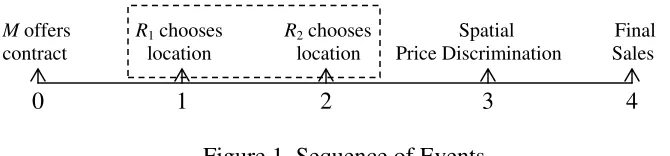
common knowledge at the end of each stage. The following figure summarizes the
sequence in which the game is played.
[image:4.612.143.478.146.224.2]
0 1 2 3 4
Figure 1. Sequence of Events
But for the sequential choice of location by R1 and R2, the structure of the game is
identical to that in Beladi et al. (2008)2. As usual, the solutions are obtained by backward
induction. For expositional convenience, let
) ( 4 b c
b R
and
5b2 16c2 20bc
..Absent the possibility of a merger, M charges a uniform wholesale price wj and a
fixed fee Fj that extracts all of the profits from each downstream firm.
The profits of R2, from selling varieties V and W, are
(1)
2 1
2 2
2 2
2 2
2 1 ( 2 ) ( )
2 )
(k w ct y y bt x y z w dz bt x y w dz F c
y y
y x
The first order condition for profit maximization yields R2’s reaction function
(2)
c b
bx bw c b x
y
4 3
2 )
( 4 2 1 )
( 2
The profits of R1, from selling varieties U and W, are
(3)
1 2
) (
1 0
1 2
2 1
1 1 ( ( ) ) ( ( ) 2 )
2 )
(k w ct x x bt y x x w dz bt x y x z w dz F c
x y x
x x
M offers R1 chooses R2 chooses Spatial Final
Sequential Spatial Competition in Vertically Related Industries with Different Product Varieties
3
Solving the first order conditions for R1’s profit-maximization and plugging this solution
into (2), we obtain
(4)
2( )
(6 8 )
(3 4 )
) ( 4 2 1 2 12 w b c b t b c
btw c b c b t b R
x
(5)
b t b c
tw b c wb
cb t
b R
y 2 4( ) 2( 2 ) 1
) ( 4 2
1
This leads to our first proposition.
Proposition I. Absent the possibility of any merger, the Nash equilibrium locations of the
two downstream firms, engaged in spatial competition in a vertically related industry, are
2( ) (6 8 ) (3 4 )
) ( 4 2 1 2 1
2 w b c b t b c
btw c b c b t b
R for the leader and
b t b c tw b c wb
c b t
b
R 2 4( ) 2( 2 ) 1
) ( 4 2
1
for the follower.
If there is a merger between M and R1, M sets
w1,F1
=
0,0 and charges awholesale price w2 0 and a fixed fee F2that extracts all of the profits from R2. The
profits of R1, from selling varieties U and W, are
(6)
dz z y x t b dz x y t b x x ct ck y x x x 2 0 2 21 1 ( ) ( 2 )
2
Solving the first order conditions for R1’s profit-maximization and plugging this solution
into (2), we obtain
(7)
2( ) (3 4 )
) ( 4 2 1 2 2 c b w c b c b b Rx
(8)
2 2
) 2 )( ( 4 ) ( 4 2 1 w c b c b b c b b R
y
Sequential Spatial Competition in Vertically Related Industries with Different Product Varieties
4
t bw c b R
(3 4 ) 1
t w b R
1
2
[image:6.612.115.487.75.173.2]
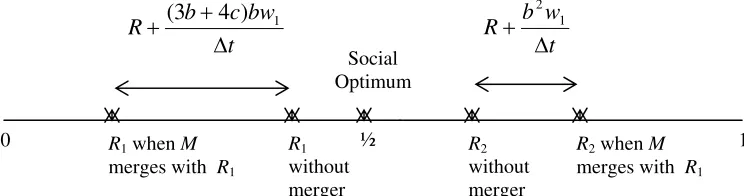
Figure 2. Vertical Merger with Downstream Leader
This leads to our next two propositions.
Proposition 2. If the downstream leader merges upstream, the Nash equilibrium locations
of the two downstream firms, engaged in spatial competition in a vertically related
industry, are
2( ) (3 4 )
) ( 4 2
1
2 2
c b w c b c b
b
R for the integrated firm and
2 2
) 2 )( ( 4 )
( 4 2
1
w c b c b b c b
b
R for the un-integrated firm.
Proposition 3. A merger between the downstream leader and the upstream monopolist
induces the integrated firm to move further away from the socially optimal location by
t bw c
b 4 ) 1
3 (
and the un-integrated firm to move further away from the socially
optimal location by
t w
b2 1
.
If there is a merger between M and R2, M sets
w2,F2
=
0,0 and charges awholesale price w1 0 and a fixed fee F1 that extracts all of the profits from R1. The
profits of R2, from selling varieties V and W, are
0 ½ 1
Social Optimum
R1 without merger
R2 without merger
R2 when M merges with R1
Sequential Spatial Competition in Vertically Related Industries with Different Product Varieties
5
(9)
dz y x t b dz z y x t b y y ct ck y y y x 1 2 2 22 1 ( 2 ) ( )
2
The first order condition for profit maximization yields R2’s reaction function
(10)
c b bx c b x y 4 3 ) ( 2 ) (
Solving the first order conditions for maximizing R1’s profit (3) and plugging this
solution into (10), we obtain
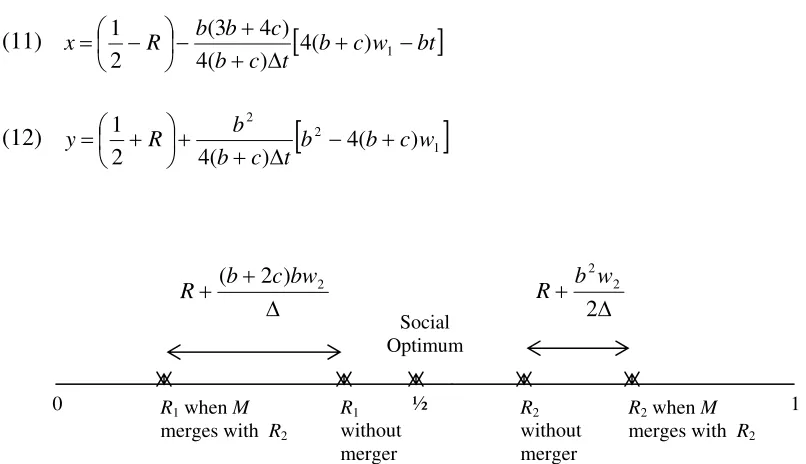
(11)
b c w bt
t c b c b b Rx
4( ) 1
) ( 4 ) 4 3 ( 2 1
(12)
2 1
2 ) ( 4 ) ( 4 2 1 w c b b t c b b Ry
(b 2c)bw2
[image:7.612.89.492.265.497.2]R 2 2 2 w b R
Figure 3. Vertical Merger with Downstream Follower
This leads to our final propositions.
Proposition 4. If the downstream follower merges upstream, the Nash equilibrium
locations of the two downstream firms, engaged in spatial competition in a vertically
0 ½ 1
Social Optimum R1 without merger R2 without merger
R2 when M merges with R2
Sequential Spatial Competition in Vertically Related Industries with Different Product Varieties
6
related industry, are
b c w bt
t c b
c b b
R 4( ) 1
) ( 4
) 4 3 ( 2
1
for the un-integrated firm
and
1
2 2
) ( 4 )
( 4 2
1
w c b b t c b
b
R for the integrated firm.
Proposition 5. A merger between the downstream follower and the upstream monopolist
induces the integrated firm to move further away from the socially optimal location by
) 20 16
5 (
) 2 (
2 2
2
bc c
b
bw c b
and the un-integrated firm to move further away from the
socially optimal location by
16 20 ) 5
(
2 2 2
2 2
bc c
b
w b
.
It is worth noting (ref. figures 2 and 3) that when the downstream firms are allowed
to move sequentially, in contrast3 with Beladi et al. (2008), the merged firm
(notwithstanding the order of its move) locates farther away from the social optimum
than does the firm outside the merger. Also, notwithstanding the vertical structure of the
industry, the equilibrium locations of the sequentially moving downstream firms no
longer gravitate toward Braid’s (2008) partially social optimum R
2 1
even if the
upstream monopoly is broken up.
3. Conclusion
In this paper we have taken a step forward along the path of efforts that continue to
capture the implications of the vertical structure4 of an industry for the location of
downstream firms that move sequentially. We have shown that, with sequentially moving
Sequential Spatial Competition in Vertically Related Industries with Different Product Varieties
7
merged firm (notwithstanding the order of its move) will locate farther away from the
social optimum than will the firm outside the merger.5 A couple of interesting extensions,
we are currently working on, include a) allowing incomplete information when each
downstream firm’s unit cost is unknown6 to its rival and b) endogenizing the sequence of
moves by adding a prior stage where each firm chooses when to pick its location..
References
Arozamena, L., Weinschelbaum, F., 2009. Simultaneous vs. sequential price competition with incomplete information. Economics Letters 104, 23-26.
Beladi, H., Chakrabarti, A., Marjit, S., 2008. Vertical mergers and downstream spatial competition with different product varieties, Economics Letters 101, 262-264.
Braid, R.M., 2008. Spatial price discrimination and the locations of firms with different product selections or product varieties. Economics Letters 98, 23-26.
Dasgupta, P., Maskin, E., 1986. The existence of equilibrium in discontinuous economic games, II: Applications. Review of Economic Studies 53, 27-41.
Haller, S. A., 2009. The impact of multinational entry on domestic market structure and investment. International Review of Economics and Finance 18, 52-62.
Hoover, E.M., 1937. Spatial price discrimination. Review of Economic Studies 4, 182-191. Hotelling, H., 1929. Stability in competition. Economic Journal 39, 41-57.
Kurata, H., Ohkawa, T., Okamura, M., 2009. Location choice, competition, and welfare in non-tradable service FDI. International Review of Economics and Finance 18, 20-25.
Lafontaine, F., Slade, M., 2007. Vertical Integration and firm boundaries: The evidence. Journal of Economic Literature 45, 629-85.
Lahiri, S., 2009. Foreign direct investment: An overview of issues. International Review of Economics and Finance 18, 1-2.
Lerner, A., Singer, H., 1937. Some notes on duopoly and spatial competition. Journal of Political Economy 45, 145-186.
Maskin, E., Riley, J. 1984. Optimal auctions with risk averse buyers. Econometrica 52, 1473-1518.
Raff, H. Ryan, M., Stähler, F., 2009. The choice of market entry mode: Greenfield investment, M&A and joint venture. International Review of Economics and Finance 18, 3-10.
Endnotes
1
If firms cannot price discriminate at each location between the different types of consumers who find its own variety desirable, then it might be possible to assume mixed price strategies, but unlike Dasgupta and Maskin (1986), who have a single mixed-strategy Nash equilibrium in mill prices for any given set of firm locations, there would be a different mixed-strategy Nash equilibrium in delivered prices at each consumer location for any given set of firm locations. We maintain that there is spatial price discrimination for product W of the sort first examined in Hoover (1937) and Lerner and Singer (1937), in which there is a Nash equilibrium in delivered price schedules.
2
Beladi et al. (2008) showed that in a vertically related industry, with an upstream monopoly, the downstream firms will not choose the socially optimal location. A vertical merger will exacerbate the distance of the downstream firms from the socially optimal location: the firm outside the merger will deviate more than the firm that is part of the merger when the firms move simultaneously.
3
Analogous to Beladi et al. (2008), notwithstanding the vertical structure of the market, the downstream firms gravitate toward the social optimum if b0 (i.e. when, in the absence of any demand for W, the downstream firms are reduced to spatial-price-discriminating monopolists choosing uniform delivered prices). This replicates the equilibrium one would expect, á la Hotelling (1929), in the market for a homogeneous product where the (mill) prices of the two firms are exogenous and equal, and consumers pay travel costs.
4
See Lafontaine and Slade (2007) for an insightful review of the contributions relevant to the related literature.
5
Our results are likely to have important implications for a firm’s inter-temporal choice of entry mode. See, for instance, Haller (2009), Lahiri (2009), Kurata et al. (2009) and Raff et al. (2009).
6