A M
ic r o s t r u c t u r a l
A
n a l y s is
o f
t h e
E
f f e c t s
o f
N
e w s
o n
O
r d e r
F
l o w s
a n d
o n
P
r ic e
D
is c o v e r y
in
F
o r e ig n
E
x c h a n g e
M
a r k e t s
by
Ry a n Lo v e
London School o f Economics and Political Science
Thesis submitted in partial fulfilment of the requirements of the degree of Doctor of Philosophy at the University of London
UMI Number: U194995
All rights reserved
INFORMATION TO ALL USERS
The quality of this reproduction is dependent upon the quality of the copy submitted.
In the unlikely event that the author did not send a complete manuscript and there are missing pages, these will be noted. Also, if material had to be removed,
a note will indicate the deletion.
Dissertation Publishing
UMI U194995
Published by ProQuest LLC 2014. Copyright in the Dissertation held by the Author. Microform Edition © ProQuest LLC.
All rights reserved. This work is protected against unauthorized copying under Title 17, United States Code.
ProQuest LLC
789 East Eisenhower Parkway P.O. Box 1346
esn
S
F
<?lf
0
°\
H
Library
British ubmty of Political 1 and Economic ScienceABSTRACT
This thesis brings together a number of studies using high frequency foreign ex change (FX) data. The first part examines the effects of scheduled, publicly released macroeconomic news, while the final chapter considers another, related, aspect of FX microstructure. Chapter 1 provides an introduction to the thesis and reviews the literature in high frequency empirical FX research. In Chapter 2, I use up to ten months of FX transactions and quote data to analyse foreign exchange activ ity around times of scheduled news releases. The effects of news on exchange rate levels are examined, as well as the effects on spreads, trading volume and volatility. Chapter 3 extends this analysis, asking how public information enters prices. Under rational expectations and efficient markets hypotheses, the news contained in public information announcements should be impounded directly, with there being no role for trades in this process of information assimilation. However, the results suggest that up to two thirds of the price relevant information enters via trading (order flow in particular). Chapter 4 provides an explanation why order flow is so important around public news releases and also examines the effects of news on market depths. In Chapter 5 I examine how much information is carried in trades by looking at the price impact of order flow when feedback trading is allowed. The model that is often used in the literature is proved to be misspecified when temporally aggregated data are employed and Chapter 5 introduces a method to estimate the otherwise unidentified model. Using impulse response functions, I show that trades actually carry more information than previous estimates suggest.
C ontents
C hapter 1 Introduction 13
1.1 Literature Review of Empirical FX Market Microstructure S tu d ie s ... 17
1.1.1 Indicative quotes in FX research... 18
1.1.2 Transactions data in FX re s e a r c h ... 21
C hapter 2 First and Second M om ent Effects o f M acroeconom ic N ew s in H igh Frequency Foreign Exchange D ata 28 2.1 In tro d u ctio n ... 28
2.2 D a t a ... 32
2.2.1 Foreign exchange d a t a ... 33
2.2.2 Macroeconomic data releases... 38
2.3 Empirical M ethodology... 41
2.3.1 Cointegrating structural V A R ... 43
2.3.2 Impacts of buy and sell orders sep a ra te ly ... 44
2.3.3 Intra-day patterns and d iu r n a lity ...46
2.3.4 Cointegrating relationships... 51
2.3.5 Good and bad n ew s... 55
2.3.6 E stim ation... 56
2.4 Estimation R e s u lt s ... 58
2.4.1 Error correction t e r m s ... 58
2.4.2 Asymmetric effects of buys and sells ...63
2.4.3 The effects of news on r a t e s ... 67
2.4.4 The effects of news on trades ... 69
2.4.5 The effects of news on sp re a d s ... 73
2.4.6 Impulse response a n a l y s i s ... 76
2.5 Second Moment Effect of N e w s ... 88
2.5.1 Estimation resu lts... 91
2.6 D iscussion... 94
2.6.1 On the mapping of information to p ric e ...96
2.6.2 Good and bad new s... 99
2.7 C o n clu sio n s... 99
2.A A p p e n d ix ...101
2.A.1 Cointegration analysis of high frequency foreign exchange data . . . 101
2.A.2 Empirical m ethodology... 101
2.A.3 Testing for cointegrating r a n k ...103
2.A.4 Tests of the cointegrating v e c t o r s ... 106
2.A.5 Impulse response analysis ...120
2.A.6 Variance decom positions...128
2.A.7 B ootstrapping...130
C hapter 3 M acroeconom ic N ew s, Order Flows and Exchange R ates 132 3.1 In tro d u ctio n ...132
3.2 D a t a ... 134
3.3 Empirical A n a ly s is ... 135
3.3.1 The Effects of macroeconomic news on returns and flows Separately 135 3.3.2 The role of order flow in exchange rate determination around an nouncements 141
3.3.3 Multivariate VAR analysis of returns and flows with exogenous news v a ria b les... 143
3.4 Discussion and In te rp r e ta tio n ...154
3.5 C o n clu sio n s...156
C hapter 4 Foreign Exchange Traders and their R eactions to Pu b lic Infor
m ation 158
4.1 In tro d u ctio n...158
4.2 Differences of Opinion and Order Flow Following Public News Announce ments 161
4.2.1 A simple m o d e l...162
4.2.2 Limit order schedules...163
4.2.3 Market orders and order f l o w ... 164
4.3 Liquidity in the DEM/USD Market around a Scheduled Announcement of PPI D a t a ... 166
4.3.1 D a t a ... 170
4.3.2 One minute pre announcement ...173
4.3.3 One minute post announcem ent...177
4.4 D iscussion...181
4.4.1 Technical challenges ...182
4.5 C o n clu sio n s...185
C hapter 5 Feedback Trading 187 5.1 In tro d u ctio n ...187
5.2 The Inevitability of Contemporaneous Feedback Trading in Aggregated D atal91 5.3 The VAR Model with Feedback T r a d i n g ... 195
5.3.1 Model d e s i g n ... 195
5.3.2 Instrumental v a r ia b le s ...196
5.3.3 Impulse response functions... 197
5.3.4 D a t a ... 199
5.3.5 Instrumenting the endogenous variables... 199
5.4.1 Implications of contemporaneous feedback trading: Impulse response
functions...208
5.5 Discussion and I n te rp r e ta tio n ... 211
5.6 C o n clu sio n s...213
5.A A p p e n d ix ...215
5.A.1 Aggregation of the ultra-high frequency VAR in model (5.1) . . . . 215
5.A.2 Derivation of the structural form of the twenty second VAR . . . . 217
5.A.3 Distribution of n ... 218
5.A.4 Distribution of the impulse response fu n c tio n s ...220
5.A.5 Extra information in buys and sells s e p a ra te ly ...224
C hapter 6 C onclusions 227
List o f Tables
2.1 Summary Statistics of Exchange Rate Returns and T r a d e s ... 35
2.2 The Effect of a Country’s Data Releases on its Exchange R a t e ... 39
2.3 US PPI Announcements and ‘Good’ and ‘Bad’ N e w s ... 40
2.4 Description of ‘Primary’ and ‘Secondary’ Macroeconomic D a t a ...42
2.5 Day of the Week Effects in FX Trading ... 51
2.6 Estimation of Multivariate VAR Model in Returns and T r a d e s ... 60
2.7 Effects of News Releases on Spreads and Trading V o lu m e... 74
2.8 Volatility Effects of News Releases... 93
2.9 Mann-Whitney Rank Test of Differences in Trading Volume (Announce ment Versus Non-Announcement T i m e s ) ... 98
2.A. 1 Johansen Test for Cointegrating Rank: Bid and Ask P r ic e s ... 107
2.A.2ADF Tests for Cointegration ... 110
2.A.3Test 1: Cointegration between Bid and Ask Prices and between the Three Rates ...114
2.A.4Test 2: Cointegration between the Level of the Exchange Rate and Cumu lative Order Flow ...117
2.A.5Test 3: Joint Test of the 7 Theoretical Cointegrating Vectors ... 119
3.1 Description of Macroeconomic D ata R eleases... 135
3.2 The Effects of Macroeconomic News on Returns and Flows Separately . . . 139
3.3 The Role of Order Flow in Exchange Rate Determination Around An nouncements ... 141
3.4 Johansen Test for Cointegrating Rank: Transaction P r i c e s ... 143
3.5 Multivariate VAR Analysis of Returns and Flows with Exogenous News V ariables... 147
4.1 Orders Reducing the Depth of the DEM/USD Limit Order Book Around a Release of US PPI D a t a ... 173 4.2 Orders Increasing the Depth of the DEM/USD Limit Order Book Around
a Release of US PPI D a t a ... 174 4.3 Spreads in the Spot DEM/USD Market Around a Release of US PPI . . . 176 5.1 Summary Statistics on USD/EUR Exchange Rate Returns and Flows . . . 199 5.2 Instrumenting USD/EUR Returns and Flows ... 202 5.3 USD/EUR VAR Results (1 Minute Frequency) ...204 5.4 USD/EUR VAR Results (5 Minute Frequency) ...206
List of Figures
2.1 Intra-day Patterns of Trades and Spreads...48
2.2 Day-of-the-week Patterns of T r a d e s ... 50
2.3 IRFs of Spreads Following ‘Buy’ Shocks ... 64
2.4 IRFs of Exchange Rates Following a USD/EUR ‘Buy’ S h o c k ...66
2.5 Variance Decompositions for the Three Exchange R a te s ... 68
2.6 Effects of Good and Bad US and UK News on Buyer and Seller Initiated T r a d e s ... 71
2.7 Exchange Rate and Trade IRFs Following Good US N ew s... 77
2.8 Exchange Rate and Trade IRFs Following Bad US N e w s ... 78
2.9 Exchange Rate and Trade IRFs Following Good UK N e w s ... 79
2.10 Exchange Rate and Trade IRFs Following Bad UK N e w s ... 80
2.11 Spread and Volume IRFs Following Good US N e w s ... 82
2.12 Spread and Volume IRFs Following Bad US N e w s ... 83
2.13 Spread and Volume IRFs Following Good UK N e w s ... 84
2.14 Spread and Volume IRFs Following Bad UK N ew s... 85
2.15 Effects on USD/EUR Activity Following a Release of US C P I ...87
2.16 Intra-day Volatility P a tte r n s ... 90
2.A.lImpulse Response Functions Following a USD/EUR ‘buy’ S h o c k ...122
2.A.2Impulse Response Functions Following a G BP/EU R ‘Buy’ Shock...123
2.A.3Impulse Response Functions Following a USD/GBP ‘Buy’ S h o c k ...124
2.A.4Spread and Volume IRFs Following a USD/EUR ‘Buy’ S h o c k ... 125
2.A.5Spread and Volume IRFs Following a GBP/EU R ‘Buy’ S h o c k ... 126
2.A.6Spread and Volume IRFs Following a USD/GBP ‘Buy’ S h o c k ... 127
2.A.7Variance Decompositions for the Three Exchange R a te s ... 129
3.2 Multivariate VAR Impulse Response Analysis of News on Cumulative Returns 150 3.3 Multivariate VAR Impulse Response Analysis of News on Exchange Rate
Flows ... 151 4.1 Time Line of the Model and Sequencing of E v e n ts ...163 4.2 Depths in the Spot DEM/USD Market Around the Announcement of US
PPI ...171 4.3 Intra-day Patterns of the Number and Value of T r a d e s ...178 4.4 Best Bid and Ask Prices in the Spot DEM/USD M a r k e t ... 180 5.1 Impulse Response Functions for Feedback and Non-feedback VARs . . . . 210
Acknowledgem ents
Many people have helped me during my PhD studies. First and foremost, I would like to thank my supervisor, Charles Goodhart, for his continued support, advice and encour agement. A student’s research is often only as good as the supervision he/she receives and I can only hope that the work presented here is half as good as the supervision that Charles has given.
I am also hugely thankful to the members of the Financial Markets Group, where I have been based for the duration of my graduate work. In particular, I would like to thank the Director, David Webb, for giving me the chance to work in such an exciting and stimulating environment. Interaction with other researchers and academics is vital for any PhD student and the positive working atmosphere, from which I and numerous other students have benefitted, is largely due to David’s work. Other members of the FMG, past and present, who deserve thanks are: Bob Nobay, Richard Payne, Jon Danfelsson, Paolo Vitale, Margaret Bray, Antoine Faure-Grimaud, Amil Dasgupta, Urs Haegler, Miguel Segoviano, Jinhui Luo, Dennis Kristensen, Robert Kosowski, Felix Muennich and Heski Bar-Isaac. I would also like to thank Giuseppe Bertola, Dagfinn Rime, Richard Lyons, Carol Osier, Mike Melvin, Philipp Hartmann, Michael Moore, William Killeen and Geir Bj0nnes, all of whom have contributed to this thesis, either by giving comments on my research (and co-authoring a paper in the case of Dagfinn Rime) or simply taking the time to discuss interesting aspects of FX microstructure. I would also like to thank the Economic and Social Research Council (ESRC) for financial support, specifically their three year PhD scholarship.
(LSEish); Sami, Caroline, Tammy, John and Robbie, (JT); Nicole, Wilko, Av, Eddie and Big Gay, and of course not forgetting The Mullett and Kevin. You all know who you are, and I thank you for forgiving an all too often absent friend.
Finally, I would like to thank my partner, my beautiful Jo. More than anyone, she has seen and experienced the highs and lows of my PhD career. W ithout her love, support and patience, I would surely be a much lesser man.
Chapter 1
Introduction
This thesis brings together a number of research papers, all of which consider microstruc- tural aspects of the foreign exchange market. Standard macroeconomic models of ex change rate determination have shown themselves to be remarkably unsuccessful at ex plaining movements in floating foreign exchange (FX) rates in the short term. See the seminal papers by Meese and Rogoff (1983a,b) for example, and also the surveys by Tay lor (1995) and Frankel and Rose (1994). Essentially, the short term forecasts made from numerous macroeconomic models perform worse than a random walk, i.e. the predic tion th a t tomorrow’s exchange rate will be the same as th at seen today will give a more accurate picture of exchange rate changes compared to predictions based on macroeco nomic models. Consequently, greater emphasis has been placed on microstructure factors. O ’Hara (1995) defines market microstructure as "... the study of the process and outcomes of exchanging assets under explicit trading rules” and as such gives an important role to traders and their actions, namely the quotes/prices they post and the trades they execute. By examining exchange rates at higher and higher frequencies and by rationalising the actions taken by those who actually determine the exchange rate (FX traders in a world of floating rates), it is hoped th at microstructure analyses will help explain FX prices more accurately.
Despite the poor performance of macroeconomic models when explaining short run ex change rate movements, these theories are generally successful when explaining changes in rates at longer horizons.1 On the other hand, microstructure models are usually used to explain very short term exchange rate changes, with the majority of studies using data sampled at daily or higher frequencies. This segregation of microstructure and macroeco nomic approaches is not entirely appropriate (Lyons 2001, Sarno and Taylor 2001) and it is the purpose of the first part of this thesis to examine some of the interactions between them. In particular, I examine the process of price discovery following the release of scheduled macroeconomic news. I firstly analyse the effects of news releases on a number
of microstructure variables, and then ask how information contained in these releases is incorporated into prices.
Chapter 2 focuses on the effects of scheduled US and UK news releases on three heavily traded floating rates: USD/EUR (US dollars per euro), G B P/EU R (pounds sterling per euro) and USD/GBP (US dollars per pound). By analysing the effects of news on both bid and ask prices and on the number of buyer and seller initiated trades separately, I am able to examine the effects on not only the level of the exchange rate, but also on spreads (the difference between the best prices at which traders can buy and sell currencies), volatilities, trading volume and order flow (the difference between the number of buyer and seller initiated trades). The main findings are th a t unanticipated announcements of macroeconomic data cause significant and permanent changes in the level of the exchange rate and also cause trading volume to increase. This is caused by an increase in both buyer
and seller initiated trades, irrespective of whether the news was good or bad. Volume is also found to increase even when the news release has no effect on the level of the exchange rate, consistent with the hypothesis that traders differ in their interpretation of news. Exchange rate volatility also increases post release and this volatility surge persists for some time. Spreads are also found to increase after the data announcement, but the effects are small and statistically insignificant.
By examining the three markets simultaneously, I am also able to quantify any cross market effects of news and various other interrelationships between the three rates. These cross market effects are shown to be large, with US news affecting not only the dollar markets but also GBP/EU R activity. Asymmetric effects of trades are also demonstrated, with market buy orders having a greater impact on the ask price than on the bid, and vice versa for market sell orders. Impulse response functions and variance decompositions also show significant spill-overs from one market to another.
After asking what happens to various microstructure variables around periods of macroe conomic news releases, Chapter 3 asks how public information enters FX rates. Standard rational expectations and efficient markets hypotheses suggest th a t price relevant informa tion contained in public news releases should be incorporated into prices without the need for trading. Indeed, French and Roll (1986) define public information to be th at which is incorporated into prices before anyone can trade on it. Chapter 3 tests this assertion and finds th at up to two thirds of the information contained in macroeconomic news is assimilated via the key microstructure variable — order flow. The models of Glosten and Milgrom (1985), Kyle (1985), Easley and O ’Hara (1987) and Perraudin and Vitale (1996)
all suggest th at order flow is the mechanism through which private information is incor porated into price. If public information enters price via order flow then the segregation of public and private information, an assumption commonly made in the literature, may not be entirely valid. This is an avenue explored in Chapter 4, where, using the ideas of Harris and Raviv (1993) and Kandel and Pearson (1995), I present a simple explanation why order flow is so important in the process of public information assimilation. The basic idea is th at traders receive noisy signals from a particular news announcement, but by also allowing traders to differ in their abilities to interpret news, this not only explains the increase in trading volume following the data release, but also explains the effects on order flow.
Chapter 4 also presents further empirical evidence of the effects of news announcements on the microstructure of FX markets, in particular, the effects of news on market depths (the quantities dealers are willing to trade at different prices). Using anecdotal evidence from a single release of US PPI data, the depth of the DEM/USD limit order book is found to fall, with dealers willing to trade smaller quantities for any deterioration of the bid and ask prices. This is argued to be a result of increased information asymmetry following the news release, and is not simply a result of market orders picking off limit orders which would naturally hollow out the book.
As such, the first part of this thesis focuses on the effects of scheduled, macroeconomic news announcements. Chapter 2 asks ‘ What happens around these data releases?’, Chap ter 3 asks '‘How is the news incorporated into prices?’ and Chapter 4 presents an explana tion as to why macroeconomic news enters price this way. The final chapter of the thesis considers another, related, aspect of FX microstructure. Whereas Chapter 3 demonstrates how important trading is in the assimilation of public information, Chapter 5 shows how important trading is in general, when allowing for the possibility of feedback trading by FX dealers.
introduce a shock to the trade equation and examine the cumulative effect on price. This approach has been used in numerous studies2 and assumes th a t the direction of causality runs explicitly from order flow to asset returns, i.e. returns depend on contemporaneous order flow but order flow can only depend on lagged price changes. This assumption is entirely reasonable when data are sampled at ultra-high frequencies, such as tick-by-tick, but as soon as data are aggregated at lower frequencies, the problem of contemporaneous feedback trading becomes apparent. If traders respond to price changes by executing trades themselves, then when using daily, hourly, or indeed minute by minute data if traders respond quickly enough to such price changes, it is possible th at not only will returns depend on contemporaneous order flows, but order flow will also depend on con temporaneous returns. Chapter 5 proves th at the standard model used in the literature is misspecified whenever aggregated data are used, and suggests a method to overcome these difficulties.
By using standard instrumental variables techniques, returns are not only found to be affected by contemporaneous order flows, but are also shown to be a determinant of these flows. By comparing impulse response functions with and without contemporaneous feedback, I show th at trades carry more information (have a greater price impact) than previous estimates suggest.
The rest of this chapter gives a brief review of previous FX microstructure studies, de scribing some of the datasets that have been used and giving a more historical perspective of empirical FX research. For a comprehensive study of the issues involved in market mi crostructure, see O ’Hara (1995) and for a more recent survey, see Madhavan (2000). Lyons (2001) gives more detail on the microstructure of the foreign exchange market and for an earlier description of the institutional workings of inter-dealer trading, see Flood (1991). Sarno and Taylor (2001) present a survey of the literature on FX microstructure and Vitale (2004) gives a more technical overview of some of the issues th at have been studied in recent papers.
2See Section 5.1 for specific examples.
1.1
Literature R eview of Empirical FX Market M i
crostructure Studies
The number of empirical studies of the inter-dealer foreign exchange market has grown considerably in the last few years, fuelled by the increasing availability of high quality datasets. Data availability has rarely been a problem for studies of equity markets, while the nature of the FX market has necessarily meant fewer datasets being on hand for aca demic research. Until recently the inter-bank foreign exchange market was split, roughly equally, between direct and brokered trading.3 Direct trading is characterised by traders contacting each other directly (via computer terminals, such as the Reuters D2000-1 plat form, or by telephone). The trader receiving the call/quote request gives bid and ask prices, which are subsequently accepted or declined by the initiating trader. As such, the direct market can be classified as a decentralised, continuous, multiple dealer structure. The decentralised nature of direct trading, where dealers interact in different physical locations with no requirement to notify an overseeing body of their quotes or trades, has resulted in relatively few of these datasets being used in academic work.
Brokered trading, on the other hand, is generally characterised as being quasi-centralised and continuous, with a limit order book structure. Brokers collect the limit orders of numerous dealers and place them within their limit order book.4 Traders can then trade at these prices by executing market orders, or posting ‘marketable’ limit orders, where the posted bid price is higher than the current best ask for example. The broker automatically matches these orders and the trade occurs. Information from voice brokers has been difficult, if not impossible, to obtain due to the highly confidential nature of these trades. However, in recent years, brokered trading has tended to move to electronic limit order books such as the Reuters D2000-2 and EBS (Electronic Broking Services) platforms. These have largely replaced voice brokers and have in fact become the dominant form of inter-dealer trading. The BIS reported th at in 2000, between 85 and 95% of all inter bank trading took place using electronic brokers, increasing from about 50% in 1998 and 20-30% in 1995 (Bank for International Settlements 2001).
Reuters D2000-2 was launched in 1992 and by September 1993 it was used in 28 cities, 3See Flood (1991) for an early description of the makeup of the inter-dealer market.
with 230 subscribers in 17 countries (Goodhart, Ito, and Payne 1996). September 1993 also saw the introduction of EBS as a direct competitor to the D2000-2 platform and, since these two trading structures have come to dominate inter-dealer trading, such spot market trading can be characterised as being quasi-centralised. Also, with all information on quotes and trades being stored electronically, they have naturally allowed the possibility for more thorough empirical investigation.
1.1.1
Indicative quotes in F X research
Until the direct or brokered inter-dealer data became available, high frequency empirical studies usually employed indicative quotes. These are essentially adverts posted by traders to show th at they have an active interest in the market, and are shown on the screens of electronic data providers such as Reuters (known as Reuters FXFX pages) or Telerate for example. However, the bid/ask quotes are not firm prices at which dealers can trade. They are, by their very nature, ‘indicative’.5 One of the first high frequency datasets employed in the microstructure literature was that used in Goodhart and Giugale (1993). They used indicative quote data covering four exchange rates versus the US dollar (pound sterling, Deutsche mark, yen and Swiss franc) th at were collected by MMS International from the Telerate electronic screens. The data were collected hourly, spanning 2nd January to 15th July 1986, and were used to examine a number of features of high frequency FX quotes: autocorrelation of the return series, cross-correlation between markets, the presence of a unit root, etc. This dataset was also used by Baillie and Bollerslev (1991), who examine the intra-day/hourly volatility patterns for these markets. Among other things, they found th at when the diurnal patterns are taken into consideration, volatility no longer looks like an IGARCH process; the GARCH parameters sum to much less than unity. One of the earliest studies th at make use of data sampled at the one minute frequency was th at of Goodhart and Figliuoli (1991). They use Reuters indicative quotes from three days in 1987: 14th and 15th September and 21st October. By using a number of exchange rates versus the US dollar, they analyse spreads and other time series characteristics of FX data. These data are also used in Goodhart and Figliuoli (1992), who test whether the different geographical locations of traders and country specific heterogeneities can explain the negative serial correlation of high frequency returns.
5The Reuters FXFX data have become common in high frequency FX research largely because of the work of Olsen and Associates (Zurich), who collect and store the quotes for a number of FX rates and sell them to academic researchers for a small fee.
Goodhart (1989) makes use of an even higher frequency dataset, where tick-by-tick in dicative FXFX quotes are examined, covering the period from 9th April to 3rd July 1989.6 The focus in Goodhart (1989) is to examine the effect of news releases on high frequency FX returns. This is extended in Goodhart, Hall, Henry, and Pesaran (1993) where, using the same dataset but concentrating on USD/GBP, a GARCH-M model is fitted, allowing the effects of news releases on the level and volatility of the exchange rate to be analysed simultaneously. These early studies of the effects of news are similar to the research pre sented in Chapters 2 to 4 of this thesis. However, due to the nature of the FXFX data, no data on transactions were available. Trading volume and order flow, meanwhile, are studied extensively in my research. Despite no transactions data being available in these three months of FXFX data, it has still been possible to address a number of other impor tan t issues. Goodhart and Demos (1991) present an extensive examination of weekly and intra-day patterns of quote frequency and Hsieh and Kleidon (1996) study the intra-day patterns of spreads and volatilities. This latter study compares the intra-day patterns between London and New York based traders, while the ideas of price leadership are tested explicitly using the same data in Wang (2001). Bollerslev and Domowitz (1993) look at similar issues by examining the intra-day patterns of quote frequency for large and small banks, also making reference to where the banks are located. Bollerslev and Melvin (1994), on the other hand, use these data to model and test the effect of FX volatility on spreads.
Another large FXFX dataset has been used extensively in academic research, this time covering up to three years of DEM/USD data from January 1992 to December 1994. Similar to a few of the research papers described above, de Jong, Mahieu, Schotman, and van Leeuwen (2001) test and confirm the ideas of price leadership between banks. Almeida, Goodhart, and Payne (1998) test the effects of US and German news releases on the level of the exchange rate, while Payne (1996), Andersen and Bollerslev (1997a,b) and Andersen and Bollerslev (1998) all study the effects of news on DEM/USD volatility when taking into account the intra-day/diurnal pattern of FX second moments. DeGennaro and Schrieves (1997) also study the effects of news on volatility in this period, but this time using JPY/USD FXFX quotes. The effects of news announcements on quote activity and volatility in the JPY/USD market are also analysed in Melvin and Yin (2000) when using a slightly later FXFX dataset from December 1993 to April 1995.
Indicative quote data have also been used to address other issues. Dominguez (2003) uses FXFX data from August 1989 to August 1995 to examine the intra-day and daily volatility effects of interventions made by the Federal Reserve in the JPY/USD and DEM/USD markets. Fischer (2003) uses a similar data period to analyse the effects of intervention made by the SNB (Swiss National Bank), while Payne and Vitale (2003) exploit up to ten years of CHF/USD (Swiss francs per US dollar) indicative quotes from 1986 to 1995 to study the effects of SNB intervention. As well as these studies, FXFX data have been used to test market efficiency, as tested for by the presence of triangular arbitrage (Kollias and Metaxas 2001) and also to test models of price discreteness (Hasbrouck 1999). An important set of papers th at should be mentioned in this section are those th a t test for the presence of private information in the FX market. It is natural to assume that private information is only an issue for equity markets, where the fundamentals of the stock price include earnings data, on which some traders can have insider knowledge. Foreign exchange rates, meanwhile, should be determined by macroeconomic variables, which are in the public domain (Bessembinder 1994). To test for the presence of private information, one might expect to require transaction data.7 However, until such data became available, researchers had to devise ways to test for this type of information using quote data only. When trying to explain the clustering of FX volatility, Engle, Ito, and Lin (1990) suggest that private information and the existence of traders with heterogenous priors will result in volatility continuing for some time after a particular shock. They use a multivariate GARCH model using opening and closing JPY/USD prices in different markets around the world (October 1985 to September 1986) to test whether volatility in one geographical location follows turbulent times in previously open geographical locations (meteor showers) or whether volatility increases following a turbulent domestic market yesterday (heat waves). They find evidence in favour of the meteor shower hypothesis while rejecting the heat wave explanation, suggesting th at foreign news is more important than yesterday’s domestic news. This, they argue, is consistent with the existence of private information in FX markets, or with stochastic coordination between the different countries.
Evidence of private information in FX markets is also presented in Ito, Lyons, and Melvin (1998) who use FXFX quotes from 29th July 1994 to 28th March 1995 in the JPY/USD and DEM/USD markets. This period saw the introduction of trading in the Tokyo lunch hour, after which, lunch-return variances were found to double. Using variance ratio
rThis is discussed in Section 1.1.2.
methods, similar to French and Roll (1986), they argue th at this increase in return variance is due to the presence of private information. Using the same dataset, Covrig and Melvin (2002) also find evidence for the existence of private information, suggesting th a t Japanese banks are better informed regarding the yen and tend to be price leaders.
This heterogeneity between banks is also found in Ben Omrane and Heinen (2003), who analyse the quotes of individual banks around macroeconomic news announcements. By using FXFX data on USD/EUR from August to October 2001, they find th at some banks increase their quote activity following the data release while others reduce their partici pation in the market. This, they argue, is consistent with the existence of heterogenous traders who differ in their interpretation of news. These ideas are explored in more de tail in Chapter 4.8 Other recent studies th a t analyse the effects of macroeconomic news on rates using indicative data include Andersen, Bollerslev, Diebold, and Vega (2003), Faust, Rogers, Wang, and Wright (2003) and Melvin, Sager, and Taylor (2003). Ander sen, Bollerslev, Diebold, and Vega (2003) study the effects of various US news releases on a number of currencies versus the US dollar (pound sterling, yen, Swiss franc, Deutsche mark and euro) using data sampled at the five minute frequency from January 1992 to De cember 1998. Faust, Rogers, Wang, and Wright (2003) use five minute FXFX data from 1987 to 2002. Using this long dataset they examine the effects of news on not only the USD/GBP and DEM/USD (USD/EUR) markets, but also on a number of bond markets, examining the interrelations between these different assets.9 Melvin, Sager, and Taylor (2003) use indicative quotes from HSBC when examining the high frequency effects of interest rate announcements from the Bank of England’s Monetary Policy Committee.
1.1.2
T ransactions d ata in F X research
The first half of this thesis is similar in nature to a number of the studies described above, where the effects of scheduled news releases on prices and volatility are analysed. However, in order to study the process of price discovery and to analyse how new information is incorporated into exchange rates, an obvious variable to consider is trading activity. Unfortunately, data employing indicative quotes are entirely devoid of such information 8Trader heterogeneity is also shown up in the responses to a number of questionnaires. Traders appear to differ in their use of chartist/technical analysis, in their beliefs over whether exchange rate movements reflect changes in their fundamental value, and in their forecasts of future exchange rate changes for example. See Allen and Taylor (1990), Ito (1990), Taylor and Allen (1992) and Cheung and Chinn (1999).
and therefore these studies can only go so far when analysing the mechanics of information assimilation. Fortunately, a number of transaction based datasets have become available, such as that used in this thesis and described in detail in Chapter 2. Here I describe a number of the datasets th at have been used, explaining where they come from and what they have been used to test.
One of the earliest examinations of trading activity is th a t of Goodhart and Giugale (1989). This uses the same indicative data as those used in Goodhart and Giugale (1993), covering 2nd January to 15th July 1986, but combines these data with the transactions records of two large banks operating in London. Using data on daily volumes, Goodhart and Giugale (1989) study the interaction between transactions and indicative prices, as well as the time series properties of these transactions data.
A more disaggregated transactions dataset was used by Richard Lyons, who was able to record all the quotes and transactions of a single DEM/USD trader for the week of 3rd to 7th August 1992. By observing all the trades of an individual dealer, he is able to compute and follow his inventory level, allowing a number of previously untestable microstructure hypotheses to be investigated. In particular, Lyons (1995) finds evidence for both inventory control and asymmetric information effects in the dealer’s quotes. The inventory control effects, whereby the dealer would lower his quotes following an unwanted long position (in order to attract market buy orders from other traders), were found to be strong for this dealer, while previous studies had shown relatively weak inventory control effects in the quotes of equity traders, shown in Madhavan and Smidt (1991), for example. These strong inventory control effects suggest th a t the management of intra day inventories is more important for FX traders than it is for NYSE specialists, a point illustrated by the fact th at the trader Lyons tracked, traded approximately $1 billion per day but still closed out all positions to leave overnight inventory near zero.
Lyons (1995) also found that the trader increased his spread to compensate for the risk of trading with more informed market participants. Therefore, for the first time using transaction data, Lyons (1995) found evidence for the existence of private information in FX markets. Private information was also illustrated by the significant effects of order flow on the level of the dealer’s quotes, as explained by the models of Kyle (1985) and Glosten and Milgrom (1985). Order flow models have subsequently been used extensively in empirical FX research, including the studies presented in this thesis, and all have found significant effects of order flow on the level of the exchange rate. When examining the price impact of order flow, Lyons (1996) extends his original analysis to test between the
‘event uncertainty’ versus ‘hot potato’ hypotheses. Easley and O’Hara (1992) suggest th at the price impact of order flow should be larger when trading volume is high since greater trading activity suggests the existence of more information ‘events’, i.e. more private information which needs to be incorporated into the price: the ‘event uncertainty’ hypothesis. Lyons (1996), on the other hand, suggests th a t the huge inter-dealer trading th at is seen in FX markets largely results from traders passing on unwanted inventories: the ‘hot potato’ view. Since these trades axe relatively uninformative, the price impact of any order flow should be small when volume is high. The data from Lyons’ one dealer do in fact support the hot potato view, evidence for which is also presented in Luo (2002b). Other studies th at make use of data from individual dealers include Yao (1998) and Bj0nnes and Rime (2003). Yao (1998) estimates a similar model to th at of Lyons (1995) but uses all the transactions records for a large DEM/USD dealer from 1st November to 8th December 1995, i.e. the data sample is five times as long as th at used in Lyons (1995). Whereas Lyons (1995) finds significant inventory effects in the dealer’s quotes, such effects are not found by Yao (1998). Instead, Yao argues th at the act of quote shading gives competing dealers information on your inventory position. This could prove to be very costly and therefore dealers refrain from trading in this way. This idea is confirmed in Bj0nnes and Rime (2003), who argue th at despite inventory control being of upmost importance, this is done by traders executing market orders, rather than by shading their limit order quotes. The data used by Bj0nnes and Rime (2003) cover a range of currency pairs (Norwegian, Swedish and Danish krone, and Swiss franc all against the Deutsche mark, and both Deutsche mark and Norwegian krone against the US dollar) across four dealers from 2nd to 6th March 1998.
Whereas data from individual traders can allow analysis of dealers’ inventories and there fore of a number of important microstructure hypotheses, such data have the disadvantage of lacking significant market coverage. Instead, one can use the aggregated trading infor mation th at can be taken from either the direct or brokered platforms. Fortunately, the majority of direct trading, which still accounted for a large share of inter-dealer trading in the mid 1990s, occurred via the Reuters D2000-1 system.10 D ata from this trading plat form form the basis of a number of research papers by Martin Evans and Richard Lyons. Evans and Lyons (1999) use these data (4 months of DEM/USD and JPY/USD activity from 1st May to 31st August 1996) to test a model that gives an important role to order
flow.11 Using daily data, a regression of FX returns on order flow and interest differentials (proxying macroeconomic fundamentals) produced an R 2 of 0.64 (DEM/USD) and only the coefficient on order flow was found to be significant. The importance of order flow in the determination of FX rates is attributable to the information it conveys about (non dealer) customer trades. Each trader is argued to receive a signal from his/her customer base and these signals can only be aggregated via inter-dealer order flow. Even though each trader has a private signal of the currency’s payoff, information is not concentrated, as implied by the informed trader models of equity markets, but rather it is dispersed among a large number of separate dealers. Order flow is therefore the proximate deter minant of exchange rates as it is the mechanism through which all the dispersed pieces of information in the economy get aggregated into price.
These D2000-1 data have been used to analyse a number of issues in the foreign exchange market, all placing great importance on order flow. The high frequency dynamics of the d ata are discussed in Evans (2001) and the cross market effects of order flow are illustrated in Evans and Lyons (2002a). Evans and Lyons (2003) ask how macroeconomic news is incorporated into price, in particular, whether information enters directly or whether it enters via order flow. This is directly related to the work presented in Chapter 3, and similar conclusions are drawn; the majority of public information enters via order flow, inconsistent with standard rational expectations models. In a similar exercise, Evans and Lyons (2002c) examine the price impact of order flow and ask how this changes around public news announcements, and Evans and Lyons (2001) examine the effects of order flow around Central Bank intervention.
The earliest high frequency study of brokered inter-dealer trading is th at of Goodhart, Ito, and Payne (1996). They were able to obtain the videotapes of the Reuters D2000-2 screen for 7 hours on 16th June 1993, when this trading platform was in its early stages of development. They analyse the characteristics of these brokered data, comparing them to the data from the FXFX screens, and also looking at the interaction between the different variables: quote frequency, spread, trading activity, etc. The analysis is extended in Goodhart and Payne (1996), who focus on the microstructural dynamics of bid/ask prices, executed orders, spreads and volatility.
A slightly longer D2000-2 dataset th at has been used in academic studies covers the one week of DEM/USD activity from 6th to 10th October 1997. Despite only covering five days of trading, the dataset has the advantage that it includes every entry by every
11 This is an extended version of Evans and Lyons (2002b).
trader, therefore allowing one to examine the entire limit order book, rather than purely the front end that has been available in other brokered data. These limit order data can therefore be used to analyse the depth of the DEM/USD market, as done in Chapter 4 of this thesis. An important paper th at uses this dataset is th at of Danfelsson and Payne (2002b). Similar to Goodhart, Ito, and Payne (1996), they examine the differences between the indicative FXFX data and the transactions based D2000-2 dataset, and find, among other things, th at spreads and volatilities calculated from indicative data are not representative of those th at are actually seen in the market. For example, the indicative spreads are much larger than those actually faced by traders and therefore any analysis on the cost of trading based on indicative quotes is likely to be misleading. Detailed investigations of liquidity supply on this trading platform are presented in Danfelsson and Payne (2002a) and Danfelsson and Payne (2001), while Payne (2003a) uses the data to examine the effects of order flow on FX returns. Using a VAR framework, Payne (2003a) finds a long run cumulative effect of order flow on DEM/USD price changes, consistent with the findings of Lyons (1995) and Evans (2001) where order flow was found to carry private information.12 Whereas Payne (2003a) examines the effects of order flow (net buying pressure via executed market orders), the effects of net buying/selling pressure from unfilled limit orders left on the book are examined in Love and Goodhart (2004).13 Chapter 5 fits into this branch of the literature perfectly. The conclusion th at there exists private information in FX markets comes from the finding that order flow has a permanent effect on price. However, much of the current literature assumes th at the direction of causality runs explicitly from order flow to asset return; returns depend on contemporaneous order flow but order flows do not depend on contemporaneous asset price changes. This assumption appears reasonable when data are sampled at very high frequencies, but the effects of contemporaneous feedback trading may be considerable when data are sampled more coarsely. This issue is addressed in Chapter 5.
Other studies th at exploit D2000-2 data include Danfelsson, Luo, and Payne (2002), Luo (2002b), Goodhart, Love, Payne, and Rime (2002) and Payne (2003b), all of which use the data employed in this thesis, described in Chapter 2. Danfelsson, Luo, and Payne
12This is also supported by the results in Rime (2001), who uses weekly order flow data from January 1996 to May 1999, obtained from Norges Bank. When examining a number of currencies against the Norwegian krone, order flow was found to have a permanent effect on price, suggesting the presence of private information.
(2002) analyse the cross market order flow effects (the effects of USD/EUR order flow on USD/GBP and G BP/EU R returns for example) and investigate how the effects of order flow change when the data are sampled at lower and lower frequencies and Luo (2002b) examines how the effects of order flow change with different market conditions (low versus high trading volume, tight versus wide spreads, etc.). Goodhart, Love, Payne, and Rime (2002) presents a simple comparative statics exercise to see what happened to inter-dealer spreads in the FX market after the introduction of the euro, while Payne (2003b) explores a number of relationships between spreads, volatilities and trading vol ume.14 These relationships are also investigated by Hartmann (1998) when using volume d ata from the BIS triennial surveys in 1989 and 1992, as well as futures volume from the Chicago International Monetary Markets and daily JPY/USD volumes from Tokyo brokers, which are published in the Japanese financial press. Hartmann (1999) extends this work by examining the relationships between volume and spreads in the JPY/USD market when decomposing trading volume into expected and unexpected components. Expected volume is found to lower spreads, consistent with the idea of economies of scale in the processing of FX transactions, while unexpected volume increases spreads, as it may suggest the arrival of new information. This exposes traders to the risk of asymmetric information and therefore traders post wider spreads to compensate.
Recently, however, a number of datasets from the EBS platform have become available. Analysis of these data are likely to give greater insights into how the FX market works, especially when one considers the anecdotal evidence th at suggests much of the brokered trading has moved towards this system, especially for the EUR markets.
Ito and Hashimoto (2004) use EBS data, sampled at the one second frequency, from 1st January 1999 to 31st December 2001, which cover the JPY/USD and USD/EUR markets. They present a comprehensive description of the data, paying particular attention to the intra-day patterns. Killeen, Lyons, and Moore (2002) use the twelve months of FFR/DEM (French francs per Deutsche mark) data in 1998 to examine the effects of order flow on returns pre and post announcement of the EMU parities (made over the first weekend in May), while Lyons and Moore (2003) build and test an order flow model th at explains why the US dollar acts as a vehicle currency between the yen and euro. Chaboud et al (2004) use EBS tick data on both JPY/USD and USD/EUR markets from January 1999 to January 2004 to examine the effects of scheduled macroeconomic news on FX rates and
14Goodhart, Love, Payne, and Rime (2002) has been published in Economic Policy and is not included in this thesis for the same reason as Love and Goodhart (2004); the research does not fit neatly into the ideas of public information or trade informativeness.
trading activity. Therefore, this study fits very comfortably with the research presented in Chapters 2 and 3.
Chapter 2
First and Second M om ent
Effects of M acroeconom ic
N ew s in H igh Frequency
Foreign Exchange D ata
2.1
Introduction
"(S)cheduled (macroeconomic news) releases occasionally induce large price changes, but the associated volatility shocks appear short-lived... Market participants may have different information sets, and thus differ in their interpretation of the news, but the market typi cally settles on a new equilibrium price after a brief period of hectic trading. ” Andersen and Bollerslev (1998), page 234.
A number of papers have investigated the effects of scheduled macroeconomic news an nouncements on exchange rates and their volatility. Hakkio and Pearce (1985), Goodhart, Hall, Henry, and Pesaran (1993), Almeida, Goodhart, and Payne (1998) and Andersen, Bollerslev, Diebold, and Vega (2003) all find significant and long-lasting effects of macroe conomic news releases on the level of the exchange rate. For the effects of news on FX volatility, see Goodhart, Hall, Henry, and Pesaran (1993), Ederington and Lee (1993), Payne (1996), Andersen and Bollerslev (1997a) and Andersen and Bollerslev (1998). How ever, due to the limited availability of transaction data, little has been done to examine the effects of news on trading activity. Evans and Lyons (2003) and Chaboud et al (2004) are two exceptions. The former asks how the information contained in macro news re leases is incorporated into the exchange rate, an issue also studied in Chapter 3. However, before asking how macroeconomic news is incorporated into asset prices, this chapter first asks what happens in the FX market around announcements. This chapter therefore ex amines the effects of news releases on foreign exchange prices, but also on spreads, trading activity and FX volatilities.
A large literature has emerged th at explains, primarily at very high frequencies, the link between FX prices and order flow; signed trading volume. Due to the inability of standard macroeconomic models to explain exchange rates, at least at anything other than at very low frequencies, following Meese and Rogoff (1983a), emphasis has shifted to microstructure models. These studies suggest th a t trades carry information from the more informed participants to the market as a whole. In this way (private) information is aggregated via the trading process and so order flow should have permanent effects on prices. Such ideas are not new; see for example the models of Kyle (1985) and Glosten and Milgrom (1985).1 A second strand of literature has also developed th a t tries to explain the determination of exchange rates. Rather than using macroeconomic models to explain low frequency FX rate determination, a number of researchers have examined the high frequency effects of macroeconomic news announcements on the level of exchange rates and also on their second moments. The artificial separation of these two research strands has been largely due to the lack of high frequency transactions data. If order flow, and the transactions process in general, is an important determinant of exchange rates, and if scheduled macroeconomic releases have significant effects on FX prices too, then it seems likely th at the links between order flow and FX prices, and between macro news releases and FX prices, are intimately related. Any model which tries to explain foreign exchange rates should ideally incorporate both mechanisms.
The price effects of public information th at come via order flow are analysed in Chapter 3. However, before outlining the importance of order flow in the assimilation of public information, this chapter examines exactly what happens to various market statistics around releases of scheduled macroeconomic announcements.2 Using eight months of
transactions and quote data on three foreign exchange markets, together with data on scheduled macroeconomic news, I investigate the links between news releases, FX prices, spreads, trading volume, etc. However, if there are linkages between the various market statistics and one were to examine the effects of news on FX prices, volume and spreads each in isolation, then each model would be incorrectly specified, being prone to omitted variable bias for example. Instead, I model the effects of news on prices, spreads and trading volume simultaneously by using the VAR model of Hasbrouck (1991a). The model
1See also the models of Easley and O’Hara (1987), Madhavan and Smidt (1991) and Evans and Lyons (2002b). Empirical results showing the effects of order flow on FX rates include Lyons (1995), Yao (1998), Evans (2002) and Payne (2003a).
also allows me to examine the interrelationships between three major floating rates, which are found to be considerable.
There are a number of effects th at announcements of macroeconomic news may have in the FX market. These are described briefly below.
T ra d in g a c tiv ity A number of papers have proposed th a t contrary to the pure rational expectations models, the mapping of information to price is not common knowledge. The models of Varian (1989), Kim and Verrecchia (1991), Harris and Raviv (1993) and Kandel and Pearson (1995) all assume th at market participants interpret public information differently, views echoed in empirical work by Evans (2002), Evans and Lyons (2003) and Green (2004). The model of Varian (1989), for example, suggests th at trading volume increases following an announcement of news; differences in interpretation induce an increase in both buyer and seller initiated trades following a news release. However, this is not the same as the results of Evans and Lyons (2003) and those reported in Chapter 3, which both find th at ‘good’ news induces positive order flow. Positive order flow can simply result from an increase in buyer initiated trades with no change in the number of seller initiated transactions. Also, trading volume can increase without any change in order flow.3 By splitting up
transactions into buyer and seller initiated trades, I can examine the effects of news on both order flow and trading volume simultaneously.4
P ric e s a n d v o la tility The documented increase in exchange rate volatility following a news release suggests th at it takes some time for the information contained in the release to be incorporated fully. On the other hand, the first moment (level) effects of news have been found to be almost immediate. Cheung and Chinn (1999), for example, report the results from a questionnaire sent out to FX traders and find th at the majority of traders believe the response of exchange rates to news takes place within one minute. The surge in volatility, however, can last up to a couple of hours (Andersen and Bollerslev 1998, Payne 1996). Payne (1996) suggests th at the post release volatility partly originates from dealers trading towards their new desired positions, i.e. inventory control channels are present in the propagation of volatility, as well as information channels. However, thus far, little has been done to explore 3This illustrates the fundamental difference between order flow and trading volume in the microstruc ture literature. Order flow is signed trading volume, i.e. the number (or value) of buyer initiated trades
minus seller initiated trades. Trading volume is buyer initiated trades plus seller initiated transactions.
4The effects of news on order flow, and the mechanism by which news is impounded into prices, are dealt with in more detail in Chapter 3.
these different volatility effects. It is therefore of interest to see whether an increase in exchange rate volatility occurs with or without an associated increase in trading volume. For example, heightened trading activity following news releases suggests th a t inventory channels may also be at work, in addition to possible information channels. 5
E v e n ts p re -re le ase It is also interesting to note what happens prior to the data an nouncements. Payne (1996) finds th at exchange rate volatility declines significantly in the minutes leading up to the release. This is explained by the fact th at deal ers, knowing th at an information event is imminent, cease trading and wait to see what information is contained in the data release. If traders pull out of the mar ket pre-release, one would expect market spreads to widen in this interval as well, which I am also able to test. It is, however, possible for volatility to increase prior to release, either due to some traders discovering the details of the announcement before the scheduled release time and exploiting their informational advantage6 or
by dealers trading out of exposed positions. If exchange rate volatility increases before announcements, it will be interesting to see what happens to trading volume during these periods. On the other hand, if exchange rate volatility falls immedi ately before data announcements, one may expect trading volume at th at time to be similarly reduced.
These hypotheses on the effects of scheduled news releases on exchange rates, trading activity, spreads and volatilities, both pre and post release can all be tested using the data available in this study. The main results of the chapter are given below.
1. Announcements of news th at are unexpected cause significant changes in the level
of the exchange rate. Consistent with rational expectations models, prices adjust very quickly, usually within a couple of minutes.
2. News releases also cause significant increases in trading volume. An announcement
of either good or bad news for a currency leads to significant increases in both buyer and seller initiated trades. Even when the news has no effect on the price 5This may occur if transactions that restore traders’ desired inventory levels are only worked through slowly.
of FX, trading activity still increases significantly. However, trading volume is only significantly affected for a few minutes following the release.
3. If anything, news releases cause market inside spreads to widen, but any changes are small and statistically insignificant.
4. News causes exchange rate volatility to increase and these second moment effects die out relatively slowly; the half-life of any news effects is approximately 15 minutes. 5. As well as the effects of news, this chapter also reports asymmetric effects of buys
and sells in FX markets. A market buy order, for example, increases both bid and ask prices but increases the ask more than the bid. Using impulse response analysis, a buy or sell shock is found to significantly increase the spread but these effects are short lived.
6. The cross market effects of trades are also documented. For example, a buy shock
in USD/EUR causes significant changes in not only USD/EUR prices, but also G B P/EU R and USD/GBP rates. Variance decompositions also show the impor tance of these cross market effects.
The outline for the rest of the chapter is as follows. Section 2.2 describes the data, Section 2.3 introduces the model used to analyse the effects of macroeconomic news releases and Section 2.4 examines the first moment effects of news, as well as describing how we convert the model of Section 2.3 into one th at analyses spreads and trading volume. Section 2.5 discusses how the second moment effects of news releases are investigated, Section 2.6 discusses the results, placing them within the existing finance literature and Section 2.7 concludes. Since the model used in Section 2.3 is quite involved, a number of issues surrounding model building and testing are relegated to an appendix, Section 2.A.
2.2
D ata
Throughout this thesis, extensive use is made of data from two sources. Firstly, data on foreign exchange activity are used, and the second source contains scheduled macroeco nomic data releases. In order to avoid repetition, the data are described at length here, and in subsequent chapters, the reader will be referred to this section when data are being introduced.
2.2.1
Foreign exchange data
The FX data used in this study, and also used in Chapters 3 and 5, are taken from the Reuters D2000-2 electronic trading system, one of the two dominant brokered trading platforms used in the inter-dealer spot FX markets.7 Thus the data contain no information
on customer-dealer FX trades or on direct (i.e. non-intermediated) trades between dealers. Moreover, it should be noted th at the trades occurring on D2000-2 should be regarded as public in the sense th at they are visible to anyone looking at a D2000-2 screen as they occur. For a full description of the segments of the spot FX market and the data available from each see the excellent descriptions contained in Lyons (2001).
The raw data is composed of two datasets for each of the three major floating rates: USD/EUR (dollars per euro), GBP/EU R (pounds per euro) and USD/GBP (dollars per pound). The first dataset contains transaction level information, including a time stamp for every trade, a variable indicating whether the trade was a market buy or sell and the transaction price. Thus unlike many papers in equity market analysis, I do not need to make use of potentially inaccurate, ad hoc algorithms to assign trade direction. The samples for USD/EUR and USD/GBP cover a period of ten months from 28th September 1999 to 24th July 2000. The G BP/EU R sample is somewhat shorter, covering the eight month period from 1st December 1999 to 24th July 2000. Unfortunately, no information on traded quantities is available. Thus the order flow (and trading volume) measures are simply the difference between (sum of) the number of buyer-initiated trades and seller-initiated trades in an interval, rather than being calculated from traded quantities. However, to the extent th at earlier work has shown little size variation in trades on this dealing system (Payne 2003a) and th at in other applications it is the number rather than aggregate size of trades th at has been shown to m atter for prices and volatility (Jones, Kaul, and Lipson 1994, Fleming 2001, Green 2004), it is expected th a t this limitation will not distort the results. Furthermore, even when both the number and size of trades have been available, research has often focussed on the former measure of trading activity (Hasbrouck 1991a).
The second dataset contains quote level information, where a new entry is included in the data every time there is a change in the front end of the limit order book, i.e. if there is a change in the best bid or ask price, or if the quantities available at these prices are altered. However, the dataset includes only the time stam p and the best bid and ask
prices, so again, no information on depths is available.8
In this chapter, and also in Chapters 3 and 5, I choose a 1 minute sampling frequency, i.e. at the end of each minute of my sample I record the last price (transaction, bid and ask) in each exchange rate plus the trade variables (number of buys and number of sells), from which order flow and volume can be derived. Certain sparse trading periods are also removed from the sample. These include weekends, the overnight period, defined as 1800 to 0600 GMT (BST in the summer months) where trading activity was found to be very thin and some public holidays including Christmas, New Year, Easter (Good Friday and Easter Monday) and the May Day bank holiday. Periods where the D2000-2 data feed broke down were also excluded. These periods are defined as those where no transactions (and no bid or ask price changes) occurred for at least thirty minutes during the day in any of the three FX markets.9 This filtering process reduced the total number
of observations to 124,259 for the USD/EUR, 97,158 for the G B P/EU R and 124,997 for the USD/GBP FX markets.10 For the model of Section 2.3, where the prices in the three
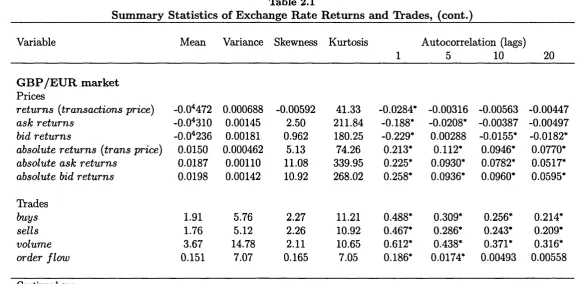
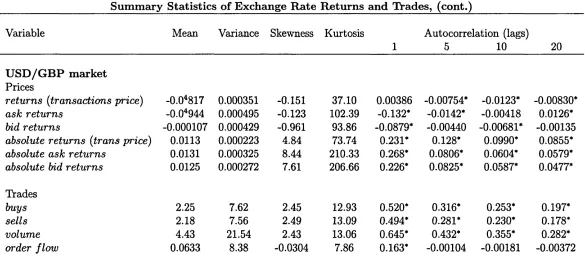
markets are determined jointly, only the periods where no breakdowns in any of the three exchange rate data feeds were considered. This resulted in 90,270 data observations. Table 2.1 contains statistical information on exchange rate returns, defined as 100 times the logarithmic difference in prices (bid, ask and transactions), transaction frequencies and order flows for the filtered data sample.
Of interest at this stage is the fact that for each of the three exchange rates, the variances of the one-minute returns calculated from transactions prices are much smaller than the variances of bid or ask returns. One may have expected the return series from