scroll down to view the document itself. Please refer to the repository record for this item and our policy information available from the repository home page for further information.
Author(s): Olasoji, Remy; Draganova, Chrisina Title: Mobile learning portal
Year of publication: 2010
Citation: Olasoji, R. and Draganova, C. (2010) ‘Mobile learning portal.’,
MOBILE LEARNING PORTAL
Remy Olasoji, Chrisina Draganova
School of Computing, Information Technology and Engineering University of East London
Water Lane, London UK
[email protected], [email protected]
Abstract. While mobile devices may be ubiquitous, increasingly powerful and portable, and equipped with features that may make learning easier and perhaps more interesting on the face of it, there are crucial requirements for effective and successful use in teaching and learning. This study presents a progress report on the development of a mobile learning portal at University of East London (uel). the study builds on previous studies in this area which have developed systems related to supporting classroom interaction.
1.
INTRODUCTION
In recent years, there have been significant investments into the use of mobile and wireless technologies in learning and teaching in the United Kingdom (UK). For example, the Learning and Skills Council (LSC) invested a considerable amount of capital (12 million) to fund Mobile Learning Network (MoleNET) during 2007-2009. MoleNET was primarily tasked with implementation of mobile learning in English Further Education (FE). Between 2007/08, 32 projects and about 10,000 in various schools and colleges participated in trials all over the UK (Attewell et al. 2009, p. 1). From a report on these trials, published by the Learning Skills Network (LSN), while ―there seemed to be a shortage of mobile learning experts, experienced practitioners and good practice exemplars‖, there were also evidence of success in several of the trials (Attewell et al. 2009, p. 11).
However, introducing mobile and wireless technologies in learning and teaching is not without some challenges. The MoleNET report has maintained that careful planning
and preparation is required as well as ―a differentiated approach, in terms of both pedagogy and the technology used‖ (Attewell et al. 2009, p. 4). Murray (2008) supported this view, stating that technology should fulfill learners‘ aims first and foremost. He has warned against introducing technology ―just for the sake of it‖, which will not achieve desired results. Moreover, while some students may be in possession of powerful mobile handsets, accessing content with these handsets may require that they have for example, Internet / WiFi enabled network connections which may lead to incurring an additional cost and reducing inclusiveness.
additional training in the use of mobile technologies and in providing mobile content for learners. A previous research carried out at UEL indicates that some academics may be unwilling to adopt mobile technologies in teaching or unconvinced of the benefits to students of using such technologies (Arreymbi & Draganova 2008).
However, many studies have established that mobile learning has potential benefits for students; especially those who may be may be struggling with their studeis (e.g. Attewell et al. 2009, Dyson et al. 2009, JISC 2005, Kukulska-Hulme & Traxler 2005, Litchfield et al. 2007; Milner 2009; Naismith et. al. 2004, Peng et al. 2009, Arreymbi & Draganova 2008).
In this study we propose a mobile learning portal for computing students which provides content, activities and access to materials that enhance and reinforce students‘ learning. Via the mobile learning portal students are also able to contact their tutors to request further support.
2.
MOBILE LEARNING AT UEL
The mobile learning portal is part of a new research project into the use of mobile technology with computing students at UEL. The project was launched in July 2009, building on work done in previous projects which involved the use of web-based systems in various teaching and learning contexts. The portal incorporates these systems namely: SMS – Edutxt system, UEL uHavePassed system and Web-based mobile self-assessment system and adds additional content, activities and relevant links. The following sub-sections give details about the mobile portal and the incorporated systems.
2.1 The mobile learning portal
The portal is currently being piloted with content from some computing modules, but it is anticipated that more will be added in future phases of the development. Once completed, it is envisaged that the portal will be used to support and engage students in their learning by providing structured, timely and accessible content, formative assessments, appropriate activities and forums for collaboration. Trials with students will begin next semester when a series of evaluation will be carried out for effectiveness and learning gains.
Key features of the portal include:
1. Module and course content: This section consists of content optimised for access and download using some of the most popular personal digital assistants (PDAs), mobile handsets, smartphones, MP3 / MP4 players (e.g. iPODs), and other handheld devices.
2. Learning activities and demos:
This section provides learning activities and demonstrations to reinforce module and course content.
3. Test question database: This
section provides access to several question databases on the UEL uHavePassed system. This is used as formative assessment, providing instant feedback to each question.
5. Link to texting and feedback
their difficulties in a classroom setting.
4. Link to the social networking
community on ‘Facebook’: This section is used to encourage collaboration and peer learning.
Figure1: Mobile learning portal
Future phases of the development will incorporate integration with the virtual learning environment (VLE) which allows students to access other content optimised for mobile devices. The portal incorporates features to enable easy maintenance and addition of new content; hence it could be rolled out and used as a template by other schools and units within UEL.
In the following sections more details are given of the previous projects mentioned above are described briefly.
2.2 SMS – Edutxt system
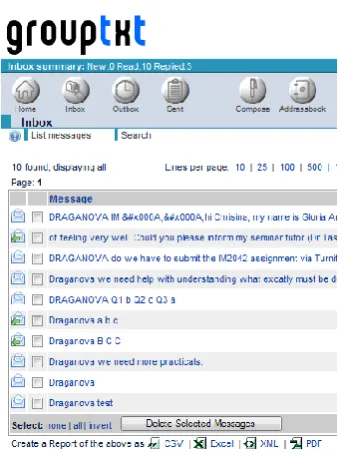
―Edutxt‖ (www.txttools.co.uk) is an online application developed and supported by texttools.co.uk, which allows the sending and receiving of SMS text messages from a desktop to a large group or single mobile phone instantly. ―Edutxt‖ is currently being
[image:4.595.324.494.166.394.2]used in a large number of colleges and universities across the UK to support marketing, recruitment, student services, learning and teaching.
Figure 2 SMS interactions during lecture ―Edutxt‖ was introduced to students in a lecture session for ―Information Systems Modelling and Design‖ module. The students were asked to submit answers to three multiple choice questions via SMS at the end of a lecture session. Students were also encouraged to use the ―Edutxt‖ to submit comments, suggestions and questions related to the module.
2.3 UEL uHavePassed system
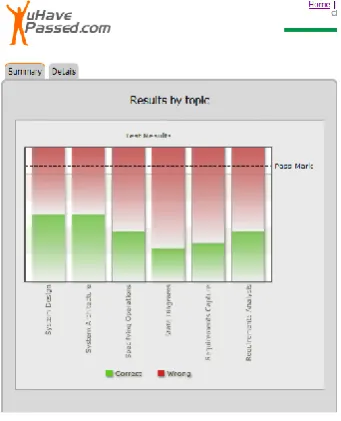
[image:5.595.83.254.279.490.2]―uHavePassed‖ is a Java application for mobile phones developed by Luzia research (luziaresearch.com). The application allows lecturers to upload question banks onto a web-based platform and make it available for download and installation, which can subsequently be used as formative assessment. The application is free of cost for the students and content is suitable for majority of the students‘ mobile devices.
Figure 3: uHavePassed feedback
Approximately 80 multiple choice questions from different topics related to the ―Information Systems Modelling and Design‖ module were uploaded for students. The main benefit of this system is the potential any time and anywhere (and perhaps just-in-time) access it provides. The system provides instant feedback to each question, which helps to reinforce learning. However, the system is more appropriate for supporting independent study rather than classroom interaction. Students, who downloaded the application gave positive feedbacks.
2.4 Web-based mobile self-assessment system
The possibility of using web applications to support classroom interaction is another viable option. In many university campuses, WiFi networks are available and students can use free broadband connections on their mobile phones. This makes it possible to have web applications that implement mobile services related to classroom interaction. Such solutions offer free-of-cost connections and make use of the modern capabilities of mobile phone devices.
It is also possible to automatically collate students‘ messages and to make intelligent interpretation of the students‘ answers. Having such capabilities in a system would enable sending appropriate automatic individual feedback to the students‘ mobile phones and providing the teacher with an idea of the students‘ misunderstandings (Lee et al., 2008). This was trialed in this system which provides online access to self-assessment multiple choice questions. This system incorporates a neural network model that categorises the learner's responses as having a significant level of similarity with a subset of answers it has previously categorised. Each category is associated with feedback composed by the lecturer on the basis of the level of understanding and predominant misconceptions of that category-group of answers. In this way the feedback addresses the level of knowledge of the individual and guides them towards a greater understanding of particular concepts.
sessions settings to support interaction and active participation, provided students have mobile devices / technology with WiFi capabilities, or other types of Internet connectivity (Lee et al., 2008).
3.
CONCLUSION
The pilot experiments carried out at UEL demonstrate the potential of mobile technologies to support learning and teaching in variety of contexts including classroom interaction, independent study, collaborative work and communication with tutors and peers. The main benefit of incorporating systems that support such functionalities in the mobile learning portal is giving the students a one-stop access to learning materials and activities at anytime and anywhere.
The mobile learning portal provides learners with additional learning support and additional means of communication supporting both synchronous and asynchronous interaction. Linking with social networking and collaborative sites provides a framework to support group work and peer assisted learning.
The mobile portal is an excellent vehicle to evaluate and assess in a larger scale the critical requirements for successful implementation of mobile technologies in learning and teaching and the related pedagogical issues.
4. ACKNOWLEDGEMENT
The mobile learning portal is a joint development by UELconnect and the school of Computing, Information Technology and Engineering (CITE) at UEL, and funded through a Higher Education Funding Council for England and Wales (HEFCE) Teaching Quality Enhancement Fund (TQEF). The project acknowledges William
Ward (Technology niche) and Seyed Mousavi (UEL) who are involved in portal and content design and development.
5. REFERENCES
Arreymbi J. and Draganova C., User requirements analysis for use of mobile phones in learning and teaching,
http://www.inter-disciplinary.net/ati/education/ioe/ioe5/Draga nova%20paper.pdf, 2008 [viewed 27 October 2009].
Attewell J., Savill-Smith C., Douch R., The impact of mobile learning: Examining what it means for teaching and learning, LSN, London, 2009.
Bär H., Häussge G., Rößling G., ―An integrated system for interaction support in lectures‖, in Proceedings of Mobile Learning 2006. IADIS Press, 2006, pp. 360– 364.
Dyson L., Litchfield A., Lawrence E., Raban R., Leijdekkers P., ―Advancing the m-learning research agenda for active, experiential learning: Four case studies‖,
Australasian Journal of Educational Technology, 25:2, 2009, pp. 250-267.
Freeman M. and Blayney P., ―Promoting interactive in-class learning environments: A comparison of an electronic response system with a traditional alternative‖, in Proceedings of the 11th Australasian Teaching Economics Conference, 2005.
http://www.jisc.ac.uk/uploaded_documents/ publication_txt.pdf, 2005 [viewed 27 October 2009].
Kukulska-Hulme A. and Traxler J. (Eds),
Mobile learning: A handbook for educators and trainers, Routledge, London, 2005.
Lee S., Palmer-Brown D., Draganova C., ―Diagnostic Feedback by Snap-drift Question Response Grouping‖, in Proceedings of 9th WSEAS International Conference on Neural Networks, 2008, pp. 208-214.
Lindquist D., Denning T., Kelly M., Malani R., Griswold W., Simon B., ―Exploring the potential of mobile phones for active learning in the classroom‖, SIGCSE„07, Covington, Kentucky, 2007, pp. 384-388.
Litchfield A., Dyson L., Lawrence E., ―Directions for m-learning research to enhance active learning‖, in Proceedings of
ICT: Providing choices for learners and learning, ascilite, Singapore, http://www.ascilite.org.au/conferences/singa pore07/procs/litchfield.pdf, 2007 [viewed 27 October 2009]
Markett C., Sánchez I., Weber S., Tangney B., ―‘Pls Turn Ur Mobile On‘: Short Message Service (SMS) Supporting Interactivity in the Classroom", in Proceedings of International Association for Development of the Information Society (IADIS) Conference on Cognition and Exploratory Learning in Digital Age, Lisbon, Portugal, 2004.
Milner H., "Digital inclusion", in Proceedings of Handheldlearning, Learning
Without Frontiers Ltd,
http://www.handheldlearning2009.com/proc
eedings/video/905-video/322-helen-milner, 2009 [viewed 27 October 2009].
Murray C., ―If we build it will they come and more importantly will they stay?‖, in Proceeding of ePortfolios, identity and personalised learning in healthcare education. Higher Education Academy Subject Centre, Special Report 10, 2008, pp.116-122.
Naismith L., Lonsdale P., Vavoula G., Sharples M., ―Literature review in mobile technologies and learning‖, Report 11,
Futurelab, Bristol,
http://www.futurelab.org.uk/resources/docu ments/lit_reviews/Mobile_Review.pdf, 2004 [viewed 3 May 2009].
Peng H., Su Y., Chou C., Tsai C., ―Ubiquitous knowledge construction: mobile learning re-defined and a conceptual framework‖, Innovations in Education and Teaching International, 46:2, 2009, pp. 171-183.
Ruhl K. and Suritsky S., ―The Pause Procedure and/or Outline: Effect on Immediate Free Recall and Lecture Notes taken by College Students with Learning Disabilities‖, Learning Disability Quarterly, 18, 1995, pp. 2-11.
Scornavacca E. and Marshall S., ―TXT-2-LRN: improving students' learning experience in the classroom through interactive SMS‖, in Proceedings of 40th Annual Hawaii International Conference on System Sciences (HICSS), HICSS, 2007, pp. 5b.