A longitudinal study of the professional development of teachers –
the challenges of comparison
Introduction
This chapter considers some of the methodological challenges encountered when revisiting the professional lives of twenty-seven mid-career teachers (Hargreaves, 2005) from cities in Germany, Norway and England in three nationally distinct public welfare regimes (Esping-Anderson and Myles, 2009). In this study teachers’ Continuing Professional Development (CPD) is situated in a complex amalgam combining teacher biography, identity work and the values embedded within different communities of practice (Wenger, 1998). It is, with varying degrees, also situated within wider international discourses reflecting the marketisation of public sector work and the development of an audit culture (Apple, 2005) in which the performance of professionals is increasingly measured by externally determined targets (Wilkins and Wood, 2009). A longitudinal comparative study is rare within the literature on teachers’ CPD and yet was considered necessary when discussing this complex amalgam within a wider European context. A context informed by the European Council’s agenda for improving the quality of teaching and teacher education across all of its constituent nation states (European Commission, 2010a). All too often international comparisons are used to legitimate claims and justify radical changes in education policy based on large-scale survey methods (Alexander, 2000). Yet many such comparisons avoid the in-depth understanding of educational perspectives and practices in situ, gained when viewed through the eyes of professionals within their own cultural context (Osborn, 2004). Exploring the variety and depth of experiences these teachers have had of CPD, this study examined the extent to which these experiences addressed their professional needs and/or the professional needs of the institutions in which they worked. The findings revealed a disparity between the activities these teachers engage in and the value they place on their own professional development.
encompasses the development of theoretical and practical descriptions of professional lives, identities and activities through detailed situated investigations (Delamont, 2008; Walford, 2008; Beach, 2010). This interpretive small-scale exploratory case study drew on established qualitative research methods associated with longitudinal studies (Elliot et al., 2008) nine years after these same teachers were interviewed in research examining their professional socialisation into teaching (Czerniawski, 2009; 2013). While initially focusing on the effects of professional socialisation on teachers’ values and identities, over time, the study shifted its focus to examine these teachers’ perceptions of their continuing professional development. By drawing on data collected with a small sample of teachers in three national locations over many years there is, therefore, also a comparative element to this study. By ‘comparative’ research I refer to the cross-cultural comparison of similarities and differences in social phenomena that a study such as this explores (Osborn, 2006). Such comparisons carry with them risks and rewards for any researcher. Oversimplified findings and superficial conclusions often accompany an inability to grasp complexities in language, history and culture. Such inabilities can lead to cherry picking and a desire to snatch something from one country expecting it, unproblematically, to work elsewhere (Alexander, 2009).
And yet, in increasingly globalised times, national educational debates need international perspectives. A European Agenda (European Commission, 2010a) for teacher mobility, for example, across all European countries is problematic when considering teachers’ CPD in different national locations. Differences in the constellations, configurations of influence and patterns of professional relationships ensure that the experience of being a teacher differs considerably for different individuals even within broadly similar contexts and settings. For the comparative researcher, the discovery of new policies, practices and institutions can, therefore, provide greater understanding of any education system regardless of its location or whether such studies are small- or large-scale.
questionnaires and the more in-depth understanding of the professional lives of these teachers, gained through interviews. This chapter then examines more closely some of the challenges faced when interviewing teachers in different national locations. Part of this discussion adopts a reflective style of writing engaging with some of the dilemmas encountered when embarking on a study such as this. The article finally refers back to some of the conclusions drawn from the micro-analysis deployed in the original study relating this to the professional development of teachers within the European Union.
Three national contexts
The three countries chosen for the original study exemplify Esping-Anderson and Myles’s (2009) three welfare state types: social democratic, in Norway; conservative and corporatist, in Germany; and free market liberal, in England. Two public sector employment models identified by the OECD (2005) are also significant when comparing professional development opportunities in these three countries: in Germany and Norway a career-based model where teachers are generally expected to stay in the public service throughout their working life; and in England a position-based model which focuses on selecting the best candidate for each position and offering more open access to a wider variety of candidates including those moving into teaching from other professions.
has, by Norwegian standards, been an overwhelming focus on international comparisons and tests, with a requirement that each municipality and county carry out competence development measures for its teachers. Norway’s recent ‘pedagogic crisis’ as a result of its performance in the OECD international PISA tests in reading, mathematics and science has resulted in a ‘panoply of initiatives to raise the competence of teachers and head teachers’ (Ure, 2007). The Strategy for
Competence Development (2005–8) is indicative of this focus and has provided 160
million Euros for the development of teachers, school leaders and trainers in primary and secondary education (Lloyd and Payne 2012). Surveys have, however, indicated that Norwegian teachers are often disappointed with the facilitation and outcomes of CPD (Lloyd and Payne, 2012).
Generalising about teachers’ CPD in Germany is even more problematic. Previous research has characterised the country’s education systems as hierarchical and fragmented (Kron, 2000). The majority of German Länder (federal states) have a tripartite system of schooling: the Hauptschule provides preparation for employment in manufacturing industry or manual work; the Realschule provides preparation for employment in the technical, financial, commercial and middle management sectors; while the Gymnasium, in which teachers in this study were not only trained to teach but also attended as pupils, provides for what are generally considered the most able pupils within the system. The Gymnasium consists of lower and upper secondary schools. Teachers are trained and employed by the Länder and receive a minimum of sixteen hours’ CPD per year. In-service training for teachers in Germany is compulsory albeit dominated by individual participation and mostly organised into short, one-day courses (Lipowski et al., 2011).
professional development pathways (e.g. coaching and mentoring, Advanced Skills Teachers, Master’s accreditation and the ‘Excellent Teachers Scheme’) do exist for teachers, once qualified, and are, in most cases, rewarded with certification and salary differentials although it is also worth noting that the majority of CPD for teachers in England is driven increasingly by school imperatives. Professional development programmes have, for example, escalated in schools, catalysed by the dissemination of National Literacy and Numeracy strategies (DfEE, 1998). However, despite this intense regulation there is no legal minimum requirement for teachers to spend on professional development. Five days of the statutory 195 days required for teachers to be available to work is, nevertheless, allocated for non-teaching activities including CPD (Eurdice, 2011).
Comparative research and the importance of contextual sensitivity
I wish now to turn to some of the issues and challenges related to comparative research, with a specific focus on the contextual sensitivity of the researcher. Such sensitivity is a vital ingredient in the repertoire of the comparative researcher wishing to explore the social contexts and meanings when a small-scale three-country study such as this is carried out. Specifically I refer to the sensitivity to actions, symbols and relationships that may carry different meanings in different societies or cultures and are of particular interest to ethnographic researchers.
Marsh (1967) has made a distinction between intra-societal comparison – “the analysis of variations within one society” and inter-societal comparison – “as the systematic and explicit comparison of data from two or more societies or their subsystems” (Marsh, 1967: page 11). The empirical data gathered for this study, through interviews with teachers working in three national settings falls mainly into the latter distinction made by Marsh because of the cross-national nature of this study. However comparative research is not just about comparison but explanation. Thomas (1998) states that:
In its most inclusive sense, comparative education refers to inspecting two or more educational entities or events in order to discover how and why they are
alike and different. An educational entity in this context means any person,
activity concerned with promoting learning ([Thomas, 1998: page 1] [my
emphasis]).
How and why becoming teachers ‘are alike and different’ is precisely what this study explored by focusing on the three social settings in which these teachers are situated. Mabbett and Bolderson (1999) have drawn attention to two broad categories of comparative social research that have influenced how such a focus might take place. The first category represents mid or ‘meso’ level cross-national analysis and is exemplified by Esping-Anderson and Myles’s (2009) classification of welfare state types referred to earlier and used as a justification for the choice of three countries in this study. The second category of comparative social research, that Mabbett and Bolderson (1999) draw attention to covers micro-studies that utilise in-depth, qualitative techniques of research. These studies emphasise cultural specificity, agency and reflexivity in the policy and research process (Kennet, 2001). By focusing on the ‘situatedeness’ of the professional development of teachers, and in particular, the role that values and teacher identities play in this process this study rests within both of Mabbett and Bolderson’s (1999) categories of comparative research.
A three-country, cross-national comparison and qualitative analysis in comparative education of the sort deployed in this study, is rare and presents both conceptual and methodological challenges to the researcher related to contextual sensitivity. Alexander (2005), for example, notes that “the language of education contains few universals and educational conversation across cultures is laced with pitfalls for the unwary” (Alexander, 2005: page 5). Uni-directional reforms do not necessarily lead to educational systems becoming more like each other (Green et al., 2007). Reutin (2004) has claimed that different historical starting points of education systems combined with variety in the various institutional structures also make meaningful generalisation at best, problematic. In addition, the provision of education is deeply influenced by the cultural context in which it is located, as well as by the economy and the political system responsible for educational policies (Hayhoe, 2007).
In a world marked by the rapid intensification of globalisation, tensions between global and local agendas and developments clearly demand ever more specialist knowledge, insight and understanding. This is of vital importance; but the very same global factors heighten the significance of the contextual sensitivities that comparative researchers have a particular responsibility to
identify [Crossley and Jarvis, 2001: page 407).
Questions related to any cross-societal equivalence between concepts are prominent in the literature on comparative education and are a crucial factor in the cross-national research that this study addresses. Phenomena or relationships may have different meanings in the three societies under examination. For example the meaning of a teacher’s action in one location can depend on the conventions, norms and values of not only the country concerned but also the particular type and location of the school in which that teacher’s action takes place (e.g. the word ‘inclusion’ within the diversity of school institutions that typify the British education might cause confusion to a Norwegian teacher working within an education system that is by its nature ‘inclusive’ and ‘comprehensive’). Carey-Wood (1991) argues that equivalence in meaning and concepts is not necessarily obtainable by ‘correct’ linguistic translations because of the semantic, cultural and societal differences inherent in words and concepts. Nevertheless “concepts are necessary as common points of reference for grouping phenomena that are differentiated geographically and often linguistically” (Rose, 1991: page 447). Without utilizing concepts, information collected about different countries provides no basis for relating one country to another. The problem of meaning and significance of actions is particularly important in a study that considers the views of teachers in different national locations. This is because much of the work that teachers do is conducted in terms of signals, symbols, coded language and symbolic behaviour.
To enhance the validity of their research, researchers need to possess, either collectively or individually the contextual knowledge and understanding needed
to design and carry out the study [Brisard et al., 2003: page 4].
As a teacher-researcher and linguist I have carried out the research for this study in ways that, I hope, address many of the concerns related to both contextual qualification and sensitivity discussed in this section and these are discussed later in the chapter when discussing the challenges of comparison.
Research design
This longitudinal, interpretive small-scale exploratory case-study, revisits the lives of mid-career teachers (Hargreaves, 2005) nine years after they were interviewed in research examining their professional socialisation into teaching. In the original study, a purposive sample (Winne and Alexander, 2006) of thirty-two teachers from Norway, Germany and England were interviewed three times during the first two years of their professional careers. In this follow-up study, ten Norwegian, nine German and eight English teachers from the original sample explore the variety and depth of experiences they have had of CPD, and consider whose interests are being satisfied by the proliferation of these activities.
Specifically these teachers’ views shed light on the extent to which these experiences have addressed their professional needs and/or the professional needs of the institutions in which they work. In so doing their views address two research questions:
1. What sorts of CPD activities did teachers engage with? 2. To what extent did teachers find these activities useful?
on one element associated with the collection of data, namely, the use of cards as a tool to generate conversation during the interviews.
In adopting a suitable analytical framework to illuminate the formal and informal processes associated with teachers’ CPD in three countries, the author has drawn on Layder’s (1998) adaptive theory. Informed by the grounded theory tradition associated with Glaser and Strauss (1967) the author utilised its more recent interpretations (Charmaz, 2006). Part of the analysis also drew on Wengerian notions of ‘communities of practice’ (Wenger, 1998). The study has been conducted along ethical guidelines (BERA, 2011). In consideration of the small sample size and the potentially sensitive nature of the data, all participants were guaranteed confidentiality and anonymity.
Initial findings and a disparity in data
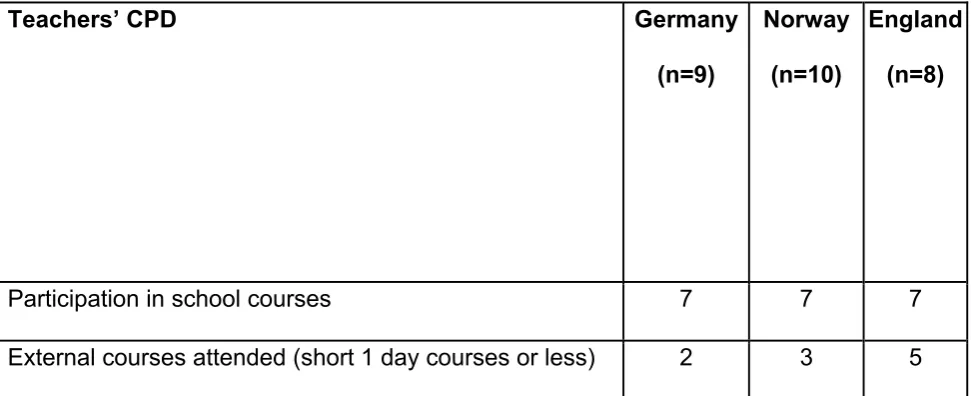
[image:9.595.80.566.545.743.2]Table 1 summarises the results from semi-structured questionnaires initially sent electronically to the teachers in this study prior to being interviewed. Drawing on the international literature on teachers’ CPD, the questionnaires asked teachers to describe professional development activities they had encountered since qualifying as teachers, briefly summarized in the table:
Table 1 – Results from the questionnaires indicating the CPD experiences of German, Norwegian and English teachers.
Teachers’ CPD Germany
(n=9)
Norway (n=10)
England (n=8)
Participation in school courses 7 7 7
External courses attended (more than one day course) 2 2 5
Experience of working with other colleagues in classroom (e.g. team teaching)
2 2 6
Working with colleagues collaboratively outside of the classroom (e.g. joint planning, curriculum projects, action research etc.)
2 3 7
Annual appraisals 2 5 7
Classroom observation of other staff 0 1 3
Classroom observation by other staff 2 2 7
Currently involved in further training (formal study) 3 2 3
Plans for further training 1 3 3
Awareness of external bodies providing professional development
5 4 7
Opportunities for future promotion 3 3 6
Experience working in different schools 3 5 6
Involvement in any form of research activity 0 2 3
The results from these questionnaires alone would seem to indicate that the teachers in England experienced the widest range of professional development opportunities. However, the data gathered from interviews with each teacher after completion of the questionnaire revealed a somewhat more complex and nuanced exploration of CPD experiences revealing a disparity between the activities these teachers engage in and the value they place on their own professional development.
sources of professional development, with the latter receiving the most support. However, interview data highlighted the instrumental nature of some of these courses and how problematic, for some, this could be:
At my school we do get funding for these sorts of courses but this tends to be anything that is exam-based – so it’s good in that we learn about the exams – but not sure it really is about developing me professionally – rather it’s developing my ability to pass examinations, theirs [pupils], not mine. [Sylvia]
It would also appear, from the table that participation in school courses featured relatively strongly in the professional lives of most of these mid-career teachers. However appearances can be deceptive. For some German teachers, for example, these days ‘hardly ever happened’, or ‘took place but are frankly speaking generally a waste of time’. While many teachers referred to these days as being opportunities, often, to ‘collect’, ‘brainstorm’, ‘share’ practice, for Harald the outcomes were less than satisfactory:
I cannot remember what we do in most of these days. We seem to sit around on tables with large pieces of paper, sharing our ideas and when I first took part I thought “oh good, this is like training again” – but actually we are never receiving anything afterwards and I wonder what is happening with all these paper tablecloths. [Harald]
This tendency for there to be few opportunities to develop further or apply what these teachers had learnt was shared across all three cohorts. Most could not see the long-term benefits of many school-based training activities. Svend, a Norwegian mid-career teacher, for instance, said that he:
Did not find [school-based CPD activities] useful as they are not implemented after the courses are finished so you wonder why you started them. We need to work these practices out together, not in isolation. [Svend]
provide a richer, more varied and accessible stream of teacher developmental opportunities. However, on closer examination, interviews revealed that the English teachers in this study experienced the harder economic utilitarian forms of professional development referred to by Earley and Bubb (2004), addressing, in most cases, the strategic goals of the school rather than their professional learning needs.
The Interview technique
the short time available for an interview to take place the participant was distracted by the cards while the recording device was being set up thereby reducing the degree of nervousness that can exist in most interview scenarios, particularly when very often respondents in schools are ‘snatching’ bits of their valuable time in order to take part in research.
On subsequent visits all teachers were offered the cards they chose at the start of the field research. However these interviews also allowed some opportunity to explore additional issues that had emerged from the analysis of the interview transcripts in general as well as increasingly being informed by the literature researched during the duration of the study. It is perhaps relevant to say here that quite a few respondents thanked me afterwards for allowing them to take part in the whole project. The general sense that was conveyed by a number of the respondents was that they found the experience cathartic. This was particularly the case with the German and Norwegian teachers, a minority of whom said that there was, in the daily routine of teaching, little opportunity to talk to other colleagues about the more abstract, yet significant, issues to do with their jobs that these interviews explored.
Encountering some of the challenges of comparison
The age range of the teachers in the three samples broadly represents the average age ranges of teachers going into the teaching profession in those particular countries although the London sample were, in general, slightly older than the national average of teachers entering the profession for the first time in the UK. That said, it is not, nor has it ever been, an aim of this research to offer data that claims to be representative of a larger group of individuals but rather draw the reader’s attention to similarities and differences between the three groups of teachers. More significant however is the fact that the German teachers were considerably older on entering teaching, on average, than either their Norwegian or English counterparts because of the extended period of study it takes German teachers to reach their final qualification. There is, therefore, a greater investment of self by the German teachers in their training than can be said about either the Norwegian or English cohorts. I cannot say that I found any qualitative difference in responses purely based on this difference in length of training and subsequently their older age on entering the profession for the first time. However, I tended to find that the German teachers were more reflective about their own experiences as classroom teachers, their professional development and about being in new situations. This might possibly be due to the fact that they had, in many cases, experienced a number of part-time jobs at university and therefore had a greater reflective stock on which to call upon when considering these experiences.
English. In most cases the standard of English spoken was extremely good and I could switch if necessary into German to clarify issues.
My rudimentary knowledge of Norwegian ruled out any possibility of carrying out interviews in Norwegian. However out of the thirteen interviewees only one student was not fluent in English. Norway is a country with a small population and one that warmly embraces the English language. English is the first foreign language that school children learn and cinema and television broadcast all foreign films with subtitles rather than being dubbed (this contrasts with the automatic dubbing of all foreign films in Germany). While many Norwegian teenagers enthusiastically follow the Norwegian domestic music industry it is impossible to escape the dominance of American and British bands in the Norwegian charts. This, in general, meant that the interviews in Norway were effortless, in terms of any potential language difficulties that might have been thrown up. That said, I cannot possibly account for how these interviews, in content, would have varied had I carried them out in Norwegian. In other words I am sure that there were interpretations made of questions I posed that highlighted linguistic differences however it is impossible for me to say what these might have been. All I can do is draw attention to the fact that I was aware of their potential existence.
Combating the dangers of misrepresentation
The relationship between teachers’ values and what teachers actually say about them, is ambiguous, fluid and difficult to unpack. Feiman-Nemser and Floden (1986) have warned that asking teachers to explain their reasons for a particular action will not necessarily guarantee that researchers can obtain a reliable picture of the values teachers hold. In attempting to achieve this, I have, up to this point, painted perhaps an overly rosy picture regarding the advantages of, not only qualitative interview strategies in general, but the idiosyncratic method of interview that I have adopted for this study. I wish now to redress this balance. There are unavoidable problems (Cicourel, 1964) that the researcher is faced with when adopting interviews as a method and I wish to refer to the ones that were significant to me when attempting to critically evaluate this study.
Mason (1996) discusses the complexities involved in writing up qualitative research findings from a large data set. The dilemma in deciding what data to include is more than balanced by the dilemma of deciding what not to include. This latter dilemma has been termed the “agony of omission” (Lofland and Lofland, 1995: page 262). The decisions I have made concerning which data to use and which to leave out has been based upon the key themes that have emerged from progressive focussing (Glaser, 1992) on key themes in relation to the study as a whole. However it is important to point out that the quotations used in the various publications that have emerged from this study are but tiny sections of the transcripts of the original interviews and here lies a significant ethical issue concerned with the typing up and representation of interview data. Holland et al. (1998) describe the transcript of any interview as a ‘transgression’ where the “original live, face-to-face conversations disappear in endless transcripts and reappear butchered into fragmented quotes” (Holland et al., 1998: page 222). However I have tried, over the nine years this study took, to remain true to the ideas conveyed by teachers in all our discussions.
and represent the meanings of others regardless of what, or how many languages are involved (Roth, 2013). Nevertheless carrying out a small-scale qualitative study in three countries was, linguistically, challenging. I have already talked about my ability to speak German and in three cases this meant that the interviews were conducted in German. This however has also meant that I transcribed these interviews into English, necessitating translation on my part. I found this process to be tougher than I had first imagined and while I attempted to do this as accurately as possible I am aware that this imposed an additional distance between what the interviewee meant and how I have conveyed their interpretation. Strategies for eliminating translation-related problems included back translation, consultation and collaboration with other people during the translation process and, pre-testing or piloting (for example, the interview cards used in this study) whenever this was possible (Birbili, 2000). During the course of this study I drew on German and Norwegian contacts and friends for their linguistic support (in the preparation of interview cards, questions and during the transcription and translation processes). This violation, in part, of the confidentiality I had promised my participants was a regrettable and yet necessary step I was faced with and one for which I could find no alternative solution.
In all three locations other facets of social location such as age, class, and gender etc might have added to the interviewer effect (Oakley 1981). However I have no way of measuring to what extent this was a significant issue or indeed how this might have impacted on the outcome of my research. I can say that class distinctions tend to dissolve more easily when talking to other foreign nationals because they may not necessarily be able to pick up on the subtle cultural ‘clues’ that infer a particular class background.
Discussion
many of these teachers reported experiencing. Teachers in all three locations in this study identified few opportunities to develop further or apply what they had learnt and many could not see the long-term benefits of many school-based training activities. Whilst expressing satisfaction with some aspects of their experiences of CPD (particularly those associated with external courses designed to enhance pupil examination results), attention was drawn to how ‘pointless’, ‘wasteful’ and ‘forgettable’ many school-based activities were.
The experiences of professional development articulated by the teachers in these three European locations varied to such an extent as to provoke further critical enquiry in relation to teachers’ CPD in a wider arena. The complex amalgam, referred to at the start of this chapter, into which teacher professional development is embedded, extends beyond the biographies, identity work and values of teachers. Into this mix one must also add the pressures associated with more economic forms of globalisation and those born from rapid societal transformation. And yet to what extent these pressures determine teachers’ CPD in particular (Day and Sachs, 2009) is open to question. It is true that the sweeping European agenda for teachers’ CPD (European Commission, 2010a; 2010b; 2011) embraces the three countries this study addresses. However, in most cases, teachers interviewed in this study identified not just a huge variation in their experience of professional development, but confirmed existing literature by registering dissatisfaction with the development they received. According to these teachers, their professional development would appear neither systematic nor particularly successful.
increasing teacher motivation and career satisfaction. Second, teacher mobility across all European countries would imply a homogenisation of the teaching profession and a unitary understanding of what constitutes appropriate and desirable CPD. As this small-scale, longitudinal, three-country study clearly indicated, this is far from the heterogeneous reality confronting any teacher seeking employment opportunities across, and in some cases within, national boundaries. Seeking a common understanding of what effective teachers’ CPD is, risks jumping to the conclusion that there is a common understanding of what being a teacher is, or indeed losing sight of the fact that teachers are professional learners and not just tools for school improvement.
Concluding thoughts
One might wonder what use a small-scale study such as the one described in this chapter might have when discussing issues related to globalisation, the professional development of teachers and their mobility within and beyond national borders. And yet the microanalysis deployed in this study did enable the drawing of conclusions at the macro-level, with a particular focus on teacher mobility and CPD within the European Union. In so doing this three-country longitudinal comparative study avoided some of the pitfalls of dichotomous assumptions associated with many two-country comparative studies i.e. an overly simplified polarisation of issues based around similarity and difference. The author recognises that drawing conclusions about the nature of CPD for teachers in these countries on the basis of a small number of interviews and questionnaires alone can be problematic. Teachers’ recollections, interpretations and explanations of their professional development reveal little about the long-term impact of CPD on their professional practice. Nevertheless the research methods deployed in this study revealed, in all three national locations, the discrepancy between the activities these teachers engaged in and the value they placed on their own professional development.
References
Apple, M. (2005). Education, markets and an audit culture. Critical Quarterly, 47, Issue 1–2: 11–29.
Alexander, R. (2000). Culture and Pedagogy: international comparisons in primary
education. Oxford: Blackwell.
Alexander R.J. (2005). Education, Culture and Cognition: intervening for growth. International Association for Cognitive Education and Psychology (IACEP) 10th
International Conference, University of Durham, UK, 10-14 July 2005
Alexander, R.J. (2009). Towards a comparative pedagogy. In: Cowen, R. and Kazamias, A.M. (ed) International Handbook of Comparative Education, pp 923-942, Springer, (2009)
Apple, M. (2005). Education, markets and an audit culture. Critical Quarterly, 47, Issue 1–2: 11–29.
Beach, D. (2010). Identifying and comparing Scandinavian ethnography: comparisons and influences. Ethnography and Education. 5. (1). pp 49-63.
Birbili, M. (2000). Translating from one language to another. Social Research
Update. Issue 31. Page 1.
British Educational Research Association (BERA). (2011). BERA Ethical Guidelines. http://www.bera.ac.uk/files/2011/08/BERA-Ethical-Guidelines-
Brisard, E., Menter, I. and Smith, I. (2003) ‘Initial teacher education practice in England and Scotland’, paper presented at European Conference on Educational Research, Hamburg, September 2003.
Broadfoot, P. Osborn, M. (1992). French lessons: comparative perspectives on what it means to be a teacher. Oxford Studies in Comparative Education. 1. pp. 69-88.
Carey-Wood J., (1991) “Leaving Home: Housing for young people in England and France” (unpublished thesis – University of Bristol – cited in: Kennet P, (2001) “Comparative Social Policy” (Open University Press) Buckingham
Charmaz, K. (2006). Constructing Grounded Theory: A practical guide through
qualitative analysis. London: Sage.
Cicourel, A. U. (1964). Method and Measurement in Sociology. New York: Free Press.
Coffey A., Delamont S. (2000). Feminism and the Classroom Teacher. London: Routledge Falmer.
Crossley M., Jarvis P., (2001). ‘Context Matters’ in: Comparative Education vol 37 no 4 pages 405-408
Czerniawski, G. (2009). Positioning the values of early career teachers in Norway, Germany and England. European Journal of Education 44, no. 3: 421-440.
Czerniawski G. (2010). Emerging Teachers and Globalisation. London: Routledge.
Czerniawski G (2013) Professional development for professional learners: teachers’ experiences in Norway, Germany and England. Journal of Education for
Teaching 39:4.
Day, C., and J. Sachs. (2009). International Handbook on the Continuing Professional
Delamont, S. (2008). For lust of knowing – observation in educational ethnography.
In: How to do ethnography, (ed). G. Walford. pp. 39-56. London: Tufnell Press.
Department for Education and Employment. (1998). The Implementation of the
National Numeracy Strategy: The Final Report of the Numeracy Task Force. London:
DfEE.
Elliot, J., Holland, J., & Thomson, R. (2008). Longitudinal and panel studies. In P. Alasuutari, L. Bickman, & J. Brannen (Eds.), The SAGE handbook of social research methods (pp. 228-248). London: SAGE Publications.
Esping-Anderson G., and J. Myles. (2009). The Welfare State and Redistribution, unpublished paper. Available at G.Esping-Anderson’s Web site. http://www.esping-anderson.com/?a201ce18
European Commission. (2010a). Improving Teacher Quality: The EU Agenda –
Lifelong learning: policies and programme. Brussels, April 2010, EAC.B.2. D (2010)
PSH.
European Commission. (2010b). Thematic report on teachers’ professional
development: Europe in international comparison [online]. Luxembourg: Office for
Official Publications of the European Communities. Available from:
http://ec.europa.eu/education/school-education/doc1962_en.htm
European Commission (2011). Entrepreneurship Education: Enabling Teachers as a Critical Success Factor “A report on Teacher Education and Training to prepare teachers for the challenge of entrepreneurship education.” Final Report November 2011 Bruxelles 2011
Feiman-Nemser, S., & Floden, R. E. (1986). The cultures of teaching. In M. C. Wittrock (Ed.), Handbook of research on teaching, third edition (pp. 505-526). New York: Macmillan.
Fuller, A., Hodkinson, H., Hodkinson, P. and Unwin, L. (2005) Learning as peripheral participation in communities of practice: a reassessment of key concepts in workplace learning. British Educational Research Journal, 31. No. 1: 49–68.
Furlong, J., Barton, L., Miles, S. and Whitty, G. (2000). Teacher Education in
Transition. Buckingham: Open University Press.
Glaser B.G.; Strauss A.L. (196)7. The Discovery of Grounded Theory. Chicago: Aldine.
Glaser B.G. (1992). Emergence vs Forcing: Basics of Grounded Theory Analysis. Mill Valley CA: The Sociology Press.
Green, A. Little, A., Kamat, S., Oketch, M. and Vickers, E. (2007) Education and Development in a Global Era: Strategies for ‘Successful’ Globalisation, DFID.
Hargreaves, A. (2005). Educational change takes ages: Life, career and generational factors in teachers’ emotional responses to educational change, in: Teaching and
Teacher Education, 8. No. 21: 967-983.
Hayhoe R. (2007). ‘The use of fideal types in comparative education: a personal reflection’ in: Comparative Education vol 43 no 2 pages 189-205
Holland J., Ramazanoglu C.. Sharpe S. and Thomson R. (1998). The Male in the Head: Young People, heterosexuality and power. London: Tufnell Press.
Kennett P., (2001). Comparative Social Policy. Bucks: Open University Press.
Kitwood T. (2004) Dementia Reconsidered The person comes first. New York: Open University Press.
Korsgaard, O. (2002). A European Demos? The Nordic Adult Education Tradition,
Kron. F. W. (2000). Germany. In: C. Brook. and W. Tulasiewicz. [Eds]. Education in a
Single Europe. London: Routlege.
Kvale S. (1996). Interviews – An introduction to qualitative research interviewing. London: Sage.
Lather, P. (1991). Getting smart: Feminist research and pedagogy with/in the
postmodern. New York: Routledge.
Layder, D. (1998). Sociological Practice: linking theory and social research. London: Sage.
Lewin, K. (1990) Data collection and analysis in Malaysia and Sri Lanka. In G. Vulliamy, K. Lewin and D. Stephens (1990) Doing Educational Research in Developing
Countries London: The Falmer Press
Lipowski, K., D. Jorde., M. Prenzel., and T. Seidel. (2011). Expert views on the implementation of teacher professional development in European Countries.
Professional Development in Education 37, no. 5: 685-700.
Lloyd, C., and J. Payne. (2012). Raising the quality of vocational teachers: continuing professional development in England, Wales and Norway. In Research Papers in
Education 27. No.1: 1–18.
Lofland, J. and L. Lofland. (1995). Analyzing Social Settings: A Guide to Qualitative Observation and Analysis, Belmont, CA: Wadsworth.
Mabbett D. and H. Bolderson (1999), ‘Theories and methods in comparative social policy’ in J Clasen, Ed, Comparative Social Policy: Concepts, Theories and Methods, Blackwell, Oxford
Marsh R., (1967) Comparative Sociology: A Codification of Cross-society analysis (Harcourt) New York
Mason J. (1996). Qualitative Researching. London: Sage.
Oakley A. (1981). ‘Interviewing Women – a contradiction in terms’ in: Roberts H., (1981) Doing Feminist Research. London: Routledge.
OECD. (2005). Teachers Matter – Attracting, Developing and Retaining Effective
Teachers. Paris: Organisation for Economic Co-operation and Development.
OECD. (2009). Creating effective teaching and learning environments: First results
from TALIS. Paris: Organisation for Economic Co-operation and Development.
http://www.oecd.org/document/54/0,
3343,en_2649_39263231_42980662_1_1_1_1,00.html
Osborn, M. (2004). New methodologies for comparative research? Establishing ‘constants’ and ‘contexts’ in educational experience. Oxford Review of Education. 30 (2) pp. 266-285.
Osborn, M. (2006), Changing the context of teachers’ work and professional development: A European Perspective. International Journal of Educational Research, vol 45, 4-5., pp. 242 - 253
Phillips, H. P. (1960) Problems of translation and meaning in field work. In R. N. Adams and J. J. Preiss (eds) Human Organisation Research: Field Relations and Techniques. Homewood, ILL: Dorsey Press Inc.
Reutin, U (2004) PhD Thesis – Munich – Examining the role of religious education in a globalized economy
Rose R., (1991) “Comparing forms of comparative analysis” in: Political Studies no 39: pages 446-62
Social Research, 14(2), Art. 13,
http://nbn-resolving.de/urn:nbn:de:0114-fqs1302132.
Seale C. (1998). Researching Society and Culture. London: Sage.
Shklarow, S. (2009). Grounding the translation: Intertwining analysis and translation in cross- language grounded theory research. The Grounded Theory Review, 8(1), pp.53-74.
Stephens, P., F. Egil Tonnessen., and C. Kyriacou. (2004). Teacher Training and Teacher Education in England and Norway: a comparative study of policy goals.
Comparative Education 40, no. 1: 109–130.
Tarozzi, Massimiliano (2012). Translating grounded theory into another language. When translating is doing. In Vivian B. Martin & Astrid Gynnild (Eds.), Grounded
theory: Philosophy, method, and the work of Barney Glaser (pp.161-175). Boca
Raton, FL.: Brown Walker Press.
Thomas R.M. (1998) Conducting Educational Research: A comparative view London: Bergin and Garvey.
Ure, O.B. (2007). Lifelong learning in Norway: a deflating policy balloon or an act of
piecemeal implementation? Oslo: Fafo.
Walford, G. (2008). The nature of educational ethnography. In: How to do
ethnography. (ed). G. Walford. pp. 115-40. London: Tufnell Press.
Wenger, R. (1998). Communities of Practice: Learning, Meaning and Identity, Cambridge, Cambridge University Press
Wermke, W. (2011). Continuing professional development in context: teachers’ continuing professional development culture in Germany and Sweden. In Professional
Wilkins, C., and P. Wood. (2009). Initial teacher education in the panopticon. Journal
of Education for Teaching 35, No. 3, 283–297.
Wilson, M. S., and T.J. Cooney. (2002). Mathematics teacher change and development. In Beliefs: A hidden variable in mathematics education, ed. G.C. Leder, E. Pehkonen, and G. Torner, 127–47. Dordrecht: Kluwer.
Winne, P.H., and P.A. Alexander. [eds] (2006). The Handbook of Educational