383
E-GOVERNMENT SERVICES IN DEVELOPING COUNTRIES:
A SUCCESS ADOPTION MODEL FROM EMPLOYEES
PERSPECTIVE
1
OMAR AHMED IBRAHIM,2NOR HIDAYATI ZAKARIA
1
,2Department of Information System, Faculty of Computing, Universiti Teknologi Malaysia, Skudai, 81310, Johor Bahru, Malaysia.
E-mail: [email protected], [email protected]
ABSTRACT
In government organizations, e-government services have become invaluable tools through the information they offer in a timely and effective manner. More specifically, ICTs have become invaluable in enhancing staff abilities to achieve effective and efficient tasks. In contrast to developed countries that encounter only limited issues in adopting e-government services, developing nations face numerous adoption issues from the viewpoint of stakeholder groups. One aspect of e-government relating to government units and their workers is government-to-employee (G2E). In the present work, the researcher determined the factors enhancing e-government adoption in a developing nation. These factors include website quality, awareness, computer self-efficacy, capability of IT workforce, and training incorporated in UTAUT - a model that has been expansively employed by studies in literature. A survey for this study was conducted and analysis was performed on the responses received from 42 Iraqi employees. The obtained data was analyzed with the help of Smart PLS 2.0 software. This study's proposed model was confirmed and validated by using data gathered from respondents who are experienced in the use of e-government services. The analysis findings showed that the proposed relationships were all significant and supported. The study provided limitations and recommendations for future studies.
Keywords: E-government Services, G2E, Adoption, UTAUT, Developing Countries
1. INTRODUCTION
The increasing development of Internet-based technologies has placed tremendous pressure on the government to provide e-services and several studies to examine factors of e-government adoption at the global level. Additionally, the rate of e-government adoption differs from one nation to another because of several factors and these include demographic gap, education levels and the users’ technology/internet experience.
After the introduction of the concept of e-government, public firms all over the globe have shifted away from convention government administration forms to e-forms, as they began to realize the importance of bringing about efficient and accessible services [1, 2].
The survey conducted by the [3] reported that 190 governments all over the world have launched websites using current ICT to deliver services to citizens. With the increasing internet-savvy individuals, higher standards of e-government
services have been expected [4, 5] and governments all over the globe have been promoting citizens-interaction through ICT, owing to its affordability and accessibility.
E-government provides citizens with several benefits; for instance, a transparent governance process, cost and time savings via efficient services, simplified procedures, enhanced office management, and friendly personnel [6]. Projects regarding e-government can be divided into various sectors on the basis of the relevant stakeholder [7].
384 deploying and adopting them. More specifically, G2E refer to the relationship between the government and its employees and it refers to transaction conducted online within which communication tools are used between government entities and its employees to provide access to information regarding the compensation, benefit policies, training and learning opportunities of employees [8].
The perception of the employees towards a novel technology in the organization differs from those of citizens or businessmen. This is because the employees have to be given special attention in the form of training programs and IT team support. Their needs have to be met when designing services and support should be provided through relevant hardware and software. The awareness of the employees also have to be ensured concerning the advantages if the services.
Generally speaking, the adoption of e-government is prevented by several challenges and hindrances in light of different aspects (technological, cultural and organizational) that have to be addressed [9]. Several studies like [5, 9-14] and [3] contended that the efforts exerted by the countries, developing countries in particular, are still affected owing to their lack of several factors like infrastructure, awareness, capacity of workforce, technical skills, technology and effective government regulations. To this end, most developing nations deem the development of their social and technological infrastructure as a crucial priority with which poverty can be alleviated.
In a related study, [15] indicated that although there exist major differences in technological and social aspects among developed and developing nations, several developing nations are making use of best strategies and practices when it comes to e-government system. This system is marked by failed IT projects that have boggled the minds of managers, experts and IT authors alike.
There are significant differences between the developed and developing countries, with each holding distinct beliefs, cultures, and multidimensional perceptions of using new technology. Several conditions differentiate between the two country groups including gross national income, rate of adult literacy, agricultural production, goods and services exports as reported by the [3] and the Economic [16]. A concise and succinct definition for developing countries can be
obtained from the above discussion – a country who is struggling in resolving its economic development, technological and industrial development and adult literacy.
Also, the failure of e-government projects stem from their delivery of expected results as they are still unfamiliar with new technology, new information, organizational factors, institutional arrangements and how to tackle socio-economic situations, and ICT implementation and use [17].
The comparison between e-government strategic issues and implementation between developed and developing nations in prior studies [15, 18] indicated that majority of the developed countries e-government strategies and the factors that influence its adoption have been addressed in literature, but only a few have been examined in the context of developing countries [19-21].
In this regard, some models and theories have been employed in literature to provide a description of relevant factors that antecede successful adoption of e-government services. The literature review revealed well-known theories including UTAUT, TAM, IS success model and TAM2. Nevertheless, there has yet to be a model/theory that highlights the issue of low-level e-government service adoption, particularly in the developing nations. Several technology adoption models have been applied to e-government studies by several studies in literature [10, 14, 19, 22-24]. Studies in literature stressed on and investigated various factors that influence the adoption of e-government services including ease of use, perceived risk, reliability, relative advantage, trust, image, facilitating conditions and cultural differences. Some studies confined themselves to specific issues such as differences in gender and adoption of technology [e.g., 24, 25], lack of services and lack of security awareness [e.g., 10, 26], as well as self-efficacy and computer anxiety [e.g., 27].
385 development and introduction of services for citizens, but ultimately, the success of such services depends on the users’ acceptance. In this study, the researcher answers the call for more examination of the factors in a developing nation, where e-government service initiatives are still riddled with issues from the government employees’ point of view.
On the basis of [7] study, current literature concerning the topic is still limited concerning developing countries in the Middle East and as such, proper exploration should be conducted in these countries. To compound the issue further, no specific topic dominates e-government research even with the numerous avenues to extend literature on the basis of the present study’s foundation. Such studies could employ theoretical models and test them against different sets of data, in different environments. Therefore, to this end, this study attempts at shedding insight into the current situation of the G2E sector in Iraq, as a Middle Eastern country and a developing one by exploring the success factors influencing Iraqi employees’ adoption of e-government services in government entities.
On the basis of need in literature and the objective of the study, the research question is developed as follows;
RQ1: What are the success factors that may affect the government employees’ successful adoption of e-government services in developing countries?
This research question was resolved by investigating the UTAUT model factors with addition factors from literature, where the use of e-government services is mandated. The survey findings were obtained following the analysis, after which their implications to the development of e-government services were expounded upon. The study provides a clear insight into the current state of e-government in a developing nation in the point of view of government employees. The results are expected to be used by decision-makers and servicdevelopers in an attempt to improve e-government services access, format and delivery. The results are generalizable to other developing nations facing the same circumstances.
2. LITERATUREONE-GOVERNMENT
ADOPTION
Successful e-government initiatives hinges on the support of government and the stakeholders’ adoption of it. In relation to this, [25] referred to adoption as a simple decision of using or refraining from using online services, while [26] stated that merely 15% of e-government projects succeed, 35% completely fail, and the remaining 50% partially fail. Evidently, a significant portion of the failed projects are reported by developing nations. According to research, on the whole, there is a low level of e-government adoption on a universal scale [25, 27]. Specifically, [25] contended that overall e-government service adoption is low in several countries, including Ireland, Poland and Kuwait, where it is reported to be less than 30%, as well as in Australia, Canada and Finland, where it is approximately 50%. Contrastingly, in the U.S., Singapore and Korea, the citizens’ proportion of adopting e-government services is greater in comparison to other developed nations [3].
More importantly, developing nations still lag behind in their implementation of e-government services and they face issues and barriers to such implementation that prevents the use of the system. Majority of the failures are brought about by disregarding the requirements and needs of the users prior to designing the service[19].
386 and spend millions of dollars in developing the system [31]. In a related study, the technical and non-technical barriers to e-government were examined by [18].
Moreover, the quality and interactivity of the website was found to have the most significant effect on the users’ intention on use e-government services [32]. Thus, e-government designers have to ensure that the system satisfies the users by providing intensive interactivity for their higher engagement with the system, and eventually, their higher intention towards e-government services usage. Literature reveals that awareness is one of the factors that prevent the adoption of e-government services (e.g., [33, 34]). Along the same line of argument, lack of awareness is a main concern when it comes to the introduction and use of new technologies [35]. Studies have been dedicated to examining the barriers to e-commerce and e-government adoption, and they highlighted users’ computer self-efficacy is related to their skills as well as their judgments of their skills capability.
According to [29], the self-efficacy variable of government attitude is akin to attitude towards e-government use. Meanwhile, [36] contended that the employees’ IT skills in the public sector are invaluable in the implementation of online services. However, it has been reported that among the government IT field workforce, low resource capability and low experience is rampant. Hence, the IT workforce should be improved in light of the employees’ knowledge and experience and this can be addressed by providing training and leveraging experienced workforce to enhance e-government service adoption level, and to bring about effective and efficient service delivery [20]. In the same line of study, [37] recommended that organizations should introduce training initiatives to promote the effective use of innovation among employees. It is important for organizations to create training and educational programs to promote the adoption and use of innovation among employees.
To reiterate, low service adoption and use level are the issues that have been continuously faced by majority of governments. In developing countries, governments have to improve their e-services by pinpointing the factors that influence e-government services to promote higher rate of users.
Judging from the above, it can be stated that governments of countries around the globe are still
faced with issues concerning e-government service adoption, stressing the need for more examination of such adoption from the employees’ viewpoint, especially in the context of developing nations, within which such issues are rampant.
3. RESEARCHMODELAND
HYPOTHESISDEVELOPMENT
One of the most current theories among the technology acceptance models is the Unified Theory of Acceptance and Use of Technology (UTAUT). Similar to its predecessors, the UTAUT primarily aims to describe user intentions towards IS use and to extend user behavior. The model was synthesized by [38] in their attempt to clarify the acceptance process to the point that it exceeds what other theories have done so before from the perspectives of individuals. Specifically, the UTAUT was developed through the integration of major elements from prior eight models namely TAM, TRA, MPCU, TPB, TAM2, MM, DOI, and SCT, with each of the models attempting to provide and explanation and prediction of user behavior via various independent constructs.
Moreover, the UTAUT model comprises of four major constructs namely performance expectancy, effort expectancy, social influence and facilitating conditions, and determines the intention towards use and behavior in a direct manner [38]. The relevant variables of gender, age, experience and voluntariness of use play the role as moderators to the direct relationship of the main four constructs of usage intention and behavior.
Furthermore, [38] expounded that the UTAUT explains 70% of the variance in intention towards technology use, which is more effective compared to other models. Several studies (e.g., [9, 22, 25, 28]) highlighted several factors in their examination of e-government services and proceeded to conceptually include it into UTAUT.
387 constructs in their quest to extend the scope of endogenous theoretical mechanisms provided in UTAUT [42] and the third type included the exogenous predictors of the UTAUT variables [43]. In the present study, UTAUT is extended through the additional factors obtained from the reviewed literature.
Added to the mentioned factors (i.e., website quality, awareness, computer self-efficacy, capability of IT workforce and training) those factors has been chosen from many factors mentioned in the literature to fit the research end user of the e-government services "Iraqi employees”, the UTAUT is extended to shed more light on the phenomenon under study in Iraq as a developing country. UTAUT is developed to examine the individual intention towards adoption of new technologies in both use cases (mandatory and voluntary) in the context of Iraqi employees working in government organizations where the use of the e-government services is mandatory and for this purpose, factors were selected and the developed hypotheses are as follows;
3.1 Performance Expectancy
Performance expectancy refers to the level to which an individual is convinced that the system use will assist in attaining gains in job performance [38]. Majority of e-users make the mistake of thinking that new e-systems are troublesome and are useless to enhancing their performance. In this regard, UTAUT posits that performance expectancy is the top significant predictor of individual behavior and in the e-government context, this construct allows the accessibility of citizens of required information in a timely manner and at the right place. Literature dedicated to e-government in the case of developing nations indicates that performance expectancy significantly affected user’s intention (e.g., [19, 21, 28]).
3.2 Effort Expectancy
Effort expectancy is described as the degree of ease perceived by the user relating to system use [25]. It refers to the way the user interacts with the system interface, and if such system is cost-effective. In relation to this, the UTAUT posits that effort expectancy affects the attitude of the user towards system use. Thus, in this study, effort expectancy is measured by obtaining the perception of users’ concerning the ease of using e-government services. Also, most studies in
literature [46, 42] revealed a significant influence of effort expectancy on intention to use.
3.3 Social Influence
Social influence refers to the degree to which an individual perceive that his important others are convinced that he should use the new system [25]. This construct has a major role in the use of technology, and in the present work, social influence is gauged through peer influence because peers often stick together and may easily influence the perceptions of each other. In this regard, studies in literature revealed social influence to be a significant driver of user behavior (e.g., [44, 45]).
3.4Facilitating Condition
This construct refers to the level to which an individual is convinced that organizational and technical infrastructure is in place to support the system use [38]. Such facilitating condition is important as the system is easy to use only if the required environment, equipment and assistance exist. In the present study, facilitating conditions was gauged trough the perception of accessibility of required resources, and the acquisition of knowledge, and support required for e-government service use. Prior empirical studies results reported that facilitating conditions directly influence intention and use of IS (e.g., [38, 40, 46]).
3.5 Website Quality
E-government portal implementation needs to go through several phases beginning with the user-friendly delivery of the overall information of e-government services from different e-government units to the users. This is followed by the provision of accessibility to the top interactive, transactional and personalized e-government services [47, 48]. More studies are needed to shed light on the functional, user-friendly and dependable e-government portals.
Additionally, e-government portals significantly impact the adoption of e-government [49], and thus, information systems analysts and designers have to come up with friendly ICT programs [11] as the ICT system ease of use directly influences the performance of both individuals and organizations.
388
3.6 Computer Self-Efficacy
Computer efficacy refers to the self-confidence of the individual in his ability to use technology [50]. Literature dedicated to computer self-efficacy evidenced the critical role of computer self-efficacy on understanding the responses of individuals towards information technology [46, 51]. Moreover, self-efficacy directly and positively influences intention towards IT adoption in Taiwan [52]. The construct was also evidenced to be a key significant factor that influences behavioral intention. In the context of e-government, self-efficacy was revealed to positively influence the adoption of e-government among citizens – these include e-tax filing and e-tendering systems [53, 54].
3.7 Awareness
Under this construct, the knowledge and awareness of e-government among the citizens of the country and the availability of e-resources are of major concern. In this regard, awareness was evidenced to significantly influence the intention of citizens towards adopting e-government services [55]. In the case of Kuwait, an organized awareness initiative was launched concerning e-government services with the help of exhibitions, conferences and seminars, periodical bulletins, TV, radio and media campaigns. Approximately half of the participants (49%) reported that lack of awareness of e-government services and their advantages, and the lack of knowledge on how to use such services form the barriers to using the system [13]. Prior studies like [33] and [34] also stated that awareness is one of the top barriers that prevent the adoption of e-government services.
3.8 Training
Added to the above, training programs made available to stakeholders in e-government services significantly impacts the e-government service adoption [30, 37, 56]. Organizations have to facilitate training programs that encourage employees to effectively use innovation [37] and to develop training and educational programs in order to promote the adoption of use of innovation among employees. In a related study, public managers were recommended to be trained on the system use [57] as use and user adoption is related to intention towards the adoption of e-government services.
Therefore, it is logical to create a system where experienced users assist their novice counterparts on how to use the system.
3.9 Workforce Capability
The IT skills of the workforce in the public sector are significant to the implementation of the online services [20]. However, the lack of resource capability along with the lack of experiences of IT workforce often exists and thus, it is important to enhance the knowledge and experience of the workforce by providing them training in the hopes of contributing to the rate of e-government service adoption, and of delivering superior service in an effective and efficient manner.
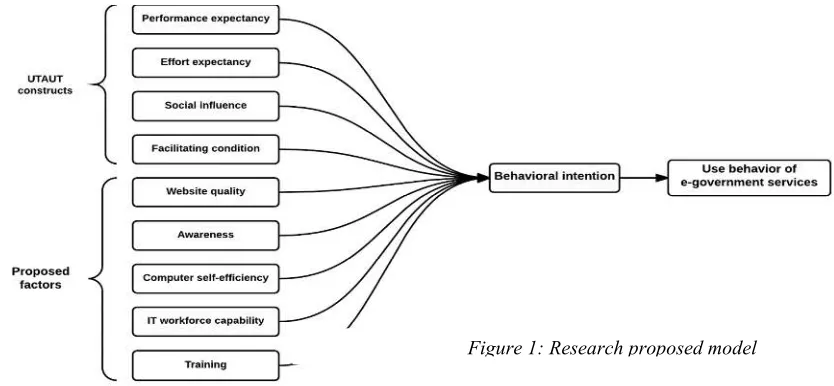
[image:6.612.102.519.543.736.2]In a related study, [58] contended that successful innovation adoption in organizations call for a skilled workforce, while [59] concentrated on the context of Jordan, and concluded that the capability of the IT workforce is significant for successful adoption of e-government service. The model employed in the current study is presented in Figure 1.
389 Based on the above discussion, the following relationships are hypothesized;
1.There is a significant and positive relationship between performance expectancy and behavioral intention to use e-government services.
2.There is a significant and positive relationship between effort expectancy and behavioral intention to use e-government services.
3.There is a significant and positive relationship between social influence and behavior intention to use e-government services.
4.There is a significant and positive relationship between facilitating conditions and behavioral intention to use e-government services.
5.There is a significant and positive relationship between website quality and behavioral intention to use e-government services.
6.There is a significant and positive relationship between computer self-efficacy and behavioral intention to use e-government services.
7.There is a significant and positive relationship between awareness and behavioral intention to use e-government services.
8.There is a significant and positive relationship between training and behavioral intention to use e-government services.
9.There is a significant and positive relationship between IT workforce capability and behavioral intention to use e-government services.
10.There is a significant and positive relationship between behavioral intention and use behavior of e-government services.
4. RESEARCHMETHODOLOGY
The objective of the present study is achieved with the help of a quantitative approach using a questionnaire survey. The study scope is limited to the five Iraqi Ministries that were chosen to distribute the questionnaires to. In Iraq, after the e-government is completely implemented, the chosen group will be the primary users and thus, understanding their attitudes and perceptions will assist in enhancing the services provided. The present study is a pilot study research – this type of research differs from being relatively informal that tries out procedures, to efficacy studies and small-scale clinical intervention trials.
For pilot studies, only limited guidelines were provided in terms of sample size by [60, 61]while[61]and [62] did not provide specific recommendations. Other studies in literature like [63] and [64], recommended 10 participants, or like [65] and [66] recommended 10% of the final study sample. The final sampling is decided on the basis of cost and time limitation and the population in terms of its size and variability. In this study, the questionnaire was distributed to 50 employees with the ratio of 10% of the main population of the study. The study questionnaire was succinct, devoid of ambiguity, and respondents could easily understand and complete it. The questionnaire items were measured on a five-point scale, ranging from 1 (strongly disagree), to 5 (strongly agree), with the middle being 3 (neutral). Moreover, the relevant constructs and items were adopted from [38] and tweaked to suit the context of the research. Furthermore, new statements linked with the constructs were included for heightened clarity. Other construct statements were obtained from prior studies were also integrated to the questionnaire.
More specifically, the study’s research model comprises nine independent variables namely performance expectancy (PE), effort expectancy (EE), social influence (SI), facilitating conditions (FC), website quality (WQ), awareness (AW), computer self-efficacy (CSE), training (TR) and IT workforce capability (ITW), with the behavioral intention (BI) as the mediating variable, and the behavioral use of e-government services as the independent variable. The study questionnaire was initially drawn up and developed in English language, but since the study was carried out in Iraq, where the mother tongue is Arabic, it was translated into Arabic language, the country’s mother tongue. The questionnaires were distributed between January and February 2016. From 50 questionnaires, 42 were obtained, indicating a rate of response of 84%.
5. RESULT
390 Moreover, the structural model was examined for model fit as suggested by [67].
Also, according to [68], the data reliability values have to be checked in terms of their outer loadings as they have to be over 0.70 with composite reliability of 0.70 or more. They added that the convergent validity (AVE) values have to be 0.50 or higher. In the present study, the SEM software PLS-SEM 2.1 was employed for the estimation of the structural model. The values of the standardized loadings, average variance extracted (AVE), and composite reliability are presented in Table1, where all the values have significant loadings that are greater than the recommended cut-off values.
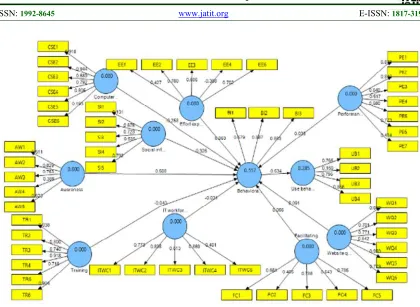
The structural model presents the relationships between constructs and it indicates the relationship of a construct to another. Table 1 indicates that the fit indices are within acceptable levels. In Figure 2, the research model is presented prior to the application of the above discussed and on the basis of the criteria 24 items were dropped from the subsequent analysis (i.e., PE3, PE4, PE5, PE7, EE1, EE2, EE4, CSE6; SI1, SI4, AW4, AW5, TR1, TR5, ITWC3, ITWC5, FC2, WQ1, WQ2, WQ3, BI1, UB2)
Table1: Results Of Convergent Validity And Reliability Analysis
Factors Items Item loading AVE Composite
Reliability
R-Square
Awareness
AW1 0.817
0.698 0.873 AW2 0.912
AW3 0.771
Behavioral intention BI2 0.962 0.930 0.964 0.507
BI3 0.966
Computer self-efficiency
CSE1 0.914
0.711 0.924 CSE2 0.934
CSE3 0.718 CSE4 0.820 CSE5 0.811
Effort expectancy EE3 0.963 0.713 0.829
EE5 0.706
Facilitating condition
FC1 0.829
0.645 0.845 FC3 0.812
FC5 0.767
IT workforce capability
ITWC1 0.816
0.741 0.896 ITWC2 0.909
ITWC4 0.855
Performance expectancy
PE1 0.938
0.712 0.881 PE2 0.774
PE6 0.812
Social influence SI3 0.860 0.614 0.759
SI5 0.700
Training
TR2 0.821
0.714 0.908 TR3 0.736
TR4 0.918 TR6 0.894
Use behavior of e-government services
UB1 0.714
0.654 0.849 0.205 UB3 0.828
UB4 0.875
Website quality
WQ4 0.966
0.775 0.911 WQ5 0.892
391
Figure 2: Proposed model with all items
After deletion of items that loaded less than 0.7, the final model is presented by Figure 3.
[image:9.612.98.514.438.701.2]392
6. DISCUSSION&CONCLUSION
This study examines the success factors impacting the intention of employees to adopt e-government services with the help of an extended theory of Unified Theory of Acceptance and Use of Technology (UTAUT). The selected additional factors to the theory were obtained from a thorough review of literature. According to the results, the proposed model is a valid one to use in understanding the intentions of employees towards e-government service adoption in the context of developing nations. It is clear that factors may be potential determinants of intention.
With regards to the contributions of the study, this study contributes to theory and practice. Theoretically, the study found contributes the finding that employees have tendency to adopt e-government services if they are convinced that it will contribute to the level of job performance, it is characterized by ease of use, and important others are convinced of their adoption. Additionally, available facilitating conditions like suitable hardware, software, infrastructure and support positively affect e-government services adoption among employees. In regards to the findings, government entities are advised to facilitate positive staff attitude before e-government services implementation. This should be aligned with a well-developed website, with simple features and the provision of professional training program to increase the employees’ technological knowledge and to make them aware of the benefits of e-government service adoption. Along with the above, a professional technical team support has to be formed to increase the chances of e-government service adoption among employees. The proposed factors are evidenced in this study to be ready for testing in an actual study with enhanced items.
The understanding of the adoption factors by the policy makers would assist them in developing strategies catering to the promotion of citizens’ intention towards e-government service adoption to obtain information or to carry out transactions with the government portal and website[69]. The government has to introduce policies and strategies that stress on the essential factors of e-government services adoption, which are; its usefulness, efficiency, awareness, infrastructure, assistance, quality and training. Moreover, the government should also add to the promotional campaigns concerning the significance of the Internet and
e-government service use among employees in their daily work.
Added to the above, the government is suggested to achieve operational excellence in its services with high quality. To do this, it should define policies to promote confidence in services and to contribute to higher rate of e-government services adoption. To this end, the successful dissemination of e-government services use is only possible if the government understand the needs of its employees.
Practically, the utilized extended UTAUT model is suitable to explore factors that affect employees’ intention to adopt e-government services. The findings obtained are expected to help researchers and practitioners as well as decision makers in the government. This would facilitate the implementation of policies and strategies to increase the e-government service adoption in Iraq and other developing countries, particularly those that share the same characteristics with Iraq. The model is suitable to be used with other e-government service adoption researches in the context of other countries, particularly developing ones.
The research outcome is consistent with the research’s expectations concerning the proposed research model and the chosen factors were successfully supported by the respondents, the proposed model's entire incorporated selected factors influenced behavioral intention to adopt e-government services in the context of Iraqi G2E sector, representing a Middle Eastern developing country, and it providing the green light to proceed with the main research.
The present study is successful in its validation of UTAUT model in a context that differs from its original context, and by extending the proposed factors. Several studies of the same focus employed the original model or the theory constructs. In regards to this, this study is the first one to examine the perspective of Iraqi government employees with the major aim of shedding light into the phenomenon using an extended UTAUT. Therefore, the proposed model has been validated on the first stage. In the next stage, the proposed model is confirmed by the main survey.
393 small to explain the intention of the employees to adopt the e-government system. But as mentioned, the size of the sample obtained is 10% of the actual sample targeted for the distribution of questionnaire.
The second limitation concerns the government employees comprising the sample, who came from a single ministry namely the Ministry of Higher Education and Scientific Research. To address this limitation, samples from other ministries may be obtained to shed insight into e-government adoption.
Moreover, the additional factors included in the UTAUT model may not encompass all the factors that have the potential to influence the e-government services adoption and hence, future studies may search for other factors that has the potential to do so. The study may also be extended to include other e-government sectors such as government to business (G2B) and government to government (G2G) sectors.
As for moderators, they have been overlooked for a long time – specifically, as a part of the research objective. In this, future studies could test the moderating role of some factors in their research models.
The employed instrument is newly developed in Arabic language that may have affected the results. The study results thus call for more validation of the instrument and to determine the new potential statements of e-government services and adoption that can be adopted
Moreover, future studies may also evaluate the attitudes and behaviour of Iraqi employees towards their adoption of e-government services aside from examining their demographic characteristics. Moreover, future studies could conduct in-depth investigations of the factors that prevent active interaction in Iraq by using focus group. To resolve the potential results bias, future studies should also consider non e-government users and conduct a comparison between their adoption of e-government services and that of their user counterparts.
On a final note, the present study concentrated on acquiring a broader e-government service perception as opposed to a distinct service and this
may be addressed by future studies by delving into a particular service.
7. ACKNOWLEDGEMENTS
The work presented in this paper is supported by the University of Mosul through the scholarship plan of 2013-2014. We would also like to thank the participants for the valuable comments, which enhanced the questionnaire.
REFERENCES
[1] M. M. Kamal, M. Themistocleous, and V. Morabito, "Justifying the decisions for EAI adoption in LGAs: a validated proposition of factors, adoption lifecycle phases, mapping and prioritisation of factors," in System Sciences, 2009. HICSS'09. 42nd Hawaii
International Conference on, 2009, pp. 1-10.
[2] T. Elliman, O. D. Sarikas, and V. Weerakkody, "Realising integrated e-government services: a UK local e-government perspective," Transforming Government:
People, Process and Policy, vol. 1, pp.
153-173, 2007.
[3] E. UN, "government Survey (2012) E-Government for the people," Department Economic and Social Affairs, United
Nations, New York, 2012.
[4] R. Gauld, S. Goldfinch, and S. Horsburgh, "Do they want it? Do they use it? The ‘Demand-Side’of e-Government in Australia and New Zealand," Government Information
Quarterly, vol. 27, pp. 177-186, 2010.
[5] Z. Irani, T. Elliman, and P. Jackson, "Electronic transformation of government in the UK: a research agenda," European
Journal of Information Systems, vol. 16, pp.
327-335, 2007.
[6] K. Laudon and J. Laudon, Management Information Systems: International Edition, 11/E: Pearson Higher Education, 2009. [7] R. C. Joseph, "A structured analysis of
e-government studies: Trends and opportunities," Government Information
Quarterly, vol. 30, pp. 435-440, 2013.
[8] H. Tang, P. Zhang, S. Song, and H. Yan, "Using association rules mining to provide personalized information in e-government,"
in E-Business and E-Government (ICEE),
2011 International Conference on, 2011, pp.
394 [9] M. Alshehri, S. Drew, T. Alhussain, and R.
Alghamdi, "The Effects of Website Quality on Adoption of E-Government Service: AnEmpirical Study Applying UTAUT Model Using SEM," arXiv preprint
arXiv:1211.2410, 2012.
[10] M. Rehman, V. Esichaikul, and M. Kamal, "Factors influencing e-government adoption in Pakistan," Transforming Government:
People, Process and Policy, vol. 6, pp.
258-282, 2012.
[11] B. Gupta, S. Dasgupta, and A. Gupta, "Adoption of ICT in a government organization in a developing country: An empirical study," The Journal of Strategic
Information Systems, vol. 17, pp. 140-154,
2008.
[12] Y. Dwivedi and Z. Irani, "Understanding the adopters and non-adopters of broadband,"
Communications of the ACM, vol. 52, pp.
122-125, 2009.
[13] S. AlAwadhi and A. Morris, "Factors influencing the adoption of e-government services," Journal of Software, vol. 4, pp. 584-590, 2009.
[14] L. Carter and V. Weerakkody, "E-government adoption: A cultural comparison," Information Systems Frontiers,
vol. 10, pp. 473-482, 2008.
[15] Y. Chen, H. Chen, W. Huang, and R. K. Ching, "E-government strategies in developed and developing countries: An implementation framework and case study,"
Journal of Global Information Management
(JGIM), vol. 14, pp. 23-46, 2006.
[16] U. N. D. o. Economic, United Nations government Survey 2010: Leveraging E-government at a Time of Financial and
Economic Crisis vol. 2: United Nations
Publications, 2010.
[17] L. F. Luna-Reyes and J. R. Gil-García, "Using institutional theory and dynamic simulation to understand complex e-Government phenomena," Government
Information Quarterly, vol. 28, pp. 329-345,
2011.
[18] H. Al-Rashidi, "Examining internal challenges to e-government implementation from system users perspective," in European
and Mediterranean Conference on
Information Systems, 2010, pp. 12-13.
[19] M. O. Ahmad, J. Markkula, and M. Oivo, "Factors influencing the adoption of e-government services in Pakistan," in
Proceedings of the 9th European,
Mediterranean & Middle Eastern
Conference on Information Systems, 2012.
[20] M. Al-Busaidy and V. Weerakkody, "E-government diffusion in Oman: a public sector employees' perspective,"
Transforming Government: People, Process
and Policy, vol. 3, pp. 375-393, 2009.
[21] O. Alhujran and A. Chatfield, "Toward a model for e-government services adoption: the case of Jordan," in Proceedings of the 8th
European Conference on e-Government,
2008, pp. 13-22.
[22] F. Harby, R. Qahwaji, and M. Kamala, "End-Users’ Acceptance of Biometrics Authentication to Secure E-Commerce within the Context of Saudi Culture: Applying the UTAUT Model,"
Globalization, Technology Diffusion and Gender Disparity: Social Impacts of ICTs,
pp. 225-246, 2012.
[23] V. Venkatesh, T. A. Sykes, and X. Zhang, "'Just what the doctor ordered': a revised UTAUT for EMR system adoption and use by doctors," in System Sciences (HICSS), 2011 44th Hawaii International Conference on, 2011, pp. 1-10.
[24] L. C. Schaupp, L. Carter, and M. E. McBride, "E-file adoption: A study of US taxpayers’ intentions," Computers in Human
Behavior, vol. 26, pp. 636-644, 2010.
[25] V. Kumar, B. Mukerji, I. Butt, and A. Persaud, "Factors for successful e-government adoption: a conceptual framework," The electronic journal of
e-Government, vol. 5, pp. 63-76, 2007.
[26] R. Heeks, "E-government for development, institute for development policy and management," University of Manchester, UK, 2008.
[27] F. Bélanger and L. Carter, "Trust and risk in e-government adoption," The Journal of
Strategic Information Systems, vol. 17, pp.
165-176, 2008.
[28] S. AlAwadhi and A. Morris, "The Use of the UTAUT Model in the Adoption of E-government Services in Kuwait," in Hawaii
International Conference on System
Sciences, Proceedings of the 41st Annual,
2008, pp. 219-219.
[29] M. A. Shareef, V. Kumar, U. Kumar, and Y. K. Dwivedi, "e-Government Adoption Model (GAM): Differing service maturity levels," Government Information Quarterly,
395 [30] M. Al-Zoubi, T. L. Sam, and L. H. Eam,
"E-government adoption among businesses in Jordan," Academic Research International,
vol. 1, pp. 141-156, 2011.
[31] M. Sambasivan, G. P. Wemyss, and R. C. Rose, "User acceptance of a G2B system: A case of electronic procurement system in Malaysia," Internet Research, vol. 20, pp. 169-187, 2010.
[32] F. T. Qutaishat, "Users’ Perceptions towards Website Quality and Its Effect on Intention to Use E-government Services in Jordan,"
International Business Research, vol. 6, p.
p97, 2012.
[33] M. AlNuaimi, K. Shaalan, M. Alnuaimi, and K. Alnuaimi, "Barriers to electronic government citizens' adoption: A case of municipal sector in the emirate of abu dhabi," in Developments in E-systems
Engineering (DeSE), 2011, 2011, pp.
398-403.
[34] X. Dong, L. Xiong, and W. Wang, "How adoption is G2C model e-government?— Evidence from Xi'an and Nan Jing," in E-Business and E-Government (ICEE), 2011
International Conference on, 2011, pp. 1-4.
[35] P. M. A. Baker and C. Bellordre, "Adoption of information and communication technologies: key policy issues, barriers and opportunities for people with disabilities," in
System Sciences, 2004. Proceedings of the
37th Annual Hawaii International
Conference on, 2004, p. 10 pp.
[36] M. Al-Busaidy, V. Weerakkody, and Y. K. Dwivedi, "Factors Influencing eGovernment Progress in Oman: An Employee's Perspective," AMCIS 2009 Proceedings, p. 262, 2009.
[37] M. Talukder, "Factors affecting the adoption of technological innovation by individual employees: An Australian study,"
Procedia-Social and Behavioral Sciences, vol. 40, pp.
52-57, 2012.
[38] V. Venkatesh, M. G. Morris, G. B. Davis, and F. D. Davis, "User acceptance of information technology: Toward a unified view," MIS quarterly, pp. 425-478, 2003. [39] V. Venkatesh, F. K. Chan, and J. Y. Thong,
"Designing e-government services: Key service attributes and citizens’ preference structures," Journal of Operations
Management, vol. 30, pp. 116-133, 2012.
[40] S.-Y. Hung, C.-M. Chang, and T.-J. Yu, "Determinants of user acceptance of the e-Government services: The case of online tax
filing and payment system," Government
Information Quarterly, vol. 23, pp. 97-122,
2006.
[41] Y. Y. Mun, J. D. Jackson, J. S. Park, and J. C. Probst, "Understanding information technology acceptance by individual professionals: Toward an integrative view,"
Information & Management, vol. 43, pp.
350-363, 2006.
[42] K. Y. Chan, M. Gong, Y. Xu, and J. Thong, "Examining user acceptance of SMS: An empirical study in China and Hong Kong,"
PACIS 2008 Proceedings, p. 294, 2008.
[43] D. J. Neufeld, L. Dong, and C. Higgins, "Charismatic leadership and user acceptance of information technology," European
Journal of Information Systems, vol. 16, pp.
494-510, 2007.
[44] M. Rogers Everett, "Diffusion of innovations," New York, p. 12, 1995.
[45] P. A. Pavlou and M. Fygenson, "Understanding and predicting electronic commerce adoption: An extension of the theory of planned behavior," MIS quarterly,
pp. 115-143, 2006.
[46] P. Y. Chau and P. J.-H. Hu, "Investigating healthcare professionals’ decisions to accept telemedicine technology: an empirical test of competing theories," Information &
management, vol. 39, pp. 297-311, 2002.
[47] A. Candiello, A. Albarelli, and A. Cortesi, "Quality and impact monitoring for local eGovernment services," Transforming Government: People, Process and Policy,
vol. 6, pp. 112-125, 2012.
[48] J. Millard, "Are you being served?: Transforming e-government through service personalisation," International Journal of Electronic Government Research (IJEGR),
vol. 7, pp. 1-18, 2011.
[49] A. Y. Chua, D. H. Goh, and R. P. Ang, "Web 2.0 applications in government web sites: prevalence, use and correlations with perceived web site quality," Online
Information Review, vol. 36, pp. 175-195,
2012.
[50] T. Perea y Monsuwé, B. G. Dellaert, and K. De Ruyter, "What drives consumers to shop online? A literature review," International
journal of service industry management, vol.
15, pp. 102-121, 2004.
396 assessment," Information systems research,
vol. 11, pp. 418-430, 2000.
[52] T. Lam, V. Cho, and H. Qu, "A study of hotel employee behavioral intentions towards adoption of information technology," International Journal of
Hospitality Management, vol. 26, pp. 49-65,
2007.
[53] Y.-S. Wang, "The adoption of electronic tax filing systems: an empirical study,"
Government Information Quarterly, vol. 20,
pp. 333-352, 2003.
[54] P.-Y. Chu, N. Hsiao, F.-W. Lee, and C.-W. Chen, "Exploring success factors for Taiwan's government electronic tendering system: behavioral perspectives from end users," Government Information Quarterly,
vol. 21, pp. 219-234, 2004.
[55] S. Mofleh and M. Wanous, "Understanding factors influencing citizens adoption of e-government services in the developing world: Jordan as a case study," Journal of
computer Science, vol. 7, pp. 1-11, 2008.
[56] V. Weerakkody, R. El-Haddadeh, T. Sabol, A. Ghoneim, and P. Dzupka, "E-government implementation strategies in developed and transition economies: A comparative study,"
International Journal of Information
Management, vol. 32, pp. 66-74, 2012.
[57] H. M. Abdelsalam, C. G. Reddick, and H. A. El Kadi, "Success and failure of local e-government projects: lessons learned from Egypt," Dig Democr: Conc, Method, Tools,
Appl, vol. 3, p. 183, 2012.
[58] I. Troshani, C. Jerram, and S. R. Hill, "Exploring the public sector adoption of HRIS," Industrial Management & Data
Systems, vol. 111, pp. 470-488, 2011.
[59] T. Almarabeh and A. AbuAli, "A general framework for e-government: definition maturity challenges, opportunities, and success," European Journal of Scientific
Research, vol. 39, pp. 29-42, 2010.
[60] P. A. Prescott and K. L. Soeken, "The potential uses of pilot work," Nursing
Research, vol. 38, p. 60, 1989.
[61] S. Grove and N. Burns, "The practice of nursing research: Conduct, critique, & utilization," ed: St. Louis, Missouri: Elsevier Saunders, 2005.
[62] D. F. Polit and C. T. Beck, Nursing
research: Principles and methods:
Lippincott Williams & Wilkins, 2004. [63] R. M. Nieswiadomy, Foundations in nursing
research: Pearson Higher Ed, 2011.
[64] R. Hill, "What sample size is “enough” in internet survey research," Interpersonal Computing and Technology: An electronic
journal for the 21st century, vol. 6, pp. 1-12,
1998.
[65] N. R. Lackey and A. L. Wingate, "The pilot study: One key to research success,"
Advanced design in nursing research, pp.
375-384, 1998.
[66] L. M. Connelly, "Pilot studies," Medsurg
Nursing, vol. 17, pp. 411-413, 2008.
[67] J. C. Anderson and D. W. Gerbing, "Structural equation modeling in practice: A review and recommended two-step approach," Psychological bulletin, vol. 103, p. 411, 1988.
[68] K. K.-K. Wong, "Partial least squares structural equation modeling (PLS-SEM) techniques using SmartPLS," Marketing
Bulletin, vol. 24, pp. 1-32, 2013.
[69] O. K. Lean, S. Zailani, T. Ramayah, and Y. Fernando, "Factors influencing intention to use e-government services among citizens in Malaysia," International Journal of
Information Management, vol. 29, pp.