RISK MANAGEMENT OF FALLS FROM HEIGHT BY USING THE BIM PLATFORM: A
SYSTEMATIC REVIEW
1
Breno Burgos da Rocha Leão,
2Bianca M. Vasconcelos,
2Béda Barkokébas Jr,
3Béda Barkokébas and
2Tomi Zlatar
1
University of Pernambuco, Brazil
2
Ph.D., University of Pernambuco, Brazil
3
M.Sc., University of Alberta, Canada
ARTICLE INFO ABSTRACT
Falls are responsible for around 0.646 million deaths per year, representing more than 30% of worker fatalities in the construction industry. Current risk management methods proved not to be effective enough. The objective of this work was to investigate the applicability of the Building Information Modeling (BIM) as a tool for managing risk of falls from height, and investigate the Brazilian and USA standards in order to identify future perspectives for improving algorithms used in such tools. Two separate reviews were conducted by using the PRISMA method. The first review was conducted by searching the Brazilian platform CAPES, databases Scopus and Google Scholar, while the second through searching the Brazilian and USA legislation related to falls from height. The BIM tool its perspective, although currently still very limited. The included studies applied only risk elimination and some engineering and administrative measures, which means that there is still space for improvement. Only few parameters required by the standards were considered by the included studies. Future studies should improve the algorithms for an automatic identification and management of falls from height, leaving the code opened, so that the users from different countries and legislation might appropriate it to their needs.
Copyright © 2019, Breno Burgos da Rocha Leão et al. This is an open access article distributed under the Creative Commons Attribution License, which permits
unrestricted use, distribution, and reproduction in any medium, provided the original work is properly cited.
INTRODUCTION
Occupational accidents and work related diseases are responsible for more than 2.78 million deaths and around 374 million non-fatal work related injuries and illnesses each year. The costs of these accidents are estimated at 3.84% of the global Gross Domestic Product each year (International Labour Organization (ILO), 2019). Falls represent the second leading cause of injury deaths worldwide, right after road traffic injuries, with an estimation of 646.000 fatal falls and around 37.3 million non-fatal falls each year (World Health Organization (WHO), 2017). While falls are present in all industries, the construction industry is responsible for around 38.8% of USA worker fatalities (OSHA, 2017). Several studies have analyzed falls from height in the construction industry, where it was concluded that the principal fall locations were scaffolds, holes in floors, structures, roofs and stairs. The occupations with mayor incidence-rate were found to be masons, carpenters, roofers, while site managers and painters were also affected.
Through the age distribution, it was found that the accident-rate was highest among workers aged from 35 to 54 years old, while those from 25 to 34 and from 55 to 64 were also significantly affected by falls from height. Interestingly, the accident-rate was correlated to the company dimension, where the companies with less than 10 workers had a highest rate, and in workers with less than one year of experience (Chan et al., 2008; Chi et al., 2005; Dong et al., 2009, 2013; Dong et al, 2014; Lin et al., 2011; Zlatar & Barkokébas Junior, 2018). However, when the risk management process is applied, the risk can be timely identified, analyzed and accordingly controlled. In order to control the risks, the hierarchy of controls should be applied, following its sequency, but when one measure is not feasible to apply it, go to the next measure in the hierarchy, and when needed, apply several of the control measures simultaneously: (1) Elimination (to physically remove the hazard); (2) Substitution (to replace the hazard); (3) Engineering Controls (to isolate people from the hazard); (4) Administrative Controls (to change the way people work);
ISSN: 2230-9926
International Journal of Development Research
Vol. 09, Issue, 11, pp. 31267-31273, November, 2019
Article History: Received xxxxxx, 2019 Received in revised form xxxxxxxx, 2019
Accepted xxxxxxxxx, 2019 Published online xxxxx, 2019 Article History:
Received 09th August, 2019
Received in revised form 06th September, 2019
Accepted 08th October, 2019
Published online 20th November, 2019
Key Words:
Building Information Modeling; Safety at work; Civil construction; Risk of falls; Work at height; Prevention through design.
RESEARCH ARTICLE
OPEN ACCESS
(5) Personal Protective Equipment – PPE (to protect the worker). Although falls from height have proved to be a significant loss for the employers and employees, being responsible for various direct and indirect costs, current traditional methods for prevention and controls were found not to be enough effective in minimizing the number of accidents. Therefore, there is a need to explore new technological solutions which might optimize the risk management. Today’s technological solutions are applicable to different phases of the working process, from the phase of prevention through design by applying the BIM - Building Information Modelling (K. Kim, Cho, & Zhang, 2016), to automatic verification of Personal Protective Equipment (PPE) which the worker is or should be wearing (Kelm et al., 2013). BIM is a tool for digitally construct an accurate virtual model of the building, containing precise geometry and data relevant and necessary for the design, acquisition, fabrication and its construction (Azhar, 2011). The virtual process includes all aspects, disciplines and systems of the installation within a single virtual model, allowing all members and designers to collaborate more accurately and efficiently than using traditional methods. Therefore it could be a technological solutions providing an effective risk management process. The objective of this work was to investigate the applicability of the Building Information Modelling (BIM) in managing the risk of falls from height in civil construction through analyzing existing studies on the topic. Further on, Brazilian and USA standards were analyzed in order to identify future persepectives in improving algorithms for managing risk of falls from height.
MATERIAL AND METHODS
In order to achieve the objectives of this work, it was decided to conduct two separate reviews: the first review analyzing studies related to the topic; and the second review analyzing Brazilian and USA legislation dealing with falls from height. The method used during the reviewing process was PRISMA - Reporting Items for Systematic Reviews and Meta-Analyses: The PRISMA Statement (Liberati et al., 2009).
Reviewing studies related to the topic: In order to get a greater number of studies to include in this review, the search was conducted in three phases. The Brazilian searching platform “CAPES” was screened by using the keywords: BIM; civil construction; health; construction; risk management; prevention; safety; evacuation; emergency. The Scopus database was screened by using the keywords: BIM; construction; fall; fall protection. The Google Scholar was screened using the keywords: BIM; building information modeling; construction safety.
Selection criteria´s: The studies were excluded if published
more than 10 years ago (before 2008), if not published in Portuguese or English language, excluded if duplicates or if didn’t have any relation with the civil construction. The studies were included if utilized the BIM platform and if dealing with falls from height or working on heights.
Data analysis: In order to establish parameters and guidelines
which can identify risks related to work and falls from height, it was analyzed how each one of the included studies used the BIM platform computational tools and the compatibilization of
programs. After this identification, each study was analyzed individually, in order to clarify and discuss each approach and its relevance to the current study. The type of construction was analyzed, dividing them into vertical, horizontal and other types of construction, and the country where the study was applied. Further, it was analyzed how the risk was identified, dividing it into automatic recognition, manual, or semi-automatic. The parameters used for identification of the risk and software were also analyzed and included. Finally, the risk management solutions and procedures proposed by studies were analyzed and divided into four main groups: measures for risk-elimination; engineering measures; administrative; and the PPE measures.
Reviewing Brazilian and USA legislation dealing with falls from heights: The review sought to compare the main characteristics, differences and similarities between the legislation of the two analyzed countries. The USA legislation was analyzed through the Occupational Safety and Health Administration standards (osha.gov), which are also accepted world-wide. The Brazilian legislation was observed through the Federal Constitution of 1988 - CF/88 (planalto.gov.br), which provides legal protection of safety and health for workers (according to the articles 6 and 7 in Sections XXII, XXIII, XXVIII and XXXII,); the Consolidation of Labor Laws – CLT (planalto.gov.br); the Ministry of Labor and Employment – MTE (trabalho.gov.br); the Regulatory Norms – NR (trabalho.gov.br); the Brazilian Association of Technical Standards – ABNT (abnt.org.br); and the Brazilian Standards – NBR (nbr.gov.br).
Selection criteria´s: The standards were excluded if already
revoked. The standards were included if mandatory for working at height or when people are exposed to risk of falls from height.
Data analysis: In the included standards, following variables
were analyzed: the height necessary for defining a work as “working at height” (analyzing it in general and on scaffolds); deck width; distance between two stages; smallest dimension of the horizontal plane of the scaffold; the scaffold distance from the working facade; maximum scaffold height suspended by ratchet; the platform length; and the smallest dimension of the horizontal plane of the scaffold.
RESULTS
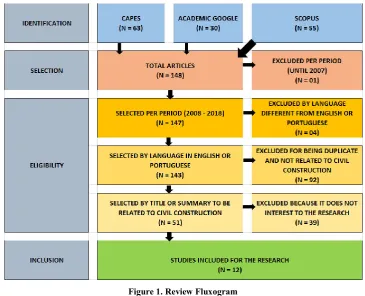
2012; Zhang, Teizer, Lee, Eastman, & Venugopal, 2013; Zhang et al., 2015). The applied selection process was illustrated in the following Figure 1. In an attempt to innovate the prevention and control of accidents, the included 12 studies seek better solutions by using the BIM tool. The methodologies were based on the collection of spatial information from construction projects, and the safety legislation of countries in which the work was carried-out, and the manual input of data into computer programs.
Through using BIM, the studies sought to investigate a method for manual or automatic risk identification, for example, by analyzing openings in slabs, walls, elevators and stairs, open peripheries, and the systems of fixation of different types of scaffolds. After the risks were identified and possible solutions were suggested. As it could be noticed from the table 1, the studies dealing with falls from height by using the BIM tool, were carried-out in North America, Europe and Asia, without any study conducted in Brazil. Several types of constructions were analyzed, including vertical constructions (buildings) and horizontal constructions (such as excavations, works of art and bridges). Five studies considered the USA legislation (K. Kim et al., 2016; Qi et al., 2014; Wang et al., 2015; Zhang, S., Lee, J.-K., Venugopal, M., Teizer, J., Eastman, 2012; Zhang et al.,
2013), two studies considered Canadian (Hammad et al., 2012; Setayeshgar, 2014), one Finish legislation (Zhang et al., 2015), one considered both the USA and Germany legislation (Melzner et al., 2013), one Portuguese (Pinto, 2017), Taiwanese (Liu et al., 2017) and South Korean (H. J. Kim & Park, 2012). The following table 2 illustrates how the risk was identified, the parameters for identifying the risk, and the tools and software utilized for the analysis. Although there is a manual way (traditional) to identify risks, most of the included
[image:3.595.114.480.163.459.2]studies (10/12), applied the automatic identification, through a developed algorithm (Hammad et al., 2012; H. J. Kim & Park, 2012; K. Kim et al., 2016; Melzner et al., 2013; Pinto, 2017; Qi et al., 2014; Setayeshgar, 2014; Zhang, S., Lee, J.-K., Venugopal, M., Teizer, J., Eastman, 2012; Zhang et al., 2015, 2013). Only one study applied the manual (Liu et al., 2017) and one semi-automatic (Wang et al., 2015) identification. For developing the algorithms it is necessary to study parameters given by the legislation and standards, which might vary depending on the country. Some examples of parameters to consider in developing algorithms managing falls from height through a BIM tool are: the smallest dimension to consider something as a hole; the smallest dimension to consider
Figure 1. Review Fluxogram
Table 1. The country where the study was applied, the risk of falls and type of construction analyzed
Nº Reference Country Risk of falls analyzed Type of construction analyzed
Vertical Horizontal Other 1 Zhang et al., 2015 Finland Through the window or slab oppening ✓
2 Kim et al., 2016 USA From scaffolds ✓
3 Zhang et al., 2013 USA Through the window or slab oppening ✓
4 Setayeshgar, S., 2014 Canada By colission ✓ ✓
5 Pinto, D., 2017 Portugal Through the window or slab oppening, from scaffolds and platforms ✓
6 Hammad et al., 2012 Canada By colission ✓ ✓
7 Melzner et al., 2013 Germany, USA Through the slab oppening ✓
8 Liu et al., 2017 Taiwan From scaffolds by analyzing the layout ✓
9 Kim et al., 2012 South korea Fall and tracking alert system, through the smartphone ✓
10 Zhang et al., 2012 USA Through the window or slab oppening ✓
11 Wang et al., 2015 USA Sliding of earth during excavation ✓
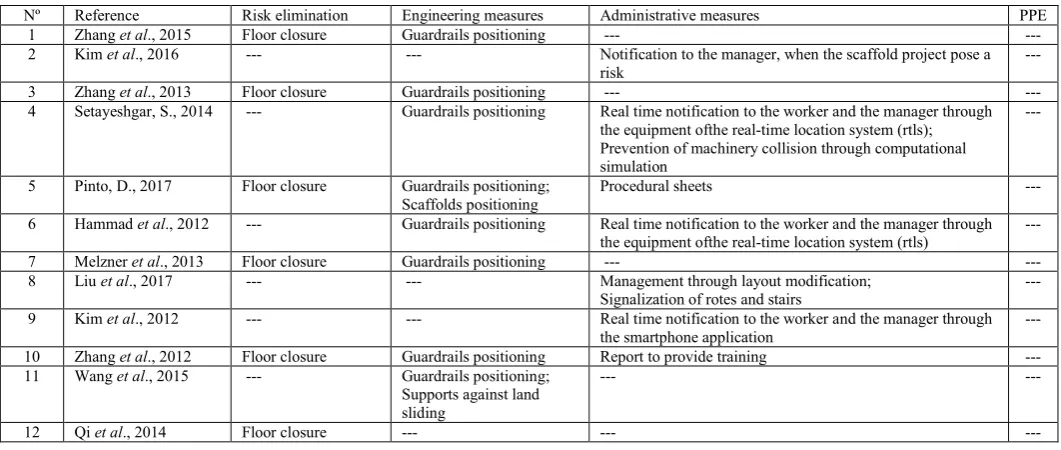
[image:3.595.38.560.479.637.2]something as an opening; the smallest vertical height to be considered as working at heights; the height on which the guardrail should be installed, and other guardrail dimensions. Some of the parameters are very specific to the object of study, such as the slope inclination and the trench depth. The parameters used in analyzed studies were included in table 2, showing also the software used in developing each of the studies. The following Table 3 represents the risk management solutions and procedures which were applied in the analyzed studies. It is observed that the risk-elimination measures were applied in five studies, achieving-it by closing the openings in the floor (Melzner et al., 2013; Pinto, 2017; Zhang, S., Lee, J.-
[image:4.595.35.566.432.657.2]K., Venugopal, M., Teizer, J., Eastman, 2012; Zhang et al., 2015, 2013) and at the same time applying an engineering measure (guardrails and scaffold positioning), and one which only applied the risk-elimination measure (Qi et al., 2014). The engineering measures were applied in 8 studies (Hammad et al., 2012; Melzner et al., 2013; Pinto, 2017; Setayeshgar, 2014; Wang et al., 2015; Zhang, S., Lee, J.-K., Venugopal, M., Teizer, J., Eastman, 2012; Zhang et al., 2015, 2013), all of them, by positioning guardrails. In addition, one study (Pinto, 2017) managed to control the risks by positioning the scaffolds, and one with supports against land sliding (Wang et al., 2015). The administrative measures were applied in 7 studies, from which four offered notifications to the interested
Table 2. Type of risk identification, Identified parameters, Tools and software utilized
Nº Reference Type of risk
identification Identified parameters
* Tool/software
1 Zhang et al., 2015 Automatic OD > ?; HS> ?; H > ?; W > ? Tekla structures 2 Kim et al., 2016 Automatic H > ? Revit, ms project
3 Zhang et al., 2013 Automatic
OD> 1.5m (quardrail); 5.1cm<HS< 1.5m (cover);
H > 1.8m
Industry foundation class (ifc); business process modeling notation (bpmn); tekla structures
4 Setayeshgar, S., 2014 Automatic H > 3.0m; GH< 1.2m; BH> 0.9m
Revit; navisworks; real-time location system (rtls); ultra-wideband technology; unity and softimage;
5 Pinto, D., 2017 Automatic H > 4.0m Autocad; revit; navisworks; microsoft excel
6 Hammad et al., 2012 Automatic H > 3.0m 1.0m< GH< 1.2m
Revit; navisworks; mep; real-time location system (rtls); dynamic virtual fences (dvf);
7 Melzner et al., 2013 Automatic
USA: OD>1.0m (guardrail) 5.1cm<HS< 1.0m (cover)
H > 1.8m
Germany: OD>3.0m (guardrail)
HS≤ 3m (cover) H > 1.0m
Industry foundation classes (ifc)
8 Liu et al., 2017 Manual --- Revit
9 Kim et al., 2012 Automatic H > ? Revit; visual studio; smartphone optimus vu
10 Zhang et al., 2012 Automatic
OD> 1.5 m (guardrail) 5.1 cm< HS< 1.5 m (cover)
H > 1.8 m
Work breakdown structure (wbs)
11 Wang et al., 2015 Semi-automatic
H > 1.83m TD< 1.52m: vertical cutting;
1.52m< TD< 6.10m: protection system; TD > 6.10m: specialized
consultor
Solo rocha: α = 90° Solo Tipo A: α = 53° Solo Tipo B: α = 45° Solo Tipo C: α = 34°
Ladar (laser); tekla structures
12 Qi et al., 2014 Automatic SO> 0.37 m² (BIM server); SO> 0.37 m² (Solibri)
Ptd baseada em formato ifc; revit; bim server; solibri model checker
* WO= Window opening; SO = Slab Opening; OD = Smallest Opening Dimension; HS = Smallest Hole Size; H = Minimum fall height; α = Slope; TD = Trench depth; GH = Guardrail height; BH = Barricade Height.
Table 3. Risk management solutions and procedures
Nº Reference Risk elimination Engineering measures Administrative measures PPE
1 Zhang et al., 2015 Floor closure Guardrails positioning --- ---
2 Kim et al., 2016 --- --- Notification to the manager, when the scaffold project pose a risk
---
3 Zhang et al., 2013 Floor closure Guardrails positioning --- ---
4 Setayeshgar, S., 2014 --- Guardrails positioning Real time notification to the worker and the manager through the equipment ofthe real-time location system (rtls); Prevention of machinery collision through computational simulation
---
5 Pinto, D., 2017 Floor closure Guardrails positioning; Scaffolds positioning
Procedural sheets ---
6 Hammad et al., 2012 --- Guardrails positioning Real time notification to the worker and the manager through the equipment ofthe real-time location system (rtls)
---
7 Melzner et al., 2013 Floor closure Guardrails positioning --- ---
8 Liu et al., 2017 --- --- Management through layout modification; Signalization of rotes and stairs
---
9 Kim et al., 2012 --- --- Real time notification to the worker and the manager through the smartphone application
---
10 Zhang et al., 2012 Floor closure Guardrails positioning Report to provide training --- 11 Wang et al., 2015 --- Guardrails positioning;
Supports against land sliding
--- ---
[image:4.595.32.566.433.657.2]parties, on imminent risks through the worker positioning systems in relation to the predetermined element (Hammad et al., 2012; H. J. Kim & Park, 2012; K. Kim et al., 2016; Setayeshgar, 2014), two studies offered issuing training reports or procedure sheets according to the risk and activity being carried out (Pinto, 2017; Zhang, S., Lee, J.-K., Venugopal, M., Teizer, J., Eastman, 2012), and one on issuing design and signalization suggestions at the planning level, to avoid or minimize risks of falls from heights (Liu et al., 2017). As can be observed, none of the authors proposed as one of the risk management solutions the use of Personal Protective Equipment (PPE). This management measure would include wearing helmets, shoes and clothing for work, as well as the use of a safety belt attached to a fall protective system.
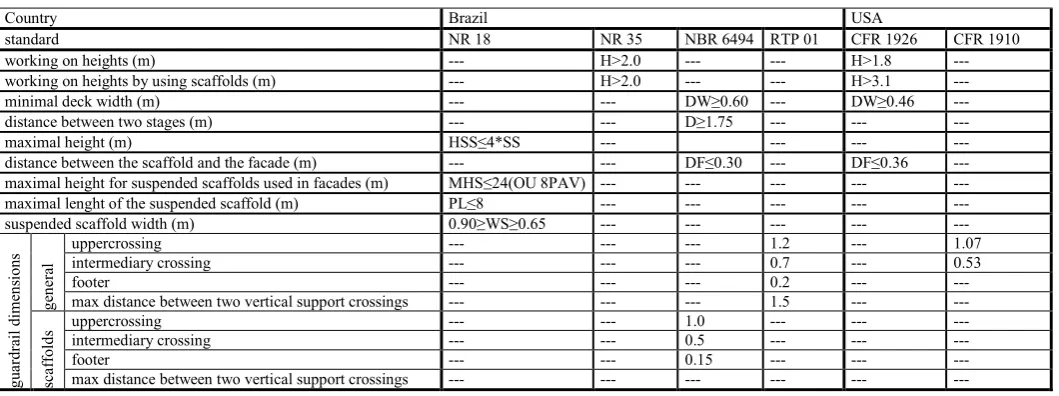
Reviewing USA and Brazilian legislation dealing with falls from heights: The conducted review found that there were 4 standards in Brazil (NR18, NR35, NBR6494 and RTP-01) and two in the USA (CFR1926 and CFR1910) dealing with risk management of falls from height. Particular attention was paid to the risk of falling from scaffolds. In Table 4, it can be observed that the Brazilian standard NR-35 makes no difference in height on whether the fall will be from a scaffold or from any other place. On the other hand, the USA regulation CFR 1926, differ the working activity on scaffolds and other working activities. Some common parameters were found in the analyzed standards, which were illustrated in Table 5. The NBR-6494 defines that the scaffold decking must have a minimum width of 0.60m and the useful height should be at least 1.75m. Further-on, the NR-18 defines that the maximum height of the scaffold as a whole must not exceed 4 times the size of the smallest dimension of the base, if there is no staging for that building. The CFR 1926 defines that the platform of the scaffold must have a width of at least 0.46m. When searching for specific types of scaffolds, it was noted that the NR-18 requires that suspended scaffolds should be positioned at a distance of not more than 0.30m from the working facade, and that the maximum height for suspended scaffolds should be greater than 8 floors or equivalent height (24m). In comparison, the CFR 1926.451 states that the scaffoldsshould be positioned at a distance of not more than 0.36m from the working facade. As illustrated in table 4, suspended scaffolds were only defined by the Brazilian Regulatory norm NR-18, showing that the maximum allowed length of this type of scaffold is 8m, and its useful working width should be at the same time greater than 0.65m and less
than 0.90m. The guardrail is one important parameter to consider when dealing with the risk of falls from heights. The Brazilian standards define the dimensions for the upper and intermediate crossings, for the footer and defining the maximal distance between vertical support crossing. The Brazilian Regulatory norm, RTP-01 (NR-18) defines dimensions for guardrails in general, while the Brazilian Technical norm NBR-6494 defines the dimensions guardrails on scaffolds. In the USA, the standard CFR 1910.29 defines only the dimensions for the upper and intermediate crossings, and the guardrails are unilateral, which means that the same dimensions of guardrails are used for any type of construction.
DISCUSSION
[image:5.595.35.565.67.265.2]As already explained, the risk management measures have its sequence in the implementation priority. First the risk is eliminated, but when this is not possible, the engineering and administrative measures are applied, and if there is still some significant residual risk, the PPE are also applied. Some of the included studies only superficially covered the topic of risks of falls, as their main focus was on the collision of working groups with machinery (Setayeshgar, 2014), or as in one study, the research on excavation dynamics, USA soil safety, accidents and land stability (Wang et al., 2015). One study (K. Kim et al., 2016) carried-out a research related to the risk of falls from temporary scaffolds. The study was based on USA normative research, and simulated the fall of the scaffolding worker, as well as his conflict with other activities. This research can be better applied on structures with large areas and few pavements. It presents the sequence of scaffolding in the same plan/pavement, typical of sheds constructions present in the Brazilian construction sector. One study (Liu et al., 2017) analyzed the layout of scaffolds in a highway project, by applying it manually through Revit and in accordance with the Taiwan standards. The BIM 4D was applied by one study (Pinto, 2017), which carried out a general risk analysis by applying Navisworks, with parameters extracted from Microsoft Excel. Nine studies applied measures of falls from height risk elimination and the implementation of engineering measures (Hammad et al., 2012; Melzner et al., 2013; Pinto, 2017; Qi et al., 2014; Setayeshgar, 2014; Wang et al., 2015; Zhang, S., Lee, J.-K., Venugopal, M., Teizer, J., Eastman, 2012; Zhang et al., 2015, 2013). Some of the mentioned points were considered and required by the Brazilian standards, while being absent from USA standards, and vice versa.
Table 4. Parameters defined by standards used in Brazil and USA
Country Brazil USA
standard NR 18 NR 35 NBR 6494 RTP 01 CFR 1926 CFR 1910
working on heights (m) --- H>2.0 --- --- H>1.8 ---
working on heights by using scaffolds (m) --- H>2.0 --- --- H>3.1 ---
minimal deck width (m) --- --- DW≥0.60 --- DW≥0.46 ---
distance between two stages (m) --- --- D≥1.75 --- --- ---
maximal height (m) HSS≤4*SS --- --- --- ---
distance between the scaffold and the facade (m) --- --- DF≤0.30 --- DF≤0.36 --- maximal height for suspended scaffolds used in facades (m) MHS≤24(OU 8PAV) --- --- --- --- ---
maximal lenght of the suspended scaffold (m) PL≤8 --- --- --- --- ---
suspended scaffold width (m) 0.90≥WS≥0.65 --- --- --- --- ---
g
u
ardra
il d
ime
n
sions
g
en
era
l
uppercrossing --- --- --- 1.2 --- 1.07
intermediary crossing --- --- --- 0.7 --- 0.53
footer --- --- --- 0.2 --- ---
max distance between two vertical support crossings --- --- --- 1.5 --- ---
scaffo
ld
s uppercrossing --- --- 1.0 --- --- ---
intermediary crossing --- --- 0.5 --- --- ---
footer --- --- 0.15 --- --- ---
It could be interesting for future studies to analyze those parameters and to define which should be included in all standards, and the dimensions which would give best results in the prevention of falls from height. The included studies considered only risk elimination and some engineering and administrative measures, which means that there is still space for improvement. A study analyzing a number of cases of falls from height (Zlatar, Lago, Soares, Santos Baptista, & Barkokébas Jr, 2019) found that most commonly failed measures were risk assessment (60.5%) and engineering measures – work platform/scaffold (60.5%), while inadequate PPE or missing PPE was noticed in 56.1% of the cases. That study found that training and certification were missing in 19.3% of the workers. Therefore, future BIM applications should provide solutions but considering all control measures, as selecting some will not solve the problem of falls from height and benefit the community. As probably the standards will not be harmonized that soon, it can be argued that the differences in standards would be even greater if considering more standards from different countries. This could pose some difficulties in offering an unilateral solution for preventing falls from height on a global level. Therefore, future studies which aim to develop tools for automatic identification or management of falls from height should consider leaving the code opened, so that the users might appropriate it to their needs. In addition, the studies which used algorithms to automatically identify risks don’t have an option to also automatically notify the user about those risks. There is still much to be done and developed in order to successfully manage risks of falls from height, which is comprehensive as BIM is a recent tool used in civil construction, and considering the the number of possible variables to be included in a programming language. The risk identification (e.g. openings in slabs, walls, elevators and ladders, open peripheries, floor scaffolds and suspended scaffold fastening systems) in future works should be elaborated based on procedures and standards, through:
- manual method, in order to propose a specification with fall-risks identified in a standard vertical work, following their normative specifications and proposed solutions; - automatic method, in order to propose a method to
automatically generate virtual fences around areas which pose risk of falls, following their normative specifications and proposed solutions;
Further on, there is a need to conduct a study on all risks of falls from height to which workers are exposed during a specific activity, throughout the working day. It is necessary to investigate on which of the engineering, administrative and PPE measures are most and less effective in each of the mentioned groups. Finally, there is a need to develop logical diagram for preventing falls from height and to implement it with all of its measures and not only with elimination and/or engineering measures.
Conclusions
Falls from height present a significant risk in the construction industry, affecting all parties involved during the process of construction and afterward. In order to eliminate or minimize the risk of falls, it is necessary to apply risk management measures, according to the defined hierarchy, starting with the elimination of risk, but when it is not possible to eliminate-it, applying engineering, administrative and PPE measures.
Nevertheless, traditional preventive and control methods were found not to be effective in applying the risk management measures. The Building Information Modeling was found to be a perspective tool in managing risks of falls from height. However, current solutions are still very limited, contributing in the identification of risks from falls, suggesting floor closures as fall-risk elimination and guardrails as engineering measures, but should be improved in order to consider different control measures. Future studies should improve the identification and management algorithms according to the parameters specified in standards dealing with prevention and control of falls from height. The code developers should consider leaving the code opened, so that users from different countries and legislation might appropriate it to their needs.
REFERENCES
Azhar, S. 2011. Building Information Modeling (BIM) Trends, Benefits, Risks, and Challenges for the AEC Industry, 11(Bazjanac 2006), 241–252.
Chan et al. 2008. No Title. Journal of Construction Engineering and Management, 134. https://doi.org/ 10.1061/(ASCE)0733- 9364(2008)134:7(527)
Chi et al. 2005. No Title. Applied Ergonomics, 36. https://doi.org/10.1016/j.apergo.2004.09.011
Dong et al. 2009. No Title. Accident Analysis and Prevention, 41. https://doi.org/10.1016/j.aap.2009.06.012
Dong et al. 2013. National Safety Council and Elsevier Ltd. Journal of Safety Research, 44. https://doi.org/ 10.1016/j.jsr.2012.08.024
Dong et al. 2014. Fatal Falls in the U.S. Residential Construction Industry, 1000. https://doi.org/ 10.1002/ajim.22341
Hammad, A., Setayeshgar, S., Zhang, C., & Asen, Y. 2012. AUTOMATIC GENERATION OF DYNAMIC VIRTUAL FENCES AS PART OF BIM-BASED PREVENTION PROGRAM FOR CONSTRUCTION SAFETY Amin. Proceedings of the 2012 Winter Simulation Conference, 1219–1229.
International Labour Organization (ILO). 2019. World Statistic. Retrieved September 24, 2019, from https://www.ilo.org/moscow/areas-of-work/occupational-safety-and-health/WCMS_249278/lang--en/index.htm Kelm, A., Laußat, L., Meins-becker, A., Platz, D., Khazaee,
M. J., Costin, A. M., … Teizer, J. 2013. Mobile passive Radio Frequency Identi fi cation ( RFID ) portal for automated and rapid control of Personal Protective Equipment ( PPE ) on construction sites. Automation in Construction, 36, 38–52. https://doi.org/10.1016/ j.autcon.2013.08.009
Kim, H. J., & Park, C. S. 2012. Smartphone Based Real-Time Location Tracking System for Automatic Risk Alert in Building Project. Applied Mechanics and Materials, 256– 259 (December 2012), 2794–2797. https://doi.org/ 10.4028/www.scientific.net/AMM.256-259.2794
Kim, K., Cho, Y., & Zhang, S. 2016. Integrating work sequences and temporary structures into safety planning: Automated scaffolding-related safety hazard identification and prevention in BIM. Automation in Construction, 70, 128–142. https://doi.org/10.1016/j.autcon.2016.06.012 Liberati, A., Altman, D. G., Tetzlaff, J., Mulrow, C., Ioannidis,
Health Care Interventions : Annals of Internal Medicine, 151(4).
Lin et al. 2011. No Title. Journal of the Chinese Institute of Industrial Engineers, 28. https://doi.org/10.1080/ 10170669.2011.647099
Liu, K. T., Lee, Y. L., Shiau, Y. C., & Lin, C. C. 2017. Examining the layout of scaffolds and decks used in construction projects from the perspective of building information modelling. ICIC Express Letters, Part B: Applications, 8(2), 319–326.
Melzner, J., Zhang, S., Teizer, J., & Bargstädt, H. J. 2013. A case study on automated safety compliance checking to assist fall protection design and planning in building information models. Construction Management and Economics, 31(6), 661–674. https://doi.org/10.1080/ 01446193.2013.780662
OSHA. 2017. Construction’s ‘Fatal Four. Retrieved October 10, 2019, from https://www.osha.gov/oshstats/ commonstats.html
Pinto, D. S. M. V. 2017. O contributo das tecnologias digitais para a segurança na construção. DSMV Pinto - 2017 - Repositorio-Aberto.up.Pt.
Qi, J., Issa, R. R. A., Olbina, S., & Hinze, J. 2014. Use of Building Information Modeling in Design to Prevent Construction Worker Falls. Journal of Computing in Civil Engineering, 28(5), A4014008. https://doi.org/10.1061/ (ASCE) CP.1943-5487.0000365
Setayeshgar, S. 2014. Improving Safety on Construction Sites Using BIM-Based Dynamic Virtual Fences and Ultra-Wideband Technology, (January), 90.
Wang, J., Zhang, S., & Teizer, J. 2015. Geotechnical and safety protective equipment planning using range point cloud data and rule checking in building information modeling. Automation in Construction, 49, 250–261. https://doi.org/10.1016/j.autcon.2014.09.002
World Health Organization (WHO). 2017. Falls. Retrieved November 30, 2017, from http://www.who.int/ mediacentre/factsheets/fs344/en/
Zhang, S., Lee, J.-K., Venugopal, M., Teizer, J., Eastman, C. M. 2012. A framework for automatic safety checking of Building Information Models. Construction Research Congress 2012: Construction Challenges in a Flat World, Proceedings of the 2012 Construction Research Congress, Pp. 574-581., (Waly 2002), 574–581.
Zhang, S., Sulankivi, K., Kiviniemi, M., Romo, I., Eastman, C. M., & Teizer, J. 2015. BIM-based fall hazard identification and prevention in construction safety planning, 72, 31–45.
Zhang, S., Teizer, J., Lee, J. K., Eastman, C. M., & Venugopal, M. 2013. Building Information Modeling (BIM) and Safety: Automatic Safety Checking of Construction Models and Schedules. Automation in Construction, 29, 183–195. https://doi.org/10.1016/j.autcon.2012.05.006 Zlatar, T., & Barkokébas Junior, B. 2018. Building
Information Modelling as a Safety Management Tool for Preventing Falls from Height (1st ed.). Mauritius: LAP Lambert Academic Publishing.
Zlatar, T., Lago, E. M. G., Soares, W. de A., Santos Baptista, J., & Barkokébas Jr, B. 2019. Falls from height : analysis of 114 cases. Production, 29. https://doi.org/10.1590/ 0103-6513.20180091