6300
A MOBILE BASED APPLICATION ON ENVIRONMENTAL
EDUCATION FOR PRIMARY SCHOOLCHILDREN IN
MALAYSIA
11K.S. SAVITA, 2NUR’ AIN ZAINUDDIN, 3MANORANJITHAM MUNIANDY, 4MAZLINA
MEHAT
1,2, Computer and Information Sciences Department 4Centre for Foundation Studies
Universiti Teknologi PETRONAS, 32610 Seri Iskandar, Perak, Malaysia
3Department of Computer Science, Universiti Tunku Abdul Rahman, 31900 Kampar, Perak, Malaysia
E-mail: 1[email protected]; 2[email protected]; 3[email protected]; 4[email protected]
ABSTRACT
The ever-rising environmental issues on industrial pollution and daily life activities are affecting our environment, and bringing negative implications globally. The Malaysian government has taken steps to overcome these problems through the implementation of 11th Malaysia Plan with focus to create green environment and sustainable nation. To do so, Malaysian government needs the cooperation and support from the society. An environmental caring society could only be established if the environmental caring habit is cultivated at early age. One of the methods is to nurture awareness on environmental friendly activities through early education. However, environmental education is still limited in the current syllabus of primary schools in Malaysia. The environmental-based contents are included in language textbooks, which with focus of educating the students on the languages and not on the importance of caring for the environment. Thus, teachers are experiencing insufficiency of appropriate teaching materials to deliver on environmental education. As one of the intervention and, to assist in teaching and learning of environmental education, a mobile based application incorporating basic environmental education topics has been developed. It is the first version of the prototype, “LOVE2GreenMY”, has been tested among Standard 4 primary schoolchildren from a few schools in Kuala Lumpur and Perak. The schoolchildren and teachers have provided positive feedbacks on the proposed solution, yet further improvements on the content and design will be carried out in the second version of the prototype. In the second version, greater scope of environmental topics and game-based activities will be included. LOVE2GreenMY aims to be the platform that educates environmental education, not only at schools but also at homes.
Keywords: Environmental Education; Education for Sustainable Development; Malaysia; Mobile
Application; Schools; Children; Teachers
1. INTRODUCTION
Environmental related issues have been highlighted as the focus of many nations to ensure a safer place to live for the people [1]. The Malaysian government too has expressed their concern on establishing green community through the implementation of 11th Malaysian Plan [2].
However, people had taken things for granted especially for their own benefits. As an end result, an unstable ecosystem due to continuous environmental pollution will be experienced [1].
One of the major causes of environmental pollution is due to human’s lack of civic conscious towards nature and too bigoted on the profits without considering the impacts of their actions [3]. The number of environmental pollution related cases has been ever increasing endlessly and the Malaysian government is having difficulties in controlling the environmental degradation situation [4].
6301 environmental crimes. Some of the major crimes and damagesto our nature are not being noticed by the society as they do not take it as a significant issue nor realizing the importance of contacting the authorities to highlight on environmental issues observed or faced. It is every person’s responsibility to preserve our nature and such sense of responsibility could only be nurtured when it is started at an early stage of a person’s life. Currently, children in Malaysia are not equipped with the needed knowledge to grow up to be a responsible adult to perform their duties, and to be part of the establishment of green nation [4]. This could be seen in primary schools in Malaysia where environmental related education is insufficient as the importance of this subject is viewed as minimal and is only included in a number of topics during the language classes only [5].
It is disappointing to know that our primary schoolchildren are lacking in terms of awareness on the importance of environmental issues and it is even more devastating to realize that teachers are experiencing insufficiency of appropriate teaching materials to deliver a quality teaching and learning process. Therefore, to significantly reduce the number of environmental related pollution, it is crucial for us to educate the society on the importance of environmental awareness as well as to go green in the our daily activities Schools have been identified as the most suitable platform to educate the society on environmental awareness by targeting the younger generations [6]. Teachers play important role in educating environmental awareness to students as the environment is a key concern to the society in developing a sustainable future [7]. One way to get hold of the attention of this younger generation in educating them on environmental related issues is through the usage of technology.
The massive advancement of technology especially in the rising number of smart mobile phones has created curiosity as well as interest on smart devices use among the younger generation. The benefits of using smart phones include portability, interactivity as well as accessibility to pool of information anytime and anywhere. Thus, the educators should take this opportunity by integrating mobile application into their teaching method and approach in academic activities [8]. Apart from that, there are not many mobile based applications on environmental education in Malaysian context which has it owns unique geographical settings, nature reserves, tropical
climates as well as local environmental policies and laws.
The study aims to inculcate students understanding, learning and knowledge on environmental issues and environmentally-friendly practices in creating a better place to live and a greener Malaysia. Thus, cultivating the children on environmental education will instill awareness in them on the consequences of their actions to the environment.
Based on a preliminary investigation carried out, it was discovered that not many suitable mobile applications exist for teaching and learning environmental education for schools in Malaysia. The schoolchildren of today’s era are technology savvy, hence, a solution in the form of mobile application incorporating contents that align to our nation’s sustainability mission is proposed in extending the current school syllabus on environmental education.
The proposed “Love2GreenMy” app will play a significant role as a learning intervention in cultivating and expanding knowledge on environmental education. The “LOVE2GreenMY” app can be used for both inside as well as outside of the classroom environment.
The next subsection highlights the importance of environmental issues to a nation and the effective method of reaching to the nation’s population.
2. LITERATURE REVIEW
2.1 Environmental Education
Environmental issues such as air pollution, deforestation, water pollution, toxic waste in ocean, vigorous fishing are causing severe effects that brings negative implications to the earth [9]. According to [10], worrying growing of environmental issues has become a very famous debated topic at international level for many years, and still going strong until today.
6302 declining state while Malaysia is occupied in addressing the increased in population and inflation issues.
Thus, in defense towards environmental protection, Malaysia has been actively participating in the global endeavor since the 1970s, and through introduction of various regulatory measures in balancing the Malaysia’s economic development and its environmental health towards building a sustainable future [11]. Thus, in attempt to build sustainable nation, instilling the environmental awareness amongst school teachers and children of primary and secondary level are a necessity [1]. Hence, a policy shift for education in Malaysia is a must from an ad-hoc basis and narrowly defined concept on environment to one which is more holistic in view of sustainable development [12].
The latest attempt by the government to reform education system was through Malaysia Education Blueprint which was published recently. However, the blueprint’s focus in educating the younger generation holistically are more towards intellectual, spiritual, emotional, and physical development, alongside a strong sense of national identity [13]. The most apparent element that is absent from Malaysia Education Blueprint is the education on environmental and sustainable development, and in turn bereft the latest curriculum reformation [1]. There are attempts in educating the students on environmental and sustainable development), yet it is still very much unorganized and dispersed, and is not clearly reflected in their syllabus [14].
Researchers have found out that the root cause of environmental problems is due to the lack awareness and urgency to care and love the environment. According to [15], it is crucial for an individual to restore positive value in relation with their surroundings. Due to the growing environmental issues, society needs to start acting in preventing environmental problems [9]. Therefore, everyone needs to give full commitment in solving these serious issues.
One of the best way is to create awareness starting from school children, parents, leaders, and educators [16]. However, more attention needs to be given to students as they are the one who will be the leaders to our future generation. It is undeniable that education is an essential element as it crafts the behavior and personality of an individual. With proper education provided by teachers, excellent and positive minded students can be produced. Thus, teachers play important role to perform
effective teaching lessons in order to reduce the number of environmental problems [17].
The environmental and sustainable development education in Malaysia is not taught as a single subject but as part of several subjects in primary schools [18] particularly in Bahasa Malaysia and English instead of in a Science subject. However, it is recognized that Science is the best curriculum structure for teaching and learning the environmental concepts to the primary school students [14]. The unavailability of a subject that focuses solely on environmental and sustainable development education has indicated that there is a gap in Malaysia’s education system. On top of that, lacking in teachers that specialize on environmental and sustainable development education further complicates the teaching and learning on these areas.
The existing knowledge of teachers and headmaster/headmistress on the environmental and sustainable development areas still remain equivocal [5]. The limited knowledge has caused poor exposure and participation of the schools in environmental related activities in classrooms as well as in external activities [18]. Their involvement in government and non-governmental organizations as well as in environmental advocacy activities, campaigns and competitions are very much lacking [5]. The similar situation exist in pre-schools, primary as well as secondary schools [5].
Despite the initiatives taken by the government, corporate leaders and influential people in the promotion of green behavior to students in schools, colleges, universities and other institutions, clear gaps still exist in systematic patterns, programs and syllabus of the environmental and sustainable development education particularly at primary schools in Malaysia.
In 2015, Yayasan Hijau Malaysia has launched Green School Campaign to promote green practices within Malaysian society at the grassroots level as well as being the change agent to the communities for successful implementation of environmental sustainability. It is also expected that integration of sustainability related subjects in all tier of education syllabus in the near future [19]. The Yayasan Hijau programme is carried out via talks, information sharing, activities, as well as through videos and songs.
6303 (ESD) are vital as these concepts lay the foundation towards healthy environmental involvement and belief. EE has been introduced to appreciate the environmental relationship between human and nature as an effort in protecting the environment [25]. In 1998, Malaysia has applied EE to its primary and secondary school curriculum with aims to inculcate the importance of environmental sustainability. Similar initiatives were also implemented by other countries such as Japan and Australia [26].
The first world intergovernmental conference on environmental education was organized by the United Nations Education, Scientific, and Cultural Organization (UNESCO) resulted in Tiblisi Declaration, that listed down the category and its objectives in achieving Environmental Education [27]. The objectives are as below:
i. Awareness - To develop a conscious mind towards the environment and its problem issues ii. Knowledge - To have a fundamental understanding about environment and undergo experiences related with green awareness. iii. Attitudes - To develop an empathy & sympathy
towards nature and enthusiastic in involving with activities associated with environmental sustainability.
iv. Behavior - To have the ability in dealing with environmental issues.
v. Involvement - To motivate society in participating in environmental awareness activities.
EE could be applied anywhere, but the basic and best place is in the school whereby the cultivation of environmental values are instilled in children, which will ultimately produce environmentally concerned and responsible citizens, or better known as green citizens [20].
It takes times to create awareness, change develop it into behavior and then turn it into involvement that includes society, not only individual as being highlighted in the Tbilisi Declaration. Thus, it is best to educate by inculcating the awareness at a very young age and in where the students spend most of their times, schools.
Learning with mobile devices is an educational response to societal transformation
characterized among other things by the detraditionalization of established modes of media and communication in everyday life [21].
The influence and impact of EE and ESD through teaching in classrooms by teachers and text books only is not extensive enough as compared with combination with mass media, social media and mobile applications. Mobile learning is considered a supplement to formal teaching and learning. Mobile learning has the potential to support student-centered pedagogies with more opportunities for students to acquire, retain and recall knowledge. Mobile learning supports social-constructivist pedagogy with emphasis on students´ responsibility and ownership of learning, in which the students take the initiative to engage with the learning content, their peers and the teachers [22]. The use of digital media such as mobile technology can be regarded as an effective lever to address different problems of environmental and sustainable development education which impactful and beneficial to the students [23].
The schools, particularly headmaster/ headmistress must instill the positive values with leading by example attitude to the teachers and students. By doing so, teachers are more prepared and equipped to teach the students through proper integration of EE and ESD into the current learning method and syllabus. Thus, schools and teachers are accountable to transform EE and ESD into a fun method with exciting elements and in depth learning for the students.
The promotion of green behavior to current generation of students must be by various medium that are subtle yet can hold their attention span with lots of fun, creative, inspiring and self-sustaining elements in building the green behavior [24]. It is well documented that powerful visuals, tied with emotions can cause a deeper engagement in the sense of future green behaviors. Hence, the initiatives carried out must be realistic, inspiring, empowering, creative and self-sustaining towards green behavior recognition.
6304 will amplify their acceptance, support and behavior towards ecological driven nation.
2.2 Mobile Application for Environmental Education
[image:5.612.99.291.394.528.2]These days, smart phones have become a necessity and parents do allow their kids to own or use one. Based on World Bank statistics data, the result indicates that 140% smartphone users from Malaysia while 96% are from United States (World Bank, 2012). It was highlighted in Nielsen Mobile Kids Report that the most predominant age when kids got a service plan in the United States at the age of 10, followed by 8 years old, 9 and 11[28]. In the same report, it was also reported that the top mobile activities include text messaging (81%), downloading apps (59%), and playing preinstalled games and mobile internet/accessing websites (tied at 53%). In Malaysia, Multimedia Communication & Multimedia Commission reported that most parents will let their kids own the first-hand phone at the age of 13-15, followed by 10-12 years old, 7-9 years old, 16-18 years old and less than 6 as the last (as in Figure 1) [29].
Figure 1 Percentage Distribution Of Age Of Handphone Ownership
With students’ familiarity to smart phone usage, it is best if we could leverage it for education instead of merely entertainment. It was highlighted that learning using mobile is significantly more effective than traditional teaching methods of only using pen-and-paper or desktop computers. Moreover, 69.95% of learners using a mobile device performed significantly better in dependent variables related with cognitive achievement than those not using mobile devices [30].
Although mobile learning is effective than traditional teaching, implementing it in classrooms
may contribute towards many possible issues that must be addressed along the learning process. For example, for some students, it is a problem to understand the content, whilst others may face difficulty to search the content [31]. Besides that, sustaining students interest and motivation on learning environmental education by using mobile phones is a new challenge for teachers [32]. This is because the teachers in Malaysia are not completely ready to engage with mobile learning in the classrooms. Therefore, teachers need to be trained in both skills and knowledge for mobile learning and teaching [33]. However, the statement was argued by [34], [35] and [36], who have suggested that teachers should use mobile phones in the learning process due to the increased in digital natives and technology savvy kids in classrooms.
The growth in mobile technology has given many benefits to almost everyone. In terms of education, using mobile application as an extra tool or as a learning intervention in teaching has enabled teachers to engage students inside and outside of the classroom. Thus, by changing the classroom environment, it will enhance student’s interest in learning rather than having the same traditional methods and settings. [37] stated that mobile learning gives flexibility for students to learn in an open distance setting. Besides that, mobile technology has been contributing as a method in cultivating student’s communication and motivation. [38] argued that student’s motivation will only increase if teachers are giving supports to students while engaging with mobile learning activities. Thus, it is necessary for teachers in encouraging the students to sustain their interest in the mobile learning method.
In the face of ecological degradation in Malaysia, educating learners, teachers and students is the first step towards promotion of green behavior to society in general and to students specifically, in moving forward as a sustainable nation. The steps could be supported by computing technology, especially mobile application, which is widely used by the students, not only for leisure but also to gain knowledge.
3. METHODOLOGY
The methodology known as Rapid Application Development (RAD) was adopted in building this prototype. There are four phases in it, (i) Requirement Planning; (ii) User Design; (iii) Construction and (iv) Cutover.
6305 The content analysis technique was used to evaluate the syllabus of standard four textbooks to know the current state of art on the effort of introducing environmental education at early stage. The analysis has revealed that only one chapter each in English language and Bahasa Malaysia languages have been allocated for environmental related topics. With the growing number of environmental problems from human activity and technology use, in Malaysia, it is much appropriate to introduce a new subject that focusses solely on EE and ESD.
Thus, the usage of mobile based application as a tool or an intervention shall allow greater coverage of content on environmental education that is aligned to our proposed nation’s sustainable movement.
Therefore, the data collections as depicted in Table 1 were performed in two schools in Kuala Lumpur state and three schools in Perak state using interview technique.
Table 1. Criteria for Site and Target Selection
Site & Target
Selection Characteristics
Number of Schools Five
School Site Perak & Kuala Lumpur
Number of Teachers Four
Teachers
Experience > 10 years
Number of Students Six
Students age group 10 years old
The total number of five schools, four teachers and six students were selected based on Nielsen’s suggestion on number of test subjects [39]. According to Nielsen, three to five respondents can highlight most of the problems faced through multiple requirement gathering sessions. Therefore, interview sessions between the teachers and students were conducted in a few sessions. The sessions took several hours to finish and generated fruitful results.
The schools in Perak state and Kuala Lumpur state were selected due to their previous participation as collaborators for the initial project on environmental awareness campaign. The right age group of the students for requirement gathering session was determined to be at minimum of 10 years old based on the reports of Multimedia
Communication and Multimedia Commission (MCMC). Children age 10 years and above occupy almost 72% of age distribution on hand phone ownership (as in Figure 1.0). Teachers with minimum experience of 10 years were considered to be experts in the field of teaching thus have been selected for the interview sessions [40].
The interview questions directed to the teachers and students during the requirement gathering session are as stated below.
There were 15 questions for the teachers. The questions were divided into three parts: Part A:
1. May I know how long have you been teaching?
2. Which age group do you fall to?
3. What subjects are you teaching?
Part B:
1. Are you a smartphone user?
2. Have you ever experienced using any mobile apps in teaching?
3. From your point of view, do you believe that environmental friendly practices or activities are compulsory knowledge for the primary students to know and learn?
4. Do you agree that mobile apps learning could effectively educate primary students on environmental issues such as air pollution, missed garbage collection, and how they can be reduced?
5. Do you think mobile apps should be used as a learning method for students?
Part C:
1. What are your opinions as a teacher about the use of mobile apps as a learning method in classrooms specifically on green environmental awareness?
2. What would be the barriers or challenges that teachers might face when using mobile apps as a learning method to standard four students?
3. In your opinion, what would be the benefits or opportunities for teachers in using mobile apps to teach students on green environmental awareness?
6306 For the students, there are seven interview questions.
1. What do you understand by the word ‘environment’?
2. What are the examples of environmental issues that you know in Malaysia?
3. Have you done any activities that relates to environmental care?
4. Do you have smartphones / tablets?
5. If yes, what do you like to do with your smartphones / tablets?
6. Do you agree if teachers use mobile apps in the classroom to teach on environmental related topics such as environmental issues?
7. If yes, what are the things that you want to know about the environment that you wish to have in the mobile apps?
The above questions were related to user preferences on usage of mobile phones or tablets, which triggers imagination and expectation of the participants and allow them to voice out their opinion on specific features and potential functions that will be in LOVE2GreenMY mobile application. The interview sessions also served as a platform for the participants to express their emotions on the implementation of mobile application as a tool for learning. The feedbacks were documented in section 4 (result and discussion).
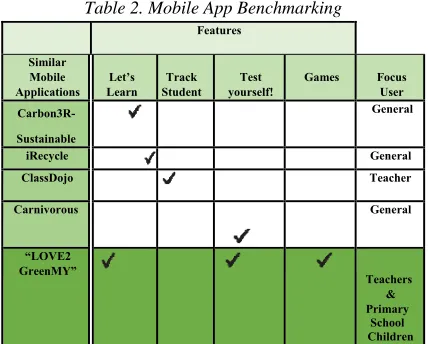
[image:7.612.311.525.95.267.2]A desktop benchmarking was conducted to identify the operating characteristics, strengths, and weaknesses of four environmental education related mobile apps for different group of users; this information was used to design, implement and refine the mobile apps that will be used in teaching students on how to care and protect the environment. Based on the benchmarking activity, the author came out with a summary of similar features:
Table 2. Mobile App Benchmarking
Features
Similar Mobile Applications
Let’s Learn
Track Student
Test yourself!
Games Focus
User Carbon3R-
Sustainable
General
iRecycle General
ClassDojo
Teacher
Carnivorous
General
“LOVE2 GreenMY”
Teachers & Primary
School Children
User Design - LOVE2GreenMY
The mobile application was designed incorporating several modules for both teachers and students. Apart from the login screen and welcome menu screen, there are 3 more modules in it; (i) Lets Learn, (ii) Test Yourself and (iii) Game Function. The three modules serve as an initial design of “LOVE2GreenMY” application, as the main purpose of the study is to validate the proposal to use mobile learning in supplementing and enhancing the existing syllabus and content of environmental education in schools.
3.3 Construction
The construction phase started off with storyboard sketching and follows with designing the flow of the application based on findings gathered. The content was validated through user review before the actual coding process. Android Studio was chosen as the platform and the application was coded using JAVA language. The user interface was also coded to ensure a smooth flow in the design. Lastly, the modules were linked and tested through unit testing. The final test was performed on Genymotion before the deployment on Android smart phones.
3.4Cutover
6307 learning through interactions with teachers and students, performing mobile based test and playing puzzle games to identify a scenario.
After the navigation session ended, a set of survey questions were distributed to obtain feedbacks from the users. The survey sessions for the students were guided by their own teachers in interpreting the meaning of the questions. However, the responses from the students were not guided by anyone. Hence, it was genuinely reported as it was received. The responses were analyzed in terms of user acceptance rate and are reported in the next subsection.
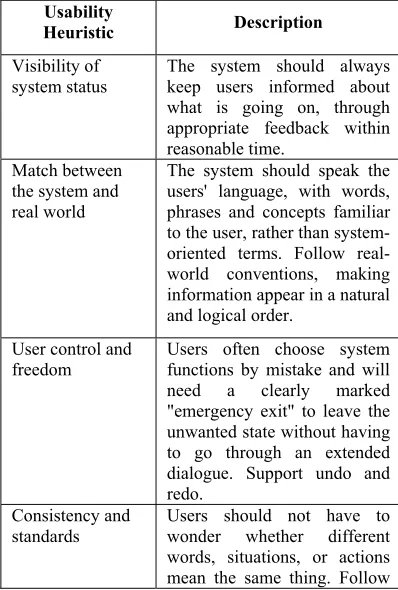
[image:8.612.94.293.433.728.2]The verification was performed through Nielsen’s ten usability evaluation to ensure the mobile application has been developed according to the standard. The ten-usability heuristic evaluation was used as a checklist to ensure the user interface design of the application is at accessible state for the users. Referring to Table 3, the heuristic description were adopted from [41]. A user interface designer with 15 years working experience has been selected as the heuristic evaluator to evaluate the interface design of LOVE2GreenMY application.
Table 3. Description of Nielsen’s Usability Heuristic
Usability
Heuristic Description
Visibility of system status
The system should always keep users informed about what is going on, through appropriate feedback within reasonable time.
Match between the system and real world
The system should speak the users' language, with words, phrases and concepts familiar to the user, rather than system-oriented terms. Follow real-world conventions, making information appear in a natural and logical order.
User control and freedom
Users often choose system functions by mistake and will need a clearly marked "emergency exit" to leave the unwanted state without having to go through an extended dialogue. Support undo and redo.
Consistency and standards
Users should not have to wonder whether different words, situations, or actions mean the same thing. Follow
Usability
Heuristic Description
platform conventions.
Error Prevention Even better than good error messages are a careful design which prevents a problem from occurring in the first place. Either eliminate error-prone conditions or check for them and present users with a confirmation option before they commit to the action. Recognition
rather than recall Minimize the user's memory load by making objects, actions, and options visible. The user should not have to remember information from one part of the dialogue to another. Instructions for use of the system should be visible or easily retrievable whenever appropriate.
Flexibility and
efficiency of use Accelerators -- unseen by the novice user -- may often speed up the interaction for the expert user such that the system can cater to both inexperienced and experienced users. Allow users to tailor frequent actions.
Aesthetic and
minimalist design Dialogues should not contain information which is irrelevant or rarely needed. Every extra unit of information in a dialogue competes with the relevant units of information and diminishes their relative visibility.
Help users recognize, diagnose, and recover from errors
Error messages should be expressed in plain language (no codes), precisely indicate
the problem, and
constructively suggest a solution.
Help and Documentation
6308
4. RESULT AND DISCUSSION
Before the interview sessions with teachers and students were conducted, preliminary reading on Standard 4 textbooks on Bahasa Malaysia, English, Science and Mathematics was completed. After reviewing the content of all chapters in each of the textbooks, it was found that there were only two subjects that cover on the environmental education for Standard 4, which are Bahasa Malaysia and English. This clearly shows the limitation on content coverage for teaching and learning on environmental education in primary schools.
A series of interviews were carried out for requirement planning/gathering phase. At the end of interview sessions, the teachers and students supported the idea of binding mobile application as a tool and a learning intervention in teaching and learning on environmental education. Below are some of the replies from the teachers and students:
“Technology is now rapidly expanding. I believe there is no harm for the teachers to use mobile apps as an extra learning tool focusing on green environmental awareness. Besides, students love new things. Thus, with these new mobile apps, we can attract students’ attention to focus during the class.” – Teacher #3
“Apart from that, teachers can have their learning sessions outside of the classroom by going to multimedia room or garden” – Teacher #4
“It will be great if the mobile apps is in Bahasa Malaysia as it will help me to understand better and I will love to use the mobile apps as it will be easier for me to read and do the exercises given.” -Teacher #5
“Our school has organized an event called “gotong-royong” for us to clean our school compound”- Student #1, #2, #5 & #6
“We always use smart phone to check Facebook notification while listening to some music on YouTube” – Student #3 & #4
Based on the responses given, it is indicated that the use of mobile technology among the primary school student is very prevalent. Thus, the proposed solution is to integrate environmental education topics into mobile application is an innovative learning intervention.
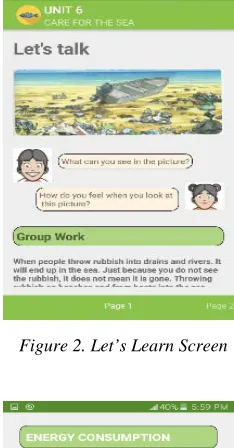
The screenshots of the first version of the prototype are in Figure 2 to Figure 5. The “Let’s
[image:9.612.356.473.204.428.2]Learn” module of Figure 2 and Figure 3 allows the teachers and students to have an interactive session through discussion, assignment of homework and additional information. This additional information can be on any selected topics describing the hazards, wastages, safety precautions and sources of environmental issues.
Figure 2. Let’s Learn Screen
Figure 3. Let’s Learn Screen
6309 Figure. 4. Test Yourself
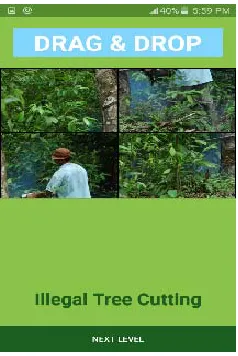
[image:10.612.319.516.121.732.2]Figure 5 shows the third module “Game Function”. The “Game Function” was designed based on puzzle like features. Given jumbled-up pictures, the user needs to drag and drop it to re-create the right pictures or scenario. This module provides a fun session to the students, enhancing their creative thinking on discovering potential environmental related issues and at the same time creating awareness in several topics related to environment protections and environmental sustainability.
Figure 5. Game Function
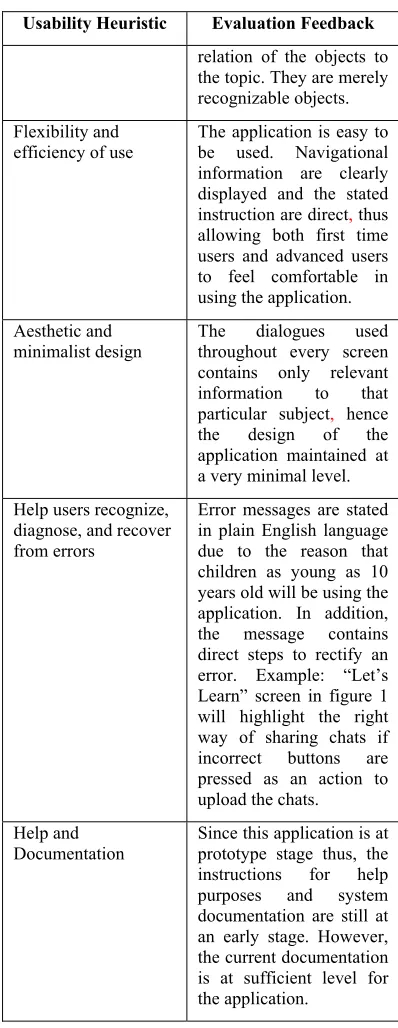
The developed prototype was mapped against Nielsen’s ten usability heuristic. Table 4 depicts the mapping of the features by the user interface designer upon using the application for a period of two hours.
Table 4. Nielsen’s Usability Heuristic Against Feature Mapping Of LOVE2GreenMY Application.
Usability Heuristic Evaluation Feedback
Visibility of system
status The application provides sufficient feedback within seconds. Example: While playing drag and drop game (figure 4), if incorrect tile is matched (drop space), the dragged tile will be relocated at the initial location to indicate the tile doesn’t belong to the new location.
Match between the
system and real world The application uses real world examples in games as well as descriptions on the topics are from the textbooks of the primary school students, thus the information displayed appeared natural and in proper sequence.
User control and freedom
At the end of every screen, there is an “exit” button available to allow users to exit an unwanted stage of the application without going through an extended dialogue.
Consistency and
standards The usage of shortcuts, location of the buttons as well as the terms specified in the content are consistent throughout the application. Standard naming convention has been followed for every related features.
Error Prevention The “self-test” function in the application has very well designed “solution-confirmation message” which prevents the users from submitting an incorrect answer. Solutions are confirmed through the pop-up
message before
submission can be made.
Recognition rather
[image:10.612.127.246.451.629.2]6310
Usability Heuristic Evaluation Feedback
relation of the objects to the topic. They are merely recognizable objects.
Flexibility and
efficiency of use The application is easy to be used. Navigational information are clearly displayed and the stated instruction are direct, thus allowing both first time users and advanced users to feel comfortable in using the application.
Aesthetic and minimalist design
The dialogues used throughout every screen contains only relevant information to that particular subject, hence the design of the application maintained at a very minimal level.
Help users recognize, diagnose, and recover from errors
Error messages are stated in plain English language due to the reason that children as young as 10 years old will be using the application. In addition, the message contains direct steps to rectify an error. Example: “Let’s Learn” screen in figure 1 will highlight the right way of sharing chats if incorrect buttons are pressed as an action to upload the chats.
Help and
Documentation Since this application is at prototype stage thus, the instructions for help purposes and system documentation are still at an early stage. However, the current documentation is at sufficient level for the application.
The verification results indicate that LOVE2GreenMY application has been designed according to the standard usability heuristic. The application is suitable for validation process involving the targeted users. Therefore, the three modules were tested among the users to obtain their valuable feedbacks, which serves as the validation for the proposed solution of this study. The summarized result of users’ acceptance testing has been presented here since the main purpose of the
study is to show the impact of the proposed solution to the users.
[image:11.612.94.293.88.602.2]Table 5 indicates the testing results in terms of overall percentage calculation. All the users felt that the application increases their knowledge on green environment.
Table 5. Feedback of Respondents on the Survey Questions
Description (Strongly Agree) Feedback (%)
LOVE2GreenMY app increases the knowledge on green
environment. 100%
LOVE2GreenMY app increases the awareness on green
environment. 90%
LOVE2GreenMY app only involves simple procedural steps.
100%
LOVE2GreenMy app is an
excellent invention 90%
Average Feedback 95%
The response of 100% for the first survey question was achieved mainly due to the first module “Let’s Learn” in the application. This function serves as the platform for the users to interact with one another with the monitoring of the teachers. The interaction in terms of describing environmental related images and discussing further on the safety measures and actions that can be taken as an individual. This also gives an opportunity to those students to better understand a concept or theme of study from various angles since the discussion is a viewpoint of many other students as well as the teachers.
A score of 90% was obtained for the second survey question which shows an increment of awareness on protecting the environment. Majority of the users has strongly agreed that “LOVE2GreenMY” application has improved their level of awareness on green related activities and issues. Once again, the “additional information” corner within the first module “Let’s Learn”, has increased their awareness on the type of potential environmental related issues and the sources of these issues. The second module “Test Yourself” is also testing their knowledge and awareness on the importance of protecting the environment to ensure the achievement of green environment.
[image:11.612.315.523.206.372.2]6311 potential issues that were being displayed in the form of jumbled up images. This module encourages a user to stay focus and to process the acquired knowledge in their mind to be useful at that moment. The entire game session also serves as recalling memory process. A fun yet intensive knowledge utilization platform was created through the implementation of “LOVE2GreenMY” application.
This could be one of the main reasons that the users have scored 100% for the third survey question and 90% for the last survey questions. They feel the application is easy to use as it involves only simple procedures. This solution was classified as an excellent invention as the users themselves could feel the positive impact after using “LOVE2GreenMY” application throughout the testing session. The teachers have also agreed that this solution can be a great tool for them to use in educating the children. In summary, the testing result has indicated a positive feedback on “LOVE2GreenMY” application which inspires the proposed solution to be implemented in schools.
In sum, this study aims to inculcate students understanding, learning and knowledge on environmental issues and environmentally-friendly practices, with the hope to create a greener Malaysia in near future. The cultivation of environmental education among the schoolchildren is proposed using mobile application, which will enhance the current content as well as teaching methods in schools.
The mobile application known as “LOVE2GreenMY” is the first complete prototype. The apps have undergone testing, however, a bigger audience of teachers and students for thenext data gathering and testing are required to cross-check further improvements made on the application before it can be rolled-out. Furthermore, for the apps to be integrated into the primary school education system, a formal approval and integration are required from the policymakers of Malaysia. Thus, the journey for “LOVE2GreenMY” is still far, yet the authors believe the impact and future that will be brought by “LOVE2GreenMY” to our education endeavors towards green and sustainable nation is promising.
5. CONCLUSION
The “LOVE2GreenMY” is a first version of the prototype that focuses primarily on Standard Four schoolchildren. The feedbacks gathered from the usability testing and user acceptance testing will be taken into consideration. Another round of data
gathering and testing will be carried out for the development of the second version of prototype. Also, more attention will be given to Human Computer Interaction (HCI) elements that will suit the younger generation users of Generation Z and Generation Alpha. Thus, a much detailed study is required to understand the characteristics of Generation Z and Generation Alpha in Malaysia.
On top of that, games-based learning and gamification features will be included in the next version of the prototype. The proposed game will focus in educating the schoolchildren on electronic waste or e-wastes with the revolution of Industry 4.0 and Internet-Of-Things (IoT).
Despite this research and product are still at an infant stage, this is the first step in familiarizing and assimilating environmental education in teaching and learning with the ultimate goal of inculcating younger generations with green values towards a greener and sustainable nation.
ACKNOWLEDGEMENT
The authors would like to convey their utmost appreciation to the Universiti Teknologi PETRONAS for the resources and findings provided. The authors also would like to express their deepest gratitude to judges of internal and external exhibition competitions as well as respected reviewers for the enlightening feedbacks, comments, suggestions.
REFERENCES
[1] A. S. Yean, “Education for Sustainable Development in Malaysia’s National Curriculum Reformation : A Theoretical Exploration,” J. Int. Comp. Educ., vol. 3, no.
2, pp. 199–212, 2014.
[2] Economic Planning Unit, Eleventh Malaysia Plan 2016-2020 Anchoring Growth on People. PNMB, 2015.
[3] T. E. Seah, “An Evaluation of Environmental Education in Selected Primary Schools in Pahang, Malaysia,” 2015.
[4] B. Mustam and E. S. Daniel, “Informal And Formal Environmental Education Infusion : Actions of Malaysian Teachers and Parents Among Students in a Polluted Area,”
Malaysian Online J. Educ. Sci., vol. 4, no. 1,
pp. 9–20, 2016.
6312
Sci. Humanit., vol. 18, no. 2, pp. 271–283,
2010.
[6] H. Mahat and S. Idrus, “Education for sustainable development in Malaysia : A study of teacher and student awareness,”
Malaysian J. Soc. Sp., vol. 12, no. 6, pp. 77–
88, 2016.
[7] UNESCO Education Sector, “Guidelines And Recommendations for Reorientating Teacher Education To Address Sustainability,” Paris, 2005.
[8] S. Hussin, M. Manap, R. Amir, and P. Krish, “Mobile Learning Readiness Among Malaysian Students At Higher Learning Institutes,” Asian Soc. Sci., vol. 8, no. 12, p.
276, 2012.
[9] P. G. Harris, “Environmental Perspectives and Behavior in China: Synopsis and Bibliography,” Environ. Behav., vol. 38, no.
1, p. 2006, 2006.
[10] K. Madruga and C. . B. da Silveira, “Can teenagers educate children concerning environmental issues?,” J. Clean. Prod., vol.
11, pp. 519–525, 2003.
[11] K. Foo, “A Vision On The Role of Environmental Higher Education Contributing To The Sustainable Development in Malaysia,” J. Clean. Prod.,
vol. 61, pp. 6–12, 2013.
[12] A. Hezri and S. Dovers, “Shifting The Policy Goal from Environment to Sustainable Development,” in Malaysia’s Development Challenges: Graduating From The Middle, H.
Tham and S. Y. Zin, Eds. London: McGraw Hill, 2013.
[13] Ministry of Education Malaysia (MOE), “Preliminary Report Malaysia Education Blueprint 2013-2025,” 2013.
[14] Z. Marrium, “A Theoretical Framework on Environmental Education In The Primary Schools of Malaysian Educational System.,”
Int. J. Acad. Res., vol. 3, no. 4, pp. 460–475,
2015.
[15] Z. Sardar, Islamic Futures. New York:
Mensell Publishing Limited, 1985.
[16] B. Thapa, “Environmentalism: The Relation of Environmental Attitudes and Environmentally Responsible Behaviors among Undergraduate Students,” Bull. Sci. Technol. Soc., vol. 19, no. 5, 1999.
[17] L. Habibah and M. Punitha, “Environmental
Education: Current curriculum situational and the challenges at Primary School, Malaysia,” in Tsukuba Conference, 2009.
[18] I. L. Khalid, R. Harun, A. Muda, and I. A. Ismail, “Level of Knowledge on Environmental Issues and Environmental Education of Primary Schools’ Headmasters in Kuala Lumpur, Malaysia,” World Appl. Sci. J. 14, vol. 14, pp. 97–100, 2011.
[19] Yayasan Hijau Malaysia, “Green Catalyst & Curriculum,” 2015. [Online]. Available:
www.yahijau.com/index.php/green-education/.
[20] H. Mahat, Y. Saleh, M. Hashim, and N. Nayan, “Model Development on Awareness of Education for Sustainable Schools Development in Malaysia,” Indones. J. Geogr., vol. 48, no. 1, pp. 39–48, 2016.
[21] B. Bachmair and N. Pachler, “Sustainability For Innovative Education - The Case of Mobile Learning,” J. Interact. Media Educ.,
vol. 1, no. 17, pp. 1–12, 2015.
[22] G. M. N. Isabwe, “Mobile Learning: Learning Supported by Mobile Technology Based Tools.,” 2014. [Online]. Available: https://ufbutv.com/2014/03/16/mobile- learning-learning-supported-by-mobile-technology-based-tools/. [Accessed: 15-Sep-2016].
[23] B. Kedzierska, J. Magenheim, J. Kedzierska, and R. Fischbach, “The Application And Impact Of ICT In Education for Sustainable Development,” in X World Conference on Computers in Education, 2013, pp. 1–10.
[24] L. T. Wah and L. C. Seng, “Methodology And Promotion Of Green Behavior Among Students In Malaysia,” Int. J. Econ. Commer. Manag., vol. 4, 2016.
[25] Perikleous, E., The Status of Environmental Education in Cyprus Today. MIO-ECSDE.
The Status of Environmental education in the Mediterranean countries within the formal & non-formal educational systems. Dec, Issues No 34, 2004
[26] Jannah, M. Halim, Meerah, T.S.M., and Fairuz, M. “Impact of Environmental Education Kit
on Student’s Environmental Literacy”. Asian Social Science, 9(2), 1, 2013
[27] Tbilisi Declaration, Available:
6313 [28] Mobile Kids The Parent, The Child and The
Smartphone,(02/28/2017)Available:
http://www.nielsen.com/us/en/insights/news/2 017/mobile-kids--the-parent-the-child-and-the-smartphone.html
[Accessed: 28-Aug-2017].
[29] MCMC Hand Phone Users Survey 2014, Available:
https://www.mcmc.gov.my/skmmgovmy/med
ia/General/pdf/MCMC-Hand-Phone-User19112015.pdf [Accessed: 28-Aug-2017]. [30] T.S, Yao, E.C.Kuo, C.L. Tzu,“The Effects
Of Integrating Mobile Devices With Teaching And Learning On Students' Learning Performance: A Meta-Analysis And Research Synthesis” in Computers & Education, vol., pp. 252-275, March 2016
[31] Ismail, I., Johari, S. S. M., & Idrus, R. M. “Acceptance on Mobile Learning via SMS: A Rasch Model Analysis.” International Journal of Interactive Mobile Technologies,
4(2). ,2010
[32] Ciampa, K., “Learning In A Mobile Age: An Investigation Of Student Motivation.”,
Journal of Computer Assisted Learning,
30(1), pp. 82-96, 2014
[33] Hussin, S., Manap, M. R., Amir, Z., & Krish, P.,“Mobile Learning Readiness Among Malaysian Students At Higher Learning Institutes.”, Asian Social Science, 8(12), pp
276, 2012
[34] Johnson, L., Adams, S., & Cummins, M., NMC horizon report: 2012 K–12 edition. Austin, TX: The New Media Consortium., 2012
[35] Thomas, K., O’Bannon, B., & Bolden, N. “Cell Phones in The Classroom: Teachers’ Perspectives of Inclusion, Benefits, And Barriers.” Computers in the Schools, 30(4),
2013, 295–308
[36] Thomas, K., & Orthober, C. “Using Text-Messaging in The Secondary Classroom.”,
American Secondary Education, 39(2), 2011,
pp55–76.
[37] Nordin, M. N., Embi, M. A., Yasin, R. M., Rahman, S., & Yunus, M. M. “The Mobile Learning Readiness of The Post-Graduate Students.”, In EABR & ETLC Conference and proceedings.,2010
[38] Walker, L. R., & Shepard, M. F. “Phenomenological Investigation of Elementary School Teachers Who Successfully Integrated Instructional Technology Into The Curriculum.” Journal of
Educational Research and Practice, 1(1),
2011, pp. 23–35.
[39] J. Nielsen and K. L. Thomas, “A Mathematical Model of the Finding of Usability Problems,” in Interchi 93, 1993, pp.
206–213.
[40] P. K. Chilana, J. O. Wobbrock, and A. J. Ko, “Understanding usability practices in complex domains,” Proc. 28th SIGCHI Conf. Hum. Factors Comput. Syst., pp. 2337–2346, 2010.