4712
WHAT INFLUENCES THE ADOPTION OF INNOVATIVE
PRODUCTS ON E-COMMERCE?
: FOCUSING ON NEED FOR POWER, INNOVATIVENESS
AND IMPLICIT SELF THEORY
JUNSIK KWAK
1 Professor, Dongseo University, Division of Global Business Administration, Busan, Korea E-mail: 1[email protected]
ABSTRACT
There are five types of consumer according to the rate of adoption about new ideas and technology. The categories of adopters are innovators, early adopters, early majority, late majority and laggards. Company that make innovative products focus on the innovators and early adopters because they are main target of innovative products and they can recommend innovative products to their friends and share their experience to social media. A few studies were about factors that influenced on buying innovative products. The purpose of this research is how consumer’s need for power (controllability), construal level, and implicit self-theory influence to adopt innovative product. Especially, Construal Level Theory says people use a high-level construal to describe distant future events in terms of primary features, whereas people use a low-level construal to describe near future events in terms of secondary features. Therefore, we examined change of innovators focus. We conducted three experiments. For data processing, univariate ANOVA was used to deduct following results. First, High need for power group (there for, High NFP) evaluated innovative product more favorably than low need for power group. Second Product evaluation is more positively in the near future than in the distant future. The difference between high versus low innovativeness was significant. That is, participants in the high innovativeness rated Google glass as more positively. In the near future, high innovative participants are not likely to different with evaluation of Google glass according to Need-For-Power. However, low innovative participants with high NFP evaluated Google glass positively more than low innovative participants with low NFP. Finally, the difference in evaluation between entity theorists and incremental theorist for innovative products is not almost significant. Results showed that power related message influenced the adoption of innovative product in the near future. In the future research, we will find the key factors to adopt the innovative product more easily
Keywords:Innovative product, Construal Level Theory, Controllability, Desirability, Implicit Self-theory.
1. INTRODUCTION
Innovation is based on successful collection and exploration of new ideas from different sources. Innovation is very important for company to increase global competitiveness. So many new products come out on the market every day. Among the many new products, innovative new products attract more attention from consumers. Innovation is a powerful core competence in which companies can survive in tough market conditions. CEO’s decisions and insights make innovative ideas and product. However, the concept of innovativeness is abstract and ambiguous although many researchers focused on consumer’s innovation. The innovative behavior of consumer was main research topic for research. Rogers(1962) classified consumers as
4713
2. THEORETICAL BACKGROUND
2.1 Innovativeness
There are five types of consumer in the aspect of innovativeness: innovators, early adopters, early majority, late majority and laggards [1]. The Innovator group is a group of 2.5% of the respondents. They are at risk of accepting innovative products and tend to accept it dramatically. Early adopters, which account for about 13.5% of the total group, do not blindly follow innovations. However, they takes the role of adopting innovation and spreading it to other people before other groups. They also act as opinion leaders. The early majority is the group of 34% of the total population. They are a group of people just before the spread of innovation. Late Majority is a group that has a sense of rejection of innovation or change. The Laggard group is a group with strong resistance to innovation and which is accepted only when completely innovative products are accepted, This classification has been used to date, after Rogers divided consumer into five types based on innovation. Especially, many companies have been interested in innovators and early adopters until now because they are main customer of innovative products and they can share their experience with many potential consumer by word of mouth and social media. They are a big influencers and opinion leaders. Consumer innovativeness is the tendency to buy new products more often and more quickly than other people according to the definition of Midgley and Dowling [2]. Steenkamp, Hofstede, and Wedel (1999) say that innate innovativeness is like behavior to buy new products and brands rather than keep previous choices and consumption patterns [3]. Roehrich (2004) classified four concept about innate innovativeness [4]. First told a innate innovativeness as an expression of the need for stimulation [5]. Consumer’s need for stimulation had significant and positive relationship with innovativeness. Second is innate innovativeness as an expression of novelty seeking [6]. Third is innate innovativeness as independence toward other’s shared experience. Fourth is innate innovativeness as an expression of need for uniqueness [7]. Consumer’s need for uniqueness had positive relationship with the number of newness that products possessed and this relationship was higher for new products than for new brands. Recently, four dimensions (functional, hedonic, social, and cognitive) to consider motivating factors for
innovative behavior was porposed by
Vandecasteele and Geuens [8]
H1. High innovation group (there for, HIG) evaluated innovative product more favorably than low innovative group.
2.2 Need for power
Power change People’s behavior and viewpoint of the world. The leader focus on larger plan and think bigger picture of the future. However, followers focuses on small things rather than big pictures. Power should cause people to view innovative products in terms of the big picture to focus on the desirability and influence of the innovative products. People who have high need for power are likely to evaluated innovative product more positively than those who have low need for power. The level of viewing depends on the power. According to Construal Level Theory, people demonstrate a high-level construal (e.g High NFP) to imagine distant future events in terms of primary features, whereas people demonstrate a low-level construal (e.g. Low NFP) to imagine near future events in terms of secondary features. For example, some researchers has examined whether temporal distance increases the importance of primary aspects and decreases the importance of secondary aspects in preferences for a word processor [9]. They show a scenario describing two options for a word processor (i.e., high quality and high learning time vs. low quality and low-learning time) to the participants and asked to select word processor according to the time distance. The study found that the impact of primary feature (e.g., Quality) increased over time, whereas the impact of secondary feature (e.g., learning time) decreased over time. Specifically, the preference of a word processor that had high quality but high learning time is higher in the distant future than in the near future. Thus, primary features are more likely to be important when you come to in mind distant future events than in near future events, whereas secondary features (e.g., learning time) are more likely to come to mind in thinking about near future events than distant future events.
4714 built-in clock. Eyal, Liberman, Trope and Walther (2004) also showed that pros loomed larger than cons in the distant future, whereas cons loomed larger than pros in the near future [10]. This showed that pros become more important in the distant future, whereas cons become more important in the near future. Thus, it is suggested that pros (e.g., quality) should be emphasized in the distant future and cons (e.g., cost) should be deemphasized in the near future. All of these studies indicate that people are likely to think more important primary features (e.g., quality, pros, benefits) and less important on secondary features (e.g., cons, costs) in distant future, whereas they are likely to place more focus on secondary features and less focus on primary features in near future situations.
H2. Need for power influenced the evaluation of innovative product
2.3 Implicit Self Theory
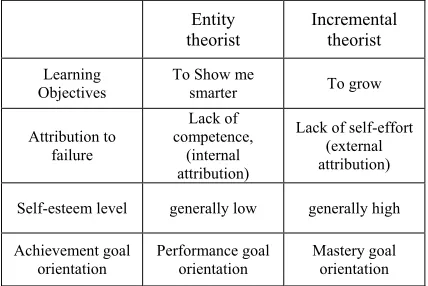
[image:3.612.311.525.110.253.2]People have the tendency or perception implicitly about self’s or other’s intelligence or ability. This is the implicit self-theory. We can evaluates an individual's intelligence or ability with subjective measure. There are two types of entity theory and incremental theory. Entity theory means that intelligence or ability is fixed. The person who believes that intelligence or ability is fixed and do not change is called entity theorist. Incremental theory means that intelligence or ability can develop. The person who believes that intelligence or ability can change and develop by effort is called incremental theorist. Different types of implicit self-theory make different behavior patterns in the same situation. As shown table 1, the learning objective of entity theorist is to show me smarter. The learning objective of incremental theorist is to grow. When they experience failure, entity theorist attributes failure internally. That is they think they fail because of my lack of competence. Incremental theorist attributes failure externally. That is they think that my failure is not due to my lack of self-effort. Entity theorist has generally low self-esteem level and has performance goal orientation in achievement goal orientation. Incremental theorist has generally high self-esteem level and has mastery goal orientation in achievement goal orientation.
Table 1: Difference According To Implicit Self-Theory
Entity
theorist Incremental theorist
Learning Objectives
To Show me
smarter To grow
Attribution to failure
Lack of competence,
(internal attribution)
Lack of self-effort (external attribution)
Self-esteem level generally low generally high
Achievement goal orientation
Performance goal orientation
Mastery goal orientation
Junsik Kwak(2017), “Impact of Default Option on Final Price in Online commerce”, JATIT, pp.5943
2.2.1 Entity theory
4715
2.2.2 Incremental theory
Incremental theorists believe that intelligence is not fixed characteristic and can be developed by learning. They think that they do their best to defeat challenges and solve problems even though they face the failure. They have mastery goals and want to adopt new skills and get smarter. They continue to make an effort to achieve goal, even if they have no experienced in a specific field. Entity theorist do not respond actively when they face failure, but incremental theorists do not blame their own intelligence and do not show a helpless appearance because they know that they have insufficient strategies or techniques. They may experience defeat during long-term learning. This is just a signal to work harder or create a new strategy. People can face a very hard task. Incremental theorists think that they can vanquish, but entity theorists do in a way that they doubt their abilities and give up. For example, Aronson and Fried (1998) did very interesting experiments. They separate the participants into two groups. One group (incremental group) showed short film to improve their intelligence and then wrote a letter to elementary students how to improve intellectual ability. The other group (control group) did not do that. The results came out that the GPA of incremental group was significantly higher in the than that of control group at the end of the semester. In addition, students in the incremental group feel more pleasure in university life and think themselves as more academic students than those in the control group.
H3. Implicit self-theory influenced the evaluation of innovative product
3. ONLINE EXPERIMENT
3.1 Experiment 1 3.1.1 Participants
One hundred forty three people participated in experiment 1. They were assigned randomly to two conditions of priming (neutral vs. power).
3.1.2 Procedure and Materials
This experiment was conducted in individual sessions with all instructions and tasks on computer. To remove issues of conscious awareness and intent, we primed high power or neutral in the experiments 1. Power associated concepts and tendencies should be activated when concept of power is activated (Bargh, 1997) [13]. Participants in the HPP(High-Power-Primed) condition wrote about a particular time or event when they had control over another
individual or individuals. Participants in the Control (No-Power-Primed) condition wrote about their day yesterday. Participants had 3 min to write about the given topic and were instructed to provide as much detail as possible. After priming task, they see the description of “Google glass” as innovative products and evaluated the product.
Camera. Google Glass can take 5 megapixel still photos and can shoot 720p videos.
Storage. Google Glass has 12GB of usable memory, synced with Google’s Cloud Storage for a total of 16GB.
Display. The Google Glass’ high resolution display is equivalent to a 25 inch High Definition (HD) screen from eight feet away.
Compatibility. The unit is compatible with any Bluetooth-capable phone. A companion app, “MyGlass” which enables GPS and SMS messaging requires Android 4.0.3 Ice Cream Sandwich or higher.
Connectivity. Google Glass is Wi-Fi –
802.11b/g and Bluetooth enabled.
Fig. 1: Google Glass Spec as InnovativeProducts
3.1.3 Variables
4716
3.1.4 Results
- Profile One hundred forty three people participated in experiment 1. One hundred forty three participants (83 men, 60 women; age: M=31.4; spend money per month: M=$1,210) were included in the final analyses.
[image:5.612.88.528.119.481.2]- Evaluation As shown Table 1, there is no significant effect in priming manipulation.
Table 1. ANOVA-test for product evaluation according to priming
Control Priming F p-value
I am interested in Google glass
3.57 3.60 F(1,141)=.022 0.883
I like Google
glass 3.45 3.61
F(1,141)
=1.047 0.308
I want to buy
Google glass 3.24 3.31 F(1,141)=.199 0.731
I like the function of Google glass
3.56 3.62 F(1,141)=.156 0.693
I like the innovativene ss of Google
glass
3.65 3.91 F(1,141)=2.968 0.087
I like ease of use go
Google glass 3.35 3.60
F(1,141)
=2.386 0.125
Google glass looks me
better
3.31 3.50 F(1,141)=1.018 0.315
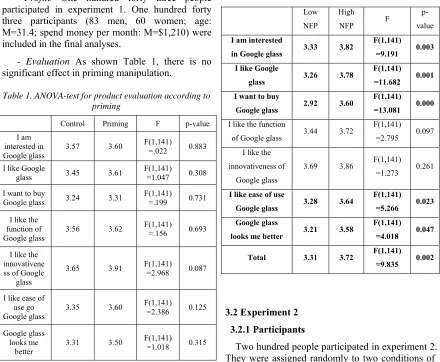
We spilt two groups with need for power group based on the average and used one way ANOVA for analyses. Shown Table 2, High NFP(Need for Power) group evaluated Google glass positively than low NFP group.
Table 2. ANOVA-test for product evaluation according to NFP(Need for power)
3.2 Experiment 2 3.2.1 Participants
Two hundred people participated in experiment 2. They were assigned randomly to two conditions of priming (near future vs. distant future).
3.2.2 Procedure and Materials
This experiment was conducted in individual sessions with all instructions and tasks on computer. We manipulated Construal Level with near or distant future in the experiments 2. Participants in the near future condition wrote about their activities tomorrow. Participants in the distant future condition wrote about their plan next year. Participants had 3 min to write about the given topic and were instructed to provide as much detail as possible. After priming task, they saw the description of “Google glass” as innovative products and evaluated the product. It was the same description of Google glass with experiment 1.
3.2.3 Variables
For dependent measures, participants rated product evaluation with three items on 7-point scales (e.g., “I am interested in Google glass, I like
Low NFP
High
NFP F
p-value
I am interested
in Google glass 3.33 3.82
F(1,141)
=9.191 0.003
I like Google
glass 3.26 3.78
F(1,141) =11.682 0.001 I want to buy
Google glass 2.92 3.60
F(1,141) =13.081 0.000
I like the function
of Google glass 3.44 3.72
F(1,141)
=2.795 0.097
I like the innovativeness of
Google glass
3.69 3.86 F(1,141)
=1.273 0.261
I like ease of use
Google glass 3.28 3.64
F(1,141)
=5.266 0.023
Google glass
looks me better 3.21 3.58
F(1,141)
=4.018 0.047
Total 3.31 3.72 F(1,141)
4717 Google glass, I want to buy Google glass”; 1 = “strongly disagree,” to 7 = “strongly agree”). Seven items were combined into a single measure and were highly reliable; = 0.91. Finally, participants were asked to rate on innovativeness and Need for Power with seven-point scales.
3.2.4 Results
- Profile Two hundred people participated in experiment 2. Only one hundred ninety three participants (116 men, 77 women; age: M=30.94; spend money per month: M=1,270,000 won) were included in the final analyses.
[image:6.612.307.528.141.381.2]- Evaluation We spilt two groups with innovative group and NFP based on the average and used one way ANOVA for analyses. As shown Table 1, three-way interaction was significant (F(1,193)= 4.984, p=.027).
Table 3. ANOVA-test for product evaluation according to CT, NFP, and INNO
Source Sum of
Squares
Df Mean
Square
F Sig
. Corrected Model Intercept CT NFP INNO CT*NFP CT*INNO NFP*INNO CT*NFP *INNO Error Total Corrected Total 40.17 1531.45 10.75 .873 18.37 1.37 1.88 .94 3.74 139.04 2325.88 179.22 7 1 1 1 1 1 1 1 1 185 193 192 5.739 1531.4 10.755 .873 18.37 1.37 1.88 .947 3.746 .752 7.63 2037 14.3 1.16 24.4 1.83 2.50 1.26 4.98 .00 .00 .00 .28 .00 .17 .11 .26 .02
* CT (Construal Level), NFP(Need for Power), INNO (Innovativeness):
As table-4 shown, product evaluation is more positively in the near future than in the distant future (M=3.47 vs. M=3.19; F(1,193)=14.309, p=.000). The difference between high versus low innovativeness was significant (M = 2.94 vs. 3.68; F(1,193)=24.452, p=.000). That is, participants in
the high innovativeness rated Google glass as more positively.
Table-4 Mean of Product Evaluation
Cons trual Leve l Inno vativ e ness Need For Powe r Interes t in Googl e glass Like Googl e glass Want to buy Googl e glass Mea n Near Low
Low 3.23 3.07 2.82 3.04a
High 3.75 3.5 3.41 3.55b
High
Low 3.92 3.78 3.35 3.69b
High 3.87 3.96 3.8 3.88b
Dis tant
Low
Low 2.93 2.93 2.48 2.78 ab
High 2.22 2.44 2.11 2.25a
High
Low 3.26 3.26 3.2 3.24b
High 3.763 3.83 367 3.69b
[image:6.612.319.517.540.691.2]4718 Fig. 2: Product Evaluation in Priming
3.2.5 Summary
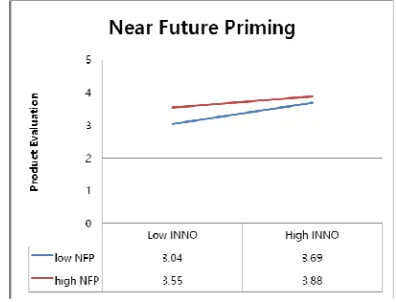
We conducted two experiments. In the experiment 1, The result showed High NFP(Need for Power) group evaluated Google glass positively than low NFP group. In the experiment 2, three-way interaction (Contrual Theory*Innovativeness*NFP) was significant. Product evaluation is more positively in the near future than in the distant future. The difference between high versus low innovativeness was significant. That is, participants in the high innovativeness rated Google glass as more positively. In the near future, high innovative participants are not likely to different with evaluation of Google glass according to Need-For-Power. But low innovative participants with high NFP evaluated Google glass more positively than low innovative participants with low NFP. This result showed that power related message influenced the adoption of innovative product in the near future.
3.3 Experiment 3 3.3.1 Participants
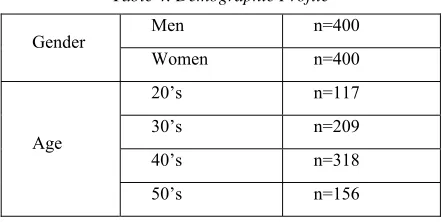
Eight hundred people participated in experiment. Demographics of participants are shown in Table 4
Table 4. Demographic Profile
Gender Men n=400
Women n=400
Age
20’s n=117
30’s n=209
40’s n=318
50’s n=156
3.3.2 Material
Experiment tested the impact of innovativeness, need for power, and implicit self-theory about innovative products. Participants was divided two conditions. One is a function-focused ad and the other is desirability-focused ad about smart glass.
- Function-focused ad: High-quality (HD) display is mounted on the eyeglasses in front of the eyes to display various information such as speed, moving distance, GPS position. It connects with mobile devices and informs you when phone calls, texts, and notifications are received, making it popular with sports fans who enjoy running and snowboarding (function).
[image:7.612.349.483.193.337.2]- Desirablity-focused ad: High-quality (HD) display is mounted on the eyeglasses in front of the eyes to display various information such as speed, moving distance, GPS position. Hollywood actors and sports stars are gaining popularity as a must-wear fashion item (desirability).
Fig. 3: smart Glass Spec as InnovativeProducts
[image:7.612.84.305.585.696.2]4719
3.3.3 Results
3.3.3.1 Innovativeness
We analyzed data to see innovativeness influence on the innovative products. As shown in Table 5, High innovative group (HIG) is more likely to evaluate more positively than Low innovative group (LIG).
First, I asked participants if they are interested in the innovative product. HIG (M=4.09) is more interested that in than LIG (M=3.37, F (1,798)= 62.669, p=.000).
Second, I asked participants if they like the innovative product. HIG (M=4.05) liked that more than LIG (M=3.35, F (1,798)=60.938, p=.000).
Third, I asked participants if they are willing to buy the innovative product. HIG (M=3.80) is likely to buy more in than LIG (M=2.99, F(1,798)=70,229, p=.000).
Fourth, I asked participants if they like features of innovative product. HIG (M=4.11) like features more than LIG (M=3.50, F(1,798)=47,745, p=.000).
Finally, I asked participants if they think it looks great to wear those glasses. HIG (M=3.67) think it looks great to wear the glasses more than LIG (M=3.13, F(1,798)=70,229, p=.000).
Table 5. The evaluation of innovative products with innovativeness
item HIG LIG p-value
Interest 4.09 3.37 F(1,798)=62.669, p=.000
Preference 4.05 3.35 F(1,798)=60.938, p=.000
Purchase 3.80 2.99 F(1,798)=70,229, p=.000
Like
Features 4.11 3.50 F(1,798)=47,745, p=.000
Look Great 3.67 3.13 F(1,798)=34,569, p=.000
3.3.3.2 Need for power
We analyzed data to see Need for Power (NFP) influence on the innovative products. As shown in Table 6, High NFP is more likely to evaluate more positively than Low NFP.
First, I asked participants if they are interested in the innovative product. High NFP (M=4.03) is more interested that in than Low HFP (M=3.50, F(1,798)= 33,076, p=.000).
Second, I asked participants if they like the innovative product. High NFP (M=4.00) liked that more than Low NFP (M=3.46, F(1,798)=36.377, p=.000).
Third, I asked participants if they are willing to buy the innovative product. High NFP (M=3.78) is likely to buy more in than Low NFP (M=3.09, F(1,798)=56,150, p=.000).
Fourth, I asked participants if they like features of innovative product. High NFP (M=4.09) like features more than Low NFP (M=3.58, F(1,798)=33.167, p=.000).
[image:8.612.81.525.443.719.2]Finally, I asked participants if they think it looks great to wear those glasses. High NFP (M=3.67) think it looks great to wear the glasses more than Low NFP (M=3.18, F(1,798)=28.465, p=.000).
Table 6. The evaluation of innovative products with Need for Power
item High
NFP Low
NFP p-value
Interest 4.03 3.50 F(1,798)=33.076, p=.000
Preference 4.00 3.46 F(1,798)=36.377, p=.000
Purchase 3.78 3.09 F(1,798)=56.150, p=.000
Like
Features 4.09 3.58 F(1,798)=33.167, p=.000
4720
3.3.3.3 Implicit Self-Theory
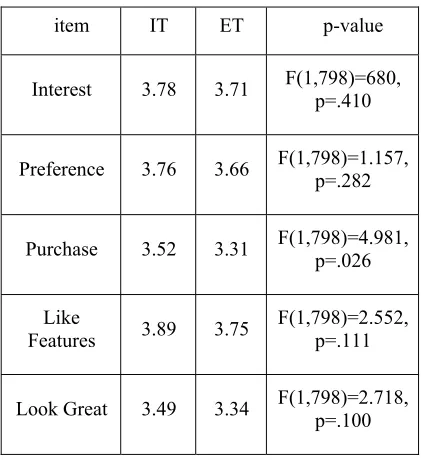
We analyzed data to see Implicit Self Theory influence on the innovative products. As shown in Table 7, Incremental theorist (IT) is not different from entity theorist (ET) except purchase intention. First, I asked participants if they are interested in the innovative product. IT (M=3.78) is not different from ET (M=3.71, F(1,798)= 680, p=.410).
Second, I asked participants if they like the innovative product. IT (M=3.76) liked that more than ET (M=3.66, F(1,798)= 1.157, p=.282).
Third, I asked participants if they are willing to buy the innovative product. IT (M=3.52) is likely to buy more in than ET (M=3.31, F(1,798)=4.971, p=.026).
Fourth, I asked participants if they like features of innovative product. IT (M=3.89) is not different from ET (M=3.31, F(1,798)=2.552, p=.111).
[image:9.612.84.295.410.640.2]Finally, I asked participants if they think it looks great to wear those glasses. IT (M=3.49) is not different from ET (M=3.34, F(1,798)=2.718, p=.100).
Table 7. The evaluation of innovative products with Implicit Self Theory
item IT ET p-value
Interest 3.78 3.71 F(1,798)=680, p=.410
Preference 3.76 3.66 F(1,798)=1.157, p=.282
Purchase 3.52 3.31 F(1,798)=4.981, p=.026
Like
Features 3.89 3.75
F(1,798)=2.552, p=.111
Look Great 3.49 3.34 F(1,798)=2.718, p=.100
3.3.3.4 Innovativeness * Implicit Self Theory We analyzed data to see the interaction between Innovativeness and Implicit self-theory. As a result, the interaction between innovativeness and implicit self-theory is not significant except item 5 (it looks great to wear those glasses). As shown in Table 8,
two way interaction between innovativeness and implicit self-theory is significant (F(1,796) =3.902, p=.049.
Table 8. ANOVA Table: Innovativeness, Implicit Self Theory
Source Sum of
Squares
Df Mean
Square
F Sig
.
Corrected Model Intercept
INNO IST INNO*IST
Error Total Corrected
Total
65.33
8871 56.64 .638 6.52 1330 10691 1395.3
3
1 1 1 1 796 800 799
21.77
8871 56.64 .638 6.52 .752
13.0
5039 33.9
0 .382 3.90
.00
.00 .00 .53 .04
* inno(innovativeness), IST(implicit self-theory)
As shown in Figure 4, the difference between entity theorist (M=3.18) and incremental theorist (M=3.05) is not significant in the low innovative group when they evaluate they looks great to wear the glasses (t(796)=.936, p=.350). However, the difference between entity theorist (M=3.54) and incremental theorist (M=3.78) is marginally significant in the high innovative group when they evaluate they looks great to wear the glasses (t(796)=1.884, p=.060). That is, incremental theorist think they looks greater to wear the glasses than entity theorist does in the high innovative group.
Figure 4. Two way interaction between innovativness and
[image:9.612.84.295.411.639.2] [image:9.612.320.525.544.701.2]4721
4. CONCLUSION
Prior research on innovative products examined how innovation propensity affects consumption of innovative products. In this study, however, the factors affecting innovative products were examined in various ways, taking into account not only the propensity for innovation of consumers but also the additional variables such as implicit self-theory and need for power.[15] The results of the study are as follows.
First, Innovative product was evaluated more positively in the high innovativeness group than in the low innovativeness. Innovation has individual differences due to differences in new ideas and innovations. Innovation is important because innovators play a role in spreading new technologies and actively accept new information.
Second, Innovative product was evaluated more positively in the high need for power group than in the low need for power group. This result shows that the group with strong NFP(need for power) has desire to get ahead of others by accepting innovative new products faster than others.
Third, the difference in evaluation between entity theorists and incremental theorist for innovative products is not almost significant except buying behavior. This result suggest that there is no difference between the two groups if there is no convincing what new innovative products will change about in their lives.
Finally, incremental theorist think they looks greater to wear the glasses than entity theorist does in the high innovative group. This result showed that in addition to innovation, Need for power and implicit self-theory influence on adopting innovative product.
The results of the survey showed the importance of innovation in the acceptance of innovative products. However, the contribution point of this study is to show that the acceptance of innovative products can be regulated not only by individual's innovation propensity but also by other factors. Specifically, the stronger the desire to control others, the need for power, the more favorable the evaluation of innovative products. It also means that it is important to emphasize that you can stay ahead of others in communicating innovative products. On the other hand, it is important to emphasize the possibility of change, even for those with strong innovation, because incremental theorists buy more innovative products than entity theorists do.
There are some limitation. I recommend the direction of future research. First, this study was conducted with real innovative product. However, participants do now know the difference between a function-focused ad and a desirability-focused ad. Therefore, the effect of interaction of innovativeness, Need of Power, and Implicit self-theory was weak. We should change the advertisements in the future research.
Second, I think smart glasses is not very innovative at the moment when more innovative products are released. I think I should changed the experimental material to more innovative product in the next study because the innovation evaluation of the product might be different according to the innovativeness of the individual in selecting the innovative new product.
Third, I don’t know why two way interaction between innovativeness and implicit self-theory is significant in the question of looking great to wear smart glasses. This may be due to the psychological effect of conspicuous consumption of innovative products. We need to study the mechanism of that in the future research.
Fourth, Sheth (1981) studied the concept of innovation resistance and presented the concept of resistance in acceptance rather than the opposite concept of innovation [15]. Negative feelings about innovation are due to lack of confidence or lack of trust or constant suspicion of innovative new technology. In the future, it will be necessary to further study the impact of innovation resistance, not innovation, on innovative products.
Finally, we can’t control participants because this study was conducted online. Therefore, we need to check whether their response has been consistent in the next time. Furthermore, it will be necessary to show innovative products more vividly by showing advertisements using videos rather than print ads.
ACKNOWLEDGMENTS:
This work was supported by the Ministry of Education of the Republic of Korea and the National Research Foundation of Korea (NRF - 2017S1A5A2A01 026639).
REFERENCES:
[1] E. M. Rogers, Diffusion of Innovations (1st edition). London: The Free Press. 1962.
[2] D. F. Midgley and G. R. Dowling,
“Innovativeness: Concept and Its
4722 [3] J. B. E. M Steenkamp, F. ter Hofstede and M.
Wedel M, “A Cross-national Comparison into the National and National Cultural Antecedents of Consumer Innovativeness,” Journal of Marketing. Vol. 63, No. 2, 1999, 55-69.
[4] G. Roehrich, “Consumer Innovativeness Concepts and Measurements,” Journal of Business Research. Vol. 27, No. 3, 2004, pp.671-677.
[5] P. S Raju, “Optimum Stimulation Level: Its Relationship to Personality, Demographics and Exploratory Behavior,” Journal of Consumer Research, Vol. 7, No. 3, 1980, pp.272-282. [6] M. P. Venkatraman and L. L. Price,
“Differentiating between Cognitive and Sensory Innovativeness,” Journal of Business Review, Vol. 20, No. 4, 1990, pp. 293-315.
[7] D. J. Burns and R. F. Krampf, “A Semiotic Perspective on Innovative Behavior,” Developments in Marketing Science. 15th Annual Conference, Academy of Marketing Science. Vol. 14, 1991, pp. 32-35.
[8] B. Vandecasteele and M. Geuens, “Motivated
consumer innovativeness: Concept,
measurement, and validation,” International Journal of Research in Marketing, Vol.27, No. 4, 2010, pp. 308-318.
[9] Y. Trope and N. Liberman, “Temporal Construal and Time-Dependent Changes in Preference,” Journal of Personality and Social Psychology. Vol. 79, No. 6, 2000, pp. 876-889.
[10] N. Liberman and Y. Trope, “The Role of Feasibility and Desirability Considerations in Near and Distant Future Decision: A Test of Temporal Construal Theory,” Journal of Personality and Social Psychology. Vol. 75, No. 1, 1998, pp. 5-18.
[11] T. Eyal, N. Liberman, Y. Trope, and E. Walther, “The Pros and Cons of Temporally Near and Distant Action,” Journal of Personality and Social Psychology, Vol. 86, No. 6, 2004, pp. 781-795.
[12] Junsik Kwak, “Impact of Default Option on Final Price in Online commerce”, Journal of Theoretical and Applied Information Technology, Vol. 95, No. 21, 2017, pp. 5941-5948.
[13] J. A. Bargh, “The automaticity of everyday life. In R. S. Wyer (Ed.), Advances in social cognition, Vol. 10, 1997, Mahwah, NJ: Erlbaum.
[14] K. P. Smith and Yaacov Trope, “You Focus on the Forest When You’re in Charge of the Trees: Power Priming and Abstract Information Processing,” Journal of Personality and Social Psychology, Vol. 90, No. 4, 2006, pp. 578-597. [15] Junsik Kwak, "Need for power and implicit
self-theory”, ICCCA 2018, proceedings [16] Sheth. Jagdish N., "Psychology of Innovation