Thomas,
Michael S.C. and Mareschal,
Denis (2001) Metaphor as
categorisation: a connectionist implementation. In: Barnden, J.A. and Lee,
M.G. (eds.) Metaphor and Artificial Intelligence. Metaphor & Symbol 16 (1).
London, UK: Psychology Press, pp. 5-27. ISBN 9780805897302.
Downloaded from:
Usage Guidelines:
Please refer to usage guidelines at or alternatively
BIROn
-
B
irkbeck
I
nstitutional
R
esearch
On
line
Enabling open access to Birkbeck’s published research output
Metaphor as categorisation: a connectionist
implementation
Journal Article
http://eprints.bbk.ac.uk/4659
Version: Final Draft (Refereed)
Citation:
© 2001
Publisher version
______________________________________________________________
All articles available through Birkbeck ePrints are protected by intellectual property law, including copyright law. Any use made of the contents should comply with the relevant law.
______________________________________________________________
Deposit Guide
Contact: [email protected]
Thomas, M.S.C. and Mareschal, D. (2001)
Metaphor as categorisation: a connectionist implementation –
Running head: CONNECTIONIST MODEL OF METAPHOR AS CATEGORISATION
Metaphor as Categorisation: A Connectionist Implementation.
Michael S. C. Thomas
Neurocognitive Development Unit,
Institute of Child Health.
Denis Mareschal
Birkbeck College, University of London.
Address for correspondence:
Dr. Michael Thomas,
Neurocognitive Development Unit, Institute of Child Health,
30, Guilford Street, London WC1N 1EH UK.
Email: [email protected]
Running head: CONNECTIONIST MODEL OF METAPHOR AS CATEGORISATION
Abstract
A key issue for models of metaphor comprehension is to explain how in some
metaphorical comparison <A is B>, only some features of B are transferred to A. The
features of B that are transferred to A depend both on A and on B. This is the central
thrust of Black's well known interaction theory of metaphor comprehension (1979).
However, this theory is somewhat abstract, and it is not obvious how it may be
implemented in terms of mental representations and processes. In this paper we
describe a simple computational model of on-line metaphor comprehension which
combines Black's interaction theory with the idea that metaphor comprehension is a
type of categorisation process (Glucksberg & Keysar, 1990, 1993). The model is
based on a distributed connectionist network depicting semantic memory (McClelland
& Rumelhart, 1986). The network learns feature-based information about various
concepts. A metaphor is comprehended by applying a representation of the first term
A to the network storing knowledge of the second term B, in an attempt to categorise
it as an exemplar of B. The output of this network is a representation of A
transformed by the knowledge of B. We explain how this process embodies an
interaction of knowledge between the two terms of the metaphor, how it accords with
the contemporary theory of metaphor stating that comprehension for literal and
metaphorical comparisons is carried out by identical mechanisms (Gibbs, 1994), and
how it accounts for both existing empirical evidence (Glucksberg, McGlone, &
Manfredi, 1997) and generates new predictions. In this model, the distinction between
Why use metaphor in language? Gibbs (1994) summarises three kinds of answers to
this question (Fainsilber & Ortony, 1987; Ortony, 1975). First, the inexpressibility
hypothesis suggests that metaphors allow us to express ideas that we cannot easily
express using literal language. Second, the compactness hypothesis suggests that
metaphors allow the communication of complex configurations of information to
capture the richness of a particular experience. The use of literal language to
communicate the same meaning would be cumbersome and inefficient. Third, the
vividness hypothesis suggests that the ideas communicable via a metaphor are in fact
richer than those we may achieve using literal language.
When we receive information coded in the form of a metaphor (e.g., not that
Richard is brave, aggressive, and so on, but that Richard is a lion), how do we process
such language to extract its vivid meaning? The traditional view in philosophy and
linguistics was that language comprehension and production are built around literal
language, that metaphorical language is both harder to comprehend (given that it is
literally false – in our example, Richard is not a lion) and requires special processing
mechanisms to decode. Although it is distinguished by its communicative advantages,
metaphor was seen as a purely linguistic phenomenon (Grice, 1975; Searle, 1975).
More recently, this view has been challenged on two grounds (e.g. Gibbs, 1994, 1996;
Lakoff, 1993). First, it is claimed that metaphor is conceptual rather than linguistic.
Second, it is claimed that metaphor is not an add-on to the more primary literal
language processing system, but a key aspect of language itself, sharing the same kind
of processing mechanisms. In this paper, we will be focussing on the second of these
claims.
The argument that metaphor comprehension does not require special
that on-line processing studies suggest that (with appropriate contextual support)
metaphors and literal statements take the same amount of time to process (e.g. Inhoff,
Lima, & Carroll, 1984; Ortony, Schallert, Reynolds, & Antos, 1978). This seems to
rule out the possibility that metaphors are initially processed as literal statements,
found to be false, and only then processed by metaphor-specific mechanisms. It does
not, however, rule out the possibility that literal and metaphorical meanings of a
sentence may be computed simultaneously and in parallel by separate mechanisms.
The second strand suggests that literal language processing is no easier than
metaphorical processing, given that both rely on a "common ground" between speaker
and listener to comprehend what a given utterance means (Gibbs, 1994). That is, an
apparently literal statement may well have an implicated meaning given a certain set
of shared assumptions between speaker and listener. If both types of language involve
similar problems, it makes sense to see them as engaging the same sort of
mechanisms.
Black (1955, 1962, 1979) outlined three views of how the metaphor
comprehension process may work. In the first of these, the substitution view, to
understand the metaphorical comparison Richard is a lion, this comparison must
initially be replaced by a set of literal propositions that fit the same context, e.g.
Richard is brave, Richard is aggressive. In the comparison view, the metaphor is taken
to imply that the two terms are similar to each other in certain (communicatively
relevant) respects. For example, both Richard and the lion are brave, aggressive, and
so forth. The intention of the comparison is to highlight these properties in the first
term Richard. In effect, the comparison is shorthand for the simile Richard is like a
lion. In the interactive view, the comparison of the two terms in the metaphor is not
creating that similarity. The topic (first term) and vehicle (second term) interact such
that the topic itself causes the selection of certain of the features of the vehicle, which
may then be used in the comparison with the topic. In turn, this “parallel implication
complex” may cause changes in our understanding of the vehicle in the comparison.
Although the interaction view has been described as “the dominant theory in
the multidisciplinary study of metaphor” (Gibbs, 1994, p. 234), it has nevertheless
been criticised for the vagueness of its central terms (ibid., p. 235). One of the key
issues for psycholinguistic models of metaphor comprehension is to explain the nature
of the interaction between topic and vehicle that constrains the emergent meaning of
the comparison. Three main models have been proposed. These are the salience
imbalance model (Ortony, 1979), the structural mapping model (Gentner, 1983;
Gentner & Clements, 1988), and the class inclusion model (Glucksberg & Keysar,
1990, 1993). The salience imbalance model proposes that metaphors are similarity
statements whose two terms share attributes. However, the salience of these attributes
is much higher in the second term than the first. The comparison serves to emphasise
these attributes in the first term. The structural mapping model suggests that topic and
vehicle can be matched in three ways: in terms of their relational structure (that is, in
the hierarchical organisation of their properties and attributes); in terms of those
properties themselves; or in terms of both relational structure and properties. People
tend to show a preference for relational mappings in metaphors. Lastly, the class
inclusion model proposes that metaphors are understood as categorical assertions. In a
metaphor <A is B>, A is assigned to a category denoted by B (that is, Richard falls
into the class of brave, aggressive things whose prototypical member is lions). Only
those categories of which B is a member that could also plausibly contain A are
The view of metaphor as a form of categorisation seems perhaps most
consistent with the claim that metaphor comprehension requires no special processes
over and above literal comprehension. Both the salience imbalance model and the
structural mapping model imply a property matching procedure which is engaged for
non-literal comparisons (Glucksberg, McGlone, & Manfredi, 1997). Moreover,
Glucksberg et al. (1997) have argued that the class inclusion theory is empirically
distinguishable from these property matching models. Although literal comparisons
are asymmetric (in that the similarity of two terms can be rated differently depending
on the order of presentation; e.g. Tversky & Gati, 1982), class inclusion statements
should be more than asymmetric, they should be non-reversible. The lion is Richard
should make very much less sense than Richard is a lion, unless Richard happens to
be a prototypical member of a category of which lion could also be a member.
Secondly, Glucksberg et al. claimed that the topic and vehicle should make very
different (though interactive) contributions to the metaphor’s meaning, and that these
contributions are predictable. While the vehicle provides the properties that may be
attributed to the topic, the listener’s familiarity with the topic constrains those
properties that may be attributed to it. Glucksberg et al. primed comprehension of
metaphorical comparisons by pre-exposure to either topic or vehicle. They predicted
that only comparisons involving topics with few potentially relevant attributes, or
vehicles with few properties available as candidate attributes, should benefit from
pre-exposure. In their view, neither property-matching model should predict the
non-reversibility or specific interactivity effects. Nevertheless, Glucksberg et al. (1997)
found empirical support for both of their predictions.
The class inclusion model contrasts with Lakoff and colleague’s theory that
memory (Lakoff, 1987, 1990, 1993; Lakoff & Johnson, 1980; Lakoff & Turner,
1989). Thus comprehension of the metaphor this relationship is going nowhere
proceeds via a pre-existing system of correspondences between the conceptual
domains of LOVE and JOURNEY. The class inclusion theory on the other hand
posits no such pre-existing metaphorical structures. In a comparison of the class
inclusion and conceptual metaphor theories, McGlone (1996) determined that it was
not yet possible to find conclusive evidence for either theory. McGlone presented four
experiments, employing metaphor paraphrasing, comparison, and cued recall, the
results of which he took to support the class inclusion theory over the conceptual
metaphor theory. However, he admitted that the use of these off-line measures may
not have tapped the use of conceptual metaphors during on-line interpretation.
Evidence for the class inclusion model comes from the irreversibility of metaphors
and related discourse phenomena (Glucksberg, 1991), while the primary evidence for
the conceptual metaphor theory comes from the observed systematicity of idiomatic
expressions in certain semantic domains. Lakoff (1993) has criticised the class
inclusion model for its use of ‘metaphorical attributive categories’ to mediate
metaphor comprehension. Thus the metaphor my job is a jail must be understood via
appeal to the category ‘restraining’ things (of which jail is a prototypical member).
However, the application of the term ‘restraining’ to the concept job itself is itself
metaphorical. Yet Lakoff’s own theory incurs the same problem in his use of the
Invariance Principle, by which domains are linked in long term memory. Thus
containers and categories, for instance, are linked in a particular way such that ‘source
domain interiors correspond to target domain interiors’ (1993, p. 215). But the notion
category. In sum, it is premature to reject either of these theories at the current time.
In what follows, we will be concentrating on the class inclusion theory.
In this paper, our aim is to propose a computational model of metaphor
comprehension based on a categorisation device, as opposed to the property-matching
device which would have to lie at the heart of a salience imbalance or a structural
mapping model. Since our model will be based on a previously proposed mechanism
of semantic memory, it exemplifies the idea that metaphor comprehension is not a
“special” function of the language processing system. Indeed we suggest that within
this mechanism, literal and metaphorical comparisons are distinguished only
quantitatively, not qualitatively. The implemented model demonstrates in concrete
terms how topic and vehicle interact in metaphor comprehension, addressing some of
the vagueness in the interaction position. Lastly, we show how the model accounts for
both of the empirical findings demonstrated by Glucksberg et al., and how it generates
new predictions.
First however, we lay out the assumptions of the MPC (metaphor by pattern
completion) model.
Assumptions of the model
The model builds on the following assumptions:
1. The aim of comprehension is the on-going development of a semantic
representation, and that representation is feature-based.
2. The on-going semantic representation is continually monitored against
expectations based on a common ground between listener and speaker.
representation is monitored for degree of expected meaning change. (It will be
monitored in other ways for other non-literal communication).
3. Comparisons of the form <A is B> are class inclusion statements where the
intended meaning is that A is a member of category B and so should inherit its
attributes (Glucksberg & Keysar, 1990, 1993).
4. The meaning produced by a metaphor is the result of using a categorisation
mechanism to transfer attributes from B to A when A is not in fact a member of B.
However, membership of B is not all-or-nothing but depends on degree of featural
overlap.
5. The categorisation mechanism is an autoassociative neural network. Category
membership is established by the accuracy of reproduction of a novel input A to a
network trained to reproduce exemplars of category B. The output of such a
network is a version of A transformed to make it more consistent with B.
6. Metaphorical comparisons must exceed some expected level of semantic
distortion (for a given context) to be interpreted as metaphorical. When a
comparison is interpreted as metaphorical, not all feature changes induced in the
topic A are accepted as the communicative intent of the comparison. More
specifically, the accepted features of the comparison are those initially non-zero
features of the topic A that are amplified by the transformation caused by the
vehicle knowledge base B.
7. Metaphorical mappings caused by the topic may be learnt in the network storing
the vehicle knowledge. The topic may become a (highly atypical) member of the
vehicle category, so changing that category in long term memory. Thus metaphors
Before describing the details of the model, we wish to expand on two of these
assumptions, and situate our model with respect to previous connectionist models of
metaphor comprehension. The first is the idea that meaning can be described as a set
of features, or in connectionist terms, as a vector representation. Although there is a
significant debate surrounding the legitimacy of feature vectors, much research has
used vector-based semantic representations. For instance, connectionist models of
word recognition which employ such representations have successfully captured a
great deal of empirical data in both normal and impaired language processing (Plaut,
McClelland, Seidenberg, & Patternson, 1996; Plaut & Shallice, 1993). Moreover,
using a semantic priming paradigm, McRae, Cree, and McNorgan (1998) generated
empirical predictions for the feature-based theory of lexical semantic representation
and its main competitor, the hierarchical semantic network theory. Their results
supported feature-based accounts, finding no evidence that priming proceeded via
intervening superordinate nodes rather than shared feature sets. McRae et al.
concluded that “lexical concepts are not represented as static nodes in a hierarchical
system” (p. 681). Lastly, corpus-based approaches have demonstrated that valid
measures of word meaning can be generated using vector based co-occurrence
statistics of the context in which words appear (Lund & Burgess, 1996). This has led
to new theories of the acquisition of word meaning per se (Landauer & Dumais,
1997). While there are certainly problems with vector-based accounts and their
difficulty in representing conceptual structure, they are nevertheless an active
theoretical approach to the representation of meaning.
The second assumption is that connectionist networks are a valid cognitive
model of categorisation. Connectionist models have tended to take two approaches to
network takes object features as inputs, and maps to category names as outputs. In the
other, a network is trained to simply reproduce the object features for the category it is
storing (a task known as “autoassociation”). Category membership is tested
depending on the accuracy with which a novel input is reproduced. An accurate
reproduction indicates a high probability of category membership. It is the latter
approach we will be adopting for our model. This approach has been used previously
in models of the acquisition of word meaning (Plunkett, Sinha, Mueller, & Strandsby,
1992) and of semantic memory (McClelland & Rumelhart, 1986; Small et al., 1996).
A number of previous researchers have exploited the soft multiple constraint
satisfaction capabilities of connectionist systems to propose models which find
systematic mappings between the two concepts of a metaphor. Some of these models
build in complex pre-existing structure to represent the various concepts (e.g.,
Holyoak & Thagard, 1989; Hummel & Holyoak, 1997; Narayanan, 1999; Veale &
Keane, 1992; Weber, 1994). Others have emphasised featural representations. Thus
Sun (1995) showed how a network trained on a subset of metaphors relating items in
the landscape to facial features (around the core metaphor, billboards are warts), could
generalise this knowledge to produce plausible meanings for metaphors it had not
seen (see also Chandler, 1991). In our model we minimise the weight attributed to
structural relations in metaphor, focusing on the learnability of the concepts in a
distributed system. Models that build in complex pre-existing structured
representations entrust much of their performance to the precise nature of these
representations, limiting their generality and robustness. We build in no a priori
metaphor structures other than the ability of a system to select the knowledge with
model do contain structure in the form of systematic (though probabilistic)
co-variation of the features which define them.
The Metaphor by Pattern Completion (MPC) model
The model below is simple and is primarily intended to illustrate the “metaphor as
categorisation” approach. Figure 1 illustrates the model architecture. A three-layer
connectionist network is trained to autoassociate (reproduce across the output units)
semantic vector representations of exemplars from a number of different categories.
Each category knowledge base is stored across a different set of hidden units
[Footnote 1]. Metaphor processing is modelled by inputting a semantic vector for the
topic to the part of the network storing a category of which it is not a member (i.e., the
vehicle). The output of the network is a semantic representation of the topic
transformed to make it more consistent with the vehicle. To understand why this
transformation should occur, we need to consider a property of connectionist
networks known as pattern completion.
--- Insert Figure 1 about here. ---
Pattern completion is a property of connectionist networks that derives from
their non-linear processing (Rumelhart & McClelland, 1986). A network trained to
respond to a given input set will still respond adequately given noisy versions of the
input patterns. For example, if an autoassociator is trained to reproduce the vector
<0 1 0 0> and is subsequently given the input <.2 .6 .2 .2>, its output is likely to be
much closer to the vector it 'knows', perhaps <.0 .9 .0 .0>. An input is transformed so
previously trained on. The connection weights store the feature correlation
information in previously experienced examples. If a partial input is presented to the
network, it can use that correlation information to reconstruct the missing features.
When processing metaphors, the input is not a noisy version of a pattern on
which the network has previously been trained, but an exemplar of another concept.
The output is then a transformed version of the topic, changed to make it more
consistent with the knowledge stored about the vehicle. Metaphorical meaning
emerges as a result of deliberate misclassification. As we will shortly see, the way in
which a network transforms an input depends on that input. In this way, the model
captures the interactivity between the terms of the metaphor.
For this simple model, we chose a small set of features with which to describe
the concepts. In order to generate knowledge bases for separate concepts, the network
was trained to autoassociate exemplars of each concept. For simplicity, we restricted
the model to the formation of A is B metaphors between three concepts: Apples,
Balls, and Forks. Two of these could plausibly be used in a metaphorical comparison
(e.g. the apple is a ball), one of them much less so (e.g. the apple is a fork).
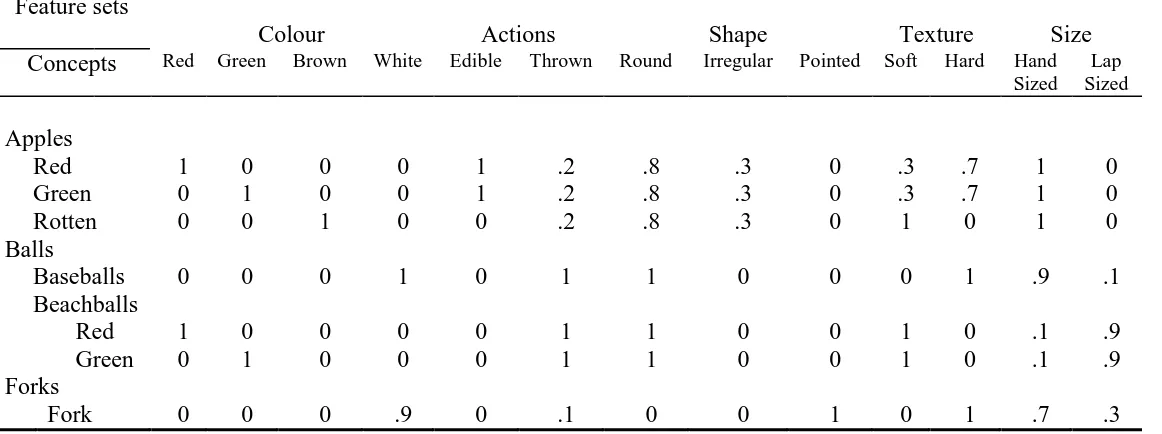
The concepts were defined by a set of prototypical tokens representing
different kinds of apples, balls, and forks that could be encountered in the individual's
world (see Table 1). The network was not trained on the prototypes themselves, but
on exemplars clustered around these prototypes. Exemplars were generated from each
prototype by adding Gaussian noise (variance 0.15) to the original.
The exemplars for each concept formed three training sets used to develop the
network’s three prior-knowledge bases ‘about’ apples, balls, and forks. The existence
of a prior knowledge base is a necessary feature of metaphor comprehension. Prior
knowledge bases are analogous to Black’s (1979) “implicative complex” and reflect
an individual’s personal experience with exemplars of each concept. The apple
sub-network was trained to autoassociate patterns corresponding to 10 exemplars of
each of three apple kinds (e.g., red, green, and rotten) for a total of 30 patterns.
Similarly, the ball sub-network was trained to autoassociate 10 exemplars from three
different kinds (for a total of 30 patterns). Finally, the fork sub-network was trained to
autoassociate 10 exemplars from 1 kind (for a total of 10 patterns). Because there was
only 1 kind of fork (as opposed to 3 kinds of both apples and balls), a single blank
training pattern (zero input and output) was added to the fork training set to inhibit
over-learning of the fork exemplars. All networks were trained with Backpropagation
using the following parameter values: learning-rate: 0.1, momentum: 0.0, initial
weight range: ±0.5. Each sub-network (knowledge-base) was trained for 1000 epochs.
All reported results are averaged over n=10 replications using different random
starting weights and concept exemplars.
After training, the network demonstrated prototype effects in each knowledge
base. They responded most strongly to the prototypes for each category, despite never
encountering them in training (cf. human performance, Posner & Keele, 1968). This
suggests that the Apple, Ball, and Fork categories had been adequately learnt.
Metaphors were processed by the redirection of information flow into one knowledge
base or another. The role of the ‘is’ in the <A is B> metaphor is to trigger that
Results
Interaction between topic and vehicle
Figure 2 shows the transformation of the semantic features of an apple concept for the
metaphor the apple is a ball. The input is an exemplar of apple close to its prototype
kind and is presented to the network storing knowledge about balls. The effect of this
metaphor is to produce as output a representation of apple in which the suitability for
throwing, the hardness, and roundness features are exaggerated, while the edibility
feature is reduced and the colour features become more ambiguous. Provided the
context dependent threshold for semantic distortion is exceeded, this metaphor will be
interpreted to mean that the apple is question is round, hard, and likely to be thrown.
--- Insert Figure 2 about here. ---
In Glucksberg and Keysar’s class inclusion theory (1990), a metaphor
highlights an underlying category of which both topic and vehicle are members (but
the vehicle is the prototypical member). Thus my job is a jail highlights that job is a
member of the underlying category {restraining things}. In the MPC model, one
could see such a new inclusive category as emerging from the juxtaposition. That is,
the features of A that are emphasised by processing in the B network define the
category of which apple and ball are both members (but of which ball is the
prototypical member): {hard round things that can be thrown}. This is a possible
response to Lakoff’s (1993) criticism that in the class inclusion theory, metaphor
comprehension relies on unlikely pre-existing ‘metaphoric attributive categories’ (e.g.
‘restraining things’ in the above example) – in the current model, such attributive
Alternatively, we could describe this transformation in terms of Black's
parallel implication complex. Either way, these modified features are a result of the
interaction of the topic and vehicle. For example, note that despite the fact that 20 of
the 30 Ball exemplars are soft beachballs, apple is still made to look harder rather than
softer by this metaphor. This is because the apple is closer in size to a hard baseball
than it is to a soft beachball. The semantic transformation is not a default imposition
of ball features onto those of an apple, but an interaction between stored ball
knowledge and the nature of the apple exemplar being presented to the ball
sub-network. Thus the model offers an instantiation of Black’s interactive theory of
metaphor comprehension.
We can now attempt to formulate a clearer answer to the question of why in a
metaphor <A is B>, some features of B should be transferred to A but not others. Let
us assume that features x, y, and z tend to co-occur in exemplars of B. Transfer of
feature z from B to A will occur only when features x and y are present in A. Concept
A can ‘key in’ to a strong co-variance of features in B, thus triggering the pattern
completion processes to transfer the additional feature z. Pattern completion would
cause the set of features x, y, z to be completed in A. Such pattern completion is even
more effective if z is already present to some extent in A, so that this feature need
only be exaggerated. Metaphorical comparisons are thus used to exaggerate existing
features of the topic.
The transfer of features also depends on the strictness of co-variance in
exemplars of B. Thus, if x, y, and z always co-occur in B, A is highly likely to inherit
feature z when it already possesses x and y. However, if there are some exemplars of
B which have x and y but not z, transfer is less likely. It may only occur if A shares
In terms of the communicative advantage of metaphor, this model accords
most closely with the compactness hypothesis. That is, vehicles embody a co-variance
of features which, so long as the topic can key into them, may be transferred to the
topic as a whole. Figure 2 demonstrates that the transformation of the features of the
topic is a subtle one – features are not all or nothing, but enhanced or attenuated. It
may also be that transformations of meaning of this sort cannot be achieved by the use
of literal language alone. Thus the model may also accord with the inexpressibility
hypothesis.
The reversibility of metaphors
Glucksberg, McGlone, and Manfredi (1997) have claimed that metaphors are
characterised by the property of non-reversibility, a property that only the class
inclusion model can explain. The authors had subjects rate the sense of literal and
metaphorical comparisons in original (sermons are sleeping pills) and reversed
(sleeping pills are sermons) formats. The subjects also paraphrased the two versions.
The experimenters judged the forward and reverse paraphrases for how much sense
they made. The results showed that literal comparisons were far more reversible than
metaphors. Glucksberg et al concluded that their data “provided strong support for the
claim that metaphors and similes either lose or change meaning when reversed”
(1997, p. 57).
Figure 3 shows the transformation for the metaphor the ball is an apple, the
reverse of the metaphor shown in Figure 2. In Figure 3, the effect of comparing the
ball to an apple is to exaggerate the softness and irregularity and edibility of the ball,
whilst reducing its likelihood of being thrown, its size, and its roundness. The
despite the fact that the feature overlap of ball exemplars and apple exemplars
defining the knowledge bases is the same in each case. The change in meaning
between the forward and reverse metaphors, found in the empirical data, arises in the
MPC model from the non-linear nature of its transformations. These transformations
are not symmetrical.
--- Insert Figure 3 about here. ---
Glucksberg et al noted that literal similarity statements are asymmetric – the
rated similarity changes with the order of presentation of two terms – and that
property matching models can account for this asymmetry by rating properties of the
first and second term differently. However, Glucksberg et al maintained that
non-reversibility is different in kind than asymmetry, and that property-matching models
such as the salience imbalance and the structural mapping model cannot account for
non-reversibility. We see literal and metaphorical comparisons as lying on a
continuum, just as category membership can be a graded rather than binary
phenomenon. We have shown elsewhere that an architecture similar to the MPC
model is able to account for the asymmetry in general similarity judgements (Thomas
& Mareschal, 1997). Reversibility and asymmetry are also matters of degree. Support
for this is provided by Sternberg, Tourangeau, and Nigro (1979) who found an inverse
relationship between the similarity of two terms in a comparison and the aesthetic
impact of that comparison. Metaphors are about having just the right amount of
Predictability of interactions
Glucksberg et al (1997) manipulated the ambiguity of vehicles and the number of
potentially relevant attributes of topics in metaphorical comparisons. They primed
comprehension of metaphors either by prior exposure of the topic or the vehicle. The
results showed that when either ambiguity or number of potentially relevant attributes
was constrained, subjects benefited from the prime, in terms of the time it took them
to comprehend the metaphors. It is difficult to directly relate our current model to
reaction time data, since we do not believe the simple mechanism depicted in our
model is the only mechanism involved in metaphorical comprehension. Other more
complex mechanisms may contribute to a comprehension response time.
Nevertheless, we are able in our model to systematically alter aspects of the topic or
vehicle and demonstrate how the interaction is affected.
Figure 4 shows the metaphorical comparison the apple is a fork. Where there
is little overlap between the concepts, the resulting output shows no strongly activated
features, only a weak activation of the characteristics of a fork. Comparisons
involving a narrowly defined vehicle with little similarity to the topic produce a weak
and non-interactive metaphor.
--- Insert Figure 4 about here. ---
Figure 5 shows the metaphorical comparison the ball is a fork for balls of
various different colours. The results again show weak imposition of the fork’s
characteristics, except when the ball is of the same colour of the fork. In this case, the
topic can key into the narrowly defined vehicle concept and evoke a stronger
--- Insert Figure 5 about here. ---
Figure 6 shows the metaphorical comparison the ball is an apple, again for
balls of various different colours. Here the vehicle, apple, is more ambiguous than
fork, in that it has more widely varying prototypes. The resulting transformation is
thus more interactive – that is, it depends more on the particular features of the topic.
Once more, when the topic keys into a particular co-variance in the vehicle (red and
green apples are firm, rotten brown apples are soft), the nature of the transformation
differs – brown balls are seen as softer as a result of this metaphor in contrast to red
and green balls.
--- Insert Figure 6 about here. ---
Figure 7 shows the metaphorical comparison the apple is a ball, but now
supplying contextual information to further specify the type of ball referred to in the
vehicle. (This is implemented by providing a label to each type of ball during
training). When the apple is compared to a small hard baseball, the transformation is
very different to when it is compared to a large soft beachball. Nevertheless, both
types of ball knowledge are represented over the same hidden units within the
network.
These effects show that under certain circumstances, the nature of the
interaction between topic and vehicle is predictable. With regard to Glucksberg et
al.’s data, we might suggest the following explanation. A topic which has many
potentially relevant properties (e.g. life is a _ ) is less able to prime subsequent
metaphors than a topic with few (e.g. temper is a _ ) since such a topic has many keys
which could engage patterns of co-variant features in the vehicle. Subsequent
interactions are therefore less predictable. A vehicle with a variety of sets of
co-variant features (e.g. _ is an ocean) is a less effective prime that one with few (e.g. _ is
a crutch) since it has more patterns which could be keyed into by the topic. Once
more, the interaction is less predictable. (Examples from Glucksberg et al., 1997).
Further predictions
Our model makes the following testable predictions.
Two phenomena can be predicted on the basis of the way autoassociative
networks generalise to novel patterns given their training set and the degree of
training they have undergone. (1) A lack of variance in the exemplars of the vehicle
category will reduce interactivity in metaphor comparisons - that is, it will produce
the same transfer of attributes across a range of topics. (2) In the same way,
over-trained or highly familiar vehicles will also generate less interactivity in metaphorical
comparisons.
We have proposed an explicit example of how literal and metaphorical
comparisons may involve the same type of processing mechanism. However, for a
metaphorical comparison, the listener does not accept the full meaning change
implied by the comparison, but accepts only features that have been enhanced. This
by the subjects. For example, in the metaphor my rock is a pet, we do not conclude
that the rock is alive. But we predict that (3) given a metaphorical comparison,
subjects will show delayed responses to questions about features of the topic which
they would nevertheless not report as aspects of the metaphorical expression (e.g., for
my rock is a pet, the question ‘Is a rock animate or inanimate?’). Evidence for such
implicit featural change would support the idea that the reported meaning of a
metaphor is the tip of the iceberg of a process of featural enhancement that has much
in common with literal language processing.
Discussion
The relation of literal to metaphorical comparisons
The MPC model uses a categorisation device to transfer attributes of the category
onto a novel input. Categorisation causes a transformation of the input vector to make
it more consistent with the category. Metaphor occurs when the novel input is not a
member of the category to which it is applied. However, category membership is a
graded notion and categories themselves have internal structure, having more or less
typical members (Rosch, 1975).
If we see metaphor as categorisation, it only requires a small step to see literal
and metaphorical categorisation as differing in degree rather than kind. A literal
comparison involves categorisation of a novel input that is a member of the vehicle
category. However, the novel item may be a highly prototypical member of the
category. This defines one end of a continuum. The item may be a less typical
member – still falling within the category but in some sense being less similar to it. A
metaphorical comparison involves an input that has some similarities to the category
involves an input that falls beyond the normal limits and has few if any similarities to
the category.
We propose then, that literal and metaphorical comparisons are on a
continuum of reducing similarity. However, importantly, we propose that literal and
metaphorical comparisons are also distinguished by how the semantic distortion
caused by the categorisation process is then handled. If the change in meaning of the
topic caused by the semantic distortion exceeds (context dependent) expectations, the
comparison is taken to be metaphorical, and the communicative intent is taken to refer
only to the features of the topic that have been amplified by the transformation. If the
threshold is low and we are told that Richard (whom we thought to be a man) is a
lion, we are likely to view this claim as literally false and ask for clarification. A
higher threshold will cause us to focus only on enhanced features of the topic
distortion, viewing the statement as a metaphor. If the threshold expectation of
meaning change is very high (for instance, the listener expects the speaker to convey
brand new information), then the same statement can be taken as literal and all
meaning change accepted as the communicative intent. Richard is a lion can be false,
or it can tell us that a man we know, Richard, is a brave and aggressive man; or it can
tell us that a particular lion has been named Richard (a name usually reserved for
humans). The actual meaning is not derivable from the comparison alone, but depends
on context. Similarly, before context definitively disambiguates the meaning, my job
is a jail could be seen as incongruous (occupations can’t be buildings), or it could tell
us that I feel constrained by my job, or it could tell us that my daytime occupation is
Criticisms of semantic feature explanations of metaphor
The MPC model is based on simple semantic feature representations of concepts.
Such representations have been criticised on a number of grounds as insufficient to
explain the processes of metaphor comprehension. In this section, we consider a
number of these criticisms. Criticisms 1-4 are from Gibbs (1994). Criticism 5
considers the importance of conceptual structure in metaphor comprehension.
Criticism 1: How can feature-based representations deal with semantically
non-deviant representations that are nevertheless metaphorical, i.e. those that can have
a valid literal interpretation? Response: Our response to this criticism is detailed in the
previous section. Simple metaphor comprehension is a two-stage process involving
both semantic distortion caused by the juxtaposition and context-dependent
interpretation of that distortion.
Criticism 2: Feature-based representations seem insufficient to deal with the
complexities of sophisticated metaphorical expressions. Response: At the moment,
this criticism is certainly valid. However, it is also true that we do not know what a
more realistic feature-based representation of meaning looks like. The representations
in our model are undoubtedly too simple to deal with anymore than two term
metaphors involving attribute mapping. We would expect more realistic and complex
feature-based representations to support richer metaphorical distortions in a system
following the same principles – that metaphor relies on pattern completion processes
invoked through deliberate mis-classification.
Criticism 3: The property transferred from vehicle to topic may not be a
property of the vehicle itself (e.g. the girl is a lollipop may be taken to imply that she
is frivolous - but lollipops themselves can be described as frivolous). Furthermore,
legislative program was a rocket to the moon, we might think this implies that both
are fast. But legislative programs and rockets are not fast in the same way. Response:
One response for a feature-based account would be that semantic features are not
lexical concepts. That is, in the previous example, a cluster of semantic features
defines fast for the rocket, and a different cluster, though sharing many of the same
features, defines fast for legislative program. Similarly, in the girl is a lollipop, the
cluster of features which is enhanced in the representation of girl by the knowledge
base for lollipop would share features with the cluster that defines the lexical concept
“frivolous”.
The notion that lexical concepts are made up of features is the essence of
sub-symbolic representation. Features only appear as lexical concepts in our own model
for ease of exposition. Thus ‘hard’ in our model might itself correspond to a set of
lower level features, different groups of which would make up different versions of
hardness. (See Harris, 1994, for an example of a connectionist model exhibiting
sub-symbolic, context dependent meanings of a lexical concept). Clearly such an account
needs to be fleshed out, but we don’t believe that this criticism is a terminal one for
feature-based representations.
Criticism 4: Feature overlap accounts do not explain why metaphors have
directionality. Response: In the section entitled The Reversibility of Metaphors, we
show how the model accounts for the directionality of metaphorical comparisons.
Criticism 5: Feature-based or vector representations cannot deal with
relational structure in concepts. Gentner (1988) has shown that adults prefer topics
and vehicles to be structurally related in metaphors. Response: The current model can
only address part of the metaphor story, for more complex metaphors will necessarily
representations are not easily implemented in connectionist systems. However, recent
work in the connectionist modelling of analogy formation has shown how
feature-based attributes may be dynamically bound to relational structure in a distributed
network (Hummel & Holyoak, 1997). Such a network still exploits similarity-based
processing and pattern completion in forming and retrieving analogies. Moreover,
Henderson and Lane (1998) have shown that such dynamically bound representations
may be learnt in a neural network architecture. We would make two claims. First, we
believe that the approach of the MPC model is extendable to structured
representations in a connectionist system (similar to that of Hummel & Holyoak,
1997). The principles of such a model would be the same: metaphor comprehension
would rely on pattern completion and subsequent semantic distortion in a system
designed for categorisation, in this case of structured concepts. Second, we believe it
important to embed such future accounts in neurally plausible learning systems, which
minimise the proportion of the theory that relies on arbitrary decisions about the
nature of pre-existing structured representations (or, indeed, postulates representations
with no apparently learnability at all).
An interesting avenue of research will be to explain why children show a shift
in preference from attribute mapping to relational mapping during development. Thus
far, we have applied the MPC model only to the emergence of the distinction between
literal and metaphorical similarity in young children, based on the maturity of their
semantic representations (Thomas, Mareschal, & Hinds, under revision). In future
work we hope to explore extensions of the model to include relational structure, and
Conclusion
In this paper we have introduced a simple and predominantly illustrative model of
how metaphor comprehension may be explained as a form of categorisation
(Glucksberg & Keysar, 1990, 1993). We have offered the beginnings of an answer to
the thorny question of why certain attributes are transferred from the vehicle to the
topic in a metaphorical comparison, but not others. The answer was in terms of
attributes that the topic possesses which key into co-variances of features in the
vehicle, and which pattern completion processes in a neural network allow to be
transferred to the topic. This is an essentially interactive account, in line with Black’s
favoured view of metaphor comprehension (1979). The model is able to offer
accounts for recent empirical evidence on the non-reversibility of metaphorical
expressions, and the nature of the interaction between topic and vehicle (Glucksberg
et al., 1997), as well as generating further testable predictions.
Lastly, in wider theoretical terms, the model conforms to the notion that
metaphor comprehension requires no special processes over and above literal
language comprehension, by suggesting that metaphorical language and literal
language are different points on a continuum of meaning change. Literal and
References
Black, M. (1955). Metaphor. Proceedings of the Aristotelian Society, 55,
273-294.
Black, M. (1962). Models and Metaphors. Ithaca, NY: Cornell University
Press.
Black, M. (1979). More about metaphor. In A. Ortony (Ed.), Metaphor and
Thought (pp. 19-43). Cambridge, England: Cambridge University Press.
Fainsilber, L. & Ortony, A. (1987). Metaphorical uses of language in the
expression of emotion. Metaphor and Symbolic Activity, 2, 239-250.
Chandler, S. R. (1991). Metaphor comprehension: A connectionist approach to
implications for the mental lexicon. Metaphor and Symbolic Activity, 6, 227-258.
Gentner, D. (1983). Structure-mapping: A theoretical framework for analogy.
Cognitive Science, 7, 155-170.
Gentner, D. (1988). Metaphor as structure mapping: The relational shift. Child
Development, 59, 47-59.
Gentner, D. & Clements, C. (1988). Evidence for relational selectivity in the
interpretation of analogy and metaphor. In G. Bower (Ed.), The psychology of
learning and motivation (Vol. 22, pp. 307-358). Orlando, FL: Academic Press.
Gibbs, R. W. (1994). The poetics of mind. Cambridge University Press.
Gibbs, R. W. (1996). Why many concepts are metaphorical. Cognition, 61,
309-319.
Gibbs, R. W. & Gerrig, R. (1989). How context makes metaphor
comprehension seem "special". Metaphor and Symbolic Activity, 4, 154-158.
Glucksberg, S. (1991). Beyond literal meanings: The psychology of allusion.
Glucksberg, S. & Keysar, B. (1990). Understanding metaphorical
comparisons: Beyond similarity. Psychological Review, 97, 3-18.
Glucksberg, S. & Keysar, B. (1993). How metaphors work. In A. Ortony (Ed.)
Metaphor and Thought (2nd Ed.). Cambridge: Cambridge University Press.
Glucksberg, S., McGlone, M. S., & Manfredi, D. (1997). Property attribution
in metaphor comprehension. Journal of Memory and Language, 36, 50-67.
Grice, H. P. (1975). Logic and conversation. In P. Cole and J. Morgan (Eds.),
Syntax and semantics: Vol. 3. Speech acts (pp. 41-58). New York: Academic Press.
Harris, C. L. (1994). Back propagation representations for the rule-analogy
continuum. In J. A. Barnden & K. J. Holyoak (Eds.), Advances in connectionist and
neural computation theory, Vol. 3: Analogy, metaphor, and reminding (282-326).
Norwood, NJ: Ablex.
Henderson, J. & Lane, P. (1998). A connectionist architecture for learning to
parse. In Proceedings of COLING-ACL'98 (pp. 531-537).
Holyoak, K. J. & Thagard, P. (1989). Analogical mapping by constraint
satisfaction. Cognitive Science, 13, 295-355.
Hummel, J. E. & Holyoak, K. J. (1997). Distributed representations of
structure: A theory of analogical access and mapping. Psychological Review, 104,
427-466.
Inhoff, A., Lima, S., & Carroll, P. (1984). Contextual effects on metaphor
comprehension in reading. Memory and Cognition, 12, 558-567.
Lakoff, G. (1987). Women, fire, and dangerous things: What categories reveal
about the mind. Chicago: University of Chicago Press.
Lakoff, G. (1990). The invariance hypothesis: Is abstract reason based on
Lakoff, G. (1993). The contemporary theory of metaphor. In A. Ortony (Ed.)
Metaphor and Thought (2nd Ed.). Cambridge: Cambridge University Press.
Lakoff, G. & Johnson, M. (1980). Metaphors we live by. Chicago: University
of Chicago Press.
Lakoff, G. & Turner, M. (1989). More than cool reason: A field guide to
poetic metaphor. Chicago: University of Chicago Press.
Landauer, T. K., & Dumais, S. T. (1997). A solution to Plato's problem: The
latent semantic analysis theory of acquisition, induction, and representation of
knowledge. Psychological Review, 104, 211-240.
Lund, K. & Burgess, C. (1996). Producing high-dimensional semantic spaces
from lexical co-occurrence. Behaviour Research Methods, Instruments and
Computers, 2, 203-208.
McClelland, J. L. & Rumelhart, D. E. (1986). A Distributed Model of Human
Learning and Memory. In J. L. McClelland, D. E. Rumelhart, & The PDP Research
Group, Parallel Distributed Processing: Explorations in the Microstructure of
Cognition. Vol. 2: Psychological and Biological Models, (pp. 170-215). Cambridge,
MA: MIT Press.
McGlone, M. S. (1996). Conceptual metaphors and figurative language
interpretation: Food for thought? Journal of Memory and Language, 35, 544-565.
McRae, K., Cree, G. S., & McNorgan, C. (1998). Semantic similarity priming
without hierarchical category structure. In Proceedings of the 20th Annual Meeting of
the Cognitive Science Society, (pp. 681-686). Erlbaum.
Narayanan, S. (1999). Moving right along: A computational model of
metaphoric reasoning about events. Proceedings of the National Conference on
Ortony, A. (1975). Why metaphors are necessary and not just nice.
Educational Theory, 25, 45-53.
Ortony, A. (1979). Beyond literal similarity. Psychological Review, 86,
161-180.
Ortony, A. (1993). The role of similarity in similes and metaphors. In A.
Ortony (Ed.), Metaphor and Thought 2nd Ed., (pp. 342-356). Cambridge, England:
Cambridge University Press.
Ortony, A., Schallert, D., Reynolds, R., & Antos, S. (1978). Interpreting
metaphors and idioms: Some effects of context on comprehension. Journal of Verbal
Learning and Verbal Behaviour, 17, 465-477.
Plaut, D., McClelland, J. L., Seidenberg, M., & Patterson, K. (1996).
Understanding normal and impaired reading: Computational principles in
quasi-regular domains. Psychological Review, 103, 56-115.
Plaut, D. & Shallice, T. (1993). Deep dyslexia: A case study of connectionist
neuropsychology. Cognitive Neuropsychology, 10, 377-500.
Plunkett, K., Sinha, C., Mueller, M. F., & Strandsby, O. (1992). Symbol
grounding or the emergence of symbols? Vocabulary growth in children and a
connectionist net. Connection Science, 4, 293-312.
Rosch, E. (1975). Cognitive representations of semantic categories. Journal of
Experimental Psychology: General, 104, 192-223.
Rumelhart, D. E., & McClelland, J. L. (1986). Parallel Distributed Processing:
Explorations in the Microstructure of Cognition. Vol. 1: Foundations. Cambridge,
MA: MIT Press.
Posner, M. & Keele, S. (1968). On the genesis of abstract ideas. Journal of
Searle, J. (1975). Indirect speech acts. In P. Cole and J. Morgan (Eds.), Syntax
and semantics: Vol. 3. Speech acts (pp. 59-82). New York: Academic Press.
Small, S. L., Hart, J., Nguyen, T., & Gordon, B. (1996). Distributed
representations of semantic knowledge in the brain: Computational experiments using
feature based codes. In J. Reggia, E. Ruppin, & R. S. Berndt, Neural modelling of
brain and cognitive disorders. World Scientific.
Sternberg, R. J., Tourangeau, R., & Nigro, G. (1979). Metaphor, induction,
and social policy: The convergence of macroscopic and microscopic views. In A.
Ortony (Ed.), Metaphor and Thought, (pp. 277-306). Cambridge, England: Cambridge
University Press.
Sun, R. (1995). A microfeature based approach towards metaphor
interpretation. In Proceedings of the 14th International Joint Conference on Artificial
Intelligence, Montreal, Canada, pp. 424-429.
Thomas, M. S. C. & Mareschal, D. (1997). Connectionism and psychological
notions of similarity. In M. G. Shafto & P. Langley (Eds.), Proceedings of the 19th
annual conference of the Cognitive Science Society (pp. 757-762). Erlbaum.
Thomas, M. S. C., Mareschal, D., & Hinds, A. C. (under revision). A
connectionist account of the emergence of the Literal-Metaphorical-Anomalous
distinction in young children.
Tversky, A. & Gati, I. (1982). Similarity, separability, and the triangle
inequality. Psychological Review, 89, 123-154.
Veale, T. & Keane, M. T. (1992). Conceptual scaffolding: A spatially founded
meaning representation for metaphor comprehension. Computational Intelligence, 8,
Weber, S. H. (1994). A structured connectionist model of figurative adjective
noun combinations. In J. A. Barnden & K. J. Holyoak (Eds.), Advances in
connectionist and neural computation theory, Vol. 3: Analogy, metaphor, and
Footnotes
Footnote 1. The use of separate banks of hidden units is not a necessary assumption of
the model. ‘Soft’ modularity of knowledge bases can be achieved by using input and
Tables
Table 1: Prototype feature sets for each category.
Feature sets
Colour Actions Shape Texture Size
Concepts Red Green Brown White Edible Thrown Round Irregular Pointed Soft Hard Hand
Sized Lap Sized
Apples
Red 1 0 0 0 1 .2 .8 .3 0 .3 .7 1 0
Green 0 1 0 0 1 .2 .8 .3 0 .3 .7 1 0
Rotten 0 0 1 0 0 .2 .8 .3 0 1 0 1 0
Balls
Baseballs 0 0 0 1 0 1 1 0 0 0 1 .9 .1
Beachballs
Red 1 0 0 0 0 1 1 0 0 1 0 .1 .9
Green 0 1 0 0 0 1 1 0 0 1 0 .1 .9
Forks
Figure Captions
Figure 1. Architecture of the MPC model.
Figure 2. Transformations of semantic features by a metaphorical comparison
(Topic/Input = Apple; Vehicle/Network = Ball).
Figure 3. The non-reversibility of metaphorical comparisons (see text).
Figure 4. When metaphors fail: interactions between topic and vehicle (see text).
Figure 5. The role of the topic in determining the interaction between topic and
vehicle (see text).
Figure 6. The role of the topic in determining the interaction between topic and
vehicle (see text).
Figure 7. The role of the vehicle in determining the interaction between topic and
Input Semantic Features Output Semantic Features
Knowledge base Selector
‘Fork’ hidden units ‘Apple’
hidden units
Input