Counseling and Psychological Services Dissertations
Department of Counseling and Psychological Services
Fall 11-15-2010
Long-Term Effects of Bullying: Exploring the
Relationships among Recalled Experiences with
Bullying, Current Coping Resources, and Reported
Symptoms of Distress
Courtney Brooke Chambless
Georgia State University
Follow this and additional works at:https://scholarworks.gsu.edu/cps_diss
This Dissertation is brought to you for free and open access by the Department of Counseling and Psychological Services at ScholarWorks @ Georgia State University. It has been accepted for inclusion in Counseling and Psychological Services Dissertations by an authorized administrator of ScholarWorks @ Georgia State University. For more information, please [email protected].
Recommended Citation
This dissertation, LONG-TERM EFFECTS OF BULLYING: EXPLORING THE RELATIONSHIPS AMONG RECALLED EXPERIENCES WITH BULLYING, CURRENT COPING RESOURCES, AND REPORTED SYMPTOMS OF DISTRESS, by COURTNEY CHAMBLESS, was prepared under the direction of the candidate‟s Dissertation Advisory Committee. It is accepted by the committee members in partial fulfillment of the requirements for the degree Doctor of Philosophy in the College of Education, Georgia State University.
The Dissertation Advisory Committee and the student‟s Department Chair, as representatives of the faculty, certify that this dissertation has met all standards of excellence and scholarship as determined by the faculty. The Dean of the College of Education concurs.
_____________________________ _________________________
Joel Meyers, Ph.D. Catherine Brack, Ph.D.
Committee Chair Committee Member
____________________________ _________________________
Greg Brack, Ph.D. Kenneth Matheny, Ph.D.
Committee Member Committee Member
____________________________ Kris Varjas, Psy.D.
Committee Member
___________________________ Date
_____________________________ JoAnna F. White, Ed.D.
Chair, Department of Counseling and Psychological Services
_____________________________ R. W. Kamphaus, Ph.D.
By presenting this dissertation as a partial fulfillment of the requirements for the
advanced degree from Georgia State University, I agree that the library of Georgia State University shall make it available for inspection and circulation in accordance with its regulations governing materials of this type. I agree that permission to quote, to copy from, or to publish this dissertation may be granted by the professor under whose direction it was written, by the College of Education's director of graduate studies and research, or by me. Such quoting, copying, or publishing must be solely for scholarly purposes and will not involve potential financial gain. It is understood that any copying from or publication of this dissertation which involves potential financial gain will not be allowed without my written permission.
All dissertations deposited in the Georgia State University library must be used in
accordance with the stipulations prescribed by the author in the preceding statement. The author of this dissertation is:
Courtney Brooke Chambless 980 Hill Street Atlanta, GA 30315
The director of this dissertation is:
Dr. Joel Meyers
Department of Counseling and Psychological Services College of Education
Courtney B. Chambless
ADDRESS: 980 Hill Street Atlanta, GA 30315
EDUCATION:
Ph.D. 2010 Georgia State University Counseling Psychology M.S. 2005 Georgia State University
Counseling and Psychological Services M.A. 2001 University of Georgia
Educational Psychology B.A. 1999 University of Georgia
Psychology
PROFESSIONAL EXPERIENCE:
2009-present Pre-doctoral Intern
University Counseling Center University of Utah
PROFESSIONAL ORGANIZATIONS:
American Psychological Association (APA) American Counseling Association (ACA)
PROFESSIONAL PRESENTATIONS
Chambless, C.B., White, N., Ruffner, C., Odenant, L., Ashby, J. (2007, August).
Influence of adult and peer approval of alcohol and drugs on adolescent usage.
Poster session submitted for the American Psychological Association Annual Convention, San Francisco, CA.
Chambless, C.B., Meyers, J.P. (2005, March). Creating an alternative to the concept of persistently dangerous schools: Framework for acknowledging persistently safe schools. Poster presented at the American Counseling Association Annual Convention, Atlanta, GA.
Chambless, C.B., Grogg, K.R., Franks, A. (2005, February). Evaluating the sustained, systemic implementation of a social skills training program. Paper presented at the National Association of School Psychologist Annual Convention, Atlanta, GA.
Davis, H. A., Chambless, C. B., Couch, K. N., Schutz, P. A., Goreman, A., & Long, C. (2000, August). Predicting the quality of relationships between middle school students and teachers. Paper presented at the American Psychological
different lenses. Paper presented at the American Educational Research Association Annual Convention, Seattle, WA.
Odenat, L., White, N., Ruffner, C., Marshall, M., Chambless, C., Meyers, J. PhD, & Ashby, J. PhD. (2007, August). Perceptions of Harmfulness, Drug Prevention Education, & Adolescent Drug Use. Poster presented at the American
Psychological Association Annual Convention, San Francisco, CA.
Schutz, P., Chambless, C. B., & DeCuir, J. T. (2003). “Multimethod Research” Chapter included in K.B. deMarrais‟s & S.D. Lapan‟s (eds.) Inquiry Frameworks in the Social Sciences: Frameworks for Knowing and Doing.
Schutz, P. A., Davis, H. A., DeCuir, J. T., Chambless, C. B., University of Georgia, and Claire Ellen Weinstein, Thea Woodruff, Dong Wook Yang, University of Texas at Austin (2001, April). Emotional regulation during self-direction. Roundtable presented at the American Educational Research Association Annual Convention, Seattle, WA.
LONG-TERM EFFECTS OF BULLYING: EXPLORING THE RELATIONSHIPS AMONG RECALLED EXPERIENCES WITH BULLYING, CURRENT COPING
RESOURCES, AND REPORTED SYMPTOMS OF DISTRESS by
Courtney B. Chambless
Retrospective studies of college students who recall experiencing bullying during
childhood and/or adolescence have found that being the target of bullying may place one
at greater risk for depression (Roth, Coles, & Heimburg, 2002; Storch et al., 2001),
anxiety disorders (McCabe, et al., 2003; Roth et al.) and interpersonal relationships
(Schafer et al., 2004) in comparison to peers who do not recall a history of bullying
during childhood or adolescence. However, researchers have found that not all targets of
bullying develop such problems in adulthood (Schafer et al., 2004; Dempsey & Storch,
2008). Little attention has been devoted to understanding resiliency among adults who
experienced bullying during childhood and/or adolescence (Davidson & Demaray, 2007).
The purpose of this dissertation was to 1). Explore gender and racial/ethnic differences in
recall of perceived seriousness of past bullying experiences 2). Replicate past findings
regarding the association between past experiences with bullying and depression, anxiety,
and loneliness in college students 3). Explore whether coping resources accounted for
differences in symptoms of distress. A total of 211 college students completed the
Retrospective Bullying Questionnaire (Schaefer, et al, 2004); The Brief Symptom
Inventory (Derogatis, 1982); UCLA Loneliness Scale (Russell, 1996) and the Coping
Resources Inventory for Stress-Short form (CRIS-SF; Matheny, Curlette, Aycock, &
Curlette, 1993). Multivariate analysis of variance (MANOVA) was used to investigate
between psychosocial distress in adults and past experiences with bullying. Females in
this study reported that they perceived their experiences with relational bullying during
middle/high school to be more serious than males. There were no significant differences
between males and females in perceived seriousness of physical bullying during
elementary or middle/high school, verbal bullying during elementary or middle/high
school or relational bullying during elementary school. Males and females did not differ
significantly in the duration of bullying experiences. White students reported that they
perceived their experiences with relational and verbal bullying during middle/high school
in middle/high school to be more serious. There were no significant differences between
the racial/ethnic groups in perceived seriousness of physical, verbal, or relational bullying
during elementary school. There also were no significant differences among the
racial/ethnic groups duration of bullying. Implications for future research and clinical
practice are addressed. Perceived seriousness of bullying and duration of bullying during
childhood and adolescence was found to predict depression, anxiety, and loneliness.
CURRENT COPING RESOURCES, AND REPORTED SYMPTOMS OF DISTRESS
by
Courtney B. Chambless
A Dissertation
Presented in Partial Fulfillment of Requirements for the Degree of
Doctor of Philsophy in
Counseling Psychology in
the Department of Counseling and Psychological Services in
the College of Education Georgia State University
i Copyright by Courtney B. Chambless
ii
ACKNOWLEDGMENTS
I would like to thank my committee members, Dr. Joel Meyers, Dr. Cathy Brack, Dr. Greg Brack, Dr. Ken Matheny, and Dr. Kris Varjas. This dissertation would not have been possible without your support, mentorship, and patience
Mom and Dad, thank you for always supporting me and teaching me the value of education.
To Mary Ann and Jim Stephens, your encouragement has meant the world to me.
Dan, I don‟t even know how to begin to thank you. I think this Ph.D. may be just as much yours as it is mine. Thank you for all the late night proofreading, words of
encouragement, and the sacrifices you have made over the years.
iii
TABLE OF CONTENTS
Page
List of Tables ... iv
List of Figures ...v
Abbreviations ... vi
Chapter 1 A PROPOSED FRAMEWORK FOR UNDERSTANDING THE LONG-TERM EFFECTS OF BULLYING: IMPLICATIONS FOR COLLEGE COUNSELORS ...1
Bullying...2
Implications for Research and Practice for College Counseling Centers ...15
References ...23
2 LONG-TERM EFFECTS OF BULLYING: EXPLORING THE RELATIONSHIPS AMONG RECALLED EXPERIENCES WITH BULLYING, CURRENT COPING RESOURCES, AND REPORTED SYMPTOMS OF DISTRESS ...31
Review of the Literature ...32
Method ...44
Results ...50
Discussion ...68
References ...77
iv
LIST OF TABLES
Table Page
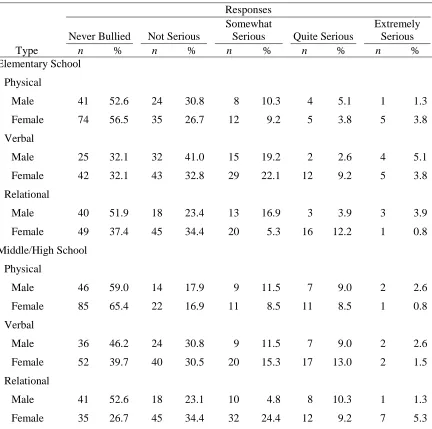
1 Perceived Seriousness of Bullying in Elementary and Middle/High School ...53
2 Descriptive Statistics of Measures in the Study ...53
3 Correlations Between Variables ...55
4 Perceived Seriousness of Bullying in Elementary and Middle/High School
by Gender ...56
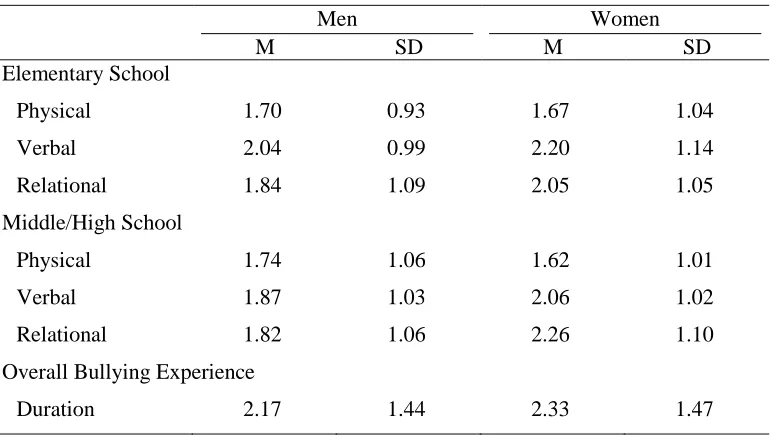
5 Means and Standard Deviations of Perceived Seriousness of Bullying in
Elementary and Middle/High School by Gender ...58
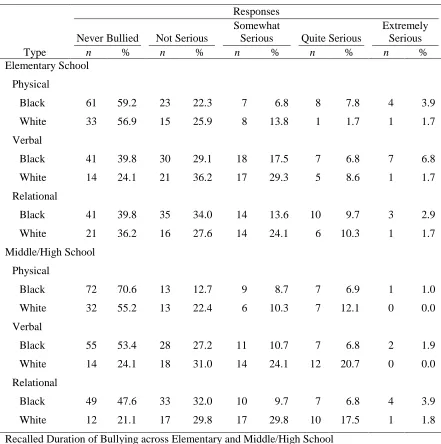
6 Perceived Seriousness of Bullying Experiences by Race/Ethnicity ...60
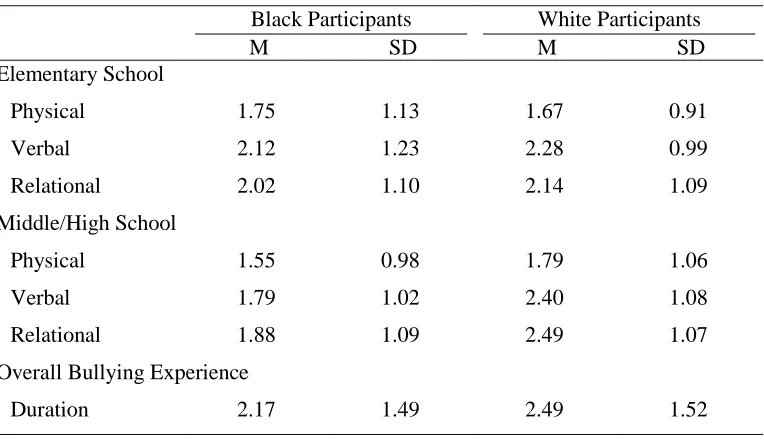
7 Means and Standard Deviations of Bullying Experiences by Race/Ethnicity ...61
8 Results of Linear Regression Testing CRE as a Moderator in the
v
LIST OF FIGURES
Figure Page
vi
ABBREVIATIONS
ANX Anxiety
BSI Brief Symptom Inventory CONF Confidence
CRIS-SF Coping Resources Inventory for Stress-Short Form CRE Coping Resource Effectiveness
DEP Depression LONE Loneliness
CRIS-SF Coping Resource Inventory for Stress, Short Form RBQ Retrospective Bullying Questionnaire
SS Social Support
1 CHAPTER 1
A PROPOSED FRAMEWORK FOR UNDERSTANDING LONG-TERM
EFFECTS OF BULLYING: IMPLICATIONS FOR COLLEGE
COUNSELING CLINICIANS
Retrospective studies (e.g., Chapell et al., 2006; Chapell et al., 2008) of past
bullying experiences among college students have documented that up to 72% (Chapell et
al., 2006) recalled that they were the target of bullying at least once during their
elementary or middle school years. These experiences may be of concern to college
counselors as bullying during the childhood and adolescent years has been found to be
associated with a greater risk for mental health and relational problems during the college
years (e.g., Dempsey & Storch, 2008; Hawker & Boulton, 2000; Jantzer, Hoover, &
Narloch, 2006; Newman, Holden, & Delville, 2005; Olweus, 1993; Schafer et al., 2004;
Tritt & Duncan, 1997).
Researchers also have found that not all targets of bullying develop such problems
in adulthood (Hawker & Boulton, 2000; Jantzer et al., 2006; Newman et al., 2005;
Olweus, 1993; Schafer et al., 2004). Despite the mounting evidence that school-aged
bullying may have implications for psychosocial functioning during the college years
(Dempsey & Storch, 2008; Hawker & Boulton, 2000; Jantzer et al., 2006; Newman et al.,
2005; Olweus, 1993; Schafer et al., 2004; Tritt & Duncan, 1997) there is limited
information in the college counseling literature for understanding why some college
students who were targets in elementary through high school may experience problems
while others do not. The purpose of this article is to address this gap in the literature by
the literature in positive psychology and cognitive theory may help explain resiliency
among former victims of bullying. Suggestions for future research and implications for
college mental health practitioners also are discussed.
Bullying
Definitions of Bullying
In order to be able to accurately assess for past bullying experiences, it is
important for college counselors to have an understanding of what behaviors constitute
bullying. A commonly referenced definition of bullying posits that bullying is a chronic
form of victimization involving unprovoked attempts to harm the other person (Olweus,
1993). Building on Olweus‟s initial definition of bullying, many researchers examining
bullying behaviors acknowledged the following five features of bullying (Griffin &
Gross, 2004; Roth, Coles, & Heimburg, 2002; Tritt & Duncan, 1997): (1) bullying
consists of behavior that is directed towards a victim with the intention to harm or instill
fear in the victim; (2) the behavior occurs without provocation from the victim; (3) the
aggression occurs repeatedly over a period of time (4) the behavior occurs within the
context of a social group; and (5) an imbalance of power exists between the aggressor
and victim. Bullying can take the form of physical attacks (hitting, kicking, or shoving);
direct verbal attacks (calling a student names, saying hurtful or unpleasant things); or
relational aggression (purposely excluding a student, starting rumors).
Long-term Effects of Bullying.
Researchers have begun to establish a literature base documenting the long-term
effects of childhood/adolescent bullying among college students (Dempsey & Storch,
Schafer et al., 2004; Tritt & Duncan, 1997). Adequate assessment of the nature of clients‟
presenting problems, as well as factors contributing to these problems is critical to
providing effective treatment (Hood & Johnson, 2002). Understanding the aspects
associated with the long-term effects of bullying may strengthen the initial assessment
phase of counseling by assisting college mental health professionals to identify former
victims of bullying and determining if further assessment of associated consequences is
needed. Retrospective studies of college students who experienced bullying during
childhood and/or adolescence were more likely than non-bullied peers to experience
depression (Roth et al. 2002; Storch et al., 2001), anxiety disorders (McCabe, et al., 2003;
Roth, Cole, &Heimburg) and problems in interpersonal relationships (Ledley et al, 2006;
Schafer et al., 2004). College students who recalled a history of bullying during school
age years reported more symptoms of depression in comparison to adults who did not
recall experiencing bullying during their primary and secondary school years (Hawker &
Boulton; Jantzer et al.; Olweus, 1993). Additionally, college students who reported being
former victims of school-aged bullying were more likely to endorse feeling that they had
little control over outcomes in their lives (Dempsey & Storch, 2008) and lower
self-esteem (Olweus). These factors also have been found to be associated with a greater risk
for depression (Orth, Robins, Trzesniewski, Maes, & Schmitt, 2009; Robbins & Hayes,
1995).
In addition to symptoms related to depression (Roth et al., 2002; Storch et al.,
2001), college mental health clinicians hould also be aware that college students who
recalled a history of bullying reported more symptoms of anxiety in comparison to
al, 2003). In studies examining retrospective recall of bullying experiences, college
students who reported being the target of school-age bullying were more likely to endorse
items related to anxiety in comparison to non-bullied peers (Dempsey & Storch;
Gladstone et al.; McCabe et al). Similarly, in a study of adult males who reported being
the target of weekly bullying for five or more years during adolescence, participants
attributed their current symptoms of anxiety to their former bullying victimization.
(Gladstone et al.). In addition to reporting more symptoms of anxiety (e.g., Dempsey &
Storch; Gladstone et al.; McCabe et al), McCabe and colleagues found that college
students who recalled a history of bullying during childhood and/or adolescence reported
an earlier onset of anxiety disorders and increased anxiety in social situations than those
who did not recall a history of bullying. In the same study, formerly bullied college
students were more likely than non-bullied peers to report viewing the world as a
dangerous place (McCabe et al.), a cognitive pattern also related to anxiety disorders
(Hawker & Boulton, 2000).
There also is at least one study that provides evidence indicating a potential link
link between school-age bullying and post-traumatic stress during childhood and
adolescence (Rivers, 2004). In a study of 119 lesbian, gay, and bi-sexual men and women
who recalled experiencing bullying related to their sexual orientation, Rivers found that
17% of the participants reported experiencing symptoms of post-traumatic stress. Over
25% of participants in this study reported continued distress associated with remembering
their bullying experiences and 21% reported that they continued to experience intrusive
memories related to bullying events. Because there are no current studies that have
between post-traumatic stress and bullying is attributable solely to the bullying
experiences or if it is connected to additional stressors related to homophobia and
heterosexism. Lesbian and gay youth have been found to report higher rates of
school-based victimization than heterosexual peers (Berrill, 1992; D‟Augelli, Pilkington, &
Hershberger, 2002; Poteat & Espelage, 2005) which may lead to greater likelihood of
experiencing symptoms associated with post-traumatic stress. Additionally, Poteat and
Espelage (2007) and D‟Augelli and colleagues have found that homophobic victimization
had a significant effect on reported rates of post-traumatic stress and problems with social
adjustment and in secondary school students. Further research is needed to explore the
relationship between school- In addition to depression (Roth et al., 2002; Storch et al.,
2001), anxiety disorders (McCabe et al., 2003; Roth et al.) and symptoms of post
traumatic stress (Rivers, 2004), college students who formerly experienced school-age
bullying also may be at greater risk than non-bullied peers for experiencing loneliness
and difficulty forming secure attachments in romantic relationships (Dempsey & Storch,
2008; Schafer et al., 2004; Tritt & Duncan, 1997). A history of bullying has been found
to be a significant predictor of high levels of loneliness in college students (Dempsey &
Storch; Schafer et al.; Tritt & Duncan). In addition, college students who recalled being
the target of school aged bullying also were more likely than non-bullied students to
endorse items regarding apprehension of others‟ evaluation of them; greater expectations
that others would evaluate them negatively; more distress related to perceived negative
evaluations; and avoidance of situations in which evaluation might occur (Dempsey &
Storch). These cognitive styles have been noted to be correlates of loneliness (Storch &
were bullied in elementary and high school identified more difficulty maintaining
friendships.
There also may be a link between bullying and social phobia (Gladstone et al.,
2006), a psychological disorder also associated with loneliness (Neal & Edelmann, 2003).
Gladstone and colleagues found that young adults who reported experiencing bullying
during childhood or adolescence were more likely to have a diagnosis of social phobia in
comparison to adults who were not bullied. However, it should be noted that this study
included a community sample rather than a college student population. While the link
between social phobia and early experiences with bullying has not been replicated in
college student populations, college counselors may need to be aware of the potential link
between social phobia and former experiences with bullying as they may want to explore
symptoms of social phobia among former victims of bullying during the initial
assessment phase.
College students who were bullied during childhood and/or adolescence also may
be at greater risk for bullying during the college years (Chapell et al., 2004). While there
is an assumption that bullying is rare on college campuses, at least one study have found
that that bullying occurred with regularity on college campuses (Chapell et al.). In a
survey of 1,025 college students, 60% of respondents reported that they had observed
another student being bullied, and over 44% of respondents had witnessed a professor or
instructor bully a student (Chapell et al.). Chapell and colleagues (2006) found a
significant positive correlation between experiencing bullying during childhood and/or
adolescence and being the target of bullying during the college years. This finding is
bullying may be at greater risk for current experiences of bullying, which may also have
implications for treatment.
Factors of Bullying Associated with Long-term Effects
In addition to understanding the potential symptoms associated with earlier
experiences with bullying, it may also be important for college counselors to understand
the factors associated with differential effects (Rivers & Cowie, 2006), as this would
strengthen the initial assessment phase by providing information about whether bullying
experiences are likely to be affecting current functioning. Frequency, duration, and
timing of bullying have been identified as potential contributing factors to the
development of long-term problems during the college years (Jantzer et al., 2006;
Newman et al., 2005; Schafer et al., 2004; Tritt & Duncan, 1997). In a retrospective study
of 853 college students, Newman and colleagues found that as the recalled frequency of
bullying increased and the recalled duration of bullying during childhood/adolescence
increased, symptoms of distress during adulthood also increased. Greater frequency of
bullying also has been found to be negatively correlated with trust in relationships and
satisfaction with quality of friendships among college students (Jantzer et al.). Tritt and
Duncan found that college students who reported greater frequency of bullying also were
more likely to report lower levels of self-esteem.
Duration of bullying is another factor that appears influential in the development
of long-term effects (Schafer et al., 2004). College students who recalled being the
subject of bullying throughout their primary and secondary school years were more likely
to report problems with psychological distress than those who were only bullied only
al.). Perceived isolation during bullying events also has been found to be significantly
associated with higher reported levels of distress. More specifically, those who were
bullied and perceived themselves as isolated, were more likely to report elevated
symptoms of distress than those who were bullied, but did not recall feeling isolated at
the time of bullying (Newman et al., 2005).
Age at the time of bullying also may be an important factor associated with
long-term effects of bullying (Schafer et al., 2004). There is some evidence that bullying
during secondary school may be more influential than bullying during the primary school
years. Schafer and colleagues found that young adults who recalled only being bullied
during secondary school were more likely to have a fearful attachment style and reported
lower self-esteem in relationships than individuals who recalled only being bullied during
primary school years. However, duration appeared to be a stronger predictor of these
problems than age at the time of bullying.
Understanding Long-term Effects of Bullying
Results of current research support the notion that bullying during childhood and
adolescence may have long-term consequences for mental health, including greater risk
for depression, anxiety, loneliness, post traumatic stress, and problems with interpersonal
functioning (Hawker & Boulton, 2000; Jantzer et al., 2006; Newman et al., 2005; Rivers,
2004; Schafer et al., 2004; Tritt & Duncan, 1997). These patterns of symptoms were
similar to symptoms displayed in children who are currently being bullied (e.g., Andreou,
2000; Craig, 1998; Espelage & Swearer, 2003; Slee 1995; Smokwoski & Holland, 2005),
suggesting that the effects of bullying may persist into young adulthood. Despite these
lead to long-term patterns of distress among former victims of bullying (Jantzer et al.;
Newman et al.; Schafer et al.) or that may facilitate resilience among former victims of
bullying. Applying a resilience framework informed by positive psychology and
cognitive theory to the experience of bullying may enhance our understanding of
long-term effects and the processes that promote adjustment among former victims of
bullying. Furthermore, understanding resiliency within the context of bullying may
provide information for college mental health clinicians to guide the initial assessment
phase of counseling and to identify appropriate interventions for clients.
Resilience refers to a “phenomena characterized by patterns of positive adaptation
in the context of significant adversity or risk” (Masten, 2001, p. 75). A potential
framework for understanding resiliency among former victims of bullying is Meyers and
Meyers‟ (2003) revision of Albee‟s (1988) prevention formula. According to the Meyers
and Meyers‟ model, resiliency can be increased when variables such as subjective
well-being, feelings of competence, and educational/social/medical supports are enhanced.
Decreasing the strength of variables such as individual predisposition to psychosocial
problems, stress, and exploitation (e.g., racism, implications of socio-economic status,
abuse) are also likely to increase resilience. Meyers and Meyers suggested that the model
could be thought of in terms of a formula, where factors associated with increasing
opportunities for positive development/adjustment (e.g., subjective well-being,
competence, and supports) were represented in the numerator and factors such as
individual predisposition, stress, and exploitation that may have hindered resilience were
Learning/Adjustment Positive Development =
Subjective Well-being + Competence + Supports
Individual Predisposition + Stress + Exploitation
Figure 1. Meyers and Meyers‟s Model Revised Prevention Formula
In the Meyers and Meyers‟ (2003) model, factors such as stress, individual
predisposition, and exploitation are considered potential hindrances to resiliency. Stress
refers to external demands or events that place excessive strain on an individual and
exhaust the individual‟s resources for coping with such demands. Examples of sources
stress may include experiences such as parental divorce, death of a loved one, and illness
(Meyers & Meyers). Within this model, bullying may serve as a stressor if it is perceived
by the victim as an on-going threat to physical safety, emotional well-being, and
self-esteem (Newman et al., 2005; Olweus, 1993). Individuals who have experienced
additional stressors, are at greater risk for exploitation, and/or who possess
predispositions for anxiety, depression, and problems in interpersonal functioning, might
be more likely to exhibit problems associated long-term effects of bullying, including
depression, anxiety, loneliness, and problems in relationships.
Individual predisposition refers to characteristics of the individual (e.g., a genetic
or biological predisposition for anxiety, depression, etc.) that may place a person at risk
for problems in psychosocial functioning (Meyers & Meyers, 2003). It also may include
tendencies to engage in negative attributions, factors associated with depression and
anxiety. Drawing from cognitive theory (Beck, 1964, 1976, 1993; Beck et al., 1985),
former victims of bullying who are more prone to negative appraisals of events may be
predisposed to problems such as depression, anxiety, loneliness, and relationship
negative appraisals. These tendencies also relate to the construct of competence, which
are further explained later in this chapter.
Exploitation refers to environmental stress resulting from systematic differences
in power between groups that lead to inequities in accessing resources (e.g., health care,
education, mental health services) which may result in decreased opportunities for
positive adjustment (Meyers & Meyers, 2003). Potential examples of sources of
exploitation include social economic status, race/ethnicity, and sexual orientation.
Victims of bullying who belong to marginalized groups may face additional challenges
such as racism, classism, and limited access to other resources/support which might
further hinder resiliency. Conversely, increased access to resources may reduce
exploitation, thereby enhancing the opportunity for positive adjustment (Meyers &
Meyers).
While individual predisposition, stress, and exploitation are theorized to be
potential hindrances to positive adjustment, factors such as subjective well-being,
support, and competence may facilitate resilience. Subjective well-being refers to “how
well a person likes the life he or she leads” (Veenhoven, 1984, p. 22). It is tied to
subjective appraisals of events (i.e., threat appraisals associated with events) and affective
responses (Andrews & Withey, 1976). In its simplest form, persons who make more
positive appraisals of events are more likely to experience positive affect and therefore,
are more likely to report higher subjective well-being (Diener, 1994; Veenhoven;
Andrews & Withey). While stressors such as bullying may pose a threat to subjective
well-being (Diener, 2000) it also ispossible that those who have other sources that
Competence encompasses the following constructs: emotional competence, social
competence, social cognitions, and flow (Meyers & Meyers, 2003). Applying the concept
of competence to bullying, victims of bullying who have other activities from which they
derive pleasure and a sense of mastery may be more likely to demonstrate resiliency.
Those who are high in emotional competence and social competence may also have
additional resources to cope with bullying, and therefore, may be less likely to develop
long-term effects associated with bullying (Meyers & Meyers). Coping resources
(Hobfoll, 1989), which refers to one‟s ability to successfully navigate stressors, may also
fall into the category of competence.
In contrast, those with low competence or fewer opportunities to develop
competence, may be more likely to internalize (or attribute) bullying victimization to
internal factors. This tendency to internalize may lead to a belief that being the target of
bullying is indicative that he or she is flawed. Internalization refers to the tendency to
attribute outside events to internal factors. Cognitive theory can provide insight into how
the process of internalization of bullying events could potentially contribute to eventual
long-term effects such as depression and anxiety. According to cognitive theory, the
meaning one ascribes to events determines the affective response (Beck, 1964; 1993).If
this tendency toward negative internalization persists, then these individuals may be at
greater risk for depression, anxiety, and or problems in relationships (Beck, 1976; Beck,
Emery, & Greenberg, 1985; Beck, Rush, Shaw, & Emery, 1979).
In Beck‟s (1976) example of a young boy being teased by his friends, he
provided an illustration of how internal evaluations of an event can be influential in
might be that his friends are simply joking with him. The boy‟s internal evaluation might
be that he is “a weakling” or “they don‟t like me” (Beck, p. 48). Because these internal
evaluations, or private meanings, are often regarded as embarrassing, the individual is
less likely to examine these beliefs with others. Without the opportunity for others to
challenge such thoughts these negative perceptions about the self may persist and
continue to influence beliefs about the self. Since children and adolescents who were
targets of bullying were more likely to be socially isolated (Boulton, Trueman, & Chau,
1999; Espelage & Swearer, 2003; Olweus, 1993; Wang, Iannotti, & Nansel, 2009) these
individuals may be particularly unlikely to have such negative perceptions disconfirmed
by others. In contrast, those with other opportunities to build social competence may be
more likely to demonstrate resilience as they have additional opportunities to have these
negative beliefs dispelled by others.
Also drawing from cognitive theory (Beck, 1976; Beck et al., 1985; Beck et al.,
1979) those low in competence or lacking other sources of developing competence may
develop negative schemas associated with social experiences. These schemas may have
implications for college counselors as they remain with the individual throughout the
college years. New social experiences during college that remind one of these earlier,
aversive experiences with peers may trigger negative social schemas, eliciting emotions,
thoughts, images, and behavioral impulses associated with these earlier, aversive
situations (Brewin, 1989). Such interpretations may reinforce anxiety associated with
social situations.
Being the target of bullying also may contribute to a sense of learned helplessness
(Abramson, Seligman, & Teasdale, 1978). Those individuals who do not possess
opportunities for developing competence may be more prone to learned helplessness. As
victims may believe that they are unable to stop the bullying they may also begin to
believe that their efforts to affect the outcomes of other situations will be futile (Roth et
al., 2002). If bullying persists for a long period of time, targets of bullying may begin to
generalize this sense of incompetence to other areas of their lives which may lead to low
self-esteem and a greater likelihood of developing depression and anxiety during the
college years (Smokowski & Holland, 2005).
In addition to internal factors such as competence, the Meyers and Meyers model
(2003) hypothesized that resiliency may be enhanced by the supports available to
bullying victims. Supports include such factors as school organization, school climate,
class structure, culturally responsible practices, teacher and peer acceptance, and peer
contexts (Meyers & Meyers). For some victims, bullying may represent a form of social
rejection (Davidson & Demaray, 2007; Hunter & Boyle, 2004). Those students who have
additional sources of supports in the form of teacher and/or peer acceptance may be
buffered against the effects of bullying and therefore may be more likely to demonstrate
resilience. One study examining the long-term effects of bullying appears to provide
support for this hypothesis. Newman and colleagues (2005) found that individuals who
perceived themselves as being isolated at the time of bullying were more likely to
demonstrate problems during the college years.
A safe school climate during primary or secondary school may also serve as a
support that enhances opportunities for resilience. Incorporating classroom meetings
students; implementing bullying prevention programs; educating teachers on how to
recognize and intervene on behalf of bully victims; identifying and monitoring spaces
where bullying tends to occur; providing culturally appropriate education practices are
some of the techniques that have been recommended to improving school safety in the
context of school bullying (Olweus, 1993; Varjas et al., 2009). Employing such practices
that improve school safety may have the potential to improve chances that learning and
positive adjustment will persist through the college years, even in the context of bullying
(Meyers & Meyers, 2003).
Implications for Research and Practice for College Counseling Centers
Research is needed to explore how the components of Meyers and Meyers‟ (2003)
model explain resiliency among college students who are former victims of bullying, as
well as to explore what types of interventions are effective for college students who are
former victims of bullying. Potential research questions include: How do differences in
subjective well-being relate to resiliency in college students? How do differences in
subjective well-being relate to resiliency and long-term effects of bullying? What factors
promote well-being and competence among former victims of bullying? What is the
relationship between environmental supports and resiliency among former victims of
bullying? Understanding the factors that contribute to resiliency in college students
would be helpful for college mental health clinicians to identify which students are likely
to experience long-term effects and in need of counseling services. Additionally, bullying
interventions aimed at targeting the immediate effects of bullying may also be applicable
for college students who did not receive such interventions during primary or secondary
One way to address these questions about the long-term effects of bullying in
college students may be to utilize longitudinal research of interventions that incorporate
elements of resiliency for current victims of bullying. An example of such efforts to
encourage resiliency in children and adolescents experiencing bullying is the Reducing
Bullying in an Urban School District project (RBSUD; Varjas et al, 2009; Varjas, et al.,
2006). This on-going project utilizes the Participatory Culture Specific Intervention
Model (Nastasi, Moore, & Varjas, 2004) which is theoretically rooted in primary
prevention and positive psychology. The intervention focuses on facilitating competence
by teaching problem focused coping skills and cognitive reframing, helping students
identify individual strength, and improving self-image. Supports are enhanced by
developing awareness of school resources for those who are being bullied, providing
access to a caring adult, and creating a safe space for students to make sense of their
experiences with bullying. The program implements culturally relevant practices in order
to reduce the potential for additional exploitation in the context of the interventions.
Initial evaluation of the project outcomes, acceptability, and treatment integrity are
promising (see Varjas et al., 2006; Varjas et al., 2009 for a detailed description of the
project and program evaluation). Longitudinal studies of RBSUD and other intervention
projects may provide valuable insight about how to foster resiliency among victims of
bullying as well as provide information about potential interventions for college students
who did not receive such interventions prior to college.
Some of the interventions used by the RBSUD (Varjas et al, 2009) program may
be adapted for college students, though additional research is needed to confirm the
with social situations and/or bullying on college campus may still be relevant for college
students. Cognitive reframing techniques may also help college students explore the
effects of bullying and develop new ways of interacting with others to overcome the
effects of bullying.
Group intervention, also a factor included in the RBSUD program (Varjas et al.,
2006), may be an effective intervention for college students who are former victims of
bullying as it has been found to be an effective mode of therapy for clients who reported
feeling isolated (Tritt & Duncan, 1997), were experiencing general anxiety, social anxiety
(Kocoviski, Fleming, & Rector, 2009; Stewart & Chambless, 2009) and/or depression
(Forman, Herbert, Moitra, Yeomans, & Geller, 2007; Shaw, 1977). Applying the Meyers
and Meyers‟ model (2003), group counseling may represent a form of support for
remediation of the potentially harmful effects of bullying. Group counseling during the
college years may also assist former victims develop feelings of social competence by
learning and practicing new ways of interacting with others. Experiencing a structured,
supportive social situation through group counseling may also help former victims learn
and practice skills for managing social anxiety. Currently, little is known about the types
of group approaches that would be most helpful for college students who have been
bullied. For example, some students might benefit from general support groups, while
others may benefit more from psychoeducational groups or interpersonal process groups
with a focus on developing social skills (Dempsey & Storch, 2008). Research is needed
to investigate the efficacy of the different types of group interventions provided by
college counseling center clinicians to college student who are former victims of
Individual counseling also may facilitate resilience for college students who
formerly experienced bullying. Drawing from the Meyers and Meyers‟ model (2003),
individual counseling could facilitate adjustment and well-being by offering offer
support, opportunities for developing or improving feelings of competence, and
facilitating subjective well-being for former victims of bullying. Currently, there have
been no published reports exploring how college counseling center clinicians might best
work with former victims of bullying (Schafer et al., 2004). Research is needed to
examine which components of individual counseling may be most effective for former
victims of bullying. As mentioned previously, it has been suggested that early
experiences with bullying may lead to cognitive patterns associated with depression,
anxiety, and loneliness (Besag, 1989; McCabe et al., 2003). Therefore, cognitive therapy
interventions implemented by college mental health clinicians may be particularly
relevant to the treatment of former victims of bullying. Consistent with cognitive therapy
(e.g., Beck, 1993; Beck et al., 1985; Beck et al., 1979), it may be helpful for college
mental health clinicians who find themselves working with survivors of
childhood/adolescent bullying to monitor clients‟ beliefs about themselves, beliefs about
their ability to control outcomes, and concerns regarding relationships with others.
Information about these issues may facilitate the development of interventions targeting
these patterns. Additional research is needed to determine whether these types of
counseling interventions or other types of counseling interventions are efficacious in
working with college student who are former victims of bullying.
Research also is needed to determine if elements associated with the college
children and/or adolescents. As suggested by Schafer and colleagues (2004), college
environments with a relatively low social hierarchy (e.g., campuses characterized by less
social stratification, fewer opportunities for power dynamics, lack of hazing, etc.) could
potentially allow for experiences that may help to counteract the negative effects of
former bullying experiences. Applying the Meyers and Meyers‟ (2003) framework to
Schafer and colleagues‟ observation, college campuses lacking in social hierarchy or
interventions designed to reduce such hierarchy may provide multiple opportunities for
developing a sense of competence in social situations which may potentially improve
self-esteem (Schafer et al.). Future research is needed to focus on whether certain
characteristics of the college environment temper the effects of bullying during childhood
and determine the types of supports offered by college campuses that may facilitate
resilience. In addition to evaluating palliative components of the college environment, it
may also be important to examine those features of the college setting that may serve to
exacerbate social-emotional problems in former victims of bullying.
The literature regarding coping resources may be a relevant line of research for
understanding resilience related to bullying (Matheny, Aycock, Pugh, Curlette, & Silva,
1986; Newman et al., 2005). Coping resources refer to personal characteristics and
perceived resources that can be drawn upon in the face of stressors (Wheaton, 1985).
They differ from coping skills in that they represent a set of resources that are already in
existence prior to the onset of a stressor. Coping resources include perceptions about
social support, confidence in ability to handle demands, assertiveness, self-control, and so
forth. Perceived lack of coping resources has been found to predict anxiety and high
as not having adequate resources to cope with life stressors, psychological distress may
be a likely outcome with symptoms such as depression, anxiety, and perceived loneliness.
Understanding the relationship between coping resources and long-term effects of
bullying may also have implications for therapeutic interventions particularly cognitive
strategies (Matheny et al., 1986).Through assessment of client‟s current coping resources,
college mental health therapists can identify areas that are in need of improvement and
assist students in developing positive coping resources.
Practical Implications Considering that up to 72% of college students have been
found to report experiencing bullying at some point in their primary, secondary, or
college school years (Chapell, 2006), it is almost inevitable that college counselors will
encounter clients who have experienced bullying. Further, victims of school-aged
bullying may be at greater risk for bullying during the college years (Chapell et al.,
2004). Although it is clear that additional research is needed to develop comprehensive
interventions for college students who have experienced bullying (Shafer et al., 2004)
some implications for the initial assessment phase of counseling can be drawn from the
existing literature. For example, treatment planning might be strengthened if college
counselors inquire during the intake phase about prior experiences with bullying.
Although the experience of bullying may not be recognized as a traumatic event by the
Diagnostic and Statistical Manual of Mental Disorders-Text Revision (American
Psychiatric Association, 2000), results of research indicate that symptoms associated with
trauma are sometimes found in victims of bullying (Carney, 2008; Rivers, 2004;
Teharani, 2004). Since college counselors routinely inquire about other traumatic
Mitchell & Lacour, 2001) counselors might consider explicitly asking clients about their
history of bullying. Consistent with Briere and Scott‟s recommendation to ask specific
questions about trauma in order to increase the likelihood of client disclosure, college
counselors may want to ask pointed questions about bullying such as: “Were you ever
hit, punched, or kicked by peers during school? Did you experience rejection, taunting, or
other hurtful experiences from your peers? Did you ever experience any other situations
that you would consider bullying? If so, what were these experiences like for you?”
Since students who were bullied during childhood or adolescence might be at greater risk
for bullying during adulthood, clinicians may want to assess for current experiences with
bullying (Chapell et al.; Schafer et al., 2004).
Frequency and duration of bullying may also be important factors to assess during
the initial assessment phase as both of these factors have been found to be associated with
a greater likelihood of symptoms and risk for future bullying (Chapell et al., 2006;
Schafer et al., 2004). Therefore, it might also be helpful for college counselors to inquire
about how often and for how long a period of time the student experienced bullying.
Perceptions of isolation and perceptions of social support following bullying experiences
are other factors to ask about during the intake process as these factors have also been
found to be related to increased distress and problems in relationships among those who
have been victims of bullying (Newman et al., 2005). More specifically, counselors may
want to consider asking about how long the bullying lasted, what types of other
friendships they had during the period of bullying, and how often the bullying occurred.
In situations in which a client shares that he or she did experience bullying, counselors
avoidance of situations that remind them of bullying. In addition to inquiring about
specific experiences with bullying and assessing for associated symptoms, college
counselors may want to consider assessing for the factors represented in the Meyers and
Meyers‟ framework (2003). More specifically, it may be helpful for college counselors to
have an understanding of clients‟ strengths, sources of efficacy that promote feelings of
competence; and supports available to clients. Having an understanding of these
resources may help clinicians identify and build on client strengths (Seligman, Parks, &
23 References
Albee, G. W. (1988). A model for classifying prevention programs. In G. W., Albee, J.
M. Joffe, & L. A. Dusenbury (Eds.), Prevention, powerlessness, and politics:
Readings on social change (pp. 13–22). Newbury Park, CA: Sage
Andrews, F. M., & Withey, S. B. (1976). Social indicators of well-being: America’s
perception of life quality. New York, NY: Plenum.
Abramson, L. Y., Seligman, M. E., & Teasdale, J. D. (1978). Learned helplessness in
humans: Critique and reformulation. Journal of Abnormal Psychology, 87, 49-74.
American Psychiatric Association, (2000). Diagnostic and statistical manual of mental
disorders (Revised 4th ed.). Washington, DC: Author.
Andreou, E. (2000). Bully/victims and their association with psychological constructs in
8 to 12 year old Greek children. Aggressive Behavior, 26, 49-56.
Beck, A. T. (1964). Thinking and depression: Theory and therapy. Archives of General
Psychiatry, 10, 561-571.
Beck, A. T. (1976). Cognitive therapy and the emotional disorders. New York, NY:
Penguin Books.
Beck, A. T. (1993). Cognitive therapy: Past, present, and future. Journal of Consulting
and Clinical Psychology, 61, 194-198.
Beck, A. T., Emery, G., & Greenberg, R. L. (1985). Anxiety disorders and phobias: A
cognitive perspective. New York: Basic Books.
Beck, A. T., Rush, A. J., Shaw, B. F., & Emery, G. (1979). Cognitive Therapy of
Berrill, K. (1992). Anti-gay violence and victimization in the United States: an overview.
In G. Herek & K. Berrill (Eds.), Hate crimes: Confronting violence against
lesbians and gay men (pp. 19-45). Newbury Park, CA: Sage.
Besag, V. (1989). Bullies and victims in schools: A guide to understanding and
management. Philadelphia, PA: Open University Press.
Boulton M. J., Trueman M., & Chau, C. (1999). Concurrent and longitudinal links
between friendship and peer victimization: Implications for befriending
interventions. Journal of Adolescence, 22, 461–466.
Brewin, C. R. (1989). Cognitive change processes in psychotherapy. Psychological
Review, 96, 379-394.
Briere, J., & Scott, C. (2006). Principles of trauma therapy: A guide to symptoms,
evaluation, and treatment. Thousand Oaks, CA: Sage Publications.
Carney, J. V. (2008). Perceptions of bullying and associated trauma during adolescence.
Professional School Counseling, 11, 179-188.
Chapell, M., Casey, D., De la Cruz, C., Ferrell, J., Forman, J., Lipkin, R., et al. (2004).
Bullying in college by students and teachers. Adolescence, 39, 53-64.
Chapell, M., Hasselman, S., Kitchin, T., Lomon, S., MacIver, K., & Sarullo, P. (2006).
Bullying in elementary school, high school, and college. Adolescence, 41,
633-648.
Craig, W. M. (1998). The relationship among bullying, victimization, depression,
anxiety, and aggression in elementary school children. Personality and Individual
D‟Augelli, A. R., Pilkington, N. W., & Hershberger, S. L. (2002). Incidence and mental
health impact of sexual orientation victimization of lesbian, gay, and bisexual
youths in high school. School Psychology Quarterly, 17, 148-167.
Davidson, L. M., & Demaray, M. K. (2007). Social support as a moderator between
victimization and internalizing-externalizing distress from bullying. School
Psychology Review, 36, 383-405.
Dempsey, A. G., & Storch, E. A. (2008). Relational victimization: The association
between recalled adolescent social experiences and emotional adjustment in early
adulthood. Psychology in the Schools, 45, 310-322
Diener, D. (1994). Assessing subjective well-being: Progress and opportunities. Social
Indicators Research, 31, 103-157.
Diener, D. (2000). Subjective well-being: The science of happiness and a proposal for a
national index. American Psychologist, 55, 34-43.
Espelage, D. L., & Swearer, S. M. (2003). Research on school bullying and victimization:
What we have learned and where do we go from here? School Psychology
Review, 32, 365-383.
Forman, E., Herbert, J., Moitra, E., Yeomans, P., & Geller, P. (2007). A randomized,
controlled effectiveness trial of Acceptance and Commitment Therapy and
Cognitive Therapy for anxiety and depression, Behavior Modification, 31,
772-799.
Gladstone, G., Parker, G., & Malhi, G. (2006). Do bullied children become anxious and
depressed adults? A cross-sectional investigation of the correlates of bullying and
Griffin, R. S., & Gross, A. M. (2004). Childhood bullying: Current empirical findings
and future directions for research. Aggression and Violent Behavior, 9, 379-400.
Hawker, D., & Boulton, M. J. (2000). Twenty years‟ research on peer victimization and
psychosocial maladjustments: A meta-analytic review of cross-sectional studies.
Journal of Child Psychology and Psychiatry and Allied Disciplines,41, 441-455.
Hobfoll, S. E. (1989). Conservation of resources: A new attempt at conceptualizing
stress. American Psychologist, 44, 513-524.
Hunter, S. C., & Boyle, J. M. (2004). Appraisal and coping strategy use in victims of
school bullying. British Journal of Educational Psychology, 74, 83-107.
Jantzer, A. M., Hoover, J. H., & Narloch, R. (2006). The relationship between
school-aged bullying and trust, shyness, and quality of friendships in young adulthood: A
preliminary research note. School Psychology International, 27, 146-156.
Kocovski, N., Fleming, J., & Rector, N. (2009). Mindfulness and acceptance-based group
therapy for social anxiety disorder: An open trial. Cognitive and Behavioral
Practice, 16(3), 276-289.
Masten, A. S. (2001). Ordinary magic: Resilience processes in development. American
Psychologist,56, 227-238.
Matheny, K. B., Aycock, D. W., Pugh, J. L., Curlette, W., & Silva-Cannella, K. (1986).
Stress coping: A qualitative and quantitative synthesis with implications for
research. The Counseling Psychologist, 14, 449-549.
McCabe, R. E., Antony, M., Summerfeldt, L., Liss, A., & Swinson, R. (2003).
and self-reported history of teasing or bullying experiences. Cognitive Behaviour
Therapy, 32, 187-193.
McCabe, R. E., Miller, J. L., Laugesen, N., Antony, M., & Young, L. (2010). The
relationship between anxiety disorders in adults and recalled childhood teasing.
Journal of Anxiety Disorders, 24, 238-243.
Meyers, J., & Meyers, B. (2003). Bidirectional influences between positive psychology
and primary prevention. School Psychology Quarterly, 18, 222-229.
Meyers, J., & Nastasi, B. K. (1999). Primary prevention in school settings. In T. B.
Gutkin & C. R. Reynolds (Eds.), The Handbook of School Psychology (3rd ed.)
(pp. 764–799). New York, NY: Wiley
Mitchell, B., & Lacour, C. (2001). Reported interpersonal violence and disposition
decisions: The impact of client and counselor variables. Journal of College
Counseling, 4, 124-137.
Nastasi, B. K., Moore, R. B., & Varjas, K. (2004). School-based mental health services:
Creating comprehensive and culturally specific programs. Washington, DC:
American Psychological Association.
Neal, J., & Edelmann, R. J. (2003). The etiology of social phobia: Toward a
developmental profile. Clinical Psychology Review, 23, 761–786.
Newman, M. L., Holden, G. W., & Delville, Y. (2005). Isolation and the stress of being
bullied. Journal of Adolescence, 28, 343-357.
Olweus, D. (1993). Bullying at school: What we know and what we can do. Malden, MA:
Orth, U., Robins, R., Trzesniewski, K., Maes, J., & Schmitt, M. (2009). Low self-esteem
is a risk factor for depressive symptoms from young adulthood to old age. Journal
of Abnormal Psychology, 118, 472-478.
Poteat, V. P., & Espelage, D. L. (2005). Exploring the relation between bullying and
homophobic verbal content: The Homophobic Content Agent Target (HCAT)
scale. Violence and Victims, 20, 513-528.
Poteat, V. P., & Espelage, D. L. (2007). Predicting Psychosocial Consequences of
Homophobic Victimization in Middle School Students. The Journal of Early
Adolescence, 27, 175-191.
Rivers, I. (2004). Recollections of bullying at school and their long-term implications for
lesbians, gay men, and bi-sexuals. Crisis, 25, 114-121.
Rivers, I., & Cowie, H.A. (2006). Bullying and homophobia in UK schools: A
perspective on factors affecting resilience and recovery. Journal of Gay and
Lesbian Issues in Education, 3, 11-43.
Robbins, S., & Hayes, D. (1995). The role of causal attributions in the prediction of
depression. In G.M. Buchanan& M.E.P. Seligman (Eds.). Explanatory style. (pp.
71–98). New Jersey: Lawrence Erlbaum Associates.
Roth, D. A., Coles, M. E., & Heimburg, R. G. (2002). The relationship between
memories for childhood teasing and anxiety and depression in adulthood. Anxiety
Disorders, 16, 149-164.
Schafer, M., Korn, S., Smith, P., Hunter, S., Mora-Merchan, J., Singer, M., & van der
Meulen, K. (2004). Lonely in the crowd: Recollections of bullying. British
Seligman, M. E., Parks, A. C., & Steen, T. (2004). A balanced psychology and a full life.
Philosophical Transactions of the Royal Society, 359, 1379-1381.
Shaw, B. (1977). Comparison of cognitive therapy and behavior therapy in the treatment
of depression. Journal of Consulting and Clinical Psychology, 45, 543-551.
Slee, R. T. (1995). Peer victimization and its relationship to depression among Australian
primary school students. Personality and Individual Differences, 18, 57-62
Smokowski, P. R. & Holland, K. (2005). Bullying in school: Correlates, consequences,
and intervention strategies for school social workers. Children & Schools, 27,
101-110.
Stewart, S., & Chambless, D. (2009). Cognitive-behavioral therapy for adult anxiety
disorders in clinical practice: A meta-analysis of effectiveness studies. Journal of
Consulting and Clinical Psychology, 77, 595-606
Storch E. A., & Masia-Warner, C. (2004). The relationship of peer victimization to social
anxiety and loneliness in adolescent females. Journal of Adolescence, 27,351
-362.
Teharani, N. (2004). Bullying: A source of chronic post traumatic stress? British Journal
of Guidance and Counseling, 32, 357-366.
Tritt, C., & Duncan, R. D. (1997). The relationship between childhood bullying and
young adult self-esteem and loneliness. Journal of Humanistic Education &
Development, 36, 35-43.
Varjas, K., Meyers, J., Henrich, C. C., Graybill, E. C., Dew, B. J., Marshall, et al (2006).
Using a participatory culture-specific intervention model to develop a peer
Co-published in: B. K. Nastasi (Ed.), Multicultural issues in school psychology. New
York, NY: The Haworth Press, Inc.
Varjas, K., Meyers, J., Meyers, B., Kim, S., Henrich, C. C., & Subbiah, L. (2009).
Positive psychology and the prevention of school-based victimization. In R.
Gilman, E. S. Huebner, & M. J. Furlong (Eds.), Handbook of Positive Psychology
in the Schools (pp. 323-338). New York, NY: Routledge Publishers.
Veenhoven, R. (1984). Conditions of happiness. New York, NY: Springer-Verlag.
Wang, J., Iannotti, R., & Nansel, T. (2009). School bullying among adolescents in the
US: Physical, verbal, relational and cyber. Journal of Adolescent Health, 45,
368-375.
Wheaton, B. (1985). Models for the stress-buffering functions of coping resources.
31 CHAPTER 2
LONG-TERM EFFECTS OF BULLYING: EXPLORING THE RELATIONSHIPS
AMONG RECALLED EXPERIENCES WITH BULLYING, CURRENT COPING
RESOURCES, AND REPORTED SYMPTOMS OF DISTRESS
Retrospective studies of college students have documented that victims of
childhood and adolescent bullying may be at greater risk than non-bullied peers for
symptoms of depression (Roth, Coles, & Heimburg, 2002; Storch et al., 2004), loneliness
(Schafer et al., 2004), anxiety disorders, (McCabe, Antony, Summerfeldt, Liss, &
Swinson, 2003; McCabe, et al., 2010; Roth et al.), loneliness (Schafer et al.), relationship
problems (Newman, Holden, & Delville, 2005; Roth et al.; Schafer et al.), and low
self-esteem (Tritt & Duncan, 1997). While the results of these studies provide evidence that
school-aged bullying may have implications for psychosocial functioning during the
college years, few studies have attempted to determine why some former victims of
bullying experience mental health and relationship problems during college while other
former victims do not (Hunter, Mora-Merchan, & Ortega, 2004; Newman et al.; Rivers &
Cowie, 2006). Additionally, there is a lack of research examining racial/ethnic and
gender differences in perceptions of bullying and long-term effects (Schafer et al.). A
potential construct for understanding differences in psychosocial and interpersonal
functioning among college students who were bullied as children is coping resources
(Newman et al.). The purpose of this study was to investigate gender and racial/ethnic
differences in recalled experiences with bullying and to explore if coping resources buffer
Before reviewing the literature on the long-term effects of bullying, it is necessary
for college mental health clinicians to have an understanding of the types of experiences
might constitute bullying so that they can accurately identify bullying experiences among
their clients. Olweus (1993) described bullying as a chronic form of victimization
characterized by an unprovoked attempt to harm the other person. Building on Olweus‟s
initial definition of bullying, researchers examining bullying behaviors acknowledge the
following five features of bullying (Greene, 2000; Griffin & Gross, 2004): (1) bullying
consists of behavior that is directed towards a victim with the intention to harm or instill
fear in the victim; (2) the behavior occurs without provocation from the victim; (3) the
aggression occurs repeatedly over a period of time; (4) the behavior occurs within the
context of a social group; and (5) an imbalance of power exists between the aggressor
and victim. Bullying can take the form of physical (hitting, kicking, harming), verbal
(teasing or threatening), or relational (spreading rumors, excluding from social groups,
rejection) aggression (Griffin & Gross).
Review of the Literature
Prevalence of Past Bullying Experiences
Retrospective studies of college students have found that many college students
have recalled experiencing school-aged bullying victimization. In a survey of 119 college
undergraduates, 48.7% of respondents reported that they had been bullied at least once or
twice; 15.1% reported they were bullied occasionally; and 2.5% stated that they were
bullied frequently during high school (Chapell et al., 2006). Newman and colleagues
(2005) found a higher rate of occasional and frequent bullying victimization than the
students, Newman et al. found that 24% of the sample reported that they were
occasionally bullied during high school and 9.1% recalled that they were frequently
bullied during high school (Newman et al.). The prevalence of recalled bullying
experiences in these college samples suggests that past bullying victimization indicates
that it is likely that college mental health professionals will encounter clients who have
experienced bullying. Therefore, it is important for college counseling center mental
health professionals to be aware of the consequences of bullying in late
adolescence/adulthood as this might strengthen their understanding of how this early peer
experiences might influence current functioning.
Long-term Effects of Bullying
Retrospective studies of college undergraduate students have found that bullying
during childhood and/or adolescence may place one at greater risk for general distress,
depression, anxiety, loneliness, and problems in interpersonal relationships (Hawker &
Boulton, 2000; Jantzer, Hoover, & Narloch, 2006; McCabe et al., 2003; Newman et al.,
2005; Rivers, 2001; Schafer et al., 2004). In a study of college undergraduates,
participants who recalled experiencing bullying reported higher rates of distress than
those who did not recall experiencing bullying (Schafer et al). Those who reported a
history of bully victimization in childhood or adolescence were also significantly more
likely to report clinical levels of depression than those who did not report past bullying
experiences. In addition to higher rates of depression, former victims of bullying have
been found to be more likely than non-bullied peers to report feeling that they have little
control over the outcomes in their lives, a cognitive pattern often associated with