Georgia State University Georgia State University
ScholarWorks @ Georgia State University
ScholarWorks @ Georgia State University
Philosophy Theses Department of Philosophy
Summer 8-18-2010
Moral Injury and the Puzzle of Immunity-Violation
Moral Injury and the Puzzle of Immunity-Violation
Jesse Gero
Georgia State University
Follow this and additional works at: https://scholarworks.gsu.edu/philosophy_theses Part of the Philosophy Commons
Recommended Citation Recommended Citation
Gero, Jesse, "Moral Injury and the Puzzle of Immunity-Violation." Thesis, Georgia State University, 2010. https://scholarworks.gsu.edu/philosophy_theses/73
MORAL INJURY AND THE PUZZLE OF IMMUNITY-VIOLATION
by
JESSE R. GERO
Under the Direction of Andrew Altman
ABSTRACT
The First Amendment gives U.S. citizens a Hohfeldian legal immunity that disables Congress
from removing citizens’ legal liberty to criticize the government. Any attempt by Congress to
remove this liberty would fail, but such an attempt would still wrong citizens. The familiar
concept of
claim-
violation does not fully account for this wrong. Claims name actions that
ought
not
be performed and are violated when those actions are performed. Immunities names actions
that
cannot
be performed. Congress would wrong citizens not by doing something it ought not do
but by attempting and failing to do something it cannot do. Using elements of Jean Hampton’s
expressive theory of punishment, I analyze Congress’ attempt (and other similar acts) as an
expressive act that denies the existence of immunities. Congress’ immunity-“contradiction”
would wrong U.S. citizens by denying the value that generates the immunity, by causing damage
to the acknowledgement of the citizens’ value, and by threatening the existence of the immunity.
MORAL INJURY AND THE PUZZLE OF IMMUNITY-VIOLATION
by
JESSE R. GERO
A Thesis Submitted in Partial Fulfillment of the Requirements for the Degree of
Master of Arts
in the College of Arts and Sciences
Georgia State University
Copyright by
Jesse Reed Gero
MORAL INJURY AND THE PUZZLE OF IMMUNITY-VIOLATION
by
JESSE R. GERO
Committee Chair:
Andrew Altman
Committee:
George Rainbolt
William Edmundson
Andrew I. Cohen
Electronic Version Approved:
Office of Graduate Studies
College of Arts and Sciences
Georgia State University
ACKNOWLEDGEMENTS
I owe a great deal to the faculty and students of the Georgia State University Philosophy Master
of Arts program for giving me my first opportunity to acquire a holistic grounding in the Western
philosophical tradition. Given that the GSU faculty and students introduced me to rights theory,
it is more than an understatement to say the merits of this thesis, such as they are, would be
fewer and less meritorious without the help they offered me as I worked out my ideas. My
greatest debt is to my committee members. I am particularly grateful to Dr. Andrew Altman for
taking me and fellow students through the book he recently co-authored with Kit Wellman,
A
Liberal Theory of International Justice
.
1Among other things, that experience showed me the
justificatory power of the concept of rights. Over the last two years, Dr. Altman has generously
and tirelessly offered intellectual mentorship whenever I have sought it. I am grateful to Dr. A. I.
Cohen for helping me work through Thomas Nagel’s “The Value of Inviolability”
2—an essay
that shaped my early interest in rights theory
—and for introducing me to Jean Hampton. Dr.
George Rainbolt generously agreed to lead me and a fellow student through a directed reading of
his
The Concept of Rights
,
3enabling me to take my first systematic foray into rights theory. This
thesis grew out of a paper I wrote for Dr. Rainbolt on the problem of immunity-violation. Dr.
Rainbolt’s guidance has been invaluable. I would also like to thank Dr. William Edmundson for
introducing me to
Walker v. The City of Birmingham
, for an exceptionally helpful conversation
about his work on the
prima facie
duty to obey administration prerogatives,
4and for incisive
comments on drafts of the thesis.
TABLE OF CONTENTS
ACKNOWLEDGEMENTS...iv
...
LIST OF FIGURES
vii
...
INTRODUCTION
1
...
CHAPTER 1: Claims, Immunities and Violation
3
...
1.1: Claims and Immunities
3
...
1.2: Edmundson on Immunities
6
...
1.3: Immunity-“Violation”
8
...
1.4: Claim-reductionism: An Alternative Analysis
11
...
CHAPTER 2: Moral Injury, Denial and Contradiction
14
...
2.1: Hampton and the Expressive Meaning of Wrongdoing
14
...
2.2: The Concept of Moral Injury Introduced
16
...
2.3: The Concept of Moral Injury Further Elaborated
19
...
2.3.1: Acts that constitute denial
19
...
2.3.2: Denial that creates the appearance of degradation
22
...
2.3.3: Appearance of degradation and moral injury
24
...
2.4: Causing Moral Injury: Claim-Violation and Claim-Contradiction
26
...
2.4.1: Hampton’s Account
27
2.4.2: Evaluation of A1' (Intentional violation of a claim constitutes contradiction of
...
2.4.3: Evaluation of A2' (Contradiction of a claim constitutes denial of the value that
...
generates the claim)
31
2.4.4: Evaluation of A3' (Denial of the value that generates a claim can cause the
appearance of the claim-holder’s degradation) and A4' (The appearance of the
...
claim-holder’s degradation can cause moral injury to the claim-holder)
32
...
2.4.5: Figure 2.2
35
...
2.4.4: Summary
36
...
2.5: Beyond Moral Injury
37
...
CHAPTER 3: Immunity-Contradiction
40
...
3.1: Contradiction
40
...
3.1.1: The Key Argument Form and Claim-Contradiction
42
...
3.1.2: The Key Argument Form and the Contradiction of Moral Immunities
45
...
3.1.3: The Key Argument Form and the Contradiction of Legal Immunities
47
...
3.2: Vindication
51
...
CONCLUSION
54
...
LIST OF FIGURES
Figure 1.1: Hohfeldian correlatives...6
Figure 1.1: Hohfeldian opposites...6
Figure 2.1: Hampton’s account...29
INTRODUCTION
On April 12 and April 14, 1963, Dr. Martin Luther King, Jr. held demonstrations in Birmingham,
Alabama with fellow civil rights activists. In doing so, Dr. King flouted an Alabama circuit court
injunction to refrain from demonstrating in Birmingham without a parade permit, as required by a City of
Birmingham ordinance. The City applied for a contempt order. At the hearing Dr. King argued that the
court injunction restrained free speech and that the City ordinance, for the same reason, was
unconstitutional. The case, Walker v. City of Birmingham, was eventually heard before the U.S. Supreme
Court in 1967, and the Court affirmed the contempt order. In his analysis of the case, William Edmundson
argues that the Court made the correct legal judgment even though Dr. King was clearly correct to point
out that the City’s ordinance restrained free speech and was therefore unconstitutional (Edmundson 1998,
51).
Rather than engage the details of Edmundson’s argument, I want to consider a question suggested
by its conclusion. Given the plausible assumption that Dr. King was wronged by the City when its
ordinance restrained Dr. King’s free speech, where can we locate this wrong if the Court was right to
affirm the contempt order? One possible answer to this question could come from an analysis that showed
how the City’s mere appeal to the ordinance wronged Dr. King. The analysis would run something like
this. The First Amendment of the U.S. Constitution protected Dr. King by making it the case that no
legislative body—at the federal, state, county or city level—could give Dr. King a legal duty to refrain
from enjoying freedom of speech. Any attempt to give Dr. King such a duty would be a legal nullity. In
the language of W. N. Hohfeld, the First Amendment of the U.S. Constitution gave Dr. King a legal
immunity against being given a legal duty to refrain from enjoying freedom of speech. When the City of
Birmingham appealed to an ordinance that abridged the freedom of speech, declaring that the ordinance
gave Dr. King a legal duty to refrain from exercising his freedom of speech by demonstrating with his
fellows, the City wronged Dr. King. One might be tempted to argue that the City wronged Dr. King by
giving him a legal duty to refrain from enjoying freedom of speech when the City should not have given
Dr. King such a duty. In Hohfeldian terms, the City violated Dr. King’s claim against them that they not
Amendment made it the case that the City could not give Dr. King such a duty. The conclusion that the
City failed to wrong Dr. King, since the City apparently failed to violate his claim, is not right either. The
aim of this essay is to give an analysis of immunities and wrongdoing that will, among other things, show
how the City treated Dr. King’s immunity in such a way that it wronged him.
The first chapter will describe the puzzle of immunity-violation more clearly, starting with
exposition of Hohfeld’s taxonomy of legal relations (focusing on claims and immunities), defining
violation and, finally, rejecting the idea that all candidate cases of immunity-violation can be explained as
cases of claim-violation. In the second chapter I introduce Jean Hampton’s expressive theory of
punishment in order eventually to identify a way of treating Hohfeldian claims that wrongs the
claim-holders without violating their claims. I call this way of treating Hohfeldian claims “claim-contradiction.”
Central to Hampton’s account are the Kantian idea that to wrong a person is to disrespect her by causing
damage to her value and the idea that acts can have expressive meanings determined by social rules. I also
introduce Elizabeth Anderson and Richard Pildes’ analysis of expressive wrongdoing, according to which
an act that expresses inappropriate attitudes about a person’s value wrongs that person whether or not it
causes damage to her value. In chapter three I show how immunities can be contradicted and how
immunity-contradiction wrongs immunity-holders; I also extend the completed analysis to legal claims
and immunities, returning finally to Dr. King’s case.
The following is a summary of the positive theses put forward in this essay regarding the ways in
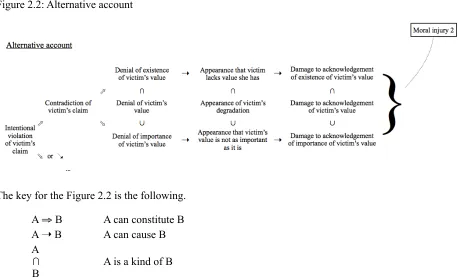
which one can treat an immunity and thereby wrong the immunity-holder. Claim-violation is one of many
expressive actions that can constitute contradiction of a claim. Other expressive actions can constitute
claim-contradiction; similar expressive actions can constitute immunity-contradiction. Of these claim- or
immunity-contradictory expressive actions, some constitute denial of the value that generates the claim or
immunity, while others constitute denial of the importance of that value. Such expressive actions wrong
the claim- or immunity-holder regardless of their consequences. We can also understand these actions to
wrong their victims by looking at their effects, including damage to the acknowledgement of the victim’s
value or its importance. Expressive acts that contradict legal claims and immunities can wrong the claim-
CHAPTER 1: Claims, Immunities and Violation
In this chapter I begin with a distinction W. N. Hohfeld drew between claims and immunities. I
will summarize William Edmundson’s (successful) attempt to demonstrate our need for this distinction
when explaining important differences between kinds of legal relations that can obtain between people.
Broadly speaking, my purpose in this essay is to ask how the difference between claims and immunities
maps onto differences between ways of wronging people. Claim-violation is a way of treating a claim that
wrongs the claim-holder. Is there a way of treating an immunity that counts as immunity-violation and
wrongs the immunity-holder? For various reasons that should become clear in this chapter, many will say
that immunities, by definition, cannot be violated. On a strict definition of violation (which I will accept
for the purposes of this essay) they are correct. Aside from violation, then, is there a way of treating an
immunity that wrongs the immunity-holder? If there is, what is the nature of the wrong done? At the end
of this chapter, I will consider the possibility that the answer to the former question is negative. I will try
to dismiss this possibility. In the next chapter I will turn to the latter question.
1.1: Claims and Immunities
With the 1913 publication of his seminal work on legal relations, “Some Fundamental Legal
Conceptions As Applied in Judicial Reasoning,” Hohfeld offered a way out of the muddle legal
professionals got themselves into when they assumed that all legal relations could be reduced to “rights”
and “duties” (Hohfeld, 35). A number of meaningful distinctions could be drawn, he showed, between
legal relations commonly called “rights” or “duties.” Without lingering too long on Hohfeld’s taxonomy,
let me briefly introduce the fundamental legal relations he identified and highlight a few features of their
interrelations that are central to the argument elaborated below.
Hohfeld identified the following eight relations: claim, duty, no-claim, liberty, immunity, power,
liability and disability. A Hohfeldian relation always involves two parties—a subject and an object—and
it always has a content, which concerns some action. Consider the following example.
In 1), Stanley is the subject of the claim-relation and Leopold is its object. Stanley has a claim against
Leopold only if Leopold should5 perform the act named in the content of Stanley’s claim.6 We can more
easily describe Stanley’s having a claim against Leopold when we examine another relation that obtains
between Stanley and Leopold: the duty-relation. The duty-relation is the correlative of the claim-relation.
The subject of a relation is always the object of its correlative duty-relation. The object of a
claim-relation is always the subject of its correlative duty-claim-relation. Thus, 1) is true only if the following is also
true.7
2) Leopold has a duty to Stanley that Leopold pay Stanley 50,000 francs.
Notice that both the relations are about an act which Leopold should perform; indeed, both relations are
about the same act. The act these relations are about is called the “content”of the relations. All correlative
relations have the same content.8
In addition to having a correlative, every relation has an opposite. This is just to say that we have
special terms we use to describe the relations that obtain between Stanley and Leopold (to continue with
the same example) when Stanley does not have a claim against Leopold and when Leopold does not have
a duty to Stanley. When Stanley does not have a claim against Leopold, we say that Stanley has a
no-claim on Leopold; when Leopold does not have a duty to Stanley, we say that Leopold has a liberty
5 This is a somewhat simplistic description of the claim-relation that ignores some of the difficulties that arise in
cases of rights conflict. In some cases, it may be sensible to say that Stanley has a claim against Leopold that Leopold do A but that it is nevertheless false that Leopold should (all things considered) do A. I do not address cases of rights conflict in this essay and have chosen to ignore certain difficulties to ease exposition. For one treatment of the problem of rights conflict, see Rainbolt 2006, Chapter 6.
6 Claim-relations can be described as positive or negative, depending on the nature of the act named in the content of
the claim-relation. Stanley’s claim named in 1) is most straightforwardly described as a positive claim—a claim that Leopold doA. If, instead, Stanley had a claim against Leopold that Leopold not divulge certain information about Stanley’s activities, then Stanley’s claim is most straightforwardly described as a negative claim—a claim that Leopold not do A. For the purposes of this essay, I will say that all claims most straightforwardly described as positive claims can be redescribed as negative claims. So, Stanley’s claim that Leopold pay 50,000 francs can be redescribed as a claim that Leopold not neglect to pay Stanley 50,000 francs. Likewise, claims most
straightforwardly described as negative claims can all be redescribed as positive claims.
7 Rainbolt agrees that all claims have correlative duties, but he argues that some duties (like the duty of charity) do
not have correlative claims, that some duties are, in other words, “non-relational” (Rainbolt, 131-133). Such duties are also sometimes called “imperfect” (Edmundson, 99). If Rainbolt is right (and I think he clearly is, at least in the case of legal duties), then 1) and 2) are not inter-entailing. Rather, 1) is true only if 2) is true and 2) is true if 1) is true. As Edmundson points out, it is difficult to tell what Hohfeld himself would have thought of the idea of non-relational duties (Edmundson 2004, 99).
8 Edmundson points out (Edmundson 2004, 95) that Hohfeld’s analysis of rights conflicts with the idea that all rights
against Stanley. Unsurprisingly, no-claims and liberties are correlative relations, and each has the same
content as its opposite—namely, in this case, that Leopold pay Stanley 50,000 francs.
The structure of the remaining four relations—immunities, powers, liabilities and disabilities—is
similar to the structure of the first four relations. These remaining relations have subjects and objects, and
they are about some act. However, they are not about acts like paying someone 50,000 francs. The
remaining four relations are always about an act that might or might not change some other relation. For
this reason, they are called second-order relations, while the first four relations are called first-order
relations. Consider the following example of a second-order relation.
3) Stanley has an immunity with respect to Leopold that Leopold not change “Stanley has a claim against Leopold that Leopold pay Stanley 50,000 francs” into “Stanley has a no-claim on Leopold that Leopold pay Stanley 50,000 francs” by saying, “Stanley, I don’t have to pay you.”
Stanley is the subject of this immunity, and Leopold is its object. The content of the immunity is
Leopold’s changing Stanley’s claim (what we call the “original relation”) into a no-claim (what we call
the “resulting relation”). The act that might or might not cause this change to happen is called the
“triggering act.” Stanley has this immunity if and only if Leopold’s performing the triggering act named
cannot bring about the change named.
As one might expect, all second-order relations have correlatives and opposites, just as do
first-order relations. Thus, 3) is true only if the following is also true.9
4) Leopold has a disability with respect to Stanley that Leopold not change “Stanley has a claim against Leopold that Leopold pay Stanley 50,000 francs” into “Stanley has a no-claim on Leopold that Leopold pay Stanley 50,000 francs” by saying, “Stanley, I don’t have to pay you.”
Disabilities and immunities are correlative relations; they both obtain when a certain change cannot be
brought about by a certain triggering act. The opposite of an immunity is a liability. That is, Stanley does
not have an immunity with respect to Leopold if and only if he has a liability with respect to Leopold.
Leopold does not have a disability with respect to Stanley if and only if he has a power with respect to
Stanley. Liabilities and powers are correlative relations; they both express the fact that a certain change
can be brought about by a certain triggering act.
9 I write that 3) is true only if 4) is also true because I assume that there are non-relational disabilities, just as there
It may be helpful, at this point, to reproduce versions10 of the tables Hohfeld used to summarize
the eight legal relations he identified and their interrelations. In the first table, each relation named in the
first row is paired with its correlative relation, just below. In the second table, each relation named in the
[image:15.612.72.539.183.237.2]first row is paired with its opposite relation, just below.
Figure 1.1: Hohfeldian correlatives Figure 1.1: Hohfeldian correlatives Figure 1.1: Hohfeldian correlatives
Figure 1.1: Hohfeldian correlatives Figure 1.2: Hohfeldian oppositesFigure 1.2: Hohfeldian oppositesFigure 1.2: Hohfeldian oppositesFigure 1.2: Hohfeldian opposites
claim liberty power immunity claim liberty power immunity
duty no-claim liability disability no-claim duty disability liability
In the analysis that follows, I will follow other legal philosophers in using Hohfeld’s taxonomy of
legal relations to investigate not only legal claims and immunities but also moral claims and immunities.11
There are certain difficulties in using Hohfeld’s taxonomy in this way, but I believe my analysis avoids
them.12
1.2: Edmundson on Immunities
Edmundson shows us that the right to free speech protected by the U.S. Constitution cannot be
satisfactorily analyzed without the concept of immunity (see Edmundson, 2004, 88-91). I will return to
the Dr. King example in Chapter 3; for now I will use the more general example Edmundson uses to make
his case. Suppose Congress passes a law criminalizing speech that expresses disrespect for the U.S.
Government—what we might call the “Anti-Sedition Act.” We can understand this as wronging U.S.
citizens in some way. But how should we understand this wrong? We might at first be inclined to say that
10 Hohfeld used the terms “right”, “no-right” and “privilege” where I have used “claim”, “no-claim” and “liberty”,
respectively. In using these alternate terms, I follow Rainbolt (and many other legal philosophers), who find that the alternate terms more clearly identify the relations Hohfeld was interested in. Hohfeld’s original tables can be found on Hohfeld, 36.
11 Edmundson notes: “Although Hohfeld was concerned solely with the analysis of legal rights, the opinion of moral
philosophers has generally been that his work reveals most, though not all, of the fundamental logical
interconnections and relationships of moral rights, as well as of legal rights” (Edmundson 2004, 94). For such an opinion, see Wellman 1985, 17 sqq. and Wellman 1995, 38 sqq. I do not mean to endorse the thesis that, in principle, moral rights are best explained through an extension of our analysis of legal rights—a thesis Raz (254) seems to attribute (perhaps wrongly) to Wellman—but rather the much weaker thesis that, as a matter of fact, Hohfeld’s analysis of legal relations gives us terms that we can use to adequately individuate at least some important moral relations that we should and do call rights.
12 For a helpful overview of some of these problems, see Edmundson on “duties not to” and “duties that”, legal and
Congress’ passing the Anti-Sedition Act violates a legal claim U.S. citizens have, created by the First
Amendment of the U.S. Constitution, that Congress not pass laws “abridging the freedom of speech.”13
That is, we might understand the first amendment to make it the case that Congress ought not abridge the
freedom of speech by passing laws like the Anti-Sedition Act. Edmundson shows that this is not in fact
what the first amendment does. If Congress passes the Anti-Sedition Act, would it give U.S. citizens a
legal duty to not speak disrespectfully of the U.S. Government? In other words, should we say that
although Congress ought not abridge the freedom of speech by passing the Anti-Sedition Act, it
nevertheless can make it illegal to speak disrespectfully of the U.S. Government by passing the Act? The
correct analysis, according to Edmundson, shows that this is not the case. Passing the Anti-Sedition Act
does not make it illegal to speak disrespectfully of the U.S. Government because the First Amendment
prevents the Anti-Sedition Act from ever becoming law in the first place. The Anti-Sedition Act is a legal
nullity. In Hohfeldian terms, the first amendment makes it the case that Congress lacks the legal power to
give U.S. citizens a duty to not speak disrespectfully of the U.S. Government by passing an act like the
Anti-Sedition Act. Congress has a disability with respect to creating such a duty, therefore; and U.S.
citizens have an immunity with respect to Congress’ turning their liberty to speak disrespectfully of the
government into a duty to not speak disrespectfully of the government.
Edmundson shows that we need the concept of immunity to understand the right to free speech
guaranteed by the U.S. Constitution. As to how we can understand the wrong that Congress does when it
passes the Anti-Sedition Act, however, Edmundson remains silent. There are two separate questions that
need to be answered. One has to do with the nature of Congress’ treatment of the immunity: Does
Congress “violate” U.S. citizens’ legal immunities if it passes such a law, in the same way that it could
violate citizens’ legal claims if it performed some other act? The second question has to do with the nature
of the wrong done the citizens through the Congress’ treatment of the immunity: Does such “violation”
wrong citizens in the same way that the violation of a legal claim would? In the following section I will
show that certain aspects of Congress’ treatment of claims it violates cannot apply in the case of
13 The full text of the Amendment reads:
immunities. This raises a terminological question about the use of “violation” that is easily set aside.
Showing that immunities cannot be violated (on a certain strict definition of violation) does little to
advance the analysis. In Chapter 2 I begin identifying a way of treating immunities that wrongs the
immunity-holders and begin explaining how this way of treating immunities wrongs the
immunity-holders.
1.3: Immunity-“Violation”
On some understandings of violation, any assertion about the violation of an immunity will
appear paradoxical. Such understandings of violation take as paradigm cases instances of claim-violation.
By definition, if you have a claim against me, then I should not do certain things. It might make it the case
that I should not drive your car without your permission, for example. The claim imposes normative
limits on my actions; I violate your claim, on this view, when I disobey or disregard the normative limits
your claim imposes on my actions—in this case, by driving your car without your permission. The
paradigm case of violation, then, is one where the party holding the duty correlative to a claim fails to
discharge the duty, doing what she should not do.14 This analysis of violation is difficult to apply to
immunities.
Immunities, like claims, can be thought of as imposing normative limits.15 The normative limits
immunities impose, however, are reminiscent of the limits imposed on us by physical laws. Much as I
might like to fly about the city on my own power as could Superman, the law of gravity (in conjunction
with various other natural laws) prevents me from doing so. Similarly, although the U.S. Congress might
like to impose a duty on U.S. citizens to not speak disrespectfully of the U.S. Government—and, indeed,
14 Violation can, in certain contexts, be helpfully distinguished from infringement, where both are doing what a
claim makes it the case one should not do but the latter is permissible and the former not. See Judith Jarvis Thomson for such a distinction, or Jeff McMahan, 10. Examination of the implications of such a distinction for the analysis I give here could prove fruitful; but I will not pursue that examination here.
15 Indeed, this fact is central to Rainbolt’s justified-constraint theory of rights, according to which both and only
might convince itself that it has imposed such a duty—U.S. citizens’ immunities (granted by the First
Amendment) impose limits on Congress that render it incapable of imposing that duty on them. Both
immunities and claims impose normative limits. However, whereas we can, with some ease, speak of the
violation of a claim—whose limits make it the case that its object should not do something—it is more
difficult to say exactly what we might mean when we speak of the violation of an immunity—whose
limits make it the case that its object cannot do something.
The difficulty of generating an adequate account of the violation of immunities is brought out
more clearly when we try to extend the parallel drawn above between immunities and physical laws.
Every now and then we make an observation that does not fit with our understanding of the laws of
physics. Upon making such an observation, we are forced to confront a contradiction: this cannot happen
(according to our understanding of the laws of physics) and yet it has happened. In such cases, it is
sometimes unclear which to trust, our understanding of the laws of physics or our observations, but the
issue is almost always resolved in one of two ways: either we decide our observation was inaccurate or
we decide our understanding of the laws of physics was inadequate. If the observation persists (over many
cases), it becomes difficult to conclude that the observation was inaccurate, and we are pressed to
conclude that what had appeared to be a violation of the laws of physics was not a violation at all, but
instead, the laws of physics are not as we originally thought.
Contrast this resolution with our response to the “violation” of an immunity. Lawyers do not
usually conclude, when confronted with a case of immunity-violation, that they had been mistaken to
believe that the immunity existed in the first place. Edmundson, for example, acknowledges the immunity
generated by the First Amendment and argues that the immunity would make the Anti-Sedition Act a legal
nullity. If Congress passes the Anti-Sedition Act, we do not conclude that we were mistaken to think the
First Amendment grant U.S. citizens an immunity against Congress giving them a duty to refrain from
speaking disrespectfully of the U.S. government. Of course, neither do lawyers conclude that the act of
violation therefore never occurred, or that it was inaccurately reported. Edmundson still acknowledges
that the Anti-Sedition Act would have been “passed”, in some empty sense, and would be, in a very real
has been committed that has wronged the immunity-holder. Edmundson’s analysis might be summarized
as follows: Congress may say that U.S. citizens now have a duty not to speak disrespectfully of the U.S.
Government, but in fact, U.S. citizens still have the liberty to speak disrespectfully, because they have an
immunity to Congress’ annulling of that liberty; and Congress has wronged them by stating, falsely, that
they no longer possess the liberty in question.
We are driven, therefore, to break from the analogy with physical laws. We observe a distinction
between physical limits and normative limits. Physical limits determine, for any given physical action,
what physical effects are possible. Normative limits of the sort imposed by immunities, on the other hand,
determine, for any given physical action, what normative effects are possible. Although we rarely think
we have achieved physical effects that are, in fact, impossible to achieve in the circumstances, we quite
frequently think that we have achieved normative effects that are, in fact, impossible to achieve in the
circumstances. We rarely convince ourselves that we have achieved self-powered flight; it is easy, on the
other hand, to think of examples where people think they have created legal relations, for instance, which
they have failed to create.
If by “violation” we just mean, “action by which one oversteps normative limits imposed on
oneself,” then we see that violation of an immunity is impossible. U.S. citizens’ immunity places limits on
what normative effects Congress can achieve through its actions—it cannot impose on U.S. citizens a
duty to not speak disrespectfully of the government. Congress literally cannot overstep the limits imposed
by the immunity. The above definition of violation may be too narrow. The important point, however, is
that lawyers, lawmakers and philosophers clearly think there is something one can do to immunities that
wrongs the immunity-holders. Whatever we call that something is beside the point. Lacking a better term,
for the moment, I will use the term “immunity-violation” to refer to whatever it is one can do to an
immunity that wrongs the immunity-holder. We have seen that immunity-violation is not like the violation
of a physical law; we have also seen that it is not like the violation of a claim. What, then, is the nature of
immunity-violation?
George Rainbolt suggests that a person violates another’s immunity if she performs the triggering
resulting relation) and then asserts that the triggering act has changed the original relation into the
resulting relation (Rainbolt, 44 and 45). This explanation is intuitively plausible. Much more can be said,
however, about the nature of this act of immunity-violation, as a way of treating an immunity and as a
way of wronging the immunity-holder. The account I offer below tries to develop Rainbolt’s explanation
in these ways. It rejects, however, the idea that immunity-violation necessarily involves performing the
triggering act mentioned in the immunity. The questions to answer are the following:
1) What way of treating an immunity wrongs its holder?
2) What kind of wrong is done to the immunity-holder when the immunity is treated in that way?
The first question can be understood to ask for a way of treating an immunity that is in some way
analogous to claim-violation. The second question can be understood to ask how this way of treating an
immunity wrongs the immunity-holder. The argument that begins in the second chapter does two things. It
introduces Jean Hampton’s analysis of the expressive meaning of wrongdoing and from it develops the
notion of contradiction. Immunity-contradiction, I will suggest in the third chapter, is a way of treating an
immunity that wrongs the immunity-holder. I will borrow a formal framework from Rainbolt to make
more systematic the application of Hampton’s analysis to the case of immunities.
1.4: Claim-reductionism: An Alternative Analysis
Some might suggest that the search for a way of treating immunities analogous to claim-violation
is misguided. If we think more creatively about how the concept of claim-violation applies to the cases we
have considered, the objection could press, we will begin to see that there is no need to look beyond the
concept of claim-violation: every aspect of every case of supposed immunity-violation can be thoroughly
explained with the concept of claim-violation. Congress’ passing the Anti-Sedition Act does wrong U.S.
citizens because it treats their legal immunities in a certain way, but we need say no more than that U.S.
citizens have a legal claim against Congress that Congress not treat their immunities in that way. So,
Congress (knowingly or unknowingly) acts as if U.S. citizens’ free speech immunity does not exist—for
now, I will refer to this treatment of the immunity as disregard of the immunity—and Congress has a duty
Suppose I have an apple and a claim against you that you not take my apple, touch it or mutilate it in any
way. If you smash my apple with a hammer, you have certainly treated the apple in a way that wrongs me,
but this is merely because the apple is something about which I have a claim. To say that there is some
special kind of wrong done me through the treatment of my immunities is like saying there is some
special kind of wrong done me through the treatment of my apple. Just as we need no concept of
apple-violation, so we need no concept of immunity-violation.
This objection, which I will call the claim-reductionist objection, is theoretically implausible.
Suppose, again, that Stanley has a claim (claimI) that Leopold give Stanley 50,000 francs. Suppose,
further, that claimI is “protected” by an immunity (immunityI) that makes it impossible for Leopold to get
rid of claimI by saying something like, “Stanley, you no longer have claimI.” The claim-reductionist
suggests that Stanley has a further claim (claimII) against Leopold that Leopold not disregard Stanley’s
immunity—that he not act as if he can get rid of Stanley’s claimI. It is the violation of claimII, the
claim-reductionist suggests, that explains how Leopold wrongs Stanley if Leopold disregards immunityI. Now, it
seems to me that the claim-reductionist would be quite willing to posit the existence of another immunity,
immunityII, that protects claimII. Without the protection of immunityII Leopold could easily get rid of
claimII and he would no longer be wronging Stanley if he disregarded immunityI by acting as if he can
get rid of Stanley’s claim. This would conflict with out intuitions about the (normal) moral requirements
of owing someone money. But if Stanley has immunityII, surely Leopold’s disregarding it would also
wrong Stanley. Leopold could say, perhaps, that he has gotten rid of Stanley’s claimII against Leopold’s
disregarding immunityI. The only way the claim-reductionist can explain why this wrongs Stanley is to
posit yet another claim, claimIII, against Leopold’s disregarding immunityII. We would likely assume that
there is then another new immunity protecting that claim (immunityIII), and a new claim against
disregarding that new immunity (claimIV), and a new immunity protecting that new claim (immunityIV),
and so on, ad infinitum. It is an open question whether such an infinite regress is vicious or not; but the
claim-reductionist seems to carry at least an equal share of the burden of proof.
The analysis I offer in the following chapters is not so suggestive of an infinite regress. I aim to
immunity-holders—without appealing to claims about immunities, or immunities about claims about
immunities—and I should be able to show how my analysis accommodates various intuitions and
considered opinions about real cases of wrongdoing. I will look at Hampton’s murder example.
CHAPTER 2: Moral Injury, Denial and Contradiction
In this chapter I introduce Jean Hampton’s analysis of expressive wrongdoing, I adopt weakened
versions of several of her theses, and I suggest that we must look beyond her consequentialist conception
of moral injury in order to identify another important form of expressive wrongdoing. Hampton’s analysis
deepens our understanding of claim-violation as wrongdoing by showing us how claim-violation causes
moral injury; furthermore, her analysis makes it is easy to see how one can separate claim-violation from
other elements in the cause chain for moral injury, namely claim-contradiction. Claim-contradiction, I will
argue, need not cause moral injury in order to constitute expressive wrongdoing; rather,
claim-contradiction can constitute another, direct form of wrongdoing. In the next chapter I will show how the
analysis of these two ways of wronging through claim-contradiction can translate into an analysis of two
ways of wronging through immunity-contradiction, and I will identify a third way of wronging someone
through immunity-contradiction.
2.1: Hampton and the Expressive Meaning of Wrongdoing
In the 1988 articulation of her expressive theory of punishment, Hampton proposed that “part of
what it is to view an act as immoral is to have the desire to reassert the victim’s value through
punishment” (Hampton 1988, 132).16 We find here the idea that to view an act as immoral is, among other
things, to have some view about what would be an appropriate response to the wrongful act. When
attempting to distinguish types of wrongdoing, as I am, it can be informative, therefore, to consider
arguments for different responses to wrongdoing. Such arguments attempt to show why a given response
“fits” a particular wrongful act. They articulate a view not only of the nature of the response to the
wrongful act but also of the nature of the wrongful act itself. I aim to identify a way of treating an
immunity that wrongs the immunity-holder. I propose to identify this type of wrongdoing by examining
16 See Hampton’s “The retributive idea,” Chapter 4 in Murphy, Jeffrie and Jean Hampton, Forgiveness and Mercy
one kind of response to wrongdoing, namely, retributive punishment. Jean Hampton has made a
compelling case for understanding retributive punishment as a fitting response to wrongful acts that cause
what she calls “moral injury.” Hampton’s analysis of moral injury will help identify ways of treating
claims that wrong the claim-holders but do not involve violation and are also (I will show in the next
chapter) ways of treating immunities that wrong the immunity-holders.
Retributive punishment is punishment justified by its retributive function. There is some
disagreement about whether punishment can be justified by other functions or even if it has other
functions. To put the idea of retributive punishment in context, however, I will name a few other functions
that have been attributed to punishment, rightly or wrongly. Punishment’s function is often described with
reference to wrongdoers or would-be wrongdoers: punishment can serve to rehabilitate actual
wrongdoers17 and can have a deterrent effect on would-be wrongdoers.18 At other times, the function of
punishment is described with reference to the victims of wrongdoing. Corrective punishment is said to
have this sort of function when it imposes upon a wrongdoer a duty to compensate her victim for material
damage. Corrective punishment imposes such a duty on a wrongdoer with the goal of repairing material
damage done to the victim, restoring the victim to the material state she would have been in had the
wrong not been done.19
Hampton argues that at least part of the function of retributive punishment, like corrective
punishment, is repairing damage done to the victim of a wrong (Hampton 1992, 1698). However, whereas
corrective punishment aims at repairing material damage (Hampton 1992, 1663), retributive punishment
aims at repairing what Hampton calls moral injury (Hampton 1992, 1666). Moral injury, in contrast to
material damage, is damage to the victim’s value caused by certain expressive acts (Hampton 1992,
1679). Retributive punishment repairs moral injury by vindicating the value of the victim (Hampton 1992,
17 For an analysis of such a concept of punishment’s function, see Jean-Christophe Merle’s German Idealism and the
Concept of Punishment (Cambridge: Cambridge University Press, 2009).
18 Jeremy Bentham famously emphasized punishment’s function as a deterrent. See Volume 4 of The Works of
Jeremy Bentham (ed. John Bowring, London, 1838-1843, Reprinted by the University of Michigan Library, 2009).
1686). In developing this argument, Hampton can be seen to follow G. W. F. Hegel, who famously
claimed that punishment “annuls the crime.”20
Hampton’s analysis of the fit between retribution and moral injury is fascinating and important. I
set this analysis aside, however, because I am not concerned with arguing for or against any particular
response to wrongful acts. I introduce Hampton’s analysis in order to extract from it the analysis of the
sort of wrongful acts to which Hampton argues retributive punishment is an appropriate response, viz.,
wrongful acts that cause moral injury. I will suggest that a number of acts can cause moral injury. The
violation of claims can cause moral injury; so can what I will call the “contradiction” of claims.
Immunity-contradiction is a way of treating an immunity that causes moral injury to the immunity-holder
and is, in that sense, analogous to claim-violation.
2.2: The Concept of Moral Injury Introduced
I will first more thoroughly set out Hampton’s concept of moral injury and then turn to the
problem of identifying the acts that cause moral injury. Hampton’s concept of moral injury is built on two
fundamental theoretical endorsements. First, she endorses a Kantian conception of human value according
to which all humans have equal value in virtue of their humanity (Hampton 1992, 1667). Second, she
endorses a Gricean understanding of human behavior as expressive (Hampton 1992, 1669, 1670).21 Some
expressive acts, Hampton writes, diminish a person’s value. Moral injury is caused by these expressive
acts.22 To diminish a person’s value, for Hampton, is not to degrade (reduce the value of) the person—a
20 See Hegel’s Philosophy of right (S. W. Dyde trans. Amherst: Prometheus Books, 1996). Cited and quoted in
Hampton 1988 on pages 114 and 131. For an analysis of the Hegelian elements of Hampton’s theory, see Farnham’s “A Hegelian Theory of Retribution” (Journal of Social Philosophy, 39 (4), Dec. 2008).
21 Hampton references Grice’s “Logic and Conversation” and “Meaning”, Chapters 2 and 14 in his Studies in the
Way of Words (Cambridge, MA: Harvard University Press, 1989).
22 At some points Hampton claims that diminishment causes moral injury: “it is diminishment that causes moral
Kantian conception of human value would not allow such a result—but rather to create the appearance of
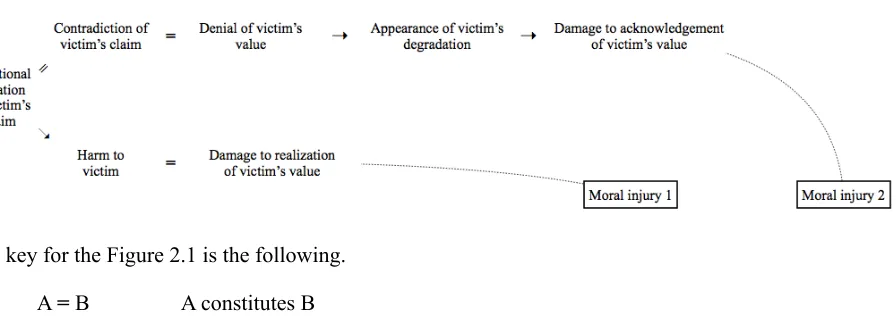
her degradation (Hampton 1992, 1673). The appearance of a person’s degradation, on Hampton’s account,
seems to be the appearance that the person is worth less than she is actually worth.23 For Hampton, the
following are different ways of saying the same thing: to diminish a person, to create the appearance of a
person’s degradation, and to cause a person moral injury.24
To help explicate the concept of diminishment Hampton offers the following analogy. Consider a
valuable artistic object like the Book of Kells. That the Book of Kells has a certain value “implies that
only certain kinds of treatment are appropriate for it” (Hampton, 1992, 1674). In other words, the value of
the object “generates certain entitlements” for the object—that it not be burned, for example, or torn to
pieces (Hampton, 1992, 1674, original emphasized).25 Someone who intentionally disregards these
entitlements and treats the object in an inappropriate way—by burning it, say—is “denying that the object
really has [the] value [that it has], because he is denying the entitlements which that value
generates” (Hampton, 1992, 1674). Denying that the Book of Kells has the value that it has is what
creates the appearance of the Book’s degradation—it is what diminishes the Book’s value. Acts that
diminish a person’s value, on Hampton’s account, follow a similar pattern. They disregard the
entitlements of the person and thereby deny that the person has the value that generates the entitlements.
This denial diminishes the person, causing her moral injury.
Hampton argues that there are two kinds of moral injury: 1) damage to the realization of the
victim’s value and 2) damage to the acknowledgement of the victim’s value (Hampton 1992, 1678 and
1679). Put simply, a person sustains the first kind of moral injury when she is prevented from doing,
having or being what she is entitled to do, have or be. This kind of damage, for Hampton, is done through
23 At least on my reading, Hampton does not understand appearance of someone’s degradation to mean the
appearance that someone has become less valuable.
24 I understand Hampton to hold that all moral injury is caused by diminishment—i.e. that there are no other causes
of moral injury other than diminishment. I will not defend any particular view of this issue, but I am inclined to think that there are ways of causing moral injury that do not involve diminishment. Moreover, Hampton appears to hold that all wrongful acts are wrongful because they cause moral injury. Here too, I will not defend any particular view. It is enough, for my purposes, that some wrongful acts are wrongful because they cause moral injury. I am only looking for one way of treating immunities that wrongs immunity-holders.
25 Many find it odd, or worse, to say that an object has entitlements. In using Hampton’s example I do not mean to
harm that results from a wrongful act, where harm is defined as “a disruption of or interference in a
person’s well-being, including damage to that person’s body, psychological state, capacities to function,
life plans, or resources over which we take this person to have an entitlement” (Hampton 1992, 1662). A
first approximation understanding of the second kind of moral injury is relatively self-evident. Damage to
the acknowledgement of a person’s value can be done by an act that has no harmful effects (where harm
is defined as above). I will have more to say about this second kind of moral injury in a moment.
I reproduce the gruesome example Hampton uses to illustrate the application of her analysis. The
example is of a white farmer who causes moral injury to a black farmhand and his four sons.
When one day the farmhand did something that enraged the farmer, the farmer apprehended him and his four sons, put them in large burlap bags, hung the bags holding the men to a tree, and began burning them. Before he was burned, one of the men asked for a cigar. The farmer answered him by using a knife to slit the bag holding him, cutting off the man’s penis, and then sticking it in his mouth, saying “Here, smoke that.” (Hampton 1992, 1675)
The farmhand and his sons had entitlements to not be burned and to not be mutilated. The farmer
disregarded these entitlements. Because of the meaning relevant social rules assign to the acts of burning
a person in a bag, cutting off a man’s penis and treating the penis as if it were not a sexual organ, the
farmer’s acts amounted to denial of the value of the farmhand and his sons (as persons) that generated
their entitlements. In denying the value of the farmhand and his sons, the farmer diminished them (created
the appearance of their degradation) and caused them moral injury. The farmhand and his sons sustained
both kinds of moral injury named above. The farmhand and his sons sustained damage to the realization
of their value (the first kind of moral injury) when they were prevented from securing what their value as
persons entitled them to secure—their autonomy, their bodily integrity, their possession of property and
their lives. The farmhand and his sons also sustained damage to the acknowledgement of their value (the
second kind of moral injury). The farmer’s acts encouraged other people—other white farmers, other
black farmhands and even the victims themselves—to believe that the farmhand and his sons lacked the
value of persons that generates entitlements to autonomy, bodily integrity and so forth. Notice that this
moral injury could have been inflicted even if the farmer had not harmed the farmhand and his sons.
them in full view of other farmers and farmhands. The farmer’s act, though minimally harmful, would
have resulted in significant damage to the acknowledgement of the victims’ value.
In what follows, I focus solely on moral injury as damage to the acknowledgement of a person’s
value. I will continue to use Hampton’s example of the farmer’s burning and mutilating the farmhands.
The farmer’s actions caused both kinds of moral injury; I will focus on the way in which the actions
caused the first kind of moral injury—damage to the acknowledgement of the farmhands’ value. I will
identify a way of treating claims and immunities that causes this kind of moral injury without violation. It
may be possible to show how this way of treating claims and immunities causes the first kind of moral
injury—damage to the realization of a person’s value—but the more limited demonstration is sufficient
for my purposes. From now on I will use the term “moral injury” to refer only to damage to the
acknowledgement of a person’s value.26
2.3: The Concept of Moral Injury Further Elaborated
Several points of clarification are overdue. More must be said about how acts can constitute
denial. We must also ask how denial can create the appearance of degradation and, importantly, to whom
denial causes the victim to appear degraded. The third point I will address is more difficult and concerns
the relationship between the appearance of degradation and moral injury. I will argue that Hampton would
do best to understand the relationship to be a causal and not a constitutive relationship.
2.3.1: Acts that constitute denial
In the examples above Hampton maintained that acting in a certain way constitutes denial of
something. Burning the Book of Kells would be to deny its value; burning and mutilating the farmhand
and his sons was to deny their value as persons. This is the idea of expressive non-linguistic acts. I have
already mentioned briefly that Hampton deploys a Gricean analysis of the expressive meaning of acts.
26 I am also somewhat dubious of the fit between the first kind of moral injury (damage to the realization of a
The details of Grice’s theory (and Hampton’s appropriation of it) are not crucial here.27 What is important
is the idea that social rules can make it the case that certain acts, in certain contexts, have certain
expressive meanings.28 Indeed, it is generally agreed that social rules determine the “meaning” of more
than acts. John Searle, for example, writes of social rules of the form “X counts as Y in context C”,
arguing that rules of this form can be seen to determine what counts as a courthouse, what a religious
sanctuary, and so forth (see Searle, 43-51).29 I will say an act communicates or expresses M when M is an
expressive meaning of the act as determined by relevant social rules.30
So, for example, in most parts of the United States one can usually beckon without giving offense
by waving one’s fingers up and down, palm up, while in China such a gesture conveys disrespect—to
beckon without giving offense, one’s palm should face down. Social rules likewise determine which acts
have the expressive meaning of greeting, thanking, ignoring, respecting, paying a bill, incurring a debt,
voting, obtaining a degree, becoming an adult, getting married or divorced, attending a religious service,
committing a crime, and so on.31 Most directly to the point (for our case), rules determine which acts
count as denial. In many parts of the world (I have in mind southern and eastern Africa in particular), a
person who looks an elder in the eyes when being spoken to communicates the view that the elder does
27 Hampton cites four ways Grice argues conduct can be meaningful: Natural meaning, word meaning, speaker
meaning and conversational implicature (Hampton 1992, 1675-1678, citing Grice 1989).
28 I do not intend to make much more explicit what I have in mind when I use the word “meaning.” On Grice’s
account, “x meant something” is roughly equivalent to “Somebody meant something by x”, and “A meant something by x” is roughly equivalent to “A in tended the utterance of x to produce some effect in an audience by means of the recognition of this intention” (Grice, 220). Searle (1969) attempts to amend this overly intention-centric account by acknowledging the role of social rules. For Searle, (in the case of illocutionary acts, which I discuss further below) a speaker means x when “the speaker intends to produce a certain effect by means of getting the hearer to recognize his intention to produce that effect; and furthermore, if he is using words literally, he intends this recognition to be achieved in virtue of the fact that the rules for using the expressions he utters associate the expression with the production of that effect” (Searle, 45).
29 Andrew Altman discusses Searle in these terms (and uses the courthouse example) on page 78 of Altman’s
“Expressive Meaning, Race, and the Law” (Legal Theory, 5 (1999), 75-99). The meanings of acts or spaces that are determined by such social rules can be distinguished from meanings determined by physical properties or “natural” meanings. Thus, while what counts as a courthouse is determined by social rules, what counts as a physical shelter is not (Altman, 78). Some, like Grice, argue that just as physical spaces, like shelters, can have natural meanings, so acts can have natural meanings. Hampton follows Grice on this point. Whether or not acts have a natural meaning is not crucial to the argument I present here, although the existence of natural meaning would be relevant if I were to work out the implications of my argument in more detail.
30 What an act communicates or expresses could be contrasted with the natural meaning of an act, which we might
call evidence given by the act. This is the term Hampton uses when employing Grice’s analysis of natural meaning.
31 Most of the items on this list come from Altman, 78 and page 1506 of Anderson and Pildes’ “Expressive Theories
not hold the social and moral stature that the elder holds.32 In most parts of the United States, by contrast,
the expressive meanings of looking an elder in the eyes and failing to look an elder in the eyes are nearly
reversed.
Importantly, the idea that social rules determine the meaning of acts has implications for
linguistic as well as non-linguistic acts. J. L. Austin famously made the case for understanding some
speech as a kind of act.33 One of his speech-act examples should illustrate the point.34 Two men stand
beside a woman. One of the men turns to the other and says, “Shoot her.” The other man is shocked, but
pulls out a gun and shoots the woman. The first man can be said to have performed several different
speech-acts. First, he performed what Austin calls a locutionary act: he made sounds that have a certain
sense and reference as determined by English language conventions.35 Second, the man performed what
Austin calls a perlocutionary act: by saying, “Shoot her,” he shocked the second man and persuaded him
to shoot the woman. This second kind of speech-act is defined in reference to the effects of the act. Third,
the man performed what Austin calls an illocutionary act: in saying “shoot her”, he urged the second man
to shoot the woman. Notice that, depending on the context, the first man might have used different
locutionary acts to perform that same illocutionary act of urging the second man to shoot the woman.36
Moreover, performing the same locutionary act, in a different context—in the context of a joke, for
example—the man might not have performed the illocutionary act of urging the second to shoot the
woman.
Of the three kinds of speech-acts just enumerated, it is illocutionary acts that are of greatest
importance for understanding what kinds of acts can constitute denial. I will say Y performs the
illocutionary act of denying X’s F (where F is some feature of X) if the relevant social rules give Y’s act
the expressive meaning, “X does not have F.” Part of what it means for the relevant social rules to give
Y’s act the expressive meaning “X does not have F” is for it to appear to competent navigators of the
32 This is an example taken from Tsitsi Dangarembga’s The Book of Not (Banbury, UK: Ayebia Clarke Pub., 2006). 33 See Austin’s How to Do Things with Words (Cambridge, MA: Harvard University Press, 1962).
34 This is Rae Langton adaptation of Austin’s own example (Austin, 121), used on pages 27 and 28 in her essay,
“Speech Acts and Unspeakable Acts,” Chapter 1 in her Sexual Solipsism (Oxford: Oxford University Press, 2009).
35 See Austin, 108.
36 He might has said, “This woman deserves to be shot.” Or, if they were members of a band of thugs looking to
relevant social rules that Y intends that others understand her to express “X does not have F” by her act.37
A simple example might be where the man who said, “Shoot her,” in the example above, first said, of the
woman, “She is not innocent.” Assuming the context does not give the utterance an ironic or otherwise
“non-standard” meaning, the man performs the illocutionary act of denying the woman’s innocence
because relevant social rules give the act the expressive meaning, “The woman does not have the feature
of innocence.” All linguistic acts that are illocutionary acts with the expressive meaning, “X does not
have F” constitute denial of X’s F.
Similarly, when Hampton holds that Y’s non-linguistic act of intentionally disregarding X’s
entitlement E is for Y to deny X’s value V, I take Hampton to mean that Y’s intentionally disregarding X’s
E has the expressive meaning “X does not have V.” In a moment I will turn to the evaluation of
Hampton’s specific claims about the expressive meaning of intentionally disregarding an entitlement. The
foregoing is offered in an attempt to explain Hampton’s general idea about acts’ constituting denial. Later,
I will return to the role of linguistic acts in causing moral injury. The main idea, for now, is that the
expressive meaning of many acts (linguistic and non-linguistic) is determined by social rules.
2.3.2: Denial that creates the appearance of degradation
Denial of a person’s value can create the appearance of her degradation.38 The relation between
denial of value and the appearance of degradation is therefore different from the relation between the act
of burning, for example, and denial of value. The farmer’s act of burning counted as denial of the
farmhand’s and his sons’ value because of certain social rules. In part, this is to say that it appeared to
competent navigators of the relevant rules that the farmer meant, by the act of burning, “the farmhand and
his sons do not have the value of full personhood.” Once this denial was performed, it was a further
question whether it would appear to anyone that the farmhand and his sons did not have the value of full
37 See Grice, 220 and Searle, 45.
38 I understand the creative relation to be a causal one. But by “causal,” here and throughout the rest of the essay, I