© 2016, IRJET | Impact Factor value: 4.45 | ISO 9001:2008 Certified Journal
| Page 2151
Modified Active Contour Snake Model for Image Segmentation using
Anisotropic Filtering
Inderpreet Kaur, Dr. Amandeep Kaur
Inderpreet Kaur,
M.Tech(CSE) Dept. of Computer Science and Engg., Punjabi University, Patiala, Punjab
Dr. Amandeep Kaur, Assistant Professor, Dept. of Computer Science and Engg, Punjabi University, Patiala, Punjab
---***---Abstract -
The role of segmentation is to partition a digital image into multiple regions to simplify or change the representation of an image into something more meaningful and easier to analyze. Active Contour Snake model is a very effective technique used for medical image Segmentation. This method finds the curve that best separates objects in an image. It attempts to minimize an energy associated to the current contour as a sum of an internal and external energy. Despite, several advantages there are several limitations of this method. Major drawback taken into is that active contour models are difficult to use when the edges of a feature are weak, noisy, and diffuse; they tend to get distracted and trapped by nearby edges that do not belong to the desired feature.The main purpose of this paper is to improve the smoothing efficiency of snakes to a very extent keeping in mind that less computation efforts would be made. In the proposed approach we have used anisotropic filters instead of Gaussian filters in the pre-processing phase of active contour snake model to suppress noise in the medical images. As anisotropic filters are more efficient in suppressing noise. Diffusion coefficient is chosen to be an appropriate function of the image gradient so that anisotropic diffusion enhances edges maintaining the stability of diffusions. The proposed algorithm when used to smoothen the noisy images gives efficient results when noisy medical images are segmented using active contour Snake model. Experimental results are shown on number of images.
Key Words:
(Size 10 & Bold) Key word1, Key word2,
Key word3, etc (Minimum 5 to 8 key words)…
1. INTRODUCTION
Active contours are a name for methods that find the curve that best separates objects in an image. This is known as segmentation. Snake is an energy minimizing deformable spline influenced by constraint and image forces that pull it towards object contours. Applications of Snakes are: Object Tracking, Shape Recognition Segmentation, Edge detection, Stereo matching. Snakes is a general technique of matching a deformable model to an image by means of energy minimization.[6] Snakes exhibit dynamic behavior as it always minimizes its energy functional. A simple elastic snake[5] is thus defined by a set of n points, an internal elastic energy term, an external edge based energy term Snake is placed near the object contour. It will dynamically
move towards object contour by minimizing its energy iteratively. In Snakes, we use the technique of matching a deformable model[5] to an image by means of energy minimization. A snake initialized near the target gets refined iteratively and is attracted towards the salient contour. A snake in image can be represented as a set of n points. vi=(xi,yi), where i=0…n-1
Parametric representation of curve:
V(s)=(x(s),y(s))
Energy Function
E=∫Esnake(v(s))ds=∫
[Einternal(v(s))+Eimage(v(s))+Econ(v(s))]ds
Einternal is internal energy of the spline (snake) due to bending, Eimage is image forces acting on the spline Econ refers to external constraint forces introduced by the user[6].
Snakes are autonomous and self adapting [7] in their search for a minimal energy state. They can be easily manipulated using external image forces. They can be made sensitive to image scale by incorporating Gaussian smoothing in the image energy function[4].They can be used to track dynamic objects in temporal as well as the spatial dimensions.
2.
ACTIVE CONTOUR SNAKE MODEL
2.1 ACTIVE
CONTOUR SNAKE MODEL
© 2016, IRJET | Impact Factor value: 4.45 | ISO 9001:2008 Certified Journal
| Page 2152
and matching them in stereo sis. The variation approach differs from the traditional approach of detecting edges and then linking them.
Snakes do not try to solve the entire problem of finding salient image contours. They rely on other mechanisms to place them somewhere near the desired contour. Snakes are an example of a more general technique of matching a deformable model to an image by means of energy minimization. From, any starting point, the snake deforms itself into conformity with the nearest salient contour. Our basic snake model is a controlled continuity [7] spline under the influence of image forces and external constraint forces. The internal spline forces serve to impose a piecewise smoothness constraint. The image forces push the snake toward salient image features like lines, edges, and subjective contours. The external constraint forces are responsible for putting the snake near the desired local minimum. Parametric representation [5] of curve
V(s)=(x(s),y(s)) We can write its energy functional as:
E=∫Esnake(v(s))ds=∫ [Einternal(v(s))+Eimage(v(s))+Econ(v(s))]ds where Einternal is internal energy of the spline(snake) due to bending, Eimage is image forces acting on the spline and Econ refers to external constraint forces.
External Energy Eexternal= Eimage+ Econ
Eexternal=External energy acting on the spline
Internal energy Einternal=Econt+Ecurv[5]
where Econt is the energy of the snake contour, Ecurv is the energy of the spline curvature,
Einternal=(α(s)│vs(s)│2+β(s)│vss(s)│2)/2m
Here, the first order term makes the snake act like a membrane. Large values of α(s) will increase the internal energy of the snake as it stretches more and more, whereas small values of α(s) will make the energy function insensitive to the amount of stretch, Second order term makes it act like a “thin plate”n term-minimum energy when the curve is smooth. Control α and β to vary between extremes
Image Energy
Variety of terms gives different effects
eg: Eimg=w.│I(x,y)-Idesired│, minimizes energy at intensity Idesired. Eimg has three components: Lines, Edges and Terminations. The energies can be represented as follows: Eimg=wlineEline+wedgeEedge+wtermEterm[5]
Adjusting the weights in the image will determine salient features in the image which will be considered by the snake Lines: A line is the intensity of the image which can be represented as Eline=I(x,y). Depending on the sign of wline, the line will be attracted to either dark lines or light lines.
Edges: Gradient based[8]. Edges in the image can be found by the following energy function which will make the snake attract towards contours with large image gradients.
Eimg= -w║ I(x,y)║2
It is common that a snake started far from the object converges to the desired object contour. If a part of the snake finds a low energy feature, it pulls the other parts of the snake to continue to the contour.[5] Scale space continuation can be used in order to achieve desired results. One can allow the snake to come to equilibrium on a blurry energy edge functional and reduce the blurring as the calculation progresses. The energy functional is
Eimg=-w│ * 2 I│2
where is a Gaussian standard deviation minima of this functional lie on zero crossings of 2I which define edges in[6] Marr-hildreth theory. Thus the snake gets attracted towards zero crossing constrained by its own smoothness. Laplacian-based
Eimg=w.
It can also be smoothened with Gaussian.
Termination: Curvature of level lines in a slightly smoothed image is used to detect corners and terminations in an image. Let C(x,y)=G*I(x,y) be a slightly smoothed version of the
image. Let θ=arctan( ) be the gradient angle.[6] And let n=(cos θ, sinθ) and n﬩=(-sinθ,cosθ) be the unit vectors along
and perpendicular to the gradient direction. The termination functional of energy can be represented as
Eterm=
Scale Space : In order to show the relationship of scale- space continuation to the Marr-Hildreth theory of edge detection[8], experiments have been done with a slightly different edge functional. The edge energy functional is
Eline= -( * 2 I)2
where is a Gaussian of standard deviation.
Minima of this functional lie on ero-crossings of * 2 I which define edges in the Marr-Hildreth theory. Adding this energy term to a snake means that the snake is attracted to zero-crossings, but still constrained by its own smoothness. Constraint Energy
© 2016, IRJET | Impact Factor value: 4.45 | ISO 9001:2008 Certified Journal
| Page 2153
Spring: Econ=k.║v-x║2
Repulsion: Econ=
[image:3.595.369.507.106.213.2]2.2 ANALYSIS OF IMAGE SEGMENTATION USING
ACTIVE CONTOUR SNAKE MODEL ON NOISY IMAGES
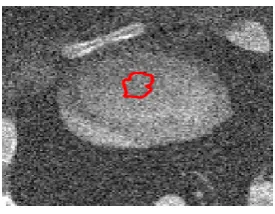
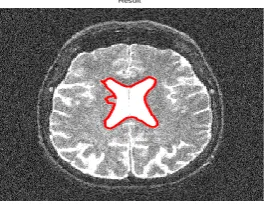
The analysis is shown with the help of two different images. Figure 1 is a an original cortex image. Figure 2 is the original image in Figure 1 with added Gaussian noise. Figure 3 shows the segmentation results of noisy cortex image with active contour snake model with given parameters. Figure 4 is the original cardia image. Figure 5 is the original cardia image with added Gaussian noise. Figure 6 shows the segmentation results of noisy cardia image with active contour snake model with given parameters. For this experiment values are shown at the bottom of each figure.Fig -1: Original Cortex Image Fig -2: Cortex image added with 0.25 noise
Result
Fig -3: Segmented image with parameters alpha and beta=0.1 kappa and gamma=0.5
Fig -4: Original Cardia image Fig -5: Cardia image added with 0.5 noise
Result
Fig -6: Segmented image with parameters alpha and beta=0.5 kappa and gamma=1.0
2.3 SHORTCOMINGS OF THE ACTIVE CONTOUR
SNAKE MODEL
Snake Model has some advantages over other segmentation methods. However, it also has some disadvantages. Observing from figure 3 and 6, we can examine that Active Contour Models are difficult to use when the edges of a feature are weak, noisy, and diffuse; they tend to get distracted and trapped by nearby edges that do not belong to the desired feature.
.
3.
MODIFIED ACTIVE CONTOUR SNAKE MODEL
USING ANISOTROPIC DIFFUSION
In our proposed algorithm, we have used anisotropic filters[10] proposed by perona and malik instead of Gaussian filters in the preprocessing phase of active contour snake model[4]. This technique aims at reducing image noise without removing significant parts of the image content. Noised images are denoised with this proposed approach. It resembles the process that creates a scale space where an image generates a parametrized family of successively more and more blurred images based on a diffusion process. It is as defined as:
where denotes the Laplacian, denotes the gradient, div(…) is the divergence operator and c(x,y,t) controls the rate of diffusion which is a diffusion co-efficient.[10] Among the two diffusion co-efficients proposed by perona and malik we have used
c( ) =
where the constant k controls the sensitivity to edges and is usually known as a function of the noise in the image and apply to the image f(x,y).
[image:3.595.38.280.302.537.2]© 2016, IRJET | Impact Factor value: 4.45 | ISO 9001:2008 Certified Journal
| Page 2154
the boundaries. The blurring would then take place separately in each region with no interaction between regions. The region boundaries would remain sharp. Taking an estimate E(x,y,t), the conduction coefficient c(x,y,t) can be chosen to be a function c=g(║E║) of the magnitude E. Acc to above definition, g has to be a nonnegative monotonically decreasing function with g(0)=1. Thus, the diffusion process will mainly take place in the interior of regions, and will not affect the region boundaries where the magnitude of E is large. The gradient of the brightness function used is E(x,y,t)= I(x,y,t)
Edge Enhancement
With low pass filtering and linear diffusion, eliminating the noise and for performing scale space, results in the blurring of edges. This causes their detection and localization to be difficult and thus the segmentation. Edge enhancement and reconstruction of blurry images can be achieved by high-pass filtering or running the diffusion equation backwards in time. This causes numerically unstable computational methods, unless the problem is appropriately constrained and reformulated. The algorithm is as follows:
1. Reading the image f(x,y)
2. Adding additive Gaussian noise to the image as: f(x,y)+ƞ(x,y)=g(x,y)
where f(x,y)=original image ƞ(x,y)=additive noise g(x,y)=Noised image
3. Taking the concept of anisotropic diffusion proposed by perona and malik[10] and applying it to the noised image g(x,y), the conduction coefficient is choosen to be appropriate function of the image gradient, the anisotropic diffusion enhance edges while running forward in time and stability of diffusions is also appropriate. An edge is modeled as a step function convolved with a Gaussian. Without loss of generality, assume that the edge is aligned with the y axis. The expression of the divergence operator simplifies to
Choose c to be a function of gradient of I:
c(x,y,t)= g( ). Let denote the flux c . Then the 1-D version of the diffusion equation (1) becomes
=
The edge is oriented in such a way that At the point of inflection since the point of inflection corresponds to the point with maximum slope. Then the
neighbourhood of the point of inflection has sign opposite to If , the slope of the edge will decrease in time and if , the slope will increase with time. This increase in slope cannot be caused by scaling of the edge. The image is denoised and the edges becomes sharper.
The image g(x,y) is thus denoised with anisotropic diffusion and this denoised image f(x,y) is then segmented using the active contour snake model as follows:
Gradient- descent minimization[11] is used to minimize the snake energy as follows:
a and
Vector representation
Approximate the energy function[5] of the snake by using the discrete points on the snake.
Sum of derivatives
Iteratively adjust the point vector by using gradient descent minim```````````````````````````````````````````````````````ization
Applying the derivative to energy function
Derivative of internal energy of the image can be solved as
=[(
=
These can be approximated using finite differences- the second derivative w.r.to s can be calculated using three adjacent points on the snake, and the fourth derivative can be calculated using five adjacent points.
Final equations are:
© 2016, IRJET | Impact Factor value: 4.45 | ISO 9001:2008 Certified Journal
| Page 2155
+
}
+
} where
The control parameters for the snake are:
Alpha: Specifies the elasticity of the snake. This controls the tension in the contour by combining with the first derivative term.
Beta: Specifies the rigidity in the contour by combining with the second derivativeterm.
Gamma: specifies the step size.
Kappa: acts as the scaling factor for energy term. Pseudocode:
1.Before entering the iteration calculate and the derivatives of this w.r.t x and y separately.
2. At the start of iteration, calculate
using the three adjacent points and using five adjacent points.
3. Then, calculate change in x and y for each point in use the precalculated
In general, snake is placed near the object contour. It will dynamically move towards object contour by minimizing its energy iteratively.
Thus, we used the proposed algorithm to smoothen the noisy images and get efficient segmentation results with active contour snake model. Experimental Results are given below.
4. EXPERIMENTAL RESULTS
4.1 RESULTS OF MODIFIED ALGORITHM
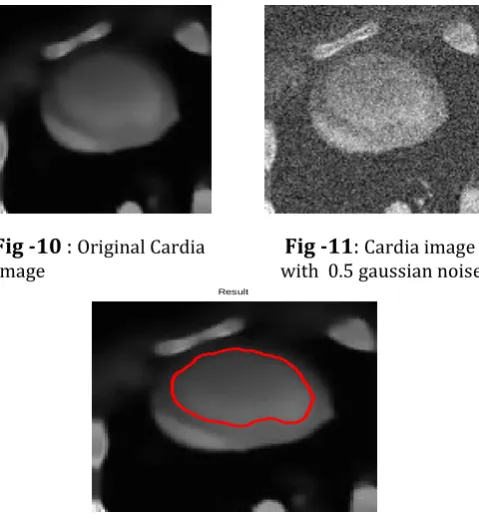
Figure 7 and 10 are the original cortex and cardia images respectively. Figure 8 is the original cortex image with added 0.25 gaussian noise and figure 11 is the original cardia image with 0.5 added noise. Figure 9 is the segmented cortex image using modified approach with parameters given below the figure. Figure 12 is the segmented cardia image using modified approach with parameters given below the figure.
Fig -7
:
Original Cortex Image Fig -8:
Cortex image with 0.25 added noiseResult
Fig -9
:
Segmented noisy cortex image with proposedmethod with parameters alpha and beta 0.1 & kappa and gamma 0.5
Fig -10
:
Original Cardia Fig -11:
Cardia imageImage with 0.5 gaussian noise
Result
[image:5.595.342.495.282.380.2] [image:5.595.312.552.441.702.2]© 2016, IRJET | Impact Factor value: 4.45 | ISO 9001:2008 Certified Journal
| Page 2156
[image:6.595.351.482.104.194.2]4.2 COMPARING RESULTS OF PROPOSED METHOD
WITH PREVIOUS ACTIVE CONTOUR SNAKE
METHOD
Figure 13 shows the segmentation of noisy cortex image with active contour snake model. Figure 14 shows the segmentation of noisy cortex image with modified algorithm. Figure 15 shows the segmentation of noisy cardia image with active contour snake model. Figure 16 shows the segmentation of noisy cardia image with modified algorithm with certain parameters given below the figure.
[image:6.595.68.202.251.353.2]Result
Fig -13
:
: Segmented noisy image with active contour snakemodel. Parameters alpha &beta=0.1 kappa &gamma=0.5
Result
Fig -14: Segmented noisy cortex image with proposed
method with parameters alpha and beta 0.1 & kappa and gamma 0.5Result
Fig -15: Segmented noisy cardia image with active contour
snake model. Parameters alpha and beta=0.5 kappa and gamma=1.0Result
Fig -16:
Segmented noisy cardia image with proposedmethod with parameters alpha and beta 0.5 & kappa and gamma 1.
Thus, from the above results it is clear that noisy images segmented using proposed approach in which concept of anisotropic filtering is used gives more effective results.
5. CONCLUSIONS
Active Contour Model is a very efficient technique of image Segmentation. But then also there are certain drawbacks of this model as any other technique. Many modifications have been done in this model. Major drawback taken into is that active contour models are difficult to use when the edges of a feature are weak, noisy, and diffuse; they tend to get distracted and trapped by nearby edges that do not belong to the desired feature. In our work we have tried to segment the images with more smoothing efficiency to get good results. In this domain, we have proposed an algorithm in which anisotropic filtering is used in the preprocessing phase of active contour snake model instead of Gaussian filters to remove noise from the medical images as anisotropic filters worked more effectively on noised images in which diffusion coefficient is chosen to vary spatially so that the region boundaries remain sharp and obtain a high quality edge detector. Thus, the proposed algorithm when used to smoothen the noisy images and gives efficient segmentation results with active contour snake model.
REFERENCES
[1] Rafael C. Gonzalez et al., “Digital Image Processing 2009,” “Image Segmentation,” PP.711-704.
[2] Rajeshwar Das et al., “Image Segmentation Techniques,” IJECT Vol.3 Issue 1, March 2012.
[3] Xiaolei Huang et al., “Medical Image Segmentation”. [4] Jim Ivins, “Everything you always wanted to know about
Snakes,” AIVRU Technical Memo #86, July 1995. [5] Guy Rosman, “Active Contours,” Numerical Geometry of
Images,2013.
[6] M.Kass et al., “Snakes: Active Contour Model,” International Journal of Computer Vision, pages 321-331,1988.
[image:6.595.68.208.407.515.2] [image:6.595.88.231.572.687.2]© 2016, IRJET | Impact Factor value: 4.45 | ISO 9001:2008 Certified Journal
| Page 2157
[8] Daniel Cremers et al., “Diffusion Snakes: Statistical Shape Knowledege in Mumford-shah based Segmentation,” International Journal of Computer Vision, 2002. [9] Chenyang Xu et al., “Gradient Vector Flow: A New
External Force for Snakes,” IEEE Proc. Conf. on Comp Vis. Patt Recog. CVPR, July 1997.
[10}Pietro Perona et al., “Scale Space and Edge Space using Anisotropic Diffusion,” IEEE Transactions on Pattern Analysis and Machine Intelligenc12, No.7, July 1990.