© 2016, IRJET | Impact Factor value: 4.45 | ISO 9001:2008 Certified Journal | Page 2000
Iris Recognition for Mobile security
Pooja C. Kaware
1, Dr.D.M.Yadav
21
PG Scholar, J.S.P.M ,NTC, Pune, India
2
Director of J.S.P.M,Narhe technical campus (Department of E &TC), Pune, India
---***---
Abstract
-In day to day life security is most importantAs modern mobile devices increase they introducenew application for security particularly authentication. The widespread use of mobile devices this has heightened the need to perform reliable user authentication. Biometric systems is very fast, secure and reliable authentication process The biometric person identification technique based on the pattern of the human iris is well suited for device security or e-security. Security systems is initially based on to verify & to identify users. In proposed system, Mobile devices consider eye image, then we performing automated iris segmentation over it. This segmentation is one of the critical part in iris recognition, which separates the iris from other ocular attributes. This iris segmentation method will provide security for mobile devices. And also this proposed system is applicable for mobile application security.Key Words
:
security, irisrecognition, segmentation,biometrics mobile device.
1. INTRODUCTION
Now a days the growth of communication is increases via mobile devices. Examples of mobile devices include smartphones, tablet PCs, etc. The wireless communication capability of a cell phone has been increasingly access to remote services such as e-commerce and online bank transaction. These will require extremely high security for personal information and privacy protection against un-authorized use in a networked society. Currently, the most adopted method is the verification of Personal Identification by using Number (PIN) and password. Today's e-security needs accurate, secure and cost-effective alternatives behalf of passwords and personal identification numbers (PIN) . Many mobile phone users used the PIN and password this are complicated and it is possibility forgotten. Very few users change their PIN regularly for higher security.
Biometric solutions address these fundamental problems, because an individual's biometric data is unique
for person to person and we cannot be transferred it . Biometrics, is a authentication process based on different characteristics like physiological characteristics or behavioral characteristics, its capability to distinguish authorized person and an unauthorized. A main advantage biometric authentication is that it cannot be lost or forgotten, as the person has to be physically present during identification process. The commonly used biometric features include speech, fingerprint,face, Iris, voice etc. Recently, Iris recognition is one of the biometrics that is used for identification and verification due to its accuracy. This iris recognition technology has been utilized for the security of mobile phones. The iris is more reliable as a form of identification because of the uniqueness of its pattern. Iris biometric identifies a person unique iris patterns. This iris contain many distinctive features such as texture, arching ligaments, furrows, ridges, crypts, rings, corona, freckles, and a zigzag collarets. The two major advantage of iris, is that original iris patterns are randomly generated after three months of birth and are not changed all life. And second one is iris does not having any effects of aging, which means it remains in a stable from about age of one until death. Due to this advantages, iris recognition provides high level of security. We can used this technology for cellular phone or cellular phone based services.
2.LITERATURE SURVEY
In 1936, ophthalmologist Frank Burch proposed the concept of using iris patterns as a method to recognize an individual. In1985, Drs. Leonard Flom and AranSafir, proposed the concept of automated iris recognition and were awarded a patent for the iris identification concept in 1987[1] .
© 2016, IRJET | Impact Factor value: 4.45 | ISO 9001:2008 Certified Journal | Page 2001
Hough transform, The Hough transform considers a set ofedge points and finds the circle that best fits the most edge points. And gradient edge detection for pupil detection. Wildes applies a Laplacian of Gaussian filter at multiple scales to produce a template. Wildes’ approach involves computing a binary edge map followed by a Hough transform to detect circles. Li.Ma et al. [3] used Hough transformation and extracted features using spatial filter, this technique first converts the round image of the iris into rectangular pattern by unwrapping the circular image.
Boles and Boashash [5] have given an algorithm that locates the pupil center using an edge detection method, records grey level values on virtual concentric circles, and then constructs the zero-crossing representation on these virtual circles based on a one-dimensional dyadic wavelet transform. Corresponding virtual circles in different images are determined by rescaling the images to have a common iris diameter. The authors create two dissimilarity functions for the purposes of matching, one using every point of the representation and the other using only the zero crossing points. The algorithm has been tested successfully on a small database of iris images, with and without noise. Lim, et al., in [6]. iris localization and conversion to polar coordinates relative to the center of the pupil, Are alternative approaches to both feature extraction and matching. Tisse et al.(7) proposed a segmentation method based on integro- differential operator with Hough transform. Due to this the computational get reduce and exclude potential centers outside of eye image. eyelash and pupil noise are not consider in this method.
[image:2.612.329.567.74.330.2]3 . METHODOLOGY
[image:2.612.63.269.534.588.2]Fig 1 : Basic set up of proposed system.
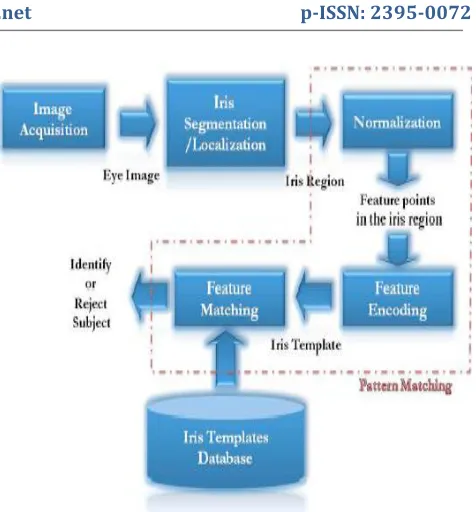
Fig 2: A block diagram of an iris recognition system
This section gives details of the proposed system. The basic set up is in shown in Figure1 . The iris recognition system is consisting of 5 steps shown in fig 2.
Therefore The iris recognition systems steps are as follows:
Step1:Image Acquisition:
It is the process of acquiring image, which is done using CCD camera or we can use database.
Step2:Iris segmentation:
when eye is captured in CCD camera, next need to acquire only iris pattern .it including localization of iris inner and outer boundaries and localization of boundary between iris and eyelids.
Step3: Iris Normalization:
After achieving circular iris, which is to be converted to rectangular form.
Step 4:Feature Extraction:
Decomposing and formation of iris pattern into iris codes.
Step 5:Matching or Verification:
Computer
( matlab )
Mobile
© 2016, IRJET | Impact Factor value: 4.45 | ISO 9001:2008 Certified Journal | Page 2002
In this stage doing comparing of new pattern withreference pattern which are stored in database .images are accept and reject is based on this comparison
IMAGE ACQUISITION:
To capture high quality images for automated iris recognition systems is a major challenge. Typically image is acquired using a sensor of adequate resolution to capture the iris texture. The device used for acquiring iris images is typically referred to as an iris sensor .when Acquiring images of Iris need consider good resolution , sharpness of image and need to maintain adequate intensity of source. Mostly or image acquisition the CCD camera is used. In this proposed work, publicly available database i.e., Institute of Automation, Chinese Academy of science (CASIA) isused.
Preprocessing:
Basically, preprocessing is initial step in iris recognition process. This is primary processing stage and this will performed on iris images. This step is use to improve Quality of image which are required for segmentation stage .Pre-processing of the acquired iris image involves detection of specular reflections and remove this noise elements. 2-D median filtering or canny edge detection is widely used, if specular reflections are present in image.
Fig.3 Original Image andpreprocessing output
Iris segmentation :
Iris segmentation plays aimportant role in the performance of an iris recognition system. The process of automatically locating the iris boundaries and excluding the noisy regions is called as iris segmentation. if segmentation is improper then it can lead to incorrect feature extraction. Hence for correct person identification need to proper segmentation.
Segmentation stage includes followingsteps:
1. Localization of iris inner boundary
2. Localization of iris outer boundary
3. Localization of boundary between eyelids and iris.
Hough Transform :
The Hough transform is a standard computer vision algorithm that can be used to determine the simple geometric parameters such as lines and circles, present in an image. The circular Hough transform can be employed to deduce the radius and center coordinates of the pupil and iris regions. Firstly, an edge map is generated by calculating the first derivatives of intensity values in an eye image and then thresholding the result. From the edge map, votes are cast in Hough space for the parameters of circles passing through each edge point. These parameters are the center coordinates xc and yc, and the radius r, which are able to define any circle according to the equation (1),
XC2 + YC2 – R2 = 0 (1)
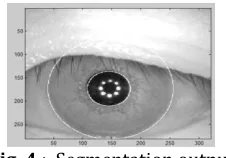
A maximum point in the Hough space will correspond to the radius and center coordinates of the circle best defined by the edge points. For more efficient and accurate circle detection process, the Hough transform for the iris/sclera boundary is performed first, then the Hough transform for the iris/pupil boundary was performed within the iris region,instead of the whole eye region, as the pupil is always inside the iris region. After the completion of this procedure, six parameters; the radius, and x and y center coordinates for both circles are saved.
Algorithm for Hough transform (Segmentation)
Step 1: Initialize pupil radius =28 and
Iris radius =75 for CASIA database.
Step 2: Scale the image.
Step 3: Gaussian filtering.
Step 4: Edge map creation using 2-D Median filter.
Step 5: Circular Hough transform for limbi boundary detection
Step 6: Circular Hough transform for pupillary
Boundary detection inside located iris.
Step 7: Linear Hough transform for eyelid detection.
© 2016, IRJET | Impact Factor value: 4.45 | ISO 9001:2008 Certified Journal | Page 2003
Fig. 4 : Segmentation output Normalization:
The segmented iris is usually unwrapped that means the size of the iris can vary significantly across images due to pupil dilation and contraction, resolution of the sensor used.to address such a variation the normalization is used. Once the iris region is successfully segmented then next step is to transform this iris region into fixed dimensions for patternmatching. This normalization operation is performed by representing the segmented iris as a rectangular image in normalization converts each Cartesian coordinates to polar coordinates.
Steps for normalizing Iris image.
Use of Daugman’s rubber sheet model.
Representing Cartesian to polar coordinates.
Output normalized iris image.
A widely popular technique for iris normalization, Daugman’s rubber sheet model [2] re-maps every point in the segmented iris region to a pair of polar coordinates. Therefore, iris area is obtained as a normalized strip with regard to iris boundaries and pupillary center.. The remapping of the iris image I(x, y) from raw Cartesian
coordinate to polar coordinates I(r, ) can be represented
as in eq 2.
I (x(r, ), y(r, )) I (r, ) (2)
Where r radius lies in the unit interval (0, 1) and is the
angle between (0, 2π).
The eq. 2 yields from eq. 3 and eq.4 and they are x (r, ) = (1-r)*xp (r*xi (3
y (r,r)*yp (r*yi (4
Where (xp (yp ()) and (xi (), yi ()) are the
coordinates of pupil and iris boundary points respectively. The normalization step not only reduces exactly the distortion of the iris caused by pupil movement and also simplifies subsequent processing. After normalization, the feature extraction and matching process are performed..
Fig.4.:Daugman’s Rubber sheet model
FEATURE EXTRACTION:
This is important step in automatic iris recognition is which have ability of extracting some unique attributes from iris, in proposed system used texture for feature extraction .Gabor and wavelet transforms are mostly used for analyzing t human iris patterns and extracting features this human iris pattern them.
Some functions are extracted from segmented iris, as feature vector .then this discriminatory information is encode this process is called Feature extraction .Each isolated iris pattern is then demodulated to extract its phase information using quadrature 2D Gabor wavelets.
A Gabor filter is obtained by modulating a sinusoid with a Gaussian. For one dimensional (1D) signals is with a Gaussian. This filter will respond only some part of the image or localized part of the signal i.e it will consider only some frequency. For 2Dsignals such as images, consider the sinusoid Along with Gaussian .this filter will respond to image. Let g(x, y, Ѳ, Φ) be the function defining a Gabor filter centered at the origin with Ѳ as the spatial frequency and Φas the orientation. We can view Gabor filters as:
g(x,y,Ѳ,Φ) = exp(-X2 + Y2 /σ2) exp(2𝞹Ѳi(x cos Φ + y sin
Φ)))
(5)
It has been shown that σ, the standard deviation and its value is σ = 0.65Ѳ the response of a Gabor filter to an image is obtained by a 2D convolution operation. Let I(x, y) denote the image and G(x, y, Ѳ , Φ) denote the response of a Gabor filter with frequency Ѳ and orientation Φ to an image at point (x, y) on the image plane. G(.) is obtained as
G(x, y, Ѳ , Φ) =ʃʃ (p, q)g(x − p, y − q, Ѳ ,Φ ) dpdq. (6)
In this only phase information is used for recognizing irises because amplitude information is not very discriminating, and it depends upon extraneous factors such as imaging contrast, illumination, and camera gain. [9].
PATTERN MATCHING:
[image:4.612.106.219.105.184.2]© 2016, IRJET | Impact Factor value: 4.45 | ISO 9001:2008 Certified Journal | Page 2004
then distance is equal and when they both are non-matchthen it found to be different. Thus, the matching process is carried out. The Manhattan distance Md (X i , Yi) is calculated as bellow:
Md= ∑[ X i - Y i] (7)
In this proposed system consider the Manhattan distance. This is the maximum distance in between trained and testing image. If this distance is less than Manhattan distance then the person is authorize. If distance is greaterthan or equal to Manhattan distance then person is unauthorized. This pattern is then send to mobile phone through Bluetooth. In this proposed system “ A” is send for authorized person and “B ”is used for unauthorized person. by using this key the mobile phone is getting lock and unlock. This concept is further extended for mobile application lock and unlocked.
3 .EXPERIMENTAL WORK AND RESULT.
[image:5.612.329.569.467.620.2]In this proposed system iris is automatically detected, to generate a bit code and this bit code is store in the database as a trained image. These trained image is compared with another image which is called testing image. When Testing image is matched with trained image then it generated key “A” for authorized person and when these two images are different then key “B” is generated for unauthorized person. After this, these keys is send to mobile for further processing i.e. to lock and unlocked. Mobile as well as mobile applications.
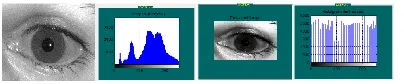
Fig.5: Original Eye Histogram & Pre-Processing Histogram
Fig 6: Edge Detection of Inner Boundary & Its Binary O/P.
Fig 7: Edge Detection ofOuter Boundary& Its Binary O/P.
Fig 8: Final Segmentation Output
Fig 9: Final String Generation.
Now we consider the database, according to that database we need to find out Statistical analysis which is performed based on parameters such as true positive, false positive , accuracy etc. The True Positive (TP) occurs onlywhen the testing image xi matches with training images yi . Considering Manhattan distance is 09. This is the maximum distance in between trained and testing image. If value is greater than 9 then it will be unauthorized person. If value is less than 9 then it will be authorized person.
The accuracy of pattern matching is given by as follows:
Table -1: Accuracy Table.
Name of
person TP FP Accuracy (%)
Jyoti 8.5 1.5 85
Dipika 9.0 1.0 90
Roshni 8.2 1.8 82
Nikhil 9.5 0.5 95
prasad 8.7 1.3 87
4. CONCLUSION
[image:5.612.71.273.493.535.2]© 2016, IRJET | Impact Factor value: 4.45 | ISO 9001:2008 Certified Journal | Page 2005
encoded by using Gabor filter, this was produce phasequantizing output in order to produce a bit-wise biometric template. This bits were used for pattern matching. For this pattern matching the Manhattan distance method is used. This method requires less computation than other distance methods. The average accuracy of this proposed system is approximately 87%. The keys generated by pattern matching is send to mobile for further processing. These keys are providing security for mobile as well as mobile applications.
ACKNOWLEDGEMENT
Author would specially like to thanks Dr.D.M YadavDirector ofJ.S.P.M ,NTC ,Campus,Pune for their guidance and reviews.
REFERENCES
1. Flom and A. Safir: Iris Recognition System. U.S.
atent No.4641394 (1987).
2. J. G. Daugman: High confidence visual
recognition of persons by a test of statistical independence. IEEE Transactions on Pattern Analysis and Machine Intelligence Vol. 15 (1993) 1148–1161
3. Li Ma, Tieniu Tan, Yunhong Wang and Dexin
Zhang, Efficient Iris Recognition by
Characterizing Key Local Variations, IEEE Transactions on Image processing, Vol. 13, No.6, (June 2004).
4. R.P. Wildes, Iris recognition: an emerging
biometrics technology, Proc. IEEE 85 (9) (1997) 1348–1363.
5. W. Boles, B. Boashash, A human identification
technique using images of the iris and wavelet transform, IEEE Trans. Signal Process. 46 (1998) 1185–1188.
6. S. Lim, K. Lee, O. Byeon, T. Kim, Efficient iris
recognition through improvement of feature vector and classifier, ETRI J. 23 (2) (2001) 1–70.
7. C.L. Tisse,L.Martin,L.Torres and M.Robert, “Iris
recognisation system for person identification .”
in pro.2nd Int Workshop Pattern
Recog.Inf.syst.,2002,pp.186-199.
8. D. J. Gabor, “Theory of communication,” IEE, vol.
93, no. 26, pp. 429–457, 1946.
9. John Daugmann, “How Iris Recognition Works,”
IEEE Trans. Circuits Syst. Video Technol. ,vol.14, no.1, pp. 21-30, 2004.
10. Li Ma, Tieniu Tan, Yunhong Wang and Dexin
Zhang, Efficient Iris Recognition by
Characterizing Key Local Variations, IEEE
Transactions on Image processing, Vol. 13, No.6, (June 2004).
11. Dr.S.Prasath, A.Selvakumar “A Novel Iris Image