© 2018, IRJET | Impact Factor value: 6.171 | ISO 9001:2008 Certified Journal | Page 1897
Utilization of Chemical Agent in Concrete for Self Curing
Vikram M B
1, Vijay B V
2, Deepak Kumar
3, Rashmi R Ghali
41,4
Assistant Professor
,Department of Civil Engineering, JSSATE, Bangalore, Karnataka, India.
2,3Under Graduate Students, Department of Civil Engineering, JSSATE, Bangalore, Karnataka, India.
---***---Abstract -
Conventional concrete need water curing for aminimum of 28 days to achieve its target strength. Hence water curing is very much essential to prevent unsatisfactory properties of cement concrete. In order to have good curing, excess of evaporation from the surface need to be prevented. Self-curing concrete is one of the special concretes which is gaining importance in recent days as it avoids errors which were caused by human, structures which are not accessible, terrains where curing becomes difficult and in places where the fluoride content badly influences the property of concrete. This kind of curing technique can widely be practiced in places where there is scarcity of water. Polyethylene glycol is non-toxic, odorless, neutral, lubricating, non-volatile and non-irritating and is used in a variety of pharmaceuticals. Thus, it is a shrinkage reducing admixture. The aim of this investigation is to study the strength and durability properties of concrete using water soluble Polyethylene Glycol (PEG-400 and PEG-600) as self-curing agent using M25 grade concrete. The compressive strength at 7days and 28 days have been obtained with normal curing and self-curing condition. In this study, the percentage of PEG vary from 0.5% to 2.0% by weight of cement added to mixing water. The optimum dosage of PEG-400 and PEG-600 for maximum compressive strength was observed that to be 1.0%.
Key Words: PEG-400, PEG-600, self-curing concrete, slump test, compressive strength.
1. INTRODUCTION
A lot of potable water is used by the construction industry for the process of curing. The days are not so far that all the construction industry has to search for an alternative curing system, not only to save water for the environment but also to use water for indoor and outdoor construction activities in remote areas where there is scarcity of water.
Curing of concrete is the maintaining of an optimum moisture content and temperature in concrete at early ages so that the concrete can develop the properties for which the mixture was designed to achieve. Curing of concrete starts immediately after placing and finishing of concrete so that it may develop the desired strength and durability.
1.1 Self-Curing Concrete
Internal curing refers to the process by which the hydration of cement occurs because of the availability of additional internal water that is not part of the mixing Water. Conventionally, curing concrete means creating
conditions such that water is not lost from the surface i.e., curing is taken to happen ‘from the outside to inside’. ‘Internal curing’ is often also referred as Self–curing.
1.2 Advantages of Self-Curing
1. It reduces autogenously cracking.
2. It largely eliminates autogenously shrinkage. 3. It reduces permeability.
4. It protect steel reinforcement. 5. It provide greater durability. 6. It improved rheology.
7. It increases the early age strength. 8. Lower maintenance.
2. LITERATURE REVIEW
Basil M Joseph (2016)
studied on self-curing concrete and PEG400 were used as a self-curing agent in concrete. M20 grade of concrete is adopted for investigation. The author added 0-1.5% of PEG400 by weight of cement for M20 grade concrete from that he found 1% of PEG400 by weight of cement was optimum for M20 grade of concrete for achieve good maximum strength. The author found that the percentage of PEG400 gets increased slump as well as compaction factor also get increased.Dahyabhai (2014) studied on “introducing the self-curing concrete in construction industry”. Compressive strength of self-curing concrete is increased by applying self-curing admixtures. The optimum amount of PEG600 for maximum effective compressive strength was found to be 1% of weight of cement for M25 grade of concrete. The optimum amount of PEG1500 of maximum compressive strength was found to be 1% of weight of cement for M25 grade of concrete. Self-curing concrete is the best solutionto the problem faced in the desert region and faced due to lack of proper curing.
© 2018, IRJET | Impact Factor value: 6.171 | ISO 9001:2008 Certified Journal | Page 1898
3. METHODOLOGY
3.1 Materials Used
Binder: Ordinary Portland Cement (OPC) is used
Chemical Admixtures: Polyethylene Glycol of molecular weight 400 (i.e., PEG-400) and 600 (i.e. PEG-600).
Water: Potable water is used.
Fine Aggregates: River Sand was used.
Coarse Aggregates: Coarse aggregate with 20 mm downsize was used.
3.2 Experimental Procedure
Mix design (M25) of concrete using IS method.
Study on properties of ingredients:
Cement:
Normal consistency test, Specific gravity test, Fineness of cement, Setting time.
Fine Aggregates
Specific Gravity, Water content and Sieve analysis test have been carried out for fine aggregates.
Coarse Aggregates
Specific Gravity, Water content and Sieve analysis test have been carried out for coarse aggregates.
Specific Gravity of Polyethylene Glycol (PEG-400) and (PEG-600).
Casting of cubes by varying percentage of PEG-400 and PEG-600 from 0% to 2.0%.
Slump test
Compression test
4. TEST ON MATERIALS
4.1 Cement
An OPC 53 grade Zuari cement was used in this study. The physical properties of cement are as follows:-
Table 1:- Properties of Cement
4.2 Fine Aggregate
River sand was used in this study. The physical properties of fine aggregate are as follows:-
Table 2:- Properties of Fine Aggregate
4.3 Coarse Aggregate
[image:2.595.309.559.352.405.2]Coarse aggregate with 20 mm downsize was used in this study. The physical properties of coarse aggregate are as follows:-
Table 3:- Properties of Coarse Aggregate
Sl. No. Tests Value
1 Specific Gravity 3.13 2 Water Absorption 0.52%
4.4 Polyethylene Glycol
In this study we have used polyethylene glycol of molecular weight 400 and 600.
Table 4:- Specific Gravity of PEG
[image:2.595.309.560.607.726.2]5. MIX PROPORTIONING
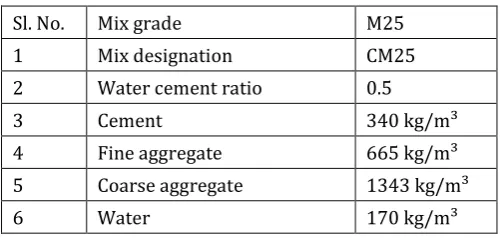
Table 5:- Mix proportioning for M25 grade
Sl. No. Mix grade M25 1 Mix designation CM25 2 Water cement ratio 0.5
3 Cement 340 kg/m³
4 Fine aggregate 665 kg/m³ 5 Coarse aggregate 1343 kg/m³
6 Water 170 kg/m³
Sl. No. Test Value
1 Normal Consistency 29.5% 2 Initial setting time 100 minutes 3 Final setting time 600 minutes 4 Specific gravity 3.15
5 Fineness 6.5%
Sl. No. Tests Value
1 Specific Gravity 2.3 2 Water Absorption 1% 3 Sieve Analysis Zone 1 4 Fineness Modulus 3.73
Sl. No. Tests Value
© 2018, IRJET | Impact Factor value: 6.171 | ISO 9001:2008 Certified Journal | Page 1899
6. TESTING OF CONCRETE
[image:3.595.30.278.105.675.2]6.1 SLUMP TEST
Table 6:- For PEG-400
% OF PEG-400 SLUMP IN mm
0.0 27
0.5 40
1.0 55
1.5 70
[image:3.595.316.566.119.388.2]2.0 83
Table 7:- For PEG-600
% OF PEG-600 SLUMP IN mm
0.0 23
0.5 38
1.0 54
1.5 69
2.0 86
6.2 COMPRESSIVE STRENGTH TEST
The compression test is carried out on a specimen cube. For compressive strength, cubes of size 100mm X 100mm X 100mm were casted. Cubes for compressive strength are tested at 7 days and 28 days using compression testing machine.
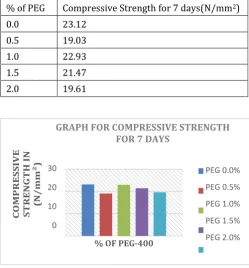
[image:3.595.33.280.418.674.2]Table 8:- Compressive strength of concrete cube with PEG-400 for 7 days.
Table 9:- Compressive strength of concrete cube with PEG-600 for 7 days
0 20 40 60 80 100 SL U M P V AL U E IN ( m m )
% OF PEG-400
GRAPH FOR SLUMP TEST
PEG 0.0% PEG 0.5% PEG 1.0% PEG 1.5% PEG 2.0% C OMPR E SS IVE ST R E N G TH IN N /mm ²
% of PEG Compressive Strength for 7 days(N/mm2)
0.0 23.12 0.5 19.03 1.0 22.93 1.5 21.47 2.0 19.61
% of PEG Compressive Strength for 7 days(N/mm2)
0.0 23.12 0.5 18.58 1.0 21.93 1.5 19.54 2.0 18.65
0 50 100 SL U M P V AL U E IN (m m )
% OF PEG-600
GRAPH FOR SLUMP TEST
PEG 0.0% PEG 0.5% PEG 1.0% PEG 1.5% PEG 2.0% COM PR E S S IV E S TR E NG TH IN (N/m m
²) PEG 0.0%
PEG 0.5%
PEG 1.0%
PEG 1.5%
PEG 2.0%
GRAPH FOR COMPRESSIVE STRENGTH FOR 7 DAYS
% OF PEG-400
30
20
10
0
PEG-400 PEG-600
COMPRESSIVE STRENGTH COMPARISION BETWEEN PEG-400 AND PEG-600 FOR 7
DAYS
PERCENTAGE OF PEG
0.00% 0.50% 1.00% 1.50% 2.00%
[image:3.595.312.561.446.776.2]© 2018, IRJET | Impact Factor value: 6.171 | ISO 9001:2008 Certified Journal | Page 1900
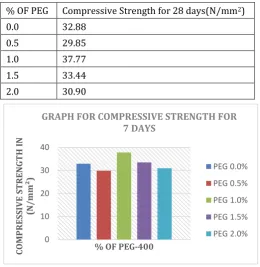
Table 10:- Compressive strength of concrete cube with PEG-400 for 28 days.
% OF PEG Compressive Strength for 28 days(N/mm2)
[image:4.595.30.293.610.709.2]0.0 32.88 0.5 29.85 1.0 37.77 1.5 33.44 2.0 30.90
Table 11:- Compressive strength of concrete cube with PEG-600 for 28 days.
% OF PEG Compressive Strength for 28 days(N/mm2)
0.0 32.88 0.5 33.04 1.0 34.77 1.5 32.44 2.0 31.59
CONCLUSION
The optimum dosage of PEG-400 for M25 grade is obtained as 1.0% by weight of cement and the optimum dosage of PEG-600 is also 1.0%. Hence self-curing concrete showed a better performance with respect to its compressive strength properties. Thus Self-cured concrete is found to be less porous compared to the conventional types. It shows that the self-curing concrete is able to withstand extreme conditions and corrosion effects. Viewing the above strength characteristics properties it can be concluded that self-curing concrete is a better option in field conditions where there is scarcity of water.
REFERENCES
[1] Joseph Basil M (2016) Studies On Properties Of Self-Curing Concrete Using Poly Ethylene Glycol, IOSR Journal of Mechanical and Civil Engineering, 12-17
[2] Magda I. Mousa , Mohamed G. Mahdy , Ahmed H. Abdel-Reheem, Akram Z. Yehia (2015) Self-curing concrete types; water retention and durability, Alexandria Engineering Journal, 54, 565–575
0 10 20 30 40
0.00% 0.50% 1.00% 1.50% 2.00%
CO MPR ES SIV E ST R EN G TH IN N /mm ²
PERCENTAGE OF PEG
COMPRESSIVE STRENGTH COMPARISION BETWEEN PEG-400 AND PEG-600 FOR 28 DAYS
PEG-400 PEG-600 0 10 20 30 40 COM PR ES SI V E STR ENG TH IN (N/m m ²)
% OF PEG-400
GRAPH FOR COMPRESSIVE STRENGTH FOR 7 DAYS PEG 0.0% PEG 0.5% PEG 1.0% PEG 1.5% PEG 2.0% 30 31 32 33 34 35 36 COM PR ES SI V E STR ENG TH IN (N/m m ²)
% OF PEG-400
GRAPH FOR COMPRESSIVE STRENGTH FOR 7 DAYS
PEG 0.0% PEG 0.5% PEG 1.0% PEG 1.5% PEG 2.0% 0 5 10 15 20 25 COM PR ES SI V E STR ENG TH IN (N/m m ²)
% OF PEG-600
GRAPH FOR COMPRESSIVE STRENGTH FOR 7 DAYS
PEG 0.0%
PEG 0.5%
PEG 1.0%
PEG 1.5%
© 2018, IRJET | Impact Factor value: 6.171 | ISO 9001:2008 Certified Journal | Page 1901 [3] Shikha Tyagi (2016) an experimental investigation of
self-curing concrete incorporated with polyethylene glycol as self-curing agent International Research Journal of Engineering and Technology (IRJET), 2, 2395-0072
[4] Sona K. S, Martin Irin Mary (2015) Evaluation on Self Curing and Durability of Concrete Using Super Absorbent Polymer, International Conference on Technological Advancements in Structures and Construction, 89-93