Munich Personal RePEc Archive
Financing Higher Education Reforms in
the UK: An Institutional Analysis
Todeva, Emanuela
1999
Online at
https://mpra.ub.uni-muenchen.de/52847/
FINANCING HIGHER EDUCATION REFORMS IN THE UK:
AN INSTITUTIONAL ANALYSIS1
Dr. Emanuela Todeva
Introduction:
After the Second World War, with the evolution of the welfare state, the higher education
became one of the beneficiary social spheres that attracted additional resources. The expansion
of mass higher education was the main feature of the entire post-war period. It is mostly during
the 80’s when resources for education and training came under the scrutiny of the British
Government. During these years it was realised that the widening of participation of young
people in the higher education system can not be achieved without increasing efficiency and
effectiveness of the education provision, and without private contribution for higher education.
This paper examines the evolution of the higher education reforms in the UK after the Second
World War, the changes in the Government intervention, and the changes in the funding
mechanisms in the sector. The most recent changes in the institutional framework are discussed
in the context of the globalisation of knowledge and education, and the deepening of the equality
of educational opportunities for different generations.
Widening Participation:
Three consecutive reports commissioned by the British Government (Robbins, 1963, Lindop,
1986 and Dearing, 1997) on the development of higher education in the UK have raised the
issues of widening participation, reducing unit costs, improving efficiency and effectiveness of
the education providers, and enhancing quality standards.
Following Robbins Report, two new types of institutions emerged in 1964/66 - the Polytechnics,
and the Council for National Academic Awards (CNAA). It was realised that the scale of
1In: ‘Control of Educational Processes – Economic and Educational Perspectives’, Seeber, S. and van
Electronic copy available at: http://ssrn.com/abstract=1458587 Electronic copy available at: http://ssrn.com/abstract=1458587
2
expansion of higher education through new educational institutions will require a new approach:
a) in funding, b) in curriculum development, and c) in conferment of degree awards. The
Polytechnics were funded by the Local Educational Authorities and this allowed the British
Government to achieve not only diversity of funding, but also alternative forms of management
of higher education. This new management of education was introduced through CNAA as a
government body that exercise control in a dialogue with the Polytechnics.
The two alternative funding mechanisms in the 70’s were ‘block grants’, allocated to
Universities by a national institution - the University Grants Committee (transformed in 1980 -
1992 into University Funding Council), and the direct funding of Colleges and Polytechnics by
the Local Educational Authorities. The implications of this dual funding system were that the
allocation of resources in the higher education generated two parallel paths of development until
1992. The ‘old’ Universities continued to maintain their privileged position and elitist attitude in
students’ recruitment. The Polytechnics extended the opportunities for disadvantaged groups in
the society to enter into higher education.
The ‘old’ Universities enjoyed traditionally complete autonomy in curriculum development and
degree awards. These functions for the Polytechnics were performed by the CNAA until 1992.
CNAA had the formal responsibility to give awards of the courses taught by the Polytechnics,
and to monitor the teaching programmes.
The efforts of the CNAA to co-ordinate the course content, the documentation and the standards
of delivery, established a practice of a nation-wide quality assurance system. This has been
discussed in the literature as the ‘new managerialism’ in the higher education (Barnett, 1996).
The multi-staged dialogue that CNAA established with the Polytechnics is exemplary in terms of
institutionalisation of externally determined objectives.
The role of the CNAA can be interpreted in at least two different ways - as a governing body,
setting up targets and controlling the Polytechnics, and as a facilitator that helps these
institutions through intensive communication to establish new systems for curriculum
The intensive communication between the CNAA and the Polytechnics involved the following
stages:
(1) development of the regulations (setting up the rules, defining the questions and the
structure of the self-evaluation reports that the Polytechnics were required to produce);
(2) evaluation of the teaching practices (through evaluation of the reports from the
Polytechnics by teams of CNAA experts);
(3) recommendations for improvement (based on professional judgements by academics
appointed by the CNAA as experts to conduct the evaluation);
(4) monitoring the implementation of the recommended changes (through interviews and
visits to the Polytechnics, through assessment of the coherence between stated facts in the
reports and established practices);
(5) further recommendations for changes (a detailed feedback to the Polytechnics about their
work and examples of recommended practices);
(6) follow-up assessment of the response by the Polytechnics to the recommended changes
(assessment of the measures taken by the Polytechnics in response to the CNAA evaluation).
The dynamics of this multistage dialogue between the Polytechnics and the government agency
is an example of policy implementation through institutional development. The government
carefully assisted the former technical colleges in their work to develop degree programmes and
to establish a portfolio of courses at undergraduate and post-graduate level. The CNAA also
made sure that the formal rules are transformed into tacit rules and regular institutional practices.
In other words, the institutionalisation of government policies involved development of new
forms of control based on elements of negotiation between the CNAA and the Polytechnics.
This mechanism of institutionalisation of change has been used to certain extend by the system
of external examination applied in the ‘old University’ sector. The reports from the appointed
external examiners were used as a mechanism for external evaluation and feedback rather than as
a form of institutional control. The transformation of the Polytechnics into autonomous higher
4
establishment of the Higher Education Funding Councils (1992) brought together the two
practices (of allocation of resources and of assessment of University performance) at a national
scale. This is a turning point in the government control over the higher education in the UK.
The Nature of Government Intervention:
Parallel to the changes in the funding mechanisms, the state acquired more operational control
over the academic matters, and in this way it opened a new public discussion about the role of
the University autonomy within the framework of increased financial constraints. The relative
decline in funding (over 40 % reduction of unit costs for the last 20 years) was achieved through
expansion of students numbers and reduction of the block grants to Universities.
The aim of the British Government was not only to control the expenditure for the higher
education, but also to increase the accountability of the Universities, and to assure that there are
sound systems of quality control. This managerialist approach to higher education was
institutionalised initially in the former Polytechnics through the CNAA (1964-1992). With the
abolishment of the two-tier system in 1992, and the creation of new national institutions for
funding and quality assessment, the British Government made another significant step towards
enhanced control over the University matters. The new institutional framework included four
regional Higher Education Funding Councils (HEFC, 1992), and the Higher Education
Quality Council (HEQC, 1992-1997)
The new regional HEFCs received the formal responsibilities to monitor different aspects of the
curriculum, to evaluate the self-assessment conducted by he Universities, to organise the
Research Assessment Exercise (which is one the main sources of research funding for the UK
Universities), to distribute the grants for teaching within the higher education sector, and to
participate in the grading of the overall performance of higher education institutions.
The HEQC (which existed only for the period 1992 - 1997) was created as a professional body
for self-regulation, with the task to facilitate the implementation of quality monitoring and
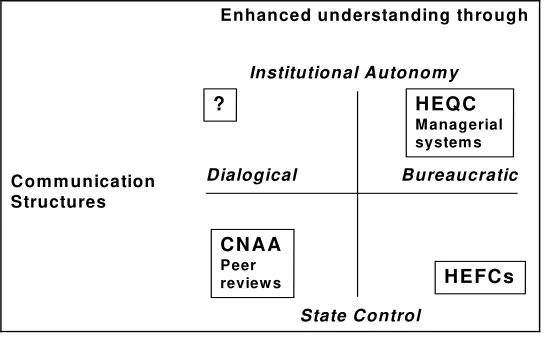
All these initiatives of the British Government highlight the efforts to introduce changes to the
higher education sector. Fig. 1: is an adaptation from Ronald Barnett’s analysis (1996) of
different types of state control in the higher education. The diagram compares different forms of
communication structures (dialogical vs. bureaucratic) with different levels of University
autonomy. Fig. 1 demonstrates that the experience in the U.K. has moved towards a bureaucratic
[image:6.595.137.409.283.454.2]form of state control, which is represented by the new HEFC’s.
Fig. 1: Forms of Regulation
Com m unication Structures
Dialogical Bureaucratic
Institutional Autonom y
State Control
Enhanced understanding through
CN AA
Peer
review s HEFC s
H EQ C
M anagerial system s
?
The replacement of HEQC in 1997 with a new institution Quality Assurance Agency (QAA)
represents a further concentration of state power. It aims to link quality assessment to funding,
and in this way , following the fundamental market principles, it is expected to produce strong
incentives for Universities to improve their quality of teaching and research. The main worries at
present are that this new agency will diminish University autonomy, and it will generate a
formalistic attitude to quality, and it will increase the short-term developments in compliance
with centrally designed criteria by the QAA. Preferential funding of Universities, based on
quality assessment, will also distort the equality of opportunities.
The option of autonomous Universities, regulated through an intensive dialogue with the state,
6
Obviously, it is difficult to achieve a balance between institutional autonomy and state control.
Even with overwhelming financial independence of the Universities (as in the case of Japan),
there is a need for state regulation of the system of awards and certificates.
The state control of the higher education in the UK is publicly justified by the following
arguments:
a) An increased demand, and henceforth increased cost for education provision, which
raises the pressure on the budget.
b) Systemic budget deficits for welfare support, and hencefore, continuous attempts by
all government to control expenditure for education.
c) The recent evolution of the state through creation of regulatory agencies, as part of the
macro-de-regulatory activities in the 80s. The wave of de-regulation has generated a web
of new state institutions and a wide range of experience in state regulations.
d) Growing competition world-wide as part of the globalisation process, and the demand
by businesses for a different type of educated and experienced graduates, with high
quality and transferability of skills. This is particularly visible in isolated educational
systems that do not prepare their graduates to work in a global environment.
All of these factors imply both increased control over financial matters, and control over content
and quality of higher education. While the former Polytechnics (now the ‘new’ Universities)
were accustomed to almost direct financial control by Local Educational Authorities, this type of
control put a lot of pressure on the ‘old’ Universities.
It is clear that the increased state control over finance is different by nature from control over
standards and curriculum content. The quality assessment and quality control has become one of
the controversial issues in the UK higher education. According to Barnett (1996), the HEQC,
established in 1992 and closed in 1997, represented a bureaucratic institution that aimed to
implement managerial systems of quality control into the autonomous Universities. Its failure to
the government to re-evaluate its policy. It is yet to be seen how the new institution - Quality
Assurance Agency will operate in order to achieve its objectives.
Another discussion that takes place, is about the forms of communication between the
Government and the Universities - dialogical vs. bureaucratic. The comparison between the
former CNAA and HEQC is quite an interesting one. Both institutions had national
responsibilities. However, the CNAA used peer reviews and established a continuous dialogue
with the higher education institutions, while the HEQC used bureaucratic mechanisms for
assessment and control. However, the critique of bureaucratic forms of state intervention is
weakened by the fact that managerialism in higher education improves cost-effectiveness. The
problem that is still unresolved is that direct intervention by the state is not able to stimulate
quality improvement. One of the main tasks for the new QAA, obviously, will be to find new
ways of quality assessment that enhances continuous professional development.
Funding of the Expansion of Higher Education in the U.K.:
The reduction of unit costs in the higher education was achieved in three ways: 1) through
imposing financial constraints on the educational institutions; 2) through providing incentives for
the ‘new’ Universities to extend their provision; and 3) through the creation of competition for
resources and quasi-markets in the entire sector. The competition for full-time undergraduate
students remained mainly within the former division between the ‘new’ and the ‘old’
Universities. The courses for post-graduate and part-time students, however, created a wider
competition across the two-tier system. The ‘new’ Universities extended rapidly their flexible
offers to part-time and overseas students and created a more dynamic educational environment.
The three Research Assessment Exercises (between 1986 - 1996) generated controversial
experience in the distribution of financial resources for research. The results from 1996 Research
Assessment Exercise confirm that the competition for research funding is still dominated by the
division between the ‘old’ and the ‘new’ Universities. At departmental level, however, there are
some changes, where the ‘new’ Universities have shown significant research capacity. Inspite of
8
As expected, this system created short-termism in the academic sector. However, there is an
overall consensus in the U.K. that the current system allows a very detailed assessment of the
research capacity at departmental level, and the most recent proposals aim to consolidate the
current practice. Proposals for changes include new joint funds for private and public investment
in building of a new research infrastructure.
In terms of curriculum development, the division between the ‘old’ and the ‘new’ Universities
has different orientation. The ‘old’ Universities have been slow to respond to government
policies, while the ‘new’ Universities have led the dynamics in the sector. The ‘new’
Universities’ responded very fast to the changes in government funding for teaching, as well as
the requirements for quality assurance, for diversification of provision, and for enhancement of
the links between the higher education, the industry, and the local community. Some of the
‘new’ Universities also developed better practices to accommodate the diversity of student’s
abilities, needs, and choices, and this made them better equipped to meet the challenges of the
future.
The division between the ‘old’ and the ‘new’ Universities has been gradually bridged and a new
division within the ‘old’ University sector has emerged. This division is a result of the
constraints in funding, and has formed a small group of elite institutions that would like to
maintain their privileged position in the sector.
Most of the recommendations in the last report for the higher education, the Dearing Report
(1997), aim at the same direction - to consolidate the higher education sector and to establish
national standards in teaching and research that encompass the achievements in both the ‘new’
and the ‘old’ Universities, and to allow some research centres to focus on leading-edge
innovation projects.
Proposed changes related to the teaching practices include radical shift towards externally
developed resource materials. This is expected to lead to intensive standardisation of the
curriculum and further reduction of the staff-time costs. These developments inevitably will
The argument developed in the Dearing Report suggests that the Resource Based Learning
(RBL) based on externally developed materials will change dramatically the nature of the
University education in terms of the structure of study hours. The new teaching methods will
allow both further expansion of the higher education, and parallel reduction of costs per unit.
In summary, some of the main changes in funding, recommended in the Dearing Report for
future implementation are the following:
- introduction of tuition contribution by students (already in place) through an income contingent
loan;
- an income contingent loan as part of the maintenance contribution;
- non-competitive funding for University departments to support research and scholarship which
underpins teaching;
- establishment of an Industrial Partnership Fund to supplement financial resources for research;
- establishment of a Loan Fund financed jointly by public and private research sponsors - for
large and infrastructural research projects.
These proposals are justified with a very detailed analysis of the role of globalisation and the
challenges that the higher education has to meet in the next 20 years.
Future Challenges for the Higher Education - the Dearing Report (1997):
The last report on higher education by Sir Ron Dearing (1997) proclaims the development of
“cutting edge knowledge”, and the financing of new research infrastructure that will correspond
with the challenges of the globalisation. The relationship between the higher education and the
globalisation of the business environment is described by the following developments:
* the globalisation of knowledge - There are no more isolated national systems of
knowledge. The transfer of goods and know-how across borders includes transmission of
information, cultural artefacts, and values. The globalisation of the media continuously
10
is part of this process and takes place both at the level of international scientific research,
and the level of the media institutions.
* the national education determines the competitive advantage of nations - the quality of
the labour force is one of the most important factors for foreign investors, and it also
determines the quality of operation of the business infrastructure in each country.
Important task for the higher education is to build the intellectual capital of the society.
* the development of the democratic society is related to the expansion of the mass
higher education and the inclusion of minority groups from the society. The participation
of young people from minority groups into higher education, as well as adults re-entering
the Universities on a part-time mode, or through distant learning, is a guarantee for
equality of opportunities.
* constraints on public expenditure require commitment to higher education not only by
the state, but also by the individuals themselves, by employers, and by education providers.
* the individualisation of higher education is a path towards development of a life-long
learning society where individual needs for knowledge and experience are met by specially
designed and tailor-made programmes.
* the disappearance of the boundaries between vocational and academic education is a
challenge for the University sector to adapt to the need of the business sector for graduates
with wide generic skills, with critical thinking, decision making, and communication skills,
and with a balanced professional and theoretical knowledge.
These general trends for the higher education have resulted in a specific re-orientation of the
policy of the British Government. Emphasis is put on the compulsory education and the
improvement of the further and adult education. The funding to the University sector will
include contributions both from students and from employers. The establishment of a national
framework for standards in higher education will enhance further the comparability between
University programmes.
It is expected by the British Government, that the changes proposed in the Dearing Report will
- enhanced responsiveness of higher education where Universities will meet the labour
market needs and at the same time will lead the restructuring of the labour market itself in
correspondence with the processes of globalisation;
- enhanced standards and managing quality of education by the Universities;
- flexibility of provision through modularisation, credit accumulation, part-time, mixed
modes of study, and distance learning opportunities;
- enrichment of student’s experience through links with industry and with local
community, and through development of broad and generic skills.
- improved accountability for funding, improved completion rates in the Universities,
and further reduction of unit costs.
These targets for the higher education are expected to enhance further the competitiveness and
attractiveness of the British Universities.
The proposals in the Dearing Report include further institution building. It is proposed that a
new ‘Learning Bank’, or a system of ‘Individual Learning Accounts’ is created to facilitate the
income contingent contribution scheme for students. The proposed ‘Unified Student Support
Agency’ will enhance further the standardisation of support mechanisms for different students’
groups. The proposed representation of higher education institutions in regional bodies
established by the Government will lead to regionalisation of the education sector and diversity
of missions of the Universities according to their location, and research capacity.
The changes proposed in the Dearing Report clearly map a development of the University
12 Fig. 2: Managing contradictions in higher education
Expansion & widening participation of young people into higher education
Public funding of higher education
Institutional autonomy of universities
evaluation & Self-improvement of universities
Globalisation of knowledge
Globalisation of competition
Reduction of government expenditure for education and training
Private funding of higher education
Quality standards & cost effectiveness of education providers
Public accountability & judgments of organisational performance by external evaluators
Specialisation of knowledge application
Flexibility of education provision and adaptability of the labour force
Conclusions:
The analysis of the recent educational reforms in the UK provides a good opportunity for
examination of the institutional theory and the role of incentives, constraints and enforcement on
the educational practices. The constraints in funding and the gradual enforcement of quality
standards has produced a distinctive response in the University sector. The reduction of the unit
costs with more than 40% over the last 20 years was achieved through gradual increase of the
lectures, as the main teaching methods, at the expense of seminar groups. In addition to that, the
in-house development of teaching materials during the last years supported partially the
weakened learning processes, and compensated for the deficiencies of the University funding
system. At present, it is acknowledged that radical changes in attitudes to teaching and learning
are required. Teaching should be dominated by the use of communication and information
technology and the further professionalisation of the lecturers. The new attitudes to learning
should include the value of the work experience, learning how to learn, and flexible
The two main instruments for government intervention established in the UK are resource
allocation and implementation of quality standards. Both instruments usually carry a bias and
are used to establish direct and indirect control in educational institutions. These recent
developments in the UK create a dilemma for the Government how to preserve the academic
autonomy, which is particularly important to stimulate research and creativity in education. All
proposed changes and new institutions are oriented in the opposite direction towards reduced
autonomy and this presents the main danger for the British Universities.
Our analysis of the response of higher education institutions to government policies suggests that
constraints in resources do not provide automatically incentives for improvement of efficiency. It
is the regulatory intervention of the Government that leads to changes in University provision,
and that could force an educational establishment to change its practices, to examine critically its
curriculum provision, its teaching quality, and its research strategy.
References:
Barnett, R. (1996) “The evaluation of the Higher Education System in the United Kingdom”, In:
World Yearbook of Education, 1996: The Evaluation of Higher Education Systems, ed. by R. Cowen, Kogan Page, London.
Dearing Report (1997) (Submitted to the Secretaries of State for Education and Employment,
Wales, Scotland and Northern Ireland, July 1997),