QoS Aware Power Efficient Multicast Routing Protocol
(QoS-PEMRP) with Varying Mobility Speed for Mobile Ad
Hoc Networks
S. Kannan
Assistant Professor Sri Guru Institute of Technology
Varathiyangarpalam Coimbatore.
A.Rajaram
Associate Professor Karpagam College of Engineering
Coimbatore.
ABSTRACT
Power efficient multicast routing is one of the key issues in the field of mobile ad hoc networks. Multicasting is a term which refers to delivering data packets to a group of mobile nodes from an intended source. Quality of Service enlarges the support level of predictable performance for network systems. This research work focuses on design and development strategy of QoS aware power efficient multicast routing protocol which best suits for wireless nodes moving around the network with varying mobility speed. The QoS metrics such as average group delivery ratio, average power consumption and average delay are taken into account for measuring the performance of the proposed protocol QoS-PEMRP. Extensive simulation results are carried out through NS2 simulator. From the simulation results it is shown that the proposed QoS-PEMRP outperforms On-Demand Multicast Routing Protocol (ODMRP) routing protocol by reduced delay and increased packet delivery ratio along with decreased power consumption.
1.
INTRODUCTION
Mobile Ad-hoc network which is an infrastructure less network is a kind of wireless network consisting of mobile nodes with the ability to deploy anytime anywhere. These networks are highly dynamic in nature in terms of various mobility speed, topology changes. The routing protocols plays a vital role in MANETs and they are broadly classified into proactive, reactive and hybrid. This research work focuses on the problem of multicasting in MANETs. The primary objective of a multicast protocol is to convey packets from a source to the members of a multicast group with an acceptable quality of service (QoS) [12], [13]. The goal in QoS provisioning is to achieve a more deterministic network behavior (i.e., bounded delay, power consumption, and PDR) [11]. Actually, flooding, which is the simplest group communication algorithm, is good enough to achieve high PDR provided that the data traffic and/or node density is not very high so that the network is not congested. Consequently, the next objective of a multicast routing protocol is to utilize the bandwidth efficiently, which is directly related with the number of retransmissions (throughout this paper, the term retransmission is used for relaying) required to deliver generated data packets to all members of a multicast group with a high enough PDR. The third objective of a multicast protocol is to minimize the power consumption of the mobile nodes present in the MANET. Although optimizing the performance of a wireless communication system by incorporating cross-layer design is a tempting choice, several researchers have argued that such a cross-layer design is not
the best choice in the long run because it sacrifices modularity and can lead to unintended cross-layer interactions [16], [24].
2.
LITERATURE REVIEW
which considers both stability and residual power of neighboring nodes when selecting cluster heads and gateways, is proposed. This algorithm significantly reduces routing-related control overhead. The focus of the model is on multicast services in wireless LANs. In [3], an approximation algorithm with guaranteed approximation ratios for minimizing the total power consumption of tree based all-to-all multicasting in wireless ad hoc networks is devised. In [4], a self-managing, power-efficient multicast routing suite based on the self-stabilization paradigm is proposed. However, the power dissipation models used in these studies include only transmit and/or receive power dissipation terms. While this may be a good approximation for certain radios, there are other power dissipation modes (i.e., idle, carrier sense, and sleep modes) for many current radios [9]. Thus, it is important to consider all sources of power dissipation when designing a multicasting protocol.
3.
PROPOSED WORK
Estimating Link Robustness (LR)
The link robustness is one of the key factor in QoS – EEMRP. Based on the estimation of link robustness, the quality of the link can be identified. It is used in the branch maintenance and also helps in re-establishing branch. When a sending node broadcasts RTS packet, it piggybacks its transmission power (Pwr Tran). While receiving the RTS packet, the projected node
quantifies the strength of the signal received.
Pwr Rvr = Pwr Ttr (λ / 4 ∏ d) 2
* (UGT) * (UGR)
LR = Pwr Rvr – Noise ---- (1)
Where, Pwr Rvr refers Power of the Receiving node, Pwr Ttr
stands for Power of the Transmitting node, λ stands for wavelength carrier (without noise removed), d is the distance between the sending and the receiving node, UGR stands for
unity gain of receiving omni-directional antenna, UGT stands
for unity gain of transmitting omni-directional antenna, Noise represents the noise of the channel.
Overview of QoS – EEMRP
InFl is used to create a redundant multicast mesh through network-wide flooding, which also serves as the initial topology discovery mechanism. The redundancy introduced by InFl is pruned by the Sp mechanism using receiver based and transmitter-based feedbacks. The initial multicast tree formed by InFl and Sp is broken in time due to node mobility. Tree branches broken primarily due to leaf node (multicast group member node) mobility are repaired by the BrMn mechanism. Relay node mobility-induced tree branch breakages are repaired by the BrMn mechanism. BrMn is a local scope maintenance mechanism and hence they cannot repair the global scope failures in the multicasting structure. The ReBr mechanism is designed to recreate totally collapsed tree branches, and it is the global scope maintenance mechanism of MC-TRACE. The MNB, RPB, and CRB mechanisms utilize a passive mesh around the active tree branches to repair or replace the broken branches. The QoS-PEMRP architecture is designed for multiple multicast groups, and it can support multiple flows within each multicast group.
Initial Flooding (InFl)
In this section, we describe initial flooding as a stand-alone mechanism. Actually, initial flooding and pruning are two mechanisms working simultaneously; however, we describe
these as sequential mechanisms to make them easier to understand. A source node initiates a session by broadcasting packets to its one-hop neighbors. Nodes that receive a data packet contend for channel access, and the ones that obtain channel access retransmit the data they received. Eventually, the data packets are received by all the nodes in the network, possibly multiple times. Each retransmitting node acknowledges its upstream node by announcing the ID of its upstream node in its InS packet, which precedes its data packet transmission. The source node announces its own ID as its upstream node ID. Initially, all retransmitting nodes announce the null ID as their downstream node ID. However, when an upstream node is acknowledged by a downstream node, the node updates its downstream node ID by the ID of this node. The leaf nodes (i.e., nodes that do not have any downstream nodes that are acknowledging them as upstream nodes) continue to announce the null ID as their downstream node ID. At this point, some of the nodes have multiple upstream nodes (i.e., multiple nodes that have lower hop distance to the source than the current node) and downstream nodes (i.e., multiple downstream nodes acknowledging the same upstream node as their upstream node).
A node with multiple upstream nodes chooses the upstream node that has the least packet delay as its upstream node to be announced in its InS slot. Since a retransmitting node indicates its hop distance to the source (HDTS) in its InS packet, it is possible to choose the node with the least HDTS as the upstream node; however, our primary objective is minimizing delay rather than minimizing the tree size. A node updates its own HDTS by incrementing the least HDTS it hears within THDTS1 time. The initial HDTS value is set to HDTSMAX, and the HDTS value is again set to HDTSMAX if a node does not receive any IS or data packets for more than THDTS2 time (THDTS2 > THDTS1). Nodes that are not members of the multicast group set their multicast group ID to the null multicast group ID. If an upstream node receives an acknowledgement (ACK) from a downstream multicast group member, it marks itself as a multicast relay and announces its multicast relay status by setting the corresponding status (i.e., multicast relay bit) in the IS packet. This mechanism continues in the same way up to the source node. In other words, an upstream node that gets an ACK from a downstream multicast relay marks itself as a multicast relay. Furthermore; a multicast group member that receives an ACK from an upstream multicast relay marks itself as a multicast relay as well. Multicast relay status expires if no ACK is received from any downstream (for both members and non-members of the multicast group) or upstream (only for members of the multicast group) multicast relay or multicast group member for TRLY time. Initial flooding results in a highly redundant multicast mesh, where most of the nodes hear IS packets and could potentially receive data packet transmissions with the same ID multiple times. Note that due to data discrimination through packet ID announcement via IS packets, a data packet is never actually received twice. Thus, a sprucing mechanism is needed to eliminate the redundancies of the mesh created by the initial flooding.
Sprucing (Sp)
any downstream node. After the initial flooding, all the nodes receive the data packets and they determine their upstream and downstream nodes. Multicast relays are also determined. The redundant upper branch, where no multicast group members are present, is spruced. Unlike the upper branch, the lower branch is not pruned due to the fact that the lower branch has a multicast node as the leaf node. Node M1 acknowledges the upstream node upon receiving the first data packet. Hence, the branch of the active multicast tree is spruced. InFl and Sp mechanisms are not always capable of maintaining the multicast tree in a mobile network. Hence there is a need for additional mechanisms to repair broken branches.
Branch Maintenance (BrMn)
Some of the multicast group members are not multicast relays. Some mobile nodes not cease retransmitting data packets that it receives from its upstream node instantly because a multicast relay does not reset its status. Thus it continues to retransmit data packets based on LR (Link Robustness as discussed in 3.1). Although none of the other multicast nodes acknowledge any node, they monitor their upstream node through InS and data packets. When the upstream node of one or multiple multicast group member node(s) announces the null ID as its downstream node ID, the multicast nodes start to acknowledge the upstream node by announcing the ID of the upstream node in their InS packets. Thus, node 17 continues to be a multicast relay and one of the downstream multicast nodes (node M4 in this scenario) becomes a multicast relay after receiving a downstream ACK from its upstream node however; there are situations where new branches should be incorporated into the tree.
After a node marks itself as a multicast relay, it continuously monitors its upstream node to detect a possible link break between itself and its upstream multicast relay node, which manifests itself as an interruption of the data flow without any prior notification. If such a link break is detected, the downstream node uses the RPB mechanism to fix the broken link. It is to be noted that the members of the passive outer scab create a condensed mesh around the tree breakage temporarily, and after it is repaired, this mesh is pruned down to a thin active tree branch. However, in a dynamic network, limited scope algorithms are not always capable of completely eliminating multicast tree breaks, or in some cases, the total collapse of the multicast tree. Thus, the ReBr mechanism is needed.
Re-establishing Branch (ReBr)
It is possible that due to the dynamics of the network (e.g., mobility, unequal interference), a complete branch of a multicast tree can become inactive, and the leaf multicast group member node cannot receive data packets from the source node. If a multicast group member, detects an interruption in the data flow for TCRB time, it switches to ReBr status and announces this information. A ReBr packet is transmitted by using one of the empty InS slots, which is chosen randomly. Upon receiving a ReBr packet, all nodes in the receive range of the transmitting node switch to ReBr status if their own HDTS is less than or equal to the HDTS of the sender. When a node switches to ReBr mode, it starts to relay the data packets if it has data packets for the desired multicast group. If it does not have the desired data packets, it propagates the ReBr request by broadcasting a ReBr packet to its one-hop neighbors. This procedure continues until a node with the desired data packets is found.
Power Efficiency
QoS - EEMRP is designed for maximum power efficiency in real-time data multicasting, and there are several mechanisms that enable this: 1. Nodes are only required to be awake and receive packets for a small fraction of time (the InS-subframe). This time is used for monitoring schedules, for data discrimination of the data flow, and for network control. All the necessary control information is intelligently packed into this time.2. In the remaining time, which is much longer than the InS-subframe, nodes are mostly in the sleep mode whenever they are not directly involved in data transmission or reception, saving the power that would be wasted in idle mode or in carrier sensing. 3. Nodes can selectively choose what data to receive based on information from the IS packets, enabling the nodes to avoid receiving redundant data (i.e., multiple receptions of the same packet). Note that each data packet has a unique ID, formed by combining the source node ID and the sequential packet ID.
4.
SIMULATION SETTINGS AND
PERFORMANCE METRICS
Network Simulator 2 (NS2) is used to simulate QoS-PEMRP and ODMRP; 50 to 250 mobile nodes starting from IP address 192.168.1.1 to 192.168.1.250 move in a 2000 x 2000 meter rectangular region for 200 seconds simulation time. The channel capacity of mobile nodes is set to the value ranging between 0.5 to 2 Mbps. We use the distributed coordination function (DCF) of IEEE 802.11 for wireless LANs. It has the functionality to notify the network layer about link breakage. We assume each node moves independently with the different mobility speed between 0.5 m/s to 3 m/s. All nodes have the different transmission range ranging between 150 to 250 meters. The simulated traffic is Constant Bit Rate (CBR) with varying initial power between 1.75 to 2.5 joules. The simulation settings are also represented in tabular format as shown in Table 1.
Table 1. NS2 Simulation Settings
No. of Nodes 50, 100, 150, 200, 250
Terrain Size 2000 X 2000 m
MAC 802.11b
Radio Transmission Range 150 to 250 meters
Simulation Time 200 seconds
Traffic Source CBR (Constant Bit Rate)
Packet Size 512 KB
Mobility Model Random Waypoint
Model
Speed 0.5 m/s to 3 m/s
delay, packet delivery ratio and power consumption metrics are taken.
5.
RESULTS AND DISCUSSIONS
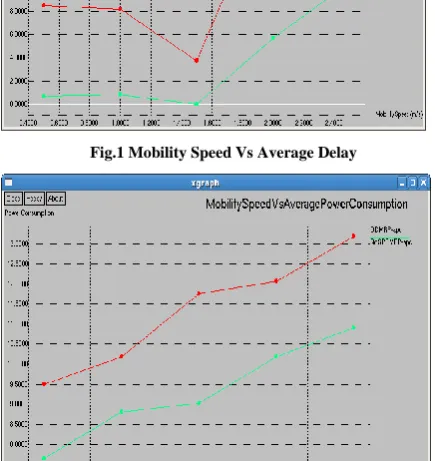
[image:4.595.53.279.189.643.2]From Fig. 1, delay metric it can be seen that the proposed QoS-PEMRP has reduced average delay than that of ODMRP. Fig.3 shows that the average delivery ratio is more in QoS-PEMRP compared to ODMRP. In Fig. 2, it can be seen that, QoS-PEMRP’s average power consumption of overall nodes is lesser than that of ODMRP.
[image:4.595.55.271.194.383.2]Fig.1 Mobility Speed Vs Average Delay
Fig.2 Mobility Speed Vs Average Power Consumption
Fig.3 Mobility Speed Vs Average Delivery Ratio
6.
CONCLUSION
This research work focused on design and development strategy of QoS aware power efficient multicast routing protocol which best suits for wireless nodes moving around
the network with varying mobility speed. The QoS metrics such as average group delivery ratio, average power consumption and average delay are taken into account for measuring the performance of the proposed protocol QoS-PEMRP. Extensive simulation results are carried out through NS2 simulator. From the simulation results it is shown that the proposed QoS-PEMRP outperforms On-Demand Multicast Routing Protocol (ODMRP) routing protocol by reduced delay and increased packet delivery ratio along with decreased power consumption.
7. REFERENCES
[1] B. Tavli and W. Heinzelman, “MH-TRACE: Multi Hop Time Reservation Using Adaptive Control for Energy Efficiency,” IEEE J. Selected Areas Comm., vol. 22, no. 5, pp. 942-953, June 2004.
[2] E. Astier, A. Hafid, and A. Benslimane, “Energy and Mobility Aware Clustering Technique for Multicast Routing Protocols in Wireless Ad Hoc Networks,” Proc. IEEE Wireless Comm. and Networking Conf., pp. 1-6, 2009.
[3] W. Liang, R. Brent, Y. Xu, and Q. Wang, “Minimum-Energy Allto- All Multicasting in Wireless Ad Hoc Networks,” IEEE Trans. Wireless Comm., vol. 8, no. 11, pp. 5490-5499, Nov. 2009.
[4] T. Mukherjee, G. Varsamopoulos, and S.K.S. Gupta, “Self Managing Energy-Efficient Multicast Support in MANETs under End-to-End Reliability Constraints,” Computer Networks, vol. 53, pp. 1603-1627, 2009.
[5] S. Guo and O.W.W. Yang, “Energy-Aware Multicasting in Wireless Ad Hoc Networks: A Survey and Discussion,” Computer Comm., vol. 30, pp. 2129-2148, 2007.
[6] B. Tavli and W. Heinzelman, “QoS and Energy Efficiency in Network-Wide Broadcasting: A MAC Layer Perspective,” Computer Comm., vol. 30, pp. 3705-3720, 2007.
[7] B. Tavli and W. Heinzelman, “Energy and Spatial Reuse Efficient Network Wide Real-Time Data Broadcasting in Mobile Ad Hoc Networking,” IEEE Trans. Mobile Computing, vol. 5, no. 10, pp. 1297-1312, Oct. 2006.
[8] H. Moustafa and H. Labiod, “A Performance Comparison of Multicast Routing Protocols in Ad Hoc Networks,” Proc. IEEE Personal, Indoor and Mobile Radio Conf., pp. 497-501, 2003.
[9] Network Simulator (NS), http://www.isi.edu/nsnam/ns, 2010.
[10] S.J. Lee, W. Su, J. Hsu, M. Gerla, and R. Bagrodia, “A Performance Comparison of Ad Hoc Wireless Multicast Protocols,” Proc. IEEE Conf. Computer Comm., pp. 565-574, 2000.
[11] C.S.R. Murthy and B.S. Manoj, Ad Hoc Wireless Networks: Architectures and Protocols. Prentice Hall, 2004.
[image:4.595.55.273.277.508.2] [image:4.595.56.269.538.724.2][13] B. Tavli and W. Heinzelman, Mobile Ad Hoc Networks: Energy- Efficient Real-Time Group Communications. Springer, 2006.
[14] C.W. Wu and Y.C. Tay, “AMRIS: A Multicast Protocol for Ad Hoc Wireless Networks,” Proc. IEEE Military Comm. Conf., vol. 1, pp. 25-29, 1999.
[15] S.J. Lee, W. Su, and M. Gerla, “On-Demand Multicast Routing Protocol in Multihop Wireless Mobile Networks,” Mobile Networks and Applications, vol. 7, pp. 441-453, 2002.
[16] V. Kawadia and P.R. Kumar, “A Cautionary Perspective on Cross- Layer Design,” IEEE Wireless Comm., vol. 12, no. 1, pp. 3-11, Feb. 2005.
[17] J.G. Jetcheva and D.B. Johnson, “Adaptive Demand-Driven Multicast Routing in Multi-Hop Wireless Ad Hoc Networks,” Proc. ACM Int’l Symp. Mobile Ad Hoc Networking and Computing, pp. 33-44, 2001.
[18] S. Athanassopoulos, I. Caragiannis, C. Kaklamanis, and P. Kanellopoulos, “Experimental Comparison of Algorithms for Energy-Efficient Multicasting in Ad Hoc Networks,” Proc. Int’l Conf. Ad-Hoc, Mobile, and Wireless Networks, pp. 183-196, 2004.
[19] W. Liang, “Approximate Minimum-Energy Multicasting in Wireless Ad Hoc Networks,” IEEE Trans. Mobile Computing, vol. 5, no. 4, pp. 377-387, Apr. 2006.
[20] B. Tavli and W. Heinzelman, “TRACE: Time Reservation Using Adaptive Control for Energy Efficiency,” IEEE J. Selected Areas Comm., vol. 21, no. 10, pp. 1506-1515, Dec. 2003.
[21] W. Ye and J. Heidemann, “Medium Access Control in Wireless Sensor Networks,” Technical Report ISI-TR-580, Information Sciences Inst., Univ. of Southern California, 2003.
[22] J.-P. Ebert, S. Aier, G. Kofahl, A. Becker, B. Burns, and A. Wolisz, “Measurement and Simulation of the Energy
Consumption of an WLAN Interface,” Telecomm. Network Group Technical Report TKN-02-010, Technical Univ. of Berlin, 2002.
[23] B. Tavli and W. Heinzelman, “MC-TRACE: Multicasting through Time Reservation Using Adaptive Control for Energy Efficiency,” Proc. IEEE Military Comm. Conf., pp. 2076-2081, 2005.
[24] M. Conti, G. Maselli, G. Turi, and S. Giordano, “Cross-Layering in Mobile Ad Hoc Network Design,” Computer, vol. 37, no. 2, pp. 48- 51, Feb. 2004.
[25] M. Van Der Schaar and S. Shankar, “Cross-Layer Wireless Multimedia Transmission: Challenges, Principles and New Paradigms,” IEEE Wireless Comm., vol. 12, no. 4, pp. 50-58, Aug. 2005.
[26] V. Srivastava and M. Motani, “Cross-Layer Design: A Survey and the Road Ahead,” IEEE Comm. Magazine, vol. 43, no. 12, pp. 112- 119, Dec. 2005.
[27] M. Gerla, Y.-Z. Lee, J.-S. Park, and Y. Yi, “On Demand Multicast Routing with Unidirectional Links,” Proc. IEEE Wireless Comm. and Networking Conf., pp. 2162-2167, 2005.
[28] T. Numanoglu, B. Tavli, and W. Heinzelman, “Energy Efficiency and Error Resilience in Coordinated and Non-Coordinated Medium Access Control Protocols,” Computer Comm., vol. 29, pp. 3493-3506, 2006.
[29] L. Junhai, Y. Danxia, X. Liu, and F. Mingyu, “A Survey of Multicast Routing Protocols for Mobile Ad-Hoc Networks,” IEEE Comm. Surveys and Tutorials, vol. 11, no. 1, pp. 78-91, First Quarter 2009.