R E S E A R C H
Open Access
Use of a highly sensitive strand-specific
quantitative PCR to identify abortive replication
in the mouse model of respiratory syncytial virus
disease
Richard Bannister, Deborah Rodrigues, Edward J Murray, Carl Laxton, Mike Westby, Helen Bright
*Abstract
Background:The BALB/c mouse is commonly used to study RSV infection and disease. However, despite the many advantages of this well-characterised model, the inoculum is large, viral replication is restricted and only a very small amount of virus can be recovered from infected animals. A key question in this model is the fate of the administered virus. Is replication really being measured or is the model measuring the survival of the virus over time? To answer these questions we developed a highly sensitive strand-specific quantitative PCR (QPCR) able to accurately quantify the amount of RSV replication in the BALB/c mouse lung, allowing characterisation of RSV negative and positive strand RNA dynamics.
Results:In the mouse lung, no increase in RSV genome was seen above the background of the original inoculum whilst only a limited transient increase (< 1 log) in positive strand, replicative intermediate (RI) RNA occurred. This RNA did however persist at detectable levels for 59 days post infection. As expected, ribavirin therapy reduced levels of infectious virus and RI RNA in the mouse lung. However, whilst Palivizumab therapy was also able to reduce levels of infectious virus, it failed to prevent production of intracellular RI RNA. A comparison of RSV RNA kinetics in human (A549) and mouse (KLN205) cell lines demonstrated that RSV replication was also severely delayed and impairedin vitroin the mouse cells.
Conclusions:This is the first time that such a sensitive strand-specific QPCR technique has been to the RSV mouse system. We have accurately quantified the restricted and abortive nature of RSV replication in the mouse. Furtherin vitrostudies in human and mouse cells suggest this restricted replication is due at least in part to species-specific host cell-viral interactions.
Background
Respiratory Syncytial Virus (RSV) is the leading cause of lower respiratory tract infection (LRTI) in infants and children world-wide and is increasingly recognised as a cause of serious disease in adults and immune compro-mised transplant patients [1,2]. Over half of all children will be infected with RSV by their first birthday and by the age of 2 nearly all children will have been infected with RSV at least once [3]. LRTI caused by RSV infec-tion is a major cause of both infant hospitalisainfec-tion and
infant viral induced death [4]. A number of medical treatments, including use of bronchodilators, palliative care (supportive ventilation, nitric oxide) and use of anti inflammatory agents are available but none of these treatments relieve the viral burden in RSV-infected patients. The only small molecule antiviral therapeutic agent for treating RSV is Virazole (aerosolised ribavirin), which has been shown to be of limited use because of its lengthy administration and questionable efficacy [5,6]. Palivizumab (Synagis) is a humanised monoclonal IgG1 antibody specifically directed to the RSV fusion protein which has been used prophylactically to good effect in at-risk infants. However, a therapeutic treat-ment did not result in significant clinical benefit [7]. * Correspondence: [email protected]
Infectious Diseases Group, Pfizer Global Research and Development, Sandwich, Kent, CT13 9NJ, UK
Thus, there is a clear, unmet medical need to develop therapies able to ameliorate RSV disease [8-10].
RSV is a negative-stranded RNA virus belonging to theParamyxoviridae family. The negative sense single-strand RSV genome comprises a RNA molecule encod-ing 11 proteins. Upon host cell infection positive-sense viral mRNAs are synthesised by the viral RNA polymer-ase, these mRNAs make use of host-cell machinery to synthesise viral proteins. Genome replication occurs via the production of a positive sense replicative intermedi-ate (RI) RNA strand by the same viral RNA polymerase; this RI RNA is used as a template for the synthesis of more negative sense genome [11-13].
The use of in vivomodels with good clinical transla-tion is vital in the search for new treatments for dis-ease A number of different animal models have been used to study RSV infection and replication and to evaluate potential therapies, including primates,
bovines and rodents [14]. The majority ofin vivo
stu-dies have been conducted using either the BALB/c mouse [15] or the cotton rat (Sigmodon hispidus) [16] models. The cotton rat is moderately permissive to human respiratory viral infection and RSV is able to replicate and produce viral progeny in the lungs [17]. The BALB/c mouse is also susceptible to RSV infection [18] and, though less permissive than the cotton rat [19], constitutes a more practical model due to the availability of a larger number of immunological and molecular reagents as well as the availability of trans-genic animals. Like the cotton rat, the mouse requires
inoculation with a high dose (usually 106 PFU) to
achieve viral replication. The actual amount of viral replication occurring following infection with such a supra-physiological dose of RSV has never been accu-rately determined.
We therefore developed a strand-specific real-time quantitative polymerase chain reaction (QPCR) method to monitor the kinetics of RSV RNA replication in the mouse lung. BALB/c mice were infected with RSV A2 and viral RNA in mouse lungs were monitored over an extended time course. Levels of infectious virus in lungs were also measured. Taken together, results from these 2 assays showed that RSV RNA synthesis and viral repli-cation was severely limited in the mouse. Treatment with a prophylactic antibody (palivizumab) did not affect viral RNA replication and persistence, but did impair the production of infectious progeny virus, indicating that abortive replication [16] occurs in the mouse. By contrast, positive sense viral RNA and infectious virus production were both disrupted by ribavirin. Further in vitro studies in human and mouse cells demonstrated that although both cell types were equally susceptible to infection; viral RNA synthesis was delayed and impaired in mouse cells. This finding suggests that a
species-specific host-virus interaction inhibits the capacity for RSV replication in the mouse.
Methods
Animals
Female BALB/c mice (6-8 weeks old), specific pathogen free, were purchased from Charles River Laboratories and housed in an animal care facility in ventilated isola-tion cubicles. Water and chow were provided ad libitum. Mice were allowed to acclimate to the new environment for 1-2 weeks and housed in groups according to experi-mental setup. All experiments with animals were carried out in compliance with UK legislation and subject to local ethical review.
Virus, cells and viral assays
RSV-A2 was obtained from Advanced Biotechnologies Inc. Stocks were produced by infecting Hep-2 cells at a multiplicity of infection (MOI) of 0.1 focus forming units (FFU) per cell. Following 4-5 days incubation, infected cells were harvested and snap frozen in dry ice and methanol and stored at -80°C. Viral titres were determined by a HEp2 based immunofluorescence assay and expressed as FFU/ml [20]. UV-inactivated RSV (UVRSV) was generated by exposing RSV A2 to UV radiation at 254 nm for 20 minutes using a Stratalinker (Stratagene). Loss of infectivity of UVRSV was con-firmed by infecting Hep2 cells (MOI ranging from 0.1-1 FFU/cell). For animal studies, viral titres were expressed as geometric means +/- standard errors of means (SEM) for all animals in a group.
A549 cells (human lung carcinoma) and KLN205 cells (DBA/2 mouse lung squamous cell carcinoma) were purchased from ATCC and maintained in DMEM or EMEM respectively, each supplemented with 100 IU/ml
of penicillin, 100 μg/ml streptomycin, 2 mM
L-gluta-mine, and 10% foetal calf serum (FCS).
Drugs
Ribavirin was obtained from Sigma-Aldrich and Palivi-zumab (Synagis, MedImmune) was obtained from Idis Ltd.
RSV infection in vivo
For preliminary RSV replication and dynamics studies, mice were inoculated once intranasally (i.n.) with 50μl
of either RSV A2 (1 × 10⁶ FFU per animal) or an
analyses. The second lung was processed by hand-held homogeniser (Omni) in 1 ml MEM (Invitrogen). Homo-genates were centrifuged, clarified viral supernatant
diluted 1:3 in MEM and 50 μl used in triplicate in
immunofluorescence assay [20].
For experiments conducted to investigate inhibition of RSV replication, one group of animals were adminis-tered a single intramuscular injection of palivizumab (5 mg/kg of body weight) 24 hours prior to infection with RSV. A second group were administered ribavirin (100 mg/kg of body weight) intraperitoneally one hour prior to RSV challenge. These groups, plus a further untreated group, were inoculated intra nasally with
75μL RSV A2 (2.6 × 10⁶ FFU/mouse). Ribavirin
treat-ment was re-administered 5 hours post virus inoculation and twice daily dosing of this compound continued for a further day. Ribavirin treatment was not administered on day 2. Dosing continued on day 3 at 50 mg/kg twice daily until day 6 post virus infection. Animals were sacrificed at 1, 8, 24, 48 and 72 hours and 5, 7 and 10 days post infection (6 animals per group per time point). Lungs were harvested for viral titrations and RNA extraction.
In-vitro transcript standard production
A region of the RSV A2 nucleocapsid domain was iso-lated using a nested primer approach. RSV A2 viral RNA was prepared from crude preparation using the QIAamp viral RNA minikit (Qiagen). RNA was reverse transcribed using the High Capacity cDNA reverse-transcription kit (Applied Biosystems) with random primers. PCR was
conducted usingPwoSuperyield polymerase (Roche) with
external primers (Table 1) at an annealing temperature of 60°C for 35 cycles followed by nested primer (Table 1) PCR using cycling conditions as described above. Gel-purified PCR product was restriction-cloned into
pGEM-4Z vector (Promega), grown in Oneshot TOP10
chemically competent E. coli (Invitrogen) and plasmid
purified by QIAprep Spin Miniprep Kit (Qiagen). Clones were sequence-checked at Lark Technologies, UK. The insert plus bacterial promoter vector sequences of verified
clones was isolated by PCR usingPwo Superyield
poly-merase with M13 forward (-20) and reverse primers at an annealing temperature of 55°C for 35 cycles. Positive and negative sense in vitro transcripts were synthesised by Sp6 and T7 RNA polymerase (Promega) respectively, these products were treated with Turbo DNase (Ambion) and purified by 3 M sodium acetate (pH 5.5) precipita-tion. Stocks of 108 absolute copies perμl were prepared and stored at -80°C.
Strand-specific real time QPCR
RNA was prepared from mouse lungs using an RNeasy kit (Qiagen) following manufacturer’s instructions. First strand cDNA was synthesised from RNA using Reverse Transcription Reagents (Applied Biosystems) with gene specific primers targeted to the positive or negative sense RSV A2 nucleocapsid region RNA (Table 1). Primers contain a tag sequence recognised by a tag-spe-cific primer in QPCR reactions; this reduces the detec-tion of non-specific, self-primed cDNAs [21]. Reacdetec-tions (10 μl) comprised 1 × reaction buffer, 5.5 mM MgCl2,
0.5 mM dNTP mix, 2.5μM strand-specific primers, 4 U
RNase inhibitor and 12.5 U reverse transcriptase with
4 μl total RNA preparation in water. Reactions were
[image:3.595.58.534.554.701.2]performed at 50°C for 40 mins followed by 95°C for 5 mins. Positive strand detection by QPCR was per-formed using TaqMan® Universal PCR mastermix (Applied Biosystems) with positive sense RNA specific primer, 800 nM tag-specific primer and 100 nM probe (Table 1). Reactions were performed using an Applied Biosystems 7900 HT. Samples were held at 50°C for
Table 1 Primer sequences used for RNA standard generation, cDNA synthesis and QPCR.
Primer Sequence
In vitro standard external positive sense TCCAGCAAATACACCATCCA
In vitro standard external negative sense CTGCTTCACCACCCAATTTT
In vitro standard nested positive sense ATAGAATTCGGTATGTTATATGCGATGTCTAGGT1
In vitro standard nested positive sense ATAGGATCCTGCTAAGACTCCCCACCGTAA2
Positive sense RNA-specific cDNA synthesis CGGTCATGGTGGCGAATAATCCTGCAAAAATCCCTTCAACT3
Negative sense RNA-specific cDNA synthesis CGGTCATGGTGGCGAATAAACTTTATAGATGTTTTTGTTCA3
Positive sense-specific QPCR primer CCCCACTTTATAGATGTTTTTGTTCA
Negative sense-specific QPCR primer TCCTGCAAAAATCCCTTCAACT
QPCR tag primer CGGTCATGGTGGCGAATAA
Probe FAM-TTGGTATAGCACAATCTTCTACCAGAGGTGGC-TAMRA
1
Sequence contains an EcoRI restriction site (bold, underlined) 2
Sequence contains a BamHI restriction site (bold, underlined) 3
2 mins followed by 95°C for 10 mins and then 40 cycles of 95°C for 15 secs and 60°C for 1 min. Negative sense strand detection was performed as described for the positive sense RNA reaction but substituting the positive sense RNA specific primer for a negative sense RNA primer. Positive and negative sense RNA transcript stan-dard ranges (10-107 absolute copies/μl) were processed alongside samples. The limits of detection for this assay were defined as values measured outside the range of
the standard curves. RSV copy number perμl of total
mouse lung RNA were normalised to beta-actin detected using commercially available TaqMan® VIC/ MGB primer-limited endogenous control (Applied
Bio-systems) with random-primed 1ststrand cDNA
synthe-sised using the High Capacity cDNA reverse-transcription kit (Applied Biosystems). Absolute values of normalised RSV copy number were subsequently divided by the weight of the lung tissue from which RNA was extracted and expressed as normalised copy number/g lung wt.
RSV infectionin vitro
To investigate whether RSV RNA synthesis occurs effec-tively in a mouse cell line compared to a human cell line in vitro, human lung carcinoma cells (A549) and mouse lung epithelial squamous cells (KLN205) were plated at a density of 1 × 10⁴ cells per well in 96 well plates and infected with RSV A2 to yield various multi-plicities of infection (MOIs) ranging from 1 × 10⁻³to 1. Media containing 10% FCS was replaced with fresh media containing 2% FCS after 24 hours. Cells were lysed with RLT buffer (Qiagen) at 1, 8, 24, 48 and 72 hours and after 5 (A549) or 6 (KLN205), 7 and 10 days. Total RNA was prepared using the RNeasy 96 kit (Qia-gen). RSV strand-specific QPCR was performed as
described above. RSV copy number perμl of total RNA
were not normalised to beta-actin but rather analysed separately due to variable rates of cell death observed throughout the experiment and expressed as RSV copy number.
Statistics
For QPCR analyses the ratio of positive to negative copy number is analysed on the logarithmic scale. Treatments are compared to untreated RSV infected controls at each time point by two-sample t-test incor-porating Satterthwaite’s adjustment to the degrees to freedom. To allow for testing of multiple time points within a treatment a Bonferroni adjustment was made to achieve an approximate 5% significance level within that treatment. Infectious virus assay data were ana-lysed by 1 way analysis of variance (ANOVA) for sig-nificant differences (p = < 0.05) between treated
groups and untreated RSV infected controls at each time point.
Results
Development of an RSV strand-specific real time quantitative PCR method
A strand-specific QPCR method was developed to study RSV intracellular RNA dynamics. This method distin-guishes between negative sense (genomic) RNA and positive sense RNAs (nucleocapsid mRNA and RI RNA)
by discrimination at the 1st strand cDNA synthesis
[image:4.595.305.539.319.666.2]stage. The strand-specific RSV primers used in the reverse transcription stage contain tag sequences that are incorporated into specifically primed cDNA and this sequence can be specifically targeted by a tag-specific primer during QPCR cycling (Table 1). The use of this tag is designed to reduce detection of cDNAs synthe-sised due to RNA self-priming in the reverse
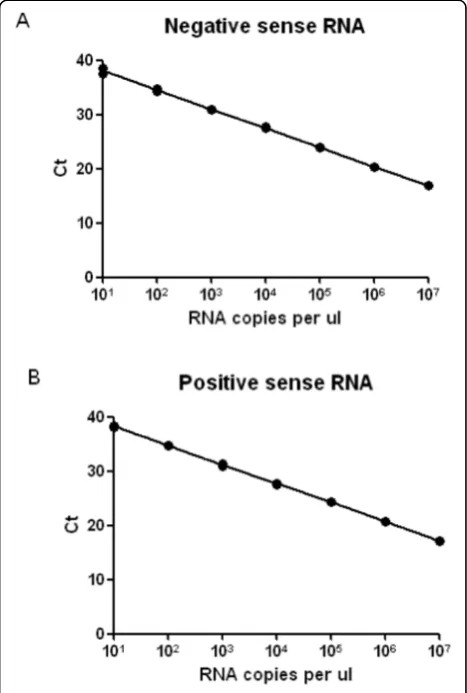
transcription reaction. Standard curves generated using in vitro transcribed RNA standards to monitor negative (Figure 1A) and positive (Figure 1B) strand specific
QPCR revealed that both assays were ≥95% efficient
with R2 values above 0.99 (Table 2). The specificity of the reactions was assessed by spiking positive and nega-tive sense RSV RNA standards into naïve mouse lung RNA and using both positive and negative strand-speci-fic reagents to measure RSV RNA. The detection of non-specific RNA strand in mouse lung RNA back-ground was <0.001% of specific strand detection in both positive and negative sense-specific reactions (Table 2). No signal was detected when naïve mouse lung alone was assayed, ruling out any non-specific effect from self-priming RNA species.
RSV replication dynamics in BALB/c mouse lungs
RSV RNAs were analysed in the lungs of female BALB/c
mice dosed i.n. with 106 FFU per animal over a 59 day
period. Another group were infected with UV-inacti-vated RSV as a control.
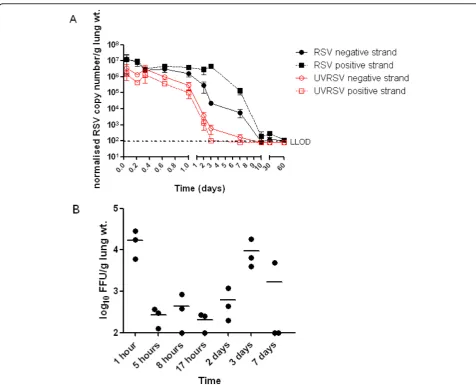
Mean normalised copy number/g lung wt. of both positive and negative RSV strands from infected mouse
lung RNA preparations remained above 1 × 10⁶ for 24
hours following infection (Figure 2A). From 24 hours onwards the amount of RSV negative strand reduced and this trend continued until day 10 when mean
mea-sured RNA reached a basal level of approximately 102
normalised copies/g lung wt. that persisted to 59 days post-infection. By contrast, the mean positive sense
strand RNA remained above 106 normalised copies/g
lung wt. until 72 hours post-infection. The mean nega-tive and posinega-tive strand UVRSV RNA both declined in a time dependent manner from >106normalised copies/g lung wt. 1 hour post infection and could not be detected after day 7 p.i. (Figure 2A). FFU assay performed on lung homogenates revealed a high mean FFU/g lung wt.
of >104 at 1 hour post-dosing that was markedly
reduced to <103 FFU/g lung wt. by 5 hours (Figure 2B). Infectious virus remained at this low level until 72
hours post infection when an increase to 104 FFU/g
lung wt. was observed. Infectious virus reduced again on day 7. No infectious virus was detected from lungs excised from UVRSV dosed mice. Note that no RSV RNA or infectious virus could be detected in the lungs of control, untreated mice. These FFU data agree well
with previously published results describing detection of infectious virus from RSV-infected BALB/c mouse lungs over a time-course [22].
Effect of ribavirin and palivizumab on RSV replication in BALB/c mouse lungs
Having conducted a time-course overview of intracellu-lar RSV RNA in BALB/c mouse lungs, we investigated the effects that palivizumab and ribavirin treatments have on RNAs in RSV-infected BALB/c mice and how these correlated with their effects on infectious virus
production. A group of mice infected with 2.6 × 10⁶
FFU RSV were treated prophylactically with palivizumab (5 mg/kg of body weight) 24 hours prior to infection with RSV. A second group were administered ribavirin (100 mg/kg of body weight) intraperitoneally one hour prior to RSV challenge and re-administered throughout the experiment as described in Materials and Methods. Untreated RSV infected mice were also monitored in this experiment.
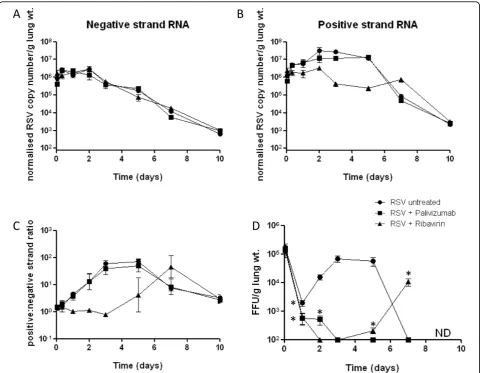
[image:5.595.56.547.101.140.2]The use of either ribavirin or palivizumab had no effect on the quantities of intracellular negative sense genomic RNA measured throughout the experiment when com-pared to untreated RSV dosed mice (Figure 3A). How-ever, ribavirin treatment did correlate with an alteration in the time course profile of positive sense RI RNA in mouse lungs compared to untreated RSV dosed mice (Figure 3B). There was a≥1 log reduction in mean posi-tive strand RNA relaposi-tive to untreated RSV infected mice on days 3 and 5. There was no drop in positive strand copy numbers between days 5 and 7 in ribavirin treated mice, however positive strand copy numbers decreased to between 103-104normalised copies/g lung wt. on day 10, as was also measured in untreated mice. In palivizumab treated mice the positive sense RNA profile tracked closely that observed in untreated RSV infected mice. Measured RNA quantities were expressed as ratios of positive to negative strand RNA for each treatment (Figure 3C). Statistical analyses reveal that the positive/ negative RNA ratio in ribavirin treated mouse lungs is significantly lower than that of untreated mice at days 1, 2, 3 and 5, and significantly higher at day 7. There is no significant difference to untreated RSV infected mice at day 10. It should be noted that dosing of ribavirin to mice was stopped at day 6, which coincides with the time at which the ratio of positive to negative strand RNA in
Table 2 Standard curve fits, R2and specificity of the QPCR.
RNA strand Slope Reaction Efficiency (%) R2 Specificity (% non-specific strand detected)
Negative (genomic) Y = -3.44x+41.11 95 0.997 < 0.001
Positive (mRNA and RI) Y = -3.37x+41.06 98 0.997 < 0.001
Specificity was assessed by spiking non strand-specific RNA standards into naïve mouse lung RNA. Detection of spiked non strand-specific RNA is expressed as a percentage of measured specific sense standards spiked to mouse lung. Reaction Efficiency defined as 10(-1/slope)
ribavirin treated mouse lungs switched from being signifi-cantly lower than untreated RSV dosed mice at day 5 to significantly greater at day 7. The RSV RNA strand ratio from palivizumab-treated mouse lungs is not significantly different to that of untreated RSV infected mice at any time point (Figure 3C).
Infectious virus was quantified from lungs 1 hour post-infection by FFU assay (Figure 3D). Mean values from the 3 RSV infected groups were all approximately 105FFU/g lung weight. In untreated RSV infected mice, levels of quantified infectious virus increased by 1-2 logs
from approximately 103 FFU/g lung wt. at 24 hours to
almost 105 FFU/g lung wt. at 3 days post infection.
Measured infectious virus remained above 104 FFU/g
lung weight to day 5 but became undetectable at 7 days. In ribavirin treated mice infectious virus in lung homo-genates was significantly lower than in untreated RSV infected mice at 24 hours and was undetectable at 48 hours. Infectious virus was again detectable in this group at day 5 and increased at day 7. This increase coincides with a persistence of positive strand RNAs
above 105 copies/g lung wt. at a time when positive
sense RNA in untreated mice fell below 105 copies/g
lung wt. (Figure 3B).
[image:6.595.58.535.86.472.2]Infectious virus detected in lungs from mice treated with palivizumab was significantly lower than untreated
RSV infected mice at 24 and 48 hours post infection. Infectious virus was undetectable from palivizumab trea-ted mouse lungs at all time points past 48 hours.
RSV RNA replication is severely impaired in mouse cellsin vitro
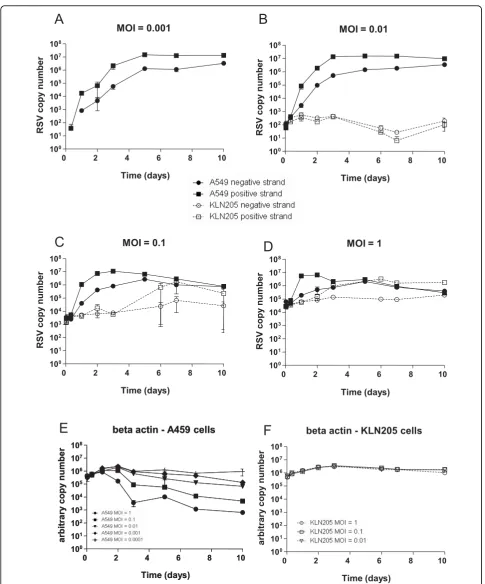
In human A549 cells infected with a low MOI of 1 × 10⁻³ or 1 × 10⁻², viral RNAs increased from below the limit of detection at 1 hour post infection to maximum levels (negative sense >106 copies; positive strand >107 copies) at day 5 which were sustained up to the end of the experiment at day 10. When the cells were infected
with higher MOIs of 1 × 10⁻¹ or greater, the positive
and negative RSV RNA attained similar maximum levels to those observed in the lower MOI infections (negative sense >106 copies; positive strand >107 copies) (Figure 4C and 4D). Viral RNA reaches maximum expression values earlier in cells infected with higher MOI. A decrease in measured negative and positive RNA was
observed in MOI 1 × 10⁻¹and 1 infections after day 5
(Figure 4C and 4D) which correlated with a progressive decrease in beta actin gene expression, indicative of cell death (Figure 4E).
[image:7.595.58.541.88.461.2]In mouse KLN205 cells infected with RSV at a low MOI of 1 × 10⁻³no viral RNA could be detected (Figure 4A). At an MOI of 1 × 10⁻² very low levels of positive
MOI = 1
0 2 4 6 8 10
100
101
102
103
104
105
106
107
108
Time (days)
RSV copy
number
MOI = 0.1
0 2 4 6 8 10
100
101
102
103
104
105
106
107
108
Time (days)
RSV copy
number
MOI = 0.01
0 2 4 6 8 10
100
101
102
103
104
105
106
107
108
Time (days)
RSV copy
number
MOI = 0.001
0 2 4 6 8 10
100
101
102
103
104
105
106
107
108
Time (days)
RSV copy
number
beta actin - A459 cells
0 2 4 6 8 10
100
101
102
103
104
105
106
107
108
Time (days)
arbitrary
copy
number
beta actin - A459 cells
0 2 4 6 8 10
100
101
102
103
104
105
106
107
108
Time (days)
arbitrary
copy
number
A
F
E
D
C
B
beta actin - KLN205 cells
0 2 4 6 8 10
100
101
102
103
104
105
106
107
108
Time (days)
arbitrary
copy
[image:8.595.56.542.84.669.2]number
and negative sense RSV RNA could be detected (Figure 4B), but at day 10 the mean amounts of neither strand were higher than those measured 1 hour post-infection (102 copies).
In cells infected at a MOI of 1 × 10⁻¹, mean positive
sense RSV RNA increased by 2 logs from 104copies on
day 3 to 106 copies by day 7 (Figure 4C). However, no
increase in negative sense RNA copy number was observed over the 10 day culture period. A limited increase in positive sense RNA was also observed in cul-tures infected with an MOI of 1, rising from day 2 (105 copies) to day 7 (106 copies) and was maintained until the end of the study at day 10. Similar to cells infected with the MOI of 1 × 10⁻¹, no increase in negative strand RNA was observed (Figure 4D). Beta actin levels in the mouse KLN205 cells fell less than 0.5 logs between days 2 and 10 indicating that no appreciable cell death had occurred throughout the study (Figure 4F).
Discussion
We have developed a strand-specific QPCR method to
measure RSV in vitroandin vivo. This method
distin-guishes between negative sense viral RNA (genome) and positive sense RNA (replicative intermediate and nucleo-capsid mRNA). Using this method, we provide a detailed insight into RSV RNA production in infected BALB/c mouse lung. To our knowledge, this is the first time that a strand specific method has been applied to profile RSV RNA dynamics in the BALB/c mouse over such a detailed time course.
Early viral RNA synthesis in mouse lungs is charac-terised by absolute measures of positive and negative sense RNA being equivalent at infection, followed by a 1-2 logs relative increase in positive strand RNA by day 3 post infection. This disparity between RNA strands decreases again from day 7. It should be noted that this window of maximum disparity between the positive and negative strand copy numbers at day 3 coincides with the highest level of infectious progeny virus detected from mouse lungs following infection. It is known that paramyxovirus replicative intermediate RNA represent 10-40% of the genome [16], therefore the majority of positive strand RNA synthesis seen here is accounted for by nucleocapsid mRNA production.
That RSV genome and positive strand RNA can be detected in mouse lungs up to at least 59 days post-infection has been reported both here and elsewhere [15,23]. It therefore appears that mice are unable to fully clear the virus following infection. The fact that UV killed RSV was not detected by QPCR past day 7 supports this view of viral persistence. RSV persistence in the lungs has been reported from humans with chronic obstructive pulmonary disease (COPD) [24], although in another study, RSV infections in COPD
were attributed to acute infection rather than low-level persistence [25]. The significance of persistent low levels of RSV in this and other conditions is unclear at present and further studies are required to elucidate the scope and impact of this phenomenon [26]. However, it is pos-sible that low levels of persistent virus exist between RSV seasons and it is apparent that RSV persistence and strategies for complete viral clearance may be studied in rodent models.
Viral RNA replication has been studied by strand-dis-criminate QPCR previously in the cotton rat [16]. Viral genome levels increased by approximately 2 logs from 6 hours post infection to a peak measured on day 4 whereas our studies indicate that in the mouse lung total genomic RNA did not increase in this time frame. Indeed, in the mouse model we observed that viral gen-ome load either decreased after 24 hours or (if a higher inoculum was applied), was maintained for a period of time before decreasing after day 5. These data suggest that RSV has a greater replicative capacity in the cotton rat model compared to the mouse. However until a direct head to head comparison is made between the two species, this cannot be concluded.
Ribavirin has been used extensively as an antiviral therapeutic. Its exact mode of action is poorly defined although several mechanisms have been proposed [27]. Here, as expected, ribavirin treatment had a marked effect on RSV intracellular RNA dynamics as evidenced by the reduction in positive sense RNA in mouse lungs. However, there was little difference seen in the time-course profiles of total genomic RNA in ribavirin treated and untreated RSV infected mice. This suggests that the amount of new genome synthesised following infection is only a small fraction of that dosed initially and that measuring positive sense RNA specifically is vital to the study of the intracellular viral processes in mouse lung following supra-physiologic dosing.
To investigate whether the restricted replication pat-tern seen in the mouse is purely anin vivophenomenon, we infected lung epithelial carcinoma cells from human (A549) and mouse (KLN205) with RSV and studied viral replication by strand-specific QPCR. One hour post infection, the input viral RNA levels were very similar in both human and mouse cells, irrespective of MOI or cell type, indicating that the mouse and human cells had been exposed to equivalent amounts of viral RNA. How-ever, a clear increase in either viral RNA strand only occurred in mouse cells when they were infected with a high MOI of 0.1 or 1. This situation mirrors that which
occurs in the mousein vivomodel in that an extremely
high viral titre is required for replication [14]. Moreover, the increase in positive strand viral RNA was consider-ably delayed, occurring after a lag time of 3 days in cul-ture suggesting that the virus has undergone a period of adaptation. Overall, RSV RNA synthesis in human A549 cells was at least 3 orders of magnitude more efficient than that observed in mouse cells, illustrating that RSV cannot replicate efficiently in mouse KLN205 cells. This data suggests that some host-specific block to viral repli-cation exists, though a wider range of human and mouse cell lines require testing to confirm this.
It is unclear why the murine cells did not facilitate RSV RNA synthesis to the same extent as seen in human cells. It may be that RNA replication in KLN205 cells is inhibited either by the presence or absence of one or more host factors required for the viral life cycle. For example, it is known that RSV can modulate host cell anti-viral responses, such as the degradation of STAT2 by NS1 [28], which inhibits the interferon response. Poor replication of RSV in mouse embryo cells has been described previously [29]. This was attrib-uted to the mouse interferon response as treatment of infected cells with anti-mouse interferon improved virus yields. Perhaps RSV is not able to modulate the mouse interferon response to the same extent as human inter-feron. Alternatively, it is also known that RSV requires host proteins to replicate efficiently. Phosphorylation of the RSV P protein by casein 2 is required for transcrip-tion elongatranscrip-tion activity of the viral polymerasein-vitro
[30]. It is plausible that species-specific differences in host factors may impair the ability of RSV to replicate efficiently in mouse cells, as is exemplified with HIV and APOBEC3G [31].
In conclusion, we have demonstrated and quantified the abortive and restricted nature of RSV RNA synthesis and replication in mouse using a highly sensitive and specific QPCR method. We have gone on to provide evidence that the impaired replication may be due to a murine host-virus interaction. We suggest a number of candidates and work is ongoing to identify these interactions.
Acknowledgements
The authors thank Julien Browne, Frances Burden, Bhavika Desai, Tansi Khodai, Susanne Lang, Hannah Perkins and Joanne Strawbridge for practical support. We would also like to thank Chloe Brown, Lisa-Marie Burrows and Lindsey Cousens in Pfizer CM. The statistical support of Katrina Gore and Richard Lyons is also gratefully acknowledged.
Authors’contributions
RB carried out the molecular and cellular studies and drafted the manuscript. DR carried out thein vivoand cellular assays and analysis and interpretation of data, EJM, MW and CL participated in the design of the study and analysis and interpretation of data. HB conceived of the study, participated in its design and coordination and helped to draft the manuscript. All authors read and approved the final manuscript.
Competing interests
All authors are or were employed in a full-time capacity by Pfizer Research and Development.
Received: 15 June 2010 Accepted: 22 September 2010 Published: 22 September 2010
References
1. Han LL, Alexander JP, Anderson LJ:Respiratory syncytial virus pneumonia among the elderly: an assessment of disease burden.J Infect Dis1999, 179:25-30.
2. McCarthy AJ, Kingman HM, Kelly C, Taylor GS, Caul EO, Grier D, Moppett J, Foot AB, Cornish JM, Oakhill A,et al:The outcome of 26 patients with respiratory syncytial virus infection following allogeneic stem cell transplantation.Bone Marrow Transplant1999,24:1315-1322. 3. Glezen WP, Greenberg SB, Atmar RL, Piedra PA, Couch RB:Impact of
respiratory virus infections on persons with chronic underlying conditions.Jama2000,283:499-505.
4. Leader S, Kohlhase K:Recent trends in severe respiratory syncytial virus (RSV) among US infants, 1997 to 2000.J Pediatr2003,143:S127-132. 5. DeVincenzo JP:Therapy of respiratory syncytial virus infection.Pediatr
Infect Dis J2000,19:786-790, discussion 802-784, 811-783.
6. Greenough A, Thomas M:Respiratory syncytial virus prevention: past and present strategies.Expert Opin Pharmacother2000,1:1195-1201. 7. Saez-Llorens X, Moreno MT, Ramilo O, Sanchez PJ, Top FH Jr, Connor EM:
Safety and pharmacokinetics of palivizumab therapy in children hospitalized with respiratory syncytial virus infection.Pediatr Infect Dis J
2004,23:707-712.
8. Andries K, Moeremans M, Gevers T, Willebrords R, Sommen C, Lacrampe J, Janssens F, Wyde PR:Substituted benzimidazoles with nanomolar activity against respiratory syncytial virus.Antiviral Res2003,60:209-219. 9. Douglas JL, Panis ML, Ho E, Lin KY, Krawczyk SH, Grant DM, Cai R,
Swaminathan S, Cihlar T:Inhibition of respiratory syncytial virus fusion by the small molecule VP-14637 via specific interactions with F protein.
J Virol2003,77:5054-5064.
10. Wyde PR, Chetty SN, Timmerman P, Gilbert BE, Andries K:Short duration aerosols of JNJ 2408068 (R170591) administered prophylactically or therapeutically protect cotton rats from experimental respiratory syncytial virus infection.Antiviral Res2003,60:221-231.
11. Cowton VM, McGivern DR, Fearns R:Unravelling the complexities of respiratory syncytial virus RNA synthesis.J Gen Virol2006,87:1805-1821. 12. Hacking D, Hull J:Respiratory syncytial virus–viral biology and the host
response.J Infect2002,45:18-24.
13. Sugrue RJ:Interactions between respiratory syncytial virus and the host cell: opportunities for antivirus strategies?Expert Rev Mol Med2006, 8:1-17.
14. Domachowske JB, Bonville CA, Rosenberg HF:Animal models for studying respiratory syncytial virus infection and its long term effects on lung function.Pediatr Infect Dis J2004,23:S228-234.
15. Estripeaut D, Torres JP, Somers CS, Tagliabue C, Khokhar S, Bhoj VG, Grube SM, Wozniakowski A, Gomez AM, Ramilo O,et al:Respiratory syncytial virus persistence in the lungs correlates with airway hyperreactivity in the mouse model.J Infect Dis2008,198:1435-1443. 16. Boukhvalova MS, Prince GA, Blanco JC:Respiratory syncytial virus infects
and abortively replicates in the lungs in spite of preexisting immunity.
17. Boukhvalova MS, Prince GA, Blanco JC:The cotton rat model of respiratory viral infections.Biologicals2009,37:152-159.
18. Taylor G, Stott EJ, Hughes M, Collins AP:Respiratory syncytial virus infection in mice.Infect Immun1984,43:649-655.
19. Vaux-Peretz F, Meignier B:Comparison of lung histopathology and bronchoalveolar lavage cytology in mice and cotton rats infected with respiratory syncytial virus.Vaccine1990,8:543-548.
20. Malhotra R, Ward M, Bright H, Priest R, Foster MR, Hurle M, Blair E, Bird M: Isolation and characterisation of potential respiratory syncytial virus receptor(s) on epithelial cells.Microbes Infect2003,5:123-133. 21. Bessaud M, Autret A, Jegouic S, Balanant J, Joffret ML, Delpeyroux F:
Development of a Taqman RT-PCR assay for the detection and quantification of negatively stranded RNA of human enteroviruses: evidence for false-priming and improvement by tagged RT-PCR.J Virol Methods2008,153:182-189.
22. Chavez-Bueno S, Mejias A, Gomez AM, Olsen KD, Rios AM, Fonseca-Aten M, Ramilo O, Jafri HS:Respiratory syncytial virus-induced acute and chronic airway disease is independent of genetic background: an experimental murine model.Virol J2005,2:46.
23. Schwarze J, O’Donnell DR, Rohwedder A, Openshaw PJ:Latency and persistence of respiratory syncytial virus despite T cell immunity.Am J Respir Crit Care Med2004,169:801-805.
24. Wilkinson TM, Donaldson GC, Johnston SL, Openshaw PJ, Wedzicha JA: Respiratory syncytial virus, airway inflammation, and FEV1 decline in patients with chronic obstructive pulmonary disease.Am J Respir Crit Care Med2006,173:871-876.
25. Falsey AR, Formica MA, Hennessey PA, Criddle MM, Sullender WM, Walsh EE:Detection of respiratory syncytial virus in adults with chronic obstructive pulmonary disease.Am J Respir Crit Care Med2006, 173:639-643.
26. Sikkel MB, Quint JK, Mallia P, Wedzicha JA, Johnston SL:Respiratory syncytial virus persistence in chronic obstructive pulmonary disease.
Pediatr Infect Dis J2008,27:S63-70.
27. Sidwell RW, Barnard DL:Respiratory syncytial virus infections: recent prospects for control.Antiviral Res2006,71:379-390.
28. Elliott J, Lynch OT, Suessmuth Y, Qian P, Boyd CR, Burrows JF, Buick R, Stevenson NJ, Touzelet O, Gadina M,et al:Respiratory syncytial virus NS1 protein degrades STAT2 by using the Elongin-Cullin E3 ligase.J Virol
2007,81:3428-3436.
29. Hanada N, Morishima T, Nishikawa K, Isomura S, Nagai Y: Interferon-mediated self-limiting growth of respiratory syncytial virus in mouse embryo cells.J Med Virol1986,20:363-370.
30. Dupuy LC, Dobson S, Bitko V, Barik S:Casein kinase 2-mediated phosphorylation of respiratory syncytial virus phosphoprotein P is essential for the transcription elongation activity of the viral polymerase; phosphorylation by casein kinase 1 occurs mainly at Ser(215) and is without effect.J Virol1999,73:8384-8392.
31. Browne EP, Littman DR:Species-specific restriction of apobec3-mediated hypermutation.J Virol2008,82:1305-1313.
doi:10.1186/1743-422X-7-250
Cite this article as:Bannisteret al.:Use of a highly sensitive strand-specific quantitative PCR to identify abortive replication in the mouse model of respiratory syncytial virus disease.Virology Journal20107:250.
Submit your next manuscript to BioMed Central and take full advantage of:
• Convenient online submission
• Thorough peer review
• No space constraints or color figure charges
• Immediate publication on acceptance
• Inclusion in PubMed, CAS, Scopus and Google Scholar
• Research which is freely available for redistribution