Proceedings
Effect of population stratification on the identification of
significant single-nucleotide polymorphisms in genome-wide
association studies
Sara M Sarasua
1,2, Julianne S Collins
1,2, Dhelia M Williamson
3,
Glen A Satten
3and Andrew S Allen*
4Addresses:1Department of Genetics and Biochemistry, Clemson University, 100 Jordan Hall, Clemson, South Carolina 29634-0318, USA, 2JC Self Research Institute of Human Genetics, Greenwood Genetic Center, 113 Gregor Mendel Circle, Greenwood, South Carolina 29646, USA, 3National Center for Chronic Disease Prevention and Health Promotion, Centers for Disease Control and Prevention, 4770 Buford Highway,
Atlanta, Georgia 30341, USA and4Department of Biostatistics and Bioinformatics and Duke Clinical Research Institute, Duke University, 2400 Pratt Street, Durham, North Carolina 27705, USA
E-mail: Sara M Sarasua - [email protected]; Julianne S Collins - [email protected]; Dhelia M Williamson - [email protected]; Glen A Satten - [email protected]; Andrew S Allen* - [email protected]
*Corresponding author
fromGenetic Analysis Workshop 16 St Louis, MO, USA 17-20 September 2009
Published: 15 December 2009
BMC Proceedings2009,3(Suppl 7):S13 doi: 10.1186/1753-6561-3-S7-S13
This article is available from: http://www.biomedcentral.com/1753-6561/3/S7/S13 ©2009 Sarasua et al; licensee BioMed Central Ltd.
This is an open access article distributed under the terms of the Creative Commons Attribution License (http://creativecommons.org/licenses/by/2.0), which permits unrestricted use, distribution, and reproduction in any medium, provided the original work is properly cited.
Abstract
The North American Rheumatoid Arthritis Consortium case-control study collected case participants across the United States and control participants from New York. More than 500,000 single-nucleotide polymorphisms (SNPs) were genotyped in the sample of 2000 cases and controls. Careful adjustment for the confounding effect of population stratification must be conducted when analyzing these data; the variance inflation factor (VIF) without adjustment is 1.44. In the primary analyses of these data, a clustering algorithm in the program PLINK was used to reduce the VIF to 1.14, after which genomic control was used to control residual confounding. Here we use stratification scores to achieve a unified and coherent control for confounding. We used the first 10 principal components, calculated genome-wide using a set of 81,500 loci that had been selected to have low pair-wise linkage disequilibrium, as risk factors in a logistic model to calculate the stratification score. We then divided the data into five strata based on quantiles of the stratification score. The VIF of these stratified data is 1.04, indicating substantial control of stratification. However, after control for stratification, we find that there are no significant loci associated with rheumatoid arthritis outside of the HLA region. In particular, we find no evidence for association ofTRAF1-C5 with rheumatoid arthritis.
Background
Population stratification occurs when a population is composed of subpopulations that have varying allele frequencies. When these subpopulations also have differing baseline risks for a trait, then population stratification can lead to spurious allele-trait associations. To control for confounding by population stratification in case-control studies, statistical methods have been developed that use genetic markers to provide informa-tion on populainforma-tion structure. Among such methods are genomic control [1,2], structured association [3,4], and principal components [5,6].
A new statistical approach for controlling for population stratification in case-control studies was recently pro-posed by Epstein et al. [7]. This method involves modeling the odds of disease, given data on substruc-ture-informative loci. For each participant the stratifica-tion score, which is that participant’s estimated odds of disease calculated using his or her substructure-informa-tive-loci data, is calculated using the disease-odds model. Next, subjects are assigned to (typically five) strata defined by quantiles of the stratification score. Finally, the association between genotypes and the trait is ascertained using a stratified test. This approach is similar in spirit to the use of the propensity score to control for confounding in an observational study [8,9]. Epstein et al. showed that testing using the stratification score could control for confounding by population stratification in some situations where other methods fail [7].
The goal of this study was to assess the effect of controlling for population stratification in a genome-wide association study using the stratification score described above.
Methods
We analyzed the genome-wide association study data from the North American Rheumatoid Arthritis Con-sortium (NARAC) provided as Problem 1 for Genetic Analysis Workshop 16 [10,11]. This dataset is composed of cases from several sources: families, sib-pairs, sporadic cases, persons with long time disease, and new onset cases. Control participants were selected from a popula-tion-based cancer study in New York, frequency-matched to case participants for self-reported ethnic origin. Genotyping was performed with the Illumina Infinium HumanHap550 (version 1.0) platform (San Diego, CA) with 545,080 single-nucleotide polymorphisms (SNPs) for all case participants and 48% of control participants; 33% of controls were genotyped using HumanHap550 version 3.0 and 20% with the HumanHap300 and HumanHap240S arrays. The multiple sources of case and
control participants in these data argues for careful examination of the role of population stratification in any associations found.
We followed the basic quality control procedures out-lined by Fellay et al. [12], excluding data from SNPs that had extensive missingness (missingness > 5%), deviations from Hardy-Weinberg equilibrium (p-value < 0.001 in controls), and low minor allele frequency (<1%). After removing duplicated and contaminated samples, infor-mation was available for 2058 individuals (868 cases; 1190 controls). Of these, 568 individuals were male and 1490 were female. A total of 501,228 SNPs were used in subsequent analyses. The average genotyping rate for subjects was 0.994. PLINK [13] was used for data cleaning and to calculate both the unstratified and stratified Mantel-Haenszel allelic association test. p-Values of the max(T) were computed using both the Bonferroni method and 10,000 permutation datasets.
analysis. We note that the computation demands presented by this procedure are quite minimal; it took approximately 30 minutes to generate the principal components and calculate the stratification score using a Linux workstation with two dual core 2.39-GHz opteron processors and 6 GB of RAM.
We measured confounding by population stratification using the variance inflation factor (VIF), defined as the median of the observed c2 test statistics divided by the expected value of this median under the null hypothesis of no association of any SNP with rheumatoid arthritis (RA) [1].
Results
The unstratified analysis has a VIF of 1.44, while the VIF of the stratified analysis using the method of Epstein et al. was 1.034. In this context, it is worth noting that the identity-by-state (IBS) clustering approach to con-trolling for confounding by population stratification that is implemented in PLINK, and that was used by Plenge et al. [11], only attained a VIF of 1.14. For this reason, Plenge et al. also used genomic control [1,2] to control the residual confounding.
Aside from SNPs in the HLA region on chromosome 6, genome-wide we found no SNPs that were significantly associated with RA at the a = 0.05 level (Figure 1).
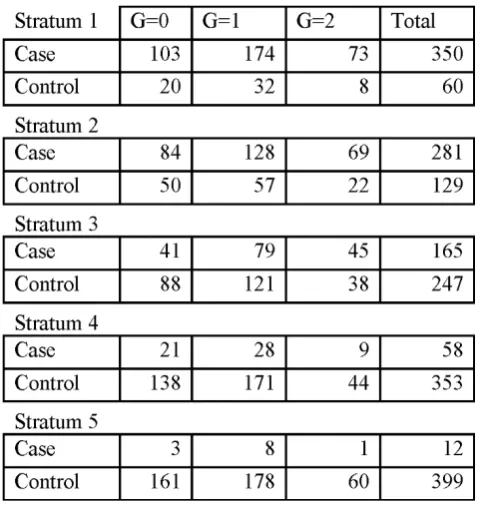
Interestingly, rs2900180 and rs3761847 on chromosome 9 in theTRAF1-C5gene (reported by Plenge et al. [11]) and rs2476601 on chromosome 1 in the PTPN22 gene (reported by Begovich et al. [16]), were far from significant genome-wide (empirical adjustedp= 1,p= 1 andp= 0.21, respectively). To further investigate, we examined the five 2 × 3 tables for rs3761847 (Figure 2) and noted that there are only 12 cases in stratum 5. We then pooled strata 4 and 5 and recalculated the VIF to be 1.035. Pooling these strata did not increase the significance of these three SNPs (empirical adjustedp= 1,p= 1, andp= 0.084) and lack of statistical significance was not due to small strata size. The top three SNPs ranked byp-values, outside chromosome 6, were rs2476601 (chromosome 1, empiricalp-value = 0.08), rs6596147 (chromosome 5, empiricalp-value = 0.09), and rs1038848 (chromosome 8, empiricalp-value = 0.21).
Conclusion
Differences in recruitment of cases and controls suggest that control of population stratification is crucial for a proper analysis of these data. This is confirmed by the large VIF for the unadjusted analysis. Stratification score analysis dramatically reduces the VIF, increasing con-fidence in any associations that are found. Interestingly, once we controlled for population stratification, we found no SNPs outside the HLA region on chromosome 6 that were associated with rheumatoid arthritis at the genome-wide significance level ofa= 0.05.
Like all stratified analyses, the stratification score approach will tend to lose power relative to a pooled (unadjusted) analysis when there is no confounding. Thus, our failure to replicate the associations found previously in these data may result from a loss of power from using the stratification score approach. However, the large VIF for these data makes confounding highly likely and, therefore, a competing explanation is that residual stratification in the primary analyses led to false associations. Further, Epstein et al. found that the stratification score approach had comparable power compared with other methods for control of population stratification [7]. Finally, we note that a spurious association may replicate if population stratification is not fully controlled in each analysis.
List of abbreviations used
IBS: Identity-by-state; LD: Linkage disequilibrium; NARAC: North American Rheumatoid Arthritis Consor-tium; PC: Principal-component; PLS: Partial least squares; RA: Rheumatoid arthritis; SNP: Single-nucleo-tide polymorphism; VIF: Variance inflation factor.
Competing interests
The authors declare that they have no competing interests.
Figure 2
Authors
’
contributions
SMS and ASA cleaned and analyzed the data. All authors participated in the design of the study and the writing of the manuscript.
Acknowledgements
The Genetic Analysis Workshops are supported by NIH grant R01 GM031575 from the National Institute of General Medical Sciences. SMS received a travel award from the Genetic Analysis Workshop. SMS and JSC were supported in part by a grant from the South Carolina Department of Disabilities and Special Needs. ASA acknowledges support from grants R01MH084680 and K25HL077663 from the National Institutes of Health. The authors thank Min He for useful discussions and assistance performing computations.
This article has been published as part of BMC Proceedings Volume 3 Supplement 7, 2009: Genetic Analysis Workshop 16. The full contents of the supplement are available online at http://www.biomedcentral.com/ 1753-6561/3?issue=S7.
References
1. Devlin B and Roeder K: Genomic control for association studies.Biometrics1999,55:997–1004.
2. Devlin B, Roeder K and Wasserman L:Genomic control, a new approach to genetic-based association studies.Theor Popul Biol 2001,60:155–1663.
3. Pritchard JK and Rosenberg NA: Use of unlinked genetic markers to detect population stratification in association studies.Am J Hum Genet1999,65:220–228.
4. Pritchard JK, Stephens M, Rosenberg NA and Donnelly P: Associa-tion mapping in structured populaAssocia-tions.Am J Hum Genet2000,
67:170–181.
5. Chen H-S, Zhu X, Zhao H and Zhang S:Qualitative semipara-metric test to detect genetic association in case-control design under structured population. Ann Hum Genet 2003,
67:250–264.
6. Price AL, Patterson NJ, Plenge RM, Weinblatt ME, Shadick NA and Reich D:Principal components analysis corrects for stratifi-cation in genome-wide association studies. Nat Genet 2006,
38:904–909.
7. Epstein MP, Allen AS and Satten GA: A Simple and improved correction for population stratification in case-control studies.Am J Hum Genet2007,80:921–930.
Figure 1
8. Rosenbaum PR and Rubin DB: The central role of the propensity score in observational studies for causal effects.
Biometrika1983,70:41–55.
9. Rosenbaum PR and Rubin DB:Reducing bias in observational studies using subclassification on the propensity score.J Am Stat Assoc1984,79:516–524.
10. Amos CI, Chen WV, Seldin MF, Remmers E, Taylor KE, Criswell LA, Lee AT, Plenge RM, Kastner DL and Gregersen PK: Data for Genetic Analysis Workshop 16 Problem 1, association analysis of rheumatoid arthritis data. BMC Proceedings 2009,
3(Suppl 7):S2.
11. Plenge RM, Seielstad M, Padyukov L, Lee AT, Remmers EF, Ding B, Liew A, Khalili H, Chandrasekaran A, Davies LR, Li W, Tan AK, Bonnard C, Ong RT, Thalamuthu A, Pettersson S, Liu C, Tian C, Chen WV, Carulli JP, Beckman EM, Altshuler D, Alfredsson L, Criswell LA, Amos CI, Seldin MF, Kastner DL, Klareskog L and Gregersen PK: TRAF1-C5 as a risk locus for rheumatoid arthritis–a genomewide study. N Engl J Med 2007, 357:
1199–1209.
12. Fellay J, Shianna KV, Ge D, Colombo S, Ledergerber B, Weale M, Zhang K, Gumbs C, Castagna A, Cossarizza A, Cozzi-Lepri A, De Luca A, Easterbrook P, Francioli P, Mallal S, Martinez-Picado J, Miro JM, Obel N, Smith JP, Wyniger J, Descombes P, Antonarakis SE, Letvin NL, McMichael AJ, Haynes BF, Telenti A and Goldstein DB:A whole-genome association study of major determinants for host control of HIV-1.Science2007,317:944–947.
13. Purcell S, Neale B, Todd-Brown K, Thomas L, Ferreira MAR, Bender D, Maller J, Sklar P, de Bakker PIW, Daly MJ and Sham PC:
PLINK: a toolset for whole-genome association and popula-tion-based linkage analysis.Am J Hum Genet2007,81:559–575. 14. Lee S, Sullivan P, Zou F and Wright F:Comment on a simple and improved correction for population stratification.Am J Hum Genet2008,82:524–526.
15. Epstein MP, Allen AS and Satten GA:Response to Lee et al.Am J Hum Genet2007,82:526–528.
16. Begovich AB, Carlton VEH and Honigberg LA:A missense single-nucleotide polymorphism in a gene encoding a protein tyrosine phosphatase (PTPN22) is associated with rheuma-toid arthritis.Am J Hum Genet2004,75:330–337.
Publish with BioMed Central and every scientist can read your work free of charge
"BioMed Central will be the most significant development for disseminating the results of biomedical researc h in our lifetime."
Sir Paul Nurse, Cancer Research UK
Your research papers will be:
available free of charge to the entire biomedical community
peer reviewed and published immediately upon acceptance
cited in PubMed and archived on PubMed Central
yours — you keep the copyright