R E S E A R C H
Open Access
RZA-NLMF algorithm-based adaptive sparse
sensing for realizing compressive sensing
Guan Gui
1*, Li Xu
1and Fumiyuki Adachi
2Abstract
Nonlinear sparse sensing (NSS) techniques have been adopted for realizing compressive sensing in many applications such as radar imaging. Unlike the NSS, in this paper, we propose an adaptive sparse sensing (ASS) approach using the reweighted zero-attracting normalized least mean fourth (RZA-NLMF) algorithm which depends on several given parameters, i.e., reweighted factor, regularization parameter, and initial step size. First, based on the independent assumption, Cramer-Rao lower bound (CRLB) is derived as for the performance comparisons. In addition, reweighted factor selection method is proposed for achieving robust estimation performance. Finally, to verify the algorithm, Monte Carlo-based computer simulations are given to show that the ASS achieves much better mean square error (MSE) performance than the NSS.
Keywords:Nonlinear sparse sensing (NSS); Adaptive sparse sensing (ASS); Normalized least mean fourth (NLMF); Reweighted zero-attracting NLMF (RZA-NLMF); Sparse constraint; Compressive sensing
1 Introduction
Compressive sensing (CS) [1,2] has been attracting high attention in compressive radar/sonar sensing [3,4] due to its many applications such as civilian, military, and biomedical. The main task of CS problems can be di-vided into three aspects as follows: (1) sparse signal learning: The basic model suggests that natural signals can be compactly expressed, or efficiently approximated, as a linear combination of prespecified atom signals, where the linear coefficients are sparse as shown in Figure 1 (i.e., most of them zero). (2) Random measurement matrix design: It is important to make a sensing matrix which allows recovery of as many entries of unknown signal as possible by using as few measurements as pos-sible. Hence, sensing matrix should satisfy the conditions of incoherence and restricted isometry property (RIP) [5]. Fortunately, some special matrices (e.g., Gaussian matrix and Fourier matrix) have been reported that they are satis-fying RIP in high probability. (3) Sparse reconstruction algorithms: Based on the previous two steps, many sparse
reconstruction algorithms have been proposed to find the suboptimal sparse solution.
It is well known that the CS provides a robust frame-work that can reduce the number of measurements re-quired to estimate a sparse signal. Many nonlinear sparse sensing (NSS) algorithms and their variants have been proposed to deal with CS problems. They mainly fall into two basic categories: convex relaxation (basis pursuit de-noise (BPDN) [6]) and greedy pursuit (or-thogonal matching pursuit (OMP) [7]). The above NSS-based CS methods have either high complexity or low performance, especially in the case of low signal-to-noise ratio (SNR) regime. Indeed, it was very hard to adapt trade-off between high complexity and good performance.
In this paper, we propose an adaptive sparse sensing (ASS) method using the reweighted zero-attracting nor-malized mean fourth error algorithm (RZA-NLMF) [8] to solve the CS problems. Different from NSS methods, each observation and corresponding sensing signal vec-tor will be implemented by the RZA-NLMF algorithm to reconstruct the sparse signal during the process of adap-tive filtering. According to the concrete requirements, the complexity of the proposed ASS method could be
* Correspondence:[email protected] 1
Department of Electronics and Information Systems, Akita Prefectural University, Akita 015-0055, Japan
Full list of author information is available at the end of the article
adaptively reduced without sacrificing much recovery performance. The effectiveness of our proposed method is confirmed via computer simulation when comparing with NSS.
The remainder of the paper is organized as follows. The basic CS problem is introduced and the typical NSS method is presented in Section 2. In Section 3, ASS using the RZA-NLMF algorithm is proposed for solving CS problems and its derivation process is highlighted. Computer simulations are given in Section 4 in order to evaluate and compare performances of the proposed ASS method. Finally, our contributions are summarized in Section 5.
2 Nonlinear sparse sensing
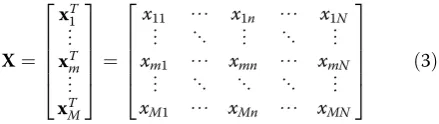
Assume that a finite-length discrete signal vectors= [s1, s2,⋯,sN]Tcan be sparse represented in a signal domain a random measurement signal matrix W, and then the received signal vectory= [y1,⋯,ym,⋯,yM]Tcan be
writ-where X=WDdenotes a M×N random sensing matrix as noise (AWGN) with distributionCN 0;σ2
nIM
;whereIM denotes anM×M identity matrix. From the perspective of CS, the sensing matrix Xsatisfies the restricted isom-etry property (RIP) in overwhelming probability [5] so that the sparse signal h can be reconstructed correctly by NSS methods, e.g., BPDN [6] and OMP [7]. Take the BPDN as an example to illustrate the NSS realization ap-proach. Since the sensing matrixXsatisfies RIP of order
Kwith positive parameterδK∈(0, 1), i.e.,X∈RIP(K,δK)
holds for all h having no more than K nonzero coeffi-cients, then the unknown sparse vectorh can be recon-structed by BPDN as
~
where λ denotes a regularization parameter which bal-ances the mean square error (MSE) term and sparsity of
h. If the mutual interference of sensing matrixXcan be completely removed, then the theoretical Cramer-Rao lower bound (CRLB) of the NSS can be derived as [9,10]
CRLB h~nss
3 Adaptive sparse sensing
We reconsider the above system model (2) with respect to the adaptive sensing case. At the observation side, the
mth observed signalymcan be written as
ym¼hTxmþzm; ð7Þ
for m= 1, 2,⋯, M. The objective of ASS is to adaptively estimate the unknown sparse vectorhusing the sensing signal vector xm and the observed signal ym. Different from NSS approaches, we proposed an alternative ASS method using the RZA-NLMF algorithm as shown in Figure 2. Assume that~ymð Þ ¼n xTmh~ð Þn is an estimated ob-served signal which depends on signal estimatorh~ð Þn and hence the nth observed signal error asem(n) =ym−ỹm(n).
Notice thatem(n) is in correspondence with thenth itera-tive error when using themth sensing signal vectorxmand
m= mod(n,M). Notice that mod(⋅) denotes a modulo function, for example, mod(5,3) = 2 and mod(5,2) = 1. First of all, the cost function of the RZA-NLMF algorithm is constructed as
G nð Þ ¼1 4e
4
mð Þ þn λass
XN
i¼1log 1ð þεj jhiÞ; ð8Þ
whereλass> 0 is a regularization parameter which trades
off the sensing error and coefficient vector sparsity.ε> 0 denotes a reweighted factor which enhances to exploit
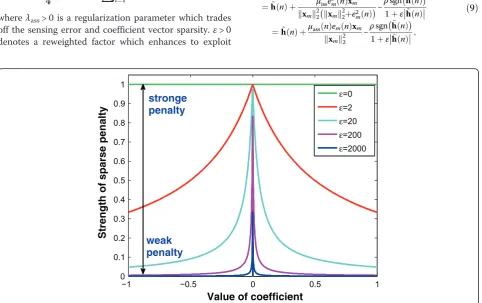
the signal sparsity at each iteration. A figure example to show the relationship between reweighted factors and sparse constraint strength is given in Figure 3. Accord-ing to the cost function (8), the correspondAccord-ing update equation can be derived as
~
hðnþ1Þ ¼h~ð Þn−μiss ∂G nð Þ ∂h~ð Þn ¼h~ð Þ þn μisse
3 mð Þnxm xm
k k2 2 k kxm
2 2þe2mð Þn
−ρsgn h~ð Þn
1þε ~hð Þn
¼h~ð Þ þn μassð Þnemð Þnxm xm k k2
2
−ρsgn h~ð Þn
1þε h~ð Þn ;
ð9Þ Figure 2RZA-NLMF algorithm for ASS.
−1 −0.5 0 0.5 1
0 0.1 0.2 0.3 0.4 0.5 0.6 0.7 0.8 0.9 1
Value of coefficient
Strength of sparse penalty
ε=0 ε=2 ε=20 ε=200 ε=2000
weak penalty
stronge penalty
whereρ=μissλ/εis a parameter which depends on initial
step size μiss, regularization parameter λ, and threshold ε. In the second term of (9), if the coefficient magnitudes of ~hð Þn are smaller than 1/ε, then these small coeffi-cients will be replaced by zeros in high probability [11]. Here, it is worth noting that μass(n) is a variable step
size:
μassð Þ ¼n
μisse2mð Þn
xm k k2
2þe2mð Þn
; ð10Þ
which depends on three factors: initial step size μiss,
in-put signalxm, and update iterative errorem(n). Sinceμiss
is a given initial step size andxmis a random scaling in-put signal, hence,μassin Equation 10 can also be
rewrit-ten as
μassð Þ ¼n
μiss
xm k k2
2=e2mð Þ þn 1
; ð11Þ
which is a variable step size (VSS) that is adaptive to change as square sensing error em2(n); a smaller error incurs a smaller step size to ensure the stability of the gradient descent while a larger error yields a larger step size to accelerate the convergence speed of this algorithm [12]. According to the update equation in (9), our proposed ASS method can be concluded in Algorithm 1.
As for the trademark of the performance comparisons, the CRLB of the proposed ASS method is derived in the subse-quent. The signal error is defined asvð Þn :¼h~ð Þn −h, ande (n) can be written asem(n) =zm−vT(n)xm. To simply derive the CRLB, four assumptions are considered in the subse-quent analysis: (1) the input signalxmand noisezmare mu-tually independent, (2) each rowxmof the signal matrixXis random independent with zero mean and random Gaussian varianceσ2IN, (3) noisezmis random independent with zero mean and varianceσn2, (4)h~ð Þn is independent ofX. Assume that thenth adaptive receive errore(n) is sufficiently small so thatem2(n)≪xm; hence, μass¼μisse2mð Þ=n xm. According to (9), thenth update signal errorv(n+ 1) can be written as
vðnþ1Þ ¼vð Þ þn μisse 3
mð Þnxm xm k k2
2
−ρsgn h~ð Þn
1þε h~ð Þn ; ð12Þ
whereem3(n) can be expanded as
e3
mð Þ ¼n ðzm−vTð ÞnxmÞ3 ¼z3
m−3z2mvTð Þnxmþ3zmðvTð ÞnxmÞ2−ðvTð ÞnxmÞ3: ð13Þ
Substituting (13) into (12),v(n+ 1) can be further rep-resented as
vðnþ1Þ ¼vð Þ þn μissz 3
mxm xm k k2
2
−3μissz2mðvTð ÞnxmÞxm xm k k2
2
þ3μisszmðvTð ÞnxmÞ 2
xm xm
k k2 2
−μissðvTð ÞnxmÞ 3
xm xm k k2
2
−ρsgn h~ð Þn
1þε h~ð Þn : ð14Þ
Based on the abovementioned independent assump-tions and ideal Gaussian noise assumption [13], we can get the following approximations:
E z½ ¼m E z3m ¼E z5m ¼0; ð16Þ
xm} satisfies zero-mean Gaussian distribution, that is, E [vT(n)xm] = 0 [13]. Hence, we can also get the following
Since the adaptive update square error b(n) is too small (i.e.,b(n)≪1), hence, higher than two-order errors are considered zero, i.e., b2(n) = 0 and b3(n) = 0. The MSE can be derived from (23) as
bð Þ ¼∞ 5μissσ4n
Assume that ideal reconstruction vector h~ð Þn can be obtained, then one can get limn→∞h~ð Þn1¼k kh 1 and limn→∞sgnh~Tð Þn sgnh~ð Þn¼K, whereKdenotes the number of nonzero coefficients inh. Hence,ϕ(∞) in (25) can be derived as
CRLB h~ass
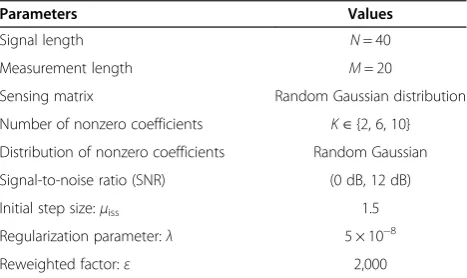
In this section, the proposed ASS approach using the RZA-NLMF algorithm is evaluated. For achieving aver-age performance, 1,000 independent Monte Carlo runs are adopted. For easy evaluation of the effectiveness of the proposed approach, signal representation domainD is assumed as an identity matrix IN × N and unknown
signal s is set as sparse directly. Sensing matrix is equivalent to random measurement matrix, i.e., X=W. For ensuring that Xsatisfies RIP,W is set as a random Gaussian matrix [5]. Then, sparse coefficient vector
h equals to s. The details of the simulation parame-ters are listed in Table 1. Notice that each nonzero coefficient of h follows random Gaussian distribution as CNð0;σ2Þ and their positions are randomly allo-cated within the signal length of h which is subject toE{||h||22} = 1, whereE{∙} denotes the expectation
oper-ator. The output signal-to-noise ratio (SNR) is defined as 20 log (Es/σn2), where Es= 1 is the unit transmission power. All of the step sizes and regularization parame-ters are listed in Table 1. The estimation performance is
evaluated by average mean square error (MSE) which is defined by
Average MSEh~ð Þn:¼E h−h~ð Þn22
n o
; ð28Þ
where hand h~ð Þn are the actual channel vector and its
nth iterative adaptive channel estimator, respectively. Ac-cording to our previous work [8], the regularization par-ameter for RZA-NLMF is set as λ= 5 × 10⁻⁸ so that it can exploit signal sparsity robustly. Since the RZA-NLMF-based ASS method depends highly on the reweighted factor ε, hence, we first select the reasonable factor εby virtue of the Monte Carlo method. Later, we compare the proposed method with two typical NSS ones, i.e., BPDN [6] and OMP [7].
4.1 Reweighted factor selection
Since the RZA-NLMF algorithm depends highly on reweighted factor, hence, selection of the robust reweighted factor for different noise environments and different signal sparsities is a typical important step for the RZA-NLMF algorithm. It is well known that ℓ0
-norm -normalized least mean fourth (L0-NLMF) for CS can achieve optimal solution, but it is a NP-hard prob-lem in practical applications such as noise environment [2]. One can find that RZA-NLMF reduces to L0-NLMF when the reweighted factor approaches to infinity. Due to the noise interference, we should select the suitable reweighted factor which not only can exploit signal sparsity but also can mitigate noise interference effect-ively. Hence, the reweighted factor of RZA-NLMF is selected empirically. By means of the Monte Carlo method, the performance curves of the proposed ASS method with different reweighted factorsε∈{2, 20, 200, 2,000, 20,000} with respect to different numbers of non-zero coefficientsK∈{2, 6, 10} and different SNR regimes (5 and 10 dB) are depicted in Figures 4, 5, 6, 7. Under the simulation setup considered, RZA-NLMF using ε= 2,000 can achieve robust performance in different cases as shown in Figures 4, 5, 6, 7. From the four figures, one can find that sparser signal requires larger reweighted factor but no more than 20,000 in this system. This is
ϕð Þ ¼∞ limn→∞ϕð Þn
Table 1 Simulation parameters
Parameters Values
Signal length N= 40
Measurement length M= 20
Sensing matrix Random Gaussian distribution Number of nonzero coefficients K∈{2, 6, 10} Distribution of nonzero coefficients Random Gaussian Signal-to-noise ratio (SNR) (0 dB, 12 dB) Initial step size:μiss 1.5
concise with the fact that stronger sparse penalty not only exploits more sparse information but also mitigates more noise interference.
4.2 Performance comparisons with NSS
Two experiments of ASS are verified in performance comparisons with conventional NSS methods (e.g., BPDN [6] and OMP [7]). In the first experiment, the
ASS method is evaluated in the case of SNR = 10 dB as shown in Figure 8. On the one hand, according to this figure, we can find that the proposed ASS method using the RZA-NLMF algorithm achieves much lower MSE performance than NSS methods and even if it is CRLB. The existing big performance gap between ASS and NSS is because ASS using RZA-NLMF not only exploits the signal sparsity but also mitigates the noise interference
0 1000 2000 3000 4000 5000 6000
10−2 10−1
Iterations
MSE
RZA−NLMF (ε=2) RZA−NLMF (ε=20) RZA−NLMF (ε=200) RZA−NLMF (ε=2000) RZA−NLMF (ε=20000)
Signal lenght: N=40 No. nonzero: K=2 SNR=5dB
Figure 4RZA-NLMF performance versus reweighted factors (K= 2 and SNR = 5 dB).
0 0.5 1 1.5 2 2.5 3
x 104 10−4
10−3 10−2 10−1
Iterations
MSE
RZA−NLMF (ε=2) RZA−NLMF (ε=20) RZA−NLMF (ε=200) RZA−NLMF (ε=2000) RZA−NLMF (ε=20000)
Signal lenght: N=40 No. nonzero: K=2 SNR=10dB
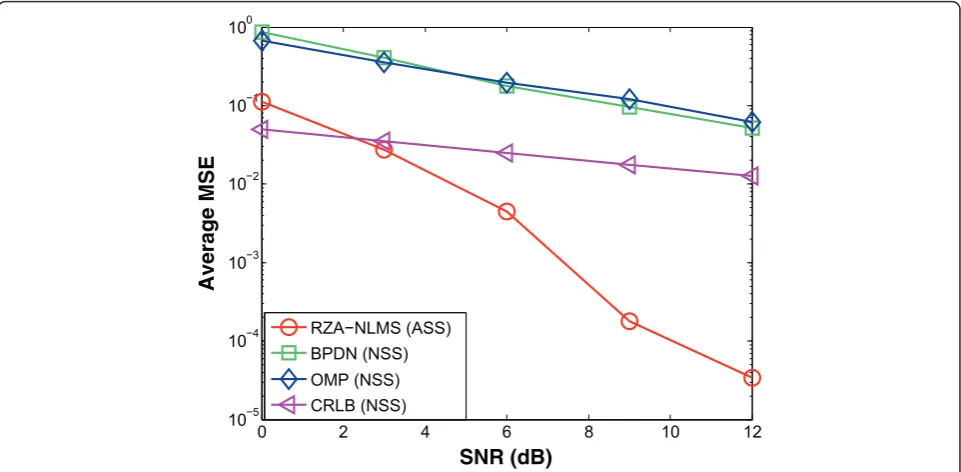
using high-order error statistics for adaptive error updat-ing. On the other hand, we can also find that ASS de-pends on the signal sparseness. That is to say, for sparser signal, ASS can exploit more signal structure in-formation as for prior inin-formation and vice versa. In the second experiment, the number of nonzero coefficients is fixed as K= 2 as shown in Figure 9. It is easy to find
that our proposed ASS is much better than conventional NSS as the SNR increases.
5 Conclusions
In this paper, we proposed an ASS method using the RZA-NLMF algorithm for dealing with CS problems. First, we selected the reweighted factor and regularization
0 0.5 1 1.5 2 2.5 3
x 104 10−4
10−3 10−2 10−1
Iterations
MSE
RZA−NLMF (ε=2) RZA−NLMF (ε=20) RZA−NLMF (ε=200) RZA−NLMF (ε=2000) RZA−NLMF (ε=20000) Signal lenght: N=40 No. nonzero: K=6 SNR=10dB
Figure 6RZA-NLMF performance versus reweighted factors (K= 6 and SNR = 10 dB).
0 0.5 1 1.5 2 2.5 3
x 104 10−4
10−3 10−2 10−1
Iterations
MSE
RZA−NLMF (ε=2) RZA−NLMF (ε=20) RZA−NLMF (ε=200) RZA−NLMF (ε=2000) RZA−NLMF (ε=20000) Signal lenght: N=40 No. nonzero: K=10 SNR=10dB
parameter for the proposed algorithm by virtue of the Monte Carlo method. Later, based on the update equation of RZA-NLMF, the CRLB of ASS was also derived based on random independent assumptions. Finally, several rep-resentative simulations have been given to show that the proposed method achieves much better MSE performance
than NSS with respect to different signal sparsities, espe-cially in the case of low SNR regime.
Since the empirical reweighted factor was selected for RZA-NLMF in the noise environment, in the future work, we will develop the learning reweighted factor for RZA-NLMF in the case of a noiseless environment. It is
2 3 4 5 6 7 8 9 10
10−5 10−4 10−3 10−2 10−1 100
K
Average MSE
RZA−NLMS (ASS)
BPDN (NSS)
OMP (NSS)
CRLB (NSS)
Figure 8Performance comparisons versus signal sparsity.
0 2 4 6 8 10 12
10−5 10−4 10−3 10−2 10−1 100
SNR (dB)
Average MSE
RZA−NLMS (ASS) BPDN (NSS) OMP (NSS) CRLB (NSS)
expected that RZA-NLMF using learning reweighted factor can achieve much better recovery performance without sacrificing much computational complexity.
Competing interests
The authors declare that they have no competing interests.
Acknowledgements
The authors would like to appreciate the editor and the anonymous reviewers for their help comments and suggestion to improve the quality of this paper.
Author details
1
Department of Electronics and Information Systems, Akita Prefectural University, Akita 015-0055, Japan.2Department of Communications
Engineering, Graduate School of Engineering, Tohoku University, Sendai 980-8579, Japan.
Received: 1 March 2014 Accepted: 31 July 2014 Published: 9 August 2014
References
1. EJ Candes, J Romberg, T Tao, Robust uncertainty principles: exact signal reconstruction from highly incomplete frequency information. IEEE Trans. Inf. Theory52(2), 489–509 (2006)
2. DL Donoho, Compressed sensing. IEEE Trans. Inf. Theory52(4), 1289–1306 (2006)
3. R Baraniuk, Compressive radar imaging, inIEEE Radar Conference, Boston, 17–20 Apr 2007, pp. 128–133
4. M Herman, T Strohmer, Compressed sensing radar, inIEEE Radar Conference, Rome, 26–30 May 2008, 1–6
5. EJ Candes, The restricted isometry property and its implications for compressed sensing. Comptes Rendus Math1(346), 589–592 (2008) 6. SS Chen, DL Donoho, MA Saunders, Atomic decomposition by basis pursuit.
SIAM J. Sci. Comput.20(1), 33–61 (1998)
7. JA Tropp, AC Gilbert, Signal recovery from random measurements via orthogonal matching pursuit. IEEE Trans. Inf. Theory53(12), 4655–4666 (2007) 8. G Gui, A Mehbodniya, F Adachi, Adaptive sparse channel estimation using re-weighted zero-attracting normalized least mean fourth, in2nd IEEE/CIC International Conference on Communications in China (ICCC), Xian, 12 Aug 2013, pp. 368–373
9. L Dai, W Zhaocheng, Z Yang, Compressive sensing based time domain synchronous OFDM transmission for vehicular communications. IEEE J. Sel. Areas Commun.31(9), 460–469 (2013)
10. L Dai, Z Wang, Z Yang, Spectrally efficient time-frequency training OFDM for mobile large-scale MIMO systems. IEEE J. Sel. Areas Commun.31(2), 251–263 (2013) 11. Y Chen, Y Gu, AO Hero III, Sparse LMS for system identification, inIEEE
International Conference on Acoustics, Speech and Signal Processing, Taipei, 19–24 Apr 2009, pp. 3125–3128
12. G Gui, L Dai, S Kumagai, F Adachi, Variable earns profit: improved adaptive channel estimation using sparse VSS-NLMS algorithms, inIEEE International Conference on Communications (ICC), Sydney, 10–14 June 2014, pp. 1–5 13. E Eweda, NJ Bershad, Stochastic analysis of a stable normalized least mean
fourth algorithm for adaptive noise canceling with a white Gaussian reference. IEEE Trans. Signal Process.60(12), 6235–6244 (2012)
doi:10.1186/1687-6180-2014-125
Cite this article as:Guiet al.:RZA-NLMF algorithm-based adaptive sparse sensing for realizing compressive sensing.EURASIP Journal on Advances in Signal Processing20142014:125.
Submit your manuscript to a
journal and benefi t from:
7Convenient online submission 7Rigorous peer review
7Immediate publication on acceptance 7Open access: articles freely available online 7High visibility within the fi eld
7Retaining the copyright to your article