Annotating Question Decomposition on Complex Medical Questions
Kirk Roberts, Kate Masterton, Marcelo Fiszman, Halil Kilicoglu, and Dina Demner-Fushman
Lister Hill National Center for Biomedical CommunicationsNational Library of Medicine National Institutes of Health
Bethesda MD, USA
[email protected], [email protected]
Abstract
This paper presents a method for annotating question decomposition on complex medical questions. The annotations cover multiple syntactic ways that questions can be decomposed, including separating independent clauses as well as recognizing coordinations and exemplifications. We annotate a corpus of 1,467 multi-sentence consumer health questions about genetic and rare diseases. Furthermore, we label two additional medical-specific annotations: (1) background sentences are annotated with a number of medical categories such as symptoms, treatments, and family history, and (2) the central focus of the complex question (a disease) is marked. We present simple baseline results for automatic classification of these annotations, demonstrating the challenging but important nature of this task.
Keywords:question decomposition, question answering, medical language processing
1.
Introduction
Natural language questions provide an intuitive interface for querying medical knowledge. This is especially true for non-experts, often referred to asconsumers. While medical experts are trained to both understand diseases and the med-ical problem solving process, consumers generally seek broader, multi-faceted medical information. This results in questions that may be far more elaborate, often contain-ing contextual background information such as a patient’s family history, diagnoses, symptoms, and comorbidities. Their information needs often yield multiple related ques-tions that, when combined with background information, are substantially more complex than the questions most ex-isting question answering systems are designed to handle. For instance:
(1) I have an infant daughter with Coffin Siris Syndrome. I am trying to find information as well as connect with other families who have an affected child.
(2) My mother has recently been diagnosed with Myofib-rillar myopathy. Her first symptoms became appar-ent about 2.5 years ago when she developed weakness in one foot. She currently has little movement in her legs, and her hands, arms, speech and breathing are af-fected. What is the prognosis and life expectancy for this condition and what can we expect from here?
(3) A family member has recently been diagnosed with hemangiopericytoma of the skull and a lesion in the lung and possibly the kidney. We are interested in learning more about this condition, including the stan-dard course of treatment.
We refer to these ascomplex questions, as they contain mul-tiple questions related by a central theme or focus. In order to process these questions, their underlying sub-questions, background elements, and focus need to be recognized. We refer to this task as a form ofquestion decomposition, as it enables the decomposition of long, complex medical ques-tions into concise quesques-tions that may reference appropri-ate background information. The information needs of the
question can then be re-formulated into more traditional medical questions. For the questions above, these decom-posed questions would be:
(1′) I am trying to find information about Coffin Siris
Syndrome.
I am trying to connect with other families who have an affected child with Coffin Siris Syndrome.
(2′) What is the prognosis for Myofibrillar myopathy?
What is the life expectancy for Myofibrillar myopathy?
What can we expect from here with Myofibrillar myopathy?
(3′) We are interested in learning more about
hemangiopericytoma.
We are interested in learning the standard course of treatment for hemangiopericytoma.
In this paper we present a manually annotated corpus of 1,467 consumer health questions related to genetic and rare diseases. The goal for this corpus is to enable the training and evaluation of automatic techniques for decomposing complex medical questions. To demonstrate the efficacy of the corpus and to get a general sense for the difficulty of the task, we further evaluate easily reproducible baselines that combine rule-based and machine learning (ML) based methods.
2.
Background
The need for efficient access to medical knowledge has led to significant study of medical question answering. Demner-Fushman and Lin (2007) propose a question-answering system based on filling in PICO (Patient, In-tervention, Comparison, Outcome) slots instead of natu-ral language questions. Andersen et al. (2012) created a medical question corpus focused on diabetes and heart disease. They concentrate, however, on concise questions, such as those easily convertible to an SQL query. Yu and Cao (2008) identify “general topics” for complex medical questions posed by physicians. These topics correspond roughly to question types, such as requesting information about diagnosis, tests, or treatments. Similar to our data, they may identify multiple information needs, but they only perform a question-level multi-labeling and do not identify the actual question boundaries. For example, in Question (2) their method would identify that there is both a test and treatment information need, but not indicate the span of text indicating these questions and any question-specific infor-mation that may be associated with it. Nor do they identify the focal concept to use to find treatment, testing, or other information about. Since they do not decompose the com-plex question into more concise questions, this limits the in-formation retrieval strategy to largely keyword-based tech-niques where the keywords for each sub-question are drawn from the entire complex question. In addition, they do not include a general information topic, which is very common in consumer-posed questions. The AskHERMES system (Cao et al., 2011) utilizes this question analysis method in a web-based medical question answering system targeted toward physicians.
Outside of the medical question answering domain, ques-tion decomposiques-tion has been approached in a variety of ways. Lacatusu et al. (2006) demonstrates an example ofsyntacticquestion decomposition, utilizing the syntactic structure of a complex question to identify sub-questions. Hartrumpf (2008) performs a deep semanticquestion de-composition, relying upon the question already being con-verted into a semantic logical form. From this logical rep-resentation, it is then possible to identify sub-questions that may be asked in isolation, acting as a filter on answers to the fully-specified question. Harabagiu et al. (2006) performs question decomposition through a random walk over a knowledge base of questions created from a corpus. The random walk increases the relevant information pre-sented to a multi-document summarization system. Of all of these methods, our data most closely resembles the syn-tactic question decomposition, yet there are several seman-tic considerations that we discuss below.
At its most general level, question decomposition can be seen as a form of text simplification (Bott et al., 2012; Drn-darevi´c et al., 2013). While question decomposition has the aim of concise questions answerable by traditional auto-matic question answering systems, text simplification seeks to simplify text for the sake of human consumption. Nev-ertheless, many of the operations presented below, such as recognizing coordinating clauses, are also part of text sim-plification tasks.
This work is part of a larger project with the aim of
auto-matically answering consumer health questions. The Na-tional Library of Medicine (NLM) receives thousands of medical questions each year, largely from individuals out-side the medical profession. Our question answering sys-tem categorizes and routes user requests according to a library-specified taxonomy. For questions about diseases, our system identifies the most appropriate consumer re-source that answers the user’s question. Typically, this an-swer is in the form of a page or section from MedlinePlus (Schnall and Fowler, 2013), a consumer-oriented medical encyclopedia. In previous work (Kilicoglu et al., 2013) we have addressed the importance of ellipses and co-reference in analyzing consumer-posed questions. In this work we concentrate on a different aspect of these complex ques-tions: identifying the explicit questions asked by consumers in long, complex medical questions.
3.
Complex Question Decomposition
The goal of question decomposition is to turn a complex, multi-faceted question into a list of related, concise ques-tions that can be answered by more traditional question an-swering systems (such as those of Demner-Fushman and Lin (2007) and Cao et al. (2011)). To accomplish this, we propose a largely syntax-based method of annotating com-plex questions with their sub-questions and background in-formation.
Question sentences can be syntactically decomposed in one of two ways. Question (2) shows how sentences can be syn-tactically split into separate questions by recognizing that the coordinating conjunctionandsplits independent clauses (What is the... and what can we...?) with syntactically self-contained questions. Alternatively, questions may be decomposed by extracting phrase level coordinations, typ-ically either a noun phrase (NP) or verb phrase (VP). Con-sider the following:
(4) I am an adult woman who has been recently diag-nosed with M´en´etrier disease. My symptoms seem to be worsening. I am seeking information about the symptoms, cause(s), prognosis, genetic association, and treatment. I am eager to hear from you and ap-preciate your assistance.
Here, a multiple coordination is used to indicate five sepa-rate questions:
(4′) I am seeking information about the symptoms of
M´en´etrier disease.
I am seeking information about the cause(s) of M´en´etrier disease.
I am seeking information about the prognosis of M´en´etrier disease.
I am seeking information about the genetic association of M´en´etrier disease.
I am seeking information about the treatment of M´en´etrier disease.
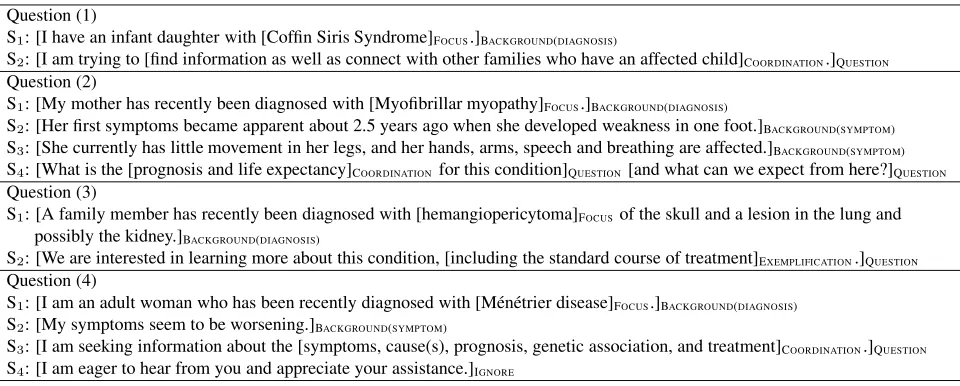
Question (1)
S1: [I have an infant daughter with [Coffin Siris Syndrome]FOCUS.]BACKGROUND(DIAGNOSIS)
S2: [I am trying to [find information as well as connect with other families who have an affected child]COORDINATION.]QUESTION
Question (2)
S1: [My mother has recently been diagnosed with [Myofibrillar myopathy]FOCUS.]BACKGROUND(DIAGNOSIS)
S2: [Her first symptoms became apparent about 2.5 years ago when she developed weakness in one foot.]BACKGROUND(SYMPTOM)
S3: [She currently has little movement in her legs, and her hands, arms, speech and breathing are affected.]BACKGROUND(SYMPTOM)
S4: [What is the [prognosis and life expectancy]COORDINATIONfor this condition]QUESTION[and what can we expect from here?]QUESTION
Question (3)
S1: [A family member has recently been diagnosed with [hemangiopericytoma]FOCUS of the skull and a lesion in the lung and
possibly the kidney.]BACKGROUND(DIAGNOSIS)
S2: [We are interested in learning more about this condition, [including the standard course of treatment]EXEMPLIFICATION.]QUESTION
Question (4)
S1: [I am an adult woman who has been recently diagnosed with [M´en´etrier disease]FOCUS.]BACKGROUND(DIAGNOSIS)
S2: [My symptoms seem to be worsening.]BACKGROUND(SYMPTOM)
S3: [I am seeking information about the [symptoms, cause(s), prognosis, genetic association, and treatment]COORDINATION.]QUESTION
S4: [I am eager to hear from you and appreciate your assistance.]IGNORE
Table 1: Decomposed Questions
(1) BACKGROUND- a sentence-level annotation that indi-cates useful contextual information, but lacks a ques-tion. There are several sub-types of background in-formation that we annotate as well: COMORBIDITY,
DIAGNOSIS, FAMILY HISTORY, LIFESTYLE, SYMP
-TOM,TEST, andTREATMENT. Since a sentence can contain more than one type of background informa-tion (or a type other than the seven listed), we con-sider these sub-types as attributes of BACKGROUND
sentences.
(2) QUESTION - a sentence- or clause-level annotation that indicates a question. When a conjunction links two clauses, the conjunction is included with the sec-ond question as in Question (2) in Table 1.
(3) COORDINATION- a phrase-level annotation that spans the set of decomposable items, such as that in Questions (1), (2), and (4) in Table 1.
(4) EXEMPLIFICATION - an phrase-level annotation that
spans an optional item, such as Question (3) in Table 1. (5) IGNORE- a sentence-level annotation indicating
noth-ing of value is present. See Question (4) in Table 1. (6) FOCUS- a NP-level annotation indicating the theme
of the complex question. Useful when filling ellipsis and substituting anaphora as in Question (2). For more information, see Kilicoglu et al. (2013). In the data discussed in this paper, this is always a disease.
BACKGROUNDtypes are annotated at the sentence level for convenience and consistency, as many of the instances of background concepts do not easily lend themselves to pre-cise boundaries (see Forbush et al. (2013)). The choice to separate clause-level QUESTION and phrase-level COOR
-DINATION annotations enables easier construction of de-composed questions. In both cases, questions are only con-sidered decomposable (i.e., a question sentence is split into multiple QUESTIONs or a phrase is annotated with a CO -ORDINATION) when semantically valid decomposed
ques-tions would result. Consider the following two question sentences:
(5) Can this disease be cured or can we only treat the symptoms?
(6) Are males or females worse affected?
While Question (5) contains two “Can...” questions and Question (6) contains the coordination “males or females”, both questions are actually providing a choice between two alternatives and decomposing them would alter the seman-tic nature of the original question. Thus both would be con-sidered a single QUESTIONwith no COORDINATIONs.
4.
Annotated Corpus
Here we provide a brief description of the annotated cor-pus and the process of creating it. The Genetic and Rare Diseases Information Center (GARD) maintains a website1 that provides information on many diseases, as well as a contact form where consumers can ask medical questions. We collected 1,467 complex questions from this resource for annotation.
Each GARD request was annotated by two of three annota-tors, a computer scientist (KR), a medical librarian (KM), and an MD (MF). After the initial annotation and prior to conflict resolution, inter-annotator agreement numbers were calculated (see Table 2). The inter-annotator agree-ment numbers were particularly low. Individual annotators, however, were fairly consistent, implying intra-annotator agreement would be quite high. This suggests that rela-tively predictable differences existed between annotators. For the most part, QUESTION splitting, COORDINATION,
and EXEMPLIFICATIONdisagreements were largely a
func-tion of one annotator missing the annotafunc-tion. Because of this, an additional effort was made during the resolution process to go back through the data to reduce the number of missed annotations. For example, while only 41 EXEM
-PLIFICATIONs were found by at least one annotator during the initial annotation process, after resolution there were 53 total EXEMPLIFICATIONs due to instances where both annotators missed. As can be seen by the baseline results discussed below, resolution drastically improved the qual-ity of the annotations, so inter-annotator agreement is not an indicator of the upper bound of each sub-task.
After annotation, we found an average of 1.7 decomposed questions per complex question, with 0.25 COORDINA
-TIONs and 0.04 EXEMPLIFICATIONs per complex
ques-1
Annotation # Items # Disagreements Accuracy Kappa
Sentence Class 4,115 100 97.5 95.0
Background Class 1,643 455 71.8 63.5
Question Split 2,465 76 41.7
Coordination 371 184 46.8
Exemplification 41 15 53.1
Focus 1,540 135 90.8
Table 2: Initial inter-annotator agreement statistics.
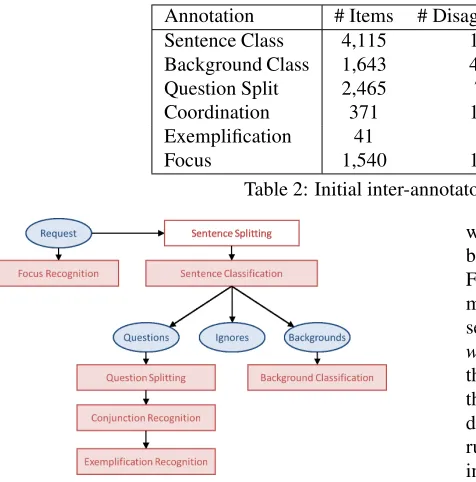
Figure 1: Question Decomposition Architecture
Task Score
Sentence Classification 97.1% Background Classification 67.3 F1 Question Splitting 90.0 F1
Coordination Recognition 71.9 F1(Relaxed) 31.5 F1(Exact)
Exemplification Recognition 70.5 F1(Relaxed) 64.5 F1(Exact)
Focus Recognition 88.9 F1(Relaxed) 55.9 F1(Exact)
Table 3: Baseline Results
tion. Additionally, there were an average of 1.2 BACK
-GROUNDsentences and 0.03 IGNORE sentences per com-plex question. The BACKGROUND sentences included 23 COMORBIDITY, 690 DIAGNOSIS, 151 FAMILY HISTORY,
13 LIFESTYLE, 320 SYMPTOM, 61 TEST, and 137 TREAT -MENTsentences. Finally, there were an average of 1.03 FO
-CUSannotations per complex question. A complex ques-tion typically has more than one FOCUSwhen the consumer is asking about the interaction or relation between two dis-eases.
The dataset is publicly available from our project web-page.2
5.
Baseline Experiments
We propose a baseline method for automatically decom-posing complex questions according to the annotations pre-sented above. The architecture of the system is shown in Figure 1. Given a complex question, we first per-form tokenization, sentence segmentation, and syntactic parsing with the Stanford Parser (Klein and Manning, 2003). Sentences are then classified using an SVM (Fan et al., 2008) with bag-of-words features into BACKGROUND, QUESTION, and IGNORE. For BACKGROUND sentences,
2
http://lhncbc.nlm.nih.gov/project/consumer-health-question-answering/
we use binary SVM classifiers, with bag-of-words and bag-of-bigrams features, to identify the seven attributes. For QUESTION sentence splitting, we use a rule-based method based on the syntactic parse tree to identify clause-separating conjunctions followed by a question word (e.g., what,how). These rules were constructed by examining the syntactic parse trees of a handful of examples from the data, and did not involve any tuning on the entire dataset. For COORDINATION recognition, we use similar rules based on the syntactic parse tree to find NPs contain-ing conjunctions. Additionally, simple three-word phrases where the left and right conjunct match parts-of-speech (e.g., “prognosis and cause”, “want and need”) are consid-ered COORDINATIONs. For EXEMPLIFICATION, a small set of rules were used in combination with a set of trigger words/phrases (e.g., such as, including). When a trigger is the head of a prepositional or adjective phrase, the en-tire phrase is considered an EXEMPLIFICATION. Finally, to identify the FOCUS, we recognize UMLS (Lindberg et al., 1993) terms in the complex question, then use an SVM to rank these. As features for the ranker, we use the candi-date words, UMLS category information (CUI and seman-tic type), the sentence offset, and the term’s offset (the first UMLS term mentioned is often the FOCUSof the question). The results of these baselines are presented in Table 3. For the machine learning-based components, 5-fold cross vali-dation is performed for evaluation.
The baseline method for BACKGROUNDclassification per-formed poorly, though it clearly perper-formed better on the more common annotations (e.g., DIAGNOSISclassification has an F1 of 80.5). It is clear the bag-of-words model is
insufficient, especially as it cannot account for negation. While the syntactic parse tree rules performed relatively well at identifying separate QUESTIONs, COORDINATION
and EXEMPLIFICATIONrecognition were quite poor. The gap between the relaxed scores (where any overlap counts as a match) and the exact score (where a complete overlap is required) is related to the difficulty of syntactic parsing of coordinations. Coordination resolution is one of the most difficult tasks in syntactic parsing (Ogren, 2010). The false positives for coordination recognition typically involve co-ordinations that were semantically inseparable, as in Ques-tion (7), where the quesQues-tion requires all the conjuncts to retain its original purpose. False negatives usually involved conjuncts that were not NPs, such as Question (8). Relax-ing from an NP rule produced worse results.
(7*) Canlupus, antiphospholipid syndrome, and ITP anti-bodiesoccur together?
The false positives for exemplification recognition indi-cate the rules cannot distinguish between an exemplifying phrase and the primary verb phrase, as in Question (9). While false negatives often involved exemplifications that did not employ trigger words, as in Question (10).
(9*) I amparticularly interested in learning more about ge-netic testing for the syndrome.
(10) I am looking for any info about heavy metal toxicity, symptoms, treatment, outcomes.
The baseline FOCUSrecognition method performed reason-ably well using the relaxed method, while most of its loss with the exact metric came from not correctly recognizing the full span of the FOCUS. This is largely due to slight differences in how UMLS encodes concepts and how they were encountered in our data. For instance, UMLS contains the concept “Ehlers Danlos, hypermobility type”, but not “Ehlers Danlos hypermobility type”. Instead, the system guessed simply “Ehlers Danlos”. Hopefully, solving minor differences such as this can dramatically improve automatic FOCUSrecognition.
6.
Conclusion
We have presented an annotated corpus and baseline meth-ods for decomposing complex medical questions posed by consumers. We employ a largely syntactic approach to question decomposition, recognizing both clause-level and NP-level conjunctions. We also recognize several contex-tual elements within the complex question that provide use-ful background information. We then presented the details of our annotated corpus. Finally, we proposed and eval-uated baseline methods for performing decomposition on complex medical questions.
For future work, we plan to develop ML-based methods for recognizing coordinations and exemplifications to over-come the difficulties of relying solely on the syntactic parse tree. Furthermore, we plan to improve upon the ML meth-ods for the remaining annotations, notably by including negation, co-reference, and discourse information.
Acknowledgements
This work was supported by the intramural research pro-gram at the U.S. National Library of Medicine, National Institutes of Health. We would additionally like to thank Stephanie M. Morrison and Janine Lewis for their help ac-cessing the GARD data.
7.
References
Andersen, U., Braasch, A., Henriksen, L., Huszka, C., Jo-hannsen, A., Kayser, L., Maegaard, B., Norgaard, O., Schulz, S., and Wedekind, J. (2012). Creation and use of Language Resources in a Question-Answering eHealth System. InProceedings of the Eighth International Con-ference on Language Resources and Evaluation, pages 2536–2542.
Bott, S., Saggion, H., and Mille, S. (2012). Text Simplifi-cation Tools for Spanish. InProceedings of the Eighth International Conference on Language Resources and Evaluation, pages 1665–1671.
Cao, Y., Liu, F., Simpson, P., Antieau, L., Bennett, A., Cimino, J. J., Ely, J., and Yu, H. (2011). AskHER-MES: An online question answering system for complex clinical questions. Journal of Biomedical Informatics, 44:277–288.
Demner-Fushman, D. and Lin, J. (2007). Answering Clin-ical Questions with Knowledge-Based and StatistClin-ical Techniques.Computational Linguistics, 33(1):63–103. Drndarevi´c, B., ˘Stajner, S., Bott, S., Bautista, S., and
Sag-gion, H. (2013). Automatic Text Simplification in Span-ish: A Comparative Evaluation of Complementing Mod-ules. InProceedings of the 14th International Confer-ence on Intelligent Text Processing and Computational Linguistics, pages 488–500.
Fan, R.-E., Chang, K.-W., Hsieh, C.-J., Wang, X.-R., and Lin, C.-J. (2008). LIBLINEAR: A Library for Large Linear Classification. Journal of Machine Learning Re-search, 9:1871–1874.
Forbush, T. B., Gundlapalli, A. V., Palmer, M. N., Shen, S., South, B. R., Divita, G., Carter, M., Redd, A., But-ler, J. M., and Samore, M. (2013). “Sitting on Pins and Needles”: Characterization of Symptom Descriptions in Clinical Notes. InAMIA Summit on Clinical Research Informatics, pages 67–71.
Harabagiu, S., Lacatusu, F., and Hickl, A. (2006). An-swer Complex Questions with Random Walk Models. In Proceedings of the 29th Annual ACM SIGIR Conference on Research and Development in Information Retrieval, pages 220–227.
Hartrumpf, S. (2008). Semantic Decomposition for Ques-tion Answering. InProceedings on the 18th European Conference on Artificial Intelligence, pages 313–317. Kilicoglu, H., Fiszman, M., and Demner-Fushman, D.
(2013). Interpreting Consumer Health Questions: The Role of Anaphora and Ellipsis. In Proceedings of BioNLP, pages 54–62.
Klein, D. and Manning, C. D. (2003). Accurate Unlexical-ized Parsing. InProceedings of the 41st Annual Meeting of the Association for Computational Linguistics, pages 423–430.
Lacatusu, F., Hickl, A., and Harabagiu, S. (2006). Impact of Question Decomposition on the Quality of Answer Summaries. InProceedings of LREC, pages 1147–1152. Lindberg, D. A., Humphreys, B. L., and McCray, A. T. (1993). The Unified Medical Language System: An in-formatics research collaboration. Methods of Informa-tion in Medicine, 32(4):281–291.
Ogren, P. (2010). Improving Syntactic Coordination Reso-lution Using Language Modeling. InProceedings of the NAACL HLT Student Research Workshop, pages 1–6. Schnall, J. G. and Fowler, S. (2013). MedlinePlus.gov:
Quality Health Information for Your Patients. American Journal of Nursing, 113(9):64–65.