R E S E A R C H
Open Access
Design and implementation of a compressive
infrared sampling for motion acquisition
Tong Liu
1and Jun Liu
2*Abstract
This article proposes a compressive infrared sampling method in pursuit of the acquisition and processing of human motion simultaneously. The spatial-temporal changes caused by the movements of the human body are intrinsical clues for determining the semantics of motion, while the movements of short-term changes can be considered as a sparse distribution compared with the sensing region. Several pyroelectric infrared (PIR) sensors with
pseudo-random-coded Fresnel lenses are introduced to acquire and compress motion information synchronously. The compressive PIR array has the ability to record the changes in the thermal radiation field caused by movements and encode the motion information into low-dimensional sensory outputs directly. Therefore, the problem of recognizing a high-dimensional image sequence is cast as a low-dimensional sequence recognition process. A database involving various kinds of motion played by several people is built. Hausdorff distance-based template matching is employed for motion recognition. Experimental studies are conducted to validate the proposed method.
1 Introduction
How to effectively acquire the human motion informa-tion is of key importance for analyzing and interpreting behavior. Wearable sensors and isomorphic vision sensors are the most used sensing methods for motion acquisi-tion. The wearable sensor-based sensing method is able to directly obtain the motion information of specific limbs or joints. It can form the low-dimensional sensor output-based feature representation [1]. However, the wearable sensor belongs to the intrusive sensing method. It needs the observed person to wear or wrap the sensor on the body, so the feeling of comfort will be affected.
The isometric vision sensor-based sensing is the non-intrusive method for motion acquisition. It has shown strong potential application prospects with the developing advantages of the sensor’s low cost and networking [2,3]. In order to achieve the recognition and understanding of visual motion, it needs to extract the useful informa-tion and feature from the high-dimensional image data. Some representations of the feature, such as the geo-metric model of the human body, spatial-temporal pat-terns, appearance, area, contours, and optical flow model,
*Correspondence: [email protected]
2College of Physics & Electronic Information Engineering, Wenzhou University, Wenzhou 325035, China
Full list of author information is available at the end of the article
have been demonstrated to be the effective methods [4]. However, a large number of studies have found that the dimension of the visual image-based feature is high. It will increase the computational complexity of recognition in the information processing and be not suitable for the real-time requirements of systems.
The field of computer vision research has found that the visual image-based data contains considerable redundant information. This makes the data analysis complicated in computation [4,5]. It needs further refinement to remove the redundant parts of the data for forming the low-dimensional feature. Many parsimony models referred as dimension reduction are seeking efficient transformation and recognition based on a low-dimensional represen-tation, such as principal component analysis (PCA) [6], isometric feature mapping (Isomap) [7], and local lin-ear embedding (LLE) [8]. One can remove the redun-dant information sampled densely by generic sensors and improve the efficiency in the subsequent data analysis procedure [9]. However, there is an imbalance between the data acquisition and data utilization. Great efforts are made to compress the features for moving the course of dimension. This is a wasteful process both for sensing and computational resources. Moreover, the compres-sion algorithms of visual feature heavily rely on software computing platforms, while little work is focused on the
physical hardware in pursuit of integrating the compres-sion processing directly.
The newly proposed compressed sensing (CS) theory is able to integrate the sparse signal acquisition and compression in a single process [10-12]. This sensing mechanism avoids the generation and processing of the redundant information. The CS theory supported that the single-pixel camera is able to use the incoherent basis to sample the observed space; then, the scene could be recorded with a low-dimensional form [13,14]. The dimension of measurements is only relevant to the spar-sity of the raw signal, and the incoherent basis has the form of random matrix. The random matrix-based mea-surement operation is the most common compression and can be embedded into the physical hardware. In addi-tion, a random matrix measurement is independent on the sparse data, and the property of data-friendly compression is preferable. The raw image of the scene can be recovered by solving optimization problems.
The a priori condition for CS is that the raw signal itself or in some transform domain can be sparsely repre-sented. Some studies have been focused on the parsimony of motion perception in human vision, such as mov-ing light displays (MLDs) [15,16] and spatial-temporal salient points [17-19]. Two major characteristics of the human motion can be found from the above studies. First, the moving and changing information of body motion is the effective clue for recognizing and understanding the human behavior. Second, the short-term changes in human motion can be considered to be sparsely dis-tributed in spatial domain. This raises a simple question: for a given motion signal, whether it is possible to incor-porate the direct acquisition and compression into a single sensing process by certain physical coder.
In general, the visible light-based vision sensors do not have the ability of acquiring the motion information directly. However, the pyroelectric infrared (PIR) sensor, due to its inherent capability in motion detection, has the ability of directly acquiring the motion information [20-28]. In addition, the PIR sensor can form the infrared multiplexed sensing with the visual modulation by Fresnel lens. This sensing mechanism supports the implemen-tation of compressed infrared sampling. Although there has been a lot of work exploiting the combination of PIR sensors and Fresnel lens arrays to form the multiplexed infrared sensing, establishing the compressed infrared sampling model for acquiring the motion information is an unsolved problem.
In this article, we exploit the compressive infrared sam-pling towards the acquisition and processing of human motion. The spatial-temporal changes caused by the movement of the human body are intrinsical clues for determining the semantics of motion, while the move-ments with short-term changes can be considered as a
sparse distribution compared with the interface region. Several PIR sensors with pseudo-random-coded Fresnel lenses are introduced to acquire and compress motion clues synchronously. The compressive PIR array has the ability to record the changes in the thermal radi-ation field caused by human movements and encode the motion information into low-dimensional sensory outputs directly. Therefore, the problem of recognizing a high-dimensional image sequence is cast as a low-dimensional sequence recognition process. Hausdorff distance-based template matching is employed for vali-dating the usefulness of the proposed sensing method. In the experimental analysis, a database involving vari-ous kinds of motion played by several people is built. The relations between the compressive dimension and correct recognition rate and the compressive dimension and the time consumed by recognition are compared detailedly, and the application of the proposed sensing paradigm to human-computer interaction is addressed.
While the proposed method is based on the follow-ing assumption: The motion of body is constrained in a predefined interface space, we assume that each motion is normalized and the same semantical motions posed by different persons should have small spatial-temporal variances. Although our assumption oversimplifies the general motion recognition problem, our purpose in this article is to present the idea of incorporating the PIR sensor and random compression theory into a single hard-ware measurement process. More solutions for the real challenges can be found in [29].
The rest of this article is organized as follows: In Section 2, we introduce the related infrared sensing model. Section 3 describes the random compression the-ory. Section 4 gives the design of compressive infrared sampling for motion acquisition. Section 5 presents the experimental setup and gives the Hausdorff distance-based recognition. The summary and conclusions of this article are given in Section 6.
2 Pyroelectric infrared sensor model
2.1 Sensing model
traditional camera-based vision system can be removed. Third, through the modulation of the sensor’s field of view (FOV) by Fresnel lens, the sensor can be achieved on a specific observation area in an optical multiplex-ing pattern. If we bridge incoherent projections from the interface region to measurement space rationally, the main information can be recorded in a low-dimensional representation.
The human body is able to make the thermal radiation exchanges with the surroundings at room temperature. By studying the pyroelectric materials, Hossain and Rashid gived the simplified equation of pyroelectric current [30]:
I(t)=ps
where ps is the pyroelectric constant and related to the pyroelectric material. T(t) is the difference of tempera-ture between the sensor and ambient environment and has the formT(t)= Cηe−GCtU(t)∗φ(t), whereU(t)is the unit step function,∗is the convolution operator,Cis the heat capacity of the sensor,Gis the total thermal conduc-tivity between the sensor and the environment,ηis the rate of absorption of the sensor, andφ(t)is the received
thermal power of the PIR sensor at time t and can be
simplified based on the Stefan-Boltzman law as
φ(t)= A(t)εhkBAs(T 4 h −Tc4)
d02 +n(t), (2)
whereAsis the surface area of the sensor,d0is the distance between the thermal radiation source and sensor,This the
temperature of human (37°C), andTcis the ambient tem-perature in Kelvin.εhandkB are the Stefan-Boltzmann’s constant and emissivity factor, respectively, andn(t)is the noise.A(t)is the surface area of the human body that can be observed by the sensor.
Figure 1 presents the transmission of thermal radia-tion and sensing process of a PIR sensor. We setH(t) = distribution function of the changing thermal radiation at the spacer. By integrating an external resistor and an amplifier, the PIR sensor’s output is refined as
m(t)=H(t)∗
v(r)s(r,t)dr, (3)
wherev(r)is the visibility function, which is ‘1’ whenris visible to the sensor, otherwise is ‘0’. The visible function
v(r)is able to be achieved by the Fresnel lens physically. The Fresnel lens is made of low-cost plastic and has two main functions. First, it has the capability of focusing the changes of thermal radiation onto the sensor; thus,
the sensitivity can be enhanced. Second, according to the requirements of sensing tasks, it can reshape and code the FOVs of the sensor.
Shankar et al. used the black body as simulated radia-tion sources of the human body and found that the upper and lower cutoff frequencies of the sensor is 0.7 and 2 Hz, respectively, [25]. The step response of the sensor can be approximated asH(t) ≈ Cvδ(t−τ),τ = 1.8 s, whereCv is the voltage constant,δis the impulse function, andτ is the delay constant. In order to facilitate the following dis-cussions, we setH(t)=δ(t). Equation 3 can be simplified as
m(t)=
v(r)s(r,t)dr, (4)
whereis the coverage area of the sensor.
2.2 Reference structure-based infrared sampling model
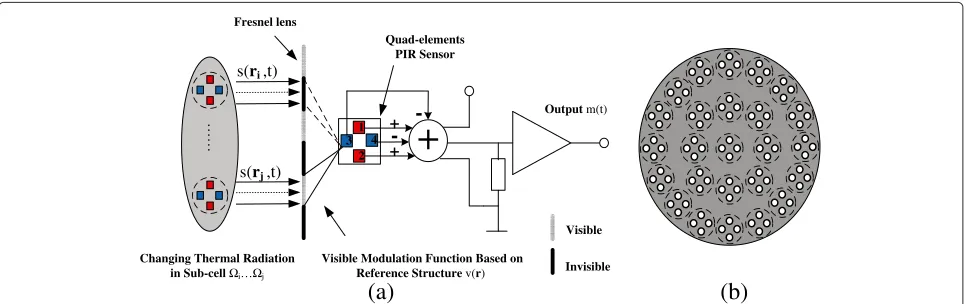
In the community of spatial imaging, the geometry ref-erence structure-based tomography is the sensing mode that samples the spatial information selectively in connec-tion with the tasks [31]. Its core idea is to use the reference structure-based coding modulation to build a projection mapping from sampling space to measurement space. In this article, using the combinations of the PIR sensor and Fresnel lens, we build an infrared sampling model, as shown in Figure 2a. Here, the reference structure is achieved by Fresnel lens physically.
Let us first assume that the FOV of a PIR sensor
is divided intoLnon-overlapping sub-celli, having the form
wherei is theith sub-cell of the raw interface space. If the FOVs of the PIR sensor are discrete, we denotevjas the visible function for thejth sensor; thejth output in the sensor arrays is
wherevjibridges the visibility between thejth sensor and
ith sub-celliandsi(t)=
is(r,t)dris the integration of the thermal radiation changes in the celliat timet. We setvj=row [vj(r)] ands(t)=col [si(t)], respectively, and Equation 6 is rewritten in matrix notation as
Ground
PIR Sensor and Its Step Response
Output of Sensor m(t)
Density Distribution Function of The Changing Thermal Radiation s(r,t)
Fresnel Lens and Visual Modulation Functionv(r)
FOV of The
Sensor Ω
Human Body 00 1 2 3 4 5 6 7 8 1
2 3 4 5
Seconds
R
es
pon
s
e
(
V
o
lt
s
)
Figure 1Schematic diagram of human thermal radiation and pyroelectric infrared sampling model.
where V =[vji] determines the spatial transform of the thermal radiation and is able to be implemented by the Fresnel lens physically.
In general, a PIR sensor commonly consists of single-, dual-, or quad-element detectors. The single-element sen-sor must add a thermal compensation module to remove the sensitivity to ambient temperature. Quad-element sensors have the inherent advantage that the output is the difference between the voltages obtained from each of the elements of the sensor [25]. The environmental effects can be removed. Figure 2a shows the sampling model of a quad-element PIR sensor, and its output is denoted as
m(t)=m1(t)+m2(t)−m3(t)−m4(t), (8)
wherem1(t) . . .m4(t)are the separated output of four ele-ments, respectively. Hence, the visual FOV of the sub-cell
can be further divided into four regions by the quad-element PIR sensor, which is denoted as
i=i1∪i2∪i3∪i4. (9)
The output of the sensor is refined as
m(t)=
L
i=1
visi(t)= L
i=1
(vi1si1(t)+vi2si2(t)
−vi3si3(t)−vi4si4(t)). (10)
Due to the Fresnel lens masks encoding the quad-element PIR sensor integrally visible or invisible for a particular cell, there isvi=vi1 =vi2 =vi3 =vi4and
m(t)=
L
i=1
vi(si1(t)+si2(t)−si3(t)−si4(t)). (11)
Then, the output of thejth sensor is
(b)
(a)
1 3 4
2 +
-+
-Quad-elements PIR Sensor Fresnel lens
Output m(t)
……
Visible Modulation Function Based on Reference Structurev(r)
Changing Thermal Radiation in Sub-cellΩi…Ωj
s(ri ,t)
s(rj ,t)
Visible Invisible
mj(t)= L
i=1
vji(si1(t)+si2(t)−si3(t)−si4(t)). (12)
Figure 2b shows the Fresnel lens containing 25 non-overlapping cells; thus, each PIR sensor is divided into four sub-cells to form a symmetrical subtraction.
2.3 Sparsity analysis on motion representation
The a prioricondition for compressive sampling is that the raw signal itself or in some transform domain can be sparsely represented. It is necessary to analyze the motion representation. This is the key to acquire the motion compressively in an efficient way.
Based on the previous PIR sensing model, the sen-sor will generate approximated impulse response on the changing thermal radiation, while the changing thermal radiation is controlled by the received thermal powerφ(t). If we assume that when the moving subjects keep a fixed distance from the sensor, both body and ambient temper-atures are isothermal and the sensor’s noise is small, then
dφ(t)
dt is only associated with the visible surface of the body
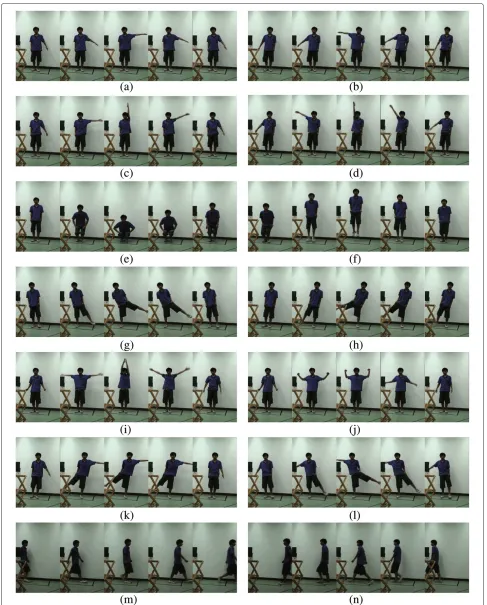
A(t)and can be represented as the moving body parts. To extract the moving body parts and prove sparsity, we first designed a set of gymnastics to build a motion database. There are 14 kinds of gymnastic motions, including the local movements generated by the arms and legs and the synergistic motions of the upper and lower limbs. Figure 3 gives the sequential images of each kind of motion. All the motions are constrained to perform at a predefined region for keeping the fixed distance from the sensor array. There are five lab members who participated in our experiments, and each member does each motion six times repeatedly. The members are with the most com-mon heights and weights; the range of height is from 160 to 180 cm. Thus, we collected 30 image sequences for each motion; the motions are sampled at 25 frames/s.
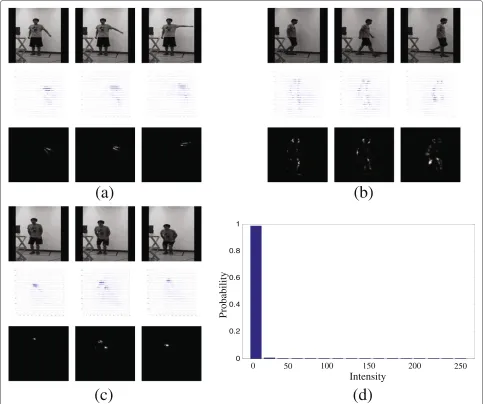
In what follows, the sophisticated optical flow method is employed to extract the changing body parts [32]. Exam-ples of three motions are shown in Figure 4a,b,c. We select three frames and three optical flow images in each cate-gory of motions for visualization and then compute the intensity of motion flow to represent the changing body parts as shown in the third row of each sub-figure. The large intensity coefficients are represented by light pixels, while small coefficients are represented by dark pixels. It can be observed that most of the coefficients of motion flow are close to zeros. We also compute the average distribution of intensity of motion flow on the designed gymnastic motions and plot the corresponding histogram in Figure 4d. Again, most coefficients are very small to zero, meaning the short-term changing body parts are sparsely distributed. This fact motivates us to set up a compressive infrared sampling for motion acquisition.
3 Random matrix-based compression
In the community of data mining and dimension reduc-tion, the random matrix-based compression or projec-tion has attracted the attenprojec-tions of a large number of researchers. It has the advantages of low generation complexity, low distance-preserving distortion, and the ability of accelerating the data processing. Given a high-dimensional and sparse data set, such as the thermal radiation space, it is natural to ask whether it could be embedded into a lower dimensional space without suffer-ing great distortion.
Johnson-Lindenstrauss (JL) lemma gives the intuition for designing the infrared sampling towards non-adaptive and stable compressed acquisition method. The origi-nal formulation of JL lemma is stated as in [33]: given a parameter α > 0 and an integer n0. If Mis a positive integer andM > O(α−2logn0), there exists a Lipschitz
mappingV : RN → RM for the setS ∈ RN which is
composed ofn0points. The mapping is denoted as
(1−α)S1−S22≤VS1−VS22≤(1+α)S1−S22
(13)
for everyS1,S2∈S. The JL lemma shows that the setSin N-dimensional Euclidean space can be mapped on theM -dimensional Euclidean space by the compression matrix
V. The JL lemma provides a compression and dimension
reduction idea, which if we are able to design the appli-cable compression projectionV, then the data processing calculated in the original high-dimensional space is trans-formed to a low-dimensional space. Johnson and Linden-strauss demonstrated inequality (13) and the existence of theV from the perspective of geometric approximation. However, they did not give the indication of how to design theVfor a specific data set [33].
In the subsequent studies, Dasgupta and Gupta pro-vided the proof of JL lemma using the probability theory [34] and pointed out that the entriesvij in the matrixV were able to be built by the independent Gaussian random variable, meaning asvij ∼ N(0, 1). When the number of samples satisfiesM ≥ 4(α2/2−α3/3)−1lnn0, inequal-ity (13) will hold with high probabilinequal-ity. However, the random Gaussian variablevij contains consecutive float-ing point numbers; it is difficult to physically integrate or realize in many areas of engineering.
Achlioptas simplified the proof of JL lemma from the perspective of probability theory [35]. The more simple and easily implemented random compression matrix is given. IfMis an integer satisfying
M≥( 4+2β
0 0.2 0.4 0.6 0.8 1
Intensity
Probability
250
50 100 150 200
0
)
b
(
)
a
(
)
d
(
)
c
(
Figure 4Sparsity analysis of human motion.(a to c)Three kinds of motion sequences and their moving parts.(d)Histogram of the average intensity of the moving parts.
and the projection entryvij has the form with random Bernoulli distribution
vij:=
+1 with probability 0.5
−1 with probability 0.5, (15)
or to meet
vij:= √
3 ⎧ ⎪ ⎨ ⎪ ⎩
1 with probability 16 0 with probability 23 −1 with probability 16,
(16)
inequality (13) will hold with high probability. The
Bernoulli distribution-based compressed projection
matrix V, due to the simple physical signification, is widely applied to the engineering field.
4 Compressive infrared sampling
4.1 Random matrix-based compressive infrared sampling
PIR sensor and Fresnel lens encoded with random masks; for the random matrix satisfying Equation 16, the com-pressive infrared sampling is achieved by the random-rotated quad-element PIR sensors and Fresnel lenses encoded with random masks. In this article, we adopt the second physical method for designing the compressive infrared sensing.
If we assume that the body’s movement is constrained in a fixed interaction space, so that a specific motion with certain semantics is composed of an infrared sequence of moving body parts. According to sampling theory for the radiation space, the original interface space can be divided into coarser-grained and non-overlapping cells. This divi-sion is achieved by the isometric mapping between the interface space and Fresnel lens. The sub-cells on the Fresnel lens have the homologous distribution to the tra-ditional visual sensor pixels. When the body moves into the sensing space, the feature of motion can be rep-resented by the changes of thermal radiation. Accord-ing to the theory of random compression proposed by Achlioptas [35], we use the random distribution of Equation 13 to modulate each of the FOV of the Fresnel lens. Figure 2b shows the Fresnel lens containing 25 non-overlapping cells; thus, each PIR sensor is divided into four sub-cells to form a symmetrical subtraction. We first select two thirds of the all FOVs of the Fresnel lens on each PIR sensor and mask them. This operation will make the changes of thermal radiation in the sub-cell to be not vis-ible for the PIR sensor. Then, we randomly select a half from all the sensors and then rotate them 90°. The above combined operation enables the sensing matrix of the sen-sor array to have a pseudo-random property and forms the fashion of compression infrared sampling for motion information:
m(t)=Vs(t). (17)
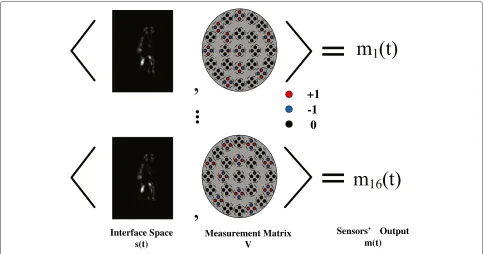
Figure 5 presents the diagram of the proposed com-pressed infrared sampling. In this article, we employ 16 PIR sensors to measure the motion information in raw space parallelly, havingm∈R16. The sub-lens on Fresnel lens is further divided into four sub-cells using the quad-element PIR sensors, so the original measured space is divided into 25×4 =100 non-overlapping sub-cells and s ∈ R100. The measurement matrixV ∈ R16×100 com-presses the original 100-dimensional states of the thermal radiation changes into the 16-dimensional sensor outputs with a non-adaptive way.
4.2 Statistical analysis of random measurement matrix
Figure 6a presents the pseudo-random measurement matrix used in this article. The white pixels in this figure represent the visible entries ‘1’, the black pixels repre-sent the visible entries ‘−1’, while the gray pixels denote
the invisible entries ‘0’. Given the measurement matrix, it is necessary to verify its effectiveness for inequality (13). However, due to the unknown knowledge of specific setS and its element numbern0, it is hard to demonstrate that inequality (13) holds with high probability directly.
Kaski proposed the cosine of the angle between two vec-tors to measure the distortion of similarity when random compression is used [36]. His method gives quantitative assessments on random compression. In this article, we employ his statistical results to assess the effectiveness of pseudo-random measurement matrix. First, assuming two vectorss1ands2are given, the inner product of two
mea-surement vectorsm1andm2by the random matrixVcan
be expressed as follows [36]:
mT1m2=sT1VTVs2, (18)
The matrixVTVcan be decomposed asVTV = I+, whereIis the identity matrix and the matrixdenotes the entities off the diagonal:
ij:=
vTi vj for i=j,
0 for i=j. (19)
Then, Equation 18 can be rewritten as
mT1m2=sT1s2+
i=j
ijs1is2j. (20)
The diagonal entities in matrix VTVshould be equal to unity since the measurement vectorvihas the normalized weights with equal probability, while the non-diagonal entriesijshould be equal to zero [36]. However, the vec-torviandvjare not orthogonal in practice, which causes the non-diagonal entriesij to be small but not to zero. The similarities of the original vectors will generate dis-tortions with the non-zero entriesij, which can be seen in Equation 20.
If the random measurement matrix is fixed, it is possi-ble to use the statistical properties of entriesijto analyze the distortions generated by compression. The ideal aver-age of ij isE[ij]= 0, with approximate varianceσ2 ≈ 1/M = 0.0625. According to the variance σ2, we can infer that the more measurements and sparser original vectors will generate smaller distortions when random compression is used. The actual average value ofijbased on previous description is −0.0105, and the variance is 0.1518. Figure 6b gives the ideal and actual distribution of ij. Although the actual variance is larger than the ideal one, theijwill have the smaller value associated with the sparse vector.
5 Experiments and results
5.1 Experimental setup
Interface Space s(t)
Measurement Matrix V
Sensors’ Output m(t)
0
+1
-1
Figure 5Pseudo-random-coded Fresnel lense-based compressive infrared sampling.
center of the module. Figure 7b shows the prototype of our proposed sensing system for the acquisition of motion information. The sensor array is composed of 16 quad-element PIR sensors. The PIR sensorsD205b com-mercially available are employed for sampling the thermal radiation changes [37]. Both the horizontal and vertical range of the sensor’s FOV are about 95°. We use the smart system-on-chip (SoC)CC2430 to sample the signal with the frequency of 10 Hz. Figure 7c shows the experimental setup for real-time measurement of the body motion. We
assume that the movements are restricted inside the vir-tual box in front of the person. The distance between the sensor unit and the subject is 1.5 m. When the limbs of the body move through the interface region, the correspond-ing sensors will be activated.
In order to test the validity of the proposed method, we designed a set of gymnastics to build a motion database. There are 14 kinds of gymnastic motions, including the local movements generated by the arms and legs and the synergistic motions of the upper and lower limbs. The
-1 -0.5 0 0.5 1
0 500 1000 1500 2000 2500
Ideal Distribution
Actual Distribution
20 40 60 80 100
2
4
6
8
10
12
14
16
Intensity of εij
Number of Intensities
Index of Interface Space
Sensor Channel
(b)
(a)
Figure 7Prototype device of the compressive infrared sampling.(a)A PIR sensor module.(b)Hardware prototype.(c)Typical experimental scenarios.
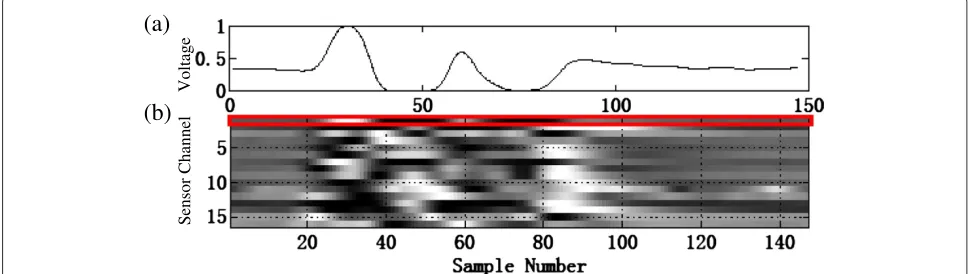
ambient temperature is kept at 25°C. Figure 3 gives the sequential images of each kind of motion. Figure 8 shows the typical sensor output vector when a person walks across the interface space.
In the following experiments, we do assume that the gymnastic motion played by each member is required to be constrained in the interaction region. The spatial and temporal differences of the same semantic motions are small. However, the general motion recognition and behavior understanding should be considered the more challenging problems. Although our assumptions sim-plify the motion recognition, the purpose of this article is to exploit the compressed infrared sampling to directly acquire human motion in a compressive form.
5.2 Measurement sequence segmentation
We use the energy-based detection method to segment the motion signal directly. First, the collected signal is normalized by removing its direct current component. Second, the normalized signal is enframed by splitting the signal into overlapping frames and denoted as
ms(t)=[ms(t−d),. . .ms(t) . . .,ms(t+d)]T, (21)
where ms(t) is the sth sensor’s frame vector at time t anddis the width of the radius in enframing operation.
In our subsequent experiments, the d is 5. Third, the
energy signal is obtained by accumulating the squared value in each column of the enframed signal, and a prede-fined threshold value is used for generating the start-end boundaries. The overall motion segmentation may be determined based on the synthetically enframed signal M(t)=[m1(t) . . .m16(t)]T.
5.3 Hausdorff distance-based recognition method
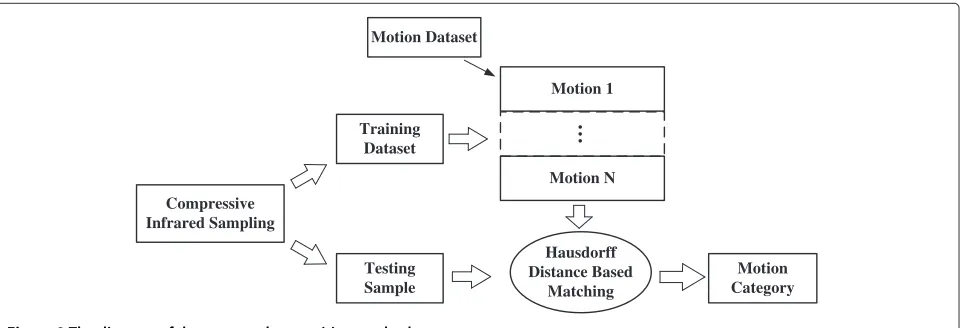
Hausdorff distance is a lightweight tool to measure the similarity between two different temporal sequences. It is able to overcome the different lengths of time between changes in the sequence and timing offset, and the out-put also includes the temporal constraints implicitly. Hausdorff distance is widely used in the temporal sequence matching and recognition [38,39]. Figure 9 gives the flow chart of recognition method.
Let us assume that a test sequence M1 =[m1
(1),. . .,m1(t1),. . .,m1(T1)] is given, and the reference
sequence is M2 =[m2(1),. . .,m2(t2),. . .,m2(T2)]. T1
and T2 are the length of the two signal sequences,
S
ens
or Channel
Voltage
(a)
(b)
Compressive Infrared Sampling
Training Dataset
Testing Sample
Motion 1
…
Motion N
Hausdorff Distance Based
Matching
Motion Category Motion Dataset
Figure 9The diagram of the proposed recognition method.
respectively. The average Hausdorff distance between two sequences is
Dh(M1,M2)= mean 1≤t1≤T1
min
1≤t2≤T2
( ˆM1(t1)− | ˆM2(t2))
,
(22)
whereMˆ1 andMˆ2 are the energy normalized sequence.
The Hausdorff distance is denoted as
Dhausdorff(M1,M2)=
1
2[Dh(M1,M2)+Dh(M2,M1)] . (23)
If we have pre-stored some reference samples of differ-ent motions in the database, then a coming test sequence needs to be matched with each reference sample. The cat-egory of the test sequence is determined by the following nearest neighbor rule:
w∗=arg min
1≤w≤W
Dhausdorff(M1,Mw), (24)
wherew∗is the category to be recognized andW is the total number of categories in the motion database.
5.4 Experimental results and discussion
The number of measurements or dimensions is an impor-tant parameter in the proposed sensing method. By the statistical experiments, we compare the recognition per-formances in different numbers of dimension. For the collection of the reference set, we randomly select half of the samples from each motion set as the template samples, and the remaining samples are used for test and analysis. The following statistical experimental results are based on 30 cross-validations.
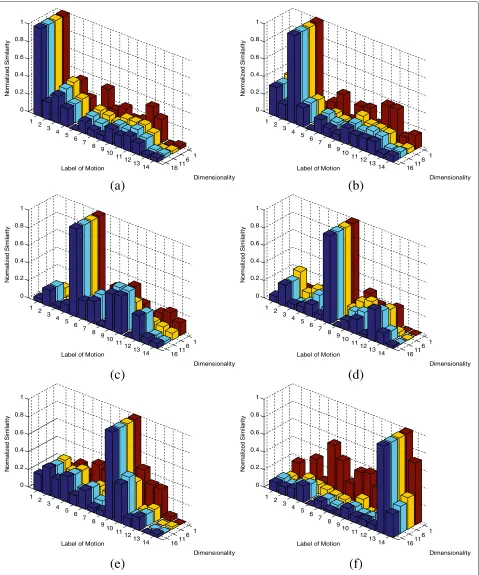
We first statistically give the average similarity of six typical categories of motion against the other motions under different sampling dimensions, as shown in Figure 10. The normalized similarity is calculated based
on the reciprocal of average Hausdorff distance. From the experimental results, it can be seen that each kind of motion samples has the confusing similarity against the other reference samples with low sampling dimen-sion, especially the one-dimensional infrared sampling on synergistic motions of the upper and lower limbs. Thus, the acquired information cannot support to determine the category of the testing motion. When the number of compressed sampling dimension increases to 6 or 11, it is obvious that each kind of the testing motion only has the maximum normalized similarity with the truly recognized category.
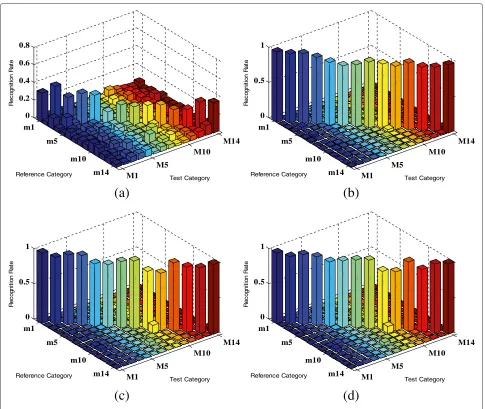
Figure 11 shows the three-dimensional confusion matrix based on the proposed sensing method with four kinds of sampling dimension. The confusion matrix shows the motion reference category (left) versus the test cate-gory (right). Each bar(mi,Mj)in the matrix denotes the percentage of motionMjbeing recognized as motionmi. The percentage of the correctly recognized motion can be obtained by calculating the trace of matrix. The remain-ing lower bars present the percentage of misclassification. It can be seen when the sample dimension is 1, due to the small sample dimension, the compression sampling signal cannot form the distance-preserving map with the origi-nal high-dimensioorigi-nal space. It causes a highly erroneous recognition rate. It is also obvious that when the num-ber of compressed sampling dimension increases to 6 or 11, the proposed method is able to obtain higher correct recognition rate.
)
Figure 10Average similarity of six typical categories of motion against other motions under four kinds of sampling dimension.(a)Raising the right arm,(b)swinging the right arm,(c)squatting and standing up,(d)lifting the right leg,(e)waving both arms, and(f)walking.
distortion with high probability. While the number of compressive dimension reaches to 6, the sensing method will get a better performance.
)
Figure 11Three-dimensional confusion matrix with the sample dimensions (a) 1, (b) 6, (c) 11, and (d) 16.
an Intel Pentium 4 2.8-GHz computer by Matlab codes. It can been seen that the larger compressed sampling dimension will consume the longer processing time, and it has approximately linear growing trend based on the Hausdorff distance matching method. It should be noted that the recognition is very fast, since the testing fea-ture is represented by a low-dimensional sequence. Even in the case of 16 dimensions, the average recognition
Table 1 The average correct rates and recognition time for motion detection with four types of dimensionality
Dimensionality
1 6 11 16
Average correct rate (%) 29.47 91.81 94.17 94.83 Average recognition time (ms) 24.66 28.23 31.53 35.05
time will not exceed 36 ms. For some real-time recog-nition system, designers can make a tradeoff on the number of sampling dimension according to the sensing resources, data processing time, and average recognition rate.
6 Conclusions
The proposed sensing method gives rise to two main advantages. First, the sensing module is able to acquire and compress motion information synchronously. Sec-ond, the problem of recognizing a high-dimensional signal is transformed into the low-dimensional space, and the computational time of recognition can be saved.
However, there are some limitations in the practi-cal application. First, the sensing method relies on the assumption that the motion is constrained in a predefined interface region, so the distance between the body and sensor array is fixed. Indeed, many motions are often asso-ciated with more freedom. Second, different from the clas-sical compressive sensing paradigm, the low-dimensional sensor outputs are used for motion classification without reconstruction. Developing more effective performance analysis method for the sensor system is our future work. Third, other parameters such as the location of the sensor unit and the distance between the sensor unit and the sub-ject to be captured could also be considered to improve the performance of the system. Although the prototype sensor system has the limitations, the sensing method has provided a proof of concept with respect to using a com-bination of PIR sensor and CS theory for compressive motion acquisition.
Competing interests
The authors declare that they have no competing interests.
Acknowledgements
The authors would like to thank the anonymous reviewers for their constructive comments and suggestions. They also wish to thank all the staff of the Information Processing & Human-Robot Systems lab in Sun Yat-sen University for their aid in conducting the measurement experiments. This work is partly supported by the National Natural Science Foundation of Liaoning Province (grant no. 2013020008) and the National Natural Science Foundation of China (grant no. 61074167).
Author details
1Department of Electronic Science, Huizhou University, Guangdong 516001,
China.2College of Physics & Electronic Information Engineering, Wenzhou University, Wenzhou 325035, China.
Received: 7 May 2013 Accepted: 16 January 2014 Published: 19 February 2014
References
1. C Yang, Y Hsu, A review of accelerometry-based wearable motion detectors for physical activity monitoring. Sensors.10(8), 7772–7788 (2010)
2. A Yilmaz, O Javed, M Shah, Object tracking: a survey. ACM Comput Surv. 38(4), 1–45 (2006)
3. P Turaga, R Chellappa, V Subrahmanian, O Udrea, Machine recognition of human activities: a survey. IEEE Trans. Circ. Syst. Video Technol.18(11), 1473–1488 (2008)
4. R Poppe, A survey on vision-based human action recognition. Image Vis Comput.28(6), 976–990 (2010)
5. L Wang, D Suter, Visual learning and recognition of sequential data manifolds with applications to human movement analysis. Comput. Vis. Image Understand.110, 153–172 (2008)
6. I Jolliffe,Principal Component Analysis. (Springer, Berlin, 1986) 7. J Tenenbaum, V Silva, J Langford, A global geometric framework for
nonlinear dimensionality reduction. Science.290(5500), 2319–2323 (2000)
8. S Roweis, L Saul, Nonlinear dimensionality reduction by locally linear embedding. Science.290(5500), 2323–2326 (2000)
9. I Toši´c, P Frossard, Dictionary learning. IEEE Signal Process. Mag.28(2), 27–38 (2011)
10. DL Donoho, Compressedsensing Trans. IEEE. Inf. Theory.52, 1289–1306 (2006)
11. R Baraniuk, Compressive sensing. IEEE Signal Process. Mag.24(4), 118–121 (2007)
12. E Candès, M Wakin, An introduction to compressive sampling. IEEE Signal Process. Mag.25(2), 21–30 (2008)
13. M Duarte, M Davenport, D Takhar, J Laska, T Sun, K Kelly, R Baraniuk, Single-pixel imaging via compressive sampling. IEEE Signal Process. Mag. 25(2), 83–91 (2008)
14. J Romberg, Imaging via compressive sampling. IEEE Signal Process Mag. 25(2), 14–20 (2008)
15. G Johansson, Visual perception of biological motion and a model for its analysis. Atten. Percept. Psychophys.14, 201–211 (1973)
16. G Johansson, Visual motion perception. Sci. Am.232, 76–88 (1975) 17. A Oikonomopoulos, I Patras, M Pantic, Spatiotemporal salient points for
visual recognition of human actions. IEEE Trans. Syst., Man Cybern. Part B: Cybernetics.36, 710–719 (2005)
18. P Dollar, V Rabaud, G Cottrell, S Belongie, Behavior recognition via sparse spatio-temporal features, in2nd Joint IEEE International Workshop on Visual Surveillance and Performance Evaluation of Tracking and Surveillance, 2005
(IEEE, Piscataway, 2005), pp. 65–72
19. J Niebles, H Wang, L Fei-Fei, Unsupervised learning of human action categories using spatial-temporal words. Int. J. Comput. Vis.79(3), 299–318 (2008)
20. R Fuksis, M Greitans, E Hermanis, Motion analysis and remote control system using pyroelectric infrared sensors. Electron. Electrical Eng.86(6), 69–72 (2008)
21. A Sixsmith, N Johnson, A smart sensor to detect the falls of the elderly. IEEE Pervasive Comput.3(2), 42–47 (2004)
22. J Burchett, M Shankar, AB Hamza, BD Guenther, N Pitsianis, DJ Brady, Lightweight biometric detection system for human classification using pyroelectric infrared detectors. Appl. Optics.45(13), 3031–3037 (2006) 23. JS Fang, Q Hao, DJ Brady, BD Guenther, KY Hsu, Real-time human
identification using a pyroelectric infrared detector array and hidden Markov models. Opt. Express.14(15), 6643–6658 (2006)
24. JS Fang, Q Hao, DJ Brady, BD Guenther, KY Hsu, A pyroelectric infrared biometric system for real-time walker recognition by use of a maximum likelihood principal components estimation (MLPCE) method. Opt. Express.15(6), 3271–3284 (2007)
25. M Shankar, JB Burchett, Q Hao, BD Guenther, DJ Brady, Human-tracking systems using pyroelectric infrared detectors. Opt. Eng.45, 106401 (2006) 26. Q Hao, D Brady, B Guenther, J Burchett, M Shankar, S Feller, Human
tracking with wireless distributed pyroelectric sensors. IEEE Sensors J.6(6), 1683–1696 (2006)
27. T Liu, X Guo, G Wang, Elderly-falling detection using distributed direction-sensitive pyroelectric infrared sensor arrays. Multidimensional Syst. Signal Process.23, 451–467 (2012)
28. T Liu, J Liu, Feature-specific biometric sensing using ceiling view based pyroelectric infrared sensors. EURASIP J. Adv. Signal Process (2012). doi:10.1186/1687–6180–2012–206
29. S Mitra, T Acharya, Gesture recognition: a survey. IEEE Trans. Syst. Man Cybernet. Part C: Appl. Rev.37(3), 311–324 (2007)
30. A Hossain, M Rashid, Pyroelectric detectors and their applications. IEEE Trans. Ind. Appl.27(5), 824–829 (1991)
31. D Brady, N Pitsianis, X Sun, Reference structure tomography. J. Opt. Soc. Am. A.21(7), 1140–1147 (2004)
32. BD Lucas, T Kanade, An iterative image registration technique with an application to stereo vision, inThe 7th International Joint Conference on
Artificial intelligence,vol. 2 (Morgan Kaufmann, San Francisco, 1981),
pp. 674–679
33. W Johnson, J Lindenstrauss, Extensions of Lipschitz mappings into a Hilbert space, inConference in Modern Analysis and Probability,vol. 26 (American Mathematical Society, Providence, 1984), pp. 189–206 34. S Dasgupta, A Gupta, An elementary proof of the Johnson-Lindenstrauss
35. D Achlioptas, Database-friendly random projections:
Johnson-Lindenstrauss with binary coins. J. Comput. Syst. Sci.66, 671–687 (2003)
36. S Kaski, Dimensionality reduction by random mapping: fast similarity computation for clustering, inThe 1998 IEEE World Congress on
Computational Intelligence,vol. 1 (IEEE, Piscataway, 1998), pp. 413–418
37. The PIR Sensor Co. Ltd. http://pirsensor.bloombiz.com. Accessed 7 May 2013
38. DG Sim, OK Kwon, RH Park, Object matching algorithms using robust Hausdorff distance measures. IEEE Trans. Image Process.8(3), 425–429 (1999)
39. SH Kim, RH Park, An efficient algorithm for video sequence matching using the modified Hausdorff distance and the directed divergence. IEEE Trans. Circ. Syst. Video Technol.12(7), 592–596 (2002)
doi:10.1186/1687-6180-2014-20
Cite this article as: Liu and Liu: Design and implementation of a
compressive infrared sampling for motion acquisition.EURASIP Journal on
Advances in Signal Processing20142014:20.
Submit your manuscript to a
journal and benefi t from:
7 Convenient online submission
7 Rigorous peer review
7 Immediate publication on acceptance
7 Open access: articles freely available online
7 High visibility within the fi eld
7 Retaining the copyright to your article