ISSN(Online): 2319-8753 ISSN (Print): 2347-6710
I
nternational
J
ournal of
I
nnovative
R
esearch in
S
cience,
E
ngineering and
T
echnology
(A High Impact Factor, Monthly, Peer Reviewed Journal)
Visit: www.ijirset.com
Vol. 6, Issue 10, October 2017
A Study on Translucent Concrete and it’s
Properties
Er.Rohan.R.Vaswani ¹
Dept. of Civil Engineering, Guru Nanak College of Engineering and Technology Rashtrasant Tukdoji Maharaj
University Nagpur, India¹
ABSTRACT:Translucent concrete allow light to pass through it because of the presence of optical fibers within the opaque concrete wall. Light is transmitted from one surface of the said wall to the other, because of the presence of optical fiber strands along the width of the wall, which allows light to pass through. The principal objective of this project is to design translucent concrete blocks with the use of glass optical fibers, and then anallize their various properties and characteristics. All tests further performed on our concrete samples and on the optical fibers as such were done to ascertain the improvements of the casted blocks over normal concrete blocks of the same size and with the same design ratios, and to ascertain the practical utility of using translucent concrete as a building material for green building development
KEYWORDS : Translucent concrete, Optical fibres,Applications, Properties, Proportion.
I. INTRODUCTION
ISSN(Online): 2319-8753 ISSN (Print): 2347-6710
I
nternational
J
ournal of
I
nnovative
R
esearch in
S
cience,
E
ngineering and
T
echnology
(A High Impact Factor, Monthly, Peer Reviewed Journal)
Visit: www.ijirset.com
Vol. 6, Issue 10, October 2017
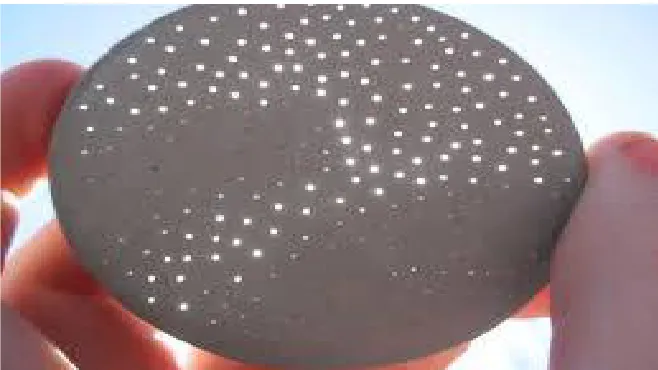
Fig. 1.Light passing through translucent concrete using optical fibre.
II. MATERIALS AND PROCEDURE
1. Cement
The cement used in this experimental works is “Koromandal King 53 Grade Ordinary Portland Cement”. All properties of Cement are tested by referring IS 12269-1987 Specification for 53 Grade Ordinary Portland cement. The specific gravity of Cement was 3.14. The initial and final setting times were found as 51minutes and 546minutes respectively. Standard consistency of cement was 40%.
2. Fine aggregate:
Locally available sand passed through 4.75mm IS sieve was used. The specific gravity 2.75 and fineness modulus of 2.80 were used as fine aggregate. The loose and compacted bulk Density values of sand are 1600 and 1688 kg/m3 respectively, the water absorption of 1.1%.
3. Coarse aggregate:
Crush granite aggregate available from local sources has been used . The coarse aggregate with maximum size of 10mm having the specific gravity value of 2.6and fineness modulus of 5.60 were used as a coarse aggregate. The loose and compacted bulkdensity values of coarse aggregate are 1437 and 1556kg/m3 respectively, the water absorption of 0.4%.
4. Optical fibre elements:
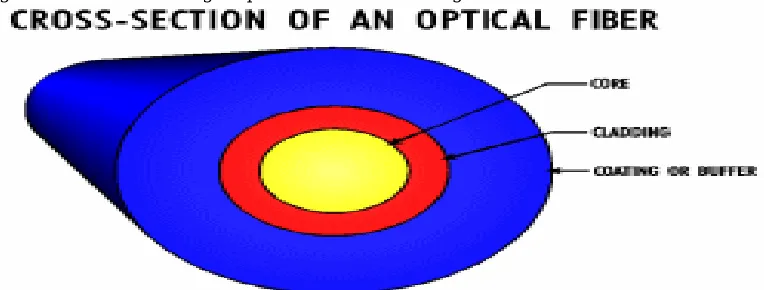
Core - The thin glass center of the fibre where the light travels is called core.
Cladding - The outer optical material surrounding the core that reflects the light back into the core. To confinethe reflection in the core, the refractive index of the core must be greater than that of the cladding.
Buffer Coating – This is the Plastic coating that protects the fibre from damage and moisture.
ISSN(Online): 2319-8753 ISSN (Print): 2347-6710
I
nternational
J
ournal of
I
nnovative
R
esearch in
S
cience,
E
ngineering and
T
echnology
(A High Impact Factor, Monthly, Peer Reviewed Journal)
Visit: www.ijirset.com
Vol. 6, Issue 10, October 2017
There are three basic types of optical fibres: [1] Multimode graded-index fibre. [2] Multimode step-index fibre. [3] Single-mode step-index fibres.
A Study on Translucent Concrete Product and Its Properties by Using Optical Fibres
III. PRINCIPAL OF OPERATION
Optical fibre is made up of three sections:
1) CORE –(carries light signals) thin glass center of fibre where light travels
2) CLADDING –(keeps light in the core) made of a material which has a lower refractive index than the core(for light to pass from the core out through the cladding, it would have to slow down). Instead, the light waves takes the path of least resistance by reflecting only in the core.
3) COATING –(protects the cladding) Plastic coating that protects the fibre from damage.
Fig. 4 shows the different part of optical fibre and ray path.
IV. MIXTURES AND PROPORTIONS
Cement Sand Coarse aggregate Water
1 1.25 2.9 0.40
V. PROCEDURE
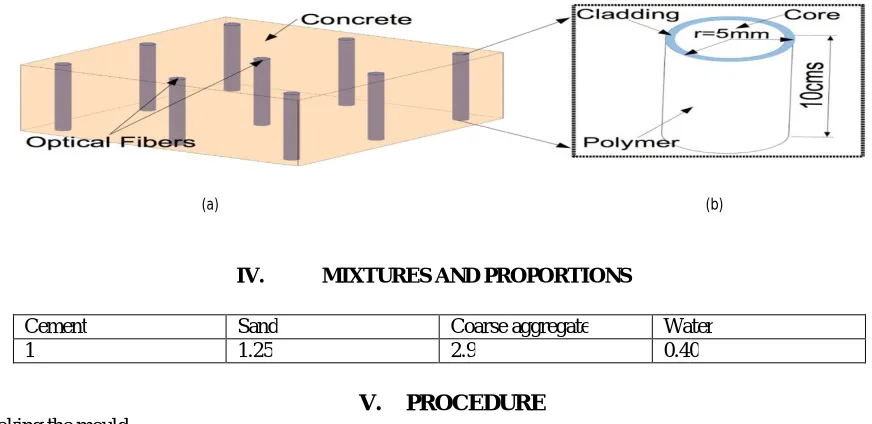
1. Making the mould
For making the mould roll some polymer clay into a circle and cut a plastic bowl from lower end to form a ring.
Fig 4.Making of mould by rolling clay or any other material so that we can embed fibres in it.Cut a ring time plastic bowl for mould.
(a)
(a) (b)
ISSN(Online): 2319-8753 ISSN (Print): 2347-6710
I
nternational
J
ournal of
I
nnovative
R
esearch in
S
cience,
E
ngineering and
T
echnology
(A High Impact Factor, Monthly, Peer Reviewed Journal)
Visit: www.ijirset.com
Vol. 6, Issue 10, October 2017
2.Fibre optics
Cut a bunch of small 1 inch segments by breaking off about 10 wires from the bundle, and cutting them short in mass. 3.Placing the fibres
Stick the small fibreoptics you cut short (in the last step) into the polymer clay. This may take a while.
I used pliers. If you use them too, be mindful not to crush the fibres they are quite fragile, even though they are plastic.
Fig 5. The figure shows placing of fibres.Place the fibres carefully in order to avoid displacement of fibres.
4.Concreting
Pour the concrete and mix the concrete pretty thin because you don’t want any air bubbles.Pour it carefully so that it does not affect the placing of fibres.Sometimes while pouring the fibres get displaced. Avoid displacements of fibres for the desired transparency
5.Breaking the mould and trimming of fibres
ISSN(Online): 2319-8753 ISSN (Print): 2347-6710
I
nternational
J
ournal of
I
nnovative
R
esearch in
S
cience,
E
ngineering and
T
echnology
(A High Impact Factor, Monthly, Peer Reviewed Journal)
Visit: www.ijirset.com
Vol. 6, Issue 10, October 2017
6.Polishing
Use sandpaper to polish your new piece of light transmitting concrete. The effect is quite strange, sort of alien feeling. Evencoloured light is able to pass rightthrough and create a pixelated likeness on the opposite side.
Figure 6.Thouroughly polish the surface of the model by using sand paper so that it can produce a light transmitting effect.
VI. PROPERTIES
1. Technical specifications
Form: prefabricated blocks / panels
Components: Concrete, Optical fibre
Density: 2100 – 2400 kg/m3
Compressive strength varying
ISSN(Online): 2319-8753 ISSN (Print): 2347-6710
I
nternational
J
ournal of
I
nnovative
R
esearch in
S
cience,
E
ngineering and
T
echnology
(A High Impact Factor, Monthly, Peer Reviewed Journal)
Visit: www.ijirset.com
Vol. 6, Issue 10, October 2017
2. Material performance
Concrete retains its strength
High density top layer concrete
Infused with optical fibres
Frost and de-icing salt resistant.
Fire protection.
Highest UV resistance.
3. Environment Impact
When a solid wall has the ability to transmit light, it means that one can use fewer lights during daylight hours.
VII. ADVANTAGES
Less energy consumption.
Illuminated Pavements.
Homogeneous in structure.
Finishing Surface.
Routine maintenance not required.
VIII. DISADVANTAGES
Very high cost about EUR 1300/m2.
Labours with technical skills are needed to manufacture it.
It’s a factory product.
It is precision material and the correct procedure need to be followed.It is extremely important to ensure the integrity of optic strands if they break within the product property would almost be neglected.
Costing of this material is difficult as the techniques are just start to develop.
IX. APPLICATIONS
Thanks to new features this material presents innovative technical solutions, semi-natural and ecological, for the traditional construction problems allowing a wide area of applications in construction, architecture, decoration and even furniture. Some of the possible applications for this new material are spread over several areas creating new
possibilities to various products Such as:
1. Translucent concrete blocks suitable for floors, pavements and load-bearing walls. 2. Facades, interior wall cladding and dividing walls based on thin panels.
3. Partitions wall and it can be used where the sunlight does not reach properly. 4. In furniture for the decorative and aesthetic purpose.
5. Light fixtures.
6. Light sidewalks at night.
7. Increasing visibility in dark subway stations.
ISSN(Online): 2319-8753 ISSN (Print): 2347-6710
I
nternational
J
ournal of
I
nnovative
R
esearch in
S
cience,
E
ngineering and
T
echnology
(A High Impact Factor, Monthly, Peer Reviewed Journal)
Visit: www.ijirset.com
Vol. 6, Issue 10, October 2017
X. CONCLUSIONS
A novel architectural material called translucent concrete can be developed by adding optical fiber or large diameter glass fiber in the concrete mixture.The translucent concrete has good light guiding property and the ratio of optical fiber volume to concrete is proportion to transmission. The translucent concrete not loses the strength parameter when compared to regular concrete and also it has very vital property for the aesthetical point of view.It can be used for the best architectural appearance of the building. Also used where the light cannot reach with appropriate intensity. This new kind of building material can integrate the concept of green energy saving with the usage self-sensing properties of functional materials.
REFERENCES
[1]ErJadhav sunil¹ErKadlag amol²,ErKawade chetan³ErTalekarpravin4 Department of Civil Engineering Amrutvahini College of Engineering,A study on translucent concrete by using optical fibers IIJMER Vol 5 Issue 4 2015 ISSN : 2249-6645
[2]ErSomyajit Paul ¹andErAvika Dutta²,Student of civil engineering in SRM University,Translucentconcrete,IJSRP Vol3 Issue 10 P9 ISSN 2250-3153.
[3]ErR Pradhipa¹PG Student 1Dr S Krishnamoorthi² Head of Department 2Kongu Engineering college of engineering, experimental study on Translucent Concrete IJSRD
Vol3 Issue 3 2015 ISSN:2321-0613
[4]ErKavya S¹Asst.Professor1Karthik D²,Principal2Sivaraja M³ ,N.S.N college,An experimental study on Light Emitting Concrete M IJARET Vol3 Issue 2 2016 P188
ISSN:2394-2975
[5]ErPatil Gourav¹,Assistant professor1 in JSPM college of engineering Patil Swapnil ² Study on Light transmitting Concrete IJERGS Vol 3 Issue 2 Part 22015