High Gain Observer Design for Nonlinear
Web Winding System
N. Rabbah1, A. Aït Elmahjoub2, N. Machkour2, M. Zegrari1
Assistant Professor, Research Group of Modeling and Control of Industrial Systems1
Assistant Professor, Research Group of Renewable Energy and Artificial Intelligence2
Laboratory of Structural Engineering, Intelligent Systems and Electrical Energy
ENSAM, Department of Electrical Engineering – Hassan II University– Casablanca, Morocco
ABSTRACT:State estimation has become an important area of research in the industrial field. This is because there are many applications that demand the knowledge of many of the state variables, if not all of them.
The purpose of this paper is to introduce a nonlinear high gain observer in order to estimate the whole process state variables. Whenever some construction conditions hold, it is possible to obtain estimates that converge asymptotically to the actual values. As a particular application, we consider the Web Winding System for a reversing mill. This WWS is widely recognized as a difficult problem for the purpose of control. Finally, computer simulations are developed for showing the performance of the proposed nonlinear observer.
KEYWORDS:web winding system (wws),high gain observer,nonlinear system,systems uniformly observable, estimated parameters.
I. INTRODUCTION
The resolution of many industrial problems requires disposal at all times state measures of the studied system. So the quality of the solution, for example a control problem, depends at least in part on the accuracy of the measured state. In the case of a cold rolling system, there must be measures of electromagnetic quantities, mechanical quantities and thermal quantities. There are physical sensors that directly provide these measures, only they are expensive and fragile. To overcome this difficulty, we use estimation algorithms online non-measurable variables. These algorithms, called observers or software sensors, based on the knowledge of the system model and the measures provided by physical sensors available. The observer’s synthesis for nonlinear systems is usually much more difficult than for linear systems. For systems admitting an exact linearization with variable change or may be observability canonical form, a type of Luenberger observer might suit [1-3]. The web winding system dynamics (WWS) is described by its strongly nonlinear behaviour. In all cases of winding or unwinding a web material, there is the flatness problem[4-5].
In the present work, we propose a nonlinear observer applied to the nonlinear affine control system. The paper is organized as follows. The web winding model is described in Section 2, with a brief description of the system. We detail the proposed observer and prove its convergence in Section 3. In Section 4 the observability analysis of the wws are treated and evaluated using simulation of the web winding model. The last section concludes the paper.
II. PLANTMODEL
A. WWS Description
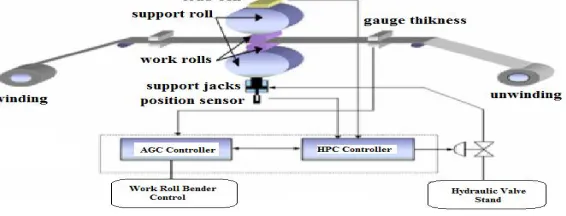
• The entry and exit velocities ensured by the winders motors, and the work rolls velocity (Fig.1). • The pressure force or the variations between the work rolls and their parallelism.
The variation of the exit strip flatness evolves because of the thermal dilation of the cylinders [6-7], but also due to the elasticity forces [8]. To avoid this phenomenon, the traction forces are applied to limit the elasticity of the rolled material. Programmable automats, which are called AGC (Automatic Gauge Control system); ensure the thickness control [9]. Their goal is to maintain the strip thickness uniform in spite of the changing of the acting factors. We start with the development of a mathematical model describing the dynamic behavior of the system.
Fig. 1. Interactions between the components of the cold rolling system.
B. Global Model
Let us consider the nonlinear model of the wws [10-11] defined by the state representation (1) which can be put in the general form of the nonlinear affine control system [4]:
̇ = ( , ) = ( ) + ( )
=ℎ( ) (1)
with :
= [ ]T
=
; = [ ]Tet = [ ]T
( ) =
⎣ ⎢ ⎢ ⎢ ⎢ ⎢ ⎢ ⎢
⎡ −
− − +
− + −
− − +
− − ⎦⎥ ⎥ ⎥ ⎥ ⎥ ⎥ ⎥ ⎤
ℎ( ) =
(2)
( ) = [ , , ] =
⎣ ⎢ ⎢ ⎢ ⎢ ⎢
⎡ . 0 0
0 0 0 0
. 0
0 0 0
0 0
. ⎦
⎥ ⎥ ⎥ ⎥ ⎥ ⎤
(3)
These parameters characterize the system: it is multivariable, strongly coupled, nonlinear and timevarying. The model (1) is composed of three subsystems: The first one is of the state vector [V1,T1]T, controlled by the tension U1, the
second has as a state vector [V2], is controlled by U2 and the third subsystem has as a state vector [T2, V3]T, is
III.OBSERVERSYNTHESIS
A. Observers
Consider the following dynamic systems: ˆ
( , ) ( , , )
( ): ( ):
( ) ˆ ( , , )
x f x u z f z u y
O
y h x x H z u y
(4)
where zM a variety differentiable such as H:M→ is a submersion, is open constituting state space of ; u and y are respectively the inputs and outputs.
The most used observer structure is:
ˆ ( , )ˆ ( ) ( )ˆ ( )
ˆ
( , , , )
x f x u G g h x y
O
g x u y g
(5)
G(g) is called observer gain and G(g)(h( )-y) is the correction term.
In the following, we will recall some existing results on the synthesis of observers.
B. Nonlinear MIMO affine in control systems uniformly observable The equation of the observer in the original coordinates is written as follows:
1
1 1
ˆ ( )
ˆ ( )ˆ ( )ˆ x T ( )ˆ
x f x g x u S C h x y
x
This observer is a copy of the model, plus a corrective term which is explicitly given. Moreover, its setting is made through the choice of a single parameter, ie .
We present an observable form characterizing class of uniformly observable of nonlinear multi-output systems. Next, we will present a particular class of uniformly observable of nonlinear multi-output systems that can presented in a canonical form. This canonical form, also known as the first canonical form was proposed by [12]. This form can be interpreted as a generalization of the canonical form characterizing the uniformly observable single-output systems [13-15].
C. Canonical form of an observer
We consider systems that can be put in the following form:
1
( , )
x Ax u x
y Cx x
The exit yP, the input um and (u,x) a triangular structure with respect to x, i.e :
1 1
2 1 2
( , ) ( , , ) ( , )
( , )
q
u x
u x x
u x
u x
The matrix A of n n dimension is the anti-offset matrix block:
0 0 0
0
0
0 0
0 0 0
p p p p
p p
p
p p p
I I A
I
(6)
0
0
p p p
C
I
A high gain observer for the system (6) is the following dynamical system:
1 1
ˆ ˆ ( , )ˆ T ˆ
x Ax u x S C Cx y
Where:
> 0 is the observer adjustment parameter.
S is the unique solution of the algebraic Lyapunov equation as follows:
T T
S A S S A C C
is the following diagonal matrix:
1
1 1
, , ,
p p q p
diag I I I
The solution S of equation (10) and the vector S1CT can be expressed as follows:
( ) 1
2
( , ) ( 1)i j ijj p
S i j C I 1 i j, n 1
2 1
q p q p T
q q p
C I C I
S C
C I
Where IP is the identity matrix P P.
IV.APPLICATION TO THE WEB WINDING SYSTEM (WWS) A. Observability analysis of the wws
Consider the following model of the wws:
2
1 1
1 2 1 1
1 1 1 1
2 2 3 1 3
2 2
2 2 2
3 2 4 3 2
2 2 2 2 2
4 3 4 3 5
2
3 3
5 4 5 3
3 3 3 3
1
. .
1
1
. .
1
1
. .
em em
em em
em em
gr r
x x x U
J k
ES ES
x x x x x
L L L
gr gr r
x x x x U
J J k
ES ES
x x x x x
L L L
gr r
x x x U
J k
The observability matrix for the wws model becomes:
(8)
(9)
(10)
(11)
(12) for
(13)
3 2
3 4
0 1 0 0 0
0 0
0 0 1 0 0
0 0 0 1 0
0 0
x x
E S ES
L L L L
O
x
x E S E S
L L L L
The WWS observability result is (locally) observable in the sense of rank. Under the local observability criterion, it follows that the model (14) is locally observed in the sense of rank if the O matrix is non-singular. For this purpose, it simply checks that the determinant of this matrix is non-zero:
2
d e t(O) E S 0
L
The determinant is always positive which allows us to deduce that the WWS is locally observable.
B. Observer synthesis for the WWS
We proceed to the change of coordinates z =(x) as follows: First output :
1
1 1 2
z y x
1
1 1 2 1 2
1
1 1 2 2 11
1 .
1
( , )
ES E S
z y y x y
L L L
ES
x ES y y z y u
L L
With:
1
2 1
1 1 1 2
1
( , ) ( )
E S
z x
L
y u E S y y
L
2
2 1 1
1 1 2 1 1
1 1 1 1
1
. .
em em
gr r
E S E S
z x x x U
L L J k
1 12(z2, , )y u
Second output :
2
1 2 3
z y x
2 2
2 2 2 2
1 3 2 4 3 2
2 2 2 2 2
1
. .
em em
g r g r r
z x x x x U
J J k
21( , )y u
Third output :
3
1 3 4
z y x
(15)
31 4 2 3 2 5 5 3 2
3
2 31
1 1
( , )
ES ES ES
z x y y y x x ES y y
L L L L L
z y u
With: 3 2 5
3 1 3 2
1
( , ) ( )
E S
z x
L
y u E S y y
L 2
3 3 3
2 5 4 5 3
3 3 3 3
3 32 2 1 . . ( , , ) em em gr r ES ES
z x x x U
L L J k
z y u
The change of coordinates leads to:
1 1 2 2 3 3 ( ) ( ) ( ) ( ) z x
z z x x
z x Such as: 1 2 1 1 1 1 1 2 2 2
2 1 3
3 4 3 1 3 3 5 2 ( ) ( ) ( ) x z
z x ES
x z
L
z x z x
x z
z x ES
x z L
We then find the following overall system:
1 1 1
1 1 1
2 2 2
2 2 2
3 3 3
3 3 3
1 1 1 2 1 2 3 3 3 ( , , ) ( , , ) ( , , ) . . .
z A z z y U
z A z z y U
z A z z y U
y C z
y C z
y C z
1 1 2
2
3 3
2
0
z
z
z
z
z
and:
1 3
2
0 1 0 0 0
A A
A
An observer from (18) is of the form:
1
ˆ ˆ ( , ,ˆ ) T( ˆ )
T T
z Az z y U S C C z y
S S A S SA C C
where:
1
2
3
1 1 1 1 1
1 1 1 1 1 1
2 2 2 1 2
2 2 2 2 2 2
3 3 3 1 3
3 3 3 3 3 3
ˆ ˆ ,ˆ , ˆ
ˆ ˆ ,ˆ , ˆ
ˆ ˆ ,ˆ , ˆ
T
T
T
z A z y z U S C C z y
z A z y z U S C C z y
z A z y z U S C C z y
The observer for the initial system:
1
ˆ ( )ˆ ( )ˆ ˆ T ˆ
x f x g x u x S C Cx y
x
V. DIGITAL RESULTS
The presentation of nonlinear observer are developed in this paper and illustrated through simulation. Figure 2 (a), (c) and (e) shows, respectively, the input, the work roll and the exit strip velocity. (b) and (d)are the upstream and downstream web tension.
1 3
2
1 0
1
C C
C
(19)
Fig.2. Comparison between the model and its estimated of each wws parameter through the proposed observer
It has noted that the good performance of the proposed observer was achieved despite the small initial gap between the model parameters and the estimated parameters. This proves that the local nature of the observer's stability will not be change in practice.
VI.CONCLUSION
In this paper, we have proposed a high-gain observer for the joint estimation of the whole state and all unknown entries for a class of nonlinear multi-output systems. The synthesis of this observer took place under certain sufficient conditions arising directly necessary and sufficient conditions established for linear systems.
Note that the proposed conditions can be relaxed if one allows to calculate the derivative with respect to time outputs and/or inputs known to express the unmeasured variables [18]. It can also release if the synthesis of an observer of the state without adopting any assumption about the unknown input is no longer set as [17] goal. In our work, these conditions were adopted to synthesize observers in the absence or non-assumption(s) on the unknown inputs, and using no derivative known input or output for the estimation of variables.
(a) (b)
(d) (e)
REFERENCES
[1] Krener, A. J., Isidori, A., “Linearization by output injection and nonlinear observers”, Systems and Control Letters. 3, pp.47-52, 1985. [2] Keller,H., “Nonlinear observer design by transformation into a generalised observer canonical form”, International Journal of Control,
Vol.46, pp.1915-1930, 1987.
[3] Plestan, F., “Linéarisation par injection d’entré-sortie généralisée et synthèse d’observateurs”, Thèse de Doctorat, Ecole Centrale de Nante, France, 1995.
[4] Rabbah,N.,Machkour,N., Zegrari,M., “A Control Lyapunov Function Approach for Nonlinear Web Winding SystemA Control Lyapunov Function Approach for Nonlinear Web Winding System,” International Journal of Innovative Research in Science, Engineering and Technology, Vol. 4, Issue 7, pp.5387-5393, July 2015.
[5] Rabbah, N., Machkour, N., Kheddioui,Elm., Zegrari,M.,Aït Elmahjoub, A., “Backsyepping control of the web winding system”, International Journal of Engineering & Technology IJET-IJENS, Vol.15, No:06, pp.31-35, December 2015.
[6] Rabbah,N., Bensassi, B., “Modélisation et simulation d’un système de laminage à froid quarto réversible”, Rencontre Nationale des Jeunes Chercheurs de Physique (RNJCP06), Casablanca, Morocco, 18-19 décembre, 2006.
[7] Rabbah,N., Bensassi, B.,“Modelling and simulation of web winding system of a reversible rolling mill”, International Conference on Applied Simulation and Modelling (ASM2007), Palma de Mallorca, Spain, August 29-31, pp.474-478, 2007a.
[8] Schmitz,A., Herman,J.C., “Modélisation du laminage à froid des aciers. Etude des aspects métallurgiques. Analyse par la méthode des tranches”, CRM Faculté Polytechnique de Mons, pp.37-43, May 16-17, 1995.
[9] Ueno,T., Sorao,K., “Improvement of Accuracy for Gauge and Elongation Control by Dynamic Process Control Simulator”, Nippon steel technical report No. 89, pp.57-62, 2004.
[10] Rabbah,N., Bensassi, B.,“Commande d’un système d’entraînement de bande”, Manifestation des Jeunes Chercheurs en Sciences et Technologies de l'Information et de la Communication (MajecSTIC 2007), Caen- France, pp.251-255, 29, 30 et 31 octobre, 2007.
[11] Rabbah,N., Bensassi, B., “Control Lyapunov Function for a Nonlinear web winding system,” International Conference on Control and Applications (CA 2008). Quebec, Canada, May 26-28, 2008.
[12] Hammouri, H., Farza, M., “Nonlinear observers for locally uniformly observable systems”, ESAIM J. on Control, Optimisation and Calculus of Variations, Vol.9, pp.353–370, 2003.
[13] Gauthier,J. P., Hammouri,H.,Othman, S., “A simple observer for nonlinear systems-Application to bioreactors”, IEEE trans. Automat. Control, Vol.37, pp.875-880, 1992.
[14] Gauthier,J. P., Bornard, G., “Observability for any u(t) of a class of bilinear Systems”, IEEE Trans. Automat. Control, Vol.26, pp.922-926, 1981.
[15] Gauthier,J. P., Kupka, I. A. K., “Observability and observers for nonlinear systems”, SIAM J. Control. Optim,Vol.32, pp.975–994, 1994. [16] Shim,H., Son, Y. I., Seo, J. H., “Semi-global observer for multi-output nonlinear systems”, Systems & Control Letters, Vol.42, pp.233–244,
2001.
[17] Farza,M., M’saad, M., Rossignol,L., “Observer design for a class of MIMO nonlinear systems”, Automatica, Vol.40, pp.135–143, 2004. [18] Barbot,J. P., Fliess,M., Floquet, T., “An algebraic framework for the design of nonlinear observers with unknown inputs”, In Proc. 46th