kk
Research Article
DEVELOPMENT OF AQUEOUS POLYMERIC DISPERSION (APD) OF EUDRAGIT E PO-
PERFORMANCE CHARACTERIZATION FOR AQUEOUS BASED TASTE MASKING COATING
SYSTEM
MEHTA NAVEEN
1*, GUPTA M.K.
2, JAIN ANUREKHA
31Department of Pharmacy, Jodhpur National University, Jodhpur (Rajasthan), 2Deapartment of Pharmacy, Oriental University (M.P.),
3Department of Pharmaceutics, B.R.Nahata College of Pharmacy, Mandsaur-458001(M.P), India. (Centre of relevance and excellence
recognized by TIFAC, SIRO & Innovation network partner), E-mail: [email protected]
Received: 31 Feb 2015, Revised and Accepted: 16 March 2015
ABSTRACT
The present research work was performed todevelop an Aqueous Polymeric Dispersions (APD) of Eudragit E PO using emulsification solvent evaporation technology including optimization of solvent, emulsifier & stabilizer. The basis rationale for the present research is to develop water based coating system over organic solvent based coating systems to achieve certain advantages over organic solvents with respect to ecological, toxicological and manufacturing safety concerns, including Pollution, Explosion hazards, Risk of operators, High cost of organic solvents, solvent toxicity and many more. The APD of Eudragit E PO was developed by emulsification solvent evaporation technology including optimization of Ethyl Acetate as solvent, 1%w/w SLS as emulsifier & 4% w/v Polaxomer F127 as stabilizer. The Concentration of Eudragit E PO was optimized as 15%w/v among three APD formulations F1-5%, F2-10% & F3-15% by optimizing Particle size, pH & Viscosity parameters. The optimized APD (F3-15%w/v APD) was characterized for different parameters viz. Average Particle Size by TEM & found 732 nm, pH by electrode pH meter & found 6.8 & viscocity by brook’s field viscometer & found 0.6 Pascle. The Optimized APD (F3-15%w/v APD) was characterized for any possible interactions by DSC & FT-IR spectra. Three different free films were prepared with three different plasticizer viz. di-butyl phthalate, propylene glycol and tri-ethyl-citrate to plasticize optimized aqueous polymeric dispersion of Eudragit EPO (F3-15%w/v APD). Tri-ethyl-tri-ethyl-citrate 30%w/v of dry polymer was optimized for the development of the free films from an optimized APD(F3). The optimized aqueous polymeric dispersion of Eudragit EPO (F3-15%w/v APD) was used for the performance characterization for taste masking coating properties of ofloxacin tablets. APD (F3-(F3-15%w/v APD) coated Ofloxacin tablets were comparatively evaluated with Eudragit E PO Organic solvent coated Ofloxacin tablets for different parameters viz. (a.) Physical- Hardness, Friability, Wt. Variation etc (b.) in-vitro dissolution profile- In Distilled water & Simulated Gastric Fluid (SGF) (c.) Biological- Taste masking. The accelerated stability study of optimized APD (F3-15%w/v APD) was also performed for 30 days evaluated for Particle size, Viscosity & Redispersibility. It was concluded that the APD was stable at room temperature & unstable at 4-80C.
Keywords: APD, Eudragit E PO, In vitro release study, TEM, FT-IR, DSC, Polaxomer F127.
INTRODUCTION
Water soluble polymers are always being in good demand because of their certain advantages over organic solvents based coating systems with respect to ecological, toxicological and manufacturing safety concerns, including Pollution, Explosion hazards, Risk of operators, High cost of organic solvents, solvent toxicity and many more.
Aqueous polymeric dispersions, latexes, or pseudolatexs are all colloidal systems in which high molecular weight polymers are homogeneously dispersed in submicron sizes with the aid of surfactant(s) and other stabilizing agents [1].
There are a wide range of water insoluble polymers includes Cellulose: Ethyl cellulose, Vinylics: Polyvinyl acetate phthalate, Cellulosic esters: cellulose acetate phalate (CAP), Acryates: Eudragit, & many more which provide a great research platform to develop an aqueous polymeric dispersions (APD) with the intention of conferring benefits and properties to the dosage form over the uncoated variety or organic coating.
To comply with government restrictions on the emission of solvents to the atmosphere, the coating industry has developed replacements for organic solvent based coating to decrease or eliminate solvent emissions, including water based coatings, high solid coatings and powder coatings. Presently, water based coatings are among the most promising candidate systems for functionality, effectiveness, convenience and economics [2].
However, these aqueous polymeric dispersions have their obvious disadvantages which are typical of colloids like they can be irreversibly affected by various factors such as electrolytes, heat or frost, pH changes and high shear forces [3-6].
The present research work was performed todevelop an Aqueous
Polymeric Dispersions (APD) of Eudragit E PO using emulsification solvent evaporation technology including optimization of solvent, emulsifier & stabilizer. The basis rationale for the present research is to develop water based coating system over organic solvent based coating systems to achieve certain advantages over organic solvents. Eudragit EPO polymer is a type of Poly (meth) acrylates.It is a cationic polymer with Dimethylaminoethyl methacrylate as a functional group helps you to seal sensitive activities and increase patient compliance by masking taste and odors. Even thin layers of Eudragit provide the desired effect, making it an extremely economical application. It is a versatile polymer for protective Oral Dosage Formulation. This polymer used for Insulating coating, taste masking, odour masking, moisture protection and light protection [7].
MATERIALS AND METHODS
Eudragit E PO (B. No- G071231197) was gifted by M/s Evonik, Mumbai. Ofloxacin was obtained from Kasliwal brothers, Indore and other chemicals was from Loba chemie Pvt. Ltd., Mumbai, India. All chemicals used were of analytical grade.
1. Preparation of Aqueous Polymeric Dispersion of Eudragit E PO by Emulsification Solvent Evaporation Method
Aqueous polymeric dispersion was prepared by emulsification solvent evaporation method in two steps using Eudragit E PO, organic phase, stabilizer and emulsifier [8].
Step 1: Preparation of oil-in-water crude emulsion
For the preparation of oil-in-waster crude emulsion, organic phase, emulsifier and stabilizer were selected and there quantities were optimized.
1.1 Selection of organic phase
Different solvent can be used for the preparation of organic phase. Polymer may solubilized or swelled in the solvent. Polymer solution should be clear for the emulsion preparation. The polymer should not be more viscous. 0.5 gm of Eudragit E PO was taken and dissolved in 10 ml of solvent/solvent system and kept for half an hour. Different solvents including methanol, ethanol, acetone, and toluene were used. The solution was observed for the clarity of solution.Toluene has revealed least solubility for polymer (100mg in 1ml). Ethyl acetate showed the solubility in 150mg in 1ml. In Methanol the solubility of polymer was 350smg/ml. In Acetone the solubility of polymer was 550smg/ml. In Ethanol solubility of polymer was more than other solvents (600smg/ml). The multiple solvent Acetone and Ethanol showed more solubility than other solvents (700mg/ml). Finally it was concluded that for single solvent system Ethanol was optimized & for multiple solvent system Acetone & Ethanol (1:1) were optimized to prepare a cost effective technique.
1.2 Selection of emulsifier
The emulsifiers are required to prepare a stable aqueous polymeric dispersion. Emulsifiers play an important role in the preparation of colloidal polymer dispersions. They facilitate the formation of the emulsion and prevent agglomeration and coalescence of the dispersed polymer particles during solvent evaporation and
storage[6,7].The emulsifying agent operative in the aqueous medium
in relatively low concentrations, generally included in proportions of about 0.1 to 3% by weight of the water in aqueous phase (%w/v). Two different formulations were prepared with two different types of emulsifiers; SLS and Tween80 were used. Formulation F1 containing Tween 80 & F2 containing SLS were formed to make an emulsion with milky white appearances. The selection of the emulsifier was done on the basis of physical evaluation Viz. Appearance, pH, Viscosity & Particle size.
Table 1:- Selection of emulsifier
S.No. Parameter F1 (Tween 80) F2 (SLS)
1 Appearance Milky white Milky white
2 pH 6.2 6.5
3 Viscosity 20 cps 14 cps
4 Particle size distribution 0.45 µm 0.756 µm
The Optimized Emulsifier was SLS because of better stability & easy redispersibility.
1.3 Optimization of emulsifier concentration
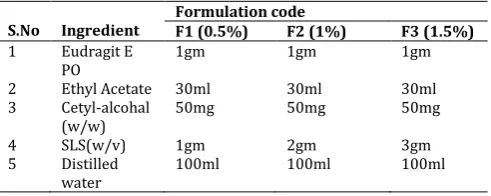
Three different formulations were prepared with various concentrations of emulsifier in process to optimize the concentration of SLS.
Table 2:- Optimization of emulsifier concentration
S.No Ingredient Formulation code F1 (0.5%) F2 (1%) F3 (1.5%)
Out of these three formulations, formulation F1 was neutralized pH, lesser viscosity and lesser particle size.
1.4 Optimization of stabilizer concentration
Five different formulations were prepared for the optimization of stabilizer concentration with different concentration of Polaxomer F127. Optimized Formulation F4 was given in table no.3. Different
parameters were preformed like pH, viscosity and particle size distribution for the best formulation.
Table 3:- Optimization of stabilizer’s concentration
S.No. Parameter F1 (0.5%)
1 Appearance Milky white
2 pH 6.9
3 Viscosity 0.54Ps
4 Particle size distribution 0.86 µm
Out of these three formulations, F4 formulation was neutralized pH, lesser viscosity and lesser particle size determination.
Step 2: Preparation of the aqueous dispersion from optimized o/w emulsion
To prepare oil-in-water crude emulsion polymer was dissolved in organic solvent. Emulsifier and stabilizer dissolved in aqueous phase at 75°C temperature and then drop wise addition of polymer solution in aqueous phase with mechanical stirrer operated at 1000 rotation per minute (rpm) and crude emulsion was obtained. Then prepared emulsion was placed in a rotating flask of the rotary evaporator and slowly rotated at 50°C and 500 mm Hg vacuum to remove the organic solvent and polymer solution was concentrated. This process was continued for three hours to obtained aqueous polymeric dispersion [6].
2.1: Optimization of Eudragit EPO concentration for development of aqueous polymeric dispersion of Eudragit EPO
Three different formulations F1, F2 & F3 of aqueous polymeric dispersion of Eudragit E PO were prepared by emulsification solvent evaporation method and characterized for different parameters like color, odor, particle size distribution, pH and viscosity were observed.
Table 4:- Optimization of Eudragit EPO concentration
S.no Ingredients Formulation (F3-15%APD)
1 Polymer Eudragit EPO 12.5gm
2 Organic solvent Ethyl acetate 20ml
4 Surfactant SLS
(1.0%w/v)
5. Stabilizer Polaxomer F127
(4%w/v)
6. Plasticizer Stearic Acid
(10%w/w)
7. Distilled water 50ml
2.2: Characterization of aqueous polymeric dispersion of Eudragit EPO
The different formulations of Aqueous Polymeric Dispersion of Eudragit EPO were characterized for the following parameters.
2.2.1: Color, odor and appearance of aqueous dispersion
The aqueous polymeric dispersion colour was milky white and has no characteristic odor that indicates the complete removal of the solvent form the formulations. Appearance of the aqueous polymeric dispersion was also good.
2.2.2: Particle Size Determination
The aqueous polymeric dispersion of Eudragit EPO formulations F1, F2, F3, F4 and F5 were diluted with distilled water and poured in to glass plates. The particle size of dispersion was measure by optical microscope [7].
Least count =(N2/N1) 0.01mm
Where, N1=Division of the eye piece N2=Division of the stage micrometer
The diameter of the particles was calculated by multiplying the division of the eyepiece to the least count. The average particle size of the formulations 5%, 10%, and 15% and found 0.838 µm, 0.24 µm, 0.27 µm and 0.28 µm respectively All the formulations formed dispersion. Due to large particle size of the dispersed phase, sedimentation was observed immediate half an hour, which although redispersed after shaking [9, 10].
2.2.3: pH of aqueous polymeric dispersion of Eudragit EPO
The pH plays an important role on the aqueous polymeric dispersion suability [11]. Formulations subjected for the pH determination using
the digital pH meter.
Table 5:- pH of different formulation
S.No Formulation Ph
1 F1 6.9
2 F2 6.5
3 F3 (Optimized) 6.8
2.2.4: Viscosity of Aqueous Polymeric Dispersion
Viscosity is an expression of the resistance of a fluid of flow, the higher the viscosity the greater the resistance. Viscosity measurement is very important for the dispersion system also [11].
Viscosities of the Aqueous Polymeric Dispersion were measure by the digital viscometer using spindle no. three at room temperature
Table 6:- Viscosity of different formulations
S.No Formulation Viscosity (Ps)
1 F1 0.54 Ps
2 F2 0.58 Ps
3 F3 (Optimized) 0.60 Ps
2.2.5: Characterization of developed Aqueous Polymeric
Dispersion of Eudragit E PO- After evaluating all the above said
three formulations for different parameter, F3 formulation (with 15% w/v Eudragit EPO) was found as the best optimized formula for the development of aqueous polymeric dispersion of Eudragit E PO.
Table 7: Characterization results of the formulation F3
S. No. Parameter Formulation F3
1 Odor Odorless
2 Appearance White dispersion
3 Particle shape Spherical
4 Average particle size (nm)
As determined by TEM 730nm
5 pH 6.8
6 Viscosity (Ps) 0.6Ps
3. Spray drying of the Optimized APD Formulation
The optimized formulation of the polymer was spray dried to convert its physical state from milky white liquid dispersion to spray dried white powder in order to extend the stability & reconstitution purpose for coating [12].
4. INTERACTION STUDIES [13, 14]
Chemical/Molecular Interaction study of the prepared spray dried APD was performed using following techniques:-
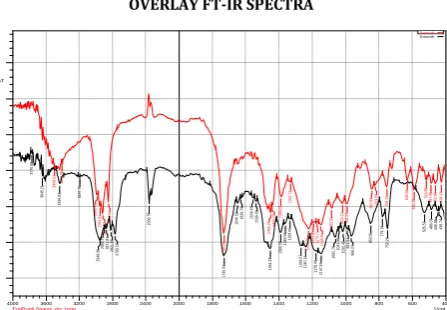
4.1 FT-IR Spectroscopy- Infrared spectroscopy of the Polymers &
its spray dried APD were performed for the interaction purpose. The FT-IR spectra of pure polymer & its spray dried APD form was compared with the help of Overlay FT-IR Spectra [13, 14].
Conclusion- Overlay FT-IR spectra confirms that there is no
molecular interaction in the basic structure of the polymer- Eudragit EPO.
4.2 DSC Analysis- DSc Analysis were done of the Polymers & its
spray dried APD by recording their DSc thermogarm & Glass transition temperatures.
Conclusion- DSC thermogram were recorded for the poymer as well
as its spray dried APD form. Overlay DSC thermograms clears that there is a decrease in glass transition tempreture (Tg) of spray dried APD form as compared to pure polymer. It means APD formation decreases glass transition tempreture (Tg) of the polymer & increases its elasticity.
OVERLAY FT-IR SPECTRA
Fig No. 1 - Eudragit EPO V/s Spray dried APD of Eudragit EPO
0.00 5.00 10.00
Fig No. 2- DSC Thermogram of Eudragit E PO
5. Development of film of Aqueous Polymeric Dispersion of Eudragit EPO
Three different films were prepared with three different plasticizer di-butyl phthalate; propylene glycol and tri-ethyl-citrate were used to plasticize aqueous polymeric dispersion of Eudragit EPO & one film was prepared without any plasticizer (Free Films). Among all the three formulation 15% w/v aqueous polymeric dispersion was formed the film with tri-ethyl-citrate (30%w/v of polymer) & 15% w/v aqueous polymeric dispersion free films were also formed without addition of any plasticizers [15].
5.1 Preparation of film of aqueous polymeric dispersion of Eudragit EPO
A clear film was obtained with tri-ethyl-citrate plasticizer. The thickness of the film was found approx 173 µm.
5.2 Optimized Formulation- 15% APD with 30%w/v of polymer of
tri-ethyl-citrate.
6. Performance Characterization of the Developed Aqueous Polymeric Dispersion Eudragit EPO
Ofloxacin uncoated tablets were prepared and these Ofloxacin uncoated tablets were coated with the aqueous polymeric dispersion of the Eudragit EPO. Eudragit EPO with organic solution was taken and drug release study was determined and compared the aqueous based coating, organic based coating and marketed based coating formulation [16].
Table 8: Formulation of Ofloxacin Tablets
S.No. Ingredients Quantity
(in mg) Uses
1 Ofloxacin 100 Active ingredients
2 Microcrystalline
Table 9: Evaluation parameter of tablets [17]
S.No. Parameters Result
1 Wt variation test Within the limits (±7.5%)
2 Friability test Within the limits (0.6%)
3 Hardness test 5kg/cm 2
4 Disintegration test Pass
6.2 Drug release study from the uncoated and aqueous polymeric dispersion of Eudragit E PO coated tablets and comparative study with aqueous polymeric dispersion of Eudragit E PO coated tablets and organic solution coated tablets
[18, 19].
A. Drug release study in distilled water
100 mg Ofloxacin tablet was weighed accurately and added to 900 ml deionized water and maintained at 37°C. Drug release was performed at 100 rpm for 30 minutes. A 5-ml sample removed from mixtures each kept at 5 to 30 minutes was filtered, and the amount of drug was estimated spectrophotometrically by using
UV-spectrophotometer at 292nm against deionized water as a blank. [18,
19]. Dissolution study of selected formulations were carried out for
30min. by using USP 24 type II dissolution apparatus. It was found that only 0.8% & 0.6% (Absorbance=0.036, y=0.0864*0.6-0.0156) of the drug was released in distilled water from APD coated tablets & Organic base coated tablets respectively indicating the stability of the optimized coating system and suitability for selecting distilled water as a vehicle for suspension.
B. Drug release study in simulated gastric pH
100 mg Ofloxacin tablet was weighed accurately and added to 900 ml simulated gastric pH i.e.1.2 (SGF) water and maintained at 37°C. Drug release was performed at 100 rpm for 30 minutes. A 5-ml sample was removed after specific time intervals from the mixtures and each kept at 5 to 30 minutes, filtered, and the amount of drug
was estimated spectrophotometrically by using
UV-spectrophotometer at 292nm against SGF as a blank [18,19].
Dissolution study of selected formulations were carried out for 2 hrs by using USP 24 type II dissolution apparatus. It was found that the drug released more than 50% drug within 30min at average gastric pH- & more than 95% (95.88%) drug was released within 2hrs 1.2 in case of both i.e. APD coated tablets & Organic base coated tablets hence the optimized coating system not effected the basic pharmacokinetics of the drug & confirm the drug release at gastric media.
Table No. 9: Observation table for drug release profile of optimized formulation of Ofloxacin
Fig No. 3In-vitro drug release profile in simulated gastric pH of
APD base coated Ofloxacin Tablet 6.3 Biological evaluation
Evaluation of bitterness was done by time sensitivity method on 10 healthy human volunteers for 15 minutes to confirm the palatability of the APD coated tablets. It was found that none of the volunteers felt considerable bitter taste of the optimized formulation after 15 min [20].
Table 10: Observation table for Bitterness Evaluation test by time sensitivity method- APD Coated Tablets
Volunteers Bitterness levels after 10
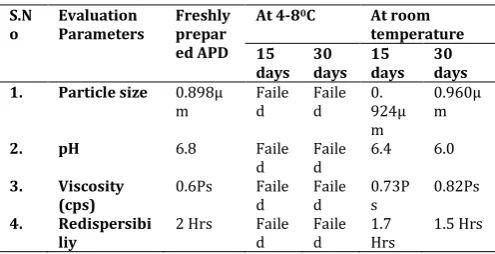
7. Stability Study of Prepared Aqueous Polymeric Dispersion of Eudragit EPO
The Aqueous Polymeric Dispersion comes under the category of functional excipients. It was designed to use for coating of pellets and tablets to prepare sustained release or modified release dosage form. It should maintain its physical form during the storage up to use. The stability study was designed to find out the preferred storage conditions for the aqueous dispersion. The prepared Aqueous Polymeric Dispersion was kept in different storage conditions like freezing, room temperature and accelerated conditions (40±2°C and 70±5% RH) [21-22].
Table No. 11: Stability testing
S.N
o Evaluation Parameters Freshly prepar
RESULTS & DISCUSSIONS
In the present research work, The development of 15%w/v Aqueous Polymeric Dispersions (APD) of Eudragit E PO were developed by using emulsification solvent evaporation technology in three following steps:-
A.) Development of Aqueous Polymeric Dispersion
B.) Development of Polymeric films of optimized Aqueous Polymeric Dispersions
C.) Performance Characterization of developed Freeze-Dried Aqueous Polymeric Dispersions
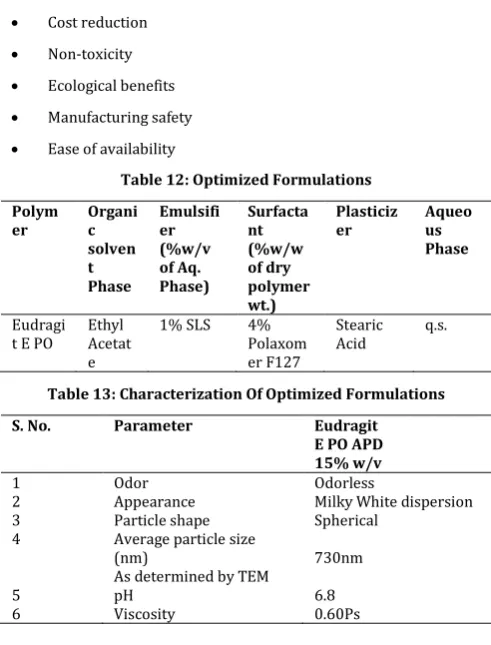
The purpose is to replace an organic solvent by aqueous solvent in order to achieve conferring benefits over Organic solvents for different aqueous insoluble polymersin pharmaceutical industries including:
Table 13: Characterization Of Optimized Formulations
S. No. Parameter Eudragit
E PO APD 15% w/v
1 Odor Odorless
2 Appearance Milky White dispersion
3 Particle shape Spherical
4 Average particle size
(nm)
As determined by TEM 730nm
5 pH 6.8
6 Viscosity 0.60Ps
ACKNOWLEDGMENT
I am thankful to Jodhpur National University, Jodhpur (Rajasthan) & B R Nahata College of Pharmacy to provide the complete research facilities. I am also thankful to my supervisor, Dr. Mahesh Kr Gupta, Prof. & Head, Dept. of Pharmacy, Oriental University, Indore (M.P.) & Co-supervisor, Prof. Anurekha Jain, Principal, B R Nahata College of Pharmacy, Mandsaur (M.P.) for their invaluable technical support & timely guidance.
REFERENCES
1. Wang J and Ghebra S, Aqueous Polymeric Dispersions as a film
former in pharmaceutical dosage forms: Dispersed systems,
edited by Liberman HA, Rieger Martin and Banker G S, Vol I, 2nd
edition, Marcel Dekker Inc., 1996.
2. Wheatley T A, Steuernagel C R,Latex emulsion for controlled drug delivery, in: J.M. McGinity (Ed.), Aqueous Polymeric Coating For Pharmaceutical Dosage Forms, Dekker, New York, 1997, pp. 1-54.
pseudolatex prepration using a novel emulsion-diffusion process involving direct displacement of partially water-miscible solvents by distillation, International Journal of Pharmaceutics 188 (1999), 155-164.
5. Bindschaedler C, Gumy R and Doelker E, Theoretical Concepts
Regarding the Formation of Films from Aqueous Microdispersions and Application to Coating, Lab. Pharm. Probl. Tech., 31, 1987.
6. Bodmeier R, Siepmann J, Nondegradable Polymers for Drug
Delivery, in Encyclopedia of controlled drug delivery, vol. II, A wiley Interscience Publication, 1997.
7. www.roehm.com, Rohm Gabh & Co. KG,Pharma Polymers,
Evonik Degussa.
8. J.W Vanderhoff., 1984. Inversion Emulsion Polymerization of
Acrylamide: Polymerization Kinetics And Process
Development. Journal Of Dispersion Science And Technology, Vol. 5, Issue 3-4, pp. 323-363.
9. Subramanyam CVS, A Textbook of physical pharmacy, Vallabh
Prakashan, 2000.
10. Lehmann KOR, Chemistry and application properties of
polymethacrylate coating systems, In: McGinity, J.W. (Ed.), Aqueous Polymeric 9.Coatings for Pharmaceutical Dosage Forms. Marcel Dekker, Inc., New York,1997, pp. 101– 176. 11. V. Gallardoa, M.E. Moralesa, M.A. Ruiza, A.V. Delgado; European
Journal of Pharmaceutical Sciences 26 (2006) 170–175.
12. Pawar. A, Theory and Practical of Pharmaceutics-1, Second
Edition, Career Publication, July 2012,”Spray Drying”, 150-151 & 264-265.
13. Chatwal G.K. Instrumental method of analysis,Meeruth
publication 2005,Page no 4.2-26
14. Silverstene,“Spectrophotometric Estimation of chemicals“ 4th
edition,2005
15. Nicholson JW., 1990. Wasson EA. Film spreading and film
formation by waterborne coatings. Surface Coatings. Elsevier Applied Science, Vol. 3, pp. 91–123.
16. Lachman. L, Lieberman. A.H, Industrial Pharmacy, Special
Indian Edition, 2009,”Manufacturing of tablets”, 317-324.
17. Lachman. L, Lieberman. A.H, Industrial Pharmacy, Special
Indian Edition, 2009, “Evaluation of tablets”, 296-303.
18. United States Pharmacopoeia-25, Asian Edition,
2002,”Dissolution test”, 2011-2022.
19. Lachman. L, Lieberman. A.H, Industrial Pharmacy, Special
Indian Edition, 2009,”Dissolution test”, 301-303.
20. Borodkin, S.; Yonker, M.H.; Journal of Pharmaceutical Sciences;
1970, 59(40),481.
21. Sanjay Bajaj, Dinesh Singla and Neha Sakhuja: Stability Testing
of Pharmaceutical Products, Journal of Applied Pharmaceutical Sciences, 02 (03); 2012: 129-138.
22. Handbook of Stability Testing In Pharmaceutical Development,
Part II, Stability Methodologies And Best Practices, Springer Sciences & Business Media, https://books.google.co.in/books.