© 2015, IRJET.NET- All Rights Reserved
Page 2141
WORK OPTIMIZATION IN THE ASSEMBLY LINE AND LINE BALANCING
IN THE SUB-ASSEMBLY
Prakash R Patel
1, Sudheer Kulkarni
2, Deepak kumar
31
Student, IEM Department, M.S.R.I.T, Bangalore, Karnataka, India
2
Assistant professor, IEM Department, M.S.R.I.T, Bangalore, Karnataka, India
3
Assistant professor, IEM Department, M.S.R.I.T, Bangalore, Karnataka, India
---***---Abstract –
In an assembly line, the balancing ofworkload at different workstations is necessary to avoid the idle time occurred between them. The time taken for the completion of task in a workstation should match the task time of next workstations to balance the assembly line. In the assembly line, the uniform distribution of workload is done by grouping the workstations so that waiting time between them can be reduced and the workload can be distributed in
grouped workstations rather than individual
workstations. If the workload is distributed in terms of grouped workstations, the task time of grouped workstations are near to the cycle time. This method is used in the main assembly line to reduce the balance delay thereby increasing the line efficiency. In the sub-assembly of power train, the time taken for completion of power train is more than the cycle time of the assembly line. Hence the completion of power train is not in synchronization with the cycle time of the assembly line. This problem is solved by distributing the work elements of the power train sub-assembly into different workstations which matches to the cycle time of the assembly line. Here, Ranked position weight (RPW) method is used for line balancing. By using RPW method, we find the number of workstations required for the sub-assembly of power train. Also, by using RPW method we find which all work elements should be grouped in the workstations. This reduces the time wastage occurred between the completion of power train and its assembly to the chassis. Hence by grouping workstations in the main assembly line & using RPW method in the sub-assembly, the line efficiency is increased & the assembly line is balanced.
Key Words:
Assembly line balancing & Ranked
LLC of USA. In May 2010, the Mahindra Group acquired a majority stake in the company by USD $16.5 billion, & was renamed to Mahindra Reva Electric Vehicles Pvt Ltd. The company's new manufacturing facility in Bengaluru, inaugurated in august 2012 is the first automobile plant in India to get platinum rating from Indian Green Building Council and is capable of producing 30,000 cars per year.In this plant, there is no manufacturing of any components. All the components are purchased from the suppliers and only the assembly operations are carried out in this plant. All the assembly operations are carried out manually and components are added from one stage to the next stage. The assembly line of this plant is a single line flow in w-shape and the waiting time in one workstation affects the overall assembly line. Once the assembly process is completed, the final product (car) undergoes a rigorous testing process to meet the company’s standards. This includes a dynamo-run, water testing and finally a full body inspection under high intensity lighting to ensure that there are no imperfections both inside and outside the car. Upon passing these tests, the cars are signed by the head of quality control. The main objective of the project is to distribute the workload uniformly between the workstations in the assembly line and line balancing in the sub-assembly of power train.
Process:
Number of stages in assembly line= 28
1. First chassis are dropped into assembly line. 2. From here, the chassis moves from one stage to
another.
3. At each stage, components or parts gets assembled into the chassis
© 2015, IRJET.NET- All Rights Reserved
Page 2142
2 PROBLEM STATEMENT
1. In a single flow manual assembly line, the starting of any work or task of a work station should be in synchronization with the completion of task of the previous workstation. This is because there is least waiting time between the workstations and hence the flow of chassis in a assembly line is smooth. In the assembly line, there is a waiting time between the workstations and hence the flow of chassis is not smooth. Since the assembly line is single line flow, the difference in workload distribution between the workstations increases the waiting time of other workstations and thereby reducing the line efficiency. To avoid the waiting time, workload should be distributed uniformly between the workstations so that there is least waiting time.
2. In the sub-assembly of power train, there are seven components to be assembled. The completion of this subassembly takes 85 mins which is 40 mins higher than the cycle time of the main assembly line. That is, on a continuous production, there is a time lag of 40 mins with the completion of sub assembly of power train with the main assembly line. This problem can be solved by assembly line balancing using RPW method.
3. METHODOLOGY
3.1
Workload
distribution
by
grouping
workstations
Find out the work activity sequence and record the observations such as cycle time, task time of workstation, waiting time etc.
Group the workstations till the task times of grouped workstations reaches near the cycle time of the assembly line. Note that the task time of grouped workstations should never cross the cycle time of the assembly line.
Calculate the performance values of grouped workstations and note down the results.
3.2 Assembly line Balancing by RPW method
1. Draw the precedence diagram of the activities performed
2. For each work element, determine the positional weight. It is the total time on the longest path from the beginning of operation to the last operation of the network.
3. Rank the work elements in descending order of ranked positional weight (R.P.W).
4. Assign the work element to a station. Choose the highest RPW element. Then, select the next one.
Continue till cycle time is not violated. Follow the precedence constraints also. Repeat this step till all operations are allotted to one station.
4 DATA COLLECTION AND CALCULATIONS
4.1 Workload in the main assembly line
Observations
Time available for work (Ta)
Shift durations= 8hrs= 480 mins. Allowance = 60 mins.
Ta =480- 60= 420 mins.
Total task time for one unit, Tt= 422 mins. Total idle time= 149 mins.
Total time taken for one unit= 571 mins.
Number of workstation, m= 28
© 2015, IRJET.NET- All Rights Reserved
Page 2143
Where, m- no. of workstations
C.T- Cycle time, T- Task time Trial 3: Stage 1,2,3 & 4= 15+20+ 8+11= 54mins
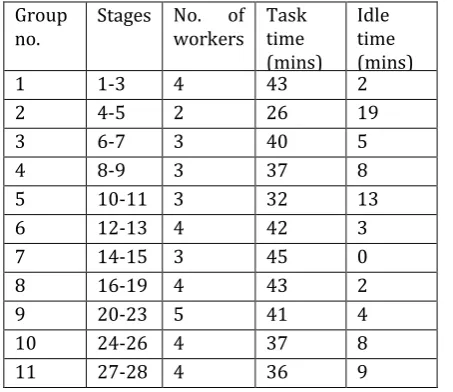
From the above trials we can see that grouping stages 1,2 & 3, we get the task time of 43 mins but grouping stages 1,2,3 &4, we get task time of 54 mins. Since the task time of grouped workstations should be less than the cycle time of the assembly line, we select trial 2. Similarly grouping is done for remaining workstations and is shown below.
Table -4.2: Task time of grouped workstations.
Group Sum of task times= 422 mins.
Number of workstations= number of groups= 11
1. Line efficiency, n =
4.3 Power train sub-Assembly line balancing
The assembly of power train has a sequence of procedure shown below
1. Fitment of Hub-subassembly (inserting bearing, bolts and pressing)
2. Fitment of hub-subassembly to shaft (LH). 3. Fitment of driveshaft to backplate (LH). 4. Fitment of driveshaft to weldment(LH). 5. Fitment of hub-subassembly to shaft (RH). 6. Fitment of driveshaft to backplate (RH). 7. Fitment of driveshaft to weldment(RH). 8. Assembly of LH and RH arms to trailing arm 9. Assembly of motor to trailing arm
10. Assembly of transmission to motor
There are 10 work operations carried out in the sub-assembly of power train. The time taken for this is shown in the precedence diagram.
© 2015, IRJET.NET- All Rights Reserved
Page 2144
Steps for line balancing1. Find RPW value of each work element in the Subassembly.
Table -4.3: RPW value of work elements of Power train
Work
The next step is to rank the work elements in descending order of ranked positional weight.
Table -4.4: Arranging the work elements as per the
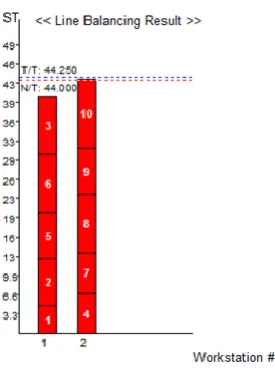
Using RPW method, grouping work elements 1,2,3,5, 6 we get task time of 41 mins and grouping work elements 4, 7, 8, 9, 10, we get task times of 44 mins. That is, there should be 2 workstations.
1 workstation= work element 1,2,3,5,6 2nd workstation= work element- 4,7,8,9,10.
The first workstation has a task time of 41 minutes and the second workstation has a task time of 44 minutes. Since the task times of both these workstations are near to
the cycle time of the assembly line, there is less waiting time, thereby increasing line efficiency.
Fig -4.2: Work elements in 2 workstations
5. RESULTS & CONCLUSIONS
By grouping the stages, the idle time is reduced from 149 mins to 73 mins. The line efficiency after grouping of workstation is increased from 33.4% to 85.2% and the balance delay reduces from 66.5% to 14.7%. This makes the workload distribution uniform across the workstations which makes the flow of the assembly line much smooth.
In the sub-assembly of power train, the task time to complete one power train was 85 minutes. The cycle time of the assembly line is 45 minutes. Since the task time of the power train sub-assembly was much higher than the cycle time of the assembly line, the completion of power train was not in synchronization with the main assembly line. By using RPW method, we infer that there should be 2 workstations for this sub-assembly so that the completion of the power train in less than the cycle time of the assembly line. If there are 2 workstations for the power train sub-assembly, there is a good synchronization of power train sub-assembly with the main assembly line. That is, the waiting time of the chassis for the completion of power train sub assembly is reduced. The first workstation has a task time of 41 minutes and the second workstation has a task time of 44 minutes. Both the workstations have task time less than the cycle time of assembly line, but are very near to the cycle time. This shows that there is less delay and becomes very efficient. Hence 2 workstations are recommended for the sub-assembly of power train.
ACKNOWLEDGEMENT
© 2015, IRJET.NET- All Rights Reserved
Page 2145
REFERENCES
[1] Helgeson, W. R. and Birnie, D (1961). “Assembly line balancing using the ranked positional weight technique”, Journal of Industrial Engineering, 12, 394-398.
[2] Merengo, C., Nava, F. and Pozzetti, A. 999 , “Balancing and sequencing manual mixed-model assembly lines”, International Journal of Production Research, Vol. 37 No. 12, pp. 2835-2860.
[3] Nils Boysen & Malte Fliedner [2008], “Assembly line balancing”, International Journals of Production Economics, pp 509–528.
[4] Scholl, A. and Becker, C. (2006), “State-of-the-art exact and heuristic solution procedures for simple assembly line balancing”, European Journal of Operational Research, Vol. 168 No. 3, pp. 666-693. [5] Sotirios G. Dimitriadis (2006) “Assembly line