Ocean circulation generated magnetic signals
C. Manoj1,2, A. Kuvshinov3,4, S. Maus1,5, and H. L¨uhr1
1GeoForchungsZentrum-Potsdam, Germany 2National Geophysical Research Institute, Hyderabad, India 3Danish National Space Center, Copenhagen, 2100, Denmark
4Geoelectromagnetic Research Institute, Troitsk, Russia 5NOAA’s National Geophysical Data Center, Boulder, U.S.A.
(Received November 15, 2004; Revised March 29, 2005; Accepted April 21, 2005; Online published April 14, 2006)
Conducting ocean water, as it flows through the Earth’s magnetic field, generates secondary electric and mag-netic fields. An assessment of the ocean-generated magmag-netic fields and their detectability may be of impor-tance for geomagnetism and oceanography. Motivated by the clear identification of ocean tidal signatures in the CHAMP magnetic field data we estimate the ocean magnetic signals of steady flow using a global 3-D EM nu-merical solution. The required velocity data are from the ECCO ocean circulation experiment and alternatively from the OCCAM model for higher resolution. We assume an Earth’s conductivity model with a surface thin shell of variable conductance with a realistic 1D mantle underneath. Simulations using both models predict an amplitude range of±2 nT atSwarmaltitude (430 km). However at sea level, the higher resolution simulation predicts a higher strength of the magnetic field, as compared to the ECCO simulation. Besides the expected signatures of the global circulation patterns, we find significant seasonal variability of ocean magnetic signals in the Indian and Western Pacific Oceans. Compared to seasonal variation, interannual variations produce weaker signals.
Key words:Ocean flow, geomagnetic field, satellite measurements.
1.
Introduction
As the conducting water in the ocean moves in the am-bient geomagnetic field of the Earth, it induces secondary electric and magnetic fields. This phenomenon is a case of motional induction, where the electrically charged ions in the sea water are deflected by the Lorentz force perpendic-ular to both the velocity and magnetic field vectors (Tyler
et al., 2003). The spatial charge accumulation causes elec-tric currents within the conducting water and bottom sedi-ments. Based on the geometry of these currents, the ocean induced magnetic fields may be classified into “toroidal” and “poloidal”. The toroidal components are caused by electric currents closing in the vertical plane and have an amplitude range of 10 to 100 nT and are confined to the ocean and the upper crust. The poloidal components arise from the electrical currents closing in the horizontal plane and have a much smaller amplitude range (1 to 10 nT) at the sea level. However its large spatial decay scale allows the poloidal fields to reach outside the ocean to remote land and satellite based sensors. The poloidal magnetic field compo-nents, observed outside the ocean are mainly proportional to the depth integrated velocities (transport) of the ocean (Tyleret al., 1999). The possibility of identifying the ocean magnetic signals on land and satellite based magnetometer records have two implications. The ocean magnetic sig-nals can give information about the major water transport
Copyright cThe Society of Geomagnetism and Earth, Planetary and Space Sci-ences (SGEPSS); The Seismological Society of Japan; The Volcanological Society of Japan; The Geodetic Society of Japan; The Japanese Society for Planetary Sci-ences; TERRAPUB.
across the oceans and their variability (Vivieret al., 2004). On the other hand, the non trivial contribution of ocean magnetic signals to the geomagnetic field necessitates ac-counting for them in geomagnetic field modeling (e.g. Maus
et al., 2005).
Faraday (1832) was the first to recognize the motional induction in sea water. Larsen (1968) and Sanford (1971) were the modern day pioneers in the investigation of the ocean generated electric fields. The effect of the ocean dy-namics, coastline and the electrical structure of the Earth on the induced electromagnetic fields were discussed by Chave (1983). Attempts to estimate ocean induced elec-tric and/or magnetic fileds with realistic ocean circulation models have been made by Stephenson and Bryan (1992), Flosad´ottiret al.(1997a,b), Tyler et al.(1997, 1999) and Palshinet al.(1999). Recently Vivieret al.(2004) corre-lated the variation in the simucorre-lated magnetic fields with the water transport across the Drake Passage. The predicted electric and/or magnetic fields were validated by under-sea-cable voltage measurements (cf. Larsen and Sanford, 1985), land based electrical or magnetic field measurements (Junge, 1988; Maus and Kuvshinov, 2004), sea floor or sea surface magnetic field measurements (Lilleyet al., 2004a,b) and satellite magnetic measurements (Tyleret al., 2003).
The use of satellite magnetic data is particularly promis-ing, considering their global coverage, and the small spa-tial decay scale of the ocean magnetic signals. The ocean generated magnetic field has a typical strength of 1 nT at CHAMP satellite altitude. To separate such signals from the observed magnetic signal (of a typical strength 50,000
nT) is not a trivial task. However, with the advancement in the technology to measure and process the satellite mag-netic data, it is now possible to identify the tidal magmag-netic signals in CHAMP data (Tyleret al., 2003). The low fre-quency magnetic signals produced by the quasi-stationary ocean circulations may be more difficult to separate as com-pared to tidal magnetic signals. However theSwarm mis-sion, which intends to measure the Earth’s magnetic field at an unprecedented precision promises to detect the ocean magnetic signals associated with ocean circulation. This pa-per details the result of the simulations carried out to assess the detectability of ocean magnetic signals with theSwarm
mission. The primary objectives of the simulation were 1) To assess the large scale as well as small scale magnetic field effects of the ocean circulation at sea level and satellite altitude and 2) to examine their temporal variability. In ad-dition, characterizing the ocean magnetic signals is an im-portant first step in trying to identify the ocean magnetic sig-nals in the satellite magnetic data. The first part of the paper discusses the forward computation, i.e. the electromagnetic numerical solution and the ocean circulation models used for the simulation. The results from the forward computa-tion are discussed in the second part. The temporal varia-tions of the ocean magnetic signals are treated in the last part of the paper.
2.
Forward Computation of Ocean Magnetic
Sig-nals
In order to calculate the magnetic fields due to global ocean steady flow, we have adopted the numerical solution which is described in Kuvshinovet al. (2002, 2005) and which has been already successfully applied for ocean tidal signals simulations (Maus and Kuvshinov, 2004; Kuvshi-nov and Olsen, 2005). The solution is based on a volume integral equation approach, which combines the modified iterative dissipative method (MIDM; Singer, 1995) with a conjugate gradients iteration. The solution allows sim-ulating the electromagnetic (EM) fields, excited by arbi-trary sources in three-dimensional (3-D) spherical models of electric conductivity. These models consist of a number of anomalies of 3-D conductivity, embedded in a host sec-tion of radially symmetric (1-D) conductivity. Within this approach Maxwell’s equations in the frequency domain,
∇ ×H=σE+jext, (1)
∇ ×E=iωμoH, (2)
are reduced, in accordance with the MIDM, to a scattering equation of specific type (Pankratovet al., 1997)
χ(r)−
Vmod
K(r,r)R(r)χ(r)dv=χo(r), (3)
which is solved by the generalized bi-conjugate gradient method (Zhang, 1997). In the equations abovejext is the exciting current, its time-harmonic dependency ise−iωt,μo
is the magnetic permeability of free space,i =√−1,ω=
2π/T is the angular frequency,Tis the period of variations,
σ(r, ϑ, ϕ)is the conductivity distribution in the model,ϑ, ϕ andr are co-latitude, longitude and the distance from the
Earth’s centre, respectively,r=(r, ϑ, ϕ),r=(r, ϑ, ϕ),
Vmodis the modelling region, and
R= σ−σo erator,Vextis the volume occupied by the exciting current
jext,Es = E−Eo is the scattered electric field,Ge o is the
3×3 dyadic Green’s function of the 1-D reference conduc-tivityσo(r).
Onceχ is determined from the solution of the scatter-ing equation (3), the magnetic field,H, at the observation points,r∈Vobs(in our caseVobsis the surface of the Earth)
Explicit expressions for the elements of Ge
o and Gho are
given in the appendix of Kuvshinovet al.(2002). Having the magnetic field at the surface of the Earth one can re-calculate the magnetic field at the satellite altitude, using a spherical decomposition of the magnetic fields calculated at the surface of the Earth.
As the present study focuses on the steady state ocean flow, the period of simulation is set to a large value. Since our 3-D conductivity model of the Earth consists of a sur-face spherical shell ofS(θ, ϕ)underlain by a radially sym-metric conductor,jext reduces to the sheet current density,
Jextτ , which is calculated as
Jextτ =σw(U×erBrm), (13)
where×denotes the vector product,σw = 3.2 S/m is the mean sea water conductivity,Uis the depth integrated ve-locity of global steady ocean flow, er is the outward unit
vector and Bm
r is the radial component of the main
the global sediment thickness given by the 1◦ ×1◦ map of Laske and Masters (1997) and calculated by a heuristic procedure similar to that described in Everettet al.(2003). Figure 1 presents the map of the surface shell conductance of 0.25◦ ×0.25◦ resolution. For the underlying spherical conductor we choose a four-layer Earth model (similar to that described in Schmucker, 1985) instead of assuming an insulating mantle (cf. Vivieret al., 2004). It consists of a 100 km resistive lithosphere with 3000m followed by a moderately resistive first layer of 70m down to 500 km, a second transition layer of 16 m from 500 km to 750 km, and an inner uniform sphere of 0.42m. Each simu-lation (with ECCO velocity data) took 1.2 hours CPU time on one processor of the type SunFire V8800 for a model discretization ofNθ×Nφ =180×360 and with an angu-lar resolution of 1◦×1◦. When simulating magnetic fields based on the OCCAM data, using a model discretization of
Nθ×Nφ =720×1440 and with an angular resolution of 0.25◦×0.25◦, it took 20 hours for the same processor.
2.1 Ocean circulation models
We obtained the velocity data for the forward compu-tations from two ocean circulation models viz. ECCO (http://www.ecco-group.org) and OCCAM (http://www. soc.soton.ac.uk/JRD/OCCAM). The ECCO (Estimating the Circulation and Climate of the Ocean) model is based on the MIT general circulation model (Marshallet al., 1997). We use the data from the ECCO 1 model run (1992 to 2002). Using a model adjoint approach, the ECCO 1 model was forced to be consistent with the World Ocean Circu-lation Experiment (WOCE) observations. The model run was configured globally with a 1◦×1◦ horizontal resolu-tion, within±80◦ latitudes and with 23 levels in the verti-cal. The horizontal components of the velocity data were in-terpolated to a common grid and were vertically integrated to obtain the transport data. The monthly transport grids from January 1992 to December 2002 were used to simu-late the ocean magnetic signals. Additionally, the data from a high resolution ocean model OCCAM (Ocean Circulation and Climate Advance Modeling) were used to simulate the magnetic field effects of the ocean eddies. The model has 36 levels in the vertical starting with a thickness of 20 m at the surface and increasing to 250 m at depth. The spa-tial resolution of the model is 0.25◦×0.25◦ (Webbet al., 1998). Archived OCCAM velocity data are available for every 15 days for most of the analysis period within the lat-itudinal limits+66◦ to−77◦. However, velocity data are not available for the North Atlantic Ocean region. For the
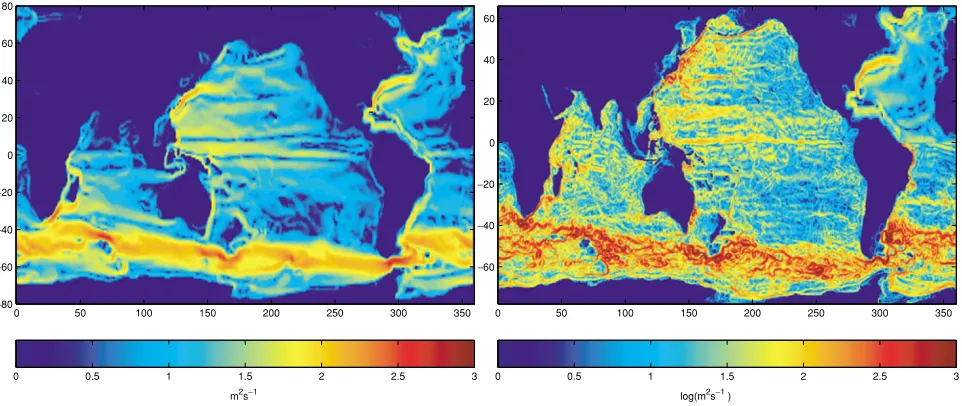
Swarmsimulations we used the average horizontal velocity fields from the 2985 and 3000 days of the OCCAM model run. Figure 2 shows the magnitude distribution of velocity data from both models. Basically, both models describe the major features of the ocean flow in a similar way. How-ever ocean eddies are resolved only by the OCCAM model. For OCCAM data, the missing data for the North Atlantic Ocean region were filled with ECCO data.
3.
Results
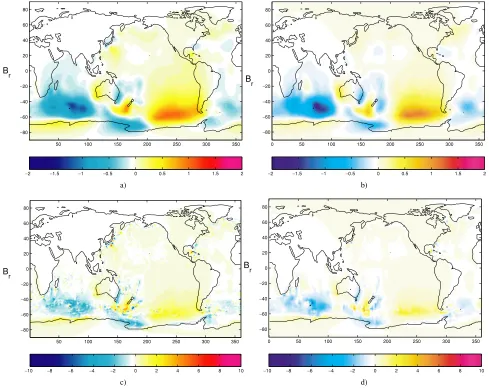
The radial components of the predicted magnetic field (Br) from ECCO and OCCAM data are presented in the
Fig. 3. The dominant ocean induced magnetic signal is
the radial component, Br and the horizontal components
have about half of that strength. We do not plot other com-ponents, as all fields are poloidal, the horizontal fields do not contain additional information. At sea level (bottom panels), both predictions are within the amplitude range ±10 nT and look quite similar. However on closer in-spection, high-intensity and short-wavelength features are more evident in OCCAM simulations. The maxima and minima of magnetic fields are 4 nT and−6 nT for ECCO and±10 nT for OCCAM simulations. The effect of ocean eddies is clearly visible in the Kuroshio Current region and along the Antarctic Circumpolar Current (ACC) region. These effects are by and large, absent in the ECCO simula-tions. Arguably, the smaller but intense flows resolved by the OCCAM model resulted in stronger magnetic signals at sea level. However, at satellite altitude (430 km) the pre-dicted magnetic fields only contain information about the large scale features of the ocean circulation. Both predic-tions are within the amplitude range ±2 nT. The mag-netic fields from ECCO data have a slightly higher ampli-tude above the ACC in the Southern Indian Ocean (ECCO: −1.5 nT and OCCAM:−1.2 nT) at satellite altitude. Both simulations are predominantly influenced by the ACC and Western boundary currents. The eastward flowing ACC re-sults in two prominent anomalies to the east and west of the southern geomagnetic pole (located in the South Australian Ocean). The predicted amplitudes of the magnetic fields at satellite altitude are in agreement with the computations by Tyleret al.(1999).
3.1 Magnetic field effect of ocean eddies
A detailed map of the Kuroshio Current region is given in Fig. 4. The bottom panel shows the radial component of the predicted magnetic field at sea level, and the upper panel the magnetic field at satellite altitude. Both maps are superimposed on the velocity vectors from the OCCAM re-sults. The induced magnetic fields due to eddies are evi-dent at sea level, with a large amplitude range of±10 nT. These anomalies can be considered as a compounded effect of magnetic fields generated by individual eddies. As the ocean-continent boundary represents a large lateral contrast in conductance, the variation in sensitivity of the magnetic fields with respect to the conductance also must be taken into account. The one-to-one relationships between eddies and predicted anomalies are difficult to explain considering these complications. At satellite altitude the magnetic fields of individual eddies are not resolved (upper panel of Fig. 4). Here, the magnetic signatures of the Kuroshio Current exist as smooth elongated anomalies running parallel to the coast. This result stress the need to use a high resolution (and eddy resolving) ocean model while looking for the ocean signals in the magnetic records from the land observatories located near to coast.
3.2 Variability of the ocean magnetic signals
Fig. 1. Map of the adopted surface shell conductance (in S).
0 50 100 150 200 250 300 350
−80 −60 −40 −20 0 20 40 60 80
0 0.5 1 1.5 2 2.5 3
m2s−1
0 50 100 150 200 250 300 350
−60 −40 −20 0 20 40 60
0 0.5 1 1.5 2 2.5 3
log(m2s−1 )
Fig. 2. Magnitude distribution of the ECCO (left panel) and OCCAM (right panel) velocity data. Magnitude is in log (m2s−1).
from the static crustal field. Indeed, it may thus be possible to have an independent measure of ocean variability from satellite magnetometer records. The total range ofBr
vari-ability for the ECCO 1 (1992–2002) simulation are given in the Fig. 5 for satellite altitudes. Strong variability of the signals can be seen over the Southern Indian and Australian Oceans (0.5 nT). The high amplitude of the variability is due to the compounded effect of the ACC flow variability and its proximity to the southern geomagnetic pole. Smaller magnitude signals are also found in the Western Pacific and Northern Atlantic Oceans.
3.3 Seasonal variation
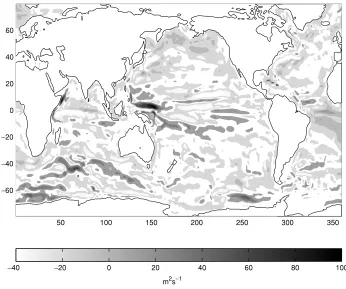
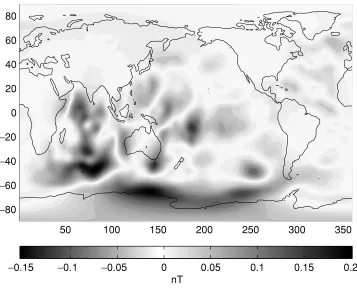
We estimated the mean flow velocities of Winter (January to March) and Summer (June to August) months for the year 2002 from ECCO output. The difference between
Summer and Winter flow velocity data (Fig. 6) shows strong variability along the equatorial region, possibly because the ocean flow responds vigorously to changes in the wind field at low latitudes. However changes of lesser extent can also be found over most of the other ocean areas.
50 100 150 200 250 300 350 −80
−60 −40 −20 0 20 40 60 80
−2 −1.5 −1 −0.5 0 0.5 1 1.5 2
Br
0 50 100 150 200 250 300 350
−80 −60 −40 −20 0 20 40 60 80
−2 −1.5 −1 −0.5 0 0.5 1 1.5 2
B r
a) b)
50 100 150 200 250 300 350
−80 −60 −40 −20 0 20 40 60 80
−10 −8 −6 −4 −2 0 2 4 6 8 10
B r
0 50 100 150 200 250 300 350
−80 −60 −40 −20 0 20 40 60 80
−10 −8 −6 −4 −2 0 2 4 6 8 10
Br
c) d)
Fig. 3. Comparison of simulations using OCCAM (left panels) and ECCO (right panels) results at sea level (bottom) and at 430 km above sea level (top) (in nT).
5000 m2s−1
125 130 135 140 145 150 155 25
30 35 40 45
−2 −1.5 −1 −0.5 0 0.5 1 1.5 2
B r
−10 −8 −6 −4 −2 0 2 4 6 8 10
5000 m2s−1
125 130 135 140 145 150 155 25
30 35 40 45
Br
a) b)
Fig. 4. Predicted radial component of ocean induced magnetic field (in nT) for the Kuroshio Current region. (a) AtSwarmaltitude (430 km) and (b) at sea level.
3.4 El Ni ˜no/Interannual variability
The global oceanic circulation also exhibits interannual to interdecadal variability. Most prominent being the
0 50 100 150 200 250 300 350 −80
−60 −40 −20 0 20 40 60 80
0 0.1 0.2 0.3 0.4 0.5
Fig. 5. The range of variability (in nT) of the simulations with ECCO 1 (1992–2002).
.
50 100 150 200 250 300 350
−60
−40
−20 0 20 40 60
−40 −20 0 20 40 60 80 100
m2s−1
Fig. 6. Difference between Summer and Winter (2002) ocean velocity data. Units in m2s−1.
changes around the world. In normal conditions, the trade winds blow towards the west and pile up warm water in the Western Pacific. During these conditions (called La Ni˜na), the sea level is 0.5 m higher at Indonesia than at Ecuador. During El Ni˜no, the trade winds relax allowing the warm equatorial current to flow towards the South
50 100 150 200 250 300 350
−80
−60
−40
−20 0 20 40 60 80
−0.15 −0.1 −0.05 0 0.05 0.1 0.15 0.2
nT
Fig. 7. Difference map (Br)between Summer and Winter predictions (in nT).
1 ms−1
180 200 220 240 260 280
−20 −15 −10 −5 0 5 10 15 20
1 ms−1
180 200 220 240 260 280
−20 −15 −10 −5 0 5 10 15 20
Fig. 8. Surface current (depth<60 m) velocity data from ECCO model November 1997 (El Ni˜no) (left panel) and November 1999 (La Ni˜na) (right panel). Units are in ms−1.
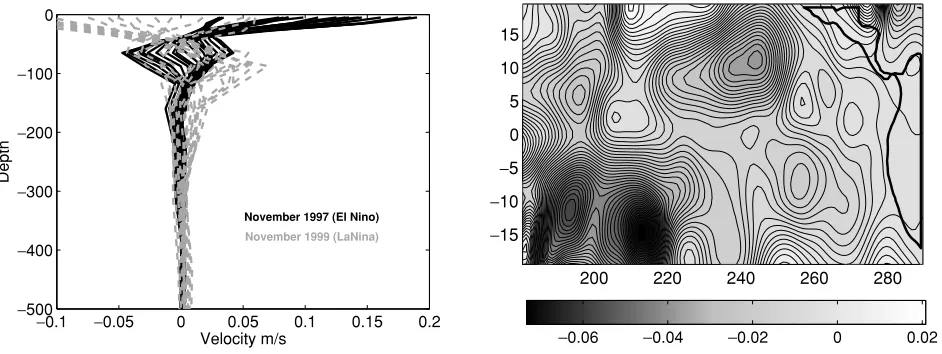
the surface velocity data from ECCO simulations as given in Fig. 8. The mean surface layer velocity vectors (depth down to 60 m) for the November 1997 (El Ni˜no) and the November 1999 (La Ni˜na) periods show a dramatic rever-sal in flow direction. The depth extent of these currents is given in a stacked velocity plot (left panel of Fig. 9) for a rectangular area of latitude 0◦–5◦and longitude 200◦–212◦. The influence of El Ni˜no on the velocity seems to exist only in the upper 250 meters of the ocean. The velocities are within a range of±0.2 m/s and have negligible magnitude for depth>250 m.
We averaged the circulation velocity data from June 1997
−0.1 −0.05 0 0.05 0.1 0.15 0.2
November 1997 (El Nino)
November 1999 (LaNina)
200 220 240 260 280
−15
Fig. 9. Left panel: Stacked velocity (zonal) depth profiles for La Ni˜na and El Ni˜no periods (depth in m). Right panel: The difference of predicted magnetic fields between El Ni˜no and La Ni˜na periods (in nT).
variation. The reasons for such small variation could be: 1) The El Ni˜no affects only a thin surface layer in the ocean, and the surface current reversal fails to produce apprecia-ble changes in the depth integrated velocity, and 2) the low strength of the radial component of the Earth’s magnetic field at low geomagnetic latitudes.
4.
Summary and Conclusion
We predicted the magnetic field generated by ocean cir-culation using a global EM induction code based on the vol-ume integral equation approach and considering a realistic 3D conductivity distribution for the Earth. The ocean circu-lation data were from two models viz. ECCO and OCCAM with 1◦×1◦resolution and 0.25◦×0.25◦ resolutions, re-spectively. Magnetic fields predicted by both models have an amplitude range of±2 nT at satellite altitude. These fields are predominantly influenced by the ACC and West-ern Boundary current. At satellite altitude the ocean model resolution does not have a strong influence on the pattern and amplitude of the magnetic signals. At sea level, how-ever, the ECCO simulations have considerably less strength than those using OCCAM. A reason could be the pres-ence of small scale circulation features such as ocean ed-dies in the OCCAM data. This is clearly visible along the Kuroshio current region where the OCCAM data produce an amplitude range of±10 nT. Nevertheless, effects of in-dividual eddies are not evident when the magnetic fields are upwardly continued toSwarmaltitude (430 km). Seasonal and interannual variations in the predicted magnetic fields were simulated by the data from the ECCO model. The difference between Summer and Winter data for the year 2002 has an amplitude range of ±0.2 nT at satellite alti-tude. An interesting region is the Indian Ocean. The vari-ations in the magnetic field related to the surface current reversal during the 1997–1998 El Ni˜no event produced con-siderably smaller amplitude than expected, probably due to its proximity to the geomagnetic equator. The small am-plitude in the temporal magnetic variability seen in these results is in general agreement with previous studies (using OPYC and ECCO ocean model data) by J. Oberhuber and R. Tyler which have been presented at international
confer-ences (Tyleret al., 1998; Tyler, 2002, 2003). Because these three different studies involved three rather different pa-rameterizations and numerical methods for calculating the magnetic fields from the flow there is now reasonable con-fidence that the small variability is not simply an artifact of either the numerical method or parameterizations.
Our simulations show a significant contribution of the ocean circulation generated magnetic signals at sea and satellite altitude. At sea level, the strong signals from the ocean eddies indicate the need of using higher resolution (0.25◦×0.25◦or less) ocean circulation data to model the effects expected in ground based magnetometer data. At satellite altitude, the similar strength and global pattern of the magnetic signals predicted from two independent ocean circulation models also strengthens the case for being able to identify non-tidal ocean magnetic signals in future satel-lite data. Presently, however, the separation of these signals from the crustal magnetic fields in the satellite data may be difficult. Mauset al.(2005) showed the importance of correcting satellite data for tidal magnetic signals in crustal field modelling. Considering the non trivial contribution of the magnetic field from the ocean circulation, we propose to correct future crustal field anomaly maps by subtracting the predicted signals of the steady ocean circulation. As
Swarmintends to bring out higher resolution crustal field anomaly map, this correction gains more importance. With the increasing precision in the modeling and measurement of geomagnetic fields, the identification of non-tidal ocean magnetic signals from satellite data and their use to gain in-formation about global ocean water transport and their vari-ations, stands as a realistic possibility.
Acknowledgments. ECCO and OCCAM ocean models were
used to derive the ocean transport. ECCO is a contribution of the Consortium for Estimating the Circulation and Climate of the Ocean (ECCO) funded by the National Oceanographic
Partner-ship Program, USA. The Swarm end-to-end simulation study
References
Chave, A., On the theory of electromagnetic induction in the earth by ocean currents,J. Geophys. Res.,88, 3531–3542, 1983.
Everett, M., S. Constable, and C. Constable, Effects of near-surface con-ductance on global satellite induction responses,Geophys. J. Int.,153, 277–286, 2003.
Faraday, M., Experimental researches in electricity (Bakerian lecture),
Philos. Trans. R. Soc. London,122, 163–177, 1832.
Flosad´ottir, A. H., J. C. Larsen, and J. T. Smith, Motional induction in North Atlantic circulation models,J. Geophys. Res.,102, 10,353– 10,372, 1997a.
Flosad´ottir, A. H., J. C. Larsen, and J. T. Smith, The relation of seafloor voltages to ocean transports in North Atlantic circulation models: Model results and practical considerations for transport monitoring,J. Physical Oceanography,27, 1547–1565, 1997b.
Fofonoff, N. P., Physical properties of seawater: A new salinity scale and equation of state for seawater,J. Geophys. Res.,90, 3322–3342, 1985. Junge, A., The telluric field in northern Germany induced by tidal motion
in North Sea,Geophys. J. Int.,95, 523–533, 1988.
Kuvshinov, N. and N. Olsen, 3-D modelling of the magnetic fields due to ocean tidal flow, inEarth Observation with CHAMP. Results from Three Years in Orbit, edited by C. Reigber, H. L¨uhr, P. Schwintzer, and J. Wickert, pp. 359–366, Springer Verlag, 2005.
Kuvshinov, A. V., D. B. Avdeev, O. V. Pankratov, S. A. Golyshev, and N. Olsen, Modelling electromagnetic fields in 3D spherical Earth using fast integral equation approach, in3D Electromagnetics, edited by M. S. Zhdanov, and P. E. Wannamaker, chap. 3, pp. 43–54, Elsevier, Holland, 2002.
Kuvshinov, A. V., H. Utada, D. Avdeev, and T. Koyama, 3-D modelling and analysis of Dst C-responses in the North Pacific Ocean region, revisited,
Geophys. J. Int.,160, 505–526, 2005.
Larsen, J. C., Electric and magnetic fields induced by deep see tides,
Geophys. J. R. Astr. Soc.,16, 47–70, 1968.
Larsen, J. C. and T. Sanford, Florida Current volume transport from volt-age measurements,Science,227, 302–304, 1985.
Laske, G. and G. Masters, A global digital map of sediment thickness,EOS Trans. AGU,78, F483, 1997.
Lilley, F., A. White, G. Heinson, and K. Procko, Seeking a seafloor mag-netic signal from the Antarctic Circumpolar Current,Geophys. J. Int., 157, 175–186, 2004a.
Lilley, F., A. Hitchman, P. R. Milligan, and T. Pedersen, Sea-surface obser-vations of the magnetic signals of ocean swells,Geophys. J. Int.,159, 565–572, 2004b.
Marshall, J., A. Adcroft, C. Hill, Perelman, and C. Heisey, A finite-volume, incompressible Navier-Stokes model for studies of the ocean on parallel computers,J. Geophys. Res.,102, 5753–5766, 1997.
Maus, S. and A. Kuvshinov, Ocean tidal signals in observatory and satellite magnetic measurements, Geophyc. Res. Lett, 31,
doi:10.1029/2004GC000, 634, 2004.
Maus, S., M. Rother, K. Hemant, H. L¨uhr, A. Kuvshinov, and N. Olsen, Earth’s crustal magnetic field determined to spherical harmonic degree 90 from CHAMP satellite measurements,Geophys. J. Int.,164, 319– 330, doi:10.1111/j.1365-246X.2005.02833.x, 2006.
Palshin, N., L. Vanyan, I. Yegorov, and K. Lebedev, Electric field induced by the glodal ocean circulation,Physics Solid Earth,35, 1028–1035, 1999.
Pankratov, O., A. Kuvshinov, and D. Avdeev, High-performance three-dimensional electromagnetic modeling using modified Neumann series. Anisotropic case,J. Geomag. Geoelectr.,49, 1541–1547, 1997. Sanford, T. B., Motionally induced electric and magnetic fields in the sea,
J. Geophys. Res.,76, 3476–3492, 1971.
Schmucker, U., Electrical properties of the Earth’s interior, in Landolt-B¨ornstein, New-Series, 5/2b, pp. 370–397, Springer-Verlag, Berlin-Heidelberg, 1985.
Singer, B., Method for solution of Maxwell’s equations in non-uniform media,Geophys. J. Int.,120, 590–598, 1995.
Stephenson, D. and K. Bryan, Large-scale electric and magnetic fields generated by the oceans,J. Geophys. Res.,97, 15,467–15,480, 1992. Tyler, R. H., Theoretical and Numerical Results on the Magnetic Fields
Generated by Ocean Flow,EGS annual conference, 2002.
Tyler, R. H., Exploring and exploiting the magnetic fields generated by ocean flow,Geophysical Research Abstracts,5, 2003.
Tyler, R., L. A. Mysak, and J. Oberhuber, Electromagnetic fields generated by a 3-D global ocean circulation,J. Geophys. Res.,102, 5531–5551, 1997.
Tyler, R. H., T. B. Sanford, and J. M. Oberhuber, Magnetic Fields Gener-ated by Ocean Flow,AGU Fall Conference, 1998.
Tyler, R., J. Oberhuber, and T. Sanford, The potential for using ocean gen-erated electromagnetic field to remotely sense ocean variability,Phys. Chem. Earth (A),24, 429–432, 1999.
Tyler, R., S. Maus, and H. L¨uhr, Satellite observations of magnetic fields due to ocean tidal flow,Science,299, 239–240, 2003.
Vivier, F., E. Maier-Reimer, and R. H. Tyler, Simulations of magnetic fields generated by the Antarctic Circumpolar Current at satellite altitude: Can geomagnetic measurements be used to monitor the flow?,Geophys. Res. Lett.,31, doi:10.1029/2004GL019, 804, 2004.
Webb, D. J., B. A. de Cuevas, and A. C. Coward, The first main run of the OCCAM global ocean model,Internal Document 34, Southampton Oceanography Centre, U.K., 1998.
Zhang, S.-L., GPCG: generalized product-type methods based on Bi-CG for solving nonsymmetric linear systems,SIAM J. Sci. Comput.,18, 537–551, 1997.