
Research Article
A High-Accuracy Nonintrusive Networking Testbed for
Wireless Sensor Networks
Wei Huangfu,
1Limin Sun,
1and Jiangchuan Liu
21Institute of Software, Chinese Academy of Sciences, Beijing 100190, China
2School of Computing Science, Simon Fraser University, Burnaby (Metro-Vancouver), Canada BC V5A 1S6
Correspondence should be addressed to Wei Huangfu,[email protected]
Received 15 February 2010; Accepted 7 June 2010
Academic Editor: Dan Wang
Copyright © 2010 Wei Huangfu et al. This is an open access article distributed under the Creative Commons Attribution License, which permits unrestricted use, distribution, and reproduction in any medium, provided the original work is properly cited.
It becomes increasingly important to obtain the accurate and spontaneous runtime network behavior for further studies on wireless sensor networks. However, the existing testbeds cannot appropriately match such requirements. A High-accuracy Nonintrusive Networking Testbed (HINT) is proposed. In HINT, the interconnected chip-level signals are passively captured with auxiliary test boards and the captured data are transferred in additional networks to test server. The test server of HINT collects all the test data and depicts the full network behavior. HINT supports networking test, protocol verification, performance evaluation and so on. The experiments show that HINT transparently gathers accurate runtime data and does not disturb the spontaneous behavior of sensor networks. HINT is also extendible to different hardware platforms of sensor nodes. Consequently, HINT is an upstanding testbed solution for the future fine-grained and experimental studies on the resource-constrained wireless sensor networks.
1. Introduction
A wireless sensor network (WSN) is usually composed of numerous micro low-power autonomous sensor nodes which collaboratively sense, process, and transmit specific interesting data in the monitoring area. In recent years, wireless sensor networks have attracted widespread attention in the international academic.
The network testing is important for the research and development of sensor networks. The foundation of the net-work testing is to perceive the netnet-work behavior. The runtime data which represent the network behavior are essential to verify network protocols, evaluate network performance, and so forth. The more accuracy and more spontaneous the runtime data are, more exactly and more deeply we under-stand wireless sensor networks. However, the network testing is challenge for wireless sensor networks. Wireless sensor networks are distributed resource-constrained embedded systems. It is difficult to generate and transfer runtime test data in such networks due to the constrained resource, the dynamics of wireless communications, the frequent failures
of sensor nodes and the variety of the applications for wireless sensor networks.
Expansion
Figure1: Gathering test data with instruments.
because of resource constraints of nodes themselves, such as computing capacity of the microcontrollers and the precision of the crystal oscillator of the sensor nodes. In summary, none of the existing test platforms provide users accurate information on the runtime data to represent the spontaneous network behavior of wireless sensor networks. The key issue here is how to observe the network status accurately in a nonintrusive manner, that is, with no side effects upon the network behavior itself.
A novel testbed HINT (High-Accuracy nonIntrusive Networking Testbed) is proposed. The test data are generated by auxiliary devices and transferred over additional networks in HINT. The major idea is to passively and accurately probe the internal chip-level signals inside sensor nodes in order to access the runtime network data in a nonintrusive and precise manner. The auxiliary devices run like many smart spies. They each probe the internal interconnected signals inside a sensor node with extra tributary wires, and then transfers the accuracy test data to the testbed server over additional networks. The testbed server of HINT collect, parse and understand all the test information, and then reconstruct the sensor network behavior.
In the rest of the paper, we first review relevant work on the existing test platforms and the architecture of typical sensor nodes. Next we present the major ideas and challenges of the design of HINT. In the next section we introduce the implementation of HINT aiming at the characteristics of typical hardware platforms for present sensor nodes. Then we show the experiment studies for HINT. Finally, we conclude with a discussion about HINT and with future work.
2. Related Works
Apparently, the awareness of the network behavior is impor-tant for the studies on wireless sensor networks. There are mainly two kinds of methods, that is, simulation and experiment, to gather the runtime data of wireless sensor networks.
NS2 [1], Glomosim [2], and OMNet++ [3] are general simulation tools, while TOSSIM [4], EMStar [5], ATEMU [6], SensorSim [7], SENS [8] are specific simulation soft-wares for wireless sensor networks. With simulation tools, researchers are able to gather the internal status of sensor nodes and access complete runtime data of the network. However, the simulation is usually based on simplified models under ideal assumptions, whereas the actual cir-cumstance for wireless sensor networks is complex and the
wireless communications are highly unpredictable dynamic. Therefore the simulation results are not credible to some extent.
Test instruments and test platforms are usually intro-duced to gather runtime data in the actual applications of wireless sensor networks, especially during the research and development stages.
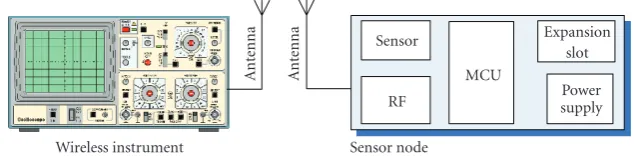
The experimental test method to use additional test instruments (or sniffer nodes) is shown in Figure 1. The wireless instruments will probe the network packets on the air without any influence on the sensor network itself. However, the wireless instruments have none of knowledge about the internal status of autonomous sensor nodes. Users cannot judge whether the sensor node received the packets which is observed by the instruments and vice versa.
The experimental methods for the existing test platforms can be divided into two categories according to the mecha-nisms of gathering data.
The former category is to obtain test data by micro-controller of sensor nodes and transfer test data over the wireless links of the wireless sensor network itself (see
Figure 2). The microcontroller unit (MCU) sends test data to radio frequency (RF) transceiver and afterwards these data are transferred in the wireless sensor network hop-by-hop towards the test server which gathers all test information to process further analysis. MoteWorks [9], designed by Crossbow Technology, belongs to this category. MoteWorks supports a series of sensor nodes made by Crossbow Technology, such as MICA and MICAZ. MoteWorks can monitor network topology, link quality, and residual energy. Without any auxiliary devices, MoteWorks is a low-cost testbed solution. However, the computing resource of the sensor node and the bandwidth of the wireless sensor network must be consumed for the purpose of collecting test data. In other words, it will interfere with spontaneous network behavior. Such interference will be quite serious because the resource of wireless sensor network is very limited. Also all test platforms of this category depend on the successful transmission for runtime data over the links of the wireless sensor network, and they do not apply to the low-layer communication debugging of wireless sensor networks, such as problems in the routing protocol.
The latter category is to obtain test data by micro-controller of sensor nodes but to transfer test data over additional networks, either wired or wireless (see
Test server
Test d ata
Expansion slot Sensor
RF
MCU
Power supply
Sensor node
A
n
te
nna
Wireless sensor network
Figure2: Gathering test data via wireless sensor network itself.
Expansion slot Sensor
RF
MCU
Power supply
Sensor node
A
nt
enna
Wireless sensor network Auxiliary network
Auxiliary
device Test server Test da
ta
Figure3: Gathering test data via extra network.
device forwards the data to the test server over additional networks. Kansei [10], MoteLab [11], Trio [12] and TWIST [13] all belong to this category. For example, Kansei takes XSM (with a 7.3 MHz 8 Bit CPU) as sensor nodes, StarGate (with 400 MHz PXA255 CPU) as auxiliary devices, and Ethernet and wireless local area network (WLAN) as the additional networks. The test platforms of this category do not disturb the wireless communications of the wireless sensor network at all because the test data are transferred over additional networks. However, the microcontrollers in the sensor nodes need to send test data out to the expansion slot. Hence they still interfere with the spontaneous behavior of wireless sensor network. Moreover, the test data collected from the sensor nodes are not so precise because of resource constraints of nodes themselves, such as computing capacity of the microcontroller and the precision of the crystal oscillator on the sensor nodes.
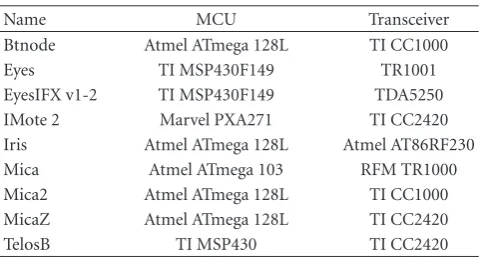
Sensor nodes are the basic cells of the wireless sensor networks. Therefore it is fundamental to learn the architec-ture of sensor nodes. At present there exist a large number of kinds of sensor nodes developed by universities, research institutes and companies. Some typical sensor nodes are listed inTable 1.
Table1: List of typical sensor nodes.
Name MCU Transceiver
Btnode Atmel ATmega 128L TI CC1000
Eyes TI MSP430F149 TR1001
EyesIFX v1-2 TI MSP430F149 TDA5250
IMote 2 Marvel PXA271 TI CC2420
Iris Atmel ATmega 128L Atmel AT86RF230
Mica Atmel ATmega 103 RFM TR1000
Mica2 Atmel ATmega 128L TI CC1000
MicaZ Atmel ATmega 128L TI CC2420
TelosB TI MSP430 TI CC2420
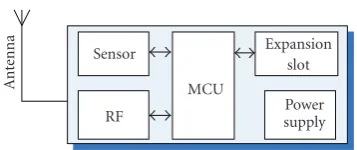
The typical architecture of all the sensor nodes listed in
Expansion
Figure4: Typical architecture of sensor node.
TelosB is a kind of popular sensor nodes. It mainly consists of MSP430 as MCU, CC2420 as RF transceiver and sensors. There are 4 Serial Peripheral Interface (SPI) wires and 6 GPIO wires between MSP430 and CC2420. The SPI bus consists of Chip Select (CS), Serial Clock (SCK), Master In Slave Out (MISO) and Master Out Slave In (MOSI). To perform any packet sending or receiving operations, the microcontroller and RF transceiver will exchange command and data via the wires. The interactive protocols and timing requirements are present in CC2420 manual in detail. As a result, we should know full information on the packet sending or receiving if we capture and understand all signals between the microcontroller and the RF transceiver. Similarly, we should know full information on the sensor sampling if we capture and understand all signals between the microcontroller and the sensors.
In summary, the typical architecture of sensor nodes at present helps us to obtain the internal status of sensor nodes. We design and implement HINT just aiming at the characteristics of typical hardware platforms for present sensor nodes.
3. Design of Hint
We proposed a novel testbed HINT. The core idea of HINT consists of three part. First, auxiliary devices passively probe the internal chip-level signals to obtain the test data in a nonintrusive manner, which does not consume any computing and storage resource of the sensor node. Second, the test data, which represent the runtime behavior inside sensor nodes, are transferred over additional networks so that they do not consume any wireless bandwidth of the sensor networks. Finally, All the test data are collected by the testbed server and then the network behavior are reconstructed to execute a full network-scale testing. The mechanisms of HINT are shown inFigure 5.
The system architecture of HINT is shown inFigure 6. HINT consists of a testbed server and a number of test units. The testbed server and all test units are connected with additional network, usually with Ethernet.
Each test unit consists of a sensor node and a test board. All sensor nodes form a wireless sensor network while all test board form another wired or wireless network for the purpose of transferring test data. Each test board is linked to the corresponding sensor node in order to probe the internal chip-level signals inside the sensor node. The testbed server is used to collect test data from all test boards and perform future analysis.
The core idea of HINT is quite simple. However there are still a number of technical challenges in the design of HINT. First, Which signals should be captured to represent the node status by the test boards in HINT? Secondly, How should such data be collected and transferred to the test server? Thirdly, how does the test server parse the test data to reconstruct the network behavior? The solutions are introduced in what follows.
3.1. Capturing Chip-Level Signals. It is essential to decide which signals inside the sensor nodes should be captured.
The useful signals inside the sensor node are divided into 5 groups. The first group is the wires between the RF transceiver and the MCU inside sensor nodes, which provide information on the radio packet. The second group is those from the MCU to the sensor, which provide information on the sensing operation. The third group is the Joint Test Action Group (JTAG) pins of the MCU, which provide functions to reprogram and debug. The forth group is external communication pins of the MCU, such as RS-232, which provide information about external data sent by MCU. The last group is the power supply lines for the sensor node, which help us to turn on or offthe sensor node and measure its power consumption. The test board is linked to the corresponding sensor node via one or more groups of wires carefully chosen. Among all the five groups, the first group, that is, the signal group between the RF transceiver and the MCU inside sensor nodes, is most important for the networking test.
The test unit is the basic cell in HINT for capturing test information. The diagram of the test unit is shown in
Figure 7.
The Test board is composed of a signal acquisition and remote control (SARC) module, a CPU and an Ethernet controller. SARC is the core component of the test board and it connects all the wires from the sensor node. The main functions of SARC include signal acquisition, power supply and remote control for the sensor node. In the test board, the SARC connects to the CPU for test data exchange. The CPU can communicate with the testbed server via Ethernet. Hence all test data captured by the SARC can be transferred to the remote server.
SARC mainly passively probes these wires, which have no side effects on the spontaneous operation of the sensor nodes. In addition, SARC can also actively control some of the wires, such as the JTAG of the MCU, to provide features of remote control and debugging.
3.2. Transferring and Collecting Test Data. The captured data of raw signals are too huge to be transferred. In HINT, such raw captured data are encoded and compacted inside the SARC module of the test board. The compacted test data are then transferred to the testbed server.
The raw signals are mainly divided into two classes, that is, analog or digital. Different encoding methods are adopted for different signals.
Wireless sensor network
Expansion slot Sensor
RF
MCU
Power supply Sensor node
A
n
te
nna Passive probing the internal
interconnect signals inside the sensor node
Auxiliary device
Test server
Test data
Auxiliary network
Figure5: The mechanisms of HINT.
Wireless sensor network
Sensor node
Test board Test unit
Wired or wireless network
Testbed server
Figure6: System architecture of HINT.
In order to decrease the amount of data, not all the sampled values will be transferred. Only the value which is beyond the threshold of last transferred value will be transferred with the corresponding timestamp (as shown inFigure 8), which will effectively decrease the amount of test data to be transferred. The digital signals are also divided into two categories, with or without corresponding clock. For the digital signal with corresponding clock, it will be captured at the edge of the clock. For the digital signal without corresponding clock, it will be captured at the edge of internal clock driven by the SARC. Only changed values and their timestamp will be transferred for both categories.
The SARC also understands some digital communication protocols, such as SPI and CAN. Such communication data will be transferred instead raw digital signals.
With all these methods of signal acquisition, the data amount encoded from raw signals should be greatly reduced.
Ethernet controler Sensor
RF
MCU
JTAG supplyPower
Signal acquisition and remote control module
Bar
re
ry
CPU
Test board To testbed
serve
A
nt
enna Inte
rf
ac
e
slot
−
+
− + Sensor node
Figure7: Block diagram of HINT test unit.
Value out of threshold is transferred, and new threshold updated
Values inside threshold are ignored Analog
signal
Sampling time
Threshold
Figure8: Analog signals acquisition.
Raw signal
reconstruction
Network event
playback
Data storage
Classifier
Time
synchronization
pre-process
Network interface
Ethernet
Packet info.
Sensor info.
Energy info.
Other info.
Control command
Publish/
subscribe
matrix
Performance
evaluation
Remote debug
and control
Application 1
Application 2
Application 3
Application 4
Figure9: Block diagram of HINT test server.
3.3. Reconstruction and Analysis of Network Behavior. In HINT, all test data gathered by the test board are trans-ferred to the test server. Different chips usually pro-vide different electrical operation manners. Therefore the Finite State Machine (FSM) algorithm is used to parse the raw test data according to the chip-level electrical interface.
The clock synchronization among test units is the foun-dation of the protocol analyzing and delay measurements. In the test server, all the data received from network are firstly processed to adjust the timestamp of different test units to a unique standard timestamp corresponding to the internal time of test server. In order to obtain high accuracy of timestamp on the captured signals, three related methods are adopted. Firstly, there is a high-stability temperature-compensated crystal oscillator on each test board to provide the high-accurate clock. Secondly, each test board exchanges time synchronization messages with the test server over the additional network in order to prevent the system from synchronization drift. The time synchronization algorithms for wired network are quite mature. However, the round trip delays for the typical TCP/IP wired network are about tens of milliseconds. It is not easy to archive accurate clock synchronization to match the requirement of timing analysis in the sensor networks only with the clock synchronization between the test server and test units. If a sensor node sends a radio message in the wireless sensor network, the RF modules in all the neighbor sensor nodes will receive and decode the radio frame simultaneously. Since the HINT platform captures all these radio frame sending and receiving operations at every test unit, such accurate timing relations are helpful for the clock synchronization in the HINT platform. Therefore finally the test server collect all the sending and receiving operations among sensor nodes and adjust the clock synchronization to provide the high accuracy of the timestamps.
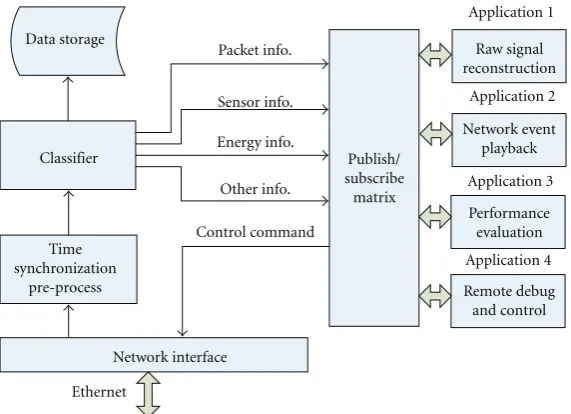
The test server is usually a desktop computer server or a laptop. The software diagram of test server is shown in
Figure 9. All synchronized data are classified to separated categories, and saved to trace files at the same time.
There are a number of applications to analyze the network behavior for different testing purposes, such as raw signal reconstruction and visualization, protocol verification, network performance evaluation and remote debugging. These applications access test data via a Publish-Subscribe Matrix to decouple related software components.
4. Implementation
HINT is quite a complex system with mixed software and hardware. The detailed implementation is introduced as follows.
4.1. Sensor Node. The chip-level signals to be captured depend on the chips inside the sensor nodes. For instance, inside the sensor nodes like TelosB, IMote-2 and MicaZ, the RF transceiver chip CC2420 is used and hence the signals to be captured between the RF transceiver and the MCU for sensor nodes are CS, SCK, MOSI, MISO, SFD, INT, FIFOP and CCA. But inside the sensor nodes like Mica2 and Btnode, the RF transceiver chip CC1000 is used and hence the signals to be captured are DIO, DCLK, PCLK, PDATA and PALE. All these signals are explained in the CC2420 and CC1100 datasheets in detail.
(a)
CC2420 RF transceiver
Sensor
MSP430 MCU
LED
30-pin
slo
t
20-pin
slo
t
(b)
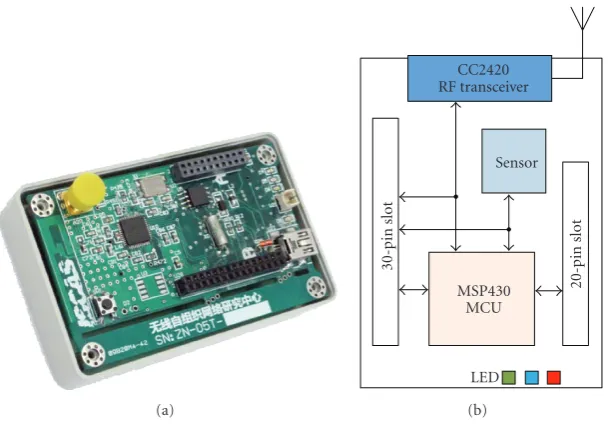
Figure10: ZiNT sensor node.
Table2: List of Signals to capture in ZiNT.
Group Signals
RF transceiver CS, SCK, MOSI, MISO, SFD, INT, FIFOP, CCA
Sensors ADC0-ADC7
External communication UART1TX, UART1RX
JTAG RESET, TDI, TDO, TMS, TCK
Power supply VCC
signals are connected to the test boards, no matter by clamps, soldering or expansion slot. the testbed HINT could obtain information enough to analysis the status of the sensor nodes and to perform the network testing.
In order to efficiently deploy the HINT testbed, we also exploited a kind of sensor node named as ZigBee Node with Testing expansion slot (ZiNT). ZiNT node is almost identical to TelosB produced by Crossbow Technology. The microcontroller and the RF transceiver of ZiNT are also TI MSP430 and CC2420, respectively. The main difference between ZiNT and TelosB is that there are more pins in the expansion slot on ZiNT for monitoring the suitable electrical signals inside the sensor nodes to support the HINT testbed directly. The actual picture and block diagram of ZiNT are shown inFigure 10.
All the signals which should be captured are connected to the expansion slot via tributary links. These signals are listed
Table 2.
4.2. Test Board. The test board is the kernel component of HINT. The test board mainly consists of two parts. One part is for data processing and transferring including CPU and Ethernet controller, whereas the other for data acquisition and remote control, that is, SARC module.
We choose Atmel AT91SAM7X256 as CPU, which is a 55 MHz high-performance processor with 32-bit RISC architecture, 256 k Flash, 64 K SRAM, 10/100 M integrated Ethernet MAC controller. An Ethernet PHY transceiver DM9161A is relevantly introduced to implement network communications. Ethernet also offers power supply to test board by means of POE. Furthermore for the purpose of flexibility, the test board supports 3 kinds of power supply in fact, that is, 5V DC, USB and Power over Ethernet (POE) [14].
We adopted an embedded OS called FreeRTOS running on the Atmel AT91SAM7X CPU. FreeRTOS is an open-source real-time operating system. A light weight TCP/IP protocol stack library named as LwIP [15] has already been ported to FreeRTOS. Thus we developed some embedded software to transfer data with TCP/IP on the basis of FreeRTOS and LwIP.
We adopted a high-performance Field-programmable gate array (FPGA) Altera Cyclone II EP2C8 [16] in order to capture signals effectively. FPGA contains a number of programmable logic cells which can be configured by the customer to implement any logical function. Altera EP2C8 contains 8256 logic cells and 182 IO pins. The logical function is written in the hardware description language (Verilog).
SRAM 64 MB (for display and alarm)LED and buzzer
SARC Altera EP2C8
FPGA
CPU AT91SAM7X256
Ethernet PHY: DM9161A
Serial port A Serial port B
Power supply
POE Ethernet
Expansion
slot
Figure11: Block diagram of test board.
Figure12: Actual picture of test board.
FPGA and CPU are connected via SPI interface. CPU is the master device to poll data from FPGA. FPGA will caches data in its internal storage or external SRAM while CPU is busy. It will greatly reduce the requirement for CPU response time. With the combination of FPGA and CPU, the test board offers us flexibility and extendibility both in hardware and software.
The block diagram and actual picture and of the test board are shown in Figures11and12, respectively.
4.3. Adapter Board and Test Unit. One of the purposes of HINT is to support as many kinds of sensor nodes as possible. FPGA in the test board offers us flexibility for electric circuits. The adapter board will offer us flexibility for mechanical junction.
The adapter board is aimed at the expansion slot of the specific sensor node and provides two slots, of which one slot is modified to fit the corresponding sensor node and the other is fixed for the test board. With the adapter board, we cannot only easily join the sensor node and test board together to form a test unit, (seeFigure 13) but also support a variety of sensor nodes via its corresponding adapter with just one kind of standard test board.
4.4. Test Server. Test server is usually a computer to run test applications in order to collect and process data received
Test unit
Adapter board
ZiNT Test board
Adapter board
Test board
ZiNT
Figure13: Mechanical structure of test unit.
from sensor nodes. All the applications are written in C++ and Python languages. Python is a flexible script language whereas C++ is an effective compiler language. The combination of Python and C++ are not only adaptable to various test requirements but also offer powerful data processing efficiency.
To comprehend the operations, that is, the radio packet sending or receiving, inside the sensor nodes, the test server unpack the test data to the raw signals and then parse the raw signals with the finite state machine algorithm. For instance, the algorithm corresponding to the CC2420 electrical interface is used for parsing the raw signals from the sensor nodes such as ZiNT, telosB and micaZ.
Once the operations in each sensor node are com-prehended, the full network-scale behavior of the sensor network can be reconstructed. We have already developed a series of applications for some typical test requirements. The core application is for network data gathering and information classification. Other applications are listed as following. “Interconnect Signal Analyzer” is to reconstruct raw internal signals and visualize them. “Network History Player” is to replay the network behavior according to the stored data. “Network Performance Measurer” is to evaluate network performance such as traffic, delay and packet loss rate. Some screenshots of these applications are shown in Figure 14. WxWidgets is chosen for the Graphics User Interface (GUI) library, because it is a cross-platform library to support both MS Windows and Linux operating system.
5. Experiments
Figure14: Screenshots of test server applications.
Testbed server
Test units
Ethernet switch with POE support
Ethernet cables
Figure15: An experiment scenario of HINT.
and several fast Ethernet switches with POE (NETGEAR FS108P). Moreover, an oscilloscope (RIGOL DS5022ME) and a logic analyzer (LA1016) are adopted for the purpose of comparison. A simplified scenario of the experiments is shown in Figure 15. These experiments are introduced as below in detail.
The experiments will show that, with the help of HINT, users can gather information of remote sensor nodes, obtain network packets with precise timestamps, evaluate network performance parameters and so on.
There are three levels for HINT to observe sensor networks (seeFigure 16). The fundamental level is to acquire the raw internal signals inside sensor nodes. The digital signals between the microcontroller and the RF transceiver inside sensor nodes are critical to obtain the radio packet information. The packet level can be achieved by parsing the raw signals. Furthermore, the network behavior could be reconstructed with all the packet information and then the
5.1. Raw Signal Level. It is fundamental for HINT to acquire the internal signals accurately inside a sensor node. Hence two experiments are carried out to verify the analog and digital signals acquisition by comparing with the outputs of oscilloscope and logic analyzer.
5.1.1. Digital Signals. The digital signals between the micro-controller and the RF transceiver consist of Start of Frame Delimiter (SFD), interrupt (INT), SPI bus and so on, which are critical for HINT to obtain the network packet information. Thus the correct acquisition of these signals will be proved in this experiment.
All the sensor nodes send packets periodically. We use HINT to acquire these internal digital signals of sensor nodes and demonstrate the result in the graphics user interface. At the meantime, these signals are observed by a logic analyzer LA1016 (see Figure 17). Both HINT and the logic analyzer support SPI protocol parsing. Comparing the output of HINT with those of the logic analyzer, we conclude that HINT can correctly gather the internal digital logic signals (including SPI communication protocol) inside sensor nodes.
5.1.2. Analog Signals. The energy consumption is a key parameter for wireless sensor networks. In HINT, the energy consumption parameter is deduced from the measurement of the electric current at power supply wire of the sensor node. The electric current is a typical analog signal. The correct acquisition of this signal will be proved in this experiment.
All the sensor nodes change their status periodically. The sensor nodes firstly stay at idle state with radio transceiver and all LEDs turned offand therefore the power consumption is very low. After 100 ms, the sensor nodes turn on radio transceiver and the power consumption increases. Then after another 100 ms, the sensor nodes turn on all LEDs and the power consumption increases more. Finally the sensor nodes enter the first idle state after 100 ms. Therefore the supply current will also change periodically.
We use HINT to acquire power supply analog signal of a sensor node and demonstrate them in the graphics user interface. At the meantime, the signal is observed by an oscilloscope, of which the probe connects to output of the current-sense amplifier MAX4173. The output waveforms are both shown inFigure 18.
Comparing the output of HINT with those of the oscilloscope, we conclude that HINT can correctly capture the current consumption of the node. Such conclusion also applies to other analog signals on the sensor nodes.
Packet
Packet sending waveform Packet receiving waveform
High-precision delay LQI and RSSI
Otherparameters:
Energy consumption
Packet loss ratio
Network topologies
Figure16: Feature levels of HINT.
supply currentI. HerePdenotes the power consumption of the sensor node.
5.2.1. RF Chip Configuration Parsing. The RF transceiver chip of ZiNT node is CC2420 manufactured by Texas Instruments (TI). When the sensor node is turned on, the microcontroller will initialize the RF transceiver via signals including VREG EN and SPI. CC2420 includes a low drop-out voltage regulator. The voltage regulator is enabled using the active high-voltage regulator enable pin VREG EN. Next microcontroller will initialize the registers of CC2420 via SPI wires in order to set frequency, Output Power Amplifier (PA) level, frame types, MAC address, work modes, and so forth.
By passively monitoring these signals, HINT is able to hear and understand what the microcontroller talks to the
RF transceiver CC2420. Technically, this progress is known as data parsing.
An initialization byte sequence send by the micro-controller via SPI bus captured by HINT is some-thing like “1D-00-18-01-1C-02-7F-18-41-AB-11-2A-E2-17-2A-56-1D-00-00-E8-80-22-00-05-00” in hexadecimal for-mat. For example, the byte slice “18-41-AB” will store value 0x41AB to register 0x18 (Frequency Synthesizer Control and Status Register), which means to set the radio frequency to 2048 + 0x01AB=2475 MHz. Again, the subsequence “E8-80-22-00-05-00” sets PAN ID to 0x0022 and node address to 0x0005. These analytical results totally correspond the setting in the TinyOS modules running on sensor nodes.
5.2.2. Packet Parsing. The datasheet of CC2420 describes the technological processes to send and receive wireless packets in detail. The core technology is the finite state machine (FSM) in CC2420.
(a) Signals capturde by Logic Analyzer LA1016
(b) Signals captured by HINT
Figure17: Comparison of logic signal acquisition.
Stage 1:
Microcontroller ON RF transceiver LEDs
OFF OFF
Stage 2:
Microcontroller ON RF transceiver LEDs
ON OFF
Stage 3:
Microcontroller ON RF transceiver LEDs
ON ON
(a) Signal captured by an oscilloscope
(b) Signal captured by HINT
Figure18: Comparison of analog signal acquisition.
TXFIFO (128 bytes transmit FIFO) via SPI, and disables CS. Then the microcontroller enables CS again, sends STXON or STXONCCA command via SPI, and disables CS. Finally, once the packet is sent on air, the SFD pin goes active when the start of frame delimiter (SFD) field has been transmitted. The sending progress is demonstrated with a partial screenshot of HINT software inFigure 19.
Accordingly, the following steps are necessary to receive a packet. First, CC2420 receives a packet on air and stores it in RXFIFO (128 bytes receive FIFO). The SFD pin goes active after the frame delimiter has been completely received. Then CC2420 informs the microcontroller by an interrupt signal on the INT (GPIO0) pin. Finally, the microcontroller enables
SFD GPIO0
MOSI
MISO
AD
0×5
0×46
Figure19: Process of packet sending.
CS
SFD GPIO0
MOSI
MISO
AD
1
1
0 1
0
0
Figure20: Process of packet receiving.
CS, reads the packet from RXFIFO via SPI, and disables CS.(seeFigure 20)
HINT is able to parse what the microcontroller talks with the RF transceiver CC2420. Thus for all packets either sent or received, HINT can obtain the corresponding complete information including packet contents and precise timestamps. We carried out a simple packet send-receive experiment on the test environment and use HINT to capture the packets. A typical byte sequence which MCU write to TXFIFO to send packet captured by HINT is something like “10-41-88-01-22-00-05-00-03-00-06-00-03-00-02” in hexadecimal format, which means 16 (0x10, the 1st byte) bytes in total length, source address 5 (0x0005, the 7-8th bytes), destination address 5 (0x0003, the 9-10th bytes), 6 (0x06, the 11th byte) bytes for payload (4 bytes data “00-03-00-02” and 2 extra CRC bytes).
The typical byte sequences which MCU read from RXFIFO to receive packet captured by HINT are similar to those of TXFIFO, except that there are 2 extra bytes at the end of each received packets, that is, Link Quality Indication (LQI) and Receive Signal Strength Indicator (RSSI).
Comparing the output of HINT with the application predesigned running on the sensor nodes, we conclude that HINT can correctly parse for network packets. Similarly, the conclusion above also applies to other sensor node status capture by monitoring inter-connect signals among the microcontroller and sensors, serial port, and expansion slot.
Figure21: Animation of the network behavior history.
5.3. Network Behavior Level. Since all test data are gathered in the testbed server, HINT can effectively reconstruct the network behavior and evaluate performance parameters of wireless sensor networks with centralized analysis.
All test data from different test units are firstly synchro-nized with the time synchronization algorithm. Then the packet information for different nodes are corresponding to the same time basis. The information of any nodes send or receive any packets at anytime are easily deduced. HINT can then depict the full spatiotemporal network actions in an animation-like manner, as shown inFigure 21.
The precision of the time synchronization in HINT is less than 10 us. The interval of a packet on the air for wireless sensor networks is about hundreds of microseconds. For example, a 20-byte packet consumes 640 us on the 250 kbps ZigBee radio channel. Therefore HINT knows whether two or more packets collides on the air. InFigure 21it is shown that two nodes are sending packets to the same destination almost simultaneously. Such feature is very helpful for the research on the MAC protocols of wireless sensor networks.
With the reconstructed network behavior information, the network performance parameters also can be deduced. Several typical parameters, link quality, the single hop delay and throughput, the network topology and the route delay will be introduced as examples.
5.3.1. Link Qualities. With HINT, we can also analyze the link quality between two sensor nodes on the basis of LQI and RSSI field at the end of CC2420 received packets. In this experiment, the typical fluctuation of link quality within 300 seconds is shown inFigure 22.
5.3.2. Single Hop Delay and Throughput. Delay is an impor-tant family of network performance parameters. In this experiment, only single-hop packet delays in the sending and or receiving cycles are studied, but the measurement mechanism is extendible.
Single-hop packet delay is defined as the interval between the start of packet sending on the sender and the end of packet receiving on the receiver. HINT can calculate the delays with the timestamp gathered from both sender
350
Figure22: Link quality versus time.
Start
writing Packet on air
TXON command sending
Figure23: Single-hop delay model for sensor nodes.
Table3: Single-hop delays for sensor nodes.
Phase Mean (ms) Std (ms)
T1: from start of transmit to SFD 7.0 2.9 T2: from SFD to end of receive 6.5 2.6
Total single-hop delays 13.5 5.5
and receiver sensor nodes, on condition that all test units in HINT are synchronized. Furthermore, HINT also can achieve delays for fine-grained phases, such as the elapsed time for TXFIFO writing (seeFigure 23).
5
3
6
7 1
2
(a)
5
3 6
7
2
(b)
Figure24: The experiment scenario and link qualities of CTP.
The cycles for FIFO reading and writing and the interval of MAC backoff make the actual throughput far less than the channel capacity. It accords with the existing experiences. However, HINT provides more accurate data about each delay stages and it is necessary for the future studies.
5.3.3. Network Topology and Route Delay. The Collection Tree Protocol (CTP) is a typical route protocol for wireless sensor networks. In this experiment, the CTP route protocol is deployed in a number of sensor nodes to form a multihop adhoc sensor network. Eight nodes are placed in the laboratory and the first node (with node identifier 1) is the sink of the network. The experiment scenario is shown in the left part ofFigure 24.
The network performance parameters can be deduced from the test data. As an example, the qualities for all wireless links are illustrated in the right part. The thickness of the lines represent the link quality. Wider lines mean better links whereas thinner lines mean worse links.
The route path and route delay can be obtained since all packet information are collected in the HINT. The fourth node is near the sink. The route path from the fourth node to the sink is almost 1 hop. However the second node is far from the sink. The route path from the second node to the sink changes dynamically among 2 to 3 hops. TheFigure 25
shows the route delay from the source nodes to the sink. The route delay for the fourth node is about 10 ms. The route delay for the second node changes from 20 ms to 1 second, which depends on the multihop queue delay and multiple retransmission.
5.4. Other Features. HINT also provides a series of inter-esting and valuable features in addition to those mentioned above.
5.4.1. Offline Analysis. In HINT, the center test server is able to store data gathered from all nodes to detailed trace files, which are similar to those generated by simulation tools. The trace files consist of full information of network events,
150 100
50 0
Time (s) 0.01
0.1 1
Ro
u
te
d
el
ay
(s
)
2 number node 4 number node
Figure25: The route delay of CTP.
in which the source address, destination address, length, content and timestamps of related phases are present for each packet (seeFigure 26).
With these trace files, users are able to replay the network events, validate network protocols and analyze the stored data in the future. Thus HINT help users to study wireless sensor network experimentally but in an easily and flexible manner, just like those in network simulations.
5.4.2. Remote Control. In the test board there is a controllable switch for the power supply to the node, which is used to turn on or offthe electric power of the node. We can control whether the node is powered either on or offfrom HINT center server remotely.
Figure26: Trace file format of HINT.
to the LED diodes and the serial port. Thus we are able to know the LED status and data transferred via the serial port of sensor nodes at the remote center server. Therefore HINT provides features of the existing testbeds. Users can append their debugging code into the software running on sensor nodes and execute testing remotely.
5.4.4. Remote Programming and Debugging. The JTAG inter-face of the microcontroller in the node is also connected to the HINT test board. Thus theoretically we can download binary code to any sensor node, run the code with predefined breakpoints or debug step by step.
6. Discussion
Two advanced characteristics should be emphasized for HINT. The first characteristic is that HINT is a nonintrusive testbed, that is, disturb-free on the runtime behavior of wireless sensor networks. The second is that HINT offers us a mechanism to precisely observe internal status of sensor nodes.
6.1. NonIntrusive and Transparency. In the test platforms such as Kansei or MoteLab, users must add software modules into the microcontrollers of the sensor nodes in order to send out test data via extra wired or wireless networks. The computing resource, the storage resource and the node status are inevitably affected for the sensor networks under testing. In the test platforms like MoteWorks, the test data are even transferred over the links of wireless sensor network itself. The wireless communications and the network traffics are awfully disturbed. Therefore the existing test platforms have more or less side effects on the runtime behavior of wireless sensor network, and all of them are not transparent to the applications. For the resource-constrained wireless sensor networks, any intrusive testing action should be avoid to obtain the real spontaneous behavior.
The test mechanism of HINT is to passively probe the chip-level interconnected signals inside the sensor node. The chips, including the microcontroller and the RF transceiver, are never aware of the existence of the test board. HINT
does not disturb the spontaneous operations of sensor nodes. Moreover, the test data are transferred over additional networks and consequently HINT does not disturb the wireless communications of the wireless sensor network at all. Therefore HINT has no size effects on the spontaneous network behavior and it is a nonintrusive testbed for wireless sensor networks.
Furthermore, the sensor nodes run in a transparent way and are never aware of the existence of HINT. Users do not need to append or modify a bit of the binary codes for the testing purpose. Hence HINT is also a transparent testbed. Consequently, HINT is especially suitable for black box testing or product testing, where the source codes of sensor nodes are not available for the reasons such as copy rights or security.
6.2. High Accuracy. Although the additional network instru-ments help users to capture and analyze packets on the air precisely without any side effects on the wireless sensor network, they are not aware of what happen inside sensor nodes.
For Kansei, MoteLab and MoteWorks platform, the inter-nal status of nodes could be observed if the microcontroller sends the status data out. However, these platforms cannot obtain precise and complete information about node status limited by some factors including the computing and storage capacity of the microcontroller, the precision of the crystal oscillator on the nodes, unreliable network links, and the performance of time synchronization protocol of the wireless sensor network itself. For instance, in the Kansei testbed the timestamp accuracy are affected by the performance of the XSM nodes, the interrupt response delay on the StarGate nodes which embedded Linux operating system without hardware real-time, and the time synchronization between the StarGate and the center server over Ethernet and WiFi links. The timestamp accuracy can hardly reach nanosecond level. Moreover, these testbeds lack in measurement the energy consumption of sensor nodes.
Again, FPGA can accumulate energy consumption by sampling power supply current at 10M SPS (samples per second). The hardware-level real-time capturing and sampling are guaranteed by the FPGA.
7. Conclusion and Future Work
It becomes increasingly important to obtain the accurate and spontaneous runtime data which represent the network behavior for further studies on the wireless sensor network. However the test mechanisms nowadays cannot appropri-ately match such requirements.
We proposed a novel test mechanism that the internal chip-level signals inside sensor nodes are passively probed in order to access the runtime network data in a nonintrusive manner. Subsequently we designed and implemented the testbed HINT. In detail we introduced the design, implemen-tation and the experiment studies of HINT.
We showed that, with the help of HINT, users can gather information of internal signals on the remote sensor nodes, measure the energy consumption of sensor nodes, parse the interconnect signal for the radio packets, obtain precise timestamps of events for fine-grained phases, evaluate the network performance parameters, program and debug the sensor nodes remotely, store the runtime data to trace files, and so forth. Most of these features are disturb-free and transparent to the applications. HINT provides users real and accurate information on the runtime data to represent the spontaneous network behavior of wireless sensor networks.
HINT is a nonintrusive testbed. HINT provides users high-accuracy information on the network behavior. HINT also supports the test mechanisms of the existing testbeds. Thus HINT is an upstanding testbed solution for the future fine-grained and experimental studies on the resource-constrained wireless sensor networks.
HINT supports any software platforms and various hardware platforms. In fact HINT cares neither the operating system and software modules running on the sensor nodes, nor the integrated chips on the nodes. HINT only depends on the chip-level interconnected protocols of the chips inside sensor nodes. However the flexibility of FPGA and adaptor still lead to a feasible solution. A series of nodes are already tested in HINT, such as TelosB, Mica2, MicaZ and ZiNT.
Up to now HINT remains a small-scale testbed. But we have already used it in some related research projects. Some interesting phenomenons are observed for future studies. We will keep improving the features and expanding the appliance fields of HINT. A remote web-based service to run the applications and download trace data for any interested users will be also provided.
Acknowledgments
This paper was supported in part by the National Major Project of Fundamental Research of China under Grant no. 2006CB303007, and the National Nature Science Foundation of China under Grants no. 60903211 and 60933011.
[1] “NS2: the Network Simulator,”http://www.isi.edu/nsnam/ns. [2] X. Zeng, R. Bagrodia, and M. Gerla, “GloMoSim: a library
for parallel simulation of large-scale wireless networks,” in
Proceedings of the 12th Workshop on Parallel and Distributed Simulation (PADS ’98), pp. 154–161, May 1998.
[3] A. Varga, “The OMNet++ discrete event simulation system,” in Proceedings of the European Simulation Multiconference (ESM ’01), Prague, Czech Republic, June 2001.
[4] P. Levis, N. Lee, M. Welsh, and D. Culler, “TOSSIM: accurate and scalable simulation of entire TinyOS applications,” in
Proceedings of the 1st International Conference on Embedded Networked Sensor Systems (SenSys ’03), pp. 126–137, Novem-ber 2003.
[5] L. Girod, N. Ramanathan, J. Elson, T. Stathopoulos, M. Lukac, and D. Estrin, “Emstar: a software environment for developing and deploying heterogeneous sensor-actuator networks,”ACM Transactions on Sensor Networks, vol. 3, no. 3, Article ID 1267061, 13 pages, 2007.
[6] J. Polley, D. Blazakis, J. McGee, D. Rusk, J. S. Baras, and M. Karir, “ATEMU: a fine-grained sensor network simulator,” in
Proceedings of the 1st IEEE Communications Society Conference on Sensor and Ad Hoc Communications and Networks (SECON ’04), Santa Clara, Calif, USA, October 2004.
[7] S. Park, A. Savvides, and M. B. Srivastava, “SensorSim: a simulation framework for sensor networks,” inProceedings of the 3rd ACM International Workshop on Modeling, Analysis and Simulation of Wireless and Mobile Systems (MSWiM ’00), pp. 104–111, August 2000.
[8] S. Sundresh, W. Kim, and G. Agha, “SENS: a sensor, envi-ronment and network simulator,” inProceedings of the 37th Annual Simulation Symposium (ANSS ’04), pp. 221–228, April 2004.
[9] Crossbow, “Moteworks wireless sensor network platform,”
http://www.xbow.com/.
[10] E. Ertin, A. Arora, R. Ramnath et al., “Kansei: a testbed for sensing at scale,” in Proceedings of the 5th International Conference on Information Processing in Sensor Networks (IPSN ’06), pp. 399–406, April 2006.
[11] G. Werner-Allen, P. Swieskowski, and M. Welsh, “MoteLab: a wireless sensor network testbed,” inProceedings of the 4th International Symposium on Information Processing in Sensor Networks (IPSN ’05), pp. 483–488, April 2005.
[12] P. Dutta, J. Hui, J. Jeong et al., “Trio: enabling sustainable and scalable outdoor wireless sensor network deployments,” in
Proceedings of the 5th International Conference on Information Processing in Sensor Networks (IPSN ’06), pp. 407–415, April 2006.
[13] V. Handziski, A. K¨opke, A. Willig, and A. Wolisz, “TWIST: a scalable and reconfigurable testbed for wireless indoor experiments with sensor networks,” in Proceedings of 2nd International Workshop on Multi-Hop Ad Hoc Networks: From Theory to Reality (REALMAN ’06), vol. 2006, pp. 63–70, Florence, Italy, May 2006.
[14] IEEE 802. 3af, “Data Terminal Equipment (DTE) Power via Media Dependant Interface (MDI),” IEEE Computer Society, June 2003.
[15] A. Dunkels, “Design and implementation of the LwIP TCP/IP Stack,” Tech. Rep., Swedish Institute of Computer Science, February 2001.
[16] Altera Corporation, “Cyclone II Data Sheet,” http://www
![Real time processing on the road: a guided tour of [iks]'s abstr/cncr setup](data:image/gif;base64,R0lGODlhAQABAIAAAP///wAAACH5BAEAAAAALAAAAAABAAEAAAICRAEAOw==)